


 |
市場調查報告書
商品編碼
2157097
金屬成型機械:市場佔有率分析、產業趨勢與統計、成長預測(2026-2031)Metal Forming Equipment - Market Share Analysis, Industry Trends & Statistics, Growth Forecasts (2026 - 2031) |
||||||

※ 本網頁內容可能與最新版本有所差異。詳細情況請與我們聯繫。
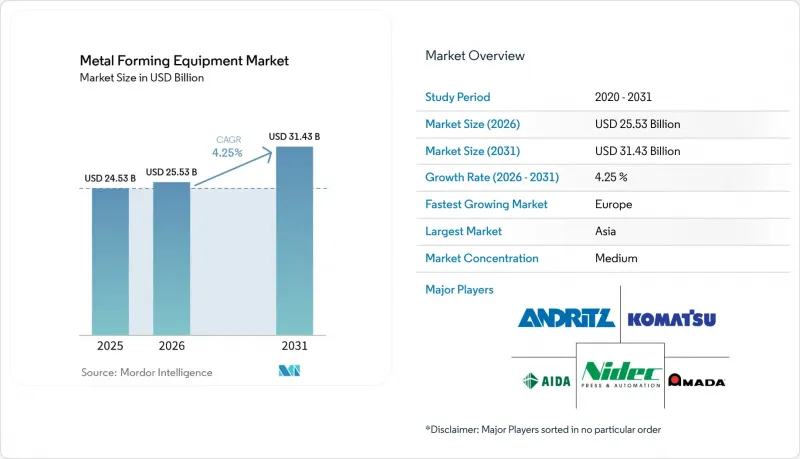
據 Mordor Intelligence 稱,2025 年金屬成型設備市值為 245.3 億美元,預計到 2031 年將達到 314.3 億美元,而 2026 年為 255.3 億美元,預測期(2026-2031 年)的複合年成長率為 4.25%。
全球金屬成型設備市場趨勢及洞察
汽車電氣化和輕量化
電池式電動車(BEV)平台正在改變金屬成形設備市場的設備配置。電池外殼、馬達外殼和結構件都需要對高抗張強度鋼進行可控成形。據新日鐵住金公司稱,某些汽車用鋼的抗張強度高達2.0 GPa,這使得可程式設計滑動運動和可控力施加變得越來越重要。一項針對1500 MPa級冷成形鋼的研究也表明,DP1470和MS1500鋼需要最佳化的成形條件和自適應壓力機控制。傳統的定速機械壓力機無法可靠地提供同等的運動範圍。因此,新的汽車專案不僅可能導致設備需求的逐步成長,還可能導致現有設備的更換。
自動化和智慧製造
隨著整合成型單元的出現,金屬成型設備市場的投資正轉向具備即時品質監控功能的設備。 2026年1月,安德里茨舒勒公司發布了「HFA plus+」精密沖裁系列產品,該系列產品採用伺服控制液壓泵驅動、工業4.0介面,衝程速度高達每分鐘85次。據該公司稱,與定速液壓系統相比,這種新型驅動系統可將能源效率提高兩個數量級。這些特性能夠實現更穩定的製程控制,使供應商能夠記錄生產狀態。自動化折彎系統也有助於製造商實現有人值守和無人值守的輪班生產。除了設備本身,供應商如果還能提供監控、控制和維護服務,則可以同時解決生產效率和勞動力方面的限制。
高額資本投入和較長的更換週期
高昂的設備成本和較長的使用壽命可能會減緩金屬成型設備市場的現代化進程。根據聯準會的報告,2026年6月美國製造業產能運轉率為75.7%,低於1972年至2025年78.2%的平均水準。現有產能可能會降低短期內添置設備的緊迫性。根據美國國家標準與技術研究院(NIST)的報告,折舊免稅額的製造業資產總額達3.3兆美元(其中2.6兆美元為機械設備),但只有4.9%的折舊免稅額資產被歸類為「新資產」。這反映出資本基礎老化以及延長資產使用壽命的趨勢。對於中小加工企業而言,承擔伺服系統和數位整合系統的全生命週期成本可能較為困難。
細分市場分析
到2025年,壓平機將佔金屬成型設備市場規模的39%。這主要得益於汽車車身本體壓力機、金屬加工產品以及大規模生產工廠的工業零件的生產。機械壓力機和液壓壓平機仍然是那些使用成熟模具和可預測零件設計執行重複性任務的工廠的主力設備。伺服壓力機預計在2026年至2031年間將以6.8%的複合年成長率成長,成為所有類型設備中成長率最高的。其可程式設計的滑動運動允許在工作區域內的不同位置施加力,並可根據特定材料和零件進行調整。此功能支援高抗張強度鋼(AHSS)的成型,並可追溯電池模組和精密零件的受力特性。
安德里茨·舒勒的HFA plus+精密沖裁系統,採用伺服控制泵浦驅動裝置和製程監控介面,為金屬成形設備產業的投資指明了方向。彎折壓床和彎曲機整合協作機器人後,無需龐大的專用基礎設施即可實現靈活自動化的彎曲加工。航太製造商正在利用鍛造設備擴大其國內產能,生產鎳基和鈦基材料製成的壓縮機和渦輪盤。輥壓成型設備支援建築和可再生能源專案中使用的結構型材的生產。線材、管材和型材成型設備以及擠壓機則應用於電力基礎設施和汽車副車架等領域。
2025年金屬成形設備市場中,沖壓和沖孔將佔加工收入的28.5%,主要應用於汽車車身面板和結構支架的製造,這些零件均採用級進模。級進模在零件產量高且重複性要求高的場合能夠提供高效率的生產效率。折彎透過數控彎折壓床和自動化單元為通用製造業、建築業和工業機械行業提供支援。深拉延在燃料和電池機殼、消費性電子產品外殼以及精密醫療器材外殼的製造中仍然發揮著至關重要的作用。鍛造則為航太、國防和工業傳動系統零件提供支持,這些領域對晶粒結構和重複性要求極高。
預計從2026年到2031年,液壓成形製程的複合年成長率將達到7.1%,是所有成形製程中成長率最高的。此技術能夠製造中空結構件,同時減少單次沖壓工序,降低零件數量,並簡化組裝工作。這項技術應用於輕型電池式電動車的車身結構,這類車輛需要使用單一模具成形複雜的形狀。軋製、擠壓及相關製程則用於生產滑板平台及可再生能源貨架系統所需的型材。歐盟汽車排放氣體法規和美國CAFE標準持續推動對輕量化零件加工設備的需求。
區域分析
亞太地區依託中國電動車生產基地和龐大的工業產能,預計2025年將佔據金屬成形設備市場規模的53.1%。該地區對伺服壓力機生產線、液壓成形單元和高噸位鍛造機的需求旺盛,這些設備可用於製造電池外殼、馬達外殼和輕量化結構件。印度可望透過加大對汽車、國防和耐用消費品產業產能的投資,獲得更多成長機會。日本和韓國是伺服電氣化升級和精密鍛造系統成熟的升級市場。越南、泰國和印尼正經歷汽車和電子製造商近岸外包投資的激增。
北美地區在汽車生產和不斷擴大的電動車組裝基地的推動下,預計到2025年將成為全球第二大區域市場。根據《2026年美國製造業回流調查》,63%的受訪汽車製造商計劃在2026年或2027年進行國內投資。此外,36%的受訪製造商正積極尋求在2026年將生產遷回國內。加拿大受益於與美國汽車供應鏈的整合以及相關的零件需求。墨西哥新萊昂州和瓜納華托州的叢集持續吸引一級供應商的投資。
預計2026年至2031年,歐洲金屬成型設備市場將以5.2%的複合年成長率成長,成為所有地區中成長最快的市場。德國、義大利和法國正在引進伺服壓力機生產線、數控彎折壓床和整合成型單元等高附加價值設備。對功能安全和能源效率的要求正在推動設備升級,尤其是在汽車和精密機械製造廠。在巴西,汽車產業對壓床的穩定需求支撐著市場。 2025年7月,安德里茨舒勒向巴西Maxiforja公司交付了一台6500噸鍛壓機,並向摩洛哥丹吉爾的AK Nova Automotive公司交付了交付傳送壓力機。沙烏地阿拉伯和阿拉伯聯合大公國由於產業多元化,鈑金和結構件的產能不斷擴大,這帶來了長期的商業機會。
其他好處:
- Excel格式的市場預測(ME)表
- 3個月的分析師支持
目錄
第1章:引言
- 研究假設和市場定義
- 調查範圍
第2章:調查方法
第3章執行摘要
第4章 市場狀況
- 市場概覽
- 金屬成形設備的工業結構
- 鈑金成形設備和塊狀金屬成形設備
- 標準機械和定製成型系統
- 市場促進因素
- 汽車電氣化和輕量化
- 採用高強度、輕量材料
- 自動化和智慧製造
- 將製造業遷回國內並擴大該地區的製造業產能
- 基礎設施和工業資本投資
- 可再生能源和電氣設備的製造
- 市場限制因素
- 大額資本投入和較長的更換週期
- 模具和夾具的成本
- 熟練操作人員和模具/控制技術人員短缺
- 原物料和關鍵部件價格波動
- 傳統設備與自動化生產系統的整合
- 價值供應鏈分析
- 結構材料和機械零件
- 驅動裝置、液壓系統、馬達及控制設備
- 模具和夾俱生態系統
- 金屬成型設備製造商
- 自動化和系統整合商
- 分銷和經銷商網路
- 服務、維修和生命週期支持
- 監理情勢
- 機器安全和功能安全
- 能源效率和環境要求
- 終端用戶產業的資格要求
- 貿易、關稅和出口管制
- 技術展望
- 伺服和先進驅動技術
- 數控和先進製程控制
- 機器人和自動化物料輸送系統
- 互聯機器和工業物聯網
- 預測性維護和狀態監測
- 高效率成型系統
- 先進高強度輕量材料的模塑成型
- 評估地緣政治事件對市場的影響
第5章 市場規模與成長預測
- 依設備類型
- 壓平機
- 機械壓力機
- 油壓機
- 伺服壓力機
- 其他通用印刷機
- 彎折壓床和彎曲機
- 液壓彎折壓床
- 伺服/電動彎折壓床
- 機械彎折壓床
- 其他折彎機
- 鍛造設備
- 鍛壓機
- 鍛造錘
- 壓縮成型機和鐓頭機
- 其他鍛造設備
- 輥壓成型及板材/型材軋製設備
- 輥壓成型機
- 板材軋機
- 結構鋼和型材軋機
- 其他二次軋製成型設備
- 線材/管材/型材成型設備
- 線材/棒材拉拔/成型設備
- 管材成型和彎曲設備
- 型材機
- 擠出機
- 液壓成型設備
- 其他金屬成型設備
- 壓平機
- 透過成型工藝
- 壓制和沖壓
- 深畫
- 彎曲過程
- 鍛造
- 軋製和輥壓成型
- 擠壓
- 液壓成型
- 其他成型工藝
- 透過模壓材料
- 碳鋼和低合金鋼
- 不銹鋼
- 鋁及鋁合金
- 銅及銅合金
- 鈦、鎳和其他非鐵金屬
- 其他材料
- 按最終用途行業分類
- 汽車和運輸業
- 航太/國防
- 工業機械及資本財
- 金屬製品及加工
- 電氣和電子設備
- 建築和基礎設施
- 能源與電力
- 家用電器耐用消費品
- 醫療和精密製造
- 其他終端用戶產業
- 按地區
- 北美洲
- 美國
- 加拿大
- 墨西哥
- 南美洲
- 巴西
- 阿根廷
- 其他南美國家
- 歐洲
- 德國
- 義大利
- 法國
- 英國
- 西班牙
- 俄羅斯
- 其他歐洲國家
- 亞太地區
- 中國
- 日本
- 印度
- 韓國
- 東協(新加坡、馬來西亞、印尼、泰國、越南、菲律賓、緬甸、柬埔寨、寮國、汶萊)
- 澳洲
- 其他亞太國家
- 中東和非洲
- 沙烏地阿拉伯
- 阿拉伯聯合大公國
- 土耳其
- 南非
- 其他中東和非洲國家
- 北美洲
第6章 競爭情勢
- 市場集中度
- 策略趨勢
- 市佔率分析
- 公司簡介
- ANDRITZ Schuler Group
- AIDA Engineering, Ltd.
- Komatsu Industries Corp.
- AMADA Group/AMADA Press System Co., Ltd.
- Nidec Press & Automation
- Fagor Arrasate S. Coop.
- JIER Machine-Tool Group Co., Ltd.
- Yangli Group
- Chin Fong Machine Industrial Co., Ltd.
- SEYI Machinery Co., Ltd.
- SIMPAC Inc.
- TRUMPF SE+Co. KG
- Bystronic AG
- Salvagnini Italia SpA
- LVD Company NV
- Ermaksan Makina Sanayi ve Ticaret AS
- Prima Power/Prima Industrie SpA
- SMS group GmbH
- Siempelkamp Maschinen-und Anlagenbau GmbH
- LASCO Umformtechnik GmbH
- Tianjin Tianduan Press Co., Ltd.(GENERTEC Tianduan)
- Beckwood Press Company
- Macrodyne Technologies Inc.
第7章 市場機會與未來展望
According to Mordor Intelligence, the metal forming equipment market size was valued at USD 24.53 billion in 2025, and is estimated to grow from USD 25.53 billion in 2026 to reach USD 31.43 billion by 2031, at a CAGR of 4.25% during the forecast period (2026-2031).
Global Metal Forming Equipment Market Trends and Insights
Automotive Electrification and Lightweighting
Battery electric vehicle platforms are changing the mix of equipment used in the metal forming equipment market. Battery enclosures, motor housing, and structural members need controlled forming of ultra-high-strength steels. Nippon Steel reported that some automotive grades reach tensile strengths of up to 2.0 GPa, which increases the need for programmable slide motion and controlled force delivery. Research on 1,500 MPa-class cold-forming steels also showed that DP1470 and MS1500 grades need tailored forming conditions and adaptive press control. Conventional fixed-speed mechanical presses cannot reliably provide the same operating range. New vehicle programs can therefore lead to replacement demand rather than only incremental equipment demand.
Automation and Smart Manufacturing
Integrated forming cells are shifting spending in the metal forming equipment market toward equipment with real-time quality monitoring. ANDRITZ Schuler introduced its HFA plus+ fineblanking series in January 2026 with servo-controlled hydraulic pump drives, Industry 4.0 interfaces, and stroke rates of up to 85 strokes per minute. The company stated that the new drives deliver double-digit energy-efficiency gains against fixed-speed hydraulic systems. These capabilities support more consistent process control and allow suppliers to document production conditions. Automated bending systems also help manufacturers operate manned and unmanned shifts. Suppliers that offer monitoring, controls, and maintenance alongside equipment can address both productivity and labor constraints.
High Capital Investment and Long Replacement Cycles
High equipment costs and long useful lives can delay modernization in the metal forming equipment market. The Federal Reserve reported the United States manufacturing capacity utilization of 75.7% in June 2026, below the 1972-2025 average of 78.2%. Existing capacity can reduce the urgency to add equipment in the near term. NIST reported USD 3.3 trillion in depreciable manufacturing assets, including USD 2.6 trillion in machinery and equipment, while only 4.9% of depreciable assets were classified as new. This reflects an aging capital base and a preference for extending asset life. Small and mid-sized fabricators can find it difficult to fund the full lifecycle cost of servo and digitally integrated systems.
Other drivers and restraints analyzed in the detailed report include:
- Adoption of High-Strength and Lightweight Materials
- Reshoring and Expansion of Regional Manufacturing Capacity
- Raw Material and Critical Component Price Volatility
For complete list of drivers and restraints, kindly check the Table Of Contents.
Segment Analysis
Press machines held 39% of the metal forming equipment market size in 2025, supported by automotive body-in-white stamping, fabricated metal products, and industrial-parts production across high-volume manufacturing plants. Mechanical and hydraulic variants remained the volume base for plants handling repeat work with established tooling and predictable part designs. Servo presses are forecast to grow at a 6.8% CAGR from 2026 to 2031, the fastest rate among equipment types. Their programmable slide motion can deliver force at different points in the working zone and can be adapted to a specific material or part. This capability supports AHSS forming and force-signature traceability for battery modules and precision components.
ANDRITZ Schuler's HFA plus+ fineblanking system shows the investment direction in the metal forming equipment industry, with servo-controlled pump drives and process-monitoring interfaces. Press brakes and bending machines benefit from collaborative robot integration that supports flexible, automated bending without the same level of dedicated infrastructure. Forging equipment serves aerospace producers expanding domestic capacity for compressor and turbine disks made from nickel- and titanium-based materials. Roll-forming equipment supports structural profiles used in construction and renewable-energy projects. Wire, tube, and profile forming equipment and extrusion presses serve electrical infrastructure and automotive sub-frame applications.
Stamping and punching held 28.5% of process revenue within the metal forming equipment market in 2025, led by automotive body panels and structural brackets produced through progressive dies. Progressive dies support efficient throughput where part volumes remain high and repeatability is important. Bending supports general fabrication, construction, and industrial machinery through CNC press brakes and automated cells. Deep drawing remains important for fuel and battery enclosures, appliance bodies, and precision medical housings. Forging supports aerospace, defense, and industrial drivetrain components where grain structure and cyclic performance are important.
Hydroforming is forecast to grow at a 7.1% CAGR from 2026 to 2031, the fastest rate among forming processes. It can create hollow structural members with fewer separate stampings, lower part counts, and less assembly work. This application is relevant to lightweight battery electric vehicle body structures that need complex geometry from a single tool. Rolling, extrusion, and related processes support aluminum profiles for skateboard platforms and renewable-energy racking systems. EU carbon dioxide fleet requirements and the United States CAFE standards sustain the case for equipment that processes lightweight components.
Complete Report Scope:
- By Equipment Type
- Press Machines
- Mechanical Presses
- Hydraulic Presses
- Servo Presses
- Other General-Purpose Presses
- Press Brakes and Bending Machines
- Hydraulic Press Brakes
- Servo / Electric Press Brakes
- Mechanical Press Brakes
- Other Bending Machines
- Forging Equipment
- Forging Presses
- Forging Hammers
- Upsetting and Heading Machines
- Other Forging Equipment
- Roll Forming and Plate/Profile Rolling Equipment
- Roll Forming Machines
- Plate Rolling Machines
- Section and Profile Rolling Machines
- Other Secondary Rolling/Forming Equipment
- Wire, Tube and Profile Forming Equipment
- Wire and Bar Drawing/Forming Equipment
- Tube Forming and Bending Equipment
- Profile Forming Equipment
- Extrusion Presses
- Hydroforming Equipment
- Other Metal Forming Equipment
- Press Machines
- By Forming Process
- Stamping and Punching
- Deep Drawing
- Bending
- Forging
- Rolling and Roll Forming
- Extrusion
- Hydroforming
- Other Forming Processes
- By Material Formed
- Carbon and Low-Alloy Steel
- Stainless Steel
- Aluminum and Aluminum Alloys
- Copper and Copper Alloys
- Titanium, Nickel and Other Non-Ferrous Metals
- Other Materials
- By End-Use Industry
- Automotive and Transportation
- Aerospace and Defense
- Industrial Machinery and Capital Equipment
- Metal Products and Fabrication
- Electrical and Electronics
- Construction and Infrastructure
- Energy and Power
- Consumer Appliances and Durable Goods
- Medical and Precision Manufacturing
- Other End-Use Industries
- By Geography
- North America
- United States
- Canada
- Mexico
- South America
- Brazil
- Argentina
- Rest of South America
- Europe
- Germany
- Italy
- France
- United Kingdom
- Spain
- Russia
- Rest of Europe
- Asia-Pacific
- China
- Japan
- India
- South Korea
- ASEAN (Singapore, Malaysia, Indonesia, Thailand, Vietnam, Philippines, Myanmar, Cambodia, Laos, Brunei)
- Australia
- Rest of Asia-Pacific
- Middle East & Africa
- Saudi Arabia
- United Arab Emirates
- Turkey
- South Africa
- Rest of Middle East & Africa
- North America
Geography Analysis
Asia-Pacific held 53.1% of the metal forming equipment market size in 2025, supported by China's electric-vehicle production base and broad industrial manufacturing capacity. The region needs servo stamping lines, hydroforming cells, and high-tonnage forging presses for battery enclosures, motor housings, and lightweight structural members. India offers incremental opportunity through capacity investment across automotive, defense, and consumer durables. Japan and South Korea are mature replacement markets for servo-electric upgrades and precision forging systems. Vietnam, Thailand, and Indonesia are receiving near-shoring investment from automotive and electronics manufacturers.
North America was the second-largest regional market in 2025, supported by vehicle production and an expanding electric-vehicle assembly footprint. The 2026 USA Reshoring Survey found that 63% of responding OEMs planned domestic capital expenditures in 2026 or 2027. It also found that 36% were actively executing reshoring in 2026. Canada benefits from integration with the United States automotive supply chain and its related demand for components. Mexico's Nuevo Leon and Guanajuato clusters continue to attract tier-1 supplier investment.
Europe is forecast to grow at a 5.2% CAGR from 2026 to 2031, the fastest regional pace in the metal forming equipment market. Germany, Italy, and France have a high-value installed base of servo press lines, CNC press brakes, and integrated forming cells. Functional safety and energy-efficiency requirements support replacement, especially in automotive and precision-engineering plants. Brazil supports consistent press-machine demand through its automotive sector. ANDRITZ Schuler delivered a 6,500-ton forging press to Maxiforja in Brazil in July 2025 and a transfer press to AK Nova Automotive in Tangier, Morocco. Saudi Arabia and the United Arab Emirates offer longer-term opportunities as industrial diversification adds sheet-metal and structural-component capacity.
- ANDRITZ Schuler Group
- AIDA Engineering, Ltd.
- Komatsu Industries Corp.
- AMADA Group / AMADA Press System Co., Ltd.
- Nidec Press & Automation
- Fagor Arrasate S. Coop.
- JIER Machine-Tool Group Co., Ltd.
- Yangli Group
- Chin Fong Machine Industrial Co., Ltd.
- SEYI Machinery Co., Ltd.
- SIMPAC Inc.
- TRUMPF SE + Co. KG
- Bystronic AG
- Salvagnini Italia S.p.A.
- LVD Company NV
- Ermaksan Makina Sanayi ve Ticaret A.S.
- Prima Power / Prima Industrie S.p.A.
- SMS group GmbH
- Siempelkamp Maschinen- und Anlagenbau GmbH
- LASCO Umformtechnik GmbH
- Tianjin Tianduan Press Co., Ltd. (GENERTEC Tianduan)
- Beckwood Press Company
- Macrodyne Technologies Inc.
Additional Benefits:
- The market estimate (ME) sheet in Excel format
- 3 months of analyst support
TABLE OF CONTENTS
1 INTRODUCTION
- 1.1 Study Assumptions and Market Definition
- 1.2 Scope of the Study
2 RESEARCH METHODOLOGY
3 EXECUTIVE SUMMARY
4 MARKET LANDSCAPE
- 4.1 Market Overview
- 4.1.1 Metal Forming Equipment Industry Structure
- 4.1.2 Sheet-Metal vs. Bulk-Metal Forming Equipment
- 4.1.3 Standard Machines vs. Engineered Forming Systems
- 4.2 Market Drivers
- 4.2.1 Automotive Electrification and Lightweighting
- 4.2.2 Adoption of High-Strength and Lightweight Materials
- 4.2.3 Automation and Smart Manufacturing
- 4.2.4 Reshoring and Expansion of Regional Manufacturing Capacity
- 4.2.5 Infrastructure and Industrial Capital Investment
- 4.2.6 Renewable Energy and Electrification Equipment Manufacturing
- 4.3 Market Restraints
- 4.3.1 High Capital Investment and Long Replacement Cycles
- 4.3.2 Tooling and Die Costs
- 4.3.3 Skilled Operator, Tooling and Controls Talent Shortages
- 4.3.4 Raw Material and Critical Component Price Volatility
- 4.3.5 Integration of Legacy Equipment with Automated Production Systems
- 4.4 Value / Supply-Chain Analysis
- 4.4.1 Structural Materials and Machine Components
- 4.4.2 Drives, Hydraulics, Motors and Controls
- 4.4.3 Tooling and Die Ecosystem
- 4.4.4 Metal Forming Equipment Manufacturers
- 4.4.5 Automation and System Integrators
- 4.4.6 Distribution and Dealer Network
- 4.4.7 Service, Retrofit and Lifecycle Support
- 4.5 Regulatory Landscape
- 4.5.1 Machinery Safety and Functional Safety
- 4.5.2 Energy Efficiency and Environmental Requirements
- 4.5.3 End-Industry Qualification Requirements
- 4.5.4 Trade, Tariffs and Export Controls
- 4.6 Technological Outlook
- 4.6.1 Servo and Advanced Drive Technologies
- 4.6.2 CNC and Advanced Process Controls
- 4.6.3 Robotics and Automated Material Handling
- 4.6.4 Connected Machines and IIoT
- 4.6.5 Predictive Maintenance and Condition Monitoring
- 4.6.6 Energy-Efficient Forming Systems
- 4.6.7 Advanced High-Strength and Lightweight Material Forming
- 4.7 Impact Assessment of Geopolitical Events on the Market
5 MARKET SIZE AND GROWTH FORECASTS (Value, In USD Billion)
- 5.1 By Equipment Type
- 5.1.1 Press Machines
- 5.1.1.1 Mechanical Presses
- 5.1.1.2 Hydraulic Presses
- 5.1.1.3 Servo Presses
- 5.1.1.4 Other General-Purpose Presses
- 5.1.2 Press Brakes and Bending Machines
- 5.1.2.1 Hydraulic Press Brakes
- 5.1.2.2 Servo / Electric Press Brakes
- 5.1.2.3 Mechanical Press Brakes
- 5.1.2.4 Other Bending Machines
- 5.1.3 Forging Equipment
- 5.1.3.1 Forging Presses
- 5.1.3.2 Forging Hammers
- 5.1.3.3 Upsetting and Heading Machines
- 5.1.3.4 Other Forging Equipment
- 5.1.4 Roll Forming and Plate/Profile Rolling Equipment
- 5.1.4.1 Roll Forming Machines
- 5.1.4.2 Plate Rolling Machines
- 5.1.4.3 Section and Profile Rolling Machines
- 5.1.4.4 Other Secondary Rolling/Forming Equipment
- 5.1.5 Wire, Tube and Profile Forming Equipment
- 5.1.5.1 Wire and Bar Drawing/Forming Equipment
- 5.1.5.2 Tube Forming and Bending Equipment
- 5.1.5.3 Profile Forming Equipment
- 5.1.6 Extrusion Presses
- 5.1.7 Hydroforming Equipment
- 5.1.8 Other Metal Forming Equipment
- 5.1.1 Press Machines
- 5.2 By Forming Process
- 5.2.1 Stamping and Punching
- 5.2.2 Deep Drawing
- 5.2.3 Bending
- 5.2.4 Forging
- 5.2.5 Rolling and Roll Forming
- 5.2.6 Extrusion
- 5.2.7 Hydroforming
- 5.2.8 Other Forming Processes
- 5.3 By Material Formed
- 5.3.1 Carbon and Low-Alloy Steel
- 5.3.2 Stainless Steel
- 5.3.3 Aluminum and Aluminum Alloys
- 5.3.4 Copper and Copper Alloys
- 5.3.5 Titanium, Nickel and Other Non-Ferrous Metals
- 5.3.6 Other Materials
- 5.4 By End-Use Industry
- 5.4.1 Automotive and Transportation
- 5.4.2 Aerospace and Defense
- 5.4.3 Industrial Machinery and Capital Equipment
- 5.4.4 Metal Products and Fabrication
- 5.4.5 Electrical and Electronics
- 5.4.6 Construction and Infrastructure
- 5.4.7 Energy and Power
- 5.4.8 Consumer Appliances and Durable Goods
- 5.4.9 Medical and Precision Manufacturing
- 5.4.10 Other End-Use Industries
- 5.5 By Geography
- 5.5.1 North America
- 5.5.1.1 United States
- 5.5.1.2 Canada
- 5.5.1.3 Mexico
- 5.5.2 South America
- 5.5.2.1 Brazil
- 5.5.2.2 Argentina
- 5.5.2.3 Rest of South America
- 5.5.3 Europe
- 5.5.3.1 Germany
- 5.5.3.2 Italy
- 5.5.3.3 France
- 5.5.3.4 United Kingdom
- 5.5.3.5 Spain
- 5.5.3.6 Russia
- 5.5.3.7 Rest of Europe
- 5.5.4 Asia-Pacific
- 5.5.4.1 China
- 5.5.4.2 Japan
- 5.5.4.3 India
- 5.5.4.4 South Korea
- 5.5.4.5 ASEAN (Singapore, Malaysia, Indonesia, Thailand, Vietnam, Philippines, Myanmar, Cambodia, Laos, Brunei)
- 5.5.4.6 Australia
- 5.5.4.7 Rest of Asia-Pacific
- 5.5.5 Middle East & Africa
- 5.5.5.1 Saudi Arabia
- 5.5.5.2 United Arab Emirates
- 5.5.5.3 Turkey
- 5.5.5.4 South Africa
- 5.5.5.5 Rest of Middle East & Africa
- 5.5.1 North America
6 COMPETITIVE LANDSCAPE
- 6.1 Market Concentration
- 6.2 Strategic Moves
- 6.3 Market Share Analysis
- 6.4 Company Profiles (includes Global Level Overview, Market Level Overview, Core Segments, Financials as available, Strategic Information, Products and Services, Recent Developments)
- 6.4.1 ANDRITZ Schuler Group
- 6.4.2 AIDA Engineering, Ltd.
- 6.4.3 Komatsu Industries Corp.
- 6.4.4 AMADA Group / AMADA Press System Co., Ltd.
- 6.4.5 Nidec Press & Automation
- 6.4.6 Fagor Arrasate S. Coop.
- 6.4.7 JIER Machine-Tool Group Co., Ltd.
- 6.4.8 Yangli Group
- 6.4.9 Chin Fong Machine Industrial Co., Ltd.
- 6.4.10 SEYI Machinery Co., Ltd.
- 6.4.11 SIMPAC Inc.
- 6.4.12 TRUMPF SE + Co. KG
- 6.4.13 Bystronic AG
- 6.4.14 Salvagnini Italia S.p.A.
- 6.4.15 LVD Company NV
- 6.4.16 Ermaksan Makina Sanayi ve Ticaret A.S.
- 6.4.17 Prima Power / Prima Industrie S.p.A.
- 6.4.18 SMS group GmbH
- 6.4.19 Siempelkamp Maschinen- und Anlagenbau GmbH
- 6.4.20 LASCO Umformtechnik GmbH
- 6.4.21 Tianjin Tianduan Press Co., Ltd. (GENERTEC Tianduan)
- 6.4.22 Beckwood Press Company
- 6.4.23 Macrodyne Technologies Inc.
7 MARKET OPPORTUNITIES AND FUTURE OUTLOOK
- 7.1 White-Space and Unmet-Need Assessment
- 7.1.1 Servo and Energy-Efficient Forming Equipment
- 7.1.2 Automation and Flexible Manufacturing Cells
- 7.1.3 Retrofit and Digitalization of Legacy Equipment
- 7.1.4 EV, Battery and Lightweight Structural Component Manufacturing
- 7.1.5 Advanced High-Strength and Lightweight Material Forming
- 7.1.6 Manufacturing Localization in Emerging Markets
- 7.1.7 Future Demand by Equipment Type and End-Use Industry

 一次性紙杯製造機市場:全球市場預測,2026-2032年
 2026-2030年全球輥壓成型機市場
 旋壓成型機市場規模、佔有率和成長分析:按機器類型、操作方式、應用領域、最終用戶、產能和地區分類-2026-2033年產業預測
 輥壓成型機市場機會、成長要素、產業趨勢分析及2026-2035年預測。
 北美金屬成型設備:市場佔有率分析、產業趨勢與統計及成長預測(2026-2031 年)日本金屬成型設備:市場佔有率分析、產業趨勢與統計及成長預測(2026-2031)美國金屬成型設備:市場佔有率分析、產業趨勢與統計、成長預測(2026-2031 年)多功能三軸攪拌機市場:依功能、攪拌技術、容量範圍、設計類型、驅動機構和終端用戶產業分類-全球預測,2026-2032年輥壓成型機及生產線市場:依材料、機器類型、控制技術及最終用戶分類,全球預測,2026-2032年全球輥壓成型系統市場(按產品類型、材料類型、機器類型、驅動類型、運行速度和最終用途產業分類)預測(2026-2032年)