


 |
市場調查報告書
商品編碼
2157049
復甦編配:市場佔有率分析、產業趨勢與統計、成長預測(2026-2031)Recovery Orchestration - Market Share Analysis, Industry Trends & Statistics, Growth Forecasts (2026 - 2031) |
||||||

※ 本網頁內容可能與最新版本有所差異。詳細情況請與我們聯繫。
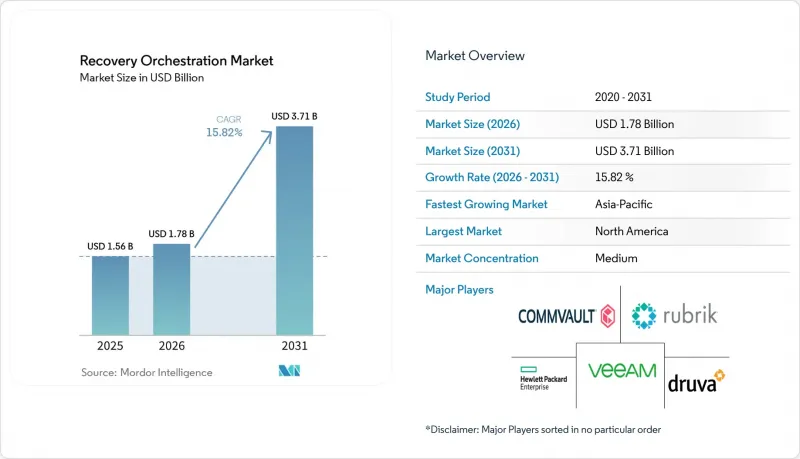
據 Mordor Intelligence 稱,2025 年恢復編配市場價值為 15.6 億美元,預計到 2031 年將從 2026 年的 17.8 億美元成長至 37.1 億美元,預測期(2026-2031 年)的複合年成長率為 15.82%。
全球恢復編配市場趨勢及洞察
對勒索軟體和網路攻擊的復原需求日益成長
由於勒索軟體攻擊會暴露傳統備份和復原流程在事件發生時的運作局限性,因此復原編配已與網路防禦緊密相連。 Sophos 對 17 個國家的 3400 家機構進行了調查,結果顯示,到 2025 年,不包括贖金支付在內的平均恢復成本將下降 44%,至 153 萬美元。調查發現,53% 的機構在一週內實現了完全恢復,高於前一年的 35%。 IBM 估計,2025 年勒索軟體事件的平均總成本將達到 508 萬美元,其 2026 年報告指出,由於人工智慧驅動的攻擊日益增多,資料外洩成本將達到歷史新高。 Rubrik 在 2026 年的報告中指出,88% 的 IT 和安全主管擔心無法達到當前的復原時間目標 (RTO),因為威脅正在將攻擊視窗從數月縮短到數秒。這凸顯了恢復編配市場對能夠準備隔離環境、檢驗資料免受威脅並按順序恢復業務系統的工作流程的需求。
擴展混合雲和多重雲端基礎設施
混合雲和多重雲端的採用為分散式企業環境帶來了復原方面的挑戰,而傳統的備份工具無法完全應對這些挑戰。工作負載可能駐留在本地資料中心、私有雲端和多個雲端區域,這些區域擁有不同的網路模型、身分設計和配置管理系統。某一層的故障可能會影響其他依賴層,導致復原時間超出手動流程在業務永續營運承諾下無法達到的範圍。管理這些環境的組織還必須應對由 DevOps 部署、自動擴展和雲端設定變更導致的配置漂移。如果資料、基礎架構和應用程式配置沒有作為一個統一的整體進行管理,復原計畫可能會過時。基礎架構即程式碼 (IaC) 復原透過將設定版本、復原計畫和資料復原整合到單一管理流程中,正在為復原編配市場帶來益處。
在異質環境中實施的複雜性
在傳統基礎架構、容器化工作負載、雲端服務和 SaaS 應用程式中部署復原編配可能充滿挑戰。每個環境都需要整合工作、獨特的配置要求以及團隊間的協調,這可能會延遲客戶獲得實際價值的時間。準確的依賴關係映射至關重要,因為平台需要最新的拓撲資料才能正確地對資料、應用程式、網路和身分進行復原排序。許多大型企業,尤其是那些擁有獨立開發營運模式的企業,未能確保所有團隊和系統的數據都達到生產級品質。缺少第三方依賴項或過時的網路配置會導致復原序列在執行過程中失敗,從而延遲事件回應。當買家需要在缺乏顯示服務間關係的既定映射的情況下保護異質環境時,這些問題會減緩市場對恢復編配的接受度。
細分市場分析
到2025年,軟體將佔據恢復編配市場58.42%的佔有率。這反映了企業對平台架構的需求,該架構能夠將復原流程與保全行動工作流程相協調,並可作為更廣泛的彈性計畫的一部分進行部署。基於API的軟體可以將復原功能與安全資訊和事件管理(SIEM)、安全編配、自動化和回應(SOAR)以及身分識別管理工具整合。這使得復原團隊能夠在同一平台環境中維護復原策略、測試結果和流程,利用來自連接系統的運作訊號,而無需執行單獨的備份管理任務。該軟體還提供了一個統一的平台,用於定義運作手冊、管理復原策略、測試復原流程和記錄測試結果。組件細分市場中剩餘的佔有率由服務佔據,預計到2031年,服務將以19.66%的複合年成長率成長,是所有組件中成長率最高的。
此服務市場的機會源於企業內部恢復工程能力的不足,以及在不斷發展的企業系統中設計、測試、更新和運行恢復程序所需的實際工作量。託管式無塵室恢復和編配即服務 (OaaS) 模型可以為企業提供專家支持,幫助他們設計、檢驗和更新恢復流程。 2025 年 4 月,Commvault 擴展了託管服務供應商的無塵室復原服務,除了 Azure 之外,還增加了對 AWS 的支援以及檔案共用的自動化復原功能。此舉表明,可以透過管道交付擴展存取權限,而無需取代軟體優先架構,也無需每個客戶都組成專門的復原團隊。容器化工作負載、SaaS 環境和基礎設施即程式碼 (IaC) 管道可能需要部署支援、運行手冊自動化、定期測試以及隨著系統演進而進行的持續調優。由於客戶需要協助將復原策略轉化為針對特定工作負載、關鍵應用程式和相關維運團隊的操作流程,因此,除了平台訂閱之外,這些服務也成為恢復編配產業中永續的收入來源。此外,隨著應用程式、雲端資源、網路規則和身分設定隨時間推移而演變,該模型支援持續檢驗,可協助供應商和客戶保持其復原程序與受保護環境的匹配。
截至2025年,基於雲端的恢復方案佔恢復編配市場規模的61.19%。預計到2031年,基於雲端的恢復方案將以21.23%的複合年成長率成長,在所有採用類型中成長率最高。這一地位反映了工作負載持續向雲端環境遷移,以及在單一區域或生產環境中恢復服務的需求。彈性容量允許在發生復原事件時提供資源,而無需維護永久固定大小的備用設施。當故障範圍和復原需求無法預先預測時,這非常有用。多區域複製有助於為分佈在多個位置的應用程式和資料製定復原計劃。此外,付費使用制允許將恢復成本與當前風險敞口相匹配,這使得雲端交付成為恢復編配市場新採用的主要途徑。
在採用空氣間隙系統和對資料主權有嚴格要求的行業中,本地部署仍然發揮著至關重要的作用。雖然這些用途在需要對關鍵資料進行本地控制的受法規環境和復原環境中仍然至關重要,但本地部署的整體佔有率可能會下降。混合部署(即企業在不完全整合基礎架構的情況下,跨本地端和雲端基礎架構保護工作負載)也在不斷發展,從而能夠在同一復原計畫中管理不同的資料、應用程式和控制要求。 2026 年 8 月,AWS 在彈性災難復原中推出了復原計劃,用於對多伺服器應用程式進行順序復原和復原演練。使用者可以定義依賴關係序列,透過無中斷服務恢復演練檢驗這些序列,並在執行計劃的復原流程之前設定核准查核點。服務提供者可以避免被雲端提供者鎖定,並滿足跨多個環境運作且需要一致恢復管治的組織的需求。
區域分析
到2025年,北美將佔據恢復編配市場42.71%的佔有率。美國是主要貢獻者,這主要歸因於勒索軟體攻擊醫療保健、能源、金融服務和政府機構等關鍵基礎設施的猖獗。美國證券交易委員會(SEC)的資訊揭露要求使得記錄在案的恢復時間目標(RTO)和審計追蹤成為法務團隊、董事會和IT營運部門的關鍵要素。在加拿大,由於公共部門和金融服務業紛紛採用彈性計劃,市場需求正在成長。墨西哥的科技和製造業構成了一個新興的需求基礎,而日益成長的數位化進程可能會導致對結構化恢復流程的更大需求。
北美擁有最發達的競爭格局,包括一級供應商總部以及身分恢復、基礎設施即代碼 (IAC) 恢復和運作手冊自動化方面的專家。這些供應商可能會對定價、產品開發以及企業買家期望供應商提供的功能範圍(包括與安全系統、身分服務和基礎設施管理工具的整合)構成壓力。歐洲的格局受到 DORA 和 NIS2 對金融服務、能源、電信和關鍵基礎設施等產業的綜合影響。德國、英國、法國、義大利和比荷盧經濟聯盟是歐洲企業 IT 支出的主要市場。受 DORA 第 11 和 12 條款約束的金融服務公司尤其需要履行詳細的測試和文件義務,這會影響技術採購和恢復管治。在以巴西和阿根廷為首的南美洲,網路安全框架和金融業的數位化正在推動需求成長,但當地專業知識的匱乏和IT管理的不均衡可能會阻礙其應用。
預計到2031年,亞太地區將以21.49%的複合年成長率成長。這一成長與印度、中國、日本和韓國的雲端運算應用密切相關,同時也與日益嚴重的網路威脅有關,這些威脅影響著依賴關鍵數位服務持續可用性的金融機構、電信營運商和公共部門組織。印度數位基礎設施的擴張以及公共部門組織遭受的網路攻擊進一步凸顯了企業和政府規劃中韌性的重要性。中國的資料本地化要求和日本對營運技術(OT)安全的重視正在影響部署設計,除了基於雲端的復原方案外,還可能推動混合部署和本地部署用例的發展。在以阿拉伯聯合大公國和沙烏地阿拉伯為首的中東和非洲地區,由於支持復原計畫的基礎設施正在透過國家願景計畫和對主權雲端的投資進行建設,因此需求尚處於早期階段。在這些市場,政府機構和金融服務公司正在推動需求,因為它們的營運需求優先考慮業務永續營運和受控的資料環境。
其他好處:
- Excel格式的市場預測(ME)表
- 3個月的分析師支持
目錄
第1章:引言
- 研究假設和市場定義
- 調查範圍
第2章:調查方法
第3章執行摘要
第4章 市場狀況
- 市場概覽
- 市場促進因素
- 勒索軟體的興起以及從網路攻擊中恢復的需求日益成長。
- 擴展混合雲和多重雲端基礎設施
- 檢驗和可審計回收的監管要求
- IT系統宕機和業務中斷導致成本增加。
- 由於雲端配置的持續變化導致恢復延遲
- 針對級聯第三方故障的依賴感知恢復
- 市場限制因素
- 在異質環境中實施的複雜性
- 缺乏恢復工程和網路安全技能
- 依賴關係映射不完整和恢復資料質量
- 資料儲存位置、不可篡改性和復原要求之間存在衝突。
- 產業價值鏈分析
- 宏觀經濟因素的影響
- 監理情勢
- 《數位營運韌性法案》的要求
- NIS2中的業務永續營運與事件復原要求
- 美國證券交易委員會對網路安全資訊揭露的期望
- 關鍵基礎設施和特定行業要求
- 技術展望
- 持續資料保護和基於日誌的恢復
- 基礎設施即程式碼恢復
- 潔淨室及隔離恢復環境
- 利用人工智慧進行恢復檢驗
- 最佳化依賴關係圖和恢復序列
- 配置即程式碼和恢復管理
- 波特五力分析
第5章 市場規模與成長預測
- 按組件
- 軟體
- 服務
- 部署模式
- 基於雲端的
- 現場
- 混合
- 根據恢復程度而定
- 資源和工作負載等級恢復
- 應用程式和業務服務恢復
- 網站和平台恢復
- 其他程度的康復
- 按組織規模
- 大公司
- 小型企業
- 按行業分類
- 政府和公共行政
- 工業製造
- 零售與電子商務
- 運輸/物流
- 能源公用事業
- 石油和天然氣
- 資訊科技/通訊
- 媒體與娛樂
- 教育和研究機構
- 醫療保健和生命科學
- 銀行、金融服務和保險(BFSI)
- 其他工業部門
- 按地區
- 北美洲
- 美國
- 加拿大
- 墨西哥
- 南美洲
- 巴西
- 阿根廷
- 其他南美國家
- 歐洲
- 德國
- 英國
- 法國
- 義大利
- 比荷盧經濟聯盟
- 其他歐洲國家
- 亞太地區
- 中國
- 日本
- 印度
- 韓國
- 澳洲
- 其他亞太國家
- 中東和非洲
- 中東
- 阿拉伯聯合大公國
- 沙烏地阿拉伯
- 其他中東國家
- 非洲
- 南非
- 奈及利亞
- 埃及
- 其他非洲國家
- 中東
- 北美洲
第6章 競爭情勢
- 市場集中度
- 策略趨勢
- 市佔率分析
- 公司簡介
- Veeam Software Group GmbH
- Hewlett Packard Enterprise Company
- Commvault Systems, Inc.
- Rubrik, Inc.
- Druva Inc.
- Cohesity, Inc.
- Broadcom Inc.
- IBM Corporation
- OpenText Corporation
- Quest Software Inc.
- Semperis Inc.
- Infrascale, Inc.
- Perpetuuiti Co. Ltd.
- RackWare, Inc.
- LINBIT USA, Inc.
- CloudEndure, Inc.
- Hystax, Inc.
- Cristie Software Limited
- Cirrus Data Solutions, Inc.
- Cutover, Inc.
- Fusion Risk Management, Inc.
- Redwood Software, LLC
- Firefly Technologies, Inc.
- ControlMonkey Ltd.
- Respawn, Inc.
- Recovery Point Systems, Inc.
- Axcient, LLC
第7章 市場機會與未來展望
According to Mordor Intelligence, the recovery orchestration market size was valued at USD 1.56 billion in 2025 and estimated to grow from USD 1.78 billion in 2026 to reach USD 3.71 billion by 2031, at a CAGR of 15.82% during the forecast period (2026-2031).
Global Recovery Orchestration Market Trends and Insights
Escalating Ransomware and Cyberattack Recovery Requirements
Recovery orchestration has become closely connected with cyber defense because ransomware exposes the operational limits of traditional backup and restore processes during an active incident. Sophos surveyed 3,400 organizations across 17 countries and reported that average recovery costs, excluding ransom payments, fell 44% to USD 1.53 million in 2025. The same study found that 53% of organizations achieved full recovery within 1 week, compared with 35% in the previous year. IBM placed the average total cost of a ransomware incident at USD 5.08 million in 2025, while its 2026 report recorded a new high in breach costs amid AI-enabled attacks. Rubrik reported in 2026 that 88% of IT and security leaders were concerned about meeting current recovery time objectives, as threats were shortening the exploitation window from months to seconds. This supports demand in the recovery orchestration market for workflows that prepare isolated environments, validate data for threats, and restore business systems in sequence.
Expansion of Hybrid and Multi-Cloud Infrastructure
Hybrid and multi-cloud adoption has created recovery challenges that point backup tools cannot fully address across distributed enterprise estates. Workloads can sit across on-premises data centers, private clouds, and several cloud regions with different networking models, identity designs, and configuration management systems. A disruption in 1 layer can affect dependent layers and exceed the recovery time that a manual process can meet under a business continuity commitment. Organizations managing these estates must also address configuration drift caused by DevOps deployments, auto-scaling activity, and changes in cloud settings. Recovery plans can become outdated when data, infrastructure, and application configurations are not maintained together. The recovery orchestration market is benefiting as infrastructure-as-code recovery brings configuration versions, recovery plans, and data restoration into the same controlled process.
High Implementation Complexity Across Heterogeneous Environments
Recovery orchestration can be difficult to deploy across legacy infrastructure, containerized workloads, cloud services, and SaaS applications. Each environment adds integration work, distinct configuration requirements, and cross-team coordination, which can delay the customer's practical value. Accurate dependency mapping is central because a platform needs current topology data to sequence recovery correctly across data, applications, networks, and identities. Many large enterprises do not maintain this data at production quality across all teams and systems, especially where operating models have developed separately. Missing third-party dependencies or outdated network settings can cause a recovery sequence to fail during execution and lengthen an incident response. These issues can slow adoption in the recovery orchestration market when buyers must protect heterogeneous environments without an established map of service relationships.
Other drivers and restraints analyzed in the detailed report include:
- Regulatory Demand for Tested and Auditable Recovery
- Rising Cost of IT Downtime and Operational Disruption
- Shortage of Recovery Engineering and Cybersecurity Skills
For complete list of drivers and restraints, kindly check the Table Of Contents.
Segment Analysis
Software accounted for 58.42% of the recovery orchestration market in 2025. The position reflected enterprise demand for platform architectures that connect recovery processes with security operations workflows and that can be deployed as part of a wider resilience program. API-based software can link recovery functions with security information and event management, security orchestration, automation and response, and identity tools. This allows recovery teams to use operational signals from connected systems rather than running a separate backup administration task, while maintaining recovery policies, test results, and sequenced procedures within the same platform environment. Software also provides a consistent place to define runbooks, manage recovery policies, test recovery steps, and record test results. Services held the remaining share of the component split, while services are projected to expand at a CAGR of 19.66% through 2031, the fastest rate among components.
The service opportunity is linked to limited internal recovery engineering capacity and the practical work required to design, test, update, and operate a recovery program across changing enterprise systems. Managed cleanroom recovery and orchestration-as-a-service models can give organizations specialized support for designing, validating, and updating recovery processes. In April 2025, Commvault extended Cleanroom Recovery to managed service providers, adding AWS support alongside Azure and automated recovery of file shares. The move showed how channel delivery can broaden access without replacing software-first architectures or requiring every customer to build a dedicated recovery team. Containerized workloads, SaaS environments, and infrastructure-as-code pipelines may require implementation support, runbook automation, periodic testing, and ongoing tuning as systems evolve. These needs can make services a sustained revenue stream alongside platform subscriptions in the Recovery orchestration industry, as customers require help translating a recovery policy into operational procedures for individual workloads, critical applications, and related operating teams. The model can also support recurring validation as applications, cloud resources, network rules, and identity settings change over time, helping providers and customers keep recovery procedures aligned with the environment they are intended to protect.
Cloud-based recovery held 61.19% of the recovery orchestration market size in 2025. Cloud-based deployment is projected to expand at a CAGR of 21.23% through 2031, the highest rate across deployment modes. Its position reflects ongoing workload migration to cloud environments and the need to recover services across more than 1 region or operating setting. Elastic capacity can provide resources during a recovery event without maintaining a permanently sized secondary facility, which can be useful when the scope of disruption or recovery demand is not known in advance. Multi-region replication can support recovery planning for applications and data that are distributed across locations. Consumption-based pricing can also align recovery costs with current risk exposure, making cloud delivery a principal route for new adoption in the recovery orchestration market.
On-premises deployment remains relevant for air-gapped systems and sectors with stringent data sovereignty requirements. Its broader share can decline even when these uses remain important in regulated settings that require local control over critical data or in recovery environments. Hybrid deployment is also expanding as enterprises protect workloads across on-premises and cloud infrastructure without completing full infrastructure consolidation, allowing them to manage differing data, application, and control requirements in the same recovery program. In August 2026, AWS introduced Recovery Plans in Elastic Disaster Recovery for sequential recovery of multi-server applications and drills. Users can define dependency sequences, validate them through non-disruptive drills, and set approval checkpoints before proceeding through a planned recovery process. Providers that avoid cloud-provider lock-in can address organizations operating across several environments and seeking consistent recovery governance.
Complete Report Scope:
- By Component
- Software
- Services
- By Deployment Mode
- Cloud-Based
- On-Premises
- Hybrid
- By Recovery Extent
- Resource and Workload-Level Recovery
- Application and Business-Service Recovery
- Site and Platform Recovery
- Other Recovery Extents
- By Organization Size
- Large Enterprises
- Small and Medium-Sized Enterprises
- By Industry Vertical
- Government and Public Administration
- Industrial Manufacturing
- Retail and E-Commerce
- Transportation and Logistics
- Energy and Utilities
- Oil and Gas
- IT and Telecommunication
- Media and Entertainment
- Education and Research Institutions
- Healthcare and Life Sciences
- Banking, Financial Services, and Insurance (BFSI)
- Other Industry Verticals
- By Geography
- North America
- United States
- Canada
- Mexico
- South America
- Brazil
- Argentina
- Rest of South America
- Europe
- Germany
- United Kingdom
- France
- Italy
- BENELUX
- Rest of Europe
- Asia-Pacific
- China
- Japan
- India
- South Korea
- Australia
- Rest of Asia-Pacific
- Middle East and Africa
- Middle East
- United Arab Emirates
- Saudi Arabia
- Rest of Middle East
- Africa
- South Africa
- Nigeria
- Egypt
- Rest of Africa
- Middle East
- North America
Geography Analysis
North America held 42.71% of the recovery orchestration market share in 2025. The United States was the main contributor because ransomware has targeted critical infrastructure across healthcare, energy, financial services, and government agencies. SEC disclosure rules make documented recovery time objectives and audit trails relevant to legal teams, boards, and IT operations. Canada adds demand through public-sector resilience programs and financial services adoption. Mexico's technology and manufacturing sectors constitute an emerging demand base, in which greater digitalization can increase the need for structured recovery processes.
North America has the most developed competitive ecosystem, including tier-1 supplier headquarters and specialists in identity recovery, infrastructure-as-code restoration, and runbook automation. This supplier base can create pressure on pricing, product development, and the scope of functions that enterprise buyers expect from their providers, including integration with security systems, identity services, and infrastructure management tools. Europe is shaped by the combined effect of DORA and NIS2 across financial services, energy, telecommunications, and critical infrastructure. Germany, the United Kingdom, France, Italy, and the BENELUX countries represent major European markets in enterprise IT spending. Financial services firms subject to DORA Articles 11 and 12 face particularly detailed testing and documentation obligations, which affect technology procurement and recovery governance. South America, led by Brazil and Argentina, has early-stage demand shaped by cybersecurity frameworks and financial-sector digitization, although limited local expertise and uneven IT governance can constrain adoption.
Asia-Pacific is projected to expand at a CAGR of 21.49% through 2031. The growth is linked to cloud adoption in India, China, Japan, and South Korea, and to increasing cyber threats affecting financial institutions, telecommunications providers, and public agencies that depend on the continuous availability of critical digital services. India's digital infrastructure expansion and attacks on public-sector institutions have elevated resilience in enterprise and government planning. China's data localization requirements and Japan's operational technology security priorities are influencing deployment design and can favor hybrid and on-premises use cases alongside cloud recovery. The Middle East and Africa, led by the UAE and Saudi Arabia, are seeing early-stage demand as national Vision programs and sovereign cloud investments build the supporting infrastructure for recovery programs. Government and financial services organizations are leading demand in these markets as their operating requirements place a high value on continuity and controlled data environments.
- Veeam Software Group GmbH
- Hewlett Packard Enterprise Company
- Commvault Systems, Inc.
- Rubrik, Inc.
- Druva Inc.
- Cohesity, Inc.
- Broadcom Inc.
- IBM Corporation
- OpenText Corporation
- Quest Software Inc.
- Semperis Inc.
- Infrascale, Inc.
- Perpetuuiti Co. Ltd.
- RackWare, Inc.
- LINBIT USA, Inc.
- CloudEndure, Inc.
- Hystax, Inc.
- Cristie Software Limited
- Cirrus Data Solutions, Inc.
- Cutover, Inc.
- Fusion Risk Management, Inc.
- Redwood Software, LLC
- Firefly Technologies, Inc.
- ControlMonkey Ltd.
- Respawn, Inc.
- Recovery Point Systems, Inc.
- Axcient, LLC
Additional Benefits:
- The market estimate (ME) sheet in Excel format
- 3 months of analyst support
TABLE OF CONTENTS
1 INTRODUCTION
- 1.1 Study Assumptions and Market Definition
- 1.2 Scope of the Study
2 RESEARCH METHODOLOGY
3 EXECUTIVE SUMMARY
4 MARKET LANDSCAPE
- 4.1 Market Overview
- 4.2 Market Drivers
- 4.2.1 Escalating Ransomware and Cyberattack Recovery Requirements
- 4.2.2 Expansion of Hybrid and Multi-Cloud Infrastructure
- 4.2.3 Regulatory Demand for Tested and Auditable Recovery
- 4.2.4 Rising Cost of IT Downtime and Operational Disruption
- 4.2.5 Recovery Drift From Continuous Cloud Configuration Changes
- 4.2.6 Dependency-Aware Recovery for Cascading Third-Party Failures
- 4.3 Market Restraints
- 4.3.1 High Implementation Complexity Across Heterogeneous Environments
- 4.3.2 Shortage of Recovery Engineering and Cybersecurity Skills
- 4.3.3 Incomplete Dependency Mapping and Recovery Data Quality
- 4.3.4 Conflicting Data Residency, Immutability, and Recovery Requirements
- 4.4 Industry Value-Chain Analysis
- 4.5 Impact of Macroeconomic Factors
- 4.6 Regulatory Landscape
- 4.6.1 Digital Operational Resilience Act Requirements
- 4.6.2 NIS2 Business Continuity and Incident Recovery Requirements
- 4.6.3 SEC Cybersecurity Disclosure Expectations
- 4.6.4 Critical Infrastructure and Sector-Specific Requirements
- 4.7 Technological Outlook
- 4.7.1 Continuous Data Protection and Journal-Based Recovery
- 4.7.2 Infrastructure-as-Code Recovery
- 4.7.3 Cleanroom and Isolated Recovery Environments
- 4.7.4 Artificial Intelligence-Assisted Recovery Validation
- 4.7.5 Dependency Graphs and Recovery Sequence Optimization
- 4.7.6 Configuration-as-Code and Recovery Posture Management
- 4.8 Porter's Five Forces Analysis
- 4.8.1 Threat of Substitutes
- 4.8.2 Bargaining Power of Buyers
- 4.8.3 Bargaining Power of Suppliers
- 4.8.4 Threat of New Entrants
- 4.8.5 Competitive Rivalry
5 MARKET SIZE AND GROWTH FORECASTS (VALUE)
- 5.1 By Component
- 5.1.1 Software
- 5.1.2 Services
- 5.2 By Deployment Mode
- 5.2.1 Cloud-Based
- 5.2.2 On-Premises
- 5.2.3 Hybrid
- 5.3 By Recovery Extent
- 5.3.1 Resource and Workload-Level Recovery
- 5.3.2 Application and Business-Service Recovery
- 5.3.3 Site and Platform Recovery
- 5.3.4 Other Recovery Extents
- 5.4 By Organization Size
- 5.4.1 Large Enterprises
- 5.4.2 Small and Medium-Sized Enterprises
- 5.5 By Industry Vertical
- 5.5.1 Government and Public Administration
- 5.5.2 Industrial Manufacturing
- 5.5.3 Retail and E-Commerce
- 5.5.4 Transportation and Logistics
- 5.5.5 Energy and Utilities
- 5.5.6 Oil and Gas
- 5.5.7 IT and Telecommunication
- 5.5.8 Media and Entertainment
- 5.5.9 Education and Research Institutions
- 5.5.10 Healthcare and Life Sciences
- 5.5.11 Banking, Financial Services, and Insurance (BFSI)
- 5.5.12 Other Industry Verticals
- 5.6 By Geography
- 5.6.1 North America
- 5.6.1.1 United States
- 5.6.1.2 Canada
- 5.6.1.3 Mexico
- 5.6.2 South America
- 5.6.2.1 Brazil
- 5.6.2.2 Argentina
- 5.6.2.3 Rest of South America
- 5.6.3 Europe
- 5.6.3.1 Germany
- 5.6.3.2 United Kingdom
- 5.6.3.3 France
- 5.6.3.4 Italy
- 5.6.3.5 BENELUX
- 5.6.3.6 Rest of Europe
- 5.6.4 Asia-Pacific
- 5.6.4.1 China
- 5.6.4.2 Japan
- 5.6.4.3 India
- 5.6.4.4 South Korea
- 5.6.4.5 Australia
- 5.6.4.6 Rest of Asia-Pacific
- 5.6.5 Middle East and Africa
- 5.6.5.1 Middle East
- 5.6.5.1.1 United Arab Emirates
- 5.6.5.1.2 Saudi Arabia
- 5.6.5.1.3 Rest of Middle East
- 5.6.5.2 Africa
- 5.6.5.2.1 South Africa
- 5.6.5.2.2 Nigeria
- 5.6.5.2.3 Egypt
- 5.6.5.2.4 Rest of Africa
- 5.6.5.1 Middle East
- 5.6.1 North America
6 COMPETITIVE LANDSCAPE
- 6.1 Market Concentration
- 6.2 Strategic Moves
- 6.3 Market Share Analysis
- 6.4 Company Profiles (includes Global Level Overview, Market Level Overview, Core Segments, Financials as available, Strategic Information, Market Rank/Share, Products and Services, Recent Developments)
- 6.4.1 Veeam Software Group GmbH
- 6.4.2 Hewlett Packard Enterprise Company
- 6.4.3 Commvault Systems, Inc.
- 6.4.4 Rubrik, Inc.
- 6.4.5 Druva Inc.
- 6.4.6 Cohesity, Inc.
- 6.4.7 Broadcom Inc.
- 6.4.8 IBM Corporation
- 6.4.9 OpenText Corporation
- 6.4.10 Quest Software Inc.
- 6.4.11 Semperis Inc.
- 6.4.12 Infrascale, Inc.
- 6.4.13 Perpetuuiti Co. Ltd.
- 6.4.14 RackWare, Inc.
- 6.4.15 LINBIT USA, Inc.
- 6.4.16 CloudEndure, Inc.
- 6.4.17 Hystax, Inc.
- 6.4.18 Cristie Software Limited
- 6.4.19 Cirrus Data Solutions, Inc.
- 6.4.20 Cutover, Inc.
- 6.4.21 Fusion Risk Management, Inc.
- 6.4.22 Redwood Software, LLC
- 6.4.23 Firefly Technologies, Inc.
- 6.4.24 ControlMonkey Ltd.
- 6.4.25 Respawn, Inc.
- 6.4.26 Recovery Point Systems, Inc.
- 6.4.27 Axcient, LLC
7 MARKET OPPORTUNITIES AND FUTURE OUTLOOK
- 7.1 White-Space and Unmet-Need Assessment

 人工智慧基礎設施編配市場預測至2034年—按交付方式、部署方式、技術、基礎設施類型、應用和區域分類的全球分析人工智慧運算編配市場預測至2034年-按組件、部署模式、編配類型、運算資源類型、工作負載類型、最終使用者和地區分類的全球分析企業級人工智慧編配平台市場預測至2034年-全球分析(按組件、編配類型、核心功能、部署模式、企業規模、最終用戶產業和地區分類)情境工程平台市場預測至2034年-按元件、核心功能、情境資訊來源、應用、部署模式、最終使用者和地區分類的全球分析
 智慧資產管理平台市場:全球市場預測(2026-2032年)
 人工智慧編配市場機會、成長要素、產業趨勢分析及2026-2035年預測
 身份驗證編配:市場佔有率分析、行業趨勢和統計數據、成長預測(2026-2031 年)AI編配平台市場預測至2034年-全球分析(按組件、部署模式、編配類型、技術、應用、最終用戶和地區分類)人工智慧驅動的供應鏈編配市場預測至2034年:全球部署模式、產品/服務、服務類型、人工智慧技術、功能、應用、最終用戶和區域分析GPU編配:市佔率分析、產業趨勢與統計、成長預測(2026-2031年)