


 |
市場調查報告書
商品編碼
2098545
GPU編配:市佔率分析、產業趨勢與統計、成長預測(2026-2031年)GPU Orchestration - Market Share Analysis, Industry Trends & Statistics, Growth Forecasts (2026 - 2031) |
||||||

※ 本網頁內容可能與最新版本有所差異。詳細情況請與我們聯繫。
根據 Mordor Intelligence 預測,GPU編配市場預計將從 2025 年的 17.8 億美元成長到 2026 年的 23.1 億美元,到 2031 年達到 81.6 億美元,2026 年至 2031 年的複合年成長率預計為 28.71%。
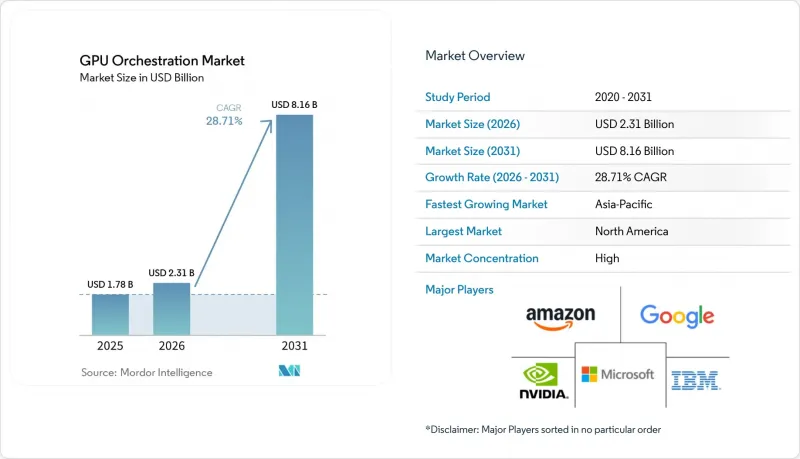
本報告按元件(軟體和服務)、部署模式(雲端、本地部署、混合部署)、應用程式(GPU調度和分配、工作負載編配、管治和多租戶等)、最終用戶(雲端服務供應商和GPU即服務供應商、IT和技術公司、銀行、金融服務和保險機構等)以及地區進行細分。市場預測以美元計價。
全球GPU編配市場趨勢與洞察
對LLM訓練和推理工作負載的需求不斷成長
由於大規模模式訓練和生產推理對同一加速器池的需求截然不同,GPU編配市場正從中受益。訓練作業需要較長的預留時間、穩定的互連性能以及協同的多節點執行,而推理則會產生不均衡的需求,並隨時間和地點快速波動。這種不匹配使得靜態GPU分配成本高且效率低。因此,GPU編配市場正逐漸成為企業AI基礎設施設計的核心。 NVIDIA已證明,編配不再僅關乎叢集管理,而是與模型效能直接相關。 NVIDIA透過闡述其NeMo框架如何利用自適應資源編配來減輕分散式訓練期間對遠端頻寬的負擔,證明了編排的重要性。由於推理模型、微調管線和生產推理都在爭奪同一基礎設施,因此,GPU編配市場對能夠平衡長時間運行作業和突發性工作負載,而無需將容量綁定到嚴格預留機制的軟體越來越感興趣。因此,GPU編配市場的供應商現在將調度、佇列策略和叢集感知功能定位為產品差異化因素,而不是買家可以忽略的後台基礎設施功能。
需要最大限度地利用昂貴的GPU
GPU編配市場的發展也受到人工智慧基礎設施高成本以及營運商日益成長的回收GPU叢集閒置容量的壓力所驅動。在近期的人工智慧建構週期中購買或預留了大規模GPU集群的公司,現在面臨著證明這些資產得到合理且可衡量利用的壓力。這些壓力正將GPU編排市場轉變為一個可操作的成本管理領域,因為即使硬體編配規模相同,更高的使用率也能顯著降低訓練、微調和推理的成本。 2026年3月,Anyscale宣布,透過機架級調度和部分分配,其使用NVIDIA H100和H200集群的生產部署中GPU運轉率保持在80%以上。這為GPU編配市場提供了一個明確的營運基準,展現了成熟實現方案所能達到的水平。 NVIDIA也透過KAI Scheduler開放原始碼了其核心調度軟體,並隨後將其動態資源分配驅動程式置於社群管治之下。這為更有效率地利用GPU建構了一個廣泛的生態系統。因此,GPU編配市場不再僅僅關乎操作便利性,而是在如何消耗和管理昂貴的GPU叢集方面提供了可衡量的改進。
異質GPU堆疊之間的互通性差距
當企業需要在混合加速器環境中,使用單一軟體層來管理硬體、驅動程式和調度邏輯時,GPU編配市場仍面臨巨大的普及障礙。許多編配堆疊最初都是基於NVIDIA的核心概念建構的,導致對其他硬體生態系統在插件、可觀測性工具、拓撲處理和策略框架等方面的支援參差不齊。這導致整合週期延長,維護成本增加,尤其對於那些不希望將整個AI堆疊標準化到單一供應商的產品。 NVIDIA於2026年3月決定將其GPU動態資源分配驅動程式捐贈給CNCF,這表明其致力於透過社群主導的調度標準來擴展互通性,但也凸顯了供應商特定的一致性仍然是一個持續存在的挑戰。因此,儘管工具領域仍然分散,但GPU編配市場正在一個多供應商相容性日益重要的環境中發展。在互通性進一步改善之前,一些買家可能會選擇規模較小的部署、更依賴託管服務合作夥伴,或使用特定供應商的堆疊,而不是更廣泛的編配層。
細分市場分析
預計到 2025 年,軟體收入將佔 GPU編配市場總收入的 78.83%,這表明 GPU 編排市場的買家更重視控制層而非相關服務。軟體的高權重反映了企業在將 AI 工作負載遷移到生產環境時,希望能夠直接控制調度策略、可觀測性、管治、多租戶存取和使用率管理。在 GPU編配市場,軟體通常是決定相同硬體基礎設施能否在不同團隊、不同優先順序和不同環境之間高效共用的關鍵因素。正因如此,即使整個基礎設施堆疊以託管雲端和整合服務為中心不斷擴展,軟體仍佔據最大的市場佔有率。買家也傾向於選擇能夠縮短部署時間並提供統一管理平台(用於資源分配、佇列策略和效能監控)的軟體平台。
預計到 2031 年,服務業將以 29.86% 的複合年成長率成長。儘管其初始基數較小,但有望成為 GPU編配市場中成長最快的組成部分。這一成長表明,企業部署仍然涉及大量的設計和維運工作,尤其是在買家需要將調度器與儲存、可觀測性、合規性和傳統內部工具整合時。 Anyscale 在 2026 年 3 月發布的版本展示了一個生產部署,該部署利用機架感知調度和部分分配來維持 NVIDIA H100 和 H200 陣列的高運轉率。這進一步印證了這樣一種觀點:正確實施的編配不僅依賴軟體購買,還依賴精細的運維調優。 NVIDIA 轉向開放原始碼KAI Scheduler 和 DRA 驅動程式可能會降低基礎調度層的准入門檻,但同時,它也正在推動 GPU編配市場的價值重心向整合、管治和最佳化服務轉移,這些服務可以幫助企業從試點階段過渡到大規模營運。從長遠來看,這種組件配置表明,GPU編配市場將繼續從平台控制軟體以及確保軟體在複雜的企業環境中可靠運作所需的服務中獲得收入。
到 2025 年,雲端將佔據 GPU編配市場 52.69% 的佔有率。這證實了託管雲端環境仍然是 AI 團隊快速存取共用GPU 資源的最佳起點。雲端的主導地位歸功於託管 Kubernetes 環境的運維簡易性和快速部署能力,以及無需預先組建大規模的內部平台團隊即可開始編配的能力。對於 GPU編配市場的許多買家而言,採用雲端也意味著在實際生產工作負載下測試佇列策略、監控模型和團隊級存取控制所需的時間更少。這使得雲端成為最大的採用模式,因為許多組織仍在建立其初始的生產 AI 運維模式。這也使超大規模資料中心業者能夠更緊密地將編配到其生態系統中,從而促進託管運算的更高效利用以及與嵌入式調度軟體的整合。
混合環境預計到2031年將以29.53%的複合年成長率成長,顯示GPU編配市場正朝著更分散式的營運模式轉變,涵蓋本地部署和租賃基礎設施。已投資本地GPU硬體的公司正在尋求一種能夠將敏感工作負載和受監管資料保存在受控環境中,並在需求激增時靈活擴展到雲端的能力。Softbank Corporation的「Infrinia AI Cloud OS」將Kubernetes即服務(KaaS)和推理即服務(IaaS)自動化整合到GPU AI資料中心的軟體堆疊中,這反映了編配軟體在管理多環境營運方面日益成長的重要性。 KDDI於2026年4月推出的「GPU Cloud」服務也支持這一趨勢,因為它面向安全性和資料主權至關重要的應用場景,例如汽車AI訓練、基因組學和金融建模。因此,這種部署組合表明 GPU編配市場正在從簡單的雲端調度轉向更廣泛的控制平面,該控制平面可以跨多個基礎設施邊界管理成本、合規性和工作負載放置。
區域分析
預計北美將在GPU編配保持領先地位,到2025年將佔47.52%的市佔率。這主要得益於超大規模資料中心業者、企業級AI需求以及密集的雲端原生軟體團隊生態系統。美國仍是GPU編配市場的主要成長引擎,因為許多託管GPU服務、編配軟體供應商和AI平台專家都總部設在美國,或與美國雲端生態系緊密相連。這種集中性使得北美成為編配能力從技術挑戰向商業產品快速轉型的地區。這也意味著GPU編配市場與託管Kubernetes的採用、企業級推理的部署以及將GPU管治視為董事會層面的基礎設施問題的趨勢密切相關。 Anyscale將於2026年6月發布基於Azure Kubernetes服務和Azure資源管理器的原生Azure整合功能,這清楚地表明,北美生態系統正在持續將編配為企業可以直接使用的軟體層。
歐洲仍然是GPU編配的第二大區域市場,其需求主要受受監管的企業工作負載、國家計算優先事項以及對可審計基礎設施控制的需求所驅動。德國和英國尤其突出,因為它們依賴生產環境,而調度策略和工作負載可追溯性在汽車人工智慧、金融服務和生命科學等領域至關重要。此外,該地區正在塑造以管治為中心的GPU編配市場需求,因為買家通常需要能夠記錄資源存取、工作負載放置和運行一致性的軟體。 NVIDIA決定在2026年3月於阿姆斯特丹舉行的KubeCon Europe大會上將其GPU DRA驅動程式置於CNCF的管治之下,這凸顯了歐洲範圍內向開放標準和社區主導的基礎設施組件發展的趨勢。因此,儘管歐洲可能不是GPU編配市場成長最快的地區,但它仍然是企業級編配的關鍵區域。
預計到2031年,亞太地區將以29.45%的複合年成長率成長,成為GPU編配市場成長最快的地區。日本是這一成長勢頭的主要推動力,KDDI於2026年4月推出“GPU Cloud”,Softbank Corporation也推出了“Infrinia AI Cloud OS”,作為面向多租戶GPU AI資料中心的本土軟體棧。 2026年3月,GMO Internet在其託管式Slurm GPU雲端服務中引進了NVIDIA HGX B300,進一步增強了該地區對先進託管運算基礎設施的存取。雖然南美洲和中東及非洲在GPU編配市場中仍處於較小規模,但隨著本土主導能力、本土資料處理能力以及特定產業雲端需求開始推動初步應用,這兩個地區的重要性日益凸顯。
其他好處:
- Excel格式的市場預測(ME)表
- 3個月的分析師支持
目錄
第1章:引言
- 研究假設和市場定義
- 調查範圍
第2章:調查方法
第3章執行摘要
第4章 市場狀況
- 市場概覽
- 市場促進因素
- 對LLM訓練和推理工作負載的需求不斷成長
- 需要最大限度地利用昂貴的GPU
- 快速過渡到雲端原生和混合 GPU 操作
- 企業內部人工智慧團隊之間的多租戶GPU共用
- 採用節能調度方式,減少人工智慧運算資源的浪費。
- 邊緣整合即時人工智慧處理
- 市場限制因素
- 異質GPU堆疊之間的互通性差距
- GPU集群編配人員短缺
- 多租戶環境中的安全和隱私風險
- 由於傳統資料中心工具的存在,高級整合變得複雜
- 產業價值鏈分析
- 監理情勢
- 技術展望
- 波特五力分析
第5章 市場規模與成長預測
- 按組件
- 軟體
- 服務
- 按部署模式
- 雲
- 現場
- 混合
- 透過使用
- GPU調度和分配
- 工作負載編配
- 叢集管理
- 管治與多租戶
- 監測和成本最佳化
- 最終用戶
- 雲端服務供應商和GPU即服務供應商
- IT和科技公司
- BFSI
- 醫療保健和生命科學
- 製造業和汽車業
- 其他最終用戶
- 按地區
- 北美洲
- 美國
- 加拿大
- 墨西哥
- 歐洲
- 德國
- 英國
- 法國
- 義大利
- 其他歐洲國家
- 亞太地區
- 中國
- 日本
- 韓國
- 印度
- 東南亞
- 其他亞太國家
- 南美洲
- 中東和非洲
- 北美洲
第6章 競爭情勢
- 市場集中度
- 策略趨勢
- Vendor Positioning Analysis
- 公司簡介
- NVIDIA Corporation
- Amazon.com, Inc.
- Microsoft Corporation
- Google LLC
- IBM Corporation
- Intel Corporation
- Hewlett Packard Enterprise Company
- Red Hat, Inc.
- Databricks, Inc.
- DigitalOcean Holdings, Inc.
- CoreWeave, Inc.
- Alibaba Group Holding Limited
- Oracle Corporation
- Anyscale, Inc.
- RunPod, Inc.
- Rafay Systems, Inc.
- OctoML, Inc.
- Atos SE
第7章 市場機會與未來展望
According to Mordor Intelligence, the GPU orchestration market size is expected to increase from USD 1.78 billion in 2025 to USD 2.31 billion in 2026 and reach USD 8.16 billion by 2031, growing at a CAGR of 28.71% over 2026-2031.
This report is Segmented by Component (Software, and Services), Deployment Model (Cloud, On-Premises, and Hybrid), Application (GPU Scheduling and Allocation, Workload Orchestration, Governance and Multi-Tenancy, and More), End User (Cloud Service Providers and GPU-As-A-Service Providers, IT and Technology Companies, BFSI, and More), and Geography. The Market Forecasts are Provided in Terms of Value (USD).
Global GPU Orchestration Market Trends and Insights
Rising Demand for LLM Training and Inference Workloads
The GPU orchestration market is benefiting from the fact that large model training and production inference now place very different demands on the same pool of accelerators. Training jobs require long reservation windows, stable interconnect performance, and coordinated multi-node execution, while inference creates uneven demand that can rise or fall quickly over time and location. That mismatch makes static GPU allocation expensive and slow, which is why the GPU orchestration market is moving closer to the center of enterprise AI infrastructure design. NVIDIA described how its NeMo Framework uses adaptive resource orchestration to reduce long-haul bandwidth pressure during distributed training, demonstrating that orchestration is now tied directly to model performance rather than solely to cluster administration. As reasoning models, fine-tuning pipelines, and production inference all compete for the same infrastructure, the GPU orchestration market is gaining from software that can balance long-running jobs with burst workloads without locking capacity into rigid reservations. This is also pushing vendors in the GPU orchestration market to treat scheduling, queue policy, and cluster awareness as product differentiators rather than background infrastructure features that buyers can ignore.
Need To Maximize Expensive GPU Utilization
The GPU orchestration market is also being driven by the high cost of AI infrastructure and the growing pressure on operators to recover idle capacity within GPU clusters. Enterprises that bought or reserved large GPU fleets during the recent AI build cycle are now under pressure to demonstrate that these assets are being used in a disciplined, measurable way. That pressure is turning the GPU orchestration market into a practical cost-control category, because utilization improvements can change the effective cost of training, fine-tuning, and inference even when the hardware footprint stays the same. Anyscale stated in March 2026 that production deployments using NVIDIA H100 and H200 fleets were sustaining more than 80% GPU utilization through rack-aware scheduling and fractional allocation, providing the GPU orchestration market with a clear operational benchmark for what mature implementations can achieve. NVIDIA also moved core-scheduling software into the open with the KAI Scheduler and later placed a Dynamic Resource Allocation driver under community governance, which supports a broader ecosystem for higher-efficiency GPU use. As a result, the GPU orchestration market is no longer selling only operational convenience; it is selling measurable improvement in how costly GPU fleets are consumed and governed.
Interoperability Gaps Across Heterogeneous GPU Stacks
The GPU orchestration market still faces a real adoption barrier when enterprises need a single software layer to manage hardware, drivers, and scheduling logic across mixed-accelerator environments. Many orchestration stacks were initially built around NVIDIA-heavy environments, so support for other hardware ecosystems remains uneven across plugins, observability tools, topology handling, and policy frameworks. That creates longer integration cycles and higher maintenance overhead for buyers who do not want to standardize their entire AI stack on one vendor. NVIDIA's decision to donate its GPU Dynamic Resource Allocation driver to the CNCF in March 2026 points to an effort to widen interoperability through community-led scheduling standards, but it also highlights that cross-vendor consistency is still a work in progress. The GPU orchestration market is therefore advancing in an environment where multi-vendor support is becoming increasingly important, even as the tooling landscape remains fragmented. Until interoperability improves further, some buyers will keep deployments smaller, rely more heavily on managed service partners, or choose vendor-specific stacks instead of broader orchestration layers.
Other drivers and restraints analyzed in the detailed report include:
- Rapid Shift to Cloud-Native and Hybrid GPU Operations
- Multi-Tenant GPU Sharing Across Enterprise AI Teams
- Limited Availability of GPU-Cluster Orchestration Talent
For complete list of drivers and restraints, kindly check the Table Of Contents.
Segment Analysis
Software accounted for 78.83% of revenue in 2025, indicating that buyers in the GPU orchestration market have placed the highest value on the control layer rather than attached services. The software-heavy mix reflects the fact that enterprises want direct command over scheduling policy, observability, governance, multi-tenant access, and utilization management as they move AI workloads into production. In the GPU orchestration market, software is often the part that determines how efficiently the same hardware base can be shared across teams, priorities, and environments. That is why software captured the largest share even as the broader infrastructure stack continued to expand around managed cloud and integration services. Buyers also tend to prefer software platforms that shorten deployment time and provide a single administrative plane for resource allocation, queue policy, and performance monitoring.
Services are projected to grow at a 29.86% CAGR through 2031, making it the fastest-growing component of the GPU orchestration market, even though it started from a smaller base. That growth signals that enterprise adoption still involves heavy design and operational work, especially when buyers need to connect schedulers with storage, observability, compliance, and legacy internal tooling. Anyscale's March 2026 release pointed to production deployments that used rack-aware scheduling and fractional allocation to sustain high utilization on NVIDIA H100 and H200 fleets, which supports the view that well-implemented orchestration depends on deep operational tuning and not only software purchase. NVIDIA's open-source moves around KAI Scheduler and the DRA driver may lower barriers at the basic scheduling layer, but they also push value in the GPU orchestration market toward integration, governance, and optimization services that help enterprises move from pilots to scaled operations. Over time, the component mix suggests that the GPU orchestration market will keep monetizing both platform control software and the services required to make that software work reliably inside complex enterprise environments.
Cloud accounted for 52.69% of the GPU orchestration market size in 2025, which confirms that managed cloud environments remained the easiest starting point for AI teams that wanted fast access to shared GPU capacity. The cloud lead came from the operational simplicity of managed Kubernetes environments, faster provisioning, and the ability to begin orchestration without first building large internal platform teams. For many buyers in the GPU orchestration market, cloud deployment also reduced the time needed to test queue policies, monitoring models, and team-level access controls under real production workloads. That made cloud the largest deployment model at a time when many organizations were still establishing their first production AI operations pattern. It also helped hyperscalers keep orchestration closer to their own ecosystems, strengthening the link between managed compute consumption and embedded scheduling software.
Hybrid is projected to expand at a 29.53% CAGR through 2031, indicating that the GPU orchestration market is moving toward a more distributed operating model across both owned and rented infrastructure. Enterprises that invested in on-premises GPU hardware now want the flexibility to burst into cloud when demand spikes, while still keeping sensitive workloads or regulated data in controlled environments. SoftBank's Infrinia AI Cloud OS was introduced as a software stack for GPU AI data centers that automates Kubernetes-as-a-Service and Inference-as-a-Service, which reflects the increasing importance of orchestration software in managing multi-environment operations. KDDI's GPU Cloud service launch in April 2026 also supports this direction, because it was positioned for secure and data-sovereign use cases such as automotive AI training, genomics, and financial modeling. The deployment mix therefore suggests that the GPU orchestration market is shifting from simple cloud scheduling toward broader control planes that can manage cost, compliance, and workload placement across several infrastructure boundaries.
Complete Report Scope:
- By Component
- Software
- Services
- By Deployment Model
- Cloud
- On-Premises
- Hybrid
- By Application
- GPU Scheduling and Allocation
- Workload Orchestration
- Cluster Management
- Governance and Multi-Tenancy
- Monitoring and Cost Optimization
- By End User
- Cloud Service Providers and GPU-as-a-Service Providers
- IT and Technology Companies
- BFSI
- Healthcare and Life Sciences
- Manufacturing and Automotive
- Other End Users
- By Geography
- North America
- United States
- Canada
- Mexico
- Europe
- Germany
- United Kingdom
- France
- Italy
- Rest of Europe
- Asia-Pacific
- China
- Japan
- South Korea
- India
- Southeast Asia
- Rest of Asia-Pacific
- South America
- Middle East and Africa
- North America
Geography Analysis
North America held 47.52% of the GPU orchestration market share in 2025, keeping the region in the lead, as it combines hyperscaler presence, enterprise AI demand, and a dense ecosystem of cloud-native software teams. The United States remains the core growth engine in the GPU orchestration market because many managed GPU services, orchestration software vendors, and AI platform specialists are either headquartered there or closely tied to its cloud ecosystem. That concentration has made North America the region where orchestration features move fastest from engineering problem to commercial product. It has also kept the GPU orchestration market closely linked to managed Kubernetes adoption, enterprise inference rollout, and the push to treat GPU governance as a board-level infrastructure issue. Anyscale's June 2026 launch of a native Azure integration built on Azure Kubernetes Service and Azure Resource Manager highlights how the North American ecosystem continues to turn orchestration into a directly consumable enterprise software layer.
Europe remained the second-largest regional market for GPU orchestration, with demand driven by regulated enterprise workloads, sovereign compute priorities, and the need for auditable infrastructure control. Germany and the United Kingdom stand out because automotive AI, financial services, and life sciences all depend on production environments where scheduling policy and workload traceability matter. The region also gives the GPU orchestration market a governance-heavy demand profile, because buyers often need software that can document resource access, workload placement, and operational consistency. NVIDIA's March 2026 move to place its GPU DRA driver under CNCF governance at KubeCon Europe in Amsterdam supports a broader European preference for open standards and community-led infrastructure components. Europe therefore remains an important region for enterprise-grade orchestration, even when it is not the fastest-growing part of the GPU orchestration market.
Asia-Pacific is projected to expand at a 29.45% CAGR through 2031, which makes it the fastest-growing region in the GPU orchestration market. Japan is a major source of that momentum, with KDDI launching GPU Cloud in April 2026 and SoftBank introducing Infrinia AI Cloud OS as a domestically developed software stack for multi-tenant GPU AI data centers. GMO Internet also introduced NVIDIA HGX B300 on its managed Slurm GPU cloud service in March 2026, which strengthens the region's access to advanced managed compute infrastructure. South America and the Middle East and Africa remain smaller in the GPU orchestration market, but both regions are becoming more relevant where sovereign AI capacity, domestic data handling, and industry-specific cloud demand are beginning to support early deployments.
- NVIDIA Corporation
- Amazon.com, Inc.
- Microsoft Corporation
- Google LLC
- IBM Corporation
- Intel Corporation
- Hewlett Packard Enterprise Company
- Red Hat, Inc.
- Databricks, Inc.
- DigitalOcean Holdings, Inc.
- CoreWeave, Inc.
- Alibaba Group Holding Limited
- Oracle Corporation
- Anyscale, Inc.
- RunPod, Inc.
- Rafay Systems, Inc.
- OctoML, Inc.
- Atos SE
Additional Benefits:
- The market estimate (ME) sheet in Excel format
- 3 months of analyst support
TABLE OF CONTENTS
1 INTRODUCTION
- 1.1 Study Assumptions and Market Definition
- 1.2 Scope of the Study
2 RESEARCH METHODOLOGY
3 EXECUTIVE SUMMARY
4 MARKET LANDSCAPE
- 4.1 Market Overview
- 4.2 Market Drivers
- 4.2.1 Rising Demand for LLM Training and Inference Workloads
- 4.2.2 Need to Maximize Expensive GPU Utilization
- 4.2.3 Rapid Shift to Cloud-Native and Hybrid GPU Operations
- 4.2.4 Multi-Tenant GPU Sharing Across Enterprise AI Teams
- 4.2.5 Energy-Aware Scheduling to Reduce AI Compute Waste
- 4.2.6 Edge-Integrated Real-Time AI Processing
- 4.3 Market Restraints
- 4.3.1 Interoperability Gaps Across Heterogeneous GPU Stacks
- 4.3.2 Limited Availability of GPU-Cluster Orchestration Talent
- 4.3.3 Security and Privacy Risks in Multi-Tenant Environments
- 4.3.4 High Integration Complexity With Legacy Data Center Tooling
- 4.4 Industry Value Chain Analysis
- 4.5 Regulatory Landscape
- 4.6 Technological Outlook
- 4.7 Porter's Five Forces Analysis
- 4.7.1 Bargaining Power of Suppliers
- 4.7.2 Bargaining Power of Buyers
- 4.7.3 Threat of New Entrants
- 4.7.4 Threat of Substitutes
- 4.7.5 Competitive Rivalry
5 MARKET SIZE AND GROWTH FORECASTS (VALUE)
- 5.1 By Component
- 5.1.1 Software
- 5.1.2 Services
- 5.2 By Deployment Model
- 5.2.1 Cloud
- 5.2.2 On-Premises
- 5.2.3 Hybrid
- 5.3 By Application
- 5.3.1 GPU Scheduling and Allocation
- 5.3.2 Workload Orchestration
- 5.3.3 Cluster Management
- 5.3.4 Governance and Multi-Tenancy
- 5.3.5 Monitoring and Cost Optimization
- 5.4 By End User
- 5.4.1 Cloud Service Providers and GPU-as-a-Service Providers
- 5.4.2 IT and Technology Companies
- 5.4.3 BFSI
- 5.4.4 Healthcare and Life Sciences
- 5.4.5 Manufacturing and Automotive
- 5.4.6 Other End Users
- 5.5 By Geography
- 5.5.1 North America
- 5.5.1.1 United States
- 5.5.1.2 Canada
- 5.5.1.3 Mexico
- 5.5.2 Europe
- 5.5.2.1 Germany
- 5.5.2.2 United Kingdom
- 5.5.2.3 France
- 5.5.2.4 Italy
- 5.5.2.5 Rest of Europe
- 5.5.3 Asia-Pacific
- 5.5.3.1 China
- 5.5.3.2 Japan
- 5.5.3.3 South Korea
- 5.5.3.4 India
- 5.5.3.5 Southeast Asia
- 5.5.3.6 Rest of Asia-Pacific
- 5.5.4 South America
- 5.5.5 Middle East and Africa
- 5.5.1 North America
6 COMPETITIVE LANDSCAPE
- 6.1 Market Concentration
- 6.2 Strategic Moves
- 6.3 Vendor Positioning Analysis
- 6.4 Company Profiles (includes Global Level Overview, Market Level Overview, Core Segments, Financials as available, Strategic Information, Market Rank/Share, Products and Services, Recent Developments)
- 6.4.1 NVIDIA Corporation
- 6.4.2 Amazon.com, Inc.
- 6.4.3 Microsoft Corporation
- 6.4.4 Google LLC
- 6.4.5 IBM Corporation
- 6.4.6 Intel Corporation
- 6.4.7 Hewlett Packard Enterprise Company
- 6.4.8 Red Hat, Inc.
- 6.4.9 Databricks, Inc.
- 6.4.10 DigitalOcean Holdings, Inc.
- 6.4.11 CoreWeave, Inc.
- 6.4.12 Alibaba Group Holding Limited
- 6.4.13 Oracle Corporation
- 6.4.14 Anyscale, Inc.
- 6.4.15 RunPod, Inc.
- 6.4.16 Rafay Systems, Inc.
- 6.4.17 OctoML, Inc.
- 6.4.18 Atos SE
7 MARKET OPPORTUNITIES AND FUTURE OUTLOOK
- 7.1 White-Space and Unmet-Need Assessment

 AI編配平台市場預測至2034年-全球分析(按組件、部署模式、編配類型、技術、應用、最終用戶和地區分類)人工智慧驅動的供應鏈編配市場預測至2034年:全球部署模式、產品/服務、服務類型、人工智慧技術、功能、應用、最終用戶和區域分析
 全球人工智慧模型路由器市場:按產品、路由方式、部署方式、組織規模和最終用戶產業分類-市場規模、產業動態、機會分析和預測(2026-2035 年)
 GPU中間件:市佔率分析、產業趨勢與統計、成長預測(2026-2031年)
 2026年全球工作流程市場報告勞動力編配平台市場預測至2034年-按平台類型、部署模式、技術、應用、最終用戶和地區分類的全球分析人工智慧市場預測:智慧流程自動化的全球分析(至2034年),涵蓋流程、組件、技術、應用、最終用戶和區域。智慧流程自動化平台市場預測至2034年—按組件、技術、部署模式、應用、最終用戶和地區分類的全球分析企業代理基礎設施:市場佔有率分析、產業趨勢與統計、成長預測(2026-2031 年)2026年全球多模型編配市場報告