


 |
市場調查報告書
商品編碼
2156979
身份驗證編配:市場佔有率分析、行業趨勢和統計數據、成長預測(2026-2031 年)Authentication Orchestration - Market Share Analysis, Industry Trends & Statistics, Growth Forecasts (2026 - 2031) |
||||||

※ 本網頁內容可能與最新版本有所差異。詳細情況請與我們聯繫。
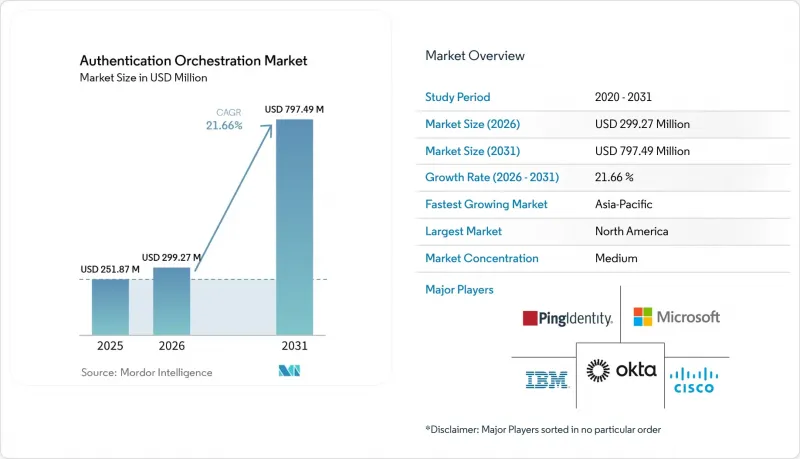
根據 Mordor Intelligence 預測,身分驗證編配市場規模預計將在 2025 年達到 2.5187 億美元,2026 年達到 2.9927 億美元,到 2031 年達到 7.9749 億美元,在 2026 年至 2031 年達到 7.9749 億美元,在 2026 年至 2031 年成長率的預測期內,複合年成長率為 1.6%。
全球身份驗證編配市場趨勢與洞察
以身分為中心的零信任架構的採用正在推動企業身分驗證相關支出的成長。
零信任計畫正從單純的安全方案轉變為許多組織(尤其是那些處理受監管資料或進行複雜員工存取管理的組織)的主動採購要求。持續檢驗需要跨會話、裝置、應用程式和存取請求進行檢查。由於單一身份驗證引擎無法可靠地管理多個身份提供者和風險訊號,因此推動了身份驗證編配市場的發展。早期階段的零信任計畫使用編配軟體在不同環境中一致地實施多因素身份驗證,而不是為每個應用程式維護不同的控制措施。更成熟的計劃在其基礎架構中添加了持續會話檢查和行為評分,從而在初始部署後擴展了策略的範圍。美國國家安全局 (NSA) 於 2026 年 1 月發布了《國家安全系統零信任實施指南》,旨在支援政府供應鏈中基於標準的採購。
防釣魚認證要求可縮短採購週期
監管要求使得防釣魚認證成為面臨重大數位存取風險的組織機構採購中更為緊迫的挑戰。 NIS2 第 21 條強制要求關鍵營業單位採用多因素認證或持續認證。認證編配市場可以幫助組織機構合規,使其能夠在單一存取流程中使用 FIDO2、金鑰和傳統認證方法。 2025 年 7 月,NIST 最終確定了 SP 800-63-4 標準,將同步金鑰認證為「認證製造商保證等級 2」。 2026 年,英國國家網路安全中心 (NCSC) 宣布,將建議在服務支援金鑰的情況下使用金鑰。這些截止日期將使承擔重疊義務的受監管金融服務機構能夠縮短從技術評估到採購的時間。
整合舊有應用程式和協定的成本會延遲部署。
對於正在取代身份驗證流程的組織而言,整合舊有系統仍然是一項重大挑戰,尤其是在高度客製化的內部應用程式中。基於 RACF、LDAP 或 SOAP 建置的應用程式通常需要在新策略部署到生產環境之前進行系統調查。此外,基於會話的身份驗證模型可能與目前的 OAuth 2.0 刷新令牌設計相衝突。在身分驗證編配市場,如果客戶管理大規模的本地環境或未記錄的存取流程,短期內採用速度可能會放緩。這些組織可能需要運行混合系統 12 到 36 個月,才能實現跨應用程式的統一策略執行。為舊協定提供預先身份驗證連接器的供應商可以減輕部署負擔,並在較長的替換週期中獲得競爭優勢。
細分市場分析
到 2025 年,軟體將佔據身分驗證編配市場 67.33% 的佔有率。這一領先地位反映了市場對跨管道和身份驗證方法的可程式設計策略引擎的需求。各組織正在利用這些平台,根據風險、使用者行為和合規性法規等因素選擇合適的身份驗證方法。這種方法避免了以往專注於購買單一令牌或生物識別感測器的做法,也避免了硬體升級和重複部署應用程式。即使身分提供者和存取管道發生變化,軟體也能幫助團隊保持一致的策略邏輯。
預計2026年至2031年,服務市場將以23.71%的複合年成長率成長。隨著部署涵蓋更廣泛的身份提供者、風險引擎和特定管道的身份驗證流程,專家部署支援、託管服務和專家協助的重要性日益凸顯。買家需要協助配置身分驗證流程、調整自適應風險閾值,並對策略變更進行清晰的管治。隨著協議的變更和應用程式新增整合需求,連接器更新也變得至關重要。 2026年初,Okta透過Mosaic平台SDK和Auth0平台的AI代理及數位憑證功能擴展了其編配能力。這些發布表明,除了軟體訂閱之外,部署專業知識在身份驗證編配市場仍然至關重要。
到 2025 年,雲端將佔據身分驗證編配市場 59.89% 的佔有率。雲端交付與分散式應用程式環境和身分即服務 (IaaS) 營運模式相契合。這使得客戶無需自行維護所有基礎設施,即可支援跨多個應用程式的身份驗證。本地部署在主權資料環境和敏感的政府網路中仍然發揮著重要作用。銀行也出於 PCI DSS 和 HIPAA 要求而採用單一租戶部署,因此也使用本地部署。然而,隨著雲端管理和自託管營運模式的管理變得更加便捷,本地部署的相對重要性正在下降。
預計到 2031 年,混合部署將以 23.02% 的複合年成長率成長。擁有傳統本地環境和雲端原生應用程式的組織並非總是能快速採用完全基於雲端的模式。這些組織需要一個身分層,該身分層能夠頒發符合通用策略規則的令牌,並同時被雲端服務和內部應用程式接受。這使得現代化進程得以推進,而無需傳統環境為每個請求重新向雲端提供者進行身份驗證。在 2026 年 3 月發布的 Entra 版本中,微軟為多因素身份驗證憑證添加了密碼密鑰設定檔和 Linux 支持,並具備反釣魚功能。這些功能體現了供應商對混合環境和身分驗證編配市場的持續投入。
區域分析
到 2025 年,北美將佔據身分驗證編配市場 35.16% 的佔有率。該地區擁有雄厚的企業安全預算、積極的監管以及集中的供應商基礎。美國聯邦政府的零信任要求正在推動各機構和承包商網路中採用多因素身份驗證和網路釣魚防護。 NIST SP 800-63-4 定義了聯邦系統和受監管私人組織的當前數位身分框架。微軟強制要求跨租用戶 Azure 登入使用多因素身份驗證,並將合規寬限期延長至 2026 年 7 月。
歐洲是身分驗證編配市場第二大區域市場。 NIS2、DORA 和 eIDAS 2.0 已在金融服務、醫療保健和大規模數位平台領域建立了並行的合規性要求。歐盟所有 27 個成員國必須在 2026 年 12 月之前提供「歐洲數位身分錢包 (EUDI Wallet)」。 2025 年 9 月,FIDO 聯盟宣布,在 EUDI Wallet 中註冊的 FIDO 通行金鑰可以滿足相關方的身份驗證要求,並達到 eIDAS 的高安全等級。德國、英國、法國和比荷盧經濟聯盟國家在該地區處於採購領先地位。 NCSC 關於通行金鑰的建議為買家提供了更清晰的指南,使其與政府政策保持一致。雖然南美洲的採用仍處於早期階段,但巴西和阿根廷的主要金融機構已有需求。
預計到2031年,亞太地區的複合年成長率將達到22.67%。印度的統一支付介面(UPI)預計在2025年將處理1,020億次身分驗證請求,這將增加身分驗證基礎設施的規模和複雜性。 2026年3月,Razorpay與萬事達卡合作,推出了符合印度儲備銀行(RBI)標準的生物識別金鑰解決方案,用於線上銀行卡交易。 2026年2月,富士通為SMBC日興證券的線上交易系統部署了FIDO2金鑰服務。中東地區的市場活動也正在加速成長,約旦中央銀行於2026年7月選擇BIO-key International作為其國家生物識別舉措的一部分。這些舉措正在將身份驗證編配市場從傳統的北美和歐洲市場拓展到其他地區。
其他好處:
- Excel格式的市場預測(ME)表
- 3個月的分析師支持
目錄
第1章:引言
- 研究假設和市場定義
- 調查範圍
第2章:調查方法
第3章執行摘要
第4章 市場狀況
- 市場概覽
- 市場促進因素
- 實施以身分為中心的零信任模型
- 監理機構推廣反釣魚認證
- 雲端和混合式環境中身份堆疊的複雜性
- 帳戶劫持和交易詐騙呈上升趨勢。
- AI代理身份歷程和非人類訪問
- 身分提供者之間身分驗證策略的可移植性
- 市場限制因素
- 整合舊有應用程式和協定的成本
- 關於生物識別資料的隱私和管治限制
- 通行金鑰恢復和身分驗證憑證生命週期中的挑戰
- 風險模型的可解釋性以及假陽性導致的風險暴露
- 價值鏈分析
- 宏觀經濟因素的影響
- 監理情勢
- 技術展望
- 用例
- 客戶登入和註冊功能的現代化
- 無密碼認證和金鑰的普及
- 轉變員工存取權限和單一登入 (SSO)
- 跨通路多因子認證(MFA)的編配
- 用於預防詐欺的自適應和基於風險的身份驗證
- 波特五力分析
第5章 市場規模與成長預測
- 按組件
- 軟體
- 服務
- 部署模式
- 雲
- 現場
- 混合
- 按組織規模
- 大公司
- 小型企業
- 按行業分類
- 政府和公共行政
- 零售與電子商務
- 運輸/物流
- 能源公用事業
- 資訊科技/通訊
- 媒體與娛樂
- 醫療保健和生命科學
- 銀行、金融服務和保險(BFSI)
- 其他工業部門
- 按地區
- 北美洲
- 美國
- 加拿大
- 墨西哥
- 南美洲
- 巴西
- 阿根廷
- 其他南美國家
- 歐洲
- 德國
- 英國
- 法國
- 義大利
- 比荷盧經濟聯盟
- 其他歐洲國家
- 亞太地區
- 中國
- 日本
- 印度
- 韓國
- 澳洲
- 其他亞太國家
- 中東和非洲
- 中東
- 阿拉伯聯合大公國
- 沙烏地阿拉伯
- 其他中東國家
- 非洲
- 南非
- 奈及利亞
- 埃及
- 其他非洲國家
- 中東
- 北美洲
第6章 競爭情勢
- 市場集中度
- 策略趨勢
- 市佔率分析
- 公司簡介
- Okta, Inc.
- Microsoft Corporation
- Ping Identity Corporation
- IBM Corporation
- Transmit Security, Inc.
- Cisco Systems, Inc.
- Thales
- CyberArk Software Ltd.
- RSA Security LLC
- ForgeRock, Inc.
- Entrust Corporation
- OneSpan Inc.
- HID Global Corporation
- Yubico AB
- SecureAuth Corporation
- OneLogin, Inc.
- Descope, Inc.
- Stytch, Inc.
- Strata Identity, Inc.
- Monokee Srl
- Cross Identity
- Authsignal Limited
- Veriff OU
- BioCatch Ltd.
- IDEMIA Identity and Security France SAS
- NEC Corporation
第7章 市場機會與未來趨勢
- 評估閒置頻段和未滿足的需求
According to Mordor Intelligence, the authentication orchestration market size was USD 251.87 million in 2025 and is estimated to grow from USD 299.27 million in 2026 to reach USD 797.49 million by 2031, at a CAGR of 21.66% during the forecast period 2026-2031.
Global Authentication Orchestration Market Trends and Insights
Identity-Centric Zero-Trust Adoption Anchors Enterprise Authentication Spending
Zero-trust programs are moving from security plans into active purchasing requirements for many organizations, particularly those handling regulated data and complex workforce access. Continuous verification requires checks across sessions, devices, applications, and access requests. The authentication orchestration market benefits from the fact that a single authentication engine cannot reliably manage multiple identity providers and risk signals. Early-stage programs use orchestration software to apply multi-factor authentication consistently across separate environments, instead of maintaining different controls in each application. More mature programs add continuous session checks and behavioral scoring to those foundations, which expands the policy scope after initial deployment. The National Security Agency issued Zero Trust Implementation Guidelines for National Security Systems in January 2026, supporting standards-based procurement across government supply chains.
Phishing-Resistant Authentication Requirements Shorten Procurement Cycles
Regulatory requirements are making phishing-resistant authentication a more immediate purchasing issue for organizations with material digital access risk. NIS2 Article 21 requires multi-factor or continuous authentication for essential entities. The authentication orchestration market can support compliance by enabling organizations to use FIDO2, passkeys, and legacy authentication methods within a single access journey. NIST finalized SP 800-63-4 in July 2025 and recognized syncable passkeys at Authenticator Assurance Level 2. In 2026, the United Kingdom's National Cyber Security Center stated that it recommends using passkeys whenever services support them. These deadlines can reduce the time between technology evaluation and purchasing for regulated financial services organizations with overlapping obligations.
Legacy Application and Protocol Integration Cost Delays Deployment
Legacy integration remains a material barrier for organizations replacing authentication processes, particularly across heavily customized internal applications. Applications built around RACF, LDAP, or SOAP often need discovery work before new policies can go live. Session-based authentication models can also conflict with current OAuth 2.0 refresh-token designs. The authentication orchestration market may face slower near-term adoption where customers manage large on-premises estates and undocumented access flows. These organizations can operate hybrid systems for 12-36 months before policy coverage becomes consistent across their applications. Vendors that offer pre-certified connectors for older protocols can reduce deployment effort and improve their position in long replacement cycles.
Other drivers and restraints analyzed in the detailed report include:
- Account-Takeover and Transaction-Fraud Escalation Forces Authentication Modernization
- Cloud and Hybrid Identity-Stack Complexity Creates Demand for Orchestration Layers
- Privacy and Biometric Data-Governance Constraints Raise Compliance Costs
For complete list of drivers and restraints, kindly check the Table Of Contents.
Segment Analysis
Software held 67.33% of the authentication orchestration market share in 2025. The leading position reflects demand for programmable policy engines across different channels and authentication methods. Organizations use these platforms to select the appropriate authenticator based on the risk context, user behavior, and compliance rules. This approach moves purchasing away from a focus on individual tokens or biometric sensors. It also avoids hardware upgrades and repeated application redeployment. Software can help teams maintain consistent policy logic as identity providers and access channels change.
Services are projected to grow at a 23.71% CAGR from 2026 to 2031. Professional implementation, managed services, and specialist support are becoming important as deployments cover more identity providers, risk engines, and channel-specific authentication journeys. Buyers need help configuring authentication journeys, tuning adaptive risk thresholds, and maintaining clear governance over policy changes. They also need connectors updated as protocols change and as applications add new integration requirements. Okta expanded its orchestration capabilities in early 2026 through its Mosaic Platform SDK and Auth0 platform features for AI agents and digital credentials. These releases show why implementation expertise remains important alongside software subscriptions in the authentication orchestration market.
Cloud accounted for 59.89% of the authentication orchestration market in 2025. Cloud delivery aligns with distributed application estates and identity-as-a-service operating models. It can support authentication across multiple applications without requiring customers to maintain all the infrastructure themselves. On-premises deployment remains relevant in sovereign data environments and classified government networks. It also serves banks that need single-tenant deployments under PCI DSS and HIPAA requirements. Its relative position is narrowing as cloud-managed and self-hosted operating models become easier to manage.
Hybrid deployment is projected to grow at a 23.02% CAGR through 2031. Organizations with legacy on-premises estates and cloud-native applications cannot always quickly adopt a fully cloud-based model. They need an identity layer that issues tokens accepted by both cloud services and internal applications, governed by common policy rules. This supports modernization without requiring the legacy environment to reauthenticate against a cloud provider for every request. Microsoft added passkey profiles and Linux support for phishing-resistant multi-factor authentication credentials in its March 2026 Entra releases. These capabilities reflect ongoing vendor investment in hybrid environments and the authentication orchestration market.
Complete Report Scope:
- By Component
- Software
- Services
- By Deployment Mode
- Cloud
- On-Premises
- Hybrid
- By Organization Size
- Large Enterprises
- Small and Medium-Sized Enterprises
- By Industry Vertical
- Government and Public Administration
- Retail and E-Commerce
- Transportation and Logistics
- Energy and Utilities
- IT and Telecommunication
- Media and Entertainment
- Healthcare and Life Sciences
- Banking, Financial Services, and Insurance (BFSI)
- Other Industry Verticals
- By Geography
- North America
- United States
- Canada
- Mexico
- South America
- Brazil
- Argentina
- Rest of South America
- Europe
- Germany
- United Kingdom
- France
- Italy
- BENELUX
- Rest of Europe
- Asia-Pacific
- China
- Japan
- India
- South Korea
- Australia
- Rest of Asia-Pacific
- Middle East and Africa
- Middle East
- United Arab Emirates
- Saudi Arabia
- Rest of Middle East
- Africa
- South Africa
- Nigeria
- Egypt
- Rest of Africa
- Middle East
- North America
Geography Analysis
North America held 35.16% of the authentication orchestration market share in 2025. The region combines extensive enterprise security budgets, active regulation, and a concentrated vendor base. U.S. federal zero-trust requirements have supported procurement of phishing-resistant multi-factor authentication across agencies and contractor networks. NIST SP 800-63-4 sets a current digital identity framework for federal systems and regulated private organizations. Microsoft required multi-factor authentication for Azure sign-ins across tenants, with extended compliance deadlines continuing through July 2026.
Europe is the second-largest regional market in the authentication orchestration market. NIS2, DORA, and eIDAS 2.0 create parallel compliance requirements across financial services, healthcare, and large digital platforms. All 27 European Union member states must provide a European Digital Identity Wallet by December 2026. The FIDO Alliance stated in September 2025 that a FIDO passkey enrolled in an EUDI Wallet can meet relying-party authentication requirements at high eIDAS assurance levels. Germany, the United Kingdom, France, and the Benelux countries lead regional procurement. The NCSC recommendation for passkeys provides buyers with a clearer, government-aligned reference point. South America remains earlier in adoption, with Brazil and Argentina showing demand from larger financial institutions.
Asia-Pacific is projected to grow at a 22.67% CAGR through 2031. India's Unified Payments Interface logged 102 billion authentication calls in 2025, adding scale and complexity to the authentication infrastructure. Razorpay launched a Reserve Bank of India-compliant biometric passkey solution with Mastercard in March 2026 for online card transactions. Fujitsu deployed its FIDO2 passkey service for SMBC Nikko Securities in February 2026 for online trading. The Middle East is also becoming more active, following the Central Bank of Jordan's selection of BIO-key International for a national biometric authentication initiative in July 2026. These programs extend the authentication orchestration market beyond its established North American and European base.
- Okta, Inc.
- Microsoft Corporation
- Ping Identity Corporation
- IBM Corporation
- Transmit Security, Inc.
- Cisco Systems, Inc.
- Thales
- CyberArk Software Ltd.
- RSA Security LLC
- ForgeRock, Inc.
- Entrust Corporation
- OneSpan Inc.
- HID Global Corporation
- Yubico AB
- SecureAuth Corporation
- OneLogin, Inc.
- Descope, Inc.
- Stytch, Inc.
- Strata Identity, Inc.
- Monokee S.r.l.
- Cross Identity
- Authsignal Limited
- Veriff OU
- BioCatch Ltd.
- IDEMIA Identity and Security France S.A.S.
- NEC Corporation
Additional Benefits:
- The market estimate (ME) sheet in Excel format
- 3 months of analyst support
TABLE OF CONTENTS
1 INTRODUCTION
- 1.1 Study Assumptions and Market Definition
- 1.2 Scope of the Study
2 RESEARCH METHODOLOGY
3 EXECUTIVE SUMMARY
4 MARKET LANDSCAPE
- 4.1 Market Overview
- 4.2 Market Drivers
- 4.2.1 Identity-Centric Zero-Trust Adoption
- 4.2.2 Regulatory Push for Phishing-Resistant Authentication
- 4.2.3 Cloud and Hybrid Identity-Stack Complexity
- 4.2.4 Account-Takeover and Transaction-Fraud Escalation
- 4.2.5 AI-Agent Identity Journeys and Non-Human Access
- 4.2.6 Authentication Policy Portability Across Identity Providers
- 4.3 Market Restraints
- 4.3.1 Legacy Application and Protocol Integration Cost
- 4.3.2 Privacy and Biometric Data-Governance Constraints
- 4.3.3 Passkey Recovery and Credential-Lifecycle Gaps
- 4.3.4 Risk-Model Explainability and False-Positive Exposure
- 4.4 Value Chain Analysis
- 4.5 Impact of Macroeconomic Factors
- 4.6 Regulatory Landscape
- 4.7 Technological Outlook
- 4.8 Use Cases
- 4.8.1 Customer Login and Registration Modernization
- 4.8.2 Passwordless Authentication and Passkey Adoption
- 4.8.3 Workforce Access and Single Sign-On (SSO) Transformation
- 4.8.4 Multi-Factor Authentication (MFA) Orchestration Across Channels
- 4.8.5 Adaptive and Risk-Based Authentication for Fraud Prevention
- 4.9 Porter's Five Forces Analysis
- 4.9.1 Threat of Substitutes
- 4.9.2 Bargaining Power of Buyers
- 4.9.3 Bargaining Power of Suppliers
- 4.9.4 Threat of New Entrants
- 4.9.5 Competitive Rivalry
5 MARKET SIZE AND GROWTH FORECASTS (VALUE)
- 5.1 By Component
- 5.1.1 Software
- 5.1.2 Services
- 5.2 By Deployment Mode
- 5.2.1 Cloud
- 5.2.2 On-Premises
- 5.2.3 Hybrid
- 5.3 By Organization Size
- 5.3.1 Large Enterprises
- 5.3.2 Small and Medium-Sized Enterprises
- 5.4 By Industry Vertical
- 5.4.1 Government and Public Administration
- 5.4.2 Retail and E-Commerce
- 5.4.3 Transportation and Logistics
- 5.4.4 Energy and Utilities
- 5.4.5 IT and Telecommunication
- 5.4.6 Media and Entertainment
- 5.4.7 Healthcare and Life Sciences
- 5.4.8 Banking, Financial Services, and Insurance (BFSI)
- 5.4.9 Other Industry Verticals
- 5.5 By Geography
- 5.5.1 North America
- 5.5.1.1 United States
- 5.5.1.2 Canada
- 5.5.1.3 Mexico
- 5.5.2 South America
- 5.5.2.1 Brazil
- 5.5.2.2 Argentina
- 5.5.2.3 Rest of South America
- 5.5.3 Europe
- 5.5.3.1 Germany
- 5.5.3.2 United Kingdom
- 5.5.3.3 France
- 5.5.3.4 Italy
- 5.5.3.5 BENELUX
- 5.5.3.6 Rest of Europe
- 5.5.4 Asia-Pacific
- 5.5.4.1 China
- 5.5.4.2 Japan
- 5.5.4.3 India
- 5.5.4.4 South Korea
- 5.5.4.5 Australia
- 5.5.4.6 Rest of Asia-Pacific
- 5.5.5 Middle East and Africa
- 5.5.5.1 Middle East
- 5.5.5.1.1 United Arab Emirates
- 5.5.5.1.2 Saudi Arabia
- 5.5.5.1.3 Rest of Middle East
- 5.5.5.2 Africa
- 5.5.5.2.1 South Africa
- 5.5.5.2.2 Nigeria
- 5.5.5.2.3 Egypt
- 5.5.5.2.4 Rest of Africa
- 5.5.5.1 Middle East
- 5.5.1 North America
6 COMPETITIVE LANDSCAPE
- 6.1 Market Concentration
- 6.2 Strategic Moves
- 6.3 Market Share Analysis
- 6.4 Company Profiles (includes Global Level Overview, Market Level Overview, Core Segments, Financials as available, Strategic Information, Market Rank/Share, Products and Services, Recent Developments)
- 6.4.1 Okta, Inc.
- 6.4.2 Microsoft Corporation
- 6.4.3 Ping Identity Corporation
- 6.4.4 IBM Corporation
- 6.4.5 Transmit Security, Inc.
- 6.4.6 Cisco Systems, Inc.
- 6.4.7 Thales
- 6.4.8 CyberArk Software Ltd.
- 6.4.9 RSA Security LLC
- 6.4.10 ForgeRock, Inc.
- 6.4.11 Entrust Corporation
- 6.4.12 OneSpan Inc.
- 6.4.13 HID Global Corporation
- 6.4.14 Yubico AB
- 6.4.15 SecureAuth Corporation
- 6.4.16 OneLogin, Inc.
- 6.4.17 Descope, Inc.
- 6.4.18 Stytch, Inc.
- 6.4.19 Strata Identity, Inc.
- 6.4.20 Monokee S.r.l.
- 6.4.21 Cross Identity
- 6.4.22 Authsignal Limited
- 6.4.23 Veriff OU
- 6.4.24 BioCatch Ltd.
- 6.4.25 IDEMIA Identity and Security France S.A.S.
- 6.4.26 NEC Corporation
7 MARKET OPPORTUNITIES AND FUTURE TRENDS
- 7.1 White-Space and Unmet-Need Assessment

 人工智慧基礎設施編配市場預測至2034年—按交付方式、部署方式、技術、基礎設施類型、應用和區域分類的全球分析人工智慧運算編配市場預測至2034年-按組件、部署模式、編配類型、運算資源類型、工作負載類型、最終使用者和地區分類的全球分析企業級人工智慧編配平台市場預測至2034年-全球分析(按組件、編配類型、核心功能、部署模式、企業規模、最終用戶產業和地區分類)情境工程平台市場預測至2034年-按元件、核心功能、情境資訊來源、應用、部署模式、最終使用者和地區分類的全球分析
 智慧資產管理平台市場:全球市場預測(2026-2032年)
 人工智慧編配市場機會、成長要素、產業趨勢分析及2026-2035年預測
 復甦編配:市場佔有率分析、產業趨勢與統計、成長預測(2026-2031)AI編配平台市場預測至2034年-全球分析(按組件、部署模式、編配類型、技術、應用、最終用戶和地區分類)人工智慧驅動的供應鏈編配市場預測至2034年:全球部署模式、產品/服務、服務類型、人工智慧技術、功能、應用、最終用戶和區域分析GPU編配:市佔率分析、產業趨勢與統計、成長預測(2026-2031年)