


 |
市場調查報告書
商品編碼
2155666
開放式無線接取網路系統整合商:市場佔有率分析、產業趨勢與統計資料、成長預測(2026-2031 年)Open RAN System Integrator - Market Share Analysis, Industry Trends & Statistics, Growth Forecasts (2026 - 2031) |
||||||

※ 本網頁內容可能與最新版本有所差異。詳細情況請與我們聯繫。
根據 Mordor Intelligence 預測,開放式 RAN 系統整合商市場規模預計將在 2025 年達到 16.4 億美元,2026 年達到 20.6 億美元,到 2031 年達到 71.8 億美元,2026 年至 2031 年的複合年成長率為 28.37%。
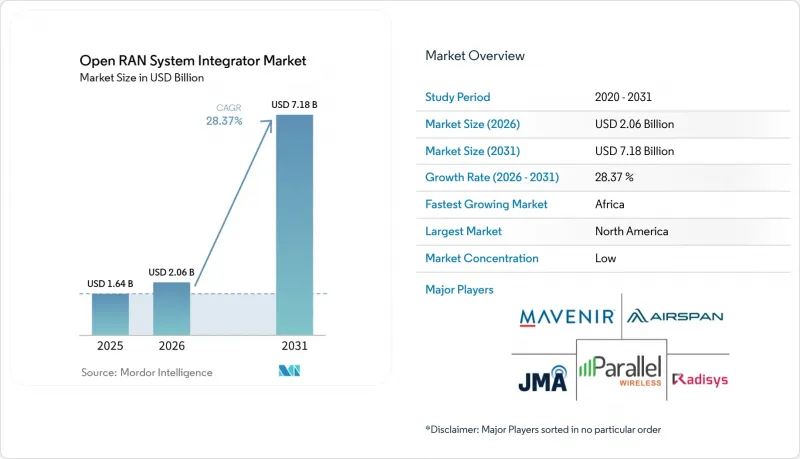
全球開放式無線接取網路系統整合商市場趨勢與洞察
5G獨立組網和雲端原生無線接取網路的部署
5G獨立網路架構正在開放式無線接取網路(Open RAN)系統整合商市場中形成重要的商業性基礎。這使得營運商能夠利用雲端原生編配來分離集中式、分散式和無線單元。因此,整合範圍已從無線單元試運行擴展到去程傳輸時序、O-Cloud生命週期管理以及自動化網路切片配置。這些任務難以使用封閉式的單一供應商工具進行管理。預計到2025年,5G業務將佔總營收的78.26%,並將在2031年之前以31.63%的年均成長率成長。樂天移動在日本經營一個完全虛擬化的雲端原生Open RAN網路,這表明該方法可以支援全國範圍的部署。
多個供應商之間互通性的要求
目前,在開放式無線接取網路(Open RAN)系統整合商市場,多廠商互通性是電信業者做出商業採購決策的重要前提條件。 2025年3月至8月期間,O-RAN聯盟發布了60份新增或更新的技術文檔,使目前版本文檔總數達到134份。這些文件涵蓋了O-RU、O-DU和近即時無線接取網(Near-RT RIC)的合規性評估領域。 2025年2月,ATIS擴展了Open RAN最低可行規範(Minimum Viable Profile),納入了去程傳輸控制、使用者、同步和管理平面介面的要求。能夠提供預先驗證組合的整合商可以減輕電信業者的檢驗工作量,並使其承擔更多交付責任。開放式測試與整合中心(Open Testing and Integration Centre)框架在採購中的重要性日益凸顯,因為它為元件和互通性檢驗提供了正式的流程。
整合的複雜性與實施週期的長短。
整合複雜性是開放式無線接取網路(Open RAN)系統整合商市場的一大限制因素。多廠商系統需要協調O-RU和O-DU之間的開放式去程傳輸鏈路、F1和E1介面以及O2雲端基礎設施介面。每個介面都可能引入單廠商無線接取網路中不存在的故障模式。美國國家電信與資訊管理局(NTIA)的電訊科學實驗室(TSL)於2025年將三個商用開放式無線接取網路系統整合到CRAIN實驗室中,並報告了與定時器配置、訊息處理和標準版本不匹配相關的互通性問題。根據相關文檔,整合和支援的額外開銷可能會使專案五年成本增加10%至20%。雖然擁有強大內部技術團隊的電信業者可以自行完成大部分整合工作,但供應商責任不明確可能會進一步延誤部署。
細分市場分析
2025年,服務收入佔比達68.91%,在開放式無線接取網路(Open RAN)系統整合商市場中佔最大佔有率。多廠商網路需要在整個專案生命週期中進行整合、測試、最佳化和運維管理。根據Digital Catapult統計,在2026年春季Plugfest大會上,70%至80%的活動都與正式測試開始前的多廠商整合和檢驗相關。這類工作量較適合長期服務合約,而非短期試運行階段。隨著雲端原生設計擴大將無線接取網路工作負載分配給商用現成(COTS)伺服器基礎設施,硬體產業正面臨壓力。因此,整合商可能會更加重視與硬體無關的自動化和生命週期服務。
軟體市場預計到2031年將以30.46%的複合年成長率成長,是其組成部分中成長最快的。原生AI SMO平台、近即時(Near-RT) RIC xApps和rApp庫在商用網路上運作前需要進行專門的整合。雖然目前軟體的收入基礎小於服務業,但平台一旦大規模部署,即可支援持續的授權收入。因此,整合商正在開發自己的自動化庫,而不是僅僅依賴第三方工具的部署。 2025年7月,O-RAN軟體社群發布了「L」版本,其中包含非即時RIC和SMO部署的整合藍圖。此次發布降低了在Open RAN系統整合產業建立軟體層能力的公司的進入門檻。
預計到2025年,5G將占公司收入的78.26%,將使該公司在開放式無線接取網路(Open RAN)系統整合商市場佔據領先地位。獨立組網(SA)5G需要O-RU、O-DU、O-CU、近即時RIC、SMO和O-Cloud等多個層面的協調。每一層都需要進行測試、認證和生命週期管理。樂天移動近期宣布計劃在日本部署大量先進的大規模MIMO O-RAN無線設備。此次部署旨在提升高密度都市區網路的吞吐量。這種多節點部署需要在部署的每個階段進行系統整合。
LTE網路在棕地改造專案中持續發揮重要作用,尤其是在LTE用戶基數龐大的新興市場。其他網路世代的佔有率較小,主要應用於撒哈拉以南非洲和南美洲部分地區的傳統網路改造場景。將LTE與新一代獨立組網系統結合的項目,其涵蓋範圍可能比單一網路世代項目更廣。 Mavenir和Parallel Wireless近期完成了基於Mavenir融合分組核心網路的多代GreenRAN協定堆疊的互通性測試。
區域分析
2025年,北美地區佔全球銷售額的41.03%,在開放式無線接取網路(Open RAN)系統整合商中佔最大佔有率。該地區擁有充滿活力的政策和標準化環境,這得益於美國公共無線供應鏈創新基金和ATIS的最低驗證配置(MVP)要求。 ATIS在2025年擴大了其影響力,為北美行動通訊業者(MNO)定義了去程傳輸傳介面要求。 AT&T在棕地環境中部署非即時無線介面控制器(RIC)以及TELUS在全國的無線系統遷移,為軟體驅動的自動化和網路替換提供了機會。美國國家電信與資訊管理局(NTIA)正在就2026年高達5,300萬美元的AI原生無線接取網(RAN)架構資金撥款徵求公眾意見。墨西哥5G頻段的部署以及加拿大向5G的過渡也為該地區創造了更多商機。
儘管歐洲擁有成熟的供應商體系和完善的商業生態系統,但亞太地區仍是開放式無線接取網路(Open RAN)系統整合商市場的核心,日本就是一個典型的例子。 SONIC Labs計畫於2026年4月結束,參與的27家供應商中有72%建立了商業夥伴關係,85%啟動了新產品研發。德國、英國和法國是歐洲電信業者積極進行試驗的地區。樂天行動持續經營虛擬化、雲端原生Open RAN網路,並於2026年在日本擴大了網路容量。樂天Symphony在經濟產業省(METI)的支持下,於2026年5月至2029年3月在南半球7個國家開展了一項耗資80億日元(約5020萬美元)的試驗。印度仍蘊藏長期發展機遇,因為目前尚無電信業者集團致力於大規模部署Open RAN。
預計到2031年,非洲將以31.28%的複合年成長率成長,成為所有地區中成長最快的地區。基礎設施成本壓力、無線共用(RAN)共享協定以及國際金融援助正在推動該地區開放式無線接取網路(Open RAN)系統整合商市場的發展。 MTN集團和Airtel Africa於2025年3月正式簽署了在烏干達和奈及利亞共用RAN和光纖的協議,並正在考慮將合作範圍擴展到剛果(布拉薩維爾)、盧安達和尚比亞。 Telkom Kenya、Rakuten Symphony和Airspan Networks於2025年1月簽署了一份合作備忘錄,旨在建設開放式無線接入網示範設施並進行現場測試,該項目獲得了美國和日本政府440萬美元的津貼。在南美洲,巴西的5G獨立組網部署以及玻利維亞和巴拉圭的試點計畫正在推動市場發展。在中東,Zain Kuwait和Rakuten Symphony正在進行試點項目,為開放式無線接取網路的發展奠定基礎。
其他好處:
- Excel格式的市場預測(ME)表
- 3個月的分析師支持
目錄
第1章:引言
- 研究假設和市場定義
- 調查範圍
第2章:調查方法
第3章執行摘要
第4章 市場狀況
- 市場概覽
- 市場促進因素
- 5G獨立組網和雲端原生無線接取網路的部署
- 多廠商互通性要求
- 政府資助開放和安全的通訊供應鏈
- 私有5G網路和中立主機網路的擴展
- 開放式無線接取網路的實驗室到現場檢驗正成為採購決策中的重要標準。
- 電信業者對獨立於供應商的SMO和自動化的需求。
- 市場限制因素
- 整合的複雜性與實施週期的長短。
- 缺乏職業級開放式無線接取網路(Open RAN)整合技能
- 供應商間績效差異及課責界限
- 商業支援和認證的責任分配
- 宏觀經濟因素對市場的影響
- 產業價值鏈分析
- 監理情勢
- 技術展望
- 波特五力分析
第5章 市場規模與成長預測
- 按組件
- 硬體
- 軟體
- 服務
- 透過網路生成
- 4G/LTE
- 5G
- 其他網路世代
- 不同的發展
- 公共大型基地台
- 專用網路及企業網路
- 室內小型基地台及分散式天線系統
- 最終用戶
- 行動電信商
- 中立主機提供商
- 按公司和行業
- 政府/國防
- 按地區
- 北美洲
- 美國
- 加拿大
- 墨西哥
- 南美洲
- 巴西
- 阿根廷
- 其他南美國家
- 歐洲
- 德國
- 英國
- 法國
- 義大利
- 西班牙
- 俄羅斯
- 其他歐洲國家
- 亞太地區
- 中國
- 日本
- 印度
- 韓國
- 其他亞太國家
- 中東
- 沙烏地阿拉伯
- 阿拉伯聯合大公國
- 土耳其
- 其他中東國家
- 非洲
- 南非
- 奈及利亞
- 埃及
- 其他非洲國家
- 北美洲
第6章 競爭情勢
- 市場集中度
- 策略趨勢
- 市佔率分析
- 公司簡介
- Mavenir Systems, Inc.
- Parallel Wireless, Inc.
- Airspan Networks Holdings Inc.
- Radisys Corporation
- JMA Wireless, Inc.
- Baicells Technologies Co., Ltd.
- ASOCS Ltd.
- Amarisoft SA
- Cisco Systems, Inc.
- Cohere Technologies, Inc.
- DeepSig, Inc.
- Dell Technologies Inc.
- Rimedo Labs Sp. z oo
- IS-Wireless Sp. z oo
- Druid Software Limited
- Qualcomm Incorporated
- Intel Corporation
第7章 市場機會與未來展望
According to Mordor Intelligence, the open RAN system integrator market size is projected to be USD 1.64 billion in 2025, USD 2.06 billion in 2026, and reach USD 7.18 billion by 2031, growing at a CAGR of 28.37% from 2026 to 2031.
Global Open RAN System Integrator Market Trends and Insights
5G Standalone and Cloud-Native RAN Rollouts
5G standalone architecture is creating the main commercial setting for the Open RAN system integrator market. It allows operators to separate the centralized, distributed, and radio units using cloud-native orchestration. Integration, therefore, extends beyond radio commissioning to fronthaul timing, O-Cloud lifecycle management, and automated network slice configuration. These tasks are harder to manage through closed, single-vendor tools. The 5G segment held 78.26% of 2025 revenue and is projected to grow at 31.63% through 2031. Rakuten Mobile operates a fully virtualized, cloud-native Open RAN network in Japan, showing that the approach can support national-scale deployment.
Multi-Vendor Interoperability Requirements
Multi-vendor interoperability is now a practical requirement before operators make commercial purchasing decisions in the Open RAN system integrator market. The O-RAN Alliance released 60 new or updated technical documents between March and August 2025, increasing the number of current-version titles to 134. These documents cover conformance areas for the O-RU, O-DU, and Near-RT RIC. ATIS expanded its Open RAN Minimum Viable Profile in February 2025 to include fronthaul control, user, synchronization, and management-plane interface requirements. Integrators that can provide pre-validated combinations can reduce operator testing work and take on more delivery responsibility. The Open Testing and Integration Centre framework is becoming relevant in procurement because it provides a formal route for component and interoperability validation.
Integration Complexity and Extended Deployment Timelines
Integration complexity is a material constraint on the Open RAN system integrator market. Multi-vendor systems must coordinate the open fronthaul link between the O-RU and O-DU, the F1 and E1 interfaces, and the O2 cloud infrastructure interface. Each interface can introduce a failure mode that is not present in a single-vendor RAN. NTIA's Institute for Telecommunication Sciences integrated 3 commercial Open RAN systems into its CRAIN Laboratory in 2025 and reported interoperability issues involving timer configuration, message handling, and standards-version mismatches. The source material noted that projects can face 10% to 20% higher 5-year costs after integration and support overhead. When operators have strong internal technical teams, they may retain more integration work, while unclear supplier accountability can further delay deployment.
Other drivers and restraints analyzed in the detailed report include:
- Government Funding for Open and Secure Telecom Supply Chains
- Operator Demand for Vendor-Independent SMO and Automation
- Shortage of Carrier-Grade Open RAN Integration Skills
For complete list of drivers and restraints, kindly check the Table Of Contents.
Segment Analysis
Services accounted for 68.91% of 2025 revenue, giving them the largest position in the Open RAN system integrator market. Multi-vendor networks require integration, testing, optimization, and managed operations across the full project lifecycle. Digital Catapult reported that 70% to 80% of activity at its Spring 2026 Plugfest related to multi-vendor integration and validation before formal testing began. This workload supports extended service engagements rather than a short commissioning phase. Hardware is under pressure as cloud-native designs place more RAN workloads on commercial off-the-shelf server infrastructure. Integrators are therefore likely to place more emphasis on hardware-agnostic automation and lifecycle services.
Software is projected to grow at a CAGR of 30.46% through 2031, the fastest rate within the component structure. AI-native SMO platforms, Near-RT RIC xApps, and rApp libraries require specialized integration before they can operate in commercial networks. Software has a smaller current revenue base than services, but it can support recurring license revenue when platforms are deployed at scale. This is encouraging integrators to develop proprietary automation libraries rather than solely deploying third-party tools. The O-RAN Software Community released its L version in July 2025 with an integrated blueprint for non-real-time RIC and SMO deployment. The release lowered entry barriers for firms building software-layer capabilities in the Open RAN system integrator industry.
5G represented 78.26% of 2025 revenue and accounted for the leading position in the Open RAN system integrator market. Standalone 5G requires coordinated work across the O-RU, O-DU, O-CU, Near-RT RIC, SMO, and O-Cloud. Each layer needs testing, certification, and lifecycle management. Rakuten Mobile recently announced plans to deploy a large number of advanced massive MIMO O-RAN radios in Japan. The deployment aims to improve throughput in high-density urban areas. Such multi-node deployments require systems integration at each stage of rollout.
The LTE segment remains relevant for brownfield overlay projects, especially in emerging markets with large LTE subscriber bases. Other network generations account for a smaller share and are associated with legacy overlay use cases in sub-Saharan Africa and parts of South America. Work that combines LTE and next-generation standalone systems can have a greater contract scope than a single-generation project. Mavenir and Parallel Wireless recently completed interoperability testing for a multi-generation GreenRAN stack with Mavenir's Converged Packet Core.
Complete Report Scope:
- By Component
- Hardware
- Software
- Services
- By Network Generation
- 4G/LTE
- 5G
- Other Network Generations
- By Deployment
- Public Macrocell
- Private and Enterprise Network
- Indoor Small Cell and DAS
- By End User
- Mobile Network Operators
- Neutral-Host Providers
- Enterprises and Industry Verticals
- Government and Defense
- By Geography
- North America
- United States
- Canada
- Mexico
- South America
- Brazil
- Argentina
- Rest of South America
- Europe
- Germany
- United Kingdom
- France
- Italy
- Spain
- Russia
- Rest of Europe
- Asia-Pacific
- China
- Japan
- India
- South Korea
- Rest of Asia-Pacific
- Middle East
- Saudi Arabia
- United Arab Emirates
- Turkey
- Rest of Middle East
- Africa
- South Africa
- Nigeria
- Egypt
- Rest of Africa
- North America
Geography Analysis
North America accounted for 41.03% of global revenue in 2025, the largest share among Open RAN system integrators. The region has an active policy and standards environment shaped by the U.S. Public Wireless Supply Chain Innovation Fund and ATIS Minimum Viable Profile requirements. ATIS expanded its profile in 2025 to define fronthaul interface requirements for North American MNOs. AT&T's brownfield, non-real-time RIC deployment and TELUS's national radio transition represent opportunities for software automation and network replacement. NTIA is seeking feedback in 2026 on a direction of up to USD 53 million for AI-native RAN architecture. Mexico's 5G spectrum rollout and Canada's transition to 5G provide additional regional pipeline opportunities.
Europe has a commercial ecosystem of validated suppliers, while Asia-Pacific remains central to the Open RAN system integrator market, with Japan as a leading example. The SONIC Labs program ended in April 2026, with 72% of 27 participating vendors securing commercial partnerships and 85% initiating new product development. Germany, the UK, and France are active European locations for operator trials. Rakuten Mobile continues to operate a virtualized cloud-native Open RAN network and expanded capacity in Japan during 2026. Rakuten Symphony is running a JPY 8 billion (USD 50.2 million), METI-backed trial across 7 Global South countries from May 2026 to March 2029. India remains a long-term opportunity because no operator circle has committed to Open RAN at scale.
Africa is projected to grow at a CAGR of 31.28% through 2031, the fastest rate among geographic areas. Infrastructure cost pressure, RAN-sharing agreements, and international funding support the Open RAN system integrator market in the region. MTN Group and Airtel Africa formalized RAN and fiber-sharing agreements in Uganda and Nigeria in March 2025, with expansion considered for Congo-Brazzaville, Rwanda, and Zambia. Telkom Kenya, Rakuten Symphony, and Airspan Networks signed a January 2025 memorandum for an Open RAN laboratory and field trials, backed by a USD 4.4 million U.S. and Japanese government grant. South America is supported by Brazil's 5G standalone activity and trial locations in Bolivia and Paraguay. The Middle East has early activity through Zain Kuwait's pilot with Rakuten Symphony.
- Mavenir Systems, Inc.
- Parallel Wireless, Inc.
- Airspan Networks Holdings Inc.
- Radisys Corporation
- JMA Wireless, Inc.
- Baicells Technologies Co., Ltd.
- ASOCS Ltd.
- Amarisoft SA
- Cisco Systems, Inc.
- Cohere Technologies, Inc.
- DeepSig, Inc.
- Dell Technologies Inc.
- Rimedo Labs Sp. z o.o.
- IS-Wireless Sp. z o.o.
- Druid Software Limited
- Qualcomm Incorporated
- Intel Corporation
Additional Benefits:
- The market estimate (ME) sheet in Excel format
- 3 months of analyst support
TABLE OF CONTENTS
1 INTRODUCTION
- 1.1 Study Assumptions and Market Definition
- 1.2 Scope of the Study
2 RESEARCH METHODOLOGY
3 EXECUTIVE SUMMARY
4 MARKET LANDSCAPE
- 4.1 Market Overview
- 4.2 Market Drivers
- 4.2.1 5G Standalone and Cloud-Native RAN Rollouts
- 4.2.2 Multi-Vendor Interoperability Requirements
- 4.2.3 Government Funding for Open and Secure Telecom Supply Chains
- 4.2.4 Private 5G and Neutral-Host Network Expansion
- 4.2.5 Open RAN Lab-to-Field Validation Becoming a Procurement Gate
- 4.2.6 Operator Demand for Vendor-Independent SMO and Automation
- 4.3 Market Restraints
- 4.3.1 Integration Complexity and Extended Deployment Timelines
- 4.3.2 Shortage of Carrier-Grade Open RAN Integration Skills
- 4.3.3 Uneven Multi-Vendor Performance and Accountability Boundaries
- 4.3.4 Fragmented Commercial Support and Certification Responsibilities
- 4.4 Impact of Macroeconomic Factors on the Market
- 4.5 Industry Value Chain Analysis
- 4.6 Regulatory Landscape
- 4.7 Technological Outlook
- 4.8 Porter's Five Forces Analysis
- 4.8.1 Bargaining Power of Suppliers
- 4.8.2 Bargaining Power of Buyers
- 4.8.3 Threat of New Entrants
- 4.8.4 Threat of Substitutes
- 4.8.5 Competitive Rivalry
5 MARKET SIZE AND GROWTH FORECASTS (VALUE)
- 5.1 By Component
- 5.1.1 Hardware
- 5.1.2 Software
- 5.1.3 Services
- 5.2 By Network Generation
- 5.2.1 4G/LTE
- 5.2.2 5G
- 5.2.3 Other Network Generations
- 5.3 By Deployment
- 5.3.1 Public Macrocell
- 5.3.2 Private and Enterprise Network
- 5.3.3 Indoor Small Cell and DAS
- 5.4 By End User
- 5.4.1 Mobile Network Operators
- 5.4.2 Neutral-Host Providers
- 5.4.3 Enterprises and Industry Verticals
- 5.4.4 Government and Defense
- 5.5 By Geography
- 5.5.1 North America
- 5.5.1.1 United States
- 5.5.1.2 Canada
- 5.5.1.3 Mexico
- 5.5.2 South America
- 5.5.2.1 Brazil
- 5.5.2.2 Argentina
- 5.5.2.3 Rest of South America
- 5.5.3 Europe
- 5.5.3.1 Germany
- 5.5.3.2 United Kingdom
- 5.5.3.3 France
- 5.5.3.4 Italy
- 5.5.3.5 Spain
- 5.5.3.6 Russia
- 5.5.3.7 Rest of Europe
- 5.5.4 Asia-Pacific
- 5.5.4.1 China
- 5.5.4.2 Japan
- 5.5.4.3 India
- 5.5.4.4 South Korea
- 5.5.4.5 Rest of Asia-Pacific
- 5.5.5 Middle East
- 5.5.5.1 Saudi Arabia
- 5.5.5.2 United Arab Emirates
- 5.5.5.3 Turkey
- 5.5.5.4 Rest of Middle East
- 5.5.6 Africa
- 5.5.6.1 South Africa
- 5.5.6.2 Nigeria
- 5.5.6.3 Egypt
- 5.5.6.4 Rest of Africa
- 5.5.1 North America
6 COMPETITIVE LANDSCAPE
- 6.1 Market Concentration
- 6.2 Strategic Moves
- 6.3 Market Share Analysis
- 6.4 Company Profiles (includes Global Level Overview, Market Level Overview, Core Segments, Financials as available, Strategic Information, Market Rank/Share, Products and Services, Recent Developments)
- 6.4.1 Mavenir Systems, Inc.
- 6.4.2 Parallel Wireless, Inc.
- 6.4.3 Airspan Networks Holdings Inc.
- 6.4.4 Radisys Corporation
- 6.4.5 JMA Wireless, Inc.
- 6.4.6 Baicells Technologies Co., Ltd.
- 6.4.7 ASOCS Ltd.
- 6.4.8 Amarisoft SA
- 6.4.9 Cisco Systems, Inc.
- 6.4.10 Cohere Technologies, Inc.
- 6.4.11 DeepSig, Inc.
- 6.4.12 Dell Technologies Inc.
- 6.4.13 Rimedo Labs Sp. z o.o.
- 6.4.14 IS-Wireless Sp. z o.o.
- 6.4.15 Druid Software Limited
- 6.4.16 Qualcomm Incorporated
- 6.4.17 Intel Corporation
7 MARKET OPPORTUNITIES AND FUTURE OUTLOOK
- 7.1 White-Space and Unmet-Need Assessment

 全球開放式無線接取網路市場規模、佔有率、趨勢和成長分析報告(2026-2034)
 無線接取網規劃與最佳化軟體:市佔率分析、產業趨勢與統計、成長預測(2026-2031)
 人工智慧驅動的交通最佳化市場預測至2034年:全球解決方案類型、技術、交通管理組件、部署模式、應用、最終用戶和區域分析虛擬化無線接取網路軟體:市場佔有率分析、產業趨勢與統計及成長預測(2026-2031 年)
 2026-2030年全球露天牧場市場
 5G、6G 和Open RAN研究服務
 交通流量管理系統市場規模、佔有率和成長分析:按系統類型、組件、應用、最終用戶、部署模式和地區分類-2026-2033年產業預測
 開放式無線接取網路市場:全球市場預測,2026-2032年通訊業者6G無線接取網路需求:調查結果與分析開放式無線接取網路市場預測至2034年:按組件、網路類型、頻段、單元類型、部署方式、最終用戶和地區分類的全球分析