


 |
市場調查報告書
商品編碼
2154734
虛擬化無線接取網路軟體:市場佔有率分析、產業趨勢與統計及成長預測(2026-2031 年)Virtualized RAN Software - Market Share Analysis, Industry Trends & Statistics, Growth Forecasts (2026 - 2031) |
||||||

※ 本網頁內容可能與最新版本有所差異。詳細情況請與我們聯繫。
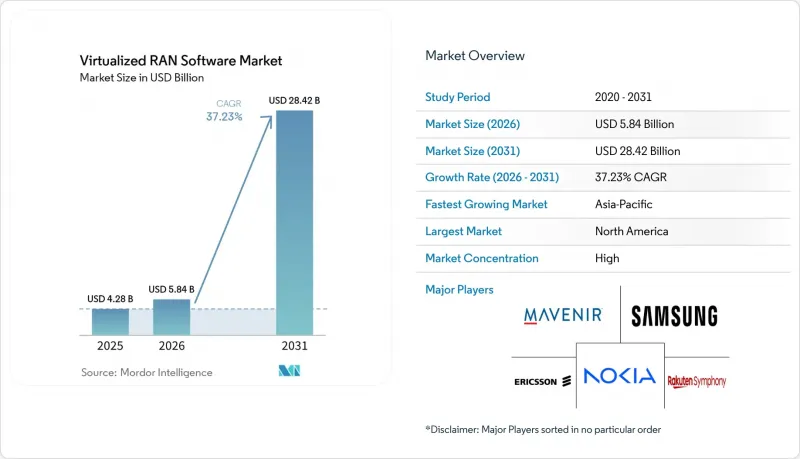
據 Mordor Intelligence 稱,虛擬化 RAN 軟體市場預計將從 2025 年的 42.8 億美元成長到 2026 年的 58.4 億美元,到 2031 年達到 284.2 億美元,2026 年至 2031 年的複合年成長率為 37.23%。
全球虛擬化無線接取網軟體市場趨勢及洞察
5G獨立組網和雲端原生無線接取網路的現代化進程正在加速。
從非獨立組網(NSA)5G 到獨立組網(SA)5G 的過渡是虛擬化無線接取網路(RAN)軟體市場短期需求的主要促進因素。截至 2026 年 3 月,全球約 1400 家營運商中,已有 95 家實現了獨立網路 5G 服務的商業化。獨立組網部署需要完整的 5G 核心網,與以 4G 核心網為基礎的網路相比,其軟體要求更為廣泛。此外,隨著支援週期縮短和基於微服務的軟體逐漸成為主流,營運商正在逐步放棄虛擬網路功能(VNF)。這增加了維護傳統網路軟體的成本,使得現代化成為一項更為緊迫的營運挑戰。 2026 年 3 月,愛立信與 Virgin Media O2 續簽了一項為期五年的夥伴關係協議,為該公司的大部分全國性 RAN 提供支援。這顯示,多年期的軟體驅動型網路計畫正逐漸被納入各大業者的規劃中。
O-RAN介面標準化和供應商柔軟性
O-RAN聯盟於2025年11月完成了第五版(Release 5)的開發,並於2026年6月正式發布。這為營運商提供了更清晰的技術基礎,以實現互通部署。此版本強制要求在整個O-RAN介面中使用TLS 1.3,並為服務管理、O-Cloud、無線單元和RAN智慧控制器新增了零信任框架。此外,它也正式規定了符合3GPP第18版(Release 18)的節能特性。這些要求為採購團隊在評估多供應商提案時提供了更清晰的標準。這種標準化減少了營運商合約中客製化介面條款的需求,尤其對於中小型業者而言。因此,隨著跨供應商指定、測試和整合相容元件變得更加容易,虛擬化RAN軟體市場也將從中受益。
多供應商整合和生命週期複雜性
多廠商解耦仍是虛擬化無線接取網路(RAN)軟體市場面臨的主要營運障礙。 F1、E1、E2 和開放式前傳(Open Fronthaul)等介面增加了整合點,而這些整合點可能會因軟體版本不相容而導致延遲。此外,集中式、分散式和無線單元的應用程式可能遵循不同的發布週期。隨著營運商增加供應商,這進一步加重了維護負擔。 Release 5 強制要求在整個 O-RAN 介面上使用 TLS 1.3 和零信任措施,這可能需要對整個協定堆疊進行協調更新。雖然系統整合商和編配平台可以減輕這種負擔,但營運商在採用解耦架構之前必須仔細考慮額外的測試、成本和交付風險。
細分市場分析
至2025年,中央單元軟體將佔據虛擬化無線接取網路(RAN)軟體市場31.83%的佔有率。這一地位反映了其在多廠商開放式RAN部署中透過無線資源控制(RRC)、分組資料融合協定(PDCP)和服務資料自適應協定(SDAP)功能支援基頻協調的作用。分散式單元軟體、無線單元和低物理層(LOW PHY)軟體負責處理影響延遲和頻譜效率的任務。在硬體領域擁有優勢的廠商繼續在這些近無線功能領域保持主導地位。隨著電信業者需要對RAN應用和現有營運支援系統進行協調的生命週期管理,營運、管理和編配軟體的重要性日益凸顯。
預計到2031年,無線接取網路(RAN)智慧控制器和自動化軟體將以38.43%的複合年成長率成長。樂天移動和樂天Symphony於2026年2月在日本完成了RIC的全國部署,並整合了來自AirHop Communications和Future Connections的第三方rApp,用於預測性維護、提升移動性和最佳化流量。此次部署表明,RIC平台已超越試點階段,開始應用於商業網路。隨著rApp生態系的發展,RIC平台將作為RAN內的AI推理層發揮作用。其他軟體類別包括AI模型服務和基於意圖的策略引擎等新興功能。雖然這些目前還不是標準報告類別,但它們已開始引起商業性的關注。
2025年,開放式vRAN佔據了虛擬化RAN軟體市場34.42%的佔有率。其市場地位得益於更成熟的O-RAN規範以及電信業者日益將合規性作為採購要求。樂天行動經營規模最大的開放式vRAN網路,並持續成為多廠商和雲端原生營運的典範。經過測試和檢驗,三星於2026年3月成為樂天移動全國5G開放式RAN無線設備供應商。三星也與KDDI合作,擴展4G和5G vRAN,從而鞏固日本在開放式RAN系統商業檢驗的地位。同時,重視與現有廠商合作關係並希望將無線功能遷移到商用伺服器的電信營運商,對專有和混合vRAN架構的需求仍然強勁。
預計到2031年,雲端原生虛擬無線接取網路(vRAN)將以38.03%的複合年成長率成長。這反映了從固定設備轉向可在Kubernetes和O-Cloud框架上運行的容器化軟體的轉變。 2026年1月,三星在美國一家一級運營商網路中,使用其搭載高達72核英特爾至強6700P-B處理器的vRAN解決方案成功進行了商業通話。此測試驗證了在高密度站點中使用單一商用伺服器處理雲端原生vRAN工作負載的可行性,透過將中央單元、分散式單元和相關AI功能整合到單一伺服器中,提高了站點的經濟效益。 Release 5中的安全需求也正在納入雲端託管無線存取網的採購規範中。
區域分析
2025年,北美將佔據虛擬化無線接取網路(vRAN)軟體市場38.26%的佔有率。該地區受益於AT&T的開放式待開發區存取網(Open RAN)專案、Dish Network的全新vRAN設計,以及主要營運商對多廠商5G獨立網路基礎設施的大規模投資。此外,美國政府對國內Open RAN發展的支持也進一步推動了市場需求。 2025年12月,Airspan輔助樂天移動(Rakuten Mobile)實現了商用Open RAN部署,該計畫部分資金來自美國國家電訊和資訊管理局(NTIA)的津貼。在加拿大,以企業為導向的私人5G應用場景正在開發中,TERAGO和愛立信將於2026年5月在麥克馬斯特製造實驗室(McMaster Manufacturing Laboratory)推出私人5G網路。
預計到2031年,亞太地區將以38.22%的複合年成長率成長。日本憑藉著樂天移動的開放式虛擬無線存取網(vRAN)以及NTT Docomo和KDDI的商用vRAN部署,在該地區處於領先地位。三星被樂天移動選為2026年全國5G開放式RAN無線設備供應商,進一步鞏固了日本作為標竿市場的地位。 2026年4月,樂天Symphony宣布與Serona合作,共同開發企業級開放式RAN私有5G網路,新增私有網路管道,以滿足區域需求。區域活動包括在印度、韓國、東南亞和其他新興市場開展試點運營和部署,日本的出口活動將支援這些國家更廣泛地採用vRAN技術。
在歐洲,沃達豐憑藉其在德國和英國的網路營運商項目,確立了重要的市場地位,其中包括沃達豐與愛立信、諾基亞和三星共同開發的多廠商項目。三星在沃達豐德國的開放式無線存取網路(Open RAN)部署中發揮了關鍵作用,在五年內覆蓋了數千個基地台。經過初步測試後,Orange集團和三星於2026年2月在歐洲擴大了其虛擬無線接取網路(vRAN)和開放式無線接取網路(Open RAN)的合作關係。在中東,Zain科威特正在進行雲端原生開放式無線存取網路(O-RAN)的早期研發工作。在非洲和南美洲,由於去程傳輸和頻寬的限制更為嚴峻,採用軟體定義系統可以比傳統無線接取網路(RAN)減少對實體硬體的需求。
其他好處:
- Excel格式的市場預測(ME)表
- 3個月的分析師支持
目錄
第1章:引言
- 研究假設和市場定義
- 調查範圍
第2章:調查方法
第3章執行摘要
第4章 市場狀況
- 市場概覽
- 宏觀經濟因素對市場的影響
- 市場促進因素
- 5G獨立組網和雲端原生無線接取網路的現代化進程正在加速。
- O-RAN介面標準化和供應商柔軟性
- RAN的能源效率和減排目標
- 私有 5G 和工業邊緣部署
- 利用GPU實現AI-RAN的商業化
- 地面電波和非地面電波網路中通訊軟體的重用
- 市場限制因素
- 多供應商整合和生命週期複雜性
- 去程傳輸傳光纖、時序和確定性延遲約束
- 商戶運算能力和效能對等風險
- RAN軟體供應鏈與網路安全風險
- 產業價值鏈分析
- 監理情勢
- 技術展望
- 波特五力分析
第5章 市場規模與成長預測
- 軟體層
- 中央處理器軟體
- 分散式單元軟體
- 無線單元與底層PHY軟體
- RAN智慧控制器與自動化軟體
- 營運、管理和編配軟體
- 其他虛擬化 RAN 軟體
- 以建築學為例
- Open vRAN
- 雲端原生虛擬無線接取網
- 專有虛擬無線存取網
- 混合虛擬無線存取網
- 按部署模式
- 雲端原生虛擬無線接取網
- 現場
- 透過網路生成
- 5G 新空口
- 4G/LTE
- 3G和舊有系統的現代化
- 最終用戶
- 行動電信商
- 企業和工業組織
- 中立主機和塔樓企業
- 政府和國防機構
- 按地區
- 北美洲
- 美國
- 加拿大
- 墨西哥
- 南美洲
- 巴西
- 阿根廷
- 其他南美國家
- 歐洲
- 德國
- 英國
- 法國
- 義大利
- 西班牙
- 俄羅斯
- 其他歐洲國家
- 亞太地區
- 中國
- 日本
- 印度
- 韓國
- 澳洲
- 其他亞太國家
- 中東
- 沙烏地阿拉伯
- 阿拉伯聯合大公國
- 土耳其
- 其他中東國家
- 非洲
- 南非
- 奈及利亞
- 肯亞
- 其他非洲國家
- 北美洲
第6章 競爭情勢
- 市場集中度
- 策略趨勢
- 市佔率分析
- 公司簡介
- Mavenir Systems, Inc.
- Parallel Wireless, Inc.
- Rakuten Symphony, Inc.
- Samsung Electronics Co., Ltd.
- Nokia Corporation
- Telefonaktiebolaget LM Ericsson
- NEC Corporation
- Fujitsu Limited
- Airspan Networks Inc.
- JMA Wireless, Inc.
- Radisys Corporation
- Celona Inc.
- Red Hat(IBM Corporation)
- NVIDIA Corporation
- Qualcomm Technologies, Inc.
- Druid Software Limited
- Software Radio Systems(SRS)Limited
- Amarisoft SAS
- Picocom Technology Limited
- Phluido, Inc.
- Wind River Systems, Inc.
第7章 市場機會與未來展望
According to Mordor Intelligence, the virtualized RAN software market size is expected to increase from USD 4.28 billion in 2025 to USD 5.84 billion in 2026 and reach USD 28.42 billion by 2031, expanding at a CAGR of 37.23% over 2026-2031.
Global Virtualized RAN Software Market Trends and Insights
Accelerating 5G Standalone and Cloud-Native RAN Modernization
The shift from non-standalone 5G to standalone 5G is a major near-term driver of demand for the virtualized RAN software market. By March 2026, 95 operators had commercially launched 5G standalone services, out of an estimated 1,400 operators worldwide. Standalone deployments require a complete 5G core and entail broader software requirements than networks that retain a 4G core anchor. Operators are also moving away from virtual network functions as support horizons narrow and microservices-based software becomes the preferred model. This raises the cost of retaining older network software and makes modernization a nearer operational decision. Ericsson extended its partnership with Virgin Media O2 in March 2026 to power most of the operator's nationwide RAN under a five-year agreement, showing that multi-year software-led network commitments are entering major operator plans.
O-RAN Interface Standardization and Supplier Flexibility
The O-RAN ALLIANCE completed Release 5 in November 2025 and announced it in June 2026, providing operators with a more clearly defined technical baseline for interoperable deployments. The release requires TLS 1.3 across O-RAN interfaces and adds a Zero Trust framework for service management, O-Cloud, radio units, and RAN intelligent controllers. It also formalizes energy-saving capabilities aligned with 3GPP Release 18. These requirements give procurement teams clearer reference points when they assess multi-vendor offers. The standards can reduce the need for customized interface terms in operator contracts, especially for smaller carriers. The virtualized RAN software market can therefore benefit as compliant components become easier to specify, test, and integrate across suppliers.
Multi-Vendor Integration and Lifecycle Complexity
Multi-vendor disaggregation remains a central operational barrier in the virtualized RAN software market. Interfaces such as F1, E1, E2, and Open Fronthaul add integration points where incompatible software versions can delay deployment. Central unit, distributed unit, and radio unit applications may also follow separate release cycles. This creates a larger maintenance burden as operators add suppliers. Release 5 requires TLS 1.3 and Zero Trust measures across O-RAN interfaces, which can require coordinated updates throughout the stack. Systems integrators and orchestration platforms can reduce this burden, but operators still need to account for added testing, cost, and delivery risk before selecting a disaggregated architecture.
Other drivers and restraints analyzed in the detailed report include:
- RAN Energy Efficiency and Emissions Reduction Targets
- Private 5G and Industrial Edge Deployment
- Fronthaul Fiber, Timing, and Deterministic-Latency Constraints
For complete list of drivers and restraints, kindly check the Table Of Contents.
Segment Analysis
Central unit software held 31.83% of the virtualized RAN software market share in 2025. Its position reflects its role in radio resource control, packet data convergence protocol, and service data adaptation protocol functions, which support baseband coordination across multi-vendor Open RAN deployments. Distributed unit software, radio unit, and low-PHY software handle processing tasks that affect latency and spectrum efficiency. Vendors with a strong hardware background retain an advantage in these near-radio functions. Operations, administration, and orchestration software is becoming more important as operators need coordinated lifecycle management across RAN applications and existing operational support systems.
RAN intelligent controller and automation software is projected to expand at a 38.43% CAGR through 2031. Rakuten Mobile and Rakuten Symphony completed a nationwide RIC deployment in Japan in February 2026, incorporating third-party rApps from AirHop Communications and Future Connections for predictive maintenance, mobility improvement, and traffic optimization. The deployment shows that RIC platforms are being used in commercial networks rather than remaining limited to trials. As rApp ecosystems develop, RIC platforms can function as an AI inference layer within the RAN. The remaining software category includes emerging functions such as AI model serving and intent-based policy engines that have not yet become standard reporting categories but are beginning to attract commercial interest.
Open vRAN accounted for 34.42% of the virtualized RAN software market size in 2025. Its position is supported by more mature O-RAN specifications and by operators that now use compliance as a procurement requirement. Rakuten Mobile operates the largest open vRAN network and remains an important example of multi-vendor, cloud-native operations. Samsung became Rakuten Mobile's nationwide 5G Open RAN radio provider in March 2026 after testing and validation. Samsung also partnered with KDDI on 4G and 5G vRAN expansion, reinforcing Japan's role in the commercial validation of open RAN systems, while proprietary and hybrid vRAN architectures retain demand among operators that prefer established vendor relationships and move radio functions to commercial servers.
Cloud-native vRAN is projected to expand at a 38.03% CAGR through 2031. This reflects a shift from fixed appliances to containerized software that can run on Kubernetes and O-Cloud frameworks. Samsung completed a commercial call with its vRAN solution on an Intel Xeon 6700P-B processor with up to 72 cores on a Tier 1 US operator network in January 2026. The test supports using a single commercial server for cloud-native vRAN workloads in dense sites, and consolidating the central unit, the distributed unit, and related AI functions on a single server can improve site economics. Security requirements in Release 5 are also being incorporated into cloud-hosted RAN procurement specifications.
Complete Report Scope:
- By Software Layer
- Central Unit Software
- Distributed Unit Software
- Radio Unit and Low-PHY Software
- RAN Intelligent Controller and Automation Software
- Operations, Administration, and Orchestration Software
- Rest of Virtualized RAN Software
- By Architecture
- Open vRAN
- Cloud-Native vRAN
- Proprietary vRAN
- Hybrid vRAN
- By Deployment Model
- Cloud-Native vRAN
- On Premise
- By Network Generation
- 5G New Radio
- 4G/LTE
- 3G and Legacy Modernization
- By End User
- Mobile Network Operators
- Enterprises and Industrial Organizations
- Neutral Hosts and Tower Companies
- Government and Defense Organizations
- By Geography
- North America
- United States
- Canada
- Mexico
- South America
- Brazil
- Argentina
- Rest of South America
- Europe
- Germany
- United Kingdom
- France
- Italy
- Spain
- Russia
- Rest of Europe
- Asia-Pacific
- China
- Japan
- India
- South Korea
- Australia
- Rest of Asia-Pacific
- Middle East
- Saudi Arabia
- United Arab Emirates
- Turkey
- Rest of Middle East
- Africa
- South Africa
- Nigeria
- Kenya
- Rest of Africa
- North America
Geography Analysis
North America accounted for 38.26% of the virtualized RAN software market share in 2025. The region benefits from AT&T's Open RAN program, Dish Network's greenfield vRAN design, and large operator investment in multi-vendor 5G standalone infrastructure, while public support for domestic Open RAN development provides additional demand support in the United States. Airspan delivered a commercial Open RAN deployment for Rakuten Mobile in December 2025, funded in part by a National Telecommunications and Information Administration grant. Canada is developing enterprise private 5G use cases, and TERAGO and Ericsson launched a private 5G network at the McMaster Manufacturing Research Institute in May 2026.
Asia-Pacific is projected to expand at a 38.22% CAGR through 2031. Japan leads the region through Rakuten Mobile's open vRAN network, as well as commercial vRAN activity at NTT Docomo and KDDI. Samsung's 2026 appointment as Rakuten Mobile's nationwide 5G Open RAN radio provider supports the country's role as a reference market. Rakuten Symphony announced a collaboration with Celona for enterprise Open RAN private 5G in April 2026, adding a private-network route to regional demand. Regional activity includes trials and deployments in India, South Korea, Southeast Asia, and other emerging markets, while Japan's export activity supports wider adoption across these countries.
Europe holds a substantial position through operator programs in Germany and the United Kingdom, including Vodafone's multi-vendor program with Ericsson, Nokia, and Samsung. Samsung's role in Vodafone's German Open RAN deployment covers thousands of sites over 5 years. Orange Group and Samsung expanded their vRAN and Open RAN partnership in Europe in February 2026 after earlier testing. The Middle East has early cloud-native O-RAN activity through Zain Kuwait. Africa and South America face greater fronthaul and spectrum constraints, although software-defined systems can reduce physical hardware requirements compared with traditional RANs.
- Mavenir Systems, Inc.
- Parallel Wireless, Inc.
- Rakuten Symphony, Inc.
- Samsung Electronics Co., Ltd.
- Nokia Corporation
- Telefonaktiebolaget LM Ericsson
- NEC Corporation
- Fujitsu Limited
- Airspan Networks Inc.
- JMA Wireless, Inc.
- Radisys Corporation
- Celona Inc.
- Red Hat (IBM Corporation)
- NVIDIA Corporation
- Qualcomm Technologies, Inc.
- Druid Software Limited
- Software Radio Systems (SRS) Limited
- Amarisoft SAS
- Picocom Technology Limited
- Phluido, Inc.
- Wind River Systems, Inc.
Additional Benefits:
- The market estimate (ME) sheet in Excel format
- 3 months of analyst support
TABLE OF CONTENTS
1 INTRODUCTION
- 1.1 Study Assumptions and Market Definition
- 1.2 Scope of the Study
2 RESEARCH METHODOLOGY
3 EXECUTIVE SUMMARY
4 MARKET LANDSCAPE
- 4.1 Market Overview
- 4.2 Impact of Macroeconomic Factors on the Market
- 4.3 Market Drivers
- 4.3.1 Accelerating 5G Standalone and Cloud-Native RAN Modernization
- 4.3.2 O-RAN Interface Standardization and Supplier Flexibility
- 4.3.3 RAN Energy-Efficiency and Emissions-Reduction Targets
- 4.3.4 Private 5G and Industrial Edge Deployment
- 4.3.5 GPU-Accelerated AI-RAN Commercialization
- 4.3.6 Telecom Software Reuse Across Terrestrial and Non-Terrestrial Networks
- 4.4 Market Restraints
- 4.4.1 Multi-Vendor Integration and Lifecycle Complexity
- 4.4.2 Fronthaul Fiber, Timing, and Deterministic-Latency Constraints
- 4.4.3 Merchant-Compute Power and Performance Parity Risk
- 4.4.4 RAN Software Supply-Chain and Cybersecurity Exposure
- 4.5 Industry Value Chain Analysis
- 4.6 Regulatory Landscape
- 4.7 Technological Outlook
- 4.8 Porter's Five Forces Analysis
- 4.8.1 Threat of New Entrants
- 4.8.2 Bargaining Power of Suppliers
- 4.8.3 Bargaining Power of Buyers
- 4.8.4 Threat of Substitutes
- 4.8.5 Intensity of Competitive Rivalry
5 MARKET SIZE AND GROWTH FORECASTS (VALUE)
- 5.1 By Software Layer
- 5.1.1 Central Unit Software
- 5.1.2 Distributed Unit Software
- 5.1.3 Radio Unit and Low-PHY Software
- 5.1.4 RAN Intelligent Controller and Automation Software
- 5.1.5 Operations, Administration, and Orchestration Software
- 5.1.6 Rest of Virtualized RAN Software
- 5.2 By Architecture
- 5.2.1 Open vRAN
- 5.2.2 Cloud-Native vRAN
- 5.2.3 Proprietary vRAN
- 5.2.4 Hybrid vRAN
- 5.3 By Deployment Model
- 5.3.1 Cloud-Native vRAN
- 5.3.2 On Premise
- 5.4 By Network Generation
- 5.4.1 5G New Radio
- 5.4.2 4G/LTE
- 5.4.3 3G and Legacy Modernization
- 5.5 By End User
- 5.5.1 Mobile Network Operators
- 5.5.2 Enterprises and Industrial Organizations
- 5.5.3 Neutral Hosts and Tower Companies
- 5.5.4 Government and Defense Organizations
- 5.6 By Geography
- 5.6.1 North America
- 5.6.1.1 United States
- 5.6.1.2 Canada
- 5.6.1.3 Mexico
- 5.6.2 South America
- 5.6.2.1 Brazil
- 5.6.2.2 Argentina
- 5.6.2.3 Rest of South America
- 5.6.3 Europe
- 5.6.3.1 Germany
- 5.6.3.2 United Kingdom
- 5.6.3.3 France
- 5.6.3.4 Italy
- 5.6.3.5 Spain
- 5.6.3.6 Russia
- 5.6.3.7 Rest of Europe
- 5.6.4 Asia-Pacific
- 5.6.4.1 China
- 5.6.4.2 Japan
- 5.6.4.3 India
- 5.6.4.4 South Korea
- 5.6.4.5 Australia
- 5.6.4.6 Rest of Asia-Pacific
- 5.6.5 Middle East
- 5.6.5.1 Saudi Arabia
- 5.6.5.2 United Arab Emirates
- 5.6.5.3 Turkey
- 5.6.5.4 Rest of Middle East
- 5.6.6 Africa
- 5.6.6.1 South Africa
- 5.6.6.2 Nigeria
- 5.6.6.3 Kenya
- 5.6.6.4 Rest of Africa
- 5.6.1 North America
6 COMPETITIVE LANDSCAPE
- 6.1 Market Concentration
- 6.2 Strategic Moves
- 6.3 Market Share Analysis
- 6.4 Company Profiles (includes Global Level Overview, Market Level Overview, Core Segments, Financials as available, Strategic Information, Market Rank/Share, Products and Services, Recent Developments)
- 6.4.1 Mavenir Systems, Inc.
- 6.4.2 Parallel Wireless, Inc.
- 6.4.3 Rakuten Symphony, Inc.
- 6.4.4 Samsung Electronics Co., Ltd.
- 6.4.5 Nokia Corporation
- 6.4.6 Telefonaktiebolaget LM Ericsson
- 6.4.7 NEC Corporation
- 6.4.8 Fujitsu Limited
- 6.4.9 Airspan Networks Inc.
- 6.4.10 JMA Wireless, Inc.
- 6.4.11 Radisys Corporation
- 6.4.12 Celona Inc.
- 6.4.13 Red Hat (IBM Corporation)
- 6.4.14 NVIDIA Corporation
- 6.4.15 Qualcomm Technologies, Inc.
- 6.4.16 Druid Software Limited
- 6.4.17 Software Radio Systems (SRS) Limited
- 6.4.18 Amarisoft SAS
- 6.4.19 Picocom Technology Limited
- 6.4.20 Phluido, Inc.
- 6.4.21 Wind River Systems, Inc.
7 MARKET OPPORTUNITIES AND FUTURE OUTLOOK
- 7.1 White-Space and Unmet-Need Assessment

 全球開放式無線接取網路市場規模、佔有率、趨勢和成長分析報告(2026-2034)
 無線接取網規劃與最佳化軟體:市佔率分析、產業趨勢與統計、成長預測(2026-2031)開放式無線接取網路系統整合商:市場佔有率分析、產業趨勢與統計資料、成長預測(2026-2031 年)
 人工智慧驅動的交通最佳化市場預測至2034年:全球解決方案類型、技術、交通管理組件、部署模式、應用、最終用戶和區域分析
 2026-2030年全球露天牧場市場
 5G、6G 和Open RAN研究服務
 交通流量管理系統市場規模、佔有率和成長分析:按系統類型、組件、應用、最終用戶、部署模式和地區分類-2026-2033年產業預測
 開放式無線接取網路市場:全球市場預測,2026-2032年通訊業者6G無線接取網路需求:調查結果與分析開放式無線接取網路市場預測至2034年:按組件、網路類型、頻段、單元類型、部署方式、最終用戶和地區分類的全球分析