


 |
市場調查報告書
商品編碼
2154724
無線接取網規劃與最佳化軟體:市佔率分析、產業趨勢與統計、成長預測(2026-2031)RAN Planning and Optimization Software - Market Share Analysis, Industry Trends & Statistics, Growth Forecasts (2026 - 2031) |
||||||

※ 本網頁內容可能與最新版本有所差異。詳細情況請與我們聯繫。
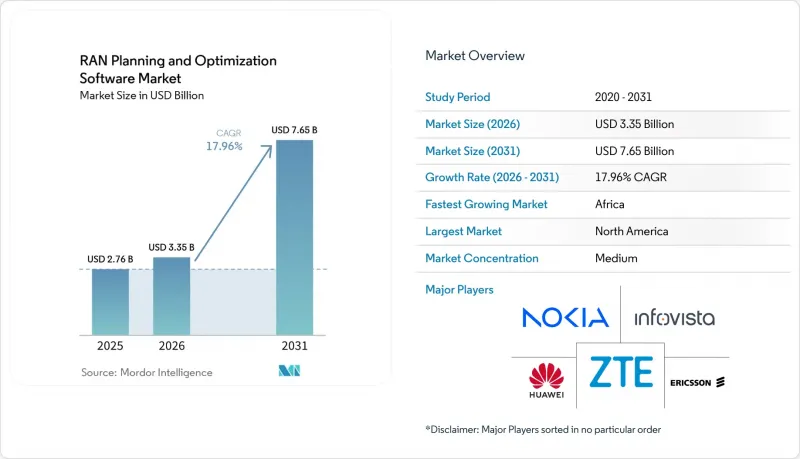
據 Mordor Intelligence 稱,2025 年 RAN 規劃和最佳化軟體市場價值為 27.6 億美元,預計到 2031 年將從 2026 年的 33.5 億美元成長至 76.5 億美元,預測期(2026-2031 年)的複合年成長率為 17.96%。
全球無線接取網規劃與最佳化軟體市場趨勢及洞察
5G網路密度不斷增加以及多技術系統的複雜度。
5G網路正從覆蓋廣域的大型基地台台轉向更密集的小型基地台網路。此外,營運商仍需同時管理2G、3G、4G和5G網路層。每個站點的運作都可能改變小區邊緣干擾模式,從而需要進一步的技術工作。當團隊需要持續的重新最佳化而非週期性的網路審查時,無線存取網(RAN)規劃和最佳化軟體市場將從中受益。 Forsk的「Naos」透過基於服務的架構,支援自動化的5G站點選擇和全國的傳輸損耗計算。隨著無線配置日益複雜,這些功能在營運商的提案文件中變得越來越重要。
基於雲端原生和人工智慧的自主無線存取網路運營
雲端原生架構正在推動規劃工具從桌面授權模式轉變為訂閱服務和應用程式介面 (API) 模式。這項轉變使得軟體供應商無需等待硬體更新即可更新規劃邏輯。愛立信於 2026 年推出了針對其「無線存取網人工智慧 (AI in RAN)」軟體的訂閱服務,該軟體具備調度、波束成形、定位和可觀測性等功能。該公司表示,該軟體包旨在將人工智慧功能更緊密地整合到無線接入網營運中。隨著最佳化工作從大量分析轉向週期性網路管理,無線存取網規劃和最佳化軟體市場將持續獲得商機。此外,該模式還將規劃決策與營運能力和服務品質更緊密地連結起來。
電信業者整合與軟體採購集中化
電信業者的合併將減少獨立採購軟體的機構數量。合併後的業者可能會要求簽訂多年期合約、享有批量折扣,以及將規劃和最佳化功能整合到合約中的方案。這些要求可能會降低無線接取網路(RAN)規劃和最佳化軟體市場供應商的單位收入。此外,在合併後的工程團隊協調技術架構期間,網路工具的選擇可能會被推遲。此類評估可能會使提案(RFP)週期延長12至24個月。已與兩家營運商的營運支援系統(OSS)實現整合的供應商,在網路合理化計畫獲得批准後將處於更有利的地位。
細分市場分析
到2025年,軟體將佔市場規模的67.98%,預計到2031年將以18.71%的複合年成長率成長。這個細分市場反映了電信業者對最新規劃邏輯和人工智慧功能的需求,他們無需等待硬體更新周期即可獲得這些功能。訂閱模式使供應商能夠透過定期商業合約交付新功能。 Nokia於2026年推出了一款採用軟體訂閱模式交付功能的AI原生無線接取網路(RAN)平台。這種方法支援規劃、無線營運和最佳化能力的持續改進,並減少了對固定版本工具發布的依賴,因為這些工具往往落後於網路變化。在混合無線環境下,對廠商中立功能的需求是推動RAN規劃和最佳化軟體產業軟體細分市場成長的主要動力。
服務包括部署、系統整合和託管營運支援。這些服務可以幫助營運商在內部無線工程資源有限的情況下配置工具。隨著營運商增加頻段、技術迭代和開放式無線存取網(Open RAN)元件,整合工作的重要性日益凸顯。非洲和南美洲的營運商可能需要外部支持,才能將新工具與其現有的營運支援系統整合。因此,即使軟體仍然是主要組成部分,服務收入也可以在授權收入之外實現成長。將軟體與長期託管服務結合的供應商可以建立更持久的客戶關係。這種模式不同於具有可選支援的永久許可模式。在將軟體功能轉化為日常營運實務方面,無線接取網路(RAN)規劃和最佳化軟體市場仍依賴服務方面的專業知識。
到2025年,本地部署將佔市場佔有率的42.15%。當電信業者優先考慮資料主權、與營運支援系統的緊密整合以及本地管理時,本地部署仍然是一個重要的選擇。預計到2031年,基於雲端的部署將以19.52%的年成長率成長,成為成長最快的部署方式。大規模MIMO建模、3D射線追蹤、AI訓練和全國範圍的路徑損耗計算都需要靈活的運算能力。 Infovista的VistaPlan Go旨在利用已調整的傳播模型和流量分佈提供最佳化的網路設計。隨著此類運算資源的可用性,無線存取網(RAN)規劃和最佳化軟體市場將受益於更短的設計週期。雲端交付也減少了現場軟體部署和手動準備地理資料的需求。
對於無法一次遷移所有資料和流程的電信業者而言,混合部署提供了一種過渡方案。它允許將計算密集型模擬遷移到雲端資源,同時將敏感的地理資訊保留在本地。這種架構也適用於對資料儲存有特殊要求的私有 5G 和政府部署。混合模式支援分階段遷移,從而降低變更管理風險。它還允許運營商在評估雲端性能的同時,保持熟悉的工作流程的連續性。無線存取網 (RAN) 規劃和最佳化軟體產業可以利用混合配置在過渡期間維護現有客戶關係。雖然本地部署的佔有率可能會下降,但其絕對值仍可能相當可觀。整體部署格局正在從即時替換本地工具轉向基於雲端運算的運算。
區域分析
根據所提供的估算,北美在2025年佔據了31.61%的市場。該地區的地位反映了其成熟的5G基礎設施以及對頻段的持續投資。 2026年7月,AT&T以230億美元完成了EchoStar頻率牌照的收購。此次收購為美國幾乎所有市場新增了50MHz的頻寬和中頻寬頻率。新頻段的部署需要對眾多基地台的覆蓋範圍、干擾和參數進行規劃。截至2026年3月,已有12家北美業者至少推出了一個商用5G獨立網路(SA)網路。加拿大也在持續推進其規劃,並於2025年獲得了3800MHz的頻率牌照。預計墨西哥將迎來與競爭和數位包容計畫相關的相對小規模的現代化機會。在南美洲,隨著巴西和智利的營運商對其LTE基礎設施進行改造以適應5G轉型,市場正在崛起。
歐洲擁有成熟的行動網路營運商基礎,並在開放式無線存取網路(Open RAN)方面積極制定政策。頻段協調和連接目標支援著網路的持續升級。愛立信於2026年3月與Virgin Media O2續簽了五年夥伴關係。該協議涵蓋了運營商全國無線網路的大部分,並包含人工智慧和機器學習軟體。德國、法國和英國是該地區的主要需求中心。亞太地區擁有大規模網路,並已率先投入人工智慧原生和開放式無線存取網(Open RAN)專案。中國需要能夠處理超大規模網路配置的工具。由於先進技術的應用和5G的持續擴展,日本、韓國和印度的需求也在不斷成長。
預計到2031年,非洲的複合年成長率將達到19.87%,在所有預測區域中成長最高。 GSMA預測,2026年底,非洲的5G連線數將不到1億,到2030年將超過3.8億。隨著營運商增加5G基地台和頻段,這種擴張將需要更強大的規劃能力。在傳統技術仍在運作的地區,隨著5G的部署,無線接取網(RAN)規劃和最佳化軟體市場仍有成長空間。 2026年7月,加納撤銷了一家電信業者的獨家批發5G牌照,使規劃環境更具競爭性。中東市場雖然規模較小,但價值巨大,其中沙烏地阿拉伯和阿拉伯聯合大公國(阿拉伯聯合大公國)佔據主導地位。智慧城市規劃和都市區的高密度部署需要詳細的覆蓋建模,以適應複雜的建築環境。
其他好處:
- Excel格式的市場預測(ME)表
- 3個月的分析師支持
目錄
第1章:引言
- 研究假設和市場定義
- 調查範圍
第2章:調查方法
第3章執行摘要
第4章 市場狀況
- 市場概覽
- 宏觀經濟因素對市場的影響
- 市場促進因素
- 5G網路密度不斷增加以及多技術發展的複雜性
- 頻寬不足以及對更高頻率利用效率的需求
- 基於雲端原生和人工智慧的自主無線存取網路運營
- 開放式無線存取網和多廠商互通性需求
- 封閉回路型最佳化提高能源效率和容量效率
- 基於代理的AI在無線工程工作流程管理的應用
- 市場限制因素
- 電信業者整合與軟體採購集中化
- 受限於傳統開源軟體和專有工具
- 自主最佳化中的可解釋性和變更管理風險
- 校準地理資料和射頻工程人員短缺
- 產業價值鏈分析
- 監理情勢
- 技術展望
- 已做好迎接 5G NR、5G Advanced 和 6G 的準備
- 開放式無線接取網路 (Open RAN)、虛擬無線接取網路 (vRAN)、C-RAN 和無線接取網路智慧控制器
- 人工智慧/機器學習、數位孿生和預測最佳化
- 雲端原生 API、容器和 RAN 即服務規劃
- NTN、私人5G、CBRS和共用頻譜計劃
- 波特五力分析
第5章 市場規模與成長預測
- 按組件
- 軟體
- 服務
- 部署模式
- 現場
- 基於雲端的
- 混合
- 透過使用
- 無線接取網規劃與設計
- 無線存取網最佳化
- 績效管理
- 能力規劃
- 覆蓋範圍和傳播分析
- 干擾管理
- 其他用途
- 最終用戶
- 行動電信商
- 中立主機和私人網路營運商
- 公司
- 政府和公共安全機構
- 網路設備供應商和系統整合商
- 按地區
- 北美洲
- 美國
- 加拿大
- 墨西哥
- 南美洲
- 巴西
- 阿根廷
- 智利
- 其他南美國家
- 歐洲
- 德國
- 英國
- 法國
- 義大利
- 西班牙
- 俄羅斯
- 其他歐洲國家
- 亞太地區
- 中國
- 日本
- 印度
- 韓國
- 澳洲
- 其他亞太國家
- 中東
- 沙烏地阿拉伯
- 阿拉伯聯合大公國
- 土耳其
- 以色列
- 其他中東國家
- 非洲
- 南非
- 奈及利亞
- 埃及
- 其他非洲國家
- 北美洲
第6章 競爭情勢
- 市場集中度
- 策略趨勢
- 市佔率分析
- 公司簡介
- Telefonaktiebolaget LM Ericsson
- Nokia Corporation
- Huawei Technologies Co., Ltd.
- ZTE Corporation
- Infovista SAS
- TEOCO Corporation
- Forsk SAS
- Keysight Technologies, Inc.
- VIAVI Solutions Inc.
- Amdocs Limited
- Comarch SA
- Anritsu Corporation
- Ranplan Wireless Network Design Ltd.
- iBwave Solutions Inc.
- Rohde & Schwarz GmbH & Co. KG
- Samsung Electronics Co., Ltd.
- Mavenir Systems, Inc.
- RADCOM Ltd.
- Siradel SAS
- ATDI SAS
- Accuver Co., Ltd.
- Ascom Holding AG
- CommScope, Inc.
第7章 市場機會與未來展望
According to Mordor Intelligence, the RAN planning and optimization software market size was valued at USD 2.76 billion in 2025 and is estimated to grow from USD 3.35 billion in 2026 to reach USD 7.65 billion by 2031, at a CAGR of 17.96% during the forecast period (2026-2031).
Global RAN Planning and Optimization Software Market Trends and Insights
5G Network Densification and Multi-Technology Complexity
5G networks are moving from broad macro coverage toward denser small-cell grids. Operators also continue to manage 2G, 3G, 4G, and 5G layers at the same time. Each site activation can alter cell-edge interference patterns and require further engineering work. The RAN Planning and Optimization Software market benefits when teams need continuous re-optimization instead of periodic network reviews. Forsk's Naos supports automated 5G site selection and country-scale path-loss calculations through service-based architecture. These capabilities are becoming important in operator requests for proposals as radio configurations become more complex.
Cloud-Native and AI-Enabled Autonomous RAN Operations
Cloud-native architecture is shifting planning tools from desktop licenses toward subscription services and application programming interfaces. This change allows software providers to update planning logic without waiting for a hardware refresh. Ericsson launched its AI in RAN software subscription in 2026 with scheduler, beamforming, positioning, and observability functions. The company stated that the package is designed to place AI functions closer to radio operations. The RAN Planning and Optimization Software market gains recurring revenue opportunities when optimization moves from batch analysis into regular network management. This model also links planning decisions more closely to operational capacity and service quality.
Operator Consolidation and Concentrated Software Buying
Operator consolidation reduces the number of organizations making independent software purchases. Merged operators can seek multi-year agreements, volume discounts, and bundled planning and optimization contracts. These requirements can reduce unit revenue for suppliers in the RAN Planning and Optimization Software market. Network tool selections may also be delayed while merged engineering teams align their technical architecture. Such evaluations can extend request-for-proposal cycles by 12 to 24 months. Suppliers with integrations across both operators' operating support systems can be better positioned when network rationalization plans are approved.
Other drivers and restraints analyzed in the detailed report include:
- Open RAN and Multi-Vendor Interoperability Requirements
- Spectrum Scarcity and Demand for Higher Spectral Efficiency
- Legacy OSS and Proprietary Tool Lock-In
For complete list of drivers and restraints, kindly check the Table Of Contents.
Segment Analysis
Software accounted for 67.98% of 2025 value and is forecast to grow at an 18.71% CAGR through 2031. The segment reflects operator demand for updated planning logic and AI functions without hardware replacement cycles. Subscription models enable suppliers to deliver new features through recurring commercial arrangements. Nokia introduced an AI-native RAN platform in 2026 that uses a software subscription model for feature delivery. This approach supports ongoing improvements to planning, radio operations, and optimization functions. It also reduces dependence on fixed-vintage tool releases that can lag network changes. The software segment of the RAN Planning and Optimization Software industry is strengthened by the need for vendor-neutral functions in mixed radio estates.
Services cover implementation, system integration, and managed operating support. They help operators configure tools when internal radio engineering resources are limited. Integration work becomes more relevant as operators add spectrum bands, technology generations, and Open RAN components. Operators in Africa and South America may need external support to integrate newer tools with existing operational support systems. Services revenue can therefore grow beside license revenue even when software remains the leading component. Providers that combine software with long-term managed services can develop more durable customer relationships. This model differs from perpetual licenses with optional support. The RAN Planning and Optimization Software market remains dependent on service expertise when software capability must be translated into routine operating practices.
On-premises deployment accounted for 42.15% of 2025 value. It remains relevant where operators prioritize data sovereignty, close operating support system integration, and local control. Cloud-based deployment is forecast to grow at 19.52% through 2031, the fastest pace among deployment modes. Massive MIMO modeling, 3D ray tracing, AI training, and country-scale path-loss calculations need flexible computing capacity. Infovista's VistaPlan Go is designed to provide optimized network designs using pre-calibrated propagation models and traffic distributions. The RAN Planning and Optimization Software market can gain from faster design cycles when such computing resources are available. Cloud delivery also reduces the need for local software deployment and manual geodata preparation.
Hybrid deployment is a transition option for operators that cannot move all data and processes at once. Sensitive geographic information may remain on premises while computationally intensive simulations move to cloud resources. Private 5G and government deployments can continue to use this structure where data residency requirements apply. A hybrid model allows a gradual migration and reduces change-management risk. It can also maintain continuity with familiar workflows while operators evaluate cloud performance. The RAN Planning and Optimization Software industry can use hybrid arrangements to preserve current customer relationships during migration. On-premises installations can remain substantial in absolute terms even as their share declines. The overall deployment mix is moving toward cloud-based computing rather than an immediate replacement of local tools.
Complete Report Scope:
- By Component
- Software
- Services
- By Deployment Mode
- On-Premises
- Cloud-Based
- Hybrid
- By Application
- RAN Planning and Design
- RAN Optimization
- Performance Management
- Capacity Planning
- Coverage and Propagation Analysis
- Interference Management
- Other Applications
- By End User
- Mobile Network Operators
- Neutral Host and Private Network Operators
- Enterprises
- Government and Public Safety Organizations
- Network Equipment Vendors and System Integrators
- By Geography
- North America
- United States
- Canada
- Mexico
- South America
- Brazil
- Argentina
- Chile
- Rest of South America
- Europe
- Germany
- United Kingdom
- France
- Italy
- Spain
- Russia
- Rest of Europe
- Asia-Pacific
- China
- Japan
- India
- South Korea
- Australia
- Rest of Asia-Pacific
- Middle East
- Saudi Arabia
- United Arab Emirates
- Turkiye
- Israel
- Rest of Middle East
- Africa
- South Africa
- Nigeria
- Egypt
- Rest of Africa
- North America
Geography Analysis
North America held 31.61% of 2025 value in the supplied estimates. The region's position reflects a mature 5G base and continued investment in spectrum. AT&T completed its acquisition of EchoStar's spectrum license in July 2026 for USD 23 billion. The acquisition added 50 MHz of low-band and mid-band spectrum across nearly all U.S. markets. New spectrum layers require coverage, interference, and parameter planning across many sites. Twelve North American operators had launched at least 1 commercial 5G standalone network by March 2026. Canada also continued a planning cycle following the 3800 MHz spectrum licenses acquired in 2025. Mexico contributes smaller modernization opportunities linked to competition and digital inclusion programs. South America is emerging as operators in Brazil and Chile adapt LTE estates for 5G migration.
Europe has a mature mobile network operator base and an active Open RAN policy setting. Spectrum harmonization and connectivity targets support continuing network upgrades. Ericsson extended its partnership with Virgin Media O2 in March 2026 for 5 years. The agreement covers most of the operator's nationwide radio network and includes AI and machine learning software. Germany, France, and the United Kingdom are major regional demand centers. Asia-Pacific combines high network scale with early work on AI-native and Open RAN planning. China requires tools that can address very large network configurations. Japan, South Korea, and India add demand through advanced technology adoption and continuing 5G expansion.
Africa is forecast to grow at a 19.87% CAGR through 2031, the fastest geographic rate in the supplied estimates. GSMA projected fewer than 100 million 5G connections in Africa by the end of 2026 and more than 380 million by 2030. This expansion requires planning capabilities as operators add 5G sites and spectrum layers. The RAN Planning and Optimization Software market has room to grow where legacy technologies remain in service during 5G rollout. Ghana removed exclusive 5G wholesale rights from one operator in July 2026, supporting a more competitive planning environment. The Middle East is smaller but high value, led by Saudi Arabia and the United Arab Emirates. Smart-city programs and dense urban deployments require detailed coverage modeling for complex built environments.
- Telefonaktiebolaget LM Ericsson
- Nokia Corporation
- Huawei Technologies Co., Ltd.
- ZTE Corporation
- Infovista SAS
- TEOCO Corporation
- Forsk SAS
- Keysight Technologies, Inc.
- VIAVI Solutions Inc.
- Amdocs Limited
- Comarch S.A.
- Anritsu Corporation
- Ranplan Wireless Network Design Ltd.
- iBwave Solutions Inc.
- Rohde & Schwarz GmbH & Co. KG
- Samsung Electronics Co., Ltd.
- Mavenir Systems, Inc.
- RADCOM Ltd.
- Siradel SAS
- ATDI S.A.S.
- Accuver Co., Ltd.
- Ascom Holding AG
- CommScope, Inc.
Additional Benefits:
- The market estimate (ME) sheet in Excel format
- 3 months of analyst support
TABLE OF CONTENTS
1 INTRODUCTION
- 1.1 Study Assumptions and Market Definition
- 1.2 Scope of the Study
2 RESEARCH METHODOLOGY
3 EXECUTIVE SUMMARY
4 MARKET LANDSCAPE
- 4.1 Market Overview
- 4.2 Impact of Macroeconomic Factors on the Market
- 4.3 Market Drivers
- 4.3.1 5G Network Densification and Multi-Technology Complexity
- 4.3.2 Spectrum Scarcity and Demand for Higher Spectral Efficiency
- 4.3.3 Cloud-Native and AI-Enabled Autonomous RAN Operations
- 4.3.4 Open RAN and Multi-Vendor Interoperability Requirements
- 4.3.5 Closed-Loop Optimization for Energy and Capacity Efficiency
- 4.3.6 Agentic AI for Governed Radio Engineering Workflows
- 4.4 Market Restraints
- 4.4.1 Operator Consolidation and Concentrated Software Buying
- 4.4.2 Legacy OSS and Proprietary Tool Lock-In
- 4.4.3 Explainability and Change-Control Risks in Autonomous Optimization
- 4.4.4 Scarcity of Calibrated Geodata and RF Engineering Talent
- 4.5 Industry Value Chain Analysis
- 4.6 Regulatory Landscape
- 4.7 Technological Outlook
- 4.7.1 5G NR, 5G Advanced, and 6G Readiness
- 4.7.2 Open RAN, vRAN, C-RAN, and RAN Intelligent Controllers
- 4.7.3 AI/ML, Digital Twins, and Predictive Optimization
- 4.7.4 Cloud-Native APIs, Containers, and RAN Planning as a Service
- 4.7.5 NTN, Private 5G, CBRS, and Shared-Spectrum Planning
- 4.8 Porter's Five Forces Analysis
- 4.8.1 Bargaining Power of Suppliers
- 4.8.2 Bargaining Power of Buyers
- 4.8.3 Threat of New Entrants
- 4.8.4 Threat of Substitutes
- 4.8.5 Competitive Rivalry
5 MARKET SIZE AND GROWTH FORECASTS (VALUE)
- 5.1 By Component
- 5.1.1 Software
- 5.1.2 Services
- 5.2 By Deployment Mode
- 5.2.1 On-Premises
- 5.2.2 Cloud-Based
- 5.2.3 Hybrid
- 5.3 By Application
- 5.3.1 RAN Planning and Design
- 5.3.2 RAN Optimization
- 5.3.3 Performance Management
- 5.3.4 Capacity Planning
- 5.3.5 Coverage and Propagation Analysis
- 5.3.6 Interference Management
- 5.3.7 Other Applications
- 5.4 By End User
- 5.4.1 Mobile Network Operators
- 5.4.2 Neutral Host and Private Network Operators
- 5.4.3 Enterprises
- 5.4.4 Government and Public Safety Organizations
- 5.4.5 Network Equipment Vendors and System Integrators
- 5.5 By Geography
- 5.5.1 North America
- 5.5.1.1 United States
- 5.5.1.2 Canada
- 5.5.1.3 Mexico
- 5.5.2 South America
- 5.5.2.1 Brazil
- 5.5.2.2 Argentina
- 5.5.2.3 Chile
- 5.5.2.4 Rest of South America
- 5.5.3 Europe
- 5.5.3.1 Germany
- 5.5.3.2 United Kingdom
- 5.5.3.3 France
- 5.5.3.4 Italy
- 5.5.3.5 Spain
- 5.5.3.6 Russia
- 5.5.3.7 Rest of Europe
- 5.5.4 Asia-Pacific
- 5.5.4.1 China
- 5.5.4.2 Japan
- 5.5.4.3 India
- 5.5.4.4 South Korea
- 5.5.4.5 Australia
- 5.5.4.6 Rest of Asia-Pacific
- 5.5.5 Middle East
- 5.5.5.1 Saudi Arabia
- 5.5.5.2 United Arab Emirates
- 5.5.5.3 Turkiye
- 5.5.5.4 Israel
- 5.5.5.5 Rest of Middle East
- 5.5.6 Africa
- 5.5.6.1 South Africa
- 5.5.6.2 Nigeria
- 5.5.6.3 Egypt
- 5.5.6.4 Rest of Africa
- 5.5.1 North America
6 COMPETITIVE LANDSCAPE
- 6.1 Market Concentration
- 6.2 Strategic Moves
- 6.3 Market Share Analysis
- 6.4 Company Profiles (includes Global Level Overview, Market Level Overview, Core Segments, Financials as available, Strategic Information, Market Rank/Share, Products and Services, Recent Developments)
- 6.4.1 Telefonaktiebolaget LM Ericsson
- 6.4.2 Nokia Corporation
- 6.4.3 Huawei Technologies Co., Ltd.
- 6.4.4 ZTE Corporation
- 6.4.5 Infovista SAS
- 6.4.6 TEOCO Corporation
- 6.4.7 Forsk SAS
- 6.4.8 Keysight Technologies, Inc.
- 6.4.9 VIAVI Solutions Inc.
- 6.4.10 Amdocs Limited
- 6.4.11 Comarch S.A.
- 6.4.12 Anritsu Corporation
- 6.4.13 Ranplan Wireless Network Design Ltd.
- 6.4.14 iBwave Solutions Inc.
- 6.4.15 Rohde & Schwarz GmbH & Co. KG
- 6.4.16 Samsung Electronics Co., Ltd.
- 6.4.17 Mavenir Systems, Inc.
- 6.4.18 RADCOM Ltd.
- 6.4.19 Siradel SAS
- 6.4.20 ATDI S.A.S.
- 6.4.21 Accuver Co., Ltd.
- 6.4.22 Ascom Holding AG
- 6.4.23 CommScope, Inc.
7 MARKET OPPORTUNITIES AND FUTURE OUTLOOK
- 7.1 White-Space and Unmet-Need Assessment

 全球開放式無線接取網路市場規模、佔有率、趨勢和成長分析報告(2026-2034)
 開放式無線接取網路系統整合商:市場佔有率分析、產業趨勢與統計資料、成長預測(2026-2031 年)
 人工智慧驅動的交通最佳化市場預測至2034年:全球解決方案類型、技術、交通管理組件、部署模式、應用、最終用戶和區域分析虛擬化無線接取網路軟體:市場佔有率分析、產業趨勢與統計及成長預測(2026-2031 年)
 2026-2030年全球露天牧場市場
 5G、6G 和Open RAN研究服務
 交通流量管理系統市場規模、佔有率和成長分析:按系統類型、組件、應用、最終用戶、部署模式和地區分類-2026-2033年產業預測
 開放式無線接取網路市場:全球市場預測,2026-2032年通訊業者6G無線接取網路需求:調查結果與分析開放式無線接取網路市場預測至2034年:按組件、網路類型、頻段、單元類型、部署方式、最終用戶和地區分類的全球分析