


 |
市場調查報告書
商品編碼
2155665
DevSecOps編配:市場佔有率分析、行業趨勢和統計數據、成長預測(2026-2031 年)DevSecOps Orchestration - Market Share Analysis, Industry Trends & Statistics, Growth Forecasts (2026 - 2031) |
||||||

※ 本網頁內容可能與最新版本有所差異。詳細情況請與我們聯繫。
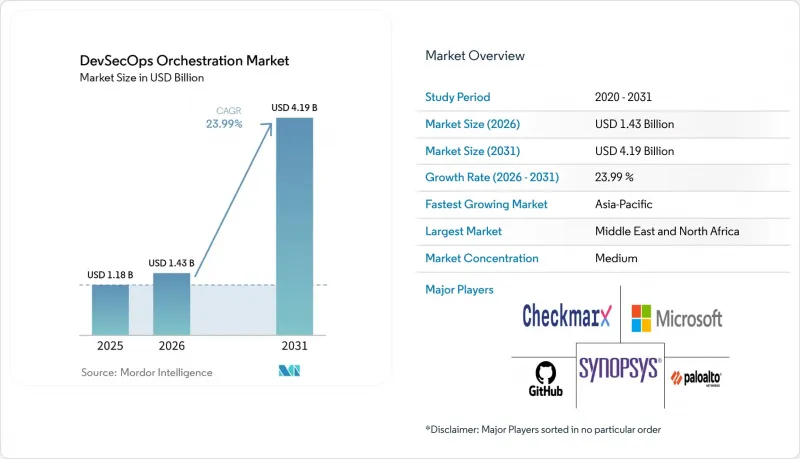
據 Mordor Intelligence 稱,DevSecOps編配市場在 2025 年的價值為 11.8 億美元,預計到 2031 年將達到 41.9 億美元,而 2026 年為 14.3 億美元,預測期(2026-2031 年)的複合年成長率為 23.39%。
全球DevSecOps編配市場趨勢與洞察
確保軟體供應鏈持續安全的監管要求
法律規範正從自願性指南轉向強制性軟體安全義務。 DevSecOps編配市場受益於買方對交付流程中可重現控制措施的需求。 2026 年 1 月 23 日發布的 OMB 備忘錄 M-26-05 以基於風險的軟體保障模式取代了標準化的自我認證方法。該備忘錄指示各機構在適當情況下要求提交軟體工程物料清單 (SBOM),並減少聯邦供應鏈中檢驗軟體的範圍。 2026 年 7 月,CISA 及其國際合作夥伴發布了關於 SBOM「最低組件」的更新指南,其中包括人工智慧軟體和 SaaS 元件。此外,《網路彈性法案》規定了軟體製造商不得推遲的漏洞回應和報告要求。
人工智慧產生的程式碼和自動安全修復
人工智慧驅動的開發使得安全團隊需要評估的程式碼量不斷增加。這一趨勢正在推動DevSecOps編配市場的擴張,因為手動修復工作量無法跟上快速部署的步伐。 Stack Overflow報告稱,到2025年,84%的開發人員將在開發中使用或計劃使用人工智慧工具。微軟透過其MDASH系統展示了一個自動化修復的實用模型,該系統透過協調100多個專用人工智慧代理提煉其模型。據微軟稱,該系統修復了兩個經過嚴格審核的Windows組件中96%和100%的已識別漏洞。能夠透過編配的工作流程產生、檢驗和提交程式碼修復的供應商可以減少發布後的修復工作量。
缺乏DevSecOps技能與職責分類不明確
缺乏了解安全架構和軟體交付的專家仍然是一個真正的障礙。如果團隊無法建立和維護管線控制,DevSecOps編配的採用可能會很緩慢。安全性測試、漏洞掃描和策略執行需要持續的工具鏈管理和設定技能。責任可能分散在開發人員、平台工程師和應用程式安全團隊之間。雖然先導計畫可能進展順利,但如果沒有團隊被授權設定品質門控策略,全面部署可能會停滯不前。託管服務和 SaaS 產品可以透過將專業任務外包給服務提供者來減輕這種負擔。
細分市場分析
到2025年,軟體和平台將佔據DevSecOps編配市場73.51%的佔有率。這一結果反映了企業傾向於使用整合平台而非單一掃描工具的趨勢。這些平台能夠強制執行從預提交活動到工件簽名的各項策略,並允許團隊在整個交付過程中集中查看發現的問題。此外,它們還支援在發布決策之前對來自各種安全工具的輸入進行標準化。整合套件減少了為每個獨立產品客製化介面和策略的需求。預計到2031年,DevSecOps編配市場的服務部分將以26.37%的複合年成長率成長。服務需求包括部署諮詢、託管偵測與回應 (MDR) 以及持續的策略調整。在內部DevSecOps專業知識仍然有限的地區,這種需求最為強烈。
服務的成長也表明,購買軟體並不能消除對維運支援的需求。團隊可能仍然難以設定既能滿足安全要求又能保證發布速度的品質關卡。諮詢和託管服務供應商可以提供策略範本和實施指導。基於訂閱的託管式 DevSecOps 服務對中小型企業和組織尤其有用。 GitLab 的 2025 年 DevSecOps 報告指出,開發人員平均每月花費 11 小時修復發布後的漏洞。如果缺乏明確的協調或問責機制,隨著控制功能的增加,這項工作量可能會進一步增加。如果在管線中正確配置,左移控制可以解決這個問題。隨著安全策略的變化,合規即代碼的要求可能會產生持續的合約。因此,DevSecOps編配產業不僅需要平台,還需要持續的服務。
到 2025 年,基於雲端的部署將佔據 DevSecOps編配市場 61.39% 的佔有率。付費使用制的定價模式以及與 GitHub、GitLab SaaS 和 AWS CodePipeline 的整合推動了雲端部署的普及。雲端交付還降低了掃描代理基礎設施的維護負擔,使其成為需要快速存取新功能和整合的團隊的實用選擇。本地部署對於國防、金融服務和政府機構的使用者仍然至關重要。這些使用者可能需要在受管環境中保留遙測資料。預計到 2031 年,混合部署的複合年成長率將達到 26.84%。這種模式將集中式編配與掃描結果和驗證的本地控制相結合,既保證了策略的一致性,也滿足了本地營運需求。
DORA強化了歐洲金融服務業的這項架構。這項於2025年1月生效的法規要求相關營業單位基於已記錄的安排來管理ICT風險。 SaaS提供者也被強制要求向客戶證明其安全的開發實務。這項要求提高了那些沒有可審計流程的純雲端提供者的進入門檻。當工作負載同時使用雲端運行器和本地代理時,建立混合平台會更具挑戰性。關於金鑰管理、運行器配置和SBOM存儲,不同地區可能適用不同的規則。這些差異進一步凸顯了在受監管的部署環境中實施支援的重要性。因此,DevSecOps編配市場迫切需要靈活的部署設計。
區域分析
到2025年,北美將佔據DevSecOps編配市場38.26%的佔有率。技術供應商、超大規模雲端生態系統以及聯邦政府的要求將支撐這一地位。美國採購法規日益要求供應商提供軟體工程物料清單(SBOM)、簽署的文件以及安全的開發流程。美國行政管理和預算辦公室(OMB)於2026年1月發布的M-26-05備忘錄確立了基於風險的軟體保障方法。擁有多重雲端應用組合的大型組織仍然需要跨環境的標準化控制措施。
歐洲是DevSecOps編配市場第二大區域市場。其市場採用模式較受法規驅動,而非聯邦採購。 NIS2擴大了關鍵實體和重要營業單位的網路安全風險管理要求。 DORA於2025年1月生效,並為ICT第三方供應商建立了監管架構。在歐洲,德國、英國和法國佔了最大的國家市場。
預計到2031年,亞太地區的複合年成長率將達到26.43%。印度的CERT-In指南和印度儲備銀行(RBI)的SBOM採購要求推動了監管審查的加強。中國、日本、韓國和澳洲也正在加強對雲端原生和數位銀行環境的安全要求。儘管中東和非洲的DevSecOps編配市場仍處於起步階段,但智慧城市計畫、主權雲端策略和公共部門數位化正在催生初步需求。目前,DevSecOps的應用主要集中在銀行、金融和保險(BFSI)以及政府部門,因為這些部門對國家級網路安全要求極為重視。
其他好處:
- Excel格式的市場預測(ME)表
- 3個月的分析師支持
目錄
第1章:引言
- 研究假設和市場定義
- 調查範圍
第2章:調查方法
第3章執行摘要
第4章 市場狀況
- 市場概覽
- 市場促進因素
- 關於軟體供應鏈持續安全的監管義務
- 雲端原生和微服務的擴展
- 加快軟體發布週期
- 人工智慧產生的程式碼和自動安全修復
- 暫時建構環境中的風險可見性
- 機器可讀的合規性證明和 SBOM 可追溯性
- 市場限制因素
- 缺乏DevSecOps技能與職責分類不明確
- 工具鏈碎片化與整合複雜性
- 高速管道中安全閘門的延遲
- 資料居住要求和跨境遙測限制
- 宏觀經濟因素的影響
- 價值鏈分析
- 監理情勢
- 技術展望
- 波特五力分析
第5章 市場規模與成長預測
- 報價
- 軟體平台
- 服務
- 按部署模式
- 基於雲端的
- 現場
- 混合
- 按組織規模
- 大公司
- 小型企業
- 編配功能
- 安全工具整合與協調
- 運行和安排安全測試
- 聚合與相關性分析
- 風險的優先排序與情境化
- 安全策略和品質門的實施
- 其他編配功能
- 按行業分類
- 政府和公共行政
- 工業製造
- 零售與電子商務
- 運輸/物流
- 能源公用事業
- 石油和天然氣
- 資訊科技/通訊
- 媒體與娛樂
- 教育和研究機構
- 醫療保健和生命科學
- 銀行、金融服務和保險(BFSI)
- 其他工業部門
- 按地區
- 北美洲
- 美國
- 加拿大
- 墨西哥
- 南美洲
- 巴西
- 阿根廷
- 其他南美國家
- 歐洲
- 德國
- 英國
- 法國
- 義大利
- 比荷盧經濟聯盟
- 其他歐洲國家
- 亞太地區
- 中國
- 日本
- 印度
- 韓國
- 澳洲
- 其他亞太國家
- 中東和非洲
- 中東
- 阿拉伯聯合大公國
- 沙烏地阿拉伯
- 其他中東國家
- 非洲
- 南非
- 奈及利亞
- 埃及
- 其他非洲國家
- 中東
- 北美洲
第6章 競爭情勢
- 市場集中度
- 策略趨勢
- 市佔率分析
- 公司簡介
- Microsoft Corporation
- Palo Alto Networks, Inc.
- GitLab Inc.
- Synopsys, Inc.
- Checkmarx Ltd.
- Aqua Security Software Ltd.
- Armory, Inc.
- ArmorCode Inc.
- Black Duck Software, Inc.
- C2A Security Ltd.
- Circle Internet Services, Inc.
- Contrast Security, Inc.
- Cycode Ltd.
- Harness, Inc.
- HashiCorp, Inc.
- JFrog Ltd.
- Mend.io Ltd.
- Qualys, Inc.
- Rapid7, Inc.
- Snyk Limited
- SonarSource SA
- Sonatype, Inc.
- Spacelift, Inc.
- Veracode, Inc.
- Wabbi Software, Inc.
- GitHub, Inc.
第7章 市場機會與未來展望
According to Mordor Intelligence, the DevSecOps orchestration market size was valued at USD 1.18 billion in 2025 and is estimated to grow from USD 1.43 billion in 2026 to reach USD 4.19 billion by 2031, at a CAGR of 23.99% during the forecast period (2026-2031).
Global DevSecOps Orchestration Market Trends and Insights
Regulatory Mandates for Continuous Software Supply-Chain Security
Regulatory frameworks are shifting from voluntary guidance toward enforceable software-security obligations. The DevSecOps orchestration market benefits because buyers need repeatable controls that operate inside delivery pipelines. OMB Memorandum M-26-05, issued on January 23, 2026, replaced a standardized self-attestation approach with a risk-based software-assurance model. The memorandum directs agencies to request SBOMs when appropriate and reduces the scope for unverified software in federal supply chains. CISA and international partners released updated SBOM Minimum Elements guidance in July 2026 that includes AI software and SaaS components. The Cyber Resilience Act also creates vulnerability-handling and reporting requirements that software manufacturers cannot defer.
AI-Generated Code and Automated Security Remediation
AI-assisted development is increasing the volume of code that security teams need to assess. This development supports the DevSecOps orchestration market because manual remediation queues cannot match rapid deployment schedules. Stack Overflow reported in 2025 that 84% of developers use or plan to use AI tools in development. Microsoft showed a practical model for automated remediation through its MDASH system. The system coordinated more than 100 specialized AI agents across the frontier and distilled models. Microsoft reported that the system recovered 96% and 100% of confirmed vulnerabilities in 2 heavily audited Windows components. Vendors that can generate, validate, and submit a code fix through an orchestrated workflow can reduce post-release remediation work.
DevSecOps Skills Shortage and Ownership Ambiguity
The shortage of professionals who understand security architecture and software delivery remains a practical barrier. The DevSecOps orchestration market can face slower adoption when teams cannot configure or maintain pipeline controls. Security testing, vulnerability scanning, and policy enforcement require continuing toolchain management and configuration skills. Ownership can be fragmented among developers, platform engineers, and application security teams. Pilot projects may work well, but broader deployments can stall without a team authorized to set quality-gate policies. Managed services and SaaS delivery can reduce this burden by moving specialist work to a provider.
Other drivers and restraints analyzed in the detailed report include:
- Cloud-Native and Microservices Expansion
- Machine-Readable Compliance Evidence and SBOM Traceability
- Toolchain Fragmentation and Integration Complexity
For complete list of drivers and restraints, kindly check the Table Of Contents.
Segment Analysis
Software and platforms accounted for 73.51% of the DevSecOps orchestration market share in 2025. This result reflected enterprise preference for integrated platforms over separate scanning tools. These platforms can apply policies from pre-commit activity through artifact signing. They also give teams a single view of findings across the delivery process. They can normalize inputs from different security tools before a release decision is made. Integrated suites reduce the need to negotiate separate interfaces and policies for each point product. The DevSecOps orchestration market size for services is projected to grow at a 26.37% CAGR through 2031. Services demand covers implementation consulting, managed detection and response, and continuing policy tuning. This demand is strongest where internal DevSecOps expertise remains limited.
Services growth also indicates that purchasing software does not remove the need for operating support. Teams may still struggle to set quality gates that balance security requirements with release speed. Advisory and managed-service providers can supply policy templates and implementation guidance. Subscription-based managed DevSecOps is especially relevant for SMEs and mid-sized organizations. GitLab reported that developers spent 11 hours per month remediating vulnerabilities after release in its 2025 DevSecOps Report. This work can increase when controls are added without clear tuning and ownership. Shift-left controls can address it when they are properly configured within pipelines. Compliance-as-code requirements can create recurring engagements as security policies change. The DevSecOps orchestration industry therefore includes a continuing services need alongside platform demand.
Cloud-based deployment held 61.39% of the DevSecOps orchestration market share in 2025. Pay-as-you-go pricing and integrations with GitHub, GitLab SaaS, and AWS CodePipeline supported its use. Cloud delivery also reduces infrastructure maintenance for scanning agents. It offers a practical route for teams that need rapid access to new features and integrations. On-premises deployment remains important for defense, financial services, and government users. These users may need to retain telemetry within controlled environments. Hybrid deployment is projected to grow at a 26.84% CAGR through 2031. This model combines centralized orchestration with local control of scan results and attestations. It can preserve policy consistency while respecting local operating requirements.
DORA has reinforced this architecture in European financial services. The regulation has been applied since January 2025 and requires relevant entities to manage ICT risk under documented arrangements. SaaS providers also face a need to demonstrate secure development practices to customers. That requirement raises the entry barrier for cloud-only providers without auditable processes. Hybrid platforms can be harder to configure when workloads use cloud runners and on-premises agents. Secrets management, runner provisioning, and SBOM storage may follow different local rules. Those differences can make implementation support more important for regulated deployments. The DevSecOps orchestration market is thus creating a practical need for flexible deployment designs.
Complete Report Scope:
- By Offering
- Software and Platforms
- Services
- By Deployment Model
- Cloud-Based
- On-Premises
- Hybrid
- By Organization Size
- Large Enterprises
- Small and Medium-Sized Enterprises
- By Orchestration Capability
- Security Tool Integration and Coordination
- Security Test Execution and Scheduling
- Finding Aggregation and Correlation
- Risk Prioritization and Contextualization
- Security Policy and Quality-Gate Enforcement
- Other Orchestration Capabilities
- By Industry Vertical
- Government and Public Administration
- Industrial Manufacturing
- Retail and E-Commerce
- Transportation and Logistics
- Energy and Utilities
- Oil and Gas
- IT and Telecommunication
- Media and Entertainment
- Education and Research Institutions
- Healthcare and Life Sciences
- Banking, Financial Services, and Insurance (BFSI)
- Other Industry Verticals
- By Geography
- North America
- United States
- Canada
- Mexico
- South America
- Brazil
- Argentina
- Rest of South America
- Europe
- Germany
- United Kingdom
- France
- Italy
- BENELUX
- Rest of Europe
- Asia-Pacific
- China
- Japan
- India
- South Korea
- Australia
- Rest of Asia-Pacific
- Middle East and Africa
- Middle East
- United Arab Emirates
- Saudi Arabia
- Rest of Middle East
- Africa
- South Africa
- Nigeria
- Egypt
- Rest of Africa
- Middle East
- North America
Geography Analysis
North America held 38.26% of the DevSecOps orchestration market share in 2025. Technology vendors, hyperscale cloud ecosystems, and federal requirements supported this position. U.S. procurement rules increasingly require suppliers to demonstrate SBOMs, signed artifacts, and secure-development processes. OMB Memorandum M-26-05 established a risk-based software-assurance approach in January 2026. Large organizations with multi-cloud application portfolios continue to need standardized controls across environments.
Europe is the second-largest regional market within the DevSecOps orchestration market. Its adoption pattern is led by regulation rather than federal procurement. NIS2 expanded cybersecurity risk-management requirements for essential and important entities. DORA has been applied since January 2025 and created a supervisory framework for ICT third-party providers. Germany, the United Kingdom, and France accounted for the largest national shares in Europe.
Asia-Pacific is projected to grow at a 26.43% CAGR through 2031. India's CERT-In guidelines and the Reserve Bank of India's SBOM procurement requirement supported a stronger regulatory push. China, Japan, South Korea, and Australia are also increasing security requirements for cloud-native and digital-banking environments. The DevSecOps orchestration market size in Middle East and Africa remains at an early stage, while smart-city programs, sovereign-cloud strategies, and public-sector digitalization are creating initial demand. Adoption is concentrated in BFSI and government where national cybersecurity requirements are most significant.
- Microsoft Corporation
- Palo Alto Networks, Inc.
- GitLab Inc.
- Synopsys, Inc.
- Checkmarx Ltd.
- Aqua Security Software Ltd.
- Armory, Inc.
- ArmorCode Inc.
- Black Duck Software, Inc.
- C2A Security Ltd.
- Circle Internet Services, Inc.
- Contrast Security, Inc.
- Cycode Ltd.
- Harness, Inc.
- HashiCorp, Inc.
- JFrog Ltd.
- Mend.io Ltd.
- Qualys, Inc.
- Rapid7, Inc.
- Snyk Limited
- SonarSource SA
- Sonatype, Inc.
- Spacelift, Inc.
- Veracode, Inc.
- Wabbi Software, Inc.
- GitHub, Inc.
Additional Benefits:
- The market estimate (ME) sheet in Excel format
- 3 months of analyst support
TABLE OF CONTENTS
1 INTRODUCTION
- 1.1 Study Assumptions and Market Definition
- 1.2 Scope of the Study
2 RESEARCH METHODOLOGY
3 EXECUTIVE SUMMARY
4 MARKET LANDSCAPE
- 4.1 Market Overview
- 4.2 Market Drivers
- 4.2.1 Regulatory Mandates for Continuous Software Supply-Chain Security
- 4.2.2 Cloud-Native and Microservices Expansion
- 4.2.3 Accelerating Software Release Cycles
- 4.2.4 AI-Generated Code and Automated Security Remediation
- 4.2.5 Ephemeral Build-Environment Risk Visibility
- 4.2.6 Machine-Readable Compliance Evidence and SBOM Traceability
- 4.3 Market Restraints
- 4.3.1 DevSecOps Skills Shortage and Ownership Ambiguity
- 4.3.2 Toolchain Fragmentation and Integration Complexity
- 4.3.3 Security-Gate Latency in High-Velocity Pipelines
- 4.3.4 Data Residency and Cross-Border Telemetry Restrictions
- 4.4 Impact of Macroeconomic Factors
- 4.5 Value Chain Analysis
- 4.6 Regulatory Landscape
- 4.7 Technological Outlook
- 4.8 Porter's Five Forces Analysis
- 4.8.1 Threat of New Entrants
- 4.8.2 Bargaining Power of Suppliers
- 4.8.3 Bargaining Power of Buyers
- 4.8.4 Threat of Substitutes
- 4.8.5 Competitive Rivalry
5 MARKET SIZE AND GROWTH FORECASTS (VALUE)
- 5.1 By Offering
- 5.1.1 Software and Platforms
- 5.1.2 Services
- 5.2 By Deployment Model
- 5.2.1 Cloud-Based
- 5.2.2 On-Premises
- 5.2.3 Hybrid
- 5.3 By Organization Size
- 5.3.1 Large Enterprises
- 5.3.2 Small and Medium-Sized Enterprises
- 5.4 By Orchestration Capability
- 5.4.1 Security Tool Integration and Coordination
- 5.4.2 Security Test Execution and Scheduling
- 5.4.3 Finding Aggregation and Correlation
- 5.4.4 Risk Prioritization and Contextualization
- 5.4.5 Security Policy and Quality-Gate Enforcement
- 5.4.6 Other Orchestration Capabilities
- 5.5 By Industry Vertical
- 5.5.1 Government and Public Administration
- 5.5.2 Industrial Manufacturing
- 5.5.3 Retail and E-Commerce
- 5.5.4 Transportation and Logistics
- 5.5.5 Energy and Utilities
- 5.5.6 Oil and Gas
- 5.5.7 IT and Telecommunication
- 5.5.8 Media and Entertainment
- 5.5.9 Education and Research Institutions
- 5.5.10 Healthcare and Life Sciences
- 5.5.11 Banking, Financial Services, and Insurance (BFSI)
- 5.5.12 Other Industry Verticals
- 5.6 By Geography
- 5.6.1 North America
- 5.6.1.1 United States
- 5.6.1.2 Canada
- 5.6.1.3 Mexico
- 5.6.2 South America
- 5.6.2.1 Brazil
- 5.6.2.2 Argentina
- 5.6.2.3 Rest of South America
- 5.6.3 Europe
- 5.6.3.1 Germany
- 5.6.3.2 United Kingdom
- 5.6.3.3 France
- 5.6.3.4 Italy
- 5.6.3.5 BENELUX
- 5.6.3.6 Rest of Europe
- 5.6.4 Asia-Pacific
- 5.6.4.1 China
- 5.6.4.2 Japan
- 5.6.4.3 India
- 5.6.4.4 South Korea
- 5.6.4.5 Australia
- 5.6.4.6 Rest of Asia-Pacific
- 5.6.5 Middle East and Africa
- 5.6.5.1 Middle East
- 5.6.5.1.1 United Arab Emirates
- 5.6.5.1.2 Saudi Arabia
- 5.6.5.1.3 Rest of Middle East
- 5.6.5.2 Africa
- 5.6.5.2.1 South Africa
- 5.6.5.2.2 Nigeria
- 5.6.5.2.3 Egypt
- 5.6.5.2.4 Rest of Africa
- 5.6.5.1 Middle East
- 5.6.1 North America
6 COMPETITIVE LANDSCAPE
- 6.1 Market Concentration
- 6.2 Strategic Moves
- 6.3 Market Share Analysis
- 6.4 Company Profiles (includes Global Level Overview, Market Level Overview, Core Segments, Financials as available, Strategic Information, Market Rank/Share, Products and Services, Recent Developments)
- 6.4.1 Microsoft Corporation
- 6.4.2 Palo Alto Networks, Inc.
- 6.4.3 GitLab Inc.
- 6.4.4 Synopsys, Inc.
- 6.4.5 Checkmarx Ltd.
- 6.4.6 Aqua Security Software Ltd.
- 6.4.7 Armory, Inc.
- 6.4.8 ArmorCode Inc.
- 6.4.9 Black Duck Software, Inc.
- 6.4.10 C2A Security Ltd.
- 6.4.11 Circle Internet Services, Inc.
- 6.4.12 Contrast Security, Inc.
- 6.4.13 Cycode Ltd.
- 6.4.14 Harness, Inc.
- 6.4.15 HashiCorp, Inc.
- 6.4.16 JFrog Ltd.
- 6.4.17 Mend.io Ltd.
- 6.4.18 Qualys, Inc.
- 6.4.19 Rapid7, Inc.
- 6.4.20 Snyk Limited
- 6.4.21 SonarSource SA
- 6.4.22 Sonatype, Inc.
- 6.4.23 Spacelift, Inc.
- 6.4.24 Veracode, Inc.
- 6.4.25 Wabbi Software, Inc.
- 6.4.26 GitHub, Inc.
7 MARKET OPPORTUNITIES AND FUTURE OUTLOOK
- 7.1 White-Space and Unmet-Need Assessment

 軟體供應鏈安全市場預測至 2034 年——按安全類型、組件、部署模式、組織規模、應用、最終用戶和地區分類的全球分析
 DevSecOps全球市場規模、佔有率、趨勢和成長分析報告(2026-2034年)
 DevSecOps:市場佔有率分析、產業趨勢與統計、成長預測(2026-2031)
 DevSecOps 市場:按產品/服務、類型、部署模式、組織規模和產業分類-2026-2032 年全球市場預測
 DevSecOps 市場:按組件、部署、最終用途和區域分類
 全球DevSecOps市場:按組件、組織規模、服務、部署方法、最終用途、國家和地區分類-產業分析、市場規模、佔有率和未來預測(2025-2032)全球DevSecOps市場:市場規模、佔有率、成長率、產業分析、依類型、應用和地區劃分的分析以及未來預測(2026-2034)
 DevSecOps市場規模、佔有率和成長分析(按組件、服務、部署類型、組織規模、垂直產業和地區分類)-2026-2033年產業預測全球 DevSecOps 市場規模(按組件、部署、組織、最終用戶產業、區域範圍和預測)
 DevSecOps、OTA 和可觀察性:實現安全且可擴展的物聯網