


 |
市場調查報告書
商品編碼
2119897
DevSecOps:市場佔有率分析、產業趨勢與統計、成長預測(2026-2031)DevSecOps - Market Share Analysis, Industry Trends & Statistics, Growth Forecasts (2026 - 2031) |
||||||

※ 本網頁內容可能與最新版本有所差異。詳細情況請與我們聯繫。
根據 Mordor Intelligence 預測,DevSecOps 市場規模將從 2025 年的 89.1 億美元成長到 2026 年的 108.8 億美元,然後在 2031 年達到 295.2 億美元,2026 年至 2031 年的複合年成長率為 22.10%。
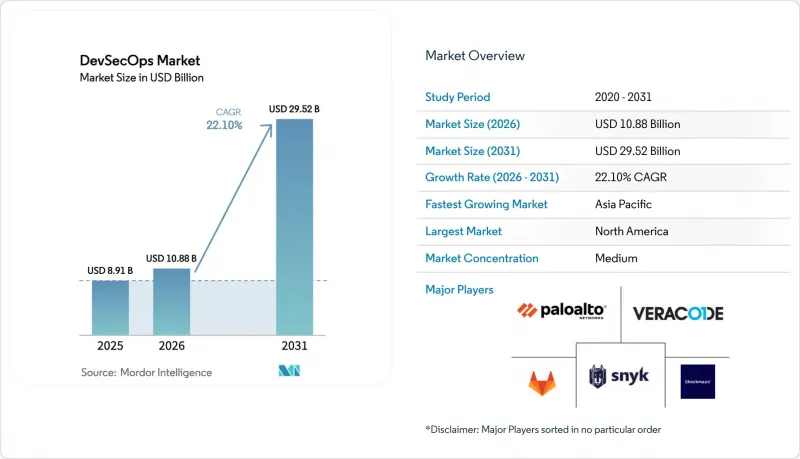
本報告按產品/服務(解決方案、服務[專業服務等])、部署模式(雲端、本地部署、混合部署)、最終用戶公司規模(中小企業、大型企業)、最終用戶行業(IT與電信、銀行、金融服務和保險、製造業等)以及地區進行細分。市場預測以美元計價。
全球DevSecOps市場趨勢與洞察
人們越來越關注安全和監管合規問題。
14028號總統令要求美國聯邦機構和供應商在2025年2月前建立軟體材料清單(SBOM)。同時,歐洲的NIS2指令和即將訂定的《網路彈性法案》將類似的「安全設計」原則應用於關鍵產業的約35萬個營業單位。如今,各組織不再僅僅將合規視為一項支出,而是將其視為一項競爭優勢,透過持續的控制監控來減輕審計負擔並加快採購週期。跨司法管轄區的標準化要求正在推動DevSecOps市場的發展,因為整合平台可以同時使技術控制與多項法規保持一致,從而降低重複部署工具的成本。
對持續自動化應用程式交付的需求
微服務、容器和無伺服器框架使得每天可以進行數百次程式碼推送,這種速度是人工滲透測試根本無法跟上的。持續整合/持續交付 (CI/CD) 管線整合了即時靜態和動態掃描以及相依性掃描,可在部署到生產環境之前阻止存在漏洞的建置。與開發流程並行運行的自動化安全門可以減少停機時間並加快功能開發,從而為企業帶來可衡量的成果。整合開發環境中的 AI 輔助工具可以在編碼過程中檢測出存在安全漏洞的程式碼,並支援及早採取糾正措施,從而縮短發布週期。
「安全設計」實踐中的文化與技能差距
對既精通程式碼交付速度又了解安全細微之處的專家的需求遠遠超過供給。據歐洲企業稱,儘管NIS2收緊了人員配備要求,但仍有32%的網路安全相關職缺。在許多工程團隊中,DevOps部門和安全部門之間存在摩擦,因為績效指標仍然優先考慮處理的功能數量,而不是漏洞修復數量。雖然培訓可以將修復工作的效率提高三倍,但在分散式團隊中部署此類培訓需要持續的預算和經營團隊支援。中小企業在與大型雲端服務供應商爭奪人才時,對此感受尤為深刻。
細分市場分析
到2025年,解決方案佔總收入的71.68%。這是因為買家更傾向於集中式儀錶板,該儀錶板可透過單一介面全面監控程式碼、容器和雲端的狀態。這些套件將靜態分析、軟體配置分析和運行時保護整合到同一工作流程中,從而降低了學習難度。相較之下,服務類產品的複合年成長率 (CAGR) 為25.4%,並吸引了那些沒有內部專家的企業。專業服務提供者負責管治模型設計、管道整合和紅隊評估,而託管服務團隊則代表客戶執行持續掃描和修補更新。由於人工智慧功能需要不斷調整,託管服務領域DevSecOps的市場規模預計將穩定成長。企業通常會先部署打包產品,然後尋求諮詢服務以進行配置最佳化、策略性套件客製化以及與工單管理系統整合。一旦管道穩定運行,他們就會將日常監控任務外包給承諾提供服務等級協定 (SLA) 的服務合作夥伴。雖然這種漸進模式為許可和服務供應商都帶來了收入,但具有前瞻性的供應商正擴大將諮詢時間與軟體訂閱捆綁在一起,以縮短銷售週期。
到 2025 年,本地部署解決方案將佔據 49.95% 的市場。然而,隨著資訊長(CIO) 將單體系統遷移到容器服務和無伺服器運作時,雲端管道正以 26.6% 的複合年成長率 (CAGR) 成長。雲端託管的安全引擎能夠靈活地處理建置週期中的突發測試,並在幾秒鐘內向開發人員提供回饋。它們還利用原生雲端日誌和身分服務簡化了策略繼承。混合部署是一種過渡狀態,敏感資料保留在本地,而監管較少的工作負載則遷移到雲端。隨著時間的推移,企業通常會整合為以下兩種形式之一:以雲端優先為導向的公司將擴展其跨多個可用區的控制範圍,而維護本地運算的公司將投資於模擬公共雲端體驗的私有雲端工具鏈。供應商必須證明在所有這些組合中都能對稱地執行策略,才能維持客戶留存率。
區域分析
到2025年,北美將佔全球整體收入的35.88%,並保持主導地位,這主要得益於聯邦採購法規要求公共機構供應商提交軟體工程物料清單(SBOM)。矽谷、西雅圖和奧斯汀的科技生態系統促進了工具供應商、整合商和開放原始碼社群之間的緊密聯繫,加速了最佳實踐的傳播。加拿大透過其國家網路安全戰略支援相關技術的應用,而墨西哥的金融科技法規則要求銀行持續合規才能使用跨境支付管道。亞太地區以22.45%的複合年成長率(CAGR)位居榜首,雲端原生新創公司正迅速超越傳統架構。中國的《網路安全法》、日本數位廳的指導方針以及印度電腦緊急應變小組(CERT-In)的漏洞揭露時間表都在推動整合安全測試。新加坡金融管理局(MAS)和澳洲審慎監理局正在收緊對數位銀行的監管,敦促供應商將加密掃描納入其持續整合/持續交付(CI/CD)流程。本地超大規模資料中心業者阿里雲、騰訊雲和AWS亞太區正與平台供應商合作,預先包裝符合區域合規架構的DevSecOps藍圖。歐洲採取「監管優先」的策略。 NIS2指令擴大了能源、運輸和醫療保健產業的事件通報義務範圍,而《數位營運彈性法案》則強制要求金融機構進行持續的控制測試。因此,各組織正在遵守ENISA指南,並實施能夠輸出機器可讀證據供審計人員使用的整合安全入口網站。雖然德國、法國和英國佔據了大部分支出,但東歐的軟體外包中心也在升級其流程以滿足客戶期望。在其他地區,巴西的《通用資料保護法》(LGPD)和阿拉伯聯合大公國的國家網路安全戰略正在推動拉丁美洲和中東地區的支出成長。
其他好處:
- Excel格式的市場預測(ME)表
- 3個月的分析師支持
目錄
第1章:引言
- 市場定義與研究假設
- 調查範圍
第2章:調查方法
第3章執行摘要
第4章 市場狀況
- 市場概覽
- 市場促進因素
- 人們越來越關注安全和監管合規性問題
- 對持續自動化應用程式交付的需求
- 向雲端原生和微服務架構遷移
- 人工智慧產生的程式碼正在擴大攻擊面。
- 軟體材料清單(SBOM) 相關法規
- 使用 GenAI 實現安全自動化的優勢
- 市場限制因素
- 「安全設計」實踐中的文化與技能差距
- 工具鏈臃腫和整合複雜性
- 平台整合導致預算削減
- 高度監管領域中傳統流程的慣性
- 價值供應鏈分析
- 重要法規結構的評估
- 對關鍵相關人員的影響評估
- 技術展望
- 波特五力分析
- 宏觀經濟因素的影響
第5章 市場規模與成長預測
- 報價
- 解決方案
- 服務
- 專業服務
- 託管服務
- 按部署模式
- 雲
- 現場
- 混合
- 按最終用戶公司規模分類
- 小型企業
- 大公司
- 按最終用戶行業分類
- IT/通訊
- BFSI
- 醫療保健和生命科學
- 政府/公共部門
- 製造業
- 零售與電子商務
- 其他(能源、教育等)
- 按地區
- 北美洲
- 美國
- 加拿大
- 墨西哥
- 南美洲
- 巴西
- 阿根廷
- 其他南美國家
- 歐洲
- 德國
- 英國
- 法國
- 義大利
- 西班牙
- 俄羅斯
- 其他歐洲國家
- 亞太地區
- 中國
- 日本
- 印度
- 韓國
- 澳洲和紐西蘭
- 其他亞太國家
- 中東和非洲
- 中東
- 沙烏地阿拉伯
- 阿拉伯聯合大公國
- 土耳其
- 其他中東國家
- 非洲
- 南非
- 奈及利亞
- 埃及
- 其他非洲國家
- 中東
- 北美洲
第6章 競爭情勢
- 市場集中度
- 策略趨勢
- 市佔率分析
- 公司簡介
- Aqua Security Software Ltd.
- Amazon Web Services, Inc.
- Black Duck Software(by Synopsys, Inc.)
- Checkmarx Ltd.
- Cisco Systems, Inc.
- Contrast Security, Inc.
- Dynatrace, Inc.
- Fortinet, Inc.
- GitLab Inc.
- IBM Corporation
- Imperva, Inc.
- Invicti Security Corp.
- JFrog Ltd.
- Microsoft Corporation
- Datadog, Inc.
- Palo Alto Networks, Inc.
- Qualys, Inc.
- Rapid7, Inc.
- Snyk Limited
- SonarSource SA
- Synopsys, Inc.
- Veracode, Inc.
第7章 市場機會與未來趨勢
- 未開發市場和未滿足需求的評估
According to Mordor Intelligence, the DevSecOps market size is expected to grow from USD 8.91 billion in 2025 to USD 10.88 billion in 2026 and is forecast to reach USD 29.52 billion by 2031 at 22.10% CAGR over 2026-2031.
This report is Segmented by Offering (Solution, Services [Professional Services, and More]), Deployment Model (Cloud, On-Premise, and Hybrid), by End-User Enterprise Size (Small and Medium Enterprise, Large Enterprises), End-User Industry ( IT and Telecom, BFSI, Manufacturing, and More), and Geography. The Market Forecasts are Provided in Terms of Value (USD).
Global DevSecOps Market Trends and Insights
Rising focus on security and regulatory compliance
Executive Order 14028 obliges United States federal agencies and suppliers to produce Software Bills of Materials by February 2025, while Europe's NIS2 directive and forthcoming Cyber Resilience Act apply similar security-by-design principles to roughly 350,000 entities across critical sectors . Organizations now treat compliance as competitive advantage rather than overhead, with continuous controls monitoring reducing audit workloads and accelerating procurement cycles. Standardized expectations across jurisdictions propel the DevSecOps market because unified platforms can map technical controls to multiple regulations simultaneously, cutting redundant tooling costs.
Need for continuous and automated application delivery
Microservices, containers, and serverless frameworks enable hundreds of daily code pushes, but manual penetration tests cannot scale to that cadence. Continuous integration / continuous delivery (CI/CD) pipelines embed real-time static, dynamic, and dependency scans that block vulnerable builds before production. Enterprises cite measurable returns when automated security gating parallels development flow, as downtime drops and feature velocity rises. AI copilots inside integrated development environments now flag insecure code during authoring, shifting remediation left and compressing release cycles.
Cultural and skills gap in secure-by-design practices
Demand for professionals who grasp both code delivery speed and security nuance far exceeds supply. European companies report that 32% of open cybersecurity roles remain vacant even as NIS2 heightens staffing requirements. Inside many engineering teams, performance metrics still reward feature throughput rather than vulnerability closure, fostering friction between DevOps and security units. Training can triple remediation productivity, yet rolling such programs across distributed workforces requires sustained budget and leadership endorsement. SMEs feel the constraint most acutely because they compete for talent against large cloud providers.
Other drivers and restraints analyzed in the detailed report include:
- Shift to cloud-native and micro-service architectures
- AI-generated code expanding attack surface
- Toolchain sprawl and integration complexity
For complete list of drivers and restraints, kindly check the Table Of Contents.
Segment Analysis
Solutions held 71.68% of 2025 revenue because buyers prefer centralized dashboards that cover code, container, and cloud posture from a single interface. These suites fold static analysis, software composition analysis, and runtime protection into identical workflows, reducing the learning curve. In contrast, services recorded a 25.4% CAGR and attract organizations lacking internal specialists. Professional service providers design governance models, integrate pipelines, and conduct red-team assessments, while managed services teams run ongoing scans and patching on behalf of clients. The DevSecOps market size for managed services is projected to climb steadily as AI features require continuous tuning. Enterprises often begin with shrink-wrapped products before seeking consulting help to optimize configuration, customize policy packs, and link ticketing systems. Once pipelines stabilize, they outsource day-to-day monitoring to service partners that guarantee response-time agreements. This sequential pattern sustains revenue for both license and service vendors, though forward-looking suppliers increasingly bundle advisory hours into software subscriptions to shorten sales cycles.
On-premise held 49.95% share in 2025. Yet cloud pipelines grow at a 26.6% CAGR as chief information officers migrate monoliths into container services and serverless runtimes. Cloud-hosted security engines elastically handle burst testing during build windows and stream results back to developers in seconds. They also tap native cloud logs and identity services, simplifying policy inheritance. Hybrid deployments serve as transitional states where sensitive data remains on-premise while less regulated workloads shift to cloud. Over time, firms often consolidate either way; those leaning cloud-first expand controls across multiple availability zones, while those retaining local compute invest in private-cloud toolchains that mimic public-cloud experience. Vendors must demonstrate symmetric policy coverage across these permutations to preserve account stickiness.
Complete Report Scope:
- By Offering
- Solutions
- Services
- Professional Services
- Managed Services
- By Deployment Model
- Cloud
- On-Premise
- Hybrid
- By End-user Enterprise Size
- Small and Medium Enterprises
- Large Enterprises
- By End-User Industry
- IT and Telecom
- BFSI
- Healthcare and Life Sciences
- Government and Public Sector
- Manufacturing
- Retail and E-commerce
- Others (Energy, Education, etc.)
- By Geography
- North America
- United States
- Canada
- Mexico
- South America
- Brazil
- Argentina
- Rest of South America
- Europe
- Germany
- United Kingdom
- France
- Italy
- Spain
- Russia
- Rest of Europe
- Asia-Pacific
- China
- Japan
- India
- South Korea
- Australia and New Zealand
- Rest of Asia-Pacific
- Middle East and Africa
- Middle East
- Saudi Arabia
- United Arab Emirates
- Turkey
- Rest of Middle East
- Africa
- South Africa
- Nigeria
- Egypt
- Rest of Africa
- Middle East
- North America
Geography Analysis
North America generated 35.88% of global revenue in 2025 and preserves leadership because federal procurement rules mandate SBOM submission for any supplier to public agencies. Technology ecosystems in Silicon Valley, Seattle, and Austin foster a dense mix of tool vendors, integrators, and open-source communities that accelerate best-practice diffusion. Canada supports adoption through its National Cyber Security Strategy, whereas Mexico's fintech regulations drive banks toward continuous compliance to access cross-border payment corridors. Asia-Pacific registers the highest 22.45% CAGR as cloud-native startups leapfrog legacy architectures. China's Cybersecurity Law, Japan's Digital Agency guidelines, and India's Computer Emergency Response Team (CERT-In) vulnerability disclosure timelines all encourage integrated security testing. Singapore's financial authority (MAS) and Australia's Prudential Regulation Authority tighten controls for digital banking, nudging vendors to embed encryption scanning into CI/CD. Local hyperscalers-Alibaba Cloud, Tencent Cloud, and AWS Asia Pacific Regions-partner with platform providers to pre-package DevSecOps blueprints for regional compliance regimes. Europe follows a regulation-first path. The NIS2 directive widens mandatory incident reporting across energy, transport, and healthcare, while the Digital Operational Resilience Act stipulates continuous controls testing for financial entities. Organizations therefore adopt unified security portals that align to ENISA guidance and emit machine-readable evidence for auditors. Germany, France, and the United Kingdom contribute the bulk of spending, but Eastern European software outsourcing hubs also upgrade pipelines to meet customer expectations. Elsewhere, Brazil's LGPD privacy law and the United Arab Emirates' National Cybersecurity Strategy catalyze spending across Latin America and the Middle East.
- Aqua Security Software Ltd.
- Amazon Web Services, Inc.
- Black Duck Software (by Synopsys, Inc.)
- Checkmarx Ltd.
- Cisco Systems, Inc.
- Contrast Security, Inc.
- Dynatrace, Inc.
- Fortinet, Inc.
- GitLab Inc.
- IBM Corporation
- Imperva, Inc.
- Invicti Security Corp.
- JFrog Ltd.
- Microsoft Corporation
- Datadog, Inc.
- Palo Alto Networks, Inc.
- Qualys, Inc.
- Rapid7, Inc.
- Snyk Limited
- SonarSource SA
- Synopsys, Inc.
- Veracode, Inc.
Additional Benefits:
- The market estimate (ME) sheet in Excel format
- 3 months of analyst support
TABLE OF CONTENTS
1 INTRODUCTION
- 1.1 Market Definition and Study Assumptions
- 1.2 Scope of the Study
2 RESEARCH METHODOLOGY
3 EXECUTIVE SUMMARY
4 MARKET LANDSCAPE
- 4.1 Market Overview
- 4.2 Market Drivers
- 4.2.1 Rising focus on security and regulatory compliance
- 4.2.2 Need for continuous and automated application delivery
- 4.2.3 Shift to cloud-native and micro-service architectures
- 4.2.4 AI-generated code expanding attack surface
- 4.2.5 Mandates for Software Bills of Materials (SBOMs)
- 4.2.6 GenAI-powered security automation advantages
- 4.3 Market Restraints
- 4.3.1 Cultural and skills gap in secure-by-design practices
- 4.3.2 Toolchain sprawl and integration complexity
- 4.3.3 Budget compression amid platform consolidation
- 4.3.4 Legacy process inertia in heavily regulated sectors
- 4.4 Value / Supply-Chain Analysis
- 4.5 Evaluation of Critical Regulatory Framework
- 4.6 Impact Assessment of Key Stakeholders
- 4.7 Technological Outlook
- 4.8 Porter's Five Forces Analysis
- 4.8.1 Bargaining Power of Suppliers
- 4.8.2 Bargaining Power of Consumers
- 4.8.3 Threat of New Entrants
- 4.8.4 Threat of Substitutes
- 4.8.5 Intensity of Competitive Rivalry
- 4.9 Impact of Macro-economic Factors
5 MARKET SIZE AND GROWTH FORECASTS (VALUE)
- 5.1 By Offering
- 5.1.1 Solutions
- 5.1.2 Services
- 5.1.2.1 Professional Services
- 5.1.2.2 Managed Services
- 5.2 By Deployment Model
- 5.2.1 Cloud
- 5.2.2 On-Premise
- 5.2.3 Hybrid
- 5.3 By End-user Enterprise Size
- 5.3.1 Small and Medium Enterprises
- 5.3.2 Large Enterprises
- 5.4 By End-User Industry
- 5.4.1 IT and Telecom
- 5.4.2 BFSI
- 5.4.3 Healthcare and Life Sciences
- 5.4.4 Government and Public Sector
- 5.4.5 Manufacturing
- 5.4.6 Retail and E-commerce
- 5.4.7 Others (Energy, Education, etc.)
- 5.5 By Geography
- 5.5.1 North America
- 5.5.1.1 United States
- 5.5.1.2 Canada
- 5.5.1.3 Mexico
- 5.5.2 South America
- 5.5.2.1 Brazil
- 5.5.2.2 Argentina
- 5.5.2.3 Rest of South America
- 5.5.3 Europe
- 5.5.3.1 Germany
- 5.5.3.2 United Kingdom
- 5.5.3.3 France
- 5.5.3.4 Italy
- 5.5.3.5 Spain
- 5.5.3.6 Russia
- 5.5.3.7 Rest of Europe
- 5.5.4 Asia-Pacific
- 5.5.4.1 China
- 5.5.4.2 Japan
- 5.5.4.3 India
- 5.5.4.4 South Korea
- 5.5.4.5 Australia and New Zealand
- 5.5.4.6 Rest of Asia-Pacific
- 5.5.5 Middle East and Africa
- 5.5.5.1 Middle East
- 5.5.5.1.1 Saudi Arabia
- 5.5.5.1.2 United Arab Emirates
- 5.5.5.1.3 Turkey
- 5.5.5.1.4 Rest of Middle East
- 5.5.5.2 Africa
- 5.5.5.2.1 South Africa
- 5.5.5.2.2 Nigeria
- 5.5.5.2.3 Egypt
- 5.5.5.2.4 Rest of Africa
- 5.5.5.1 Middle East
- 5.5.1 North America
6 COMPETITIVE LANDSCAPE
- 6.1 Market Concentration
- 6.2 Strategic Moves
- 6.3 Market Share Analysis
- 6.4 Company Profiles (includes Global level Overview, Market level overview, Core Segments, Financials as available, Strategic Information, Market Rank/Share for key companies, Products and Services, and Recent Developments)
- 6.4.1 Aqua Security Software Ltd.
- 6.4.2 Amazon Web Services, Inc.
- 6.4.3 Black Duck Software (by Synopsys, Inc.)
- 6.4.4 Checkmarx Ltd.
- 6.4.5 Cisco Systems, Inc.
- 6.4.6 Contrast Security, Inc.
- 6.4.7 Dynatrace, Inc.
- 6.4.8 Fortinet, Inc.
- 6.4.9 GitLab Inc.
- 6.4.10 IBM Corporation
- 6.4.11 Imperva, Inc.
- 6.4.12 Invicti Security Corp.
- 6.4.13 JFrog Ltd.
- 6.4.14 Microsoft Corporation
- 6.4.15 Datadog, Inc.
- 6.4.16 Palo Alto Networks, Inc.
- 6.4.17 Qualys, Inc.
- 6.4.18 Rapid7, Inc.
- 6.4.19 Snyk Limited
- 6.4.20 SonarSource SA
- 6.4.21 Synopsys, Inc.
- 6.4.22 Veracode, Inc.
7 MARKET OPPORTUNITIES AND FUTURE TRENDS
- 7.1 White-space and Unmet-need Assessment

 DevSecOps全球市場規模、佔有率、趨勢和成長分析報告(2026-2034年)
 DevSecOps 市場:按產品/服務、類型、部署模式、組織規模和產業分類-2026-2032 年全球市場預測
 DevSecOps 市場預測 2034 – 按組件、部署模式、組織規模、安全類型、開發階段、工具類型、最終用戶和地區分類的全球分析
 軟體材料清單(SBOM)管理軟體:市場佔有率分析、產業趨勢與統計、成長預測(2026-2031)
 DevSecOps 市場:按組件、部署、最終用途和區域分類
 2026年全球DevSecOps市場報告
 全球DevSecOps市場:按組件、組織規模、服務、部署方法、最終用途、國家和地區分類-產業分析、市場規模、佔有率和未來預測(2025-2032)全球DevSecOps市場:市場規模、佔有率、成長率、產業分析、依類型、應用和地區劃分的分析以及未來預測(2026-2034)
 DevSecOps市場規模、佔有率和成長分析(按組件、服務、部署類型、組織規模、垂直產業和地區分類)-2026-2033年產業預測全球 DevSecOps 市場規模(按組件、部署、組織、最終用戶產業、區域範圍和預測)