


 |
市場調查報告書
商品編碼
2155325
機器人標定視覺系統:市場佔有率分析、產業趨勢與統計、成長預測(2026-2031)Robot Calibration Vision Systems - Market Share Analysis, Industry Trends & Statistics, Growth Forecasts (2026 - 2031) |
||||||

※ 本網頁內容可能與最新版本有所差異。詳細情況請與我們聯繫。
根據 Mordor Intelligence 預測,機器人標定視覺系統的市場規模預計將從 2025 年的 1.436 億美元成長到 2026 年的 1.6045 億美元,到 2031 年達到 2.9145 億美元,2026 年至 2031 年的年複合成長率(CAGR)為 12.68%。
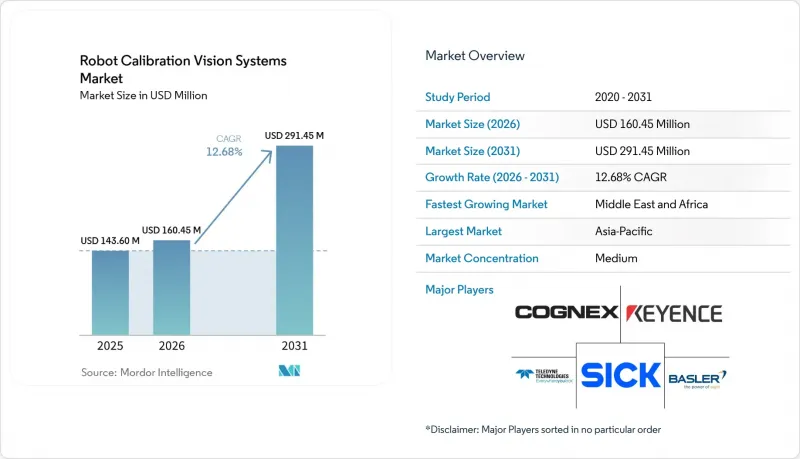
全球機器人標定視覺系統市場趨勢及洞察。
視覺引導機器人在智慧工廠的應用擴展
智慧工廠專案正在為機器人標定和視覺系統市場創造新的需求,並活性化現有機器人單元的升級改造。隨著機器人密度的增加,可用於整個生產單元人工標定的時間越來越少。因此,製造商正在轉向多機器人和感測器的協同標定。 2025年9月,ABB推出了“OmniCore EyeMotion”,使配備OmniCore的機器人能夠使用第三方相機和感測器進行即時2D和3D應用。據ABB稱,與客製化解決方案相比,該系統可將試運行時間縮短高達90%。 KUKA的「iiQKA.AI Vision」將相機標定、系統標定和AI驅動的訓練整合到一個拖放式工作流程中。
在複雜的組裝過程中引入人工智慧賦能的3D視覺技術
人工智慧賦能的3D視覺技術的引入,為「機器人校準視覺系統市場」中現有的2D系統增加了深度校準的需求。這在零件形狀多變、工作位置不斷變化的組裝任務中至關重要。 2026年3月,ABB和NVIDIA聯合發布了“RobotStudio HyperReality”,該技術將NVIDIA Omniverse庫與ABB的絕對精度技術相結合。據ABB稱,這項技術將未校準系統的定位誤差從8-15毫米降低到0.5毫米。同時,富士康對其首個應用案例進行了試點測試,精度達到99%。 2026年的一項製造研究引入了「3DVAC-HiPRoM」方法,該方法使用校準板進行粗調,使用軟性桿進行微調。這些方法滿足了市場對能夠適應特定任務校準方法的軟體平台的需求。
傳統生產線的高整合成本
將系統整合到現有生產線上的成本可能高於校準硬體本身。專有控制器、不相容的現場匯流排協定和固定的PLC邏輯都會增加工程難度。在採用多種機器人品牌的單元中建立相機和機器人座標係也可能導致部署延誤。 ABB表示,RobotStudio HyperReality可透過虛擬設計、測試和最佳化,將設定和試運行成本降低高達40%。這項優勢適用於使用OmniCore系列控制器的設備,但限制了舊設備的選擇。這項限制制約了機器人校準視覺系統在南美、中東和非洲的部署,因為這些地區的整合商覆蓋範圍和OEM支援相對較少。
細分市場分析
到2025年,手眼校準將佔銷售額的29.91%。這項技術應用於取放、揀選、焊接和組裝等任務中,攝影機安裝在機器人的末端執行器或法蘭上。相機隨末端執行器移動,有助於保持其與工具的空間關係。然而,由於工具更換或機械衝擊,可能需要重新校準。隨著這項技術在常見視覺引導任務中的應用日益普及,機器人校準視覺系統市場也從中受益。
預計到2031年,機器人間標定市場將以14.23%的複合年成長率成長。汽車和電子工廠正擴大採用工作單元,機器人直接在工位間搬運零件。這使得機器人間的位置關係與單一機器人的獨立精度同樣重要。 2026年7月,海克斯康推出了用於多區域和多工具標定的SARCA系統,可將機器人絕對定位精度提高至多10倍。這為機器人標定視覺系統市場在機器人-世界、TCP和多攝影機配置方面拓展了機會。
到2025年,工業機器人將佔銷售額的61.34%,在「機器人校準和視覺系統市場」中佔據最大佔有率。它們的應用範圍涵蓋汽車車身本體生產、電子產品組裝和物料輸送等Delta。這些需求主要來自重新校準、軟體升級和更換,而非新安裝。 Delta和SCARA機器人在食品和藥品包裝的高速取放作業中發揮著至關重要的作用。協作機器人也擴大用於機器操作輔助、檢測和套件組裝等任務。
預計到2031年,移動機器人將以18.45%的複合年成長率成長。自主移動機器人(AMR)需要將來自RGB攝影機、雷射雷達、飛行時間(ToF)感測器和超音波陣列的資訊整合到通用座標系中。振動、底盤變形和碰撞會導致這些感測器在使用過程中發生位置偏移。因此,機器人校準和視覺系統市場需要持續的機載監控,而不是只依賴週期性校準。安川馬達的「MOTOMAN NEXT」展示如何將視覺、路徑規劃和力感整合到機器人平台中。
區域分析
到2025年,亞太地區將佔據機器人校準和視覺系統市場38.72%的佔有率。工業機器人的應用主要集中在中國、日本和韓國。中國的智慧製造計畫正在推動對視覺引導自動化技術的投資。包括FANUC)、安川馬達(Yaskawa Electric)和OMRON)在內的日本原始設備製造商(OEM)正在支援系統的持續升級。韓國的半導體和顯示器製造業需要定期進行校準檢驗,以實現亞微米級的檢測。
2025年,北美在機器人標定和視覺系統市場繼續保持其重要地位,這主要得益於電動車製造、航太組裝和物流自動化等行業的推動。美國擁有康耐視(Cognex)和泰萊科技(Teledyne Technologies)等公司,這兩家公司都致力於嵌入式人工智慧視覺系統的開發。電子和國防工業的製造業回流也催生了新建和升級設施的需求。在歐洲,庫卡(KUKA)、西克(SICK)、巴斯勒(Basler)、海克斯康(Hexagon)和ABB等公司在機器視覺和測量技術領域奠定了堅實的基礎。德國汽車製造商正在推動車身本體和電動車動力傳動系統組裝過程中對多攝影機和結構化光學系統的需求。
預計到2031年,中東和非洲地區的複合年成長率將達到14.52%。與沙烏地阿拉伯「2030願景」和阿拉伯聯合大公國自動化計畫相關的製造業項目正在推動新技術的應用。南非和奈及利亞的汽車組裝和物流產能正在擴張,巴西是南美洲的主要需求中心。阿根廷農業領域的自動化也提振需求,儘管小規模。雖然這一區域擴張支撐了機器人標定視覺系統的市場,但本地系統整合商覆蓋範圍有限以及對海外OEM支援的持續依賴阻礙了其應用。
其他好處:
- Excel格式的市場預測(ME)表
- 3個月的分析師支持
目錄
第1章:引言
- 研究假設和市場定義
- 調查範圍
第2章:調查方法
第3章執行摘要
第4章 市場狀況
- 市場概覽
- 市場促進因素
- 視覺引導機器人在智慧工廠的應用擴展
- 將人工智慧驅動的3D視覺技術引入複雜的組裝流程
- 協作機器人與自主移動機器人的發展
- 對高精度檢測和零缺陷製造的需求日益成長
- 用於多攝影機和多感測器單元的自動校準
- 在現有設施中擴大自校準視覺軟體的使用範圍
- 市場限制因素
- 與傳統生產線整合成本高昂
- 缺乏機器人視覺整合的專業知識
- 由於熱力、機械和光學變化引起的校準漂移
- 機器人、攝影機和軟體之間互通性標準的碎片化
- 宏觀經濟因素對市場的影響
- 產業供應鏈分析
- 監理情勢
- 技術展望
- 波特五力分析
第5章 市場規模與成長預測
- 校準類型
- 機器人及外部環境的校準
- 人工目測校準
- 工具中心點 (TCP) 校準
- 機器人間校準
- 多相機/多感測器校準
- 按機器人類型
- 工業機器人
- 協作機器人(cobots)
- 移動機器人(AMR/AGV)
- Delta/SCARA機器人
- 其他類型的機器人
- 視覺科技
- 2D視覺校準
- 3D立體視覺校準
- 利用結構光進行3D校準
- 飛行時間(ToF)校準
- 雷射/3D掃描儀校準
- 其他視覺技術
- 按最終用戶行業分類
- 汽車與出行
- 電子和半導體
- 一般製造業
- 航太/國防
- 食品/飲料
- 藥品和醫療設備
- 物流和倉儲
- 其他終端用戶產業
- 機器人搭載視覺系統
- 移動/自主視覺系統
- 按地區
- 北美洲
- 美國
- 加拿大
- 墨西哥
- 南美洲
- 巴西
- 阿根廷
- 其他南美國家
- 歐洲
- 德國
- 英國
- 法國
- 義大利
- 西班牙
- 其他歐洲國家
- 亞太地區
- 中國
- 日本
- 印度
- 韓國
- 其他亞太國家
- 中東和非洲
- 中東
- 沙烏地阿拉伯
- 阿拉伯聯合大公國
- 土耳其
- 其他中東國家
- 非洲
- 南非
- 奈及利亞
- 其他非洲國家
- 中東
- 北美洲
第6章 競爭情勢
- 市場集中度
- 策略趨勢
- 市佔率分析
- 公司簡介
- ABB Ltd.
- Allied Vision Technologies GmbH
- Basler AG
- Cognex Corporation
- Denso Wave Incorporated
- FARO Technologies, Inc.
- FANUC Corporation
- Hexagon AB
- IDS Imaging Development Systems GmbH
- ISRA VISION GmbH
- KEYENCE CORPORATION
- KUKA AG
- LMI Technologies Inc.
- MVTec Software GmbH
- Nikon Metrology NV
- OMRON Corporation
- Photoneo sro
- SICK AG
- Teledyne Technologies Incorporated
- Yaskawa Electric Corporation
第7章 市場機會與未來展望
According to Mordor Intelligence, the robot calibration vision systems market size is projected to expand from USD 143.60 million in 2025 to USD 160.45 million in 2026, and to USD 291.45 million by 2031, registering a CAGR of 12.68% between 2026 and 2031.
Global Robot Calibration Vision Systems Market Trends and Insights
Expansion of Vision-Guided Robotics in Smart Factories
Smart factory projects are creating new demand for the Robot Calibration Vision Systems Market and increasing upgrade activity in existing fleets. A higher robot density reduces the time available for manual calibration across a production cell. Manufacturers are therefore moving toward coordinated calibration of multiple robots and sensors. ABB launched OmniCore EyeMotion in September 2025, allowing OmniCore-powered robots to use third-party cameras and sensors for real-time 2D and 3D applications. ABB stated that the system reduced commissioning time by up to 90% compared with custom solutions. KUKA's iiQKA.AI Vision combined camera calibration, system calibration, and AI-supported training in one drag-and-drop workflow.
Adoption of AI-Enabled 3D Vision for Complex Assembly
AI-enabled 3D vision introduces depth-calibration requirements to established 2D systems in the Robot Calibration Vision Systems Market. This is important for assembly tasks with variable part geometry and changing work positions. ABB and NVIDIA announced RobotStudio HyperReality in March 2026, combining NVIDIA Omniverse libraries with ABB Absolute Accuracy technology. ABB reported that the technology reduced positioning errors from 8-15 mm in uncalibrated systems to 0.5 mm, while Foxconn piloted the first use case at 99% accuracy. A 2026 manufacturing study described the 3DVAC-HiPRoM method, which used a calibration board for coarse alignment and a flexible rod for refined alignment. These approaches support demand for software platforms that can accommodate task-specific calibration methods.
High Integration Costs with Legacy Production Lines
Legacy production lines can cost more to integrate than the calibration hardware itself. Proprietary controllers, incompatible fieldbus protocols, and fixed PLC logic raise engineering requirements. Establishing camera-to-robot coordinate frames can also delay deployment in cells that use several robot brands. ABB stated that RobotStudio HyperReality could reduce setup and commissioning costs by up to 40% through virtual design, testing, and optimization. That benefit applies to facilities using OmniCore-generation controllers, leaving older installations with fewer options. This constraint limits the adoption of Robot Calibration Vision Systems in South America, the Middle East, and Africa, where integrator coverage and OEM support are less extensive.
Other drivers and restraints analyzed in the detailed report include:
- Growth of Collaborative Robots and Autonomous Mobile Robots
- Demand for High-Precision Inspection and Zero-Defect Manufacturing
- Shortage of Robot Vision Integration Expertise
For complete list of drivers and restraints, kindly check the Table Of Contents.
Segment Analysis
Hand-eye calibration accounted for 29.91% of revenue in 2025. It is used in pick-and-place, bin picking, welding, and assembly tasks that mount cameras on a robot wrist or flange. The camera moves with the end effector, which helps preserve its spatial relationship with the tool. However, tooling changes or mechanical impacts can require recalibration. The Robot Calibration Vision Systems Market benefits from the technique's established use across common vision-guided tasks.
Robot-to-robot calibration is forecast to grow at a 14.23% CAGR through 2031. Automotive and electronics plants are using more workcells where robots transfer parts directly between stations. This makes the positional relationship among robots as important as each robot's independent accuracy. Hexagon launched SARCA in July 2026 for multi-zone and multi-tool routines that improve absolute robot positioning accuracy by up to 10 times. This expands the Robot Calibration Vision Systems Market opportunity for robot-to-world, TCP, and multi-camera configurations.
Industrial robots accounted for 61.34% of revenue in 2025, giving them the largest share in the Robot Calibration Vision Systems Market. Their installed base spans automotive body-in-white production, electronics assembly, and heavy material handling. Much of this demand comes from recalibration, software upgrades, and replacements rather than new installations. Delta and SCARA models are important for fast pick-and-place work in food and pharmaceutical packaging. Cobots are also being used more often for machine tending, inspection, and kitting tasks.
Mobile robots are forecast to grow at an 18.45% CAGR through 2031. AMRs must combine information from RGB cameras, LiDAR, ToF sensors, and ultrasonic arrays in a common coordinate frame. Vibration, chassis flex, and collisions can shift those sensors during use. This creates an ongoing requirement for on-board monitoring in the Robot Calibration Vision Systems Market, rather than relying solely on scheduled calibration. Yaskawa's MOTOMAN NEXT demonstrates how vision, path planning, and force sensing are integrated into the robot platform.
Complete Report Scope:
- By Calibration Type
- Robot-to-World Calibration
- Hand-Eye Calibration
- Tool Center Point (TCP) Calibration
- Robot-to-Robot Calibration
- Multi-Camera / Multi-Sensor Calibration
- By Robot Type
- Industrial Robots
- Collaborative Robots (Cobots)
- Mobile Robots (AMR/AGV)
- Delta / SCARA Robots
- Other Robot Types
- By Vision Technology
- 2D Vision Calibration
- 3D Stereo Vision Calibration
- Structured-Light 3D Calibration
- Time-of-Flight (ToF) Calibration
- Laser / 3D Scanner Calibration
- Other Vision Technologies
- By End-User Industry
- Automotive and Mobility
- Electronics and Semiconductors
- General Manufacturing
- Aerospace and Defense
- Food and Beverage
- Pharmaceutical and Medical Devices
- Logistics and Warehousing
- Other End-User Industries
- Robotic-Mounted Vision Systems
- Mobile / Autonomous Vision Systems
- By Geography
- North America
- United States
- Canada
- Mexico
- South America
- Brazil
- Argentina
- Rest of South America
- Europe
- Germany
- United Kingdom
- France
- Italy
- Spain
- Rest of Europe
- Asia-Pacific
- China
- Japan
- India
- South Korea
- Rest of Asia-Pacific
- Middle East and Africa
- Middle East
- Saudi Arabia
- United Arab Emirates
- Turkey
- Rest of the Middle East
- Africa
- South Africa
- Nigeria
- Rest of Africa
- Middle East
- North America
Geography Analysis
Asia-Pacific held 38.72% of the Robot Calibration Vision Systems Market share in 2025. China, Japan, and South Korea have a high concentration of industrial robot installations. China's smart manufacturing programs support investment in vision-guided automation. Japan's OEM base, including FANUC, Yaskawa, and OMRON, supports continuing system upgrades. South Korean semiconductor and display manufacturing requires regular calibration verification for sub-micron inspection.
North America maintained a significant position in the Robot Calibration Vision Systems Market in 2025, driven by EV manufacturing, aerospace assembly, and logistics automation. The United States is home to Cognex and Teledyne Technologies, both of which support the development of embedded AI vision systems. Reshoring of electronics and defense manufacturing is creating demand in new and retooled facilities. Europe has established machine vision and metrology capabilities through KUKA, SICK, Basler, Hexagon, and ABB. Germany's automotive manufacturers support demand for multi-camera and structured-light systems in body-in-white and EV powertrain assembly.
The Middle East and Africa are forecast to grow at a 14.52% CAGR through 2031. Saudi Arabia's Vision 2030-linked manufacturing projects and the UAE's automation programs are supporting new deployments. South Africa and Nigeria are adding automotive assembly and logistics capacity, while Brazil is South America's main demand center, and Argentina's agroindustrial automation adds smaller demand. This regional expansion supports the Robot Calibration Vision Systems Market, although limited local integrator coverage and reliance on overseas OEM support continue to limit adoption.
- ABB Ltd.
- Allied Vision Technologies GmbH
- Basler AG
- Cognex Corporation
- Denso Wave Incorporated
- FARO Technologies, Inc.
- FANUC Corporation
- Hexagon AB
- IDS Imaging Development Systems GmbH
- ISRA VISION GmbH
- KEYENCE CORPORATION
- KUKA AG
- LMI Technologies Inc.
- MVTec Software GmbH
- Nikon Metrology NV
- OMRON Corporation
- Photoneo s.r.o.
- SICK AG
- Teledyne Technologies Incorporated
- Yaskawa Electric Corporation
Additional Benefits:
- The market estimate (ME) sheet in Excel format
- 3 months of analyst support
TABLE OF CONTENTS
1 INTRODUCTION
- 1.1 Study Assumptions and Market Definition
- 1.2 Scope of the Study
2 RESEARCH METHODOLOGY
3 EXECUTIVE SUMMARY
4 MARKET LANDSCAPE
- 4.1 Market Overview
- 4.2 Market Drivers
- 4.2.1 Expansion of Vision-Guided Robotics in Smart Factories
- 4.2.2 Adoption of AI-Enabled 3D Vision for Complex Assembly
- 4.2.3 Growth of Collaborative Robots and Autonomous Mobile Robots
- 4.2.4 Rising Demand for High-Precision Inspection and Zero-Defect Manufacturing
- 4.2.5 Automated Calibration for Multi-Camera and Multi-Sensor Cells
- 4.2.6 Increasing Use of Self-Calibrating Vision Software in Brownfield Facilities
- 4.3 Market Restraints
- 4.3.1 High Integration Costs with Legacy Production Lines
- 4.3.2 Shortage of Robot Vision Integration Expertise
- 4.3.3 Calibration Drift from Thermal, Mechanical, and Optical Variations
- 4.3.4 Fragmented Robot, Camera, and Software Interoperability Standards
- 4.4 Impact of Macroeconomic Factors on the Market
- 4.5 Industry Supply Chain Analysis
- 4.6 Regulatory Landscape
- 4.7 Technological Outlook
- 4.8 Porter's Five Forces Analysis
- 4.8.1 Bargaining Power of Suppliers
- 4.8.2 Bargaining Power of Buyers
- 4.8.3 Threat of New Entrants
- 4.8.4 Threat of Substitutes
- 4.8.5 Intensity of Competitive Rivalry
5 MARKET SIZE AND GROWTH FORECASTS (VALUE)
- 5.1 By Calibration Type
- 5.1.1 Robot-to-World Calibration
- 5.1.2 Hand-Eye Calibration
- 5.1.3 Tool Center Point (TCP) Calibration
- 5.1.4 Robot-to-Robot Calibration
- 5.1.5 Multi-Camera / Multi-Sensor Calibration
- 5.2 By Robot Type
- 5.2.1 Industrial Robots
- 5.2.2 Collaborative Robots (Cobots)
- 5.2.3 Mobile Robots (AMR/AGV)
- 5.2.4 Delta / SCARA Robots
- 5.2.5 Other Robot Types
- 5.3 By Vision Technology
- 5.3.1 2D Vision Calibration
- 5.3.2 3D Stereo Vision Calibration
- 5.3.3 Structured-Light 3D Calibration
- 5.3.4 Time-of-Flight (ToF) Calibration
- 5.3.5 Laser / 3D Scanner Calibration
- 5.3.6 Other Vision Technologies
- 5.4 By End-User Industry
- 5.4.1 Automotive and Mobility
- 5.4.2 Electronics and Semiconductors
- 5.4.3 General Manufacturing
- 5.4.4 Aerospace and Defense
- 5.4.5 Food and Beverage
- 5.4.6 Pharmaceutical and Medical Devices
- 5.4.7 Logistics and Warehousing
- 5.4.8 Other End-User Industries
- 5.4.9 Robotic-Mounted Vision Systems
- 5.4.10 Mobile / Autonomous Vision Systems
- 5.5 By Geography
- 5.5.1 North America
- 5.5.1.1 United States
- 5.5.1.2 Canada
- 5.5.1.3 Mexico
- 5.5.2 South America
- 5.5.2.1 Brazil
- 5.5.2.2 Argentina
- 5.5.2.3 Rest of South America
- 5.5.3 Europe
- 5.5.3.1 Germany
- 5.5.3.2 United Kingdom
- 5.5.3.3 France
- 5.5.3.4 Italy
- 5.5.3.5 Spain
- 5.5.3.6 Rest of Europe
- 5.5.4 Asia-Pacific
- 5.5.4.1 China
- 5.5.4.2 Japan
- 5.5.4.3 India
- 5.5.4.4 South Korea
- 5.5.4.5 Rest of Asia-Pacific
- 5.5.5 Middle East and Africa
- 5.5.5.1 Middle East
- 5.5.5.1.1 Saudi Arabia
- 5.5.5.1.2 United Arab Emirates
- 5.5.5.1.3 Turkey
- 5.5.5.1.4 Rest of the Middle East
- 5.5.5.2 Africa
- 5.5.5.2.1 South Africa
- 5.5.5.2.2 Nigeria
- 5.5.5.2.3 Rest of Africa
- 5.5.5.1 Middle East
- 5.5.1 North America
6 COMPETITIVE LANDSCAPE
- 6.1 Market Concentration
- 6.2 Strategic Moves
- 6.3 Market Share Analysis
- 6.4 Company Profiles (includes Global Level Overview, Market Level Overview, Core Segments, Financials as available, Strategic Information, Market Rank/Share, Products and Services, Recent Developments)
- 6.4.1 ABB Ltd.
- 6.4.2 Allied Vision Technologies GmbH
- 6.4.3 Basler AG
- 6.4.4 Cognex Corporation
- 6.4.5 Denso Wave Incorporated
- 6.4.6 FARO Technologies, Inc.
- 6.4.7 FANUC Corporation
- 6.4.8 Hexagon AB
- 6.4.9 IDS Imaging Development Systems GmbH
- 6.4.10 ISRA VISION GmbH
- 6.4.11 KEYENCE CORPORATION
- 6.4.12 KUKA AG
- 6.4.13 LMI Technologies Inc.
- 6.4.14 MVTec Software GmbH
- 6.4.15 Nikon Metrology NV
- 6.4.16 OMRON Corporation
- 6.4.17 Photoneo s.r.o.
- 6.4.18 SICK AG
- 6.4.19 Teledyne Technologies Incorporated
- 6.4.20 Yaskawa Electric Corporation
7 MARKET OPPORTUNITIES AND FUTURE OUTLOOK
- 7.1 White-Space and Unmet-Need Assessment

 機器人視覺和機器視覺市場預測至2034年——按產品、視覺類型、人工智慧和分析能力、應用、最終用戶和地區分類的全球分析
 2026-2030年全球2D與3D機器視覺系統市場
 雙目雷達與視覺整合系統市場:全球市場預測,2026-2032年
 智慧工廠視覺化系統:市場佔有率分析、產業趨勢與統計、成長預測(2026-2031)結構化光學3D視覺系統:市場佔有率分析、產業趨勢與統計及成長預測(2026-2031年)智慧機器視覺自動化市場預測至2034年—按產品、組件、部署模式、應用、最終用戶和地區分類的全球分析
 3D機器視覺市場規模、佔有率、成長及全球產業分析:按類型、應用和地區分類的洞察,2026-2034年預測全球3D機器視覺市場規模、佔有率、趨勢和成長分析報告(2026-2034年)工業3D機器視覺市場:依產品類型、組件、部署模式、應用、最終用戶產業分類,全球預測(2026-2032年)CNC石材成型機市場按機器類型、銷售管道、應用和最終用戶分類,全球預測(2026-2032年)