


 |
市場調查報告書
商品編碼
2155212
智慧工廠視覺化系統:市場佔有率分析、產業趨勢與統計、成長預測(2026-2031)Smart Factory Vision Systems - Market Share Analysis, Industry Trends & Statistics, Growth Forecasts (2026 - 2031) |
||||||

※ 本網頁內容可能與最新版本有所差異。詳細情況請與我們聯繫。
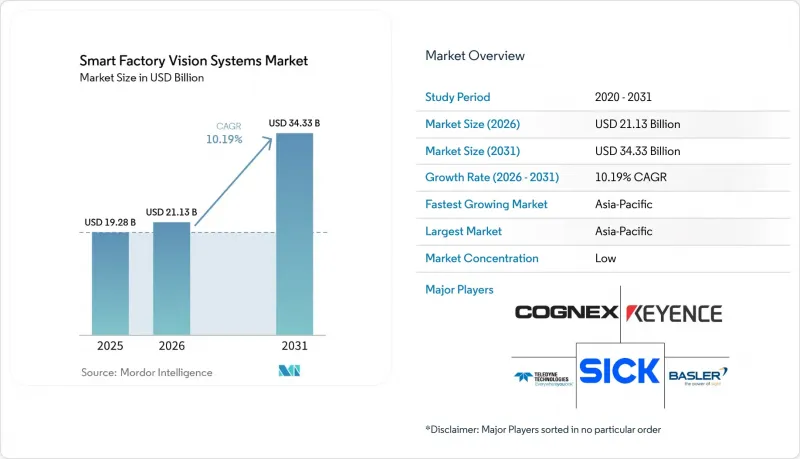
據 Mordor Intelligence 稱,2025 年智慧工廠視覺系統的市場規模為 192.8 億美元,預計到 2031 年將從 2026 年的 211.3 億美元成長至 343.3 億美元,預測期(2026-2031 年)的複合年成長率為 10.19%。
全球智慧工廠視覺系統市場趨勢及洞察
深度學習在缺陷檢測的準確性
深度學習正變得越來越適用於工廠檢測,因為缺陷模式會因形狀、表面或產品設計而異。 2026 年的一項研究表明,在複雜的缺陷檢測任務中,混合 CNN- 變壓器模型比純 CNN 模型的性能高出 2.8 至 12.6 個百分點。這些研究結果涵蓋了不規則裂紋、半導體故障和電極針孔等缺陷。這項能力使製造商更有理由利用智慧工廠視覺系統市場來處理基於規則的檢測無法一致地完成的任務。在情況不明朗的情況下,人工驗證仍然至關重要,它能夠補充混合檢測單元,而不是完全取代人工干預。提供模型訓練和持續改進工具的供應商更有能力支援這些營運模式。
電動汽車電池和半導體製造的擴張
電動汽車電池和半導體製造工廠所需的檢測流程比許多傳統生產線更為繁瑣。根據國際機器人聯合會(IFR)統計,到2024年,全球將部署59萬台工業機器人,其中亞洲佔新增部署量的70%。機器人單元通常需要視覺引導來進行揀選、定位和組裝檢測。半導體製造也需要對晶圓、塗層和封裝進行精細的檢測。 《歐洲晶片法案》規定,將投入430億歐元用於公共和私人政策支持,以增強歐洲的半導體生產能力。這些投資正在擴大智慧工廠視覺系統的市場,為能夠滿足半導體認證和可重複性要求的供應商提供更多選擇。
高昂的實施和整合成本
實施生產級視覺系統需要的不僅僅是攝影機和軟體。成本可能包括照明設計、鏡頭選擇、固定裝置、通訊映射以及與現有PLC和製造執行系統(MES)的檢驗。食品、飲料和製藥生產環境由於衛生、防塵防水和產品切換要求,可能需要額外的設計工作。安全性和記錄保存要求可能會增加文件工作量,並可能延長安裝時間。對於沒有專門機器視覺團隊的中小型製造商而言,這些成本可能是一筆不小的負擔。因此,像康耐視的In-Sight SnAPP感測器和SICK的Inspector83x系統這樣的簡易平台在智慧工廠視覺系統市場中發揮著至關重要的作用,因為它們降低了設定的複雜性。
細分市場分析
預計到2025年,硬體將佔智慧工廠視覺系統市場佔有率的70.34%。此類別包括相機、光學元件、影像擷取卡、處理器和邊緣AI加速器。攝影機仍然是最大的硬體子類別,因為所有系統都需要影像擷取。隨著製造商為現有攝影機平台添加推理功能,處理器和邊緣加速器也越來越受歡迎。預計2026年至2031年,軟體將以11.45%的複合年成長率成長,超過智慧工廠視覺系統市場的整體成長率。這一成長反映了對影像處理、深度學習工具和整合中間件日益成長的需求。
康耐視於2025年6月發布了OneVision的測試版,並於同年正式發布。在測試階段,超過100家客戶使用該平台進行集中式模型訓練和跨站點邊緣部署。該軟體使製造商能夠在多個工廠更新檢測模型,而無需更換所有相機硬體。傳統影像處理技術在可預測的輸出和授權成本方面仍然具有競爭力。雖然人工智慧工具越來越受到關注,但使用者仍需要標註、模型版本控制、合成資料和部署管理。此外,隨著相機輸出需要與PLC、MES和SCADA系統整合,整合軟體的重要性日益凸顯。因此,在智慧工廠視覺系統產業,部分價值正從初始硬體銷售轉向軟體支援。
截至2025年,2D視覺系統在智慧工廠視覺系統市場佔有63.78%的佔有率。這些系統仍然廣泛應用於平面檢測、條碼讀取和標籤檢驗。其成熟的應用經驗、廣泛的應用範圍和成本優勢支撐著其持續的市場主導地位。預計到2031年,3D視覺系統將以11.91%的複合年成長率成長。在電池單元檢測中,電極對準需要深度數據,而傳統的2D影像無法提供這些資訊。此外,3D點雲也被用於機器人揀選,以確定零件的位置和方向。
2024年8月,LMI Technologies收購了Liberty Robotics,整合了其3D視覺和機器人引導功能,應用於汽車、包裝和物流領域。頻譜和高光譜遙測系統用於特定應用,例如藥物塗層檢測、半導體薄膜測繪和食品異物檢測。熱成像和紅外線系統則專注於溫度相關的檢測,包括焊接缺陷、軸承過熱和冷鏈檢驗。同年8月,Teledyne FLIR IIS推出了用於工業檢測、環境監測和回收分類的「Forge 1GigE SWIR」系列相機。這些系統能夠區分在可見光下外觀相似的材料。因此,「智慧工廠視覺系統市場」正在擴展到除了標準成像之外,還需要深度、熱成像或頻譜資訊的應用領域。
區域分析
預計到2025年,亞太地區將佔據智慧工廠視覺系統市場34.21%的佔有率,並在2031年之前以11.56%的複合年成長率成長。中國是該地區最大的國內市場,這得益於國內邊緣相機和影像處理軟體供應商的強大實力。日本和韓國的製造商在高精度光學元件和影像感測器領域繼續佔據重要地位。 2026年7月,三菱電機和SONY半導體解決方案公司達成協議,將在日本成立“先進視覺解決方案公司”,整合雙方在工廠自動化控制、影像感測器和邊緣人工智慧技術方面的專長。印度的「生產連結獎勵計畫計畫(PLI)」正在支持新型電子製造能力的擴張,為視覺系統的部署創造了待開發區的機會。這些因素進一步鞏固了亞太地區在智慧工廠視覺系統市場中的地位。
北美市場主要受汽車組裝、半導體測試和物流自動化領域的驅動。美國《晶片與科學法案》鼓勵對可在設計階段就指定實施2D和3D視覺系統的設施進行投資。康耐視(Cognex)報告稱,2026年第一季銷售額達2.68億美元(年增24%),主要得益於家用電子電器和汽車終端市場的強勁表現。加拿大和墨西哥與該地區的汽車供應鏈緊密相連,並受到目的地設備製造商(OEM)產能決策的影響。市場需求通常集中在用於晶圓、汽車和倉儲應用的高規格系統。因此,北美智慧工廠視覺系統市場與這些產業的資本投資週期密切相關。
歐洲市場以先進的工業自動化和更嚴格的文件要求為特徵。德國是歐洲最大的市場,Basler、IDS Imaging Development Systems 和 MVTec Software 等公司都總部設於此。歐盟人工智慧法規特別強調某些受監管應用中訓練資料、檢驗和軟體的文件記錄。這些要求可能有利於那些能夠為相機、軟體和連網裝置提供一致文件的供應商。南美洲、中東和非洲仍處於應用初期,部署主要集中在食品加工、採礦、物流和投資驅動工業專案領域。巴西聖保羅的汽車產業叢集和阿布達比的工業計畫已成為成熟的需求中心。
其他好處:
- Excel格式的市場預測(ME)表
- 3個月的分析師支持
目錄
第1章:引言
- 研究假設和市場定義
- 調查範圍
第2章:調查方法
第3章執行摘要
第4章 市場狀況
- 市場概覽
- 市場促進因素
- 深度學習在缺陷檢測的準確性
- 電動汽車電池和半導體製造的擴張
- 降低邊緣人工智慧硬體的成本
- 品質控制崗位人手不足
- 視覺引導機器人簡介
- 食品、藥品和醫療設備生產的可追溯性要求
- 市場限制因素
- 高昂的實施和整合成本
- 熟練的視覺系統整合商短缺
- 互聯視覺系統中的網路安全風險
- 訓練資料、模型檢驗以及模型漂移的負擔
- 宏觀經濟因素對市場的影響
- 產業價值鏈分析
- 監理情勢
- 技術展望
- 波特五力分析
第5章 市場規模與成長預測
- 按組件
- 硬體
- 相機
- 光學元件和透鏡
- 影像擷取卡
- 處理器和邊緣人工智慧加速器
- 其他硬體
- 軟體
- 影像處理軟體
- 深度學習和人工智慧軟體
- 視覺系統整合軟體
- 其他軟體
- 硬體
- 按視覺系統類型分類
- 2D視覺系統
- 3D視覺系統
- 頻譜/高光譜遙測視覺系統
- 熱成像/紅外線視覺系統
- 其他視覺系統
- 部署模式
- 邊緣底座
- 現場
- 雲端連線
- 混合
- 透過使用
- 品質檢驗和缺陷檢測
- 測量與計量
- 識別、OCR 和代碼讀取
- 定位、導引和機器人技術
- 製程監控與控制
- 其他用途
- 按最終用戶行業分類
- 汽車及汽車零件
- 電子和半導體
- 食品/飲料
- 製藥和生命科學
- 消費品
- 工業機械和設備
- 金屬/製造業
- 其他終端用戶產業
- 按地區
- 北美洲
- 美國
- 加拿大
- 墨西哥
- 南美洲
- 巴西
- 阿根廷
- 其他南美國家
- 歐洲
- 德國
- 英國
- 法國
- 義大利
- 西班牙
- 其他歐洲國家
- 亞太地區
- 中國
- 日本
- 印度
- 韓國
- 其他亞太國家
- 中東和非洲
- 中東
- 沙烏地阿拉伯
- 阿拉伯聯合大公國
- 其他中東國家
- 非洲
- 南非
- 其他非洲國家
- 中東
- 北美洲
第6章 競爭情勢
- 市場集中度
- 策略趨勢
- 市佔率分析
- 公司簡介
- Cognex Corporation
- KEYENCE CORPORATION
- Basler AG
- Teledyne Technologies Incorporated
- SICK AG
- Allied Vision Technologies GmbH
- IDS Imaging Development Systems GmbH
- JAI A/S
- LMI Technologies Inc.
- Datalogic SpA
- Baumer Holding AG
- Euresys SA
- Photonfocus AG
- Chromasens GmbH
- Vieworks Co., Ltd.
- Zivid AS
- Photoneo sro
- SPECIM Spectral Imaging Ltd.
- Vision Components GmbH
- Emergent Vision Technologies Inc.
- Adimec Electronic Imaging BV
- Imperx, Inc.
- LUCID Vision Labs Inc.
- FLIR Systems, Inc.
第7章 市場機會與未來展望
According to Mordor Intelligence, the smart factory vision systems market size was valued at USD 19.28 billion in 2025 and estimated to grow from USD 21.13 billion in 2026 to reach USD 34.33 billion by 2031, at a CAGR of 10.19% during the forecast period (2026-2031).
Global Smart Factory Vision Systems Market Trends and Insights
Deep Learning Accuracy in Defect Detection
Deep learning has become more suitable for factory inspection, where defect patterns vary by shape, surface, or product design. Hybrid CNN-transformer models performed better than pure CNN models by 2.8 to 12.6 percentage points in complex defect tasks in a 2026 review. The findings covered defects such as irregular cracks, semiconductor failures, and electrode pinholes. This capability gives manufacturers a stronger reason to use the Smart Factory Vision Systems Market for tasks that rule-based inspection cannot handle consistently. Human review remains important for unclear cases, supporting hybrid inspection cells rather than complete labor replacement. Suppliers that offer model training and continuous improvement tools are better placed to support these operating models.
Expansion of EV Battery and Semiconductor Manufacturing
Electric vehicle battery and semiconductor facilities need more inspection steps than many conventional production lines. The International Federation of Robotics reported 590,000 industrial robot installations worldwide in 2024, and Asia accounted for 70% of new installations. Robot cells often need vision guidance for picking, placement, and assembly checks. Semiconductor manufacturing also requires close inspection of wafers, coatings, and packaging. The European Chips Act has directed EUR 43 billion of public and private policy support toward European semiconductor capacity. These investments broaden the Smart Factory Vision Systems Market opportunity for suppliers capable of meeting semiconductor qualification and repeatability requirements.
High Implementation and Integration Costs
A production-grade vision installation requires more than cameras and software. Costs can include lighting design, lens selection, fixtures, communications mapping, and validation for existing PLC and manufacturing execution systems. Food, beverage, and pharmaceutical sites may require additional design work due to hygiene, ingress protection, and product changeover requirements. Safety and recordkeeping requirements can also add documentation and extend installation periods. These costs are difficult for smaller manufacturers that do not employ dedicated machine vision teams. Simpler platforms such as Cognex In-Sight SnAPP sensors and SICK Inspector83x systems are therefore relevant to the Smart Factory Vision Systems Market because they reduce setup complexity.
Other drivers and restraints analyzed in the detailed report include:
- Declining Edge AI Hardware Costs
- Labor Shortages in Quality Inspection Roles
- Shortage of Skilled Vision-System Integrators
For complete list of drivers and restraints, kindly check the Table Of Contents.
Segment Analysis
Hardware held 70.34% of the Smart Factory Vision Systems Market share in 2025. The category includes cameras, optics, frame grabbers, processors, and edge AI accelerators. Cameras remained the largest hardware subcategory because every system requires image capture. Processors and edge accelerators are growing in popularity as manufacturers add inference capabilities to installed camera platforms. Software is projected to grow at an 11.45% CAGR from 2026 to 2031, faster than the overall Smart Factory Vision Systems Market. This growth reflects increasing demand for image processing, deep learning tools, and integration middleware.
Cognex made OneVision generally available in 2025 after a beta launch in June 2025. More than 100 customers used the platform during its beta period for centralized model training and cross-site edge deployment. Software can help manufacturers update inspection models across multiple plants without replacing all camera hardware. Traditional image processing continues to compete on predictable output and license cost. AI tools command attention, but users also need annotation, model version control, synthetic data, and deployment management. Integration software is also gaining importance because camera output must connect with PLC, MES, and SCADA systems. The Smart Factory Vision Systems industry is therefore shifting part of its value toward software support that extends beyond the initial hardware sale.
2D vision systems held 63.78% of the Smart Factory Vision Systems Market share in 2025. They remain widely used for flat-surface inspection, barcode reading, and label verification. Their installed base, broad application range, and cost profile support their continuing lead. 3D vision systems are forecast to grow at an 11.91% CAGR through 2031. Battery cell inspection needs depth data for electrode alignment that conventional 2D images cannot resolve. Robotic bin-picking also uses 3D point clouds to identify the position and orientation of parts.
LMI Technologies acquired Liberty Robotics in August 2024 to combine 3D vision with robot guidance capabilities for automotive, packaging, and logistics applications. Multispectral and hyperspectral systems are used for selected applications in pharmaceutical coating checks, semiconductor thin-film mapping, and food foreign-body detection. Thermal and infrared systems focus on temperature-related inspection, including soldering defects, bearing overheating, and cold-chain verification. Teledyne FLIR IIS launched its Forge 1GigE SWIR camera series in August 2024 for industrial inspection, environmental monitoring, and recycling classification. These systems can distinguish materials that look similar in visible light. The Smart Factory Vision Systems Market is consequently expanding into applications that require depth, thermal, or spectral information alongside standard images.
Complete Report Scope:
- By Component
- Hardware
- Cameras
- Optics and Lenses
- Frame Grabbers
- Processors and Edge AI Accelerators
- Other Hardware
- Software
- Image Processing Software
- Deep Learning and Artificial Intelligence Software
- Vision System Integration Software
- Other Software
- Hardware
- By Vision System Type
- 2D Vision Systems
- 3D Vision Systems
- Multispectral / Hyperspectral Vision Systems
- Thermal / Infrared Vision Systems
- Other Vision Systems
- By Deployment Mode
- Edge-Based
- On-Premises
- Cloud-Connected
- Hybrid
- By Application
- Quality Inspection and Defect Detection
- Measurement and Metrology
- Identification, OCR, and Code Reading
- Positioning, Guidance, and Robotics
- Process Monitoring and Control
- Other Applications
- By End-User Industry
- Automotive and Automotive Components
- Electronics and Semiconductors
- Food and Beverage
- Pharmaceuticals and Life Sciences
- Consumer Goods
- Industrial Machinery and Equipment
- Metals and Manufacturing
- Other End-User Industries
- By Geography
- North America
- United States
- Canada
- Mexico
- South America
- Brazil
- Argentina
- Rest of South America
- Europe
- Germany
- United Kingdom
- France
- Italy
- Spain
- Rest of Europe
- Asia-Pacific
- China
- Japan
- India
- South Korea
- Rest of Asia-Pacific
- Middle East and Africa
- Middle East
- Saudi Arabia
- United Arab Emirates
- Rest of the Middle East
- Africa
- South Africa
- Rest of Africa
- Middle East
- North America
Geography Analysis
Asia-Pacific held 34.21% of the Smart Factory Vision Systems Market share in 2025 and is forecast to grow at an 11.56% CAGR through 2031. China is the largest national market in the region, supported by domestic suppliers of edge cameras and image processing software. Japanese and South Korean manufacturers retain importance in high-precision optics and imaging sensors. Mitsubishi Electric and Sony Semiconductor Solutions agreed in July 2026 to establish Advanced Vision Solutions in Japan, bringing together expertise in factory automation control, image sensors, and edge AI technology. India's Production Linked Incentive program is supporting new electronics manufacturing capacity, which creates greenfield opportunities for vision deployment. These conditions reinforce Asia-Pacific's role in the Smart Factory Vision Systems Market.
North America is supported by automotive assembly, semiconductor inspection, and logistics automation. The U.S. CHIPS and Science Act has encouraged investment in facilities where 2D and 3D vision systems can be specified at the design stage. Cognex reported USD 268 million in first-quarter 2026 revenue, a 24% year-over-year increase, and cited strength in consumer electronics and automotive end markets. Canada and Mexico are linked to the region's automotive supply chain and follow original equipment manufacturer capacity decisions. Demand often centers on high-specification systems for wafer, vehicle, and warehouse applications. The Smart Factory Vision Systems Market in North America is, therefore, closely tied to capital investment cycles in these sectors.
Europe is shaped by advanced industrial automation and stricter documentation requirements. Germany is the leading European market and is home to Basler, IDS Imaging Development Systems, and MVTec Software. The European Union's AI rules add emphasis on training data, validation, and software documentation for certain regulated applications. These requirements can favor suppliers that provide consistent records across cameras, software, and connected equipment. South America, the Middle East, and Africa remain earlier-stage areas where adoption is concentrated in food processing, mining, logistics, and investment-led industrial projects. Brazil's Sao Paulo automotive cluster and Abu Dhabi's industrial programs offer established demand corridors.
- Cognex Corporation
- KEYENCE CORPORATION
- Basler AG
- Teledyne Technologies Incorporated
- SICK AG
- Allied Vision Technologies GmbH
- IDS Imaging Development Systems GmbH
- JAI A/S
- LMI Technologies Inc.
- Datalogic S.p.A.
- Baumer Holding AG
- Euresys S.A.
- Photonfocus AG
- Chromasens GmbH
- Vieworks Co., Ltd.
- Zivid AS
- Photoneo s.r.o.
- SPECIM Spectral Imaging Ltd.
- Vision Components GmbH
- Emergent Vision Technologies Inc.
- Adimec Electronic Imaging B.V.
- Imperx, Inc.
- LUCID Vision Labs Inc.
- FLIR Systems, Inc.
Additional Benefits:
- The market estimate (ME) sheet in Excel format
- 3 months of analyst support
TABLE OF CONTENTS
1 INTRODUCTION
- 1.1 Study Assumptions and Market Definition
- 1.2 Scope of the Study
2 RESEARCH METHODOLOGY
3 EXECUTIVE SUMMARY
4 MARKET LANDSCAPE
- 4.1 Market Overview
- 4.2 Market Drivers
- 4.2.1 Deep Learning Accuracy in Defect Detection
- 4.2.2 Expansion of EV Battery and Semiconductor Manufacturing
- 4.2.3 Declining Edge AI Hardware Costs
- 4.2.4 Labor Shortages in Quality Inspection Roles
- 4.2.5 Vision-Guided Robotics Adoption
- 4.2.6 Traceability Requirements in Food, Pharmaceutical, and Medical Manufacturing
- 4.3 Market Restraints
- 4.3.1 High Implementation and Integration Costs
- 4.3.2 Shortage of Skilled Vision-System Integrators
- 4.3.3 Cybersecurity Risks in Connected Vision Systems
- 4.3.4 Training-Data, Model-Validation, and Model-Drift Burden
- 4.4 Impact of Macroeconomic Factors on the Market
- 4.5 Industry Value Chain Analysis
- 4.6 Regulatory Landscape
- 4.7 Technological Outlook
- 4.8 Porter's Five Forces Analysis
- 4.8.1 Bargaining Power of Suppliers
- 4.8.2 Bargaining Power of Buyers
- 4.8.3 Threat of New Entrants
- 4.8.4 Threat of Substitutes
- 4.8.5 Intensity of Competitive Rivalry
5 MARKET SIZE AND GROWTH FORECASTS (VALUE)
- 5.1 By Component
- 5.1.1 Hardware
- 5.1.1.1 Cameras
- 5.1.1.2 Optics and Lenses
- 5.1.1.3 Frame Grabbers
- 5.1.1.4 Processors and Edge AI Accelerators
- 5.1.1.5 Other Hardware
- 5.1.2 Software
- 5.1.2.1 Image Processing Software
- 5.1.2.2 Deep Learning and Artificial Intelligence Software
- 5.1.2.3 Vision System Integration Software
- 5.1.2.4 Other Software
- 5.1.1 Hardware
- 5.2 By Vision System Type
- 5.2.1 2D Vision Systems
- 5.2.2 3D Vision Systems
- 5.2.3 Multispectral / Hyperspectral Vision Systems
- 5.2.4 Thermal / Infrared Vision Systems
- 5.2.5 Other Vision Systems
- 5.3 By Deployment Mode
- 5.3.1 Edge-Based
- 5.3.2 On-Premises
- 5.3.3 Cloud-Connected
- 5.3.4 Hybrid
- 5.4 By Application
- 5.4.1 Quality Inspection and Defect Detection
- 5.4.2 Measurement and Metrology
- 5.4.3 Identification, OCR, and Code Reading
- 5.4.4 Positioning, Guidance, and Robotics
- 5.4.5 Process Monitoring and Control
- 5.4.6 Other Applications
- 5.5 By End-User Industry
- 5.5.1 Automotive and Automotive Components
- 5.5.2 Electronics and Semiconductors
- 5.5.3 Food and Beverage
- 5.5.4 Pharmaceuticals and Life Sciences
- 5.5.5 Consumer Goods
- 5.5.6 Industrial Machinery and Equipment
- 5.5.7 Metals and Manufacturing
- 5.5.8 Other End-User Industries
- 5.6 By Geography
- 5.6.1 North America
- 5.6.1.1 United States
- 5.6.1.2 Canada
- 5.6.1.3 Mexico
- 5.6.2 South America
- 5.6.2.1 Brazil
- 5.6.2.2 Argentina
- 5.6.2.3 Rest of South America
- 5.6.3 Europe
- 5.6.3.1 Germany
- 5.6.3.2 United Kingdom
- 5.6.3.3 France
- 5.6.3.4 Italy
- 5.6.3.5 Spain
- 5.6.3.6 Rest of Europe
- 5.6.4 Asia-Pacific
- 5.6.4.1 China
- 5.6.4.2 Japan
- 5.6.4.3 India
- 5.6.4.4 South Korea
- 5.6.4.5 Rest of Asia-Pacific
- 5.6.5 Middle East and Africa
- 5.6.5.1 Middle East
- 5.6.5.1.1 Saudi Arabia
- 5.6.5.1.2 United Arab Emirates
- 5.6.5.1.3 Rest of the Middle East
- 5.6.5.2 Africa
- 5.6.5.2.1 South Africa
- 5.6.5.2.2 Rest of Africa
- 5.6.5.1 Middle East
- 5.6.1 North America
6 COMPETITIVE LANDSCAPE
- 6.1 Market Concentration
- 6.2 Strategic Moves
- 6.3 Market Share Analysis
- 6.4 Company Profiles (includes Global Level Overview, Market Level Overview, Core Segments, Financials as available, Strategic Information, Market Rank/Share, Products and Services, Recent Developments)
- 6.4.1 Cognex Corporation
- 6.4.2 KEYENCE CORPORATION
- 6.4.3 Basler AG
- 6.4.4 Teledyne Technologies Incorporated
- 6.4.5 SICK AG
- 6.4.6 Allied Vision Technologies GmbH
- 6.4.7 IDS Imaging Development Systems GmbH
- 6.4.8 JAI A/S
- 6.4.9 LMI Technologies Inc.
- 6.4.10 Datalogic S.p.A.
- 6.4.11 Baumer Holding AG
- 6.4.12 Euresys S.A.
- 6.4.13 Photonfocus AG
- 6.4.14 Chromasens GmbH
- 6.4.15 Vieworks Co., Ltd.
- 6.4.16 Zivid AS
- 6.4.17 Photoneo s.r.o.
- 6.4.18 SPECIM Spectral Imaging Ltd.
- 6.4.19 Vision Components GmbH
- 6.4.20 Emergent Vision Technologies Inc.
- 6.4.21 Adimec Electronic Imaging B.V.
- 6.4.22 Imperx, Inc.
- 6.4.23 LUCID Vision Labs Inc.
- 6.4.24 FLIR Systems, Inc.
7 MARKET OPPORTUNITIES AND FUTURE OUTLOOK
- 7.1 White-Space and Unmet-Need Assessment

 機器人視覺和機器視覺市場預測至2034年——按產品、視覺類型、人工智慧和分析能力、應用、最終用戶和地區分類的全球分析
 2026-2030年全球2D與3D機器視覺系統市場
 雙目雷達與視覺整合系統市場:全球市場預測,2026-2032年
 機器人標定視覺系統:市場佔有率分析、產業趨勢與統計、成長預測(2026-2031)結構化光學3D視覺系統:市場佔有率分析、產業趨勢與統計及成長預測(2026-2031年)智慧機器視覺自動化市場預測至2034年—按產品、組件、部署模式、應用、最終用戶和地區分類的全球分析
 3D機器視覺市場規模、佔有率、成長及全球產業分析:按類型、應用和地區分類的洞察,2026-2034年預測全球3D機器視覺市場規模、佔有率、趨勢和成長分析報告(2026-2034年)工業3D機器視覺市場:依產品類型、組件、部署模式、應用、最終用戶產業分類,全球預測(2026-2032年)CNC石材成型機市場按機器類型、銷售管道、應用和最終用戶分類,全球預測(2026-2032年)