


 |
市場調查報告書
商品編碼
2155219
結構化光學3D視覺系統:市場佔有率分析、產業趨勢與統計及成長預測(2026-2031年)Structured-Light 3D Vision Systems - Market Share Analysis, Industry Trends & Statistics, Growth Forecasts (2026 - 2031) |
||||||

※ 本網頁內容可能與最新版本有所差異。詳細情況請與我們聯繫。
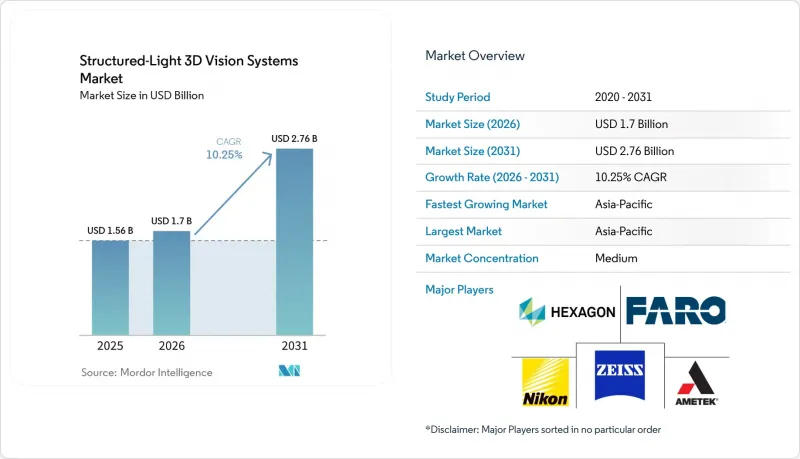
據 Mordor Intelligence 稱,2025 年結構化光學 3D 視覺系統市場價值為 15.6 億美元,預計到 2031 年將達到 27.6 億美元,而 2026 年為 17 億美元,預測期(2026-2031 年)的複合年成長率為 10.25%。
全球結構光3D視覺系統市場趨勢與洞察
智慧工廠和機器人應用的擴展
當機器人單元需要深度感知和尺寸回饋時,結構化光學3D視覺系統市場正迎來新的應用機會。根據國際機器人聯合會(IFR)預測,到2025年,全球工業機器人部署數量將達到62.1萬台。機器人供應商正日益將視覺處理整合到控制器中,而非將其視為獨立的測量儀器,這使得製造商能夠在單元設計階段同時指定感測、運動和偵測功能。庫卡(KUKA)的「iiQKA.AI Vision」平台將2D和3D視覺功能整合到機器人環境中,體現了機器人技術和機器視覺之間更緊密的協作。這種採購方式縮短了結構化光學設備的批准週期,因為感測器預算已納入整個單元,採購決策與搬運、組裝和品質性能掛鉤,而不是單一測量預算。此外,它還降低了採用阻力,使負責人能夠專注於自動化單元的最終成果,而不是單一感測器的價格。
電動車和半導體製造的興起
電動車的結構部件,例如電池托盤和馬達外殼,由於難以對其表面和形狀進行一致的測量,因此需要進行精細的檢測。 「結構光學3D視覺系統市場」正是為了滿足此需求而設立的,它需要對大面積一體成型的鋁壓鑄件進行檢測。 Vision3D在小米SU7和智捷V9的生產專案中展示了其PowerScan 5M330 Pro掃描儀,並報告其單幀精度達到了0.02毫米。先進的半導體封裝也需要對晶圓級、扇出型和系統級封裝(SiP)組件進行檢測,即使封裝形狀的微小變化也會影響組裝品質和下游可靠性。 Koh Young宣布將產能翻番,以滿足AI伺服器和先進半導體客戶的需求。隨著邏輯節點間距的縮小和晶片垂直堆疊的增加,快速表面幾何測量的重要性日益凸顯,尤其是在無法犧牲產能的情況下。檢測能力與先進封裝生產線的生產需求之間的關聯也越來越緊密。
較高的初始系統和整合成本
建構一套完整的檢測單元需要掃描器硬體、夾具、校準目標、重配置軟體以及整合工程。這些要求可能會構成巨大的資本投入障礙,製造商在獲得初步檢測結果之前就需要投入大量資金。因此,對於擁有成熟自動化團隊的大批量製造商而言,進入結構化光學3D視覺系統市場相對容易。然而,將設備連接到環境控制系統和製造執行系統 (MES) 會產生超出掃描器購買價格的成本,因為設備必須在現有的生產線環境和資料管理流程中可靠運作。重新校準、軟體更新和員工培訓會進一步增加實施後的擁有成本,尤其是在內部團隊缺乏光學測量系統及其與生產線整合經驗的情況下。小批量、多品種生產的製造商仍然難以獲得充分的服務,因為他們的預期運轉率可能不足以抵消必要的投資。
細分市場分析
預計到2025年,線上整合生產系統將佔銷售額的42.18%,並在2031年之前以13.48%的複合年成長率成長。此產品類型是結構化光學3D視覺系統市場中規模最大且成長最快的類別。固定式或機器人安裝式感測器使製造商能夠在生產流程中檢測零件。這使得在零件進入下一工序或成為大規模組件的一部分之前,即可識別生產線上的偏差,這是結構化光學3D視覺系統市場的核心應用場景。簡介式感測器只需一次投影圖案曝光即可捕捉表面圖,即使可偵測範圍受到輸送機移動或機器人循環時間的限制,也能保持測量範圍。這種功能適用於零件移動和循環時間至關重要的高產量生產線,為品管團隊提供了觀察所有單元幾何偏差的實用方法。
LMI Technologies 將 Gocator 3500 系列定位為適用於機器人偵測單元中小型零件的偵測設備。固定式和桌面系統仍然適用於實驗室測量和產品初步檢驗。在這些環境中,負責人可以控制照明、精確定位零件,並在全面生產開始前進行詳細檢查。這些系統適用於高解析度詳細資訊比生產速度更重要的場合。手持式系統則用於現場偵測、來料檢驗和供應商審核。在汽車產業的生產線部署中,可能需要對測量系統進行分析並驗證量具的重複性,這會增加現有系統的更換成本。
到2025年,硬體銷售額佔組件銷售額的72.64%,而軟體預計到2031年將以12.96%的複合年成長率成長。相機、投影機、光學元件和處理器仍然是任何檢測單元的必備組件。在整個結構化光學3D視覺系統市場中,硬體仍然是當前支出的基礎,而軟體則是影響每個系統性能的關鍵因素。隨著不同供應商的設備規格越來越趨於一致,軟體層的重要性日益凸顯。這是由於結構化光學3D視覺系統市場的競爭日益激烈,買家越來越重視系統的影像解讀能力、異常處理能力以及與自動化單元的整合能力。重建、缺陷分類和機器人引導能力是重要的差異化因素,尤其是在製造商需要對不規則表面進行可靠判斷,而無需進行大規模人工影像驗證的情況下。
供應商正日益將感測、成像和人工智慧功能整合到工業視覺設備中。服務包括安裝、校準、認證、培訓和支持,這些服務對於確定技術系統是否能在客戶特定的生產環境中提供穩定可靠的結果至關重要。當多個感測器在同一工廠內協同工作時,這些服務的重要性就更加凸顯。由於應用設定、材料表面處理和生產條件在初始部署後可能會發生變化,因此對於需要定期調整的系統,買家可能更傾向於簽訂持續支援合約。隨著軟體和服務模式的轉變,應用知識和現場整合能力的重要性也日益凸顯。
區域分析
預計到2025年,亞太地區將佔全球銷售額的38.56%,並在2031年之前以12.31%的複合年成長率成長。該地區是結構化光學3D視覺系統市場的主要驅動力,這得益於其電子、電動車和半導體製造業的集中,以及系統供應商與對生產速度和精度要求苛刻的客戶之間的距離優勢。中國正在加強其在3D工業相機硬體和演算法各個層面的國內技術能力。韓國和台灣正在拓展其半導體封裝業務,以生產高頻寬記憶體和先進邏輯裝置。日本仍然是精密機器視覺整合商的重要中心,而印度隨著電子組裝的擴張,也擁有長期的發展潛力。
預計到2025年,北美將成為第二大市場。這主要得益於汽車、航太、國防和半導體產業的需求成長,從而擴大了結構化光學3D視覺系統市場的基本客群。美國、加拿大和墨西哥都擁有適合機器人搭載式檢測系統的製造環境,其需求主要來自需要精確零件定位、尺寸回饋和記錄品質檢查的生產線。結構化光學3D視覺系統在食品飲料和製藥行業也具有巨大潛力,這些行業的檢測可以支援品管和合規性活動,包括對生產線上的產品、包裝、密封和搬運進行一致的檢查。墨西哥受益於汽車產能的擴張,需要線上系統來滿足汽車品質要求,從而催生了對能夠在不同供應商和組裝廠穩定運作的生產設備的需求。在加拿大,資源和航太產業維護作業中對可攜式掃描的需求正在推動市場發展。
歐洲是第三大市場,主要得益於德國的工程技術基礎、法國的航太供應鏈以及英國的精密製造和製藥業。德國製造商正在用全範圍光學測量取代部分接觸式工作流程,尤其是在高密度幾何數據能夠提高精度的領域,例如難以用單一探針點評估的複雜形狀的檢測。各地區的研發活動持續推動更快速的線上3D測量系統的發展。南美洲仍處於起步階段,需求主要集中在汽車組裝和礦業機械維護領域,這些領域的投資決策仍然高度依賴設備成本和當地情況。中東和非洲的需求主要集中在沙烏地阿拉伯、阿拉伯聯合大公國、南非以及工業數位化計畫。
其他好處:
- Excel格式的市場預測(ME)表
- 3個月的分析師支持
目錄
第1章:引言
- 研究假設和市場定義
- 調查範圍
第2章:調查方法
第3章執行摘要
第4章 市場狀況
- 市場概覽
- 市場促進因素
- 高精度自動化檢測的需求
- 擴大智慧工廠和機器人的應用
- 電動車和半導體製造的擴張
- 非接觸式測量與逆向工程的發展
- 人工智慧驅動的電腦3D成像
- 內建校準和邊緣處理的要求
- 市場限制因素
- 較高的初始系統和整合成本
- 校準複雜性和測量不確定性
- 反射式、透射式和暗表面成像的限制。
- 互通性和資料所有權的限制
- 宏觀經濟因素對市場的影響
- 產業供應鏈分析
- 監理情勢
- 技術展望
- 波特五力分析
第5章 市場規模與成長預測
- 依產品類型
- 手持式結構光學3D視覺系統
- 固定式/桌面式結構化光學3D視覺系統
- 線上/生產線整合式結構光學3D視覺系統
- 按組件
- 硬體
- 網路攝影機和感測器
- 投影機和照明
- 光學元件和透鏡
- 處理器和影像擷取卡
- 軟體
- 3D重建軟體
- 檢測和測量軟體
- 機器人引導軟體
- 服務
- 安裝與整合
- 校準和認證
- 培訓、支援和諮詢。
- 硬體
- 透過技術
- 邊緣投影和結構光
- 相移型結構光
- 格雷碼結構光
- 多圖案和混合結構光
- 其他結構光技術
- 透過使用
- 尺寸測量和量規測量
- 表面缺陷檢測
- 組裝檢驗
- 機器人引導與揀選
- 逆向工程和3D建模
- 醫學和身體掃描
- 虛擬模擬與數位孿生
- 在文化遺產和媒體領域的應用
- 最終用戶
- 汽車/電動車
- 電子和半導體
- 航太/國防
- 工業設備和機械
- 醫療保健和醫療設備
- 物流和倉儲
- 消費品
- 食品/飲料
- 製藥
- 建築、建造、文化資產
- 按地區
- 北美洲
- 美國
- 加拿大
- 墨西哥
- 南美洲
- 巴西
- 阿根廷
- 其他南美國家
- 歐洲
- 德國
- 英國
- 法國
- 義大利
- 西班牙
- 其他歐洲國家
- 亞太地區
- 中國
- 日本
- 印度
- 韓國
- 其他亞太國家
- 中東和非洲
- 中東
- 沙烏地阿拉伯
- 阿拉伯聯合大公國
- 土耳其
- 其他中東國家
- 非洲
- 南非
- 奈及利亞
- 其他非洲國家
- 中東
- 北美洲
第6章 競爭情勢
- 市場集中度
- 策略趨勢
- 市佔率分析
- 公司簡介
- Hexagon AB
- ZEISS Group
- Nikon Corporation
- FARO Technologies, Inc.
- AMETEK, Inc.
- SHINING 3D Tech Co., Ltd.
- LMI Technologies Inc.
- Cognex Corporation
- KEYENCE CORPORATION
- Basler AG
- SICK AG
- Photoneo sro
- Perceptron, Inc.
- Artec 3D
- Solutionix Corporation
- RangeVision
- ScanTech International, Inc.
- ShapeGrabber, Inc.
- Kreon Technologies
- SmartRay GmbH
- Revopoint 3D Technologies Inc.
第7章 市場機會與未來展望
According to Mordor Intelligence, the Structured-Light 3D vision systems market size was valued at USD 1.56 billion in 2025 and estimated to grow from USD 1.70 billion in 2026 to reach USD 2.76 billion by 2031, at a CAGR of 10.25% during the forecast period (2026-2031).
Global Structured-Light 3D Vision Systems Market Trends and Insights
Expansion of Smart Factory and Robotics Deployments
The Structured-Light 3D Vision Systems Market gains a new installation point whenever a robot cell requires depth perception or dimensional feedback. The International Federation of Robotics reported 621,000 industrial robot installations worldwide in 2025. Robot suppliers are increasingly incorporating vision processing into the controller rather than treating it as a separate metrology purchase, allowing manufacturers to specify sensing, motion, and inspection functions together during cell design. KUKA's iiQKA.AI Vision platform integrates 2D and 3D vision functions within the robot environment, reflecting the closer integration of robotics and machine vision. That purchasing approach can shorten approval cycles for structured-light equipment because the sensor is funded as part of a complete cell, with the purchasing decision tied to handling, assembly, and quality performance rather than a stand-alone measurement budget. It can also lower resistance to adoption, where buyers focus on the output of the automated cell rather than the price of a single sensor.
Rising Electric Vehicle and Semiconductor Manufacturing
Electric vehicle structures, battery trays, and motor housings need detailed inspection because their surfaces and shapes are difficult to measure consistently. The Structured-Light 3D Vision Systems Market serves this need, in which integrated die-cast aluminum parts must be inspected across a broad surface. Vision3D described the use of its PowerScan 5M330 Pro scanner on Xiaomi SU7 and Zhijie V9 production programs, reporting 0.02 mm single-frame accuracy. Advanced semiconductor packaging also requires inspection of wafer-level, fan-out, and system-in-package assemblies, where small variations in package geometry can affect assembly quality and downstream reliability. Koh Young stated that it is doubling production capacity in response to demand from AI server and advanced semiconductor customers. Narrower logic-node pitches and vertically stacked chips increase the value of rapid surface-geometry measurement, when throughput cannot be compromised, making inspection capability more closely linked to the production requirements of advanced packaging lines.
High Initial System and Integration Costs
A complete inspection cell requires scanner hardware, fixtures, calibration targets, reconstruction software, and integration engineering. These requirements can create a significant capital hurdle before a manufacturer receives its first inspection result. The Structured-Light 3D Vision Systems Market is, therefore, easier to enter for high-volume producers with established automation teams. Environmental controls and connections to manufacturing execution systems add costs beyond the scanner purchase, because the equipment must operate reliably under existing line conditions and within data-management processes. Recalibration, software renewals, and worker training can further increase ownership costs after installation, especially when internal teams lack experience with optical measurement systems and production-line integration. Low-volume, high-mix manufacturers remain underserved because their expected utilization may not justify the required investment.
Other drivers and restraints analyzed in the detailed report include:
- Growth of Non-Contact Measurement and Reverse Engineering
- AI-Enabled Computational 3D Imaging
- Calibration Complexity and Measurement Uncertainty
For complete list of drivers and restraints, kindly check the Table Of Contents.
Segment Analysis
Inline and production-integrated systems held 42.18% of revenue in 2025 and are projected to grow at a 13.48% CAGR through 2031. This product type is the largest and fastest-growing category in the Structured-Light 3D Vision Systems Market. Fixed or robot-mounted sensors allow manufacturers to inspect parts within the production flow, so a line can identify deviations before parts move to the next operation or become part of a larger assembly, which is a central use case for the Structured-Light 3D Vision Systems Market. A snapshot sensor can capture a surface map in a single projected-pattern exposure, which helps maintain measurement coverage when the available inspection window is limited by conveyor movement or robotic cycle time. That capability suits high-throughput lines where part movement and cycle time are important, and it gives quality teams a practical way to observe geometric variation across every unit.
LMI Technologies positioned the Gocator 3500 series for small and medium-sized parts in robotic inspection cells. Stationary and desktop systems remain relevant for laboratory metrology and first-article inspection, where personnel can control lighting, position parts carefully, and carry out detailed checks before production ramps up. They are used where high-resolution detail is more important than production speed. Handheld systems are used for field inspections, incoming goods checks, and supplier audits. Inline automotive installations may also require measurement system analysis and gauge repeatability studies, thereby increasing switching costs for installed systems.
Hardware accounted for 72.64% of component revenue in 2025, while software is projected to grow at a 12.96% CAGR through 2031. Cameras, projectors, optics, and processors remain essential purchases for every inspection cell. Hardware continues to anchor current spending across the Structured-Light 3D Vision Systems Market, while software shapes how effectively each system performs. The software layer is gaining importance as equipment specifications become more similar across vendors, since buyers increasingly assess how well a system interprets images, handles exceptions, and connects with the automation cell, strengthening competition within the Structured-Light 3D Vision Systems Market. Reconstruction, defect classification, and robot guidance functions can provide a stronger point of differentiation, particularly when manufacturers need reliable decisions on variable surfaces without extensive manual image review.
Suppliers are combining sensing, imaging, and AI functions more closely within industrial vision equipment. Services include installation, calibration, certification, training, and support, and they can determine whether a technical system produces consistent results in the customer's particular production environment. These services become more important when several sensors operate together within a single facility. Buyers may prefer ongoing support arrangements for systems that require regular adjustments, as application settings, material finishes, and production conditions can change after the initial installation. The shift toward software and services places greater value on application knowledge and local integration capability.
Complete Report Scope:
- By Product Type
- Handheld Structured-Light 3D Vision Systems
- Stationary/Desktop Structured-Light 3D Vision Systems
- Inline/Production-Integrated Structured-Light 3D Vision Systems
- By Component
- Hardware
- Cameras and Sensors
- Projectors and Illumination
- Optics and Lenses
- Processors and Frame Grabbers
- Software
- 3D Reconstruction Software
- Inspection and Measurement Software
- Robot Guidance Software
- Services
- Installation and Integration
- Calibration and Certification
- Training, Support, and Consulting
- Hardware
- By Technology
- Fringe Projection Structured Light
- Phase-Shifting Structured Light
- Gray-Code Structured Light
- Multi-Pattern and Hybrid Structured Light
- Other Structured-Light Technologies
- By Application
- Dimensional Measurement and Gauging
- Surface Defect Detection
- Assembly Verification
- Robot Guidance and Bin Picking
- Reverse Engineering and 3D Modeling
- Medical and Body Scanning
- Virtual Simulation and Digital Twins
- Cultural Heritage and Media Applications
- By End User
- Automotive and Electric Vehicles
- Electronics and Semiconductors
- Aerospace and Defense
- Industrial Equipment and Machinery
- Healthcare and Medical Devices
- Logistics and Warehousing
- Consumer Products
- Food and Beverages
- Pharmaceuticals
- Architecture, Construction, and Heritage
- By Geography
- North America
- United States
- Canada
- Mexico
- South America
- Brazil
- Argentina
- Rest of South America
- Europe
- Germany
- United Kingdom
- France
- Italy
- Spain
- Rest of Europe
- Asia-Pacific
- China
- Japan
- India
- South Korea
- Rest of Asia-Pacific
- Middle East and Africa
- Middle East
- Saudi Arabia
- United Arab Emirates
- Turkey
- Rest of the Middle East
- Africa
- South Africa
- Nigeria
- Rest of Africa
- Middle East
- North America
Geography Analysis
Asia-Pacific accounted for 38.56% of revenue in 2025 and is projected to grow at a 12.31% CAGR through 2031. The region leads the Structured-Light 3D Vision Systems Market because it concentrates electronics, electric vehicle, and semiconductor manufacturing, placing system suppliers near customers with demanding requirements for production speed and precision. China is increasing its domestic capabilities across the 3D industrial camera hardware and algorithm layers. South Korea and Taiwan are expanding semiconductor packaging activity for high-bandwidth memory and advanced logic. Japan remains an important base for precision machine-vision integrators, while India has longer-term potential as electronics assembly expands.
North America was the second-largest region in 2025, supported by demand in automotive, aerospace, defense, and semiconductors, which broadens the customer base for the Structured-Light 3D Vision Systems Market. The United States, Canada, and Mexico each provide manufacturing environments for robot-mounted inspection systems, with demand driven by production lines that require accurate part location, dimensional feedback, and documented quality checks. The Structured-Light 3D Vision Systems Market also has potential in food and beverages and pharmaceuticals, where inspection can support quality and compliance activities, including consistent checks of products, packages, seals, and production-line handling. Mexico benefits from automotive capacity expansion and requires inline systems that meet automotive quality requirements, creating demand for production equipment that can operate consistently across supplier and assembly locations. Canada supports the demand for portable scanning in resource and aerospace maintenance work.
Europe was the third major geography, led by Germany's engineering base, France's aerospace supply chain, and the United Kingdom's precision-manufacturing and pharmaceutical sectors. German manufacturers are replacing some contact-based workflows with full-field optical measurement, particularly where dense geometric data can improve the inspection of complex forms that are difficult to assess through individual probe points. Regional research activity continues to support the development of faster inline 3D measurement systems. South America remains at an earlier stage, with demand centered on automotive assembly and mining-equipment maintenance, where investment decisions remain sensitive to equipment costs and local conditions. The Demand in the Middle East and Africa is concentrated in Saudi Arabia, the United Arab Emirates, South Africa, and industrial digitization programs.
- Hexagon AB
- ZEISS Group
- Nikon Corporation
- FARO Technologies, Inc.
- AMETEK, Inc.
- SHINING 3D Tech Co., Ltd.
- LMI Technologies Inc.
- Cognex Corporation
- KEYENCE CORPORATION
- Basler AG
- SICK AG
- Photoneo s.r.o.
- Perceptron, Inc.
- Artec 3D
- Solutionix Corporation
- RangeVision
- ScanTech International, Inc.
- ShapeGrabber, Inc.
- Kreon Technologies
- SmartRay GmbH
- Revopoint 3D Technologies Inc.
Additional Benefits:
- The market estimate (ME) sheet in Excel format
- 3 months of analyst support
TABLE OF CONTENTS
1 INTRODUCTION
- 1.1 Study Assumptions and Market Definition
- 1.2 Scope of the Study
2 RESEARCH METHODOLOGY
3 EXECUTIVE SUMMARY
4 MARKET LANDSCAPE
- 4.1 Market Overview
- 4.2 Market Drivers
- 4.2.1 Demand for High-Accuracy Automated Inspection
- 4.2.2 Expansion of Smart Factory and Robotics Deployments
- 4.2.3 Rising Electric Vehicle and Semiconductor Manufacturing
- 4.2.4 Growth of Non-Contact Measurement and Reverse Engineering
- 4.2.5 AI-Enabled Computational 3D Imaging
- 4.2.6 Embedded Calibration and Edge Processing Requirements
- 4.3 Market Restraints
- 4.3.1 High Initial System and Integration Costs
- 4.3.2 Calibration Complexity and Measurement Uncertainty
- 4.3.3 Reflective, Transparent, and Dark-Surface Capture Limitations
- 4.3.4 Interoperability and Data-Ownership Constraints
- 4.4 Impact of Macroeconomic Factors on the Market
- 4.5 Industry Supply Chain Analysis
- 4.6 Regulatory Landscape
- 4.7 Technological Outlook
- 4.8 Porter's Five Forces Analysis
- 4.8.1 Bargaining Power of Suppliers
- 4.8.2 Bargaining Power of Buyers
- 4.8.3 Threat of New Entrants
- 4.8.4 Threat of Substitutes
- 4.8.5 Intensity of Competitive Rivalry
5 MARKET SIZE AND GROWTH FORECASTS (VALUE)
- 5.1 By Product Type
- 5.1.1 Handheld Structured-Light 3D Vision Systems
- 5.1.2 Stationary/Desktop Structured-Light 3D Vision Systems
- 5.1.3 Inline/Production-Integrated Structured-Light 3D Vision Systems
- 5.2 By Component
- 5.2.1 Hardware
- 5.2.1.1 Cameras and Sensors
- 5.2.1.2 Projectors and Illumination
- 5.2.1.3 Optics and Lenses
- 5.2.1.4 Processors and Frame Grabbers
- 5.2.2 Software
- 5.2.2.1 3D Reconstruction Software
- 5.2.2.2 Inspection and Measurement Software
- 5.2.2.3 Robot Guidance Software
- 5.2.3 Services
- 5.2.3.1 Installation and Integration
- 5.2.3.2 Calibration and Certification
- 5.2.3.3 Training, Support, and Consulting
- 5.2.1 Hardware
- 5.3 By Technology
- 5.3.1 Fringe Projection Structured Light
- 5.3.2 Phase-Shifting Structured Light
- 5.3.3 Gray-Code Structured Light
- 5.3.4 Multi-Pattern and Hybrid Structured Light
- 5.3.5 Other Structured-Light Technologies
- 5.4 By Application
- 5.4.1 Dimensional Measurement and Gauging
- 5.4.2 Surface Defect Detection
- 5.4.3 Assembly Verification
- 5.4.4 Robot Guidance and Bin Picking
- 5.4.5 Reverse Engineering and 3D Modeling
- 5.4.6 Medical and Body Scanning
- 5.4.7 Virtual Simulation and Digital Twins
- 5.4.8 Cultural Heritage and Media Applications
- 5.5 By End User
- 5.5.1 Automotive and Electric Vehicles
- 5.5.2 Electronics and Semiconductors
- 5.5.3 Aerospace and Defense
- 5.5.4 Industrial Equipment and Machinery
- 5.5.5 Healthcare and Medical Devices
- 5.5.6 Logistics and Warehousing
- 5.5.7 Consumer Products
- 5.5.8 Food and Beverages
- 5.5.9 Pharmaceuticals
- 5.5.10 Architecture, Construction, and Heritage
- 5.6 By Geography
- 5.6.1 North America
- 5.6.1.1 United States
- 5.6.1.2 Canada
- 5.6.1.3 Mexico
- 5.6.2 South America
- 5.6.2.1 Brazil
- 5.6.2.2 Argentina
- 5.6.2.3 Rest of South America
- 5.6.3 Europe
- 5.6.3.1 Germany
- 5.6.3.2 United Kingdom
- 5.6.3.3 France
- 5.6.3.4 Italy
- 5.6.3.5 Spain
- 5.6.3.6 Rest of Europe
- 5.6.4 Asia-Pacific
- 5.6.4.1 China
- 5.6.4.2 Japan
- 5.6.4.3 India
- 5.6.4.4 South Korea
- 5.6.4.5 Rest of Asia-Pacific
- 5.6.5 Middle East and Africa
- 5.6.5.1 Middle East
- 5.6.5.1.1 Saudi Arabia
- 5.6.5.1.2 United Arab Emirates
- 5.6.5.1.3 Turkey
- 5.6.5.1.4 Rest of the Middle East
- 5.6.5.2 Africa
- 5.6.5.2.1 South Africa
- 5.6.5.2.2 Nigeria
- 5.6.5.2.3 Rest of Africa
- 5.6.5.1 Middle East
- 5.6.1 North America
6 COMPETITIVE LANDSCAPE
- 6.1 Market Concentration
- 6.2 Strategic Moves
- 6.3 Market Share Analysis
- 6.4 Company Profiles (includes Global Level Overview, Market Level Overview, Core Segments, Financials as available, Strategic Information, Market Rank/Share, Products and Services, Recent Developments)
- 6.4.1 Hexagon AB
- 6.4.2 ZEISS Group
- 6.4.3 Nikon Corporation
- 6.4.4 FARO Technologies, Inc.
- 6.4.5 AMETEK, Inc.
- 6.4.6 SHINING 3D Tech Co., Ltd.
- 6.4.7 LMI Technologies Inc.
- 6.4.8 Cognex Corporation
- 6.4.9 KEYENCE CORPORATION
- 6.4.10 Basler AG
- 6.4.11 SICK AG
- 6.4.12 Photoneo s.r.o.
- 6.4.13 Perceptron, Inc.
- 6.4.14 Artec 3D
- 6.4.15 Solutionix Corporation
- 6.4.16 RangeVision
- 6.4.17 ScanTech International, Inc.
- 6.4.18 ShapeGrabber, Inc.
- 6.4.19 Kreon Technologies
- 6.4.20 SmartRay GmbH
- 6.4.21 Revopoint 3D Technologies Inc.
7 MARKET OPPORTUNITIES AND FUTURE OUTLOOK
- 7.1 White-Space and Unmet-Need Assessment

 機器人視覺和機器視覺市場預測至2034年——按產品、視覺類型、人工智慧和分析能力、應用、最終用戶和地區分類的全球分析
 2026-2030年全球2D與3D機器視覺系統市場
 雙目雷達與視覺整合系統市場:全球市場預測,2026-2032年
 智慧工廠視覺化系統:市場佔有率分析、產業趨勢與統計、成長預測(2026-2031)機器人標定視覺系統:市場佔有率分析、產業趨勢與統計、成長預測(2026-2031)智慧機器視覺自動化市場預測至2034年—按產品、組件、部署模式、應用、最終用戶和地區分類的全球分析
 3D機器視覺市場規模、佔有率、成長及全球產業分析:按類型、應用和地區分類的洞察,2026-2034年預測全球3D機器視覺市場規模、佔有率、趨勢和成長分析報告(2026-2034年)工業3D機器視覺市場:依產品類型、組件、部署模式、應用、最終用戶產業分類,全球預測(2026-2032年)CNC石材成型機市場按機器類型、銷售管道、應用和最終用戶分類,全球預測(2026-2032年)