


 |
市場調查報告書
商品編碼
2155308
南美洲安全氣囊系統:市佔率分析、產業趨勢與統計及成長預測(2026-2031 年)South America Airbag Systems - Market Share Analysis, Industry Trends & Statistics, Growth Forecasts (2026 - 2031) |
||||||

※ 本網頁內容可能與最新版本有所差異。詳細情況請與我們聯繫。
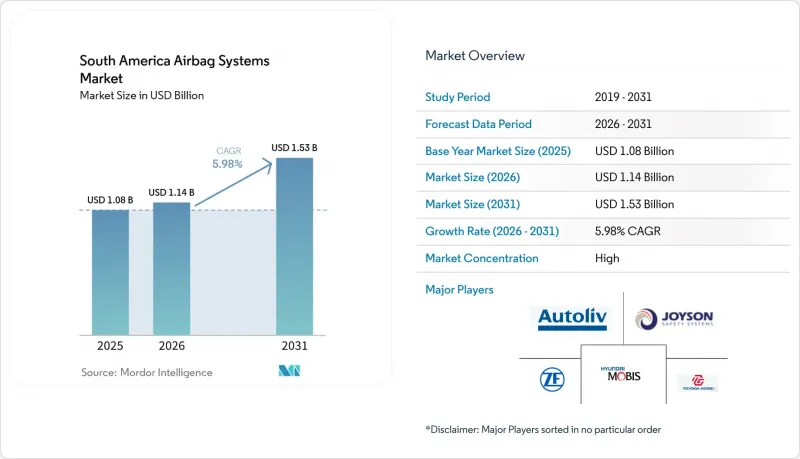
據 Mordor Intelligence 稱,2025 年南美洲安全氣囊系統市值為 10.8 億美元,2026 年預計為 11.4 億美元,預計到 2031 年將達到 15.3 億美元。
預計從 2026 年到 2031 年,其複合年成長率將達到 5.98%。
南美洲安全氣囊系統市場趨勢與洞察
全部區域將實施更嚴格的安全氣囊法規
南美洲的安全標準正從最低設備要求轉向碰撞性能的預期。巴西的CONTRAN 964/2022號決議強制M1和N1類車輛安裝前座安全氣囊,為國產和進口車輛都設定了明確的標準。 949/2022號決議也規定了轎車、SUV和皮卡車側面乘員保護測試的要求。拉丁美洲NCAP 2026-2029協議引入了時速60公里/小時的側面碰撞測試和時速32公里/小時的側面柱撞測試,進一步提升了側面和簾式安全氣囊在車輛設計中的重要性。該協議還考慮了ISOFIX兒童安全座椅介面的安裝情況以及乘客側安全氣囊的停用功能,從而將兒童安全功能與約束系統決策連結起來。這些要求將促使汽車製造商在進行小改款和推出新車型之前,統一採用更全面的安全氣囊組件。
擴大在巴西的OEM生產
巴西的新車計畫持續推動對本地供應安全氣囊系統的需求。通用汽車(GM)已擴大其在巴西的投資計劃,用於混合動力汽車、現代化生產設施和加強工程能力建設。長安汽車和中車集團(CAOA)於2026年3月在安納波利斯啟動了Uni-T SUV的在地化生產,這是2026年至2028年9.5億美元投資計畫的一部分。新平台需要獲得專門的型式認證,這為供應商提供了在每個生產週期內獲得合約的機會。進入巴西市場的中國汽車製造商通常會推出配備全面安全功能的車型,預計將提高每輛本地生產車輛的平均安全氣囊數量。南美安全氣囊系統市場將受益於本地組裝項目,這些項目將提高產量並增強安全功能,而不僅僅是依賴產量。
價格敏感的入門級市場限制了其普及。
在法規沒有強制要求的情況下,為入門級車輛配備額外的安全氣囊仍然是一項挑戰。這類車型的汽車製造商必須在設備升級和消費者期望的價格承受能力之間取得平衡。在巴西和阿根廷,由於進口零件和宏觀經濟的不確定性,採購成本可能很高,因此這項限制更為突出。製造商可以更輕鬆地為價格更高的SUV和皮卡增加四個或六個安全氣囊,因為這些車型的安全設備套裝更容易納入車輛價格範圍。因此,南美安全氣囊系統市場正在出現兩極分化,中階和高階車型的安全氣囊配置顯著增加。而在入門級車型領域,可選安全約束系統的引進仍然緩慢。
細分市場分析
前座安全氣囊模組在新車的搭載率率已接近100%,其龐大的市場規模將在2025年占到總銷售量的46.24%。受哥倫比亞和智利將彈射緩解性能合法化推動,簾式安全氣囊預計將在2026年至2031年間以6.19%的複合年成長率成長,並預計在本十年末佔據南美安全氣囊系統市場近四分之一的佔有率。側邊胸部安全氣囊受益於NCAP柱式撞擊測試標準,佔據了相當大的市場佔有率。膝部安全氣囊被定位為高階配置,在區分大眾Taos和豐田CorollaCross等車型等級方面發揮重要作用。中央安全氣囊和安全帶安全氣囊的市場佔有率較小,但主要安裝在豪華跨界車和德國進口高階車型。供應商認為,像級聯式車頂行李架和車門安裝式簾式氣囊這樣的創新技術最有潛力提高利潤率。
由於規模經濟效應,前座安全氣囊模組佔據市場主導地位,但其成長速度已趨於平緩。同時,隨著安地斯山脈各市場監管實施計畫的逐步落實,側簾式氣囊和胸部保護裝置預計將為車輛帶來新的安全防護層。未來的技術發展趨勢包括採用更輕質的織物、使用密封接縫以減少氣體用量,以及採用人工智慧驅動的充氣控制邏輯,使其能夠適應乘員的姿勢。預計安全氣囊相關收入的下降將推動南美安全氣囊系統市場的大部分成長。
到2025年,乘用車將佔南美洲安全氣囊系統市場的73.16%,這反映了該地區乘用車數量龐大。乘用車是前座安全氣囊模組及相關電子控制設備的主要需求來源。預計到2031年,輕型商用車將以6.23%的複合年成長率成長。皮卡,無論是用於個人運輸還是商務傳輸,都將是這一成長的重要組成部分。這些車輛通常標配4至6個安全氣囊。由於安裝的安全氣囊數量眾多,它們對安全氣囊銷售的貢獻遠超過僅從車輛註冊量推斷出的水平。因此,皮卡和SUV的持續成長正在推動乘用車以外的安全氣囊需求。
雖然中型和重型商用車以及巴士和長途客車的市場佔有率佔比很小,但其安全要求歷來落後於該地區的乘用車。然而,車隊營運商越來越重視乘員保護和保險方面的考量。 2026年2月,Volvo卡車在其面向北美市場的新款VNL和VNR車型上將整合式側簾式氣囊列為標準配備。此舉很好地體現了全球平台車輛安全規範的趨同。隨著車隊買家對更廣泛安全功能的需求,南美商用車安全設備的普及速度可能會超過正式的監管時間表。已向區域車隊供應產品的傳統供應商完全有能力滿足這項需求。
其他好處:
- Excel格式的市場預測(ME)表
- 3個月的分析師支持
目錄
第1章:引言
- 研究假設和市場定義
- 調查範圍
第2章:調查方法
第3章執行摘要
第4章 市場狀況
- 市場概覽
- 市場促進因素
- 加強全部區域安全氣囊法規
- 巴西OEM生產規模擴大
- SUV 和皮卡車的日益普及,推動了配備多安全氣囊系統的車輛數量的增加。
- 消費者對NCAP安全評估的興趣日益濃厚
- 側簾式安全氣囊的車隊保險福利
- 充氣機在地化生產可以降低成本障礙。
- 市場限制因素
- 價格敏感的入門級市場限制了其普及。
- 假冒安全氣囊的進口十分猖獗。
- 特種推進劑用化學品供應鏈中斷
- 將中央安全氣囊整合到傳統平台中面臨的挑戰
- 價值供應鏈分析
- 監理情勢
- 技術展望
- 波特五力分析
第5章 市場規模與成長預測
- 安全氣囊類型
- 前座安全氣囊
- 側邊氣囊
- 側簾式氣囊
- 膝部氣囊
- 中央安全氣囊
- 安全帶氣囊
- 車輛類型
- 搭乘用車
- 輕型商用車(LCV)
- 中型和重型商用車輛(MHCV)
- 巴士和長途汽車
- 按組件
- 安全氣囊模組
- 碰撞感應器
- 氣筒
- 診斷感測器
- 控制單元
- 其他
- 按銷售管道
- 目的地設備製造商
- 售後市場
- 國家
- 巴西
- 阿根廷
- 哥倫比亞
- 智利
- 其他南美國家
第6章 競爭情勢
- 市場集中度
- 策略趨勢
- 市佔率分析
- 公司簡介
- Autoliv Inc.
- ZF Friedrichshafen AG(ZF TRW)
- Joyson Safety Systems
- Toyoda Gosei Co., Ltd.
- Hyundai Mobis Co., Ltd.
- Continental AG
- Robert Bosch GmbH
- Denso Corporation
- Faurecia SE
- Yanfeng Safety Systems
- Kolon Industries, Inc.
- Toyobo Co., Ltd.
- TE Connectivity Ltd.
- Key Safety Systems
第7章 市場機會與未來展望
According to Mordor Intelligence, the South American airbag systems market size was valued at USD 1.08 billion in 2025, is estimated at USD 1.14 billion in 2026, and is projected to reach USD 1.53 billion by 2031, growing at a CAGR of 5.98% from 2026 to 2031.
South America Airbag Systems Market Trends and Insights
Stricter Region-Wide Airbag Regulations
Safety rules across South America are moving beyond minimum equipment requirements toward crash-performance expectations. Brazil's CONTRAN Resolution 964/2022 requires frontal airbags in M1 and N1 vehicles, establishing a clear baseline for both locally produced and imported models. Resolution 949/2022 also established lateral occupant-protection testing requirements for sedans, SUVs, and pickups. Latin NCAP's 2026-2029 protocol introduced a 60 km/h side-barrier test and a 32 km/h side-pole test, increasing the value of side and curtain protection in vehicle design. The protocol also considers ISOFIX availability and the ability to deactivate the passenger airbag, thereby connecting child safety features to restraint-system decisions. These requirements encourage automakers to standardize broader airbag packages before a facelift or a new model launch.
OEM Production Expansion in Brazil
Brazil's new vehicle programs create recurring demand for locally supplied airbag systems. General Motors increased its investment commitment in Brazil for hybrid vehicles, manufacturing modernization, and engineering capabilities. Changan and CAOA began local production of the Uni-T SUV in Anapolis in March 2026 as part of a USD 950 million investment cycle for 2026-2028 . The new platforms require dedicated homologation and give suppliers an opportunity to secure contracts for the duration of each production run. Chinese automakers entering Brazil commonly introduce vehicles with comprehensive safety equipment, which can raise the average number of airbags per locally produced vehicle. The South American airbag system market benefits when local assembly programs combine volume growth with higher safety content rather than relying only on unit output.
Price-Sensitive Entry-Level Segment Limits Adoption
Entry-level vehicles remain difficult to equip with additional airbags when rules do not require them. Vehicle makers in this category must balance equipment upgrades with the affordability buyers expect. This constraint is more evident in Brazil and Argentina, where imported components and macroeconomic uncertainty can raise sourcing costs. Manufacturers can more easily add 4 or 6 airbags to higher-priced SUVs and pickups, where the safety package is easier to support within the vehicle's price. The result is a split within the South American airbag system market, with stronger content growth in mid-range and premium vehicles. The entry-level segment continues to slow the adoption of optional restraint systems.
Other drivers and restraints analyzed in the detailed report include:
- Rising SUV and Pickup Penetration Boosting Multi-Airbag Count
- Growing Consumer Focus on NCAP Safety Ratings
- Prevalence of Counterfeit Airbag Imports
For complete list of drivers and restraints, kindly check the Table Of Contents.
Segment Analysis
Front modules already penetrate close to 100% of new builds, yet they still generated 46.24% of 2025 revenue owing to sheer volume. Curtain airbags are forecast to grow at a 6.19% CAGR between 2026 and 2031 as Colombia and Chile legislate ejection-mitigation performance, edging their share toward one-quarter of the South America airbag systems market by the end of the decade. Side-thorax units, benefiting from NCAP's pole-impact criteria, account for a significant portion of the market value. Knee airbags serve as a premium feature, distinguishing trims of the Volkswagen Taos and Toyota Corolla Cross. While center and seatbelt airbags hold a minimal share of the market, they're primarily found in high-end crossovers and luxury imports from Germany. Suppliers see the most promise for margin expansion in innovations such as cascading roof rails or door-mounted curtains.
While front modules dominate, offering scale efficiencies, their growth is beginning to plateau. On the other hand, as regulatory timelines come into play in various Andean markets, curtains and thorax units are set to introduce new content layers in vehicles. Future technology trends highlight a shift towards lighter fabrics, sealed seams that reduce fill gas volumes, and AI-driven inflator logic that adapts to occupant posture. Curtailed airbag revenues are expected to drive a significant portion of the growth in South America's airbag systems market.
Passenger cars accounted for 73.16% of the South American airbag system market in 2025, reflecting the high volume of this vehicle category in the region. Passenger cars provide the base demand for frontal airbag modules and related electronic controls. Light commercial vehicles are projected to grow at a 6.23% CAGR through 2031. Pickups make up a major part of this expansion because they are used for both personal and commercial transport. These vehicles typically include 4 to 6 airbags as standard safety equipment. The higher system count makes their contribution to airbag revenue greater than vehicle registrations alone suggest. The ongoing pickup-and-SUV shift, therefore, supports airbag demand beyond the passenger-car base.
Medium and heavy commercial vehicles, along with buses and coaches, hold smaller absolute shares. Their safety requirements have historically developed more slowly than requirements for passenger vehicles in the region. Fleet operators are nevertheless placing more weight on occupant protection and insurance considerations. Volvo Trucks made integrated side-curtain airbags standard on its new VNL and VNR models for North America in February 2026 . The move provides a relevant example as vehicle safety specifications converge across global platforms. South American commercial-vehicle adoption may emerge ahead of formal regulatory schedules when fleet buyers seek broader safety equipment. Established suppliers already serving regional fleets are positioned to address this demand.
Complete Report Scope:
- By Airbag Type
- Front Airbags
- Side Airbags
- Curtain Airbags
- Knee Airbags
- Center Airbags
- Seatbelt Airbags
- By Vehicle Type
- Passenger Cars
- Light Commercial Vehicles (LCVs)
- Medium & Heavy Commercial Vehicles (MHCVs)
- Buses and Coaches
- By Component
- Airbag Module
- Crash Sensor
- Inflator
- Diagnostic Sensor
- Control Unit
- Others
- By Sales Channel
- Original Equipment Manufacturer
- Aftermarket
- By Country
- Brazil
- Argentina
- Colombia
- Chile
- Rest of South America
List of Companies Covered in this Report:
- Autoliv Inc.
- ZF Friedrichshafen AG (ZF TRW)
- Joyson Safety Systems
- Toyoda Gosei Co., Ltd.
- Hyundai Mobis Co., Ltd.
- Continental AG
- Robert Bosch GmbH
- Denso Corporation
- Faurecia SE
- Yanfeng Safety Systems
- Kolon Industries, Inc.
- Toyobo Co., Ltd.
- TE Connectivity Ltd.
- Key Safety Systems
Additional Benefits:
- The market estimate (ME) sheet in Excel format
- 3 months of analyst support
TABLE OF CONTENTS
1 Introduction
- 1.1 Study Assumptions and Market Definition
- 1.2 Scope of the Study
2 Research Methodology
3 Executive Summary
4 Market Landscape
- 4.1 Market Overview
- 4.2 Market Drivers
- 4.2.1 Stricter Region-Wide Airbag Regulations
- 4.2.2 OEM Production Expansion in Brazil
- 4.2.3 Rising SUV and Pickup Penetration Boosting Multi-Airbag Count
- 4.2.4 Growing Consumer Focus on NCAP Safety Ratings
- 4.2.5 Fleet Insurance Incentives for Side-Curtain Airbags
- 4.2.6 Localization of Inflator Manufacturing Lowering Cost Barriers
- 4.3 Market Restraints
- 4.3.1 Price-Sensitive Entry-Level Segment Limits Adoption
- 4.3.2 Prevalence of Counterfeit Airbag Imports
- 4.3.3 Supply-Chain Disruptions for Specialized Propellant Chemicals
- 4.3.4 Integration Challenges of Center Airbags With Legacy Platforms
- 4.4 Value / Supply-Chain Analysis
- 4.5 Regulatory Landscape
- 4.6 Technological Outlook
- 4.7 Porter's Five Forces Analysis
- 4.7.1 Threat of New Entrants
- 4.7.2 Bargaining Power of Suppliers
- 4.7.3 Bargaining Power of Buyers
- 4.7.4 Threat of Substitutes
- 4.7.5 Intensity of Competitive Rivalry
5 Market Size and Growth Forecasts (Value in USD)
- 5.1 By Airbag Type
- 5.1.1 Front Airbags
- 5.1.2 Side Airbags
- 5.1.3 Curtain Airbags
- 5.1.4 Knee Airbags
- 5.1.5 Center Airbags
- 5.1.6 Seatbelt Airbags
- 5.2 By Vehicle Type
- 5.2.1 Passenger Cars
- 5.2.2 Light Commercial Vehicles (LCVs)
- 5.2.3 Medium & Heavy Commercial Vehicles (MHCVs)
- 5.2.4 Buses and Coaches
- 5.3 By Component
- 5.3.1 Airbag Module
- 5.3.2 Crash Sensor
- 5.3.3 Inflator
- 5.3.4 Diagnostic Sensor
- 5.3.5 Control Unit
- 5.3.6 Others
- 5.4 By Sales Channel
- 5.4.1 Original Equipment Manufacturer
- 5.4.2 Aftermarket
- 5.5 By Country
- 5.5.1 Brazil
- 5.5.2 Argentina
- 5.5.3 Colombia
- 5.5.4 Chile
- 5.5.5 Rest of South America
6 Competitive Landscape
- 6.1 Market Concentration
- 6.2 Strategic Moves
- 6.3 Market Share Analysis
- 6.4 Company Profiles {(Includes Global level Overview, Market level overview, Core Segments, Financials as available, Strategic Information, Market Rank/Share for key companies, Products & Services, and Recent Developments)}
- 6.4.1 Autoliv Inc.
- 6.4.2 ZF Friedrichshafen AG (ZF TRW)
- 6.4.3 Joyson Safety Systems
- 6.4.4 Toyoda Gosei Co., Ltd.
- 6.4.5 Hyundai Mobis Co., Ltd.
- 6.4.6 Continental AG
- 6.4.7 Robert Bosch GmbH
- 6.4.8 Denso Corporation
- 6.4.9 Faurecia SE
- 6.4.10 Yanfeng Safety Systems
- 6.4.11 Kolon Industries, Inc.
- 6.4.12 Toyobo Co., Ltd.
- 6.4.13 TE Connectivity Ltd.
- 6.4.14 Key Safety Systems
7 Market Opportunities and Future Outlook

 汽車安全系統和安全氣囊技術市場預測至2034年-全球分析(按安全系統類型、主動安全系統、安全氣囊組件、車輛動力傳動系統、銷售管道、技術、應用、最終用戶和地區分類)
 安全氣囊電子設備市場規模、佔有率、成長率、全球產業分析、區域趨勢及2026-2034年預測
 2026-2030年全球汽車安全氣囊市場
 2026-2030年全球汽車安全氣囊感知器市場
 汽車安全氣囊:市場佔有率分析、產業趨勢與統計、成長預測(2026-2031)
 汽車安全氣囊市場:按產品類型、纖維類型、塗層類型、組件類型、車輛類型和地區分類中國安全氣囊系統:市佔率分析、產業趨勢與統計及成長預測(2026-2031年)
 汽車安全氣囊市場報告:趨勢、預測與競爭分析(至2035年)汽車側簾式氣囊:市場佔有率分析、產業趨勢與統計及成長預測(2026-2031)
 2026-2030年全球汽車安全氣囊電控系統(ECU)市場