


 |
市場調查報告書
商品編碼
2113854
中國安全氣囊系統:市佔率分析、產業趨勢與統計及成長預測(2026-2031年)China Airbag Systems - Market Share Analysis, Industry Trends & Statistics, Growth Forecasts (2026 - 2031) |
||||||

※ 本網頁內容可能與最新版本有所差異。詳細情況請與我們聯繫。
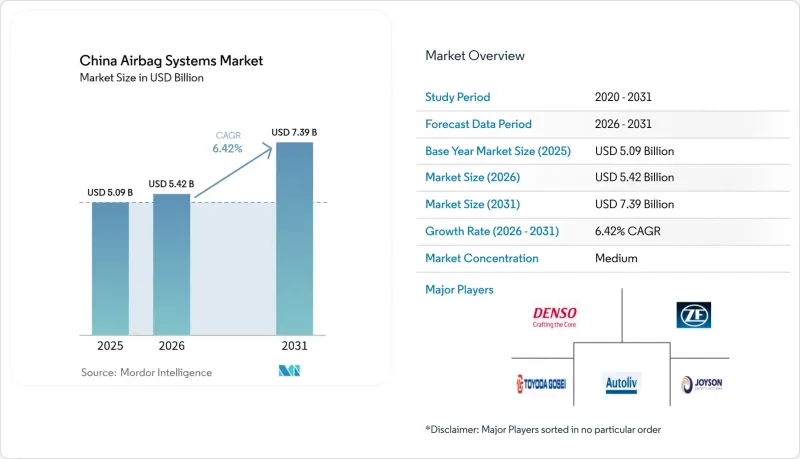
據 Mordor Intelligence 稱,中國安全氣囊系統市場預計到 2026 年價值 54.2 億美元,高於 2025 年的 50.9 億美元,預計到 2031 年將達到 73.9 億美元。
預計 2026 年至 2031 年的複合年成長率為 6.42%。
本報告按安全氣囊類型(前座安全氣囊、側面安全氣囊等)、車輛類型(乘用車、輕型商用車等)、組件(安全氣囊模組、碰撞感知器等)和銷售管道(原廠配套和售後市場)進行分類。市場預測以美元計價。
中國安全氣囊系統市場趨勢與洞察
強制法規 GB 15083 和 GB 14166
GB 15083 規定了多場景碰撞性能測試,而 GB 14166 則規定了充氣裝置的化學成分和啟動時間。供應商必須透過國家市場監督管理總局 (SAMR) 認證的測試實驗室檢驗兩段式展開、側面碰撞完整性以及無疊氮化物推進劑的穩定性。雖然遵守這些法規會略微增加工程預算,但它們確保了每年生產多種新車型的可預測標準。擁有認證測試設施、數位孿生技術和可追溯性軟體的大型企業可以將檢驗週期縮短五分之一,從而在產品上市速度方面獲得競爭優勢。國內小規模的企業通常與吉林省或重慶的專業測試實驗室合作,以避免建設資本密集的碰撞測試設施,從而加強中國安全氣囊系統市場的協同創新。
乘用車產量增加
預計到2024年,產量將恢復到2020年之前的水平,並持續穩定成長至2027年。生產集中在廣東、上海和湖北三省,這使得模組供應商的物流成本比海運進口降低了五分之一。 2018年至2020年間生產的車輛的大量換裝刺激了售後市場的替換需求,而政府對報廢車輛的激勵措施則維持了車身組裝廠的產量。可預測的訂單情況使得一級供應商能夠在短時間內收回在武漢大型工廠的投資,從而增強了中國安全氣囊系統市場的規模經濟效益。
召回相關的成本和責任激增。
中國國家市場監督管理總局(SAMR)積極與歐盟和美國監管機構簽署資料共用協議,使得在國內事故報告之前即可進行預防性召回。寶馬公司決定在2024年召回大量車輛,迫使其供應商累計大量資金用於糾正措施和訴訟費用。因此,產品責任險飆升,給利潤微薄的中型供應商帶來了巨大的財務壓力。目的地設備製造商(OEM)合約中現在包含懲罰性條款,有效地將召回風險的負擔轉移到下游。為了應對日益嚴格的審查,供應商正在轉向採用區塊鏈技術來確保零件的可追溯性。然而,此舉也導致中國競爭激烈的安全氣囊系統市場的專案報價週期延長。
細分市場分析
2025年,前座安全氣囊在中國安全氣囊系統市場仍將佔最大佔有率,達到41.15%,而中央安全氣囊預計將以6.45%的複合年成長率穩定成長至2031年。這一成長主要歸功於C-NCAP碰撞測試評分規則(該規則評估迎面而來的碰撞保護性能)以及電動車座艙寬度的增加,為座艙中央的模組提供了更多空間。在豪華轎車和跨界車上市的推動下,預計中國中央安全氣囊市場在預測期內將顯著成長。供應商已改進了爆裂縫線縫紉技術,以消除座椅套褶皺的美觀問題,此前這一問題曾阻礙了座椅套的普及。同時,由於監管要求,側氣囊和簾式氣囊的需求依然強勁,而膝部氣囊正逐漸成為運動型轎車的特色配置。
簾式氣囊模組正朝著雙腔設計發展,可同時為前後排乘客提供緩衝保護。為了應對日益複雜的結構,業界領導企業正在引入高速折疊機器人和雷射引導縫紉台,顯著提升生產效率。雖然整合於安全帶的氣囊仍處於試驗階段,但已獲得自動駕駛原型機的研發津貼,這表明其長期發展潛力巨大。中央氣囊的激增並非曇花一現。其技術進步,尤其是在新材料和緊湊型充氣裝置方面的應用,正輻射到其他模組類別,進一步加速中國安全氣囊系統市場的創新步伐。
預計到2025年,乘用車將佔交付的83.10%,相當於超過2,100萬個模組,而公車和長途客車預計將以6.46%的複合年成長率超越乘用車。電子商務物流正在推動輕型商用車的持續更新換代,而注重環保的城市法規則促使配備標準側翻簾的電動公車競標激增。隨著地方政府將公共交通工具乘員安全放在首位,預計中國商用客運安全氣囊系統市場在預測期內將迎來顯著成長。
在危險品運輸路線上,卡車現在必須配備雙充氣式駕駛側安全氣囊和預束式安全帶,這顯著提高了每個駕駛室的價值。貨運公司認知到這些措施帶來的好處,例如減少停機時間和降低保險費用,這增強了提供高品質安全設備的供應商的議價能力。隨著更大尺寸駕駛室的出現(這些駕駛室可以容納更厚的轉向輪轂),供應商目前正在測試尺寸更大的駕駛員側安全氣囊,這些氣囊相比轎車上的標準配置有了顯著的升級。這種專業技術投入清楚地表明,許多公司正在採取多元化策略,以抵消中國安全氣囊系統市場乘用車需求的週期性波動。
其他好處:
- Excel格式的市場預測(ME)表
- 3個月的分析師支持
目錄
第1章:引言
- 研究假設和市場定義
- 調查範圍
第2章:調查方法
第3章執行摘要
第4章 市場狀況
- 市場概覽
- 市場促進因素
- 關於強制實施GB 15083和GB 14166的規定
- 乘用車產量增加
- C-NCAP 2024 年版:中央安全氣囊和遠端安全氣囊的星級評定有所提升。
- 人工智慧驅動的乘員偵測技術可實現自適應安全氣囊。
- 電動車和SUV的日益精密化導致每輛車安裝的安全氣囊數量增加。
- 本地生產的充氣裝置和推進劑可降低單位成本。
- 市場限制因素
- 召回相關成本和責任激增。
- 仿冒品和平行輸入的安全氣囊損害信任。
- 不含疊氮化物的推進劑化學品供應短缺
- 新型安全氣囊概念的型式認證出現延誤
- 價值供應鏈分析
- 監理情勢
- 技術展望
- 波特五力模型
第5章 市場規模與成長預測
- 安全氣囊類型
- 前座安全氣囊
- 側邊氣囊
- 側簾式氣囊
- 膝部氣囊
- 中央安全氣囊
- 安全帶氣囊
- 車輛類型
- 搭乘用車
- 輕型商用車
- 中型和大型商用車輛
- 巴士和長途汽車
- 按組件
- 安全氣囊模組
- 碰撞感應器
- 氣筒
- 診斷感測器
- 控制單元
- 其他
- 按銷售管道
- OEM
- 售後市場
第6章 競爭情勢
- 市場集中度
- 策略趨勢
- 市佔率分析
- 公司簡介
- Autoliv Inc.
- Joyson Safety Systems
- ZF Friedrichshafen AG(TRW)
- Toyoda Gosei Co., Ltd.
- Yanfeng Automotive Safety Systems
- Jinheng Automotive Safety Technology
- Ningbo Joyson Electronic Corp.
- Denso Corporation
- Robert Bosch GmbH
- Continental AG
- Daicel Corporation
- Hyundai Mobis Co., Ltd.
- BYD Co., Ltd.
- Changzhou Changrui Automotive Parts
- Jiangsu Favour Automotive Parts
- TaiHangChangQing Automotive Safety System
- ARC Automotive Inc.
- Ashimori Industry Co., Ltd.
- Fawer Automotive Parts
第7章 市場機會與未來展望
According to Mordor Intelligence, China airbag systems market size in 2026 is estimated at USD 5.42 billion, growing from 2025 value of USD 5.09 billion with 2031 projections showing USD 7.39 billion, growing at 6.42% CAGR over 2026-2031.
This report is Segmented by Airbag Type (Front Airbags, Side Airbags, and More), Vehicle Type (Passenger Cars, Light Commercial Vehicles, and More), Component (Airbag Module, Crash Sensor, and More), and Sales Channel (OEM and Aftermarket). The Market Forecasts are Provided in Terms of Value (USD).
China Airbag Systems Market Trends and Insights
Mandatory GB 15083 and GB 14166 Regulations
GB 15083 details multi-scenario crash performance tests, while GB 14166 governs inflator chemistry and timing. Suppliers must validate dual-stage deployment, side-impact integrity, and azide-free propellant stability through SAMR-accredited labs. Compliance increases engineering budgets by a minimal amount, but regulations ensure a predictable baseline for the production of multiple new vehicles each year . Established players with certified test corridors, digital twins, and traceability software shorten validation cycles by one-fifth, gaining a time-to-market edge. Smaller domestic firms often partner with specialty labs in Jilin or Chongqing to avoid capital-intensive crash facilities, reinforcing collaborative innovation across the Chinese airbag systems market.
Rising Passenger-Vehicle Output
Volumes rebounded to pre-2020 levels in 2024 and are projected to track a steady annual increase through 2027. Production is heavily concentrated in Guangdong, Shanghai, and Hubei, allowing module suppliers to offset logistics costs by one-fifth compared to sea freight imports. Fleet renewal waves from 2018-2020 vintages stimulate aftermarket replacements, while government scrappage incentives maintain throughput at body-assembly plants. The predictable order books enable tier-ones to amortize the Wuhan mega-plant over a shorter horizon, reinforcing scale economics within the China airbag systems market.
Recall-Related Cost and Liability Spikes
In a proactive move, SAMR has signed a data-sharing agreement with regulators in both the EU and the United States, leading to precautionary recalls even before any domestic incidents are reported. BMW's decision to recall a significant number of units in 2024 compelled its suppliers to set aside a substantial amount for remediation and legal expenses. As a result, product-liability insurance premiums surged considerably, putting financial pressure on mid-tier suppliers operating on slim margins. Original Equipment Manufacturer (OEM) contracts have evolved to incorporate punitive liquidated-damage clauses that effectively transfer the burden of recall risks downstream. This heightened scrutiny has led suppliers to adopt blockchain technology for part traceability. However, this move has also extended the duration of program quotations in the competitive Chinese airbag systems market.
Other drivers and restraints analyzed in the detailed report include:
- C-NCAP 2024 Star-Rating Upgrade for Center and Far-Side Airbags
- AI-Driven Occupant-Sensing Enables Adaptive Airbags
- Counterfeit/Grey-Market Airbags Erode Trust
For complete list of drivers and restraints, kindly check the Table Of Contents.
Segment Analysis
Front airbags retained the largest 41.15% slice of the China airbag systems market in 2025, yet center airbags are on track for a robust 6.45% CAGR through 2031. That surge stems from C-NCAP scoring rules that reward far-side protection, as well as from the increasing width of EV interiors, which creates space for mid-cabin modules. Driven by the launch of premium sedans and crossovers, the market for center airbags in China is expected to witness significant growth over the forecast period. Suppliers have refined burst-seam stitching techniques to eliminate seat-cover wrinkling, a cosmetic concern that previously hindered adoption. Meanwhile, regulatory mandates ensure consistent demand for side and curtain airbags, and knee airbags find their place as a niche feature in sports sedans.
Curtain modules are evolving into dual-chamber formats, offering simultaneous cushioning for both front- and rear-row occupants. To navigate this added complexity, industry leaders are turning to high-speed folding robots and laser-guided sewing tables, achieving notable improvements in production efficiency. While seatbelt-integrated airbags remain in the experimental phase, they're drawing R&D grants for autonomous-driving prototypes, hinting at a potential surge in interest in the long term. The center-airbag surge is not just a standalone event; its technological advancements, especially in novel fabrics and compact inflators, are permeating other module categories, amplifying the innovation momentum in China's airbag systems market.
Passenger cars commanded 83.10% of deliveries in 2025, translating to more than 21 million modules, but buses and coaches will outpace with a 6.46% CAGR. E-commerce logistics spur continuous light commercial-vehicle replacement cycles, while green-city mandates trigger electric bus tenders that specify side-rollover curtains as standard. Municipalities are prioritizing occupant safety for public fleets, driving the China airbag systems market for commercial passenger transport to experience significant growth over the forecast period.
In hazardous-materials corridors, trucks are now mandated to have dual-inflator driver bags and seatbelt pretensioners, leading to a notable increase in per-cab value. Freight operators, recognizing the benefits of reduced downtime and lower insurance rates, are elevating the bargaining power of premium safety vendors. With heavy-duty cabs accommodating thicker steering hubs, suppliers are now testing larger driver airbags, a significant upgrade from the standard found in sedans. This specialized engineering move underscores the diversification strategy many firms are adopting to counterbalance the cyclical demand for passenger cars in China's airbag systems market.
Complete Report Scope:
- By Airbag Type
- Front Airbags
- Side Airbags
- Curtain Airbags
- Knee Airbags
- Center Airbags
- Seatbelt Airbags
- By Vehicle Type
- Passenger Cars
- Light Commercial Vehicles
- Medium & Heavy Commercial Vehicles
- Buses & Coaches
- By Component
- Airbag Module
- Crash Sensor
- Inflator
- Diagnostic Sensor
- Control Unit
- Others
- By Sales Channel
- OEM
- Aftermarket
List of Companies Covered in this Report:
- Autoliv Inc.
- Joyson Safety Systems
- ZF Friedrichshafen AG (TRW)
- Toyoda Gosei Co., Ltd.
- Yanfeng Automotive Safety Systems
- Jinheng Automotive Safety Technology
- Ningbo Joyson Electronic Corp.
- Denso Corporation
- Robert Bosch GmbH
- Continental AG
- Daicel Corporation
- Hyundai Mobis Co., Ltd.
- BYD Co., Ltd.
- Changzhou Changrui Automotive Parts
- Jiangsu Favour Automotive Parts
- TaiHangChangQing Automotive Safety System
- ARC Automotive Inc.
- Ashimori Industry Co., Ltd.
- Fawer Automotive Parts
Additional Benefits:
- The market estimate (ME) sheet in Excel format
- 3 months of analyst support
TABLE OF CONTENTS
1 Introduction
- 1.1 Study Assumptions and Market Definition
- 1.2 Scope of the Study
2 Research Methodology
3 Executive Summary
4 Market Landscape
- 4.1 Market Overview
- 4.2 Market Drivers
- 4.2.1 Mandatory GB 15083 and GB 14166 Regulations
- 4.2.2 Rising Passenger-Vehicle Output
- 4.2.3 C-NCAP 2024 Star-Rating Upgrade For Center and Far-Side Airbags
- 4.2.4 AI-Driven Occupant-Sensing Enables Adaptive Airbags
- 4.2.5 EV/SUV Premiumization Increases Airbags-Per-Car
- 4.2.6 Localized Inflator & Propellant Supply Cuts Unit Cost
- 4.3 Market Restraints
- 4.3.1 Recall-Related Cost and Liability Spikes
- 4.3.2 Counterfeit/Grey-Market Airbags Erode Trust
- 4.3.3 Tight Supply Of Azide-Free Propellant Chemicals
- 4.3.4 Homologation Lag For Emerging Airbag Concepts
- 4.4 Value/Supply-Chain Analysis
- 4.5 Regulatory Landscape
- 4.6 Technological Outlook
- 4.7 Porter's Five Forces
- 4.7.1 Supplier Power
- 4.7.2 Buyer Power
- 4.7.3 Threat of New Entrants
- 4.7.4 Threat of Substitutes
- 4.7.5 Competitive Rivalry
5 Market Size and Growth Forecasts (Value (USD))
- 5.1 By Airbag Type
- 5.1.1 Front Airbags
- 5.1.2 Side Airbags
- 5.1.3 Curtain Airbags
- 5.1.4 Knee Airbags
- 5.1.5 Center Airbags
- 5.1.6 Seatbelt Airbags
- 5.2 By Vehicle Type
- 5.2.1 Passenger Cars
- 5.2.2 Light Commercial Vehicles
- 5.2.3 Medium & Heavy Commercial Vehicles
- 5.2.4 Buses & Coaches
- 5.3 By Component
- 5.3.1 Airbag Module
- 5.3.2 Crash Sensor
- 5.3.3 Inflator
- 5.3.4 Diagnostic Sensor
- 5.3.5 Control Unit
- 5.3.6 Others
- 5.4 By Sales Channel
- 5.4.1 OEM
- 5.4.2 Aftermarket
6 Competitive Landscape
- 6.1 Market Concentration
- 6.2 Strategic Moves
- 6.3 Market Share Analysis
- 6.4 Company Profiles (Includes Global Level Overview, Market Level Overview, Core Segments, Financials as Available, Strategic Information, Market Rank/Share for Key Companies, Products and Services, SWOT Analysis, and Recent Developments)
- 6.4.1 Autoliv Inc.
- 6.4.2 Joyson Safety Systems
- 6.4.3 ZF Friedrichshafen AG (TRW)
- 6.4.4 Toyoda Gosei Co., Ltd.
- 6.4.5 Yanfeng Automotive Safety Systems
- 6.4.6 Jinheng Automotive Safety Technology
- 6.4.7 Ningbo Joyson Electronic Corp.
- 6.4.8 Denso Corporation
- 6.4.9 Robert Bosch GmbH
- 6.4.10 Continental AG
- 6.4.11 Daicel Corporation
- 6.4.12 Hyundai Mobis Co., Ltd.
- 6.4.13 BYD Co., Ltd.
- 6.4.14 Changzhou Changrui Automotive Parts
- 6.4.15 Jiangsu Favour Automotive Parts
- 6.4.16 TaiHangChangQing Automotive Safety System
- 6.4.17 ARC Automotive Inc.
- 6.4.18 Ashimori Industry Co., Ltd.
- 6.4.19 Fawer Automotive Parts
7 Market Opportunities & Future Outlook
- 7.1 White-space & Unmet-Need Assessment

 2026-2030年全球汽車安全氣囊市場
 2026-2030年全球汽車安全氣囊感知器市場
 汽車安全氣囊:市場佔有率分析、產業趨勢與統計、成長預測(2026-2031)
 汽車安全氣囊市場:按產品類型、纖維類型、塗層類型、組件類型、車輛類型和地區分類
 汽車安全氣囊市場報告:趨勢、預測與競爭分析(至2035年)汽車側簾式氣囊:市場佔有率分析、產業趨勢與統計及成長預測(2026-2031)
 汽車安全氣囊市場:2026-2032年全球市場預測(依安全氣囊類型、車輛類型、展開方式、材料及銷售管道分類)
 汽車安全氣囊市場分析及預測(至2035年):按類型、產品、技術、組件、應用、材料類型、部署方式、最終用戶、功能和安裝類型分類
 安全氣囊控制單元市場規模、佔有率和成長分析:按產品類型、車輛類型、感測器類型、相容安全氣囊類型、銷售管道、驅動系統和地區分類-2026-2033年產業預測
 安全氣囊系統市場規模、佔有率和成長分析:按產品類型、組件、車輛類型、應用、最終用戶產業、技術和地區分類-2026-2033年產業預測