


 |
市場調查報告書
商品編碼
2121432
汽車側簾式氣囊:市場佔有率分析、產業趨勢與統計及成長預測(2026-2031)Automotive Curtain Airbags - Market Share Analysis, Industry Trends & Statistics, Growth Forecasts (2026 - 2031) |
||||||

※ 本網頁內容可能與最新版本有所差異。詳細情況請與我們聯繫。
據 Mordor Intelligence 稱,汽車側簾式氣囊市場預計到 2026 年價值 47.1 億美元,高於 2025 年的 44.8 億美元,預計到 2031 年將達到 60.9 億美元。
預計 2026 年至 2031 年的複合年成長率為 5.24%。
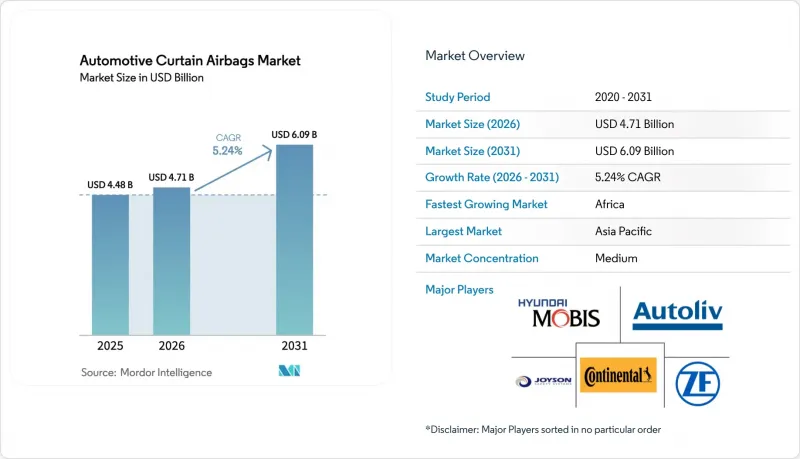
本報告按側簾式氣囊類型(例如,軀幹側簾式氣囊、頭部側簾式氣囊)、車輛類型(例如,掀背車、轎車、運動型多用途車)、最終用戶(原始設備製造商和售後市場)、充氣技術(例如,煙火式、儲氣式)、銷售管道(例如,傳統經銷商)和地區進行細分。市場預測以美元計價。
全球汽車側簾式氣囊市場趨勢及洞察
關於側面碰撞和翻車事故的嚴格法規正在推動全球範圍內的普及。
全球技術法規14號(GTR 14)統一了各市場的頭部損傷標準,並強制要求原始設備製造商(OEM)在所有平台上安裝側簾式氣囊,而不僅僅是出口車型。澳洲新的側面碰撞法規強制要求展開側簾式氣囊,已使乘員死亡率降低了30%。在此之前,美國國家公路交通安全管理局(NHTSA)預測,強制安裝側氣囊每年可挽救311條生命,這一目標得到了其碰撞事故資料庫的實證檢驗。隨著印度逐步立法強制安裝六個氣囊,以及巴西新車碰撞測試(NCAP)將星級評定與車頂側簾式氣囊的安裝掛鉤,供應商正受益於一系列法規的推動,這些法規正逐漸將側簾式氣囊從可選配置中移除。因此,織物、充氣裝置和啟動裝置的大宗訂單已提前數年鎖定,即使在經濟低迷時期也能確保產能運轉率。
SUV 和 CUV 在全球範圍內的日益普及推動了車頂行李架的採用。
SUV銷量是乘用車類別中成長最快的細分市場,這一趨勢直接推動了每輛車側簾式氣囊數量的增加。福特專為15英尺長五排座車型設計的側簾式氣囊,代表保護長車身廂型車和三排座跨界車乘員的必要技術飛躍。美國公路安全保險協會(IIHS)的數據證實,當頭部保護側簾式氣囊展開時,駕駛死亡率可降低37%。中國國內SUV市場的蓬勃發展以及印度消費者從掀背車轉向緊湊型SUV的趨勢,將在未來幾年持續推動側簾式氣囊的需求,進一步鞏固其在全球需求曲線上的地位。
因充氣機缺陷導致的召回和訴訟會推高風險溢價。
美國國家公路交通安全管理局 (NHTSA) 因側氣囊簾布破裂風險召回 298,700 輛克萊斯勒和道奇轎車,再次引發民眾對彈片傷人的擔憂。法律訴訟導致供應商保險費上漲,而汽車製造商 (OEM) 則延長了檢驗流程,造成成本增加和新車上市延遲。 BMW、起亞和豐田也將在 2024 年至 2025 年間面臨類似的側氣囊相關召回,進一步加劇了投資者對汽車側氣囊行業的謹慎情緒。
細分市場分析
到2025年,僅保護頭部的側簾式氣囊將佔據汽車側簾式氣囊市場50.62%的佔有率,這得益於其在降低側面碰撞死亡率方面取得的顯著成效,可降低31%的事故死亡率。監管機構持續重視頭部損傷相關標準,確保了市場需求的穩定成長。將頭部和軀幹保護整合於一體的組合式側簾式氣囊預計到2031年將以7.95%的複合年成長率成長,並在豪華三排座SUV中日益普及,因為這類車型更注重簡化零件數量。
為了在多輪碰撞事故中保護乘員免受二次衝擊,製造商正在改進織物密度和通風口形狀。奧托立夫最新設計的三排座椅側氣簾長度達2.5米,展開時間僅需35分鐘,顯示供應商正在積極應對車輛座艙長度不斷增加的趨勢。隨著中國MPV平台加長以適應共享出行服務,超長側氣簾有望推動汽車側氣簾市場的下一波普及浪潮。
預計到2025年,SUV將佔據汽車側簾式氣囊市場43.89%的佔有率,複合年成長率達8.74%。 SUV重心較高,翻車風險更大,因此需要覆蓋更大面積車頂橫桿的氣囊。 B級和C級跨界車在中國、印度和美國市場銷售強勁,迫使供應商開發不會影響全景天窗框架的超薄模組。
儘管轎車銷量逐漸下滑,但由於地理偏好,日本和韓國對緊湊型四門轎車側簾式氣囊的需求依然強勁。皮卡和MPV構成了一個盈利的細分市場,福特為商用廂型車設計的側簾式氣囊展現了在不影響展開時間的前提下覆蓋五排座椅的複雜性。電動SUV帶來了新的技術挑戰。由於位於底盤下方的電池會加強側門檻並將衝擊力向上傳遞,因此側簾式氣囊需要展開更長時間,以防止頭部與碎玻璃接觸。
區域分析
亞太地區在中國龐大的生產基地和印度推動強制安裝六個安全氣囊的法規的驅動下,預計到2025年將以45.74%的市場佔有率引領汽車側簾式氣囊市場。吉利和瑪魯蒂等國內汽車製造商甚至在售價低於1萬美元的掀背車也配備了全尺寸側簾式氣囊,以滿足出口目標。日本在煙火技術方面的專長正推動著DAICEL在推進劑化學領域的突破性進展,該公司為全球提供混合式充氣裝置。在韓國,ADAS演算法和被動式安全系統正在被結合,以最佳化整個高階電動車(EV)產品線的安全氣囊展開時機。
由於符合FMVSS 214標準且SUV銷售強勁,北美仍是至關重要的市場。美國正在進行的L4級自動駕駛試驗正在推動低溫混合式充氣裝置的研發,為供應商提供了一個展示極端氣候條件下解決方案的平台。墨西哥的組裝廠正在為跨境銷售的車型採用相同的側簾式氣囊規格,簡化了Tier 1供應商的模具流程。加拿大正在根據區域零件含量法規支援模組化子組件,為汽車產業增添價值。
在歐洲,永續性和技術整合是關鍵優先事項。德國高階電動車的擴張推動了先進通風控制技術的發展,而在法國和義大利,機械縫合技術被推薦用於在事故發生後快速釋放空氣,並方便緊急救援。非洲雖然基數較低,但卻是成長最快的地區,預計到2031年複合年成長率將達到5.86%。南非的CKD工廠正在採用符合歐盟出口型式認證的兩級簾式氣囊。肯亞和奈及利亞已對二手車進口實施限制,以促進標配全套安全設備的新車銷售。海灣合作理事會(GCC)國家已採納聯合國R135法規,要求在從日本和美國進口SUV時,海關檢查必須安裝頭部保護簾式氣囊。
其他好處:
- Excel格式的市場預測(ME)表
- 3個月的分析師支持
目錄
第1章:引言
- 研究假設和市場定義
- 調查範圍
第2章:調查方法
第3章執行摘要
第4章 市場狀況
- 市場概覽
- 市場促進因素
- 關於側面碰撞和翻滾的嚴格規定(FMVSS 214、Euro NCAP、GTR 14)
- 隨著SUV和CUV在全球範圍內越來越受歡迎,在車頂行李架上安裝安全氣囊的情況也越來越多。
- ADAS/主動式安全套件的整合提高了被動安全性。
- 新興市場消費者對五星NCAP評級的需求
- 電動車滑板平台將為更大的側簾式安全氣囊創造空間。
- 一種低溫混合充氣裝置,可實現機器人計程車中安全的 OOP 部署。
- 市場限制因素
- 因充氣機缺陷(Takata、ARC)引發的召回和訴訟增加了風險溢價。
- 入門級車型的價格壓力限制了低價汽車的標準化。
- 由於尼龍 6,6 織物和引髮劑供不應求,OEM 製造商正面臨生產延誤。
- 電動車結構電池組提供的新型側面碰撞保護功能
- 價值供應鏈分析
- 技術展望
- 監理情勢
- 波特五力模型
第5章 市場規模與成長預測
- 簾式氣囊類型
- 軀幹側簾式氣囊
- 頭部側簾式氣囊
- 組合式簾式氣囊
- 車輛類型
- 掀背車
- 轎車
- 運動型多用途車
- 皮卡和多用途車
- 最終用戶
- OEM
- 售後市場
- 按類別分類的充氣機技術
- 煙火風格
- 儲存氣體
- 混合型/低溫混合型
- 按銷售管道
- 傳統經銷商
- 線上銷售和直接面對消費者的銷售
- 按地區
- 北美洲
- 美國
- 加拿大
- 其他北美國家
- 歐洲
- 德國
- 英國
- 法國
- 俄羅斯
- 其他歐洲國家
- 亞太地區
- 中國
- 印度
- 日本
- 韓國
- 其他亞太國家
- 南美洲
- 巴西
- 阿根廷
- 其他南美國家
- 中東
- 沙烏地阿拉伯
- 阿拉伯聯合大公國
- 其他中東國家
- 非洲
- 南非
- 摩洛哥
- 其他非洲國家
- 北美洲
第6章 競爭情勢
- 市場集中度
- 策略趨勢
- 市佔率分析
- 公司簡介
- Autoliv Inc.
- Joyson Safety Systems
- ZF Friedrichshafen AG
- Continental AG
- Hyundai Mobis Co. Ltd
- Toyoda Gosei Co. Ltd
- Daicel Corporation
- ARC Automotive Inc.
- iSi Automotive GmbH
- Ashimori Industry Co. Ltd
- Nihon Plast Co. Ltd
- Porcher Industries SA
- Toray Industries Inc.
- East Joy Long Motor
- Neaton Auto Products
- Sumitomo Corporation
- TRW Automotive Holdings Corp.
- Visteon Corporation
- Bosch Passive Safety Systems
第7章 市場機會與未來展望
According to Mordor Intelligence, automotive curtain airbags market size in 2026 is estimated at USD 4.71 billion, growing from 2025 value of USD 4.48 billion with 2031 projections showing USD 6.09 billion, growing at 5.24% CAGR over 2026-2031.
This report is Segmented by Curtain Airbag Type (Torso Curtain Airbags, Head Curtain Airbags and More), Vehicle Type (Hatchback, Sedan, Sports Utility Vehicles, and More), End User (OEM and Aftermarket), Inflator Technology (Pyrotechnic, Stored Gas, and More), Sales Channel (Traditional Dealerships and More) and Geography. The Market Forecasts are Provided in Terms of Value (USD).
Global Automotive Curtain Airbags Market Trends and Insights
Stringent Side-Impact & Rollover Regulations Drive Global Adoption
Global Technical Regulation 14 aligns head-injury criteria across markets and forces OEMs to specify curtain airbags on every platform, not just export trims. Australia's new side-impact rule lowered occupant fatalities by 30% once curtain deployment became compulsory. Earlier, NHTSA projected its side-airbag mandate would save 311 lives per year-a target now verified through empirical crash-database reviews. With India moving toward mandatory six-airbag legislation and Brazil's NCAP tying star ratings to roof-rail curtains, suppliers benefit from a regulatory cascade that eliminates optional-equipment status for side curtains. Consequently, volume commitments for fabric, inflators, and initiators stay locked years in advance, safeguarding capacity utilization even in cyclical downturns.
Rising Global SUV & CUV Penetration Increases Roof-Rail Fitment
SUV deliveries represent the fastest-growing light-vehicle category, a trend that directly lifts per-vehicle curtain count. Ford's 15-ft-long, five-row airbag points to the engineering leap required to safeguard occupants in stretched vans and three-row crossovers. Insurance Institute for Highway Safety data corroborate a 37% drop in driver deaths when head-protecting curtains deploy. China's domestic SUV boom and India's migration from hatchbacks to compact SUVs assure a multi-year uplift in curtain volumes, further embedding this driver in global demand curves.
Recalls & Litigations from Inflator Defects Raise Risk Premium
NHTSA's 2024 recall of 298,700 Chrysler and Dodge sedans for Side Airbag Inflatable Curtain rupture risk revived public anxiety around shrapnel injuries. Legal settlements inflate supplier insurance premiums, while OEMs lengthen validation protocols, adding cost and delaying model launches. BMW, Kia, and Toyota faced similar curtain-related recalls in 2024-2025, reinforcing investor caution in the Automotive curtain airbags industry.
Other drivers and restraints analyzed in the detailed report include:
- Integration of ADAS with Passive Safety Suites
- Consumer Demand for 5-Star NCAP Ratings in Emerging Economies
- Price Pressure on Entry-Level Models Limits Standardization
For complete list of drivers and restraints, kindly check the Table Of Contents.
Segment Analysis
Head-only curtains secured 50.62% of the Automotive curtain airbags market share in 2025, supported by a proven 31% fatality reduction in side-impact crashes. Regulatory agencies continue to weigh head-injury criteria heavily, ensuring perennial demand. Combo curtains, which merge head and torso coverage in a single module, log an 7.95% CAGR through 2031 and gain traction in premium three-row SUVs seeking simpler bill-of-material counts.
Manufacturers refine weaving density and vent-hole geometry to sustain six-second inflation, protecting occupants against secondary hits in multi-roll incidents. Autoliv's latest three-row design spans 2.5 m and deploys in 35 ms, illustrating how suppliers address cabin length growth. As Chinese MPV platforms stretch to court ride-hailing services, ultra-long curtains promise the next adoption wave for the Automotive curtain airbags market.
SUVs accounted for 43.89% of the Automotive curtain airbags market size in 2025 and are on pace for a 8.74% CAGR. Their high center of gravity increases rollover exposure, necessitating extended roof-rail coverage. Crossovers in the B- and C-segments sell briskly in China, India, and the United States, pushing suppliers to develop low-profile modules that clear panoramic-sunroof frames.
Sedans decline gradually, yet regional tastes in Japan and South Korea maintain steady curtain demand for compact four-doors. Pickup trucks and MPVs create lucrative niches; Ford's commercial van curtain illustrates the complexity of spanning five seating rows without compromising deployment timing. EV SUVs bring new engineering variables: floor batteries stiffen side sills, transferring intrusion force upward, so curtains must remain inflated longer to prevent head contact with shattered glass.
Complete Report Scope:
- By Curtain Airbag Type
- Torso Curtain Airbags
- Head Curtain Airbags
- Combo Curtain Airbags
- By Vehicle Type
- Hatchback
- Sedan
- Sports Utility Vehicle
- Pick-up Trucks & MPVs
- By End User
- OEM
- Aftermarket
- By Inflator Technology
- Pyrotechnic
- Stored Gas
- Hybrid / Low-temperature Hybrid
- By Sales Channel
- Traditional Dealerships
- Online & Direct-to-Consumer
- By Geography
- North America
- United States
- Canada
- Rest of North America
- Europe
- Germany
- United Kingdom
- France
- Russia
- Rest of Europe
- Asia-Pacific
- China
- India
- Japan
- South Korea
- Rest of Asia-Pacific
- South America
- Brazil
- Argentina
- Rest of South America
- Middle East
- Saudi Arabia
- United Arab Emirates
- Rest of Middle East
- Africa
- South Africa
- Morocco
- Rest of Africa
- North America
Geography Analysis
Asia-Pacific leads the Automotive curtain airbags market with 45.74% revenue share in 2025, driven by China's large production base and India's regulatory push for six airbags. Domestic OEMs such as Geely and Maruti embed full-length curtains even in sub-USD 10,000 hatches to meet export targets. Japan's pyrotechnic expertise propels propellant chemistry breakthroughs at Daicel, which supplies hybrid inflators worldwide. South Korea pairs ADAS algorithms with passive systems to refine deployment timing across premium electric vehicle (EV) lineups.
North America remains pivotal through FMVSS 214 compliance and strong SUV sales. United States Level-4 autonomy pilots promote low-temperature hybrid inflators, giving suppliers a proving ground for extreme-climate solutions. Mexico's assembly plants adopt identical curtain specifications for cross-border models, streamlining tier-one tooling. Canada supports module sub-assembly under regional parts-content rules, adding value to its auto sector.
Europe emphasizes sustainability and technology integration. Germany's premium EV expansion drives advanced vent-hole metering, while France and Italy encourage mechanical stitching that enables rapid post-crash deflation to aid emergency access. Africa, while starting from a lower base, is the fastest-growing region with a 5.86% CAGR through 2031. South African CKD plants integrate dual-stage curtains aligned with EU export homologation. Kenya and Nigeria launch used-vehicle import restrictions, compelling new-car sales that bundle full safety suites. GCC states adopt UN R135, obliging Japanese and US SUV imports to include head-protecting curtains at customs inspection.
- Autoliv Inc.
- Joyson Safety Systems
- ZF Friedrichshafen AG
- Continental AG
- Hyundai Mobis Co. Ltd
- Toyoda Gosei Co. Ltd
- Daicel Corporation
- ARC Automotive Inc.
- iSi Automotive GmbH
- Ashimori Industry Co. Ltd
- Nihon Plast Co. Ltd
- Porcher Industries SA
- Toray Industries Inc.
- East Joy Long Motor
- Neaton Auto Products
- Sumitomo Corporation
- TRW Automotive Holdings Corp.
- Visteon Corporation
- Bosch Passive Safety Systems
Additional Benefits:
- The market estimate (ME) sheet in Excel format
- 3 months of analyst support
TABLE OF CONTENTS
1 Introduction
- 1.1 Study Assumptions & Market Definition
- 1.2 Scope of the Study
2 Research Methodology
3 Executive Summary
4 Market Landscape
- 4.1 Market Overview
- 4.2 Market Drivers
- 4.2.1 Stringent Side-Impact & Rollover Regulations (FMVSS 214, Euro NCAP, GTR 14)
- 4.2.2 Rising Global SUV & CUV Penetration Increasing Roof-Rail Airbag Fitment
- 4.2.3 Integration of ADAS/Active Safety Suites Boosting Passive Safety Content
- 4.2.4 Consumer Demand for 5-Star NCAP Ratings in Emerging Economies
- 4.2.5 EV Skateboard Platforms Freeing Packaging Space for Larger Curtain Airbags
- 4.2.6 Low-Temperature Hybrid Inflators Enabling Safe OOP Deployment in Robo-Taxis
- 4.3 Market Restraints
- 4.3.1 Recalls & Litigations From Inflator Defects (Takata, ARC) Raise Risk Premium
- 4.3.2 Price Pressure on Entry-Level Models Limits Standardisation in Low-Cost Cars
- 4.3.3 Nylon-6,6 Fabric & Initiator Supply Shortages Causing OEM Production Delays
- 4.3.4 Structural Battery Packs in EVs Offering Alternative Side-Impact Protection
- 4.4 Value / Supply-Chain Analysis
- 4.5 Technological Outlook
- 4.6 Regulatory Landscape
- 4.7 Porter's Five Forces
- 4.7.1 Threat of New Entrants
- 4.7.2 Bargaining Power of Buyers
- 4.7.3 Bargaining Power of Suppliers
- 4.7.4 Threat of Substitutes
- 4.7.5 Intensity of Competitive Rivalry
5 Market Size & Growth Forecasts (Value, USD)
- 5.1 By Curtain Airbag Type
- 5.1.1 Torso Curtain Airbags
- 5.1.2 Head Curtain Airbags
- 5.1.3 Combo Curtain Airbags
- 5.2 By Vehicle Type
- 5.2.1 Hatchback
- 5.2.2 Sedan
- 5.2.3 Sports Utility Vehicle
- 5.2.4 Pick-up Trucks & MPVs
- 5.3 By End User
- 5.3.1 OEM
- 5.3.2 Aftermarket
- 5.4 By Inflator Technology
- 5.4.1 Pyrotechnic
- 5.4.2 Stored Gas
- 5.4.3 Hybrid / Low-temperature Hybrid
- 5.5 By Sales Channel
- 5.5.1 Traditional Dealerships
- 5.5.2 Online & Direct-to-Consumer
- 5.6 By Geography
- 5.6.1 North America
- 5.6.1.1 United States
- 5.6.1.2 Canada
- 5.6.1.3 Rest of North America
- 5.6.2 Europe
- 5.6.2.1 Germany
- 5.6.2.2 United Kingdom
- 5.6.2.3 France
- 5.6.2.4 Russia
- 5.6.2.5 Rest of Europe
- 5.6.3 Asia-Pacific
- 5.6.3.1 China
- 5.6.3.2 India
- 5.6.3.3 Japan
- 5.6.3.4 South Korea
- 5.6.3.5 Rest of Asia-Pacific
- 5.6.4 South America
- 5.6.4.1 Brazil
- 5.6.4.2 Argentina
- 5.6.4.3 Rest of South America
- 5.6.5 Middle East
- 5.6.5.1 Saudi Arabia
- 5.6.5.2 United Arab Emirates
- 5.6.5.3 Rest of Middle East
- 5.6.6 Africa
- 5.6.6.1 South Africa
- 5.6.6.2 Morocco
- 5.6.6.3 Rest of Africa
- 5.6.1 North America
6 Competitive Landscape
- 6.1 Market Concentration
- 6.2 Strategic Moves
- 6.3 Market Share Analysis
- 6.4 Company Profiles (Includes Global Level Overview, Market Level Overview, Core Segments, Financials as Available, Strategic Information, Market Rank/Share, Products & Services, and Recent Developments)
- 6.4.1 Autoliv Inc.
- 6.4.2 Joyson Safety Systems
- 6.4.3 ZF Friedrichshafen AG
- 6.4.4 Continental AG
- 6.4.5 Hyundai Mobis Co. Ltd
- 6.4.6 Toyoda Gosei Co. Ltd
- 6.4.7 Daicel Corporation
- 6.4.8 ARC Automotive Inc.
- 6.4.9 iSi Automotive GmbH
- 6.4.10 Ashimori Industry Co. Ltd
- 6.4.11 Nihon Plast Co. Ltd
- 6.4.12 Porcher Industries SA
- 6.4.13 Toray Industries Inc.
- 6.4.14 East Joy Long Motor
- 6.4.15 Neaton Auto Products
- 6.4.16 Sumitomo Corporation
- 6.4.17 TRW Automotive Holdings Corp.
- 6.4.18 Visteon Corporation
- 6.4.19 Bosch Passive Safety Systems
7 Market Opportunities & Future Outlook
- 7.1 White-space & Unmet-need Assessment

 2026-2030年全球汽車安全氣囊市場
 2026-2030年全球汽車安全氣囊感知器市場
 汽車安全氣囊:市場佔有率分析、產業趨勢與統計、成長預測(2026-2031)
 汽車安全氣囊市場:按產品類型、纖維類型、塗層類型、組件類型、車輛類型和地區分類中國安全氣囊系統:市佔率分析、產業趨勢與統計及成長預測(2026-2031年)
 汽車安全氣囊市場報告:趨勢、預測與競爭分析(至2035年)
 汽車安全氣囊市場:2026-2032年全球市場預測(依安全氣囊類型、車輛類型、展開方式、材料及銷售管道分類)
 汽車安全氣囊市場分析及預測(至2035年):按類型、產品、技術、組件、應用、材料類型、部署方式、最終用戶、功能和安裝類型分類
 安全氣囊控制單元市場規模、佔有率和成長分析:按產品類型、車輛類型、感測器類型、相容安全氣囊類型、銷售管道、驅動系統和地區分類-2026-2033年產業預測
 安全氣囊系統市場規模、佔有率和成長分析:按產品類型、組件、車輛類型、應用、最終用戶產業、技術和地區分類-2026-2033年產業預測