


 |
市場調查報告書
商品編碼
2155297
AI 輸出安全:市場佔有率分析、產業趨勢與統計資料、成長預測(2026-2031 年)AI Output Security - Market Share Analysis, Industry Trends & Statistics, Growth Forecasts (2026 - 2031) |
||||||

※ 本網頁內容可能與最新版本有所差異。詳細情況請與我們聯繫。
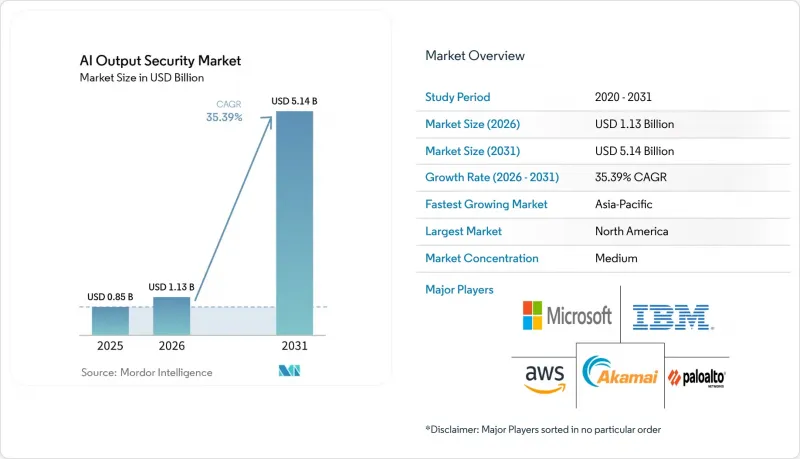
據 Mordor Intelligence 稱,2025 年人工智慧輸出安全市場價值 8.5 億美元,預計到 2031 年將從 2026 年的 11.3 億美元成長到 51.4 億美元,預測期(2026-2031 年)複合年成長率為 35.39%。
全球人工智慧輸出安全市場趨勢與洞察
生成式人工智慧在企業中的實用化
人工智慧輸出安全市場的需求主要受眾多組織機構部署生成式人工智慧的驅動,這些機構的工作流程涉及敏感資料、客戶溝通、內部文件或受監管的決策。根據聯準會的報告,到2025年底,18%的美國公司將部署人工智慧。專業服務和金融服務業的採用率分別為33%和30%。每次生產部署不僅需要管理系統接收的資料和處理的提示,還需要管理其產生的輸出,因為這些輸出可能會被共用、儲存或用於其他工作流程。 IBM的一份報告顯示,60%的人工智慧相關安全事件導致資料洩露,31%導致營運中斷。隨著企業人工智慧基礎設施的擴展,人工智慧輸出安全市場的支出越來越與傳統的安全預算週期無關,而是與推理的使用情況和受保護的工作流程數量有關。
對可靠人工智慧的監管和法律問責面臨壓力
合規性要求正成為實施輸出安全措施的直接原因。歐盟《人工智慧法案》(將於2026年8月2日生效)將對高風險系統施加義務,包括對某些高風險應用進行監控、人工監督和準確性要求。根據該法案的相關條款,罰款最高可達1,500萬歐元(1,650萬美元)或全球年銷售額的3%。 2025年3月,美國國家標準與技術研究院(NIST)擴展了對抗性機器學習的分類,將影響生成式人工智慧系統的投毒、規避和資料提取攻擊納入其中。這個框架增加了對輸出結果進行監控、測試、記錄和人工監督的證據需求。對於人工智慧輸出安全市場的許多買家而言,尤其是當管治審查需要正式記錄時,專用檢驗工具比內部自我認證更具吸引力,因為文件記錄的繁重性使得此類工具更具吸引力。
平衡偵測精度、延遲和使用者體驗。
即時評估對人工智慧輸出安全市場構成了一項實際限制,尤其是在評估應用程式的速度和反應一致性時。微軟表示,內容過濾和提示屏蔽功能可以配置用於人工智慧應用程式,包括需要非同步處理的用例。根據提供的評估結果,評估步驟可能會在文字處理流程中引入 100 到 300 毫秒的延遲。在基於代理的工作流程中,由於每個階段都需要等待策略檢查,因此這種延遲會進一步放大,因為這些工作流程會產生多個連續的輸出。在面向客戶的金融服務、零售和緊急應變應用程式中,速度可能比全面覆蓋更為重要,尤其是在輸出延遲會影響客戶互動、時間敏感型回應或大規模數位處理的情況下。常見的做法是,當全面檢查會影響使用者體驗或延遲時間敏感型決策時,對高風險輸出類別進行選擇性檢查;然而,這種方法會將一些低風險輸出排除在持續審查之外。
細分市場分析
到2025年,輸出完整性、準確性和可靠性將佔收入的34.52%。這反映了防止偽造的引文和監管參考資料進入敏感工作流程的重要性。金融服務和醫療保健行業的採購負責人可以直接將不準確的輸出與法律、合規或營運風險聯繫起來。與採購團隊仍不熟悉的新興威脅類別相比,這為這項功能提供了更清晰的商業價值。人工智慧輸出安全市場規模的擴大,得益於受監管用例中對準確性、文件性和可靠性的既定要求。
預計到 2031 年,下游操作和應用程式安全將以 43.72% 的複合年成長率成長。這項功能針對的是能夠建立檔案、呼叫 API、執行程式碼並與資料儲存互動的基於代理的系統。這些系統將風險從單一回應的內容擴展到該回應可能允許的操作。 「輸出內容安全與策略執行」已透過 Amazon Bedrock Guardrails、Microsoft Azure AI Content Safety 和 Google Vertex AI 獲得了廣泛支援。另一方面,「輸出資料保護和隱私」則著重於偵測和屏蔽生成內容中的機率性 PII(個人識別資訊),並且需要針對系統輸出的內容進行客製化的控制。 2026 年 6 月,Amazon Web Services 推出了 InvokeGuardrailChecks API,使用戶能夠在基於代理的工作流程的每個步驟中應用單獨的安全措施。
到2025年,雲端服務收入佔比將達到61.83%。 AWS、Azure、Google和Anthropic提供的託管推理端點支援了這一趨勢,因為客戶可以直接使用他們已經用於建置和運行應用程式的服務。原生安全層允許買家在其現有的雲端AI環境中部署輸出控制,而無需從頭開始設計完全獨立的控制結構。這使得雲端服務成為許多組織在AI輸出安全市場的首選,尤其是在部署初期。隨著用例變得越來越複雜,買家可能會在這些原生控制功能之外添加獨立工具,以獲得更廣泛的策略範圍和模型選擇。
預計到 2031 年,混合部署將以 39.84% 的複合年成長率成長。各組織機構透過使用基於雲端的基礎模型進行推理,並將生成的輸出路由到本地策略引擎,從而應用自身規則並維護相關記錄。這種設計解決了資料居住要求、內部審查流程和稽核日誌保留等問題,而純雲端控制可能無法滿足所有要求。對於政府機構、國防相關企業和金融監管機構而言,本地部署仍然是至關重要的選擇,因為它們在任何階段都無法將敏感內容發送到外部基礎設施。 Amazon Bedrock 於 2026 年 4 月正式推出跨帳戶保護功能,支援跨成員帳戶和組織單元的集中配置控制。
區域分析
預計到2025年,北美將佔總銷售額的41.38%。該地區匯聚了超大規模人工智慧供應商、企業軟體買家、專業安全廠商以及已在其營運中部署人工智慧的組織。預計到2025年,美國資料外洩的平均成本將達到1,022萬美元,這進一步凸顯了在涉及敏感資料和關鍵決策的情況下,企業對輸出控制的迫切需求。美國國家標準與技術研究院(NIST)發布的臨時性「網路人工智慧概況」也促使聯邦政府和私部門的買家在人工智慧輸出安全市場中就更系統化的管治展開討論。
在歐洲,由於成熟的數據管治實踐和歐盟人工智慧法案,市場需求顯著。該法案的高風險要求規定,在適用的應用情境中,必須進行監控、記錄準確性並進行人工監督,這明確了輸出控制的合規性作用。德國、法國和英國佔據了該地區的大部分市場佔有率,這得益於其對企業和公共機構積極主動的管治要求。在比荷盧經濟聯盟國家,金融業在人工智慧輸出安全市場的地位高於平均水準。在南歐和東歐,由於企業人工智慧普及率低以及專業安全採購體係不完善,人工智慧的應用仍處於起步階段。
預計到2031年,亞太地區將以44.56%的複合年成長率成長。該地區的成長主要得益於人工智慧的快速普及,以及對支援亞洲語言、本地法規和特定業務政策要求的工具日益成長的需求。在所提供的資料中,中國和日本被認為是人工智慧輸出安全市場中由管治驅動需求的主要來源。韓國、印度和澳洲也為該地區的成長做出了貢獻,因為這些國家的組織正在正式建立管治實踐。南美洲則透過巴西的科技、金融服務和零售業貢獻力量。在中東和非洲地區,阿拉伯聯合大公國和沙烏地阿拉伯的發展勢頭強勁,兩國優先推行的國家數位化政策正在推動政府和能源產業對人工智慧輸出安全市場的需求。
其他好處:
- Excel格式的市場預測(ME)表
- 3個月的分析師支持
目錄
第1章:引言
- 研究假設和市場定義
- 調查範圍
第2章:調查方法
第3章執行摘要
第4章 市場狀況
- 市場概覽
- 宏觀經濟因素的影響
- 市場促進因素
- GenAI在企業中的實用化
- 對可靠人工智慧的監管和法律問責面臨壓力
- 利用基於代理的人工智慧和工具擴展工作流程
- 人工智慧相關事件和資料外洩導致成本增加
- 在代理框架層應用運行策略
- 從代理間流量建模上下文協定和安全遙測
- 市場限制因素
- 平衡偵測準確率、延遲和使用者體驗
- 標準的變化和攻擊方法的快速變化
- 多語言和領域特定輸出中的防護措施導致的誤報
- 避免僅文字控制:模型上下文和工具/輸出污染
- 產業價值與價值鏈分析
- 監理情勢
- 技術展望
- 波特五力分析
第5章 市場規模與成長預測
- 透過安全功能
- 輸出內容的安全性和策略執行
- 輸出資料的保護和隱私
- 輸出一致性、準確性、可靠性
- 下游操作和應用程式安全
- 部署模式
- 雲
- 現場
- 混合
- 按組織規模
- 大公司
- 小型企業
- 最終用戶
- 政府和公共行政
- 工業製造
- 零售與電子商務
- 運輸/物流
- 能源公用事業
- 石油和天然氣
- IT/通訊
- 媒體與娛樂
- 教育和研究機構
- 醫療保健和生命科學
- 銀行、金融服務和保險(BFSI)
- 其他最終用戶
- 按地區
- 北美洲
- 美國
- 加拿大
- 墨西哥
- 南美洲
- 巴西
- 阿根廷
- 其他南美國家
- 歐洲
- 德國
- 英國
- 法國
- 義大利
- 比荷盧經濟聯盟
- 其他歐洲國家
- 亞太地區
- 中國
- 日本
- 印度
- 韓國
- 澳洲
- 其他亞太國家
- 中東和非洲
- 中東
- 阿拉伯聯合大公國
- 沙烏地阿拉伯
- 其他中東國家
- 非洲
- 南非
- 奈及利亞
- 埃及
- 其他非洲國家
- 中東
- 北美洲
第6章 競爭情勢
- 市場集中度
- 策略趨勢
- 市佔率分析
- 公司簡介
- Akamai Technologies, Inc.
- Amazon Web Services, Inc.
- Microsoft Corporation
- IBM Corporation
- Palo Alto Networks, Inc.
- Anthropic PBC
- Arthur AI, Inc.
- Cisco Systems, Inc.
- Cloudflare, Inc.
- Databricks, Inc.
- F5, Inc.
- Fiddler Labs, Inc.
- Giskard SAS
- Google LLC
- Guardrails AI, Inc.
- HiddenLayer, Inc.
- Lakera AI AG
- Lasso Security Ltd.
- NVIDIA Corporation
- Pangea Cyber Corporation
- Patronus AI, Inc.
- Protect AI, Inc.
- Securiti.ai, Inc.
- WhyLabs, Inc.
- Robust Intelligence, Inc.
第7章 市場機會與未來展望
According to Mordor Intelligence, the AI output security market size was valued at USD 0.85 billion in 2025 and estimated to grow from USD 1.13 billion in 2026 to reach USD 5.14 billion by 2031, at a CAGR of 35.39% during the forecast period (2026-2031).
Global AI Output Security Market Trends and Insights
Enterprise GenAI Productionization
Demand in the AI output security market follows the number of organizations that place generative AI in processes involving sensitive data, customer communications, internal documents, or regulated decisions. The Federal Reserve reported that 18% of U.S. firms had adopted AI by the end of 2025. Professional services and financial services showed adoption rates of 33% and 30%, respectively. Each production deployment must govern what the system produces, not only the data it receives or the prompts it processes, because output may be shared, stored, or used by another workflow. IBM reported that 60% of AI-related security incidents resulted in compromised data, while 31% caused operational disruption. As enterprise AI estates grow, spending in the AI output security market is increasingly linked to inference use and the number of protected workflows rather than conventional security-budget cycles.
Regulatory and Liability Pressure for Trustworthy AI
Compliance requirements are becoming a direct reason to procure output security controls. The EU AI Act applied its high-risk system obligations on August 2, 2026, including requirements for monitoring, human oversight, and accuracy in specified high-risk uses. Penalties can reach EUR 15 million (USD 16.5 million) or 3% of global annual turnover under relevant provisions of the act. NIST expanded its adversarial machine learning taxonomy in March 2025 to cover poisoning, evasion, and data extraction attacks that affect generative AI systems. These frameworks increase the need for evidence that outputs were monitored, tested, documented, and subject to human oversight. The documentation burden favors dedicated validation tools over internal self-certification for many buyers in the AI output security market, especially where formal records are needed for governance review.
Detection Accuracy Versus Latency and User Experience
Real-time evaluation creates a practical constraint for the AI output security market, especially where applications are judged by speed and response consistency. Microsoft states that content filtering and prompt-shield capabilities can be configured for AI applications, including use cases that require asynchronous processing. The supplied assessment indicates that an evaluation step can add 100-300 milliseconds to text pipelines. This cost rises in agentic workflows that generate several sequential outputs and wait for each stage to clear a policy check. Customer-facing financial services, retail, and emergency-response applications may place speed ahead of complete coverage, particularly when a delayed output affects a customer interaction, a time-sensitive response, or a high-volume digital process. Selective checks on higher-risk output categories are a common response where full inspection would impair the user experience or delay a time-sensitive decision, though this approach leaves some lower-risk outputs outside continuous review.
Other drivers and restraints analyzed in the detailed report include:
- Expansion of Agentic AI and Tool-Using Workflows
- Rising Cost of AI Incidents and Data Leakage
- Fragmented Standards and Rapidly Changing Attack Techniques
For complete list of drivers and restraints, kindly check the Table Of Contents.
Segment Analysis
Output integrity, accuracy, and reliability held 34.52% of revenue in 2025. The position reflects the priority placed on preventing fabricated citations and regulatory references from reaching sensitive workflows. Financial services and healthcare buyers can link inaccurate outputs to direct legal, compliance, or operational exposure. This gives the function a clearer business case than emerging threat categories that remain less familiar to procurement teams. The AI output security market size for this function is supported by established requirements for accuracy, documentation, and reliability in regulated use cases.
Downstream action and application security is projected to grow at a 43.72% CAGR through 2031. The function addresses agentic systems that can write files, call APIs, execute code, and interact with data stores. These systems extend the risk beyond the content of a single response and toward the action that the response can authorize. Output Content Safety and Policy Enforcement receives broad support through Amazon Bedrock Guardrails, Microsoft Azure AI Content Safety, and Google Vertex AI. Output Data Protection and Privacy instead focuses on probabilistic PII detection and redaction in generated content, which requires controls tailored to the content leaving the system. Amazon Web Services introduced the InvokeGuardrailChecks API in June 2026 to let users apply individual safeguards at each step of an agentic workflow.
Cloud delivery accounted for 61.83% of revenue in 2025. Managed inference endpoints from AWS, Azure, Google, and Anthropic support this preference because customers can begin with the services already used to build and run applications. Native safety layers allow buyers to adopt output controls within existing cloud AI environments without first designing an entirely separate control structure. This makes cloud services the first exposure to the AI output security market for many organizations, particularly during early deployment. As use cases become more complex, buyers may add independent tools alongside these native controls to gain broader policy coverage and model choice.
Hybrid deployment is projected to grow at a 39.84% CAGR through 2031. Organizations use cloud foundation models for inference while routing completions through on-premises policy engines that can apply their own rules and retain relevant records. This design supports data-residency needs, internal review processes, and audit-log retention, where cloud-only controls may not meet all requirements. On-premises deployments remain relevant for public agencies, defense contractors, and financial regulators that cannot send sensitive content to external infrastructure at any stage. Amazon Bedrock made cross-account safeguards generally available in April 2026, allowing centrally configured controls across member accounts and organizational units.
Complete Report Scope:
- By Security Function
- Output Content Safety and Policy Enforcement
- Output Data Protection and Privacy
- Output Integrity, Accuracy, and Reliability
- Downstream Action and Application Security
- By Deployment Mode
- Cloud
- On-Premises
- Hybrid
- By Organization Size
- Large Enterprises
- Small and Medium-Sized Enterprises
- By End User
- Government and Public Administration
- Industrial Manufacturing
- Retail and E-Commerce
- Transportation and Logistics
- Energy and Utilities
- Oil and Gas
- IT and Telecommunication
- Media and Entertainment
- Education and Research Institutions
- Healthcare and Life Sciences
- Banking, Financial Services, and Insurance (BFSI)
- Other End users
- By Geography
- North America
- United States
- Canada
- Mexico
- South America
- Brazil
- Argentina
- Rest of South America
- Europe
- Germany
- United Kingdom
- France
- Italy
- BENELUX
- Rest of Europe
- Asia-Pacific
- China
- Japan
- India
- South Korea
- Australia
- Rest of Asia-Pacific
- Middle East and Africa
- Middle East
- United Arab Emirates
- Saudi Arabia
- Rest of Middle East
- Africa
- South Africa
- Nigeria
- Egypt
- Rest of Africa
- Middle East
- North America
Geography Analysis
North America accounted for 41.38% of revenue in 2025. The region combines hyperscale AI providers, enterprise software buyers, specialist security vendors, and organizations that have already moved AI into business operations. The average U.S. breach cost reached USD 10.22 million in 2025, reinforcing the business case for output controls where sensitive data and important decisions are involved. NIST's preliminary Cyber AI Profile is also supporting more structured governance discussions among federal and commercial buyers in the AI output security market.
Europe has material demand because of established data-governance practices and the EU AI Act. The act's high-risk obligations require monitoring, accuracy documentation, and human oversight in applicable uses, which gives output controls a clearer compliance role. Germany, France, and the United Kingdom account for much of the region's activity because their enterprises and public institutions have active governance requirements. Benelux shows above-average financial-sector activity in the AI output security market. Southern and Eastern Europe remain earlier in adoption because enterprise AI deployment is less dense and specialist security procurement is less mature.
Asia-Pacific is projected to expand at a 44.56% CAGR through 2031. The regional scale benefits from rapid AI adoption and a growing need for tools that support Asian languages, local regulations, and business-specific policy needs. China and Japan were identified in the supplied material as important sources of governance-driven demand for the AI output security market. South Korea, India, and Australia are additional contributors to regional growth as organizations formalize governance practices. South America contributes through Brazil's technology, financial services, and retail sectors. Middle East and Africa has momentum in the United Arab Emirates and Saudi Arabia, where national digital priorities support demand in government and energy applications within the AI output security market.
- Akamai Technologies, Inc.
- Amazon Web Services, Inc.
- Microsoft Corporation
- IBM Corporation
- Palo Alto Networks, Inc.
- Anthropic PBC
- Arthur AI, Inc.
- Cisco Systems, Inc.
- Cloudflare, Inc.
- Databricks, Inc.
- F5, Inc.
- Fiddler Labs, Inc.
- Giskard SAS
- Google LLC
- Guardrails AI, Inc.
- HiddenLayer, Inc.
- Lakera AI AG
- Lasso Security Ltd.
- NVIDIA Corporation
- Pangea Cyber Corporation
- Patronus AI, Inc.
- Protect AI, Inc.
- Securiti.ai, Inc.
- WhyLabs, Inc.
- Robust Intelligence, Inc.
Additional Benefits:
- The market estimate (ME) sheet in Excel format
- 3 months of analyst support
TABLE OF CONTENTS
1 INTRODUCTION
- 1.1 Study Assumptions and Market Definition
- 1.2 Scope of the Study
2 RESEARCH METHODOLOGY
3 EXECUTIVE SUMMARY
4 MARKET LANDSCAPE
- 4.1 Market Overview
- 4.2 Impact of Macroeconomic Factors
- 4.3 Market Drivers
- 4.3.1 Enterprise GenAI Productionization
- 4.3.2 Regulatory and Liability Pressure for Trustworthy AI
- 4.3.3 Expansion of Agentic AI and Tool-Using Workflows
- 4.3.4 Rising Cost of AI Incidents and Data Leakage
- 4.3.5 Runtime Policy Enforcement at the Agent Harness Layer
- 4.3.6 Security Telemetry from Model Context Protocol and Agent-to-Agent Traffic
- 4.4 Market Restraints
- 4.4.1 Detection Accuracy Versus Latency and User Experience
- 4.4.2 Fragmented Standards and Rapidly Changing Attack Techniques
- 4.4.3 Guardrail-Induced False Positives in Multilingual and Domain-Specific Outputs
- 4.4.4 Model-Context and Tool-Output Poisoning Bypassing Text-Only Controls
- 4.5 Industry Value and Supply-Chain Analysis
- 4.6 Regulatory Landscape
- 4.7 Technological Outlook
- 4.8 Porter's Five Forces Analysis
- 4.8.1 Threat-Intelligence and Evaluation-Data Supplier Power
- 4.8.2 Enterprise Buyer Power
- 4.8.3 New Entrants and Open-Source Frameworks
- 4.8.4 Substitutes from Foundation-Model Provider Guardrails
- 4.8.5 Rivalry Among AI Security and Observability Vendors
5 MARKET SIZE AND GROWTH FORECASTS (VALUE)
- 5.1 By Security Function
- 5.1.1 Output Content Safety and Policy Enforcement
- 5.1.2 Output Data Protection and Privacy
- 5.1.3 Output Integrity, Accuracy, and Reliability
- 5.1.4 Downstream Action and Application Security
- 5.2 By Deployment Mode
- 5.2.1 Cloud
- 5.2.2 On-Premises
- 5.2.3 Hybrid
- 5.3 By Organization Size
- 5.3.1 Large Enterprises
- 5.3.2 Small and Medium-Sized Enterprises
- 5.4 By End User
- 5.4.1 Government and Public Administration
- 5.4.2 Industrial Manufacturing
- 5.4.3 Retail and E-Commerce
- 5.4.4 Transportation and Logistics
- 5.4.5 Energy and Utilities
- 5.4.6 Oil and Gas
- 5.4.7 IT and Telecommunication
- 5.4.8 Media and Entertainment
- 5.4.9 Education and Research Institutions
- 5.4.10 Healthcare and Life Sciences
- 5.4.11 Banking, Financial Services, and Insurance (BFSI)
- 5.4.12 Other End users
- 5.5 By Geography
- 5.5.1 North America
- 5.5.1.1 United States
- 5.5.1.2 Canada
- 5.5.1.3 Mexico
- 5.5.2 South America
- 5.5.2.1 Brazil
- 5.5.2.2 Argentina
- 5.5.2.3 Rest of South America
- 5.5.3 Europe
- 5.5.3.1 Germany
- 5.5.3.2 United Kingdom
- 5.5.3.3 France
- 5.5.3.4 Italy
- 5.5.3.5 BENELUX
- 5.5.3.6 Rest of Europe
- 5.5.4 Asia-Pacific
- 5.5.4.1 China
- 5.5.4.2 Japan
- 5.5.4.3 India
- 5.5.4.4 South Korea
- 5.5.4.5 Australia
- 5.5.4.6 Rest of Asia-Pacific
- 5.5.5 Middle East and Africa
- 5.5.5.1 Middle East
- 5.5.5.1.1 United Arab Emirates
- 5.5.5.1.2 Saudi Arabia
- 5.5.5.1.3 Rest of Middle East
- 5.5.5.2 Africa
- 5.5.5.2.1 South Africa
- 5.5.5.2.2 Nigeria
- 5.5.5.2.3 Egypt
- 5.5.5.2.4 Rest of Africa
- 5.5.5.1 Middle East
- 5.5.1 North America
6 COMPETITIVE LANDSCAPE
- 6.1 Market Concentration
- 6.2 Strategic Moves
- 6.3 Market Share Analysis
- 6.4 Company Profiles (includes Global Level Overview, Market Level Overview, Core Segments, Financials as available, Strategic Information, Market Rank/Share, Products and Services, Recent Developments)
- 6.4.1 Akamai Technologies, Inc.
- 6.4.2 Amazon Web Services, Inc.
- 6.4.3 Microsoft Corporation
- 6.4.4 IBM Corporation
- 6.4.5 Palo Alto Networks, Inc.
- 6.4.6 Anthropic PBC
- 6.4.7 Arthur AI, Inc.
- 6.4.8 Cisco Systems, Inc.
- 6.4.9 Cloudflare, Inc.
- 6.4.10 Databricks, Inc.
- 6.4.11 F5, Inc.
- 6.4.12 Fiddler Labs, Inc.
- 6.4.13 Giskard SAS
- 6.4.14 Google LLC
- 6.4.15 Guardrails AI, Inc.
- 6.4.16 HiddenLayer, Inc.
- 6.4.17 Lakera AI AG
- 6.4.18 Lasso Security Ltd.
- 6.4.19 NVIDIA Corporation
- 6.4.20 Pangea Cyber Corporation
- 6.4.21 Patronus AI, Inc.
- 6.4.22 Protect AI, Inc.
- 6.4.23 Securiti.ai, Inc.
- 6.4.24 WhyLabs, Inc.
- 6.4.25 Robust Intelligence, Inc.
7 MARKET OPPORTUNITIES AND FUTURE OUTLOOK
- 7.1 White-Space and Unmet-Need Assessment

 人工智慧信任、風險和安全管理全球市場規模、佔有率、趨勢和成長分析報告(2026-2034)
 2026年全球合規自動化人工智慧(AI)市場報告
 綜合品質評估系統市場:全球市場預測,2026-2032年人工智慧偏見審計服務市場:全球市場預測,2026-2032年
 全球人工智慧信任、風險和安全管理(AI TRiSM)市場:按產品、部署模式、組織規模、應用、產業和地區分類-預測至2031年
 人工智慧信任、風險和安全管理(AI TRiSM)市場預測至2034年——按組件、部署模式、技術、安全層、應用、最終用戶和地區分類的全球分析
 IT管理框架培訓:市場佔有率分析、產業趨勢與統計資料、成長預測(2026-2031年)2026年全球可信賴人工智慧市場報告AI偏向性審計與人力資源演算法公平性:市場佔有率分析、產業趨勢與統計數據以及成長預測(2026-2031年)人工智慧合規市場預測至2034年—按平台組件、部署模式、合規類型、合規功能、應用、最終用戶和地區分類的全球分析