


 |
市場調查報告書
商品編碼
2117532
IT管理框架培訓:市場佔有率分析、產業趨勢與統計資料、成長預測(2026-2031年)IT Governance Frameworks Training - Market Share Analysis, Industry Trends & Statistics, Growth Forecasts (2026 - 2031) |
||||||

※ 本網頁內容可能與最新版本有所差異。詳細情況請與我們聯繫。
IT管理框架培訓市場預計將從2025年的12.8億美元成長到2026年的14.4億美元,到2031年達到30.4億美元,2026年至2031年的複合年成長率為16.12%。
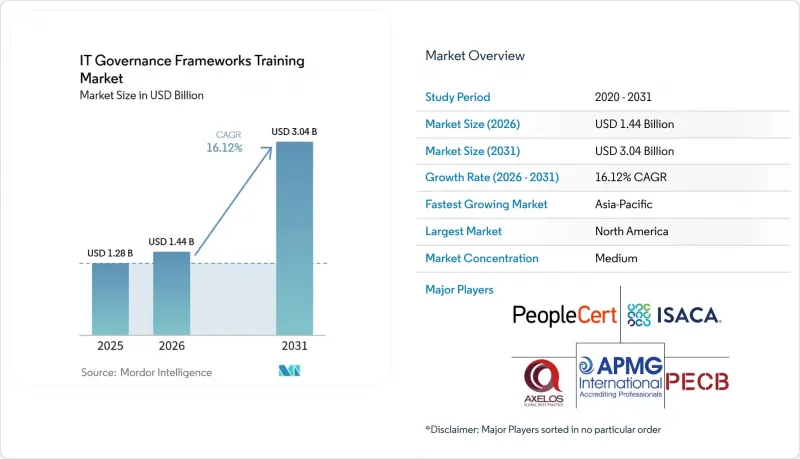
本報告按培訓類型(例如,認證考試準備課程)、授課形式(例如,主導授課)、公司規模(大型企業和中小企業)、最終用戶(例如,IT和電信、銀行、金融服務和保險、醫療保健和生命科學)以及地區進行分類。市場預測以美元計價。
全球IT管理框架培訓市場趨勢與洞察
對 COBIT 和 ISO/IEC 38500 能力建構的需求日益成長。
IT管理框架培訓市場持續受益於對COBIT 2019和ISO/IEC 38500能力建設的強勁需求,因為企業正在尋求經認證的框架來指導監督和課責。 COBIT 2019仍然是營運管治計畫的核心,許多組織將其作為控制和審計轉型活動的基礎。另一方面,ISO/IEC 38500也正受到高階主管的關注,因為它直接概述了董事會應如何評估、指導和監督技術職責。一個值得注意的採購模式是,企業傾向於為其執行和保障團隊提供COBIT培訓,同時為高階主管提供ISO/IEC 38500培訓,這導致相同客戶的培訓成本增加。在日本,這一趨勢因JIS Q 38500(與ISO/IEC 38500等效的國內標準)的修訂而進一步加強,該修訂版包含了11項擴展的IT管理原則,其中明確提及了人工智慧管治。此外,ISACA 於 2026 年 2 月宣布推出“ITAF 第 5 版”,將其範圍擴大到包括人工智慧、機器學習 (ML)、雲端運算和持續保障,涵蓋整個全球社區,進一步凸顯了準備管治認證考試的重要性。
加強董事會層級在技術管治上的課責
IT管理框架培訓市場正受到一系列法規的重塑,這些法規將技術管治的直接責任賦予了董事會和高階管理層。 《數位營運韌性法案》(Digital Operational Resilience Act)於2025年1月17日生效,該法案強制要求金融機構的經營團隊必須具備與其所控制的ICT風險相符的知識和技能。此外,《網路與資訊安全指令II》(NIS2)引入了關鍵營業單位董事的個人課責,使管治培訓從單純的自願學習投資轉變為一種合法的風險管理工具。這項轉變意義重大,因為合規審計越來越依賴持續訓練的書面證據,而非僅僅是政策聲明或名義上的角色定義。這種影響不僅限於直接受監管的營業單位,供應商和服務合作夥伴也常常感受到類似的壓力,因為合規計畫正在擴展到更廣泛的供應鏈。因此, IT管理框架培訓市場的需求主要集中在受監管的買家身上,他們可以檢驗培訓提供者的信譽,並影響相關客戶群的採用。
大型企業以外的族群對正式的IT管理認證認知度較低。
IT管理框架培訓市場仍面臨認知差距,尤其是在大型企業以外的決策者中,他們傾向於將管治培訓等同於更廣泛的安全意識提升培訓。這種誤解導致需求下降,因為買家無法區分通用意識提升模組和旨在建立決策結構、監督控制措施以及加強董事會課責的培訓。在中小企業和新興市場,這個問題特別突出,因為這些地區的競爭對手較少,難以找到能夠直接展示正式管治認證成果的企業。一項關於將COBIT 2019應用於中小企業數位轉型的研究表明,該框架對中小企業的重要性與其在該領域的實際應用之間存在差距。另一項針對印度中小企業在2026年開展的研究表明, IT管理成熟度更高的公司表現更佳,這表明儘管已有相關證據,但尚未轉化為買家的廣泛認知。除非認證機構和培訓機構加強對中小企業教育的投入,否則IT管理框架培訓市場在中小企業層級的規模可能仍將保持低迷。
細分市場分析
2025年,「認證考試準備課程」佔IT管理架構培訓市場32.41%的佔有率,成為最大的培訓類型。這一主導地位反映了審計、管治、諮詢和企業風險領域的專業人士對認證的持續需求,尤其是COBIT 2019和CGEIT認證。 ISACA於2026年2月發布的ITAF第五版進一步推動了這個細分市場的發展。此版本擴展了管治和保障的範圍,涵蓋了人工智慧、機器學習、雲端運算、敏捷審計和持續保障,為學習者和雇主創造了新的升級週期。 CGEIT仍然非常重要,因為它展現的是企業級的管治能力,而非狹隘的技術專長,因此在領導力和顧問人才招募中保持著重要地位。框架實施研討會則滿足不同的購買需求。這些課程通常由已經擁有擁有者並需要部署管治結構指導的組織購買。雖然針對高階主管和董事會的管治計畫在收入方面仍然相對小規模,但隨著經營團隊在受監管產業中承擔起更多直接的技術監督責任,其策略重要性正在增加。
以角色為基礎的實踐者培訓預計到2031年將以19.24%的複合年成長率成長,成為IT管理框架培訓市場中成長最快的培訓類型。這一轉變表明,許多企業買家希望建立基於角色設計的、具備管治能力的團隊,而不僅僅是讓個人學員通過一次性考試。以角色為基礎的專案具有明顯的商業性價值,因為隨著工作範圍的變化和管治職責在不同職能部門間的擴展,它們可以持續吸引學員報名。這與認證考試準備有著本質區別,後者通常是每個認證週期每人購買一次。 Learning Tree International計劃在2025年擴展其ISACA認證項目,包括高階課程和特定角色的管治內容,這反映了企業對與實際角色相符的培訓架構日益成長的需求。隨著越來越多的企業完成管治認證實施的第一階段並邁向可操作的實施階段,基於角色的培訓模式未來在IT管理框架培訓市場中的支出佔有率可能會更大。
至2025年,講師主導培訓將佔IT管理框架培訓市場佔有率的36.82%,成為該市場的主導交付方式。企業採購負責人仍然傾向於在管治領域進行面對面培訓,因為與許多純技術學習模組相比,討論、解讀和情境判斷在面對面培訓中更為重要。這種形式也受益於主要管治考試的性質,因為考生在準備由情境題組成的監考考試時,往往更喜歡系統性的指導。即使數位管道的地理覆蓋範圍不斷擴大,講師主導培訓的需求依然強勁。虛擬直播培訓已經吸收了部分原本由面授課程佔據的需求,因為遠端團隊希望在不承擔差旅費用的情況下進行即時互動。對於希望數位學習特定內容但又不想投入大量時間精力去獲得複習學分、進行模組化學習或參與整個課程的初級學習者來說,自主學習仍然非常重要。
混合式學習預計將在2026年至2031年間以18.73%的複合年成長率成長,成為IT管理框架培訓市場中成長最快的交付模式。學員選擇這種模式是因為它結合了主導授課的嚴謹性和自主學習的便利性,並能更好地展現整個學員群體的學習成果。框架所有者也在透過產品設計和課程架構來支持這一轉變。 PeopleCert於2026年2月發布的ITIL 5版本包含了關於人工智慧管治的出版物和更新的學習路徑,以支援混合式和自主學習的進度,這表明主要的認證機構正在將學習拓展到一次性課堂活動之外。這種模式對於尋求持續知識更新、更詳細地追蹤完成狀態以及為跨職能和跨地區的團隊提供更靈活的日程安排的企業客戶來說尤其有用。因此, IT管理框架培訓市場正從一次性培訓活動轉向支援持續管治能力維護的交付模式。
區域分析
2025年,北美成為最大的區域市場,佔IT管理框架培訓市場佔有率的34.72%。該地區受益於龐大的合格專業人員基礎、成熟的管治結構以及遍布美國和加拿大的認證培訓機構。此外,主要框架所有者的存在以及受監管且數位化程度高的企業的廣泛採用也推動了市場需求。 2025年12月,ISACA獲得美國國防供應鏈CMMC計畫獨家評估機構和講師認證機構的認證,顯著擴大了管治相關培訓的覆蓋範圍。此外,美國2026年HIPAA安全法規的更新也強化了醫療保健產業對基於角色的、有據可查的管治培訓的需求,並提供了針對該行業的專項支援。
歐洲繼續保持其作為全球第二大IT管理框架培訓區域市場的地位,因為法規環境已將管治教育事實上列為合規要求。 DORA自2025年1月起對經營團隊施加了關於ICT風險知識的直接義務,而NIS2則擴大了歐盟所有成員國關鍵營業單位的董事會課責。德國、英國和法國仍然是主要的國內市場,其中德國也受益於圍繞BSI和ISO合規計畫所建構的管治生態系統。 2026年3月,PECB透過與德國CTG GmbH的合作,加強了其區域服務,增加了在地化的管治和合規課程。
預計亞太地區在2026年至2031年間將以18.91%的複合年成長率成長,成為IT管理框架培訓市場成長最快的地區。這項成長主要得益於對數位轉型(DX)專案專家、管治認證以及印度、中國、日本、韓國和東南亞等地區本地培訓機構不斷擴大的需求。在日本,修訂後的JIS Q 38500框架納入了更廣泛的人工智慧管治條款,進一步推動了市場發展,增強了本地對正式管治培訓需求的契合度。在印度,印度理工學院孟買分校與Simplilearn於2026年6月聯合推出的為期24個月的線上「數位管治研究生文憑課程」進一步加強了人才培養基礎。在中國,隨著CGEIT認證活動的活性化和COBIT相關培訓的開展,企業管治的成熟度持續提升。儘管南美市場規模相對較小,但隨著企業努力滿足國際管治標準以服務跨國客戶,其重要性日益凸顯。中東和非洲地區也日益受到重視,沙烏地阿拉伯、阿拉伯聯合大公國(阿拉伯聯合大公國)、奈及利亞和南非正在擴大其與管治和合規相關的認證培訓計畫。
其他好處:
- Excel格式的市場預測(ME)表
- 3個月的分析師支持
目錄
第1章:引言
- 研究假設和市場定義
- 調查範圍
第2章:調查方法
第3章執行摘要
第4章 市場狀況
- 市場概覽
- 市場促進因素
- 基於COBIT和ISO/IEC 38500的能力建構需求日益成長
- 加強董事會層級在技術管治上的課責
- 增加企業支出,以提升與角色為基礎的管治相關的技能
- 數位轉型計畫的擴展須遵守相關法規
- 對嵌入式培訓的需求源自於 IT 營運模式的標準化計畫。
- 與廠商無關的管治技能的需求成長速度超過了對特定框架認證考試準備的需求。
- 市場限制因素
- 除了大型企業之外,人們對正式的IT管理認證的認知度很低。
- 人力資源、IT、風險管理和合規等部門的預算採購趨勢分散。
- 缺乏具備管治實務經驗的合格教師
- 對於已獲得初始認證的經驗豐富的從業人員來說,續約並不迫切。
- 宏觀經濟因素對市場的影響
- 產業價值鏈分析
- 科技趨勢
- 監理情勢
- 波特五力分析
第5章 市場規模與成長預測
- 按培訓類型
- 認證考試準備課程
- 框架介紹研討會
- 高階主管和董事會管治計劃
- 針對從業人員的角色特定培訓
- 透過串流媒體模式
- 講師指導式培訓
- 虛擬直播培訓
- 自主數位學習學習
- 混合式學習
- 按公司規模
- 大公司
- 小型企業
- 最終用戶
- 資訊科技/通訊
- BFSI
- 醫療保健和生命科學
- 零售與電子商務
- 工業製造
- 教育和研究機構
- 媒體與娛樂
- 政府/行政部門
- 能源公用事業
- 其他終端用戶產業
- 按地區
- 北美洲
- 美國
- 加拿大
- 墨西哥
- 南美洲
- 巴西
- 阿根廷
- 其他南美國家
- 歐洲
- 德國
- 英國
- 法國
- 俄羅斯
- 西班牙
- 其他歐洲國家
- 亞太地區
- 中國
- 日本
- 印度
- 韓國
- 東南亞
- 其他亞太國家
- 中東和非洲
- 中東
- 沙烏地阿拉伯
- 阿拉伯聯合大公國
- 其他中東國家
- 非洲
- 南非
- 奈及利亞
- 其他非洲國家
- 中東
- 北美洲
第6章 競爭情勢
- 市場集中度
- 策略趨勢
- 市佔率分析
- 公司簡介
- PeopleCert
- ISACA
- AXELOS
- APMG International
- PECB
- Learning Tree International
- QA Limited
- New Horizons Worldwide, LLC
- Global Knowledge Training LLC
- Simplilearn Solutions Private Limited
- Firebrand Training
- IT Governance Ltd
- Good e-Learning
- Infosec Institute, Inc.
- The Knowledge Academy
- NobleProg Limited
- Invensis Learning
- Tonex Training
- GTC Group
- TUV SUD
第7章 市場機會與未來展望
According to Mordor Intelligence, the IT governance frameworks training market size is expected to increase from USD 1.28 billion in 2025 to USD 1.44 billion in 2026 and reach USD 3.04 billion by 2031, growing at a CAGR of 16.12% over 2026-2031.
This report is Segmented by Training Type (Certification Preparation Courses, and More), Delivery Mode (Instructor-Led Training, and More), Enterprise Size (Large Enterprises and Small and Medium Enterprises), End User (IT and Telecommunication, BFSI, Healthcare and Life Sciences, and More), and Geography. The Market Forecasts are Provided in Terms of Value (USD).
Global IT Governance Frameworks Training Market Trends and Insights
Rising Demand for COBIT and ISO/IEC 38500 Capability Building
The IT Governance Frameworks Training Market continues to benefit from strong demand for COBIT 2019 and ISO/IEC 38500 capability-building as enterprises seek recognized frameworks to guide oversight and accountability. COBIT 2019 remains central to operational governance programs because many organizations use it as the control and audit backbone for transformation work. ISO/IEC 38500 is gaining parallel traction at the executive layer because it speaks directly to how boards evaluate, direct, and monitor technology responsibilities. A notable buying pattern is that enterprises often train delivery and assurance teams on COBIT while placing senior leaders into ISO/IEC 38500 programs, which lifts training spend within the same account. Japan strengthened this direction when JIS Q 38500, its domestic equivalent of ISO/IEC 38500, was updated to include 11 expanded IT governance principles that explicitly address AI governance. ISACA also widened the relevance of governance certification preparation when it launched ITAF 5th Edition in February 2026, extending the framework to AI and ML, cloud, and continuous assurance across its global community.
Intensifying Board-Level Accountability for Technology Governance
The IT Governance Frameworks Training Market is being reshaped by rules that place the responsibility for technology governance directly on boards and senior management. The Digital Operational Resilience Act became applicable on January 17, 2025, and requires management bodies of financial entities to maintain knowledge and skills that match the ICT risks under their control. NIS2 also introduced personal accountability for board members of essential entities, turning governance training into a legal risk management tool rather than a discretionary learning purchase. This change matters because compliance reviews increasingly depend on documented evidence of ongoing training, not just policy statements or nominal role definitions. The effect extends beyond the directly regulated entity, as suppliers and service partners often feel the same pressure as compliance programs move through the wider chain. As a result, the IT Governance Frameworks Training Market is seeing demand anchored by regulated buyers that can validate provider credibility and influence adoption across adjacent customer groups.
Limited Awareness of Formal IT Governance Credentials Outside Large Enterprises
The IT Governance Frameworks Training Market still faces an awareness gap outside large enterprises, especially among decision-makers who treat governance training as interchangeable with broader security awareness programs. That misunderstanding reduces demand because buyers fail to distinguish between commodity awareness modules and training that builds decision structures, control oversight, and board accountability. The problem is more visible in smaller firms and emerging markets where fewer peers can point to direct outcomes from formal governance credentials. Research on applying COBIT 2019 to SME digital transformation identified a persistent gap between the framework's relevance to smaller enterprises and its actual adoption in that segment. A separate 2026 study on Indian SMEs linked stronger IT governance maturity to better firm performance, suggesting that evidence exists but has not yet translated into broad buyer understanding. Until certification bodies and providers invest more heavily in SME-oriented education, the IT Governance Frameworks Training Market is likely to remain underpenetrated at the SME level.
Other drivers and restraints analyzed in the detailed report include:
- Growing Enterprise Spend on Role-Based Governance Upskilling
- Expansion of Regulated Digital Transformation Programs
- Fragmented Buying Across HR, IT, Risk, and Compliance Budgets
For complete list of drivers and restraints, kindly check the Table Of Contents.
Segment Analysis
Certification Preparation Courses accounted for 32.41% of the IT Governance Frameworks Training market in 2025, making them the largest training type. This lead reflected continued demand for recognized credentials, especially COBIT 2019 and CGEIT, among professionals working in audit, governance, advisory, and enterprise risk roles. ISACA's February 2026 launch of the ITAF 5th Edition gave the segment another boost by expanding governance and assurance coverage to include AI and ML, cloud, agile auditing, and continuous assurance, creating a new upgrade cycle for learners and employers. CGEIT remains important because it signals enterprise-wide governance capability rather than narrow technical expertise, which keeps it relevant in leadership and advisory hiring. Framework Implementation Workshops address a different buyer need, as these programs are usually purchased by organizations that already have credential holders and now need guidance on deploying governance structures. Executive and Board Governance Programs remain smaller in revenue terms, yet they are becoming more strategic as regulated sectors place direct responsibility for technology oversight on management bodies.
Role-Based Practitioner Training is projected to grow at a 19.24% CAGR through 2031, making it the fastest-growing training type in the IT Governance Frameworks Training Market. This shift shows that many enterprise buyers now want governance-capable teams built around role design instead of one-time exam success for individual learners. The commercial value is clear because role-based programs can generate recurring enrollment as job scopes change and governance responsibilities spread across functions. That makes them structurally different from certification preparation, which is often purchased once per person for a specific credential cycle. Learning Tree International's 2025 expansion across ISACA-authorized programs, including advanced and role-specific governance content, reflected the growing need for training architectures that match real organizational roles. As more organizations finish their first wave of governance certification adoption and turn toward applied implementation, the IT Governance Frameworks Training Market is likely to see role-based formats claim a larger share of future spending.
Instructor-Led Training held 36.82% of the IT Governance Frameworks Training market share in 2025, making it the leading delivery mode in the IT Governance Frameworks Training Market. Enterprise buyers still favor live facilitation in governance settings because discussion, interpretation, and contextual judgment matter more here than in many purely technical learning modules. The format also benefits from the nature of major governance exams, since candidates often prefer structured coaching when preparing for proctored assessments built around scenario-based questions. That helped preserve strong demand for instructor-led formats even as digital access widened across regions. Virtual Live Training absorbed part of the volume that once belonged to in-person classes because distributed teams wanted live interaction without travel costs. Self-Paced E-Learning remained important for renewal credits, modular learning, and early-stage learners who wanted targeted content without committing to a full program.
Blended Learning is projected to expand at a 18.73% CAGR from 2026 to 2031, making it the fastest-growing delivery format in the IT Governance Frameworks Training Market. Buyers are choosing it because it combines the rigor of instructor-led sessions with the convenience of self-paced study and stronger performance visibility across learner groups. Framework owners are also supporting this shift through product design and course architecture. PeopleCert's launch of ITIL Version 5 in February 2026 included an AI Governance publication and updated pathways that support blended and self-paced progression, which shows how major credential owners are extending learning beyond a single classroom event. This format is especially useful for enterprise customers who want ongoing refresh, better completion tracking, and more flexible scheduling for teams spread across functions and geographies. As a result, the IT Governance Frameworks Training Market is shifting toward delivery models that support continuous governance capability rather than isolated training events.
Complete Report Scope:
- By Training Type
- Certification Preparation Courses
- Framework Implementation Workshops
- Executive and Board Governance Programs
- Role-Based Practitioner Training
- By Delivery Mode
- Instructor-Led Training
- Virtual Live Training
- Self-Paced E-Learning
- Blended Learning
- By Enterprise Size
- Large Enterprises
- Small and Medium Enterprises
- By End User
- IT and Telecommunication
- BFSI
- Healthcare and Life Sciences
- Retail and E-Commerce
- Industrial Manufacturing
- Education and Research Institutions
- Media and Entertainment
- Government and administration
- Energy and Utilities
- Other end-user industries
- By Geography
- North America
- United States
- Canada
- Mexico
- South America
- Brazil
- Argentina
- Rest of South America
- Europe
- Germany
- United Kingdom
- France
- Russia
- Spain
- Rest of Europe
- Asia-Pacific
- China
- Japan
- India
- South Korea
- Southeast Asia
- Rest of Asia-Pacific
- Middle East and Africa
- Middle East
- Saudi Arabia
- United Arab Emirates
- Rest of Middle East
- Africa
- South Africa
- Nigeria
- Rest of Africa
- Middle East
- North America
Geography Analysis
North America accounted for 34.72% of the IT Governance Frameworks Training market in 2025, making it the largest regional segment. The region benefits from a dense base of credentialed professionals, mature governance structures, and strong access to authorized training organizations across the United States and Canada. Demand is further reinforced by the presence of leading framework owners and a large installed base of regulated and digitally complex enterprises. ISACA's December 2025 authorization as the exclusive assessor and instructor certification organization for the U.S. defense supply chain's CMMC program materially widened the addressable governance-adjacent training base. The United States also gained sector-specific support from the 2026 HIPAA Security Rule compliance updates, which strengthened the need for documented role-based governance training in healthcare settings.
Europe remained the second-largest regional market for IT Governance Frameworks Training because the regulatory environment made governance education a practical compliance requirement. DORA created direct management body obligations for ICT risk knowledge from January 2025, while NIS2 extended board accountability across essential entities in all EU member states. Germany, the United Kingdom, and France remain the leading national markets, and Germany also benefits from a parallel governance ecosystem around BSI and ISO-aligned programs. PECB strengthened regional delivery in March 2026 through its partnership with CTG GmbH in Germany, which added localized access to governance and compliance courses.
Asia-Pacific is projected to expand at a 18.91% CAGR from 2026 to 2031, making it the fastest-growing geography in the IT Governance Frameworks Training Market. The region is supported by national digital transformation programs, rising professional demand for governance credentials, and a growing local training base across India, China, Japan, South Korea, and Southeast Asia. Japan added momentum when its JIS Q 38500 framework update incorporated broader AI governance provisions, which strengthened local alignment with formal governance training demand. India also advanced the talent pipeline when IIT Bombay and Simplilearn launched a 24-month online Post Graduate Diploma in Digital Governance in June 2026. China continues to demonstrate greater enterprise governance maturity through active CGEIT credential activity and the availability of COBIT-related training. South America remains smaller but is gaining relevance as enterprises align with international governance expectations to serve multinational customers. The Middle East and Africa are also moving up as Saudi Arabia, the UAE, Nigeria, and South Africa build more authorized training capacity tied to governance and compliance programs.
- PeopleCert
- ISACA
- AXELOS
- APMG International
- PECB
- Learning Tree International
- QA Limited
- New Horizons Worldwide, LLC
- Global Knowledge Training LLC
- Simplilearn Solutions Private Limited
- Firebrand Training
- IT Governance Ltd
- Good e-Learning
- Infosec Institute, Inc.
- The Knowledge Academy
- NobleProg Limited
- Invensis Learning
- Tonex Training
- GTC Group
- TUV SUD
Additional Benefits:
- The market estimate (ME) sheet in Excel format
- 3 months of analyst support
TABLE OF CONTENTS
1 INTRODUCTION
- 1.1 Study Assumptions and Market Definition
- 1.2 Scope of the Study
2 RESEARCH METHODOLOGY
3 EXECUTIVE SUMMARY
4 MARKET LANDSCAPE
- 4.1 Market Overview
- 4.2 Market Drivers
- 4.2.1 Rising Demand for COBIT and ISO/IEC 38500 Capability Building
- 4.2.2 Intensifying Board-Level Accountability for Technology Governance
- 4.2.3 Growing Enterprise Spend on Role-Based Governance Upskilling
- 4.2.4 Expansion of Regulated Digital Transformation Programs
- 4.2.5 Embedded Training Demand From IT Operating Model Standardization Programs
- 4.2.6 Vendor-Neutral Governance Skills Beating Framework-Specific Cert Prep Demand
- 4.3 Market Restraints
- 4.3.1 Limited Awareness of Formal IT Governance Credentials Outside Large Enterprises
- 4.3.2 Fragmented Buying Across HR, IT, Risk, and Compliance Budgets
- 4.3.3 Shortage of Qualified Instructors With Practical Governance Delivery Experience
- 4.3.4 Low Renewal Urgency for Mature Practitioners After Initial Certification
- 4.4 Impact of Macroeconomic Factors on the Market
- 4.5 Industry Value-Chain Analysis
- 4.6 Technology Outlook
- 4.7 Regulatory Landscape
- 4.8 Porter's Five Forces Analysis
- 4.8.1 Threat of New Entrants
- 4.8.2 Bargaining Power of Suppliers
- 4.8.3 Bargaining Power of Buyers
- 4.8.4 Threat of Substitutes
- 4.8.5 Intensity of Competitive Rivalry
5 MARKET SIZE AND GROWTH FORECASTS (VALUE)
- 5.1 By Training Type
- 5.1.1 Certification Preparation Courses
- 5.1.2 Framework Implementation Workshops
- 5.1.3 Executive and Board Governance Programs
- 5.1.4 Role-Based Practitioner Training
- 5.2 By Delivery Mode
- 5.2.1 Instructor-Led Training
- 5.2.2 Virtual Live Training
- 5.2.3 Self-Paced E-Learning
- 5.2.4 Blended Learning
- 5.3 By Enterprise Size
- 5.3.1 Large Enterprises
- 5.3.2 Small and Medium Enterprises
- 5.4 By End User
- 5.4.1 IT and Telecommunication
- 5.4.2 BFSI
- 5.4.3 Healthcare and Life Sciences
- 5.4.4 Retail and E-Commerce
- 5.4.5 Industrial Manufacturing
- 5.4.6 Education and Research Institutions
- 5.4.7 Media and Entertainment
- 5.4.8 Government and administration
- 5.4.9 Energy and Utilities
- 5.4.10 Other end-user industries
- 5.5 By Geography
- 5.5.1 North America
- 5.5.1.1 United States
- 5.5.1.2 Canada
- 5.5.1.3 Mexico
- 5.5.2 South America
- 5.5.2.1 Brazil
- 5.5.2.2 Argentina
- 5.5.2.3 Rest of South America
- 5.5.3 Europe
- 5.5.3.1 Germany
- 5.5.3.2 United Kingdom
- 5.5.3.3 France
- 5.5.3.4 Russia
- 5.5.3.5 Spain
- 5.5.3.6 Rest of Europe
- 5.5.4 Asia-Pacific
- 5.5.4.1 China
- 5.5.4.2 Japan
- 5.5.4.3 India
- 5.5.4.4 South Korea
- 5.5.4.5 Southeast Asia
- 5.5.4.6 Rest of Asia-Pacific
- 5.5.5 Middle East and Africa
- 5.5.5.1 Middle East
- 5.5.5.1.1 Saudi Arabia
- 5.5.5.1.2 United Arab Emirates
- 5.5.5.1.3 Rest of Middle East
- 5.5.5.2 Africa
- 5.5.5.2.1 South Africa
- 5.5.5.2.2 Nigeria
- 5.5.5.2.3 Rest of Africa
- 5.5.5.1 Middle East
- 5.5.1 North America
6 COMPETITIVE LANDSCAPE
- 6.1 Market Concentration
- 6.2 Strategic Moves
- 6.3 Market Share Analysis
- 6.4 Company Profiles (includes Global Level Overview, Market Level Overview, Core Segments, Financials as available, Strategic Information, Market Rank/Share, Products and Services, Recent Developments)
- 6.4.1 PeopleCert
- 6.4.2 ISACA
- 6.4.3 AXELOS
- 6.4.4 APMG International
- 6.4.5 PECB
- 6.4.6 Learning Tree International
- 6.4.7 QA Limited
- 6.4.8 New Horizons Worldwide, LLC
- 6.4.9 Global Knowledge Training LLC
- 6.4.10 Simplilearn Solutions Private Limited
- 6.4.11 Firebrand Training
- 6.4.12 IT Governance Ltd
- 6.4.13 Good e-Learning
- 6.4.14 Infosec Institute, Inc.
- 6.4.15 The Knowledge Academy
- 6.4.16 NobleProg Limited
- 6.4.17 Invensis Learning
- 6.4.18 Tonex Training
- 6.4.19 GTC Group
- 6.4.20 TUV SUD
7 MARKET OPPORTUNITIES AND FUTURE OUTLOOK
- 7.1 White-Space and Unmet-Need Assessment

 全球人工智慧信任、風險和安全管理(AI TRiSM)市場:按產品、部署模式、組織規模、應用、產業和地區分類-預測至2031年
 人工智慧信任、風險和安全管理(AI TRiSM)市場預測至2034年——按組件、部署模式、技術、安全層、應用、最終用戶和地區分類的全球分析
 2026年全球可信賴人工智慧市場報告2026年全球資訊科技(IT)管治與策略市場報告
 AI偏向性審計與人力資源演算法公平性:市場佔有率分析、產業趨勢與統計數據以及成長預測(2026-2031年)人工智慧合規市場預測至2034年—按平台組件、部署模式、合規類型、合規功能、應用、最終用戶和地區分類的全球分析2026年全球差分隱私市場報告2026年全球資訊科技(IT)管治、風險與合規(GRC)市場報告2026年全球負責任人工智慧偏見審計平台市場報告2026年全球人工智慧(AI)回應安全評分市場報告