


 |
市場調查報告書
商品編碼
2155264
中波紅外線工業相機:市場佔有率分析、產業趨勢與統計及成長預測(2026-2031)MWIR Industrial Camera - Market Share Analysis, Industry Trends & Statistics, Growth Forecasts (2026 - 2031) |
||||||

※ 本網頁內容可能與最新版本有所差異。詳細情況請與我們聯繫。
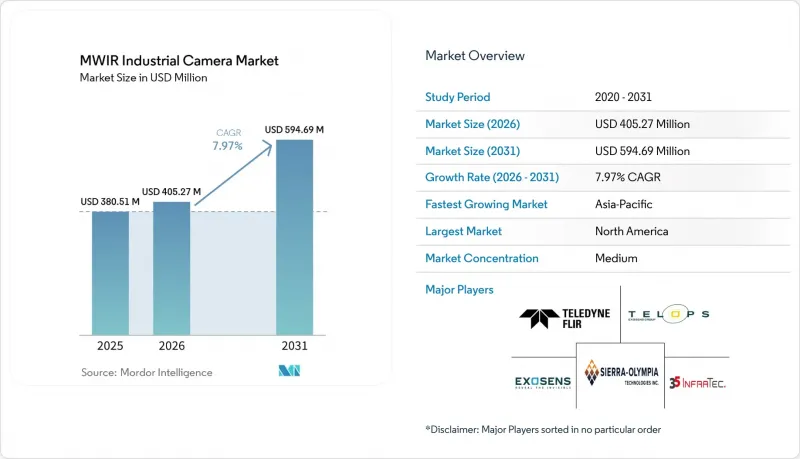
根據 Mordor Intelligence 預測,中波紅外線工業相機市場規模預計將在 2025 年達到 3.8051 億美元,2026 年達到 4.0527 億美元,到 2031 年達到 5.9469 億美元,2026 年至 2031 年的複合年成長率為 7.97%。
全球中波紅外線工業相機市場趨勢與洞察
國防能力現代化與永續的ISR採購
北約和印太地區的國防費用計畫正在推動中波紅外線(MWIR)工業相機市場採購週期的可預測性。武裝無人機、反無人機系統(UAS)電池以及持續地面監視系統等項目都需要更多的熱成像感測器。買家需要適用於陸地、海洋和空中平台、性能範圍廣、設計緊湊且功耗低的系統。 2025年,印度海軍為40多艘艦艇部署了Tonbo Imaging公司的冷卻式高解析度中波紅外線光電/紅外線(MWIR EO/IR)系統,該系統能夠偵測25公里以外的船隻。 2026年2月,Teledyne FLIR OEM發布了Neutrino SX8 ISR 50-1000,該產品集27,000小時的冷卻器壽命、人工智慧處理能力和34公里的車輛偵測範圍於一體。隨著平台部署數量的增加,供應商在冷卻器壽命、整合功能以及支援自動影像處理的電子元件方面面臨更直接的競爭。
工業預測性維護和製程自動化
工業領域的熱成像檢測正從週期性檢測轉向在整個運作週期內持續採集熱資訊的永久性系統。這種轉變推動了對中波紅外線(MWIR)攝影機的需求,這類攝影機能夠在設備故障導致運作中斷之前檢測到異常熱模式。美國能源局將預測性維護定位為一種降低營運成本的有效手段,優於被動式維護方法。製造業的採購負責人在評估用於高爐監測、複合材料檢測、電池單元品管和半導體生產的攝影機時,也採用了這種理念。 2026年2月,FLIR推出了A6450,其配備的線性冷卻器設計壽命長達27,000小時,從而消除了冷卻式攝影機持續運作的一個傳統障礙。基於NFPA 70B的熱成像維護指南進一步支持了對電力基礎設施、製造工廠和公共產業設施資產進行一致的檢測實務。
低溫冷卻的成本和維護負擔
除了國防和高價值工業應用領域外,低溫冷卻仍然是中波紅外線(MWIR)冷卻相機高成本且維護繁瑣的一大限制因素。傳統的斯特林低溫冷卻器通常在運作8000至12000小時後需要進行工廠大修,這造成了停機時間和維護計劃的挑戰。對於需要高設備運轉率但缺乏專門光電支援團隊的製造商、公共產業和汽車製造廠而言,這個問題尤其關鍵。高溫檢測器設計的進步降低了冷卻功率需求,並抑制了更高動作溫度下的機械磨損。對InAs/InAsSb nBn裝置的研究表明,其在230 K下可穩定運行,噪音等效溫差小於15 mK。一項發表於2025年的研究也指出,基於人工智慧的影像校正可以提高在180 K下運行的xBn MWIR相機的影像品質。
細分市場分析
到2025年,固定式攝影機將佔據中波紅外線(MWIR)工業攝影機市場42.68%的佔有率。這一佔有率反映了它們在生產線、石油天然氣設施和永久性邊防安全設施等場所的持續監控應用。由於運作長且工作溫度低,冷卻式固定系統適用於長時間運作。它們還支援透過GigE Vision和GenICam協議與現有工業自動化環境整合。手持式和可攜式攝影機在洩漏、損壞和資產管理(LDAR)、軍事偵察以及移動性至關重要的領域的檢查作業中繼續發揮著重要作用。雲台變焦(PTZ)和多感測器系統則用於遠端周界監控、海軍設施以及需要電動定位和感測器融合的應用。
在中波紅外線(MWIR)工業相機市場,OEM相機核心和模組的市場規模預計到2031年將以9.84%的複合年成長率成長。無人機、機器人和自動駕駛汽車的開發商無需建造完整的相機系統即可添加MWIR功能。這種方法減少了每個整合商自行開發低溫技術、光學技術和影像處理專業知識的需求。它還強調標準化介面、穩定的供應和針對特定應用的校準。 LYNRED的PlugUp平台在其產品系列中標準化了冷卻式MWIR檢測器的介面,支援在整合式檢測器、冷卻器和讀出電路時通用方案。模組可用性的提高使模組供應商能夠將MWIR的應用擴展到特定應用領域,而無需直接面向每個終端市場。
區域分析
到2025年,北美將佔據中波紅外線(MWIR)工業相機市場38.76%的佔有率。美國國防部門的情報、監視和偵察(ISR)採購對光學氣體成像技術提出了要求,促使石化、電力和航太設施安裝相機以支援相關基礎設施。加拿大油砂作業需要對管道排放氣體進行遠端監測。墨西哥製造業的擴張推動了對預測維修系統需求的成長。鑑於中國對鍺的出口限制,買家更加重視穩定的國內光學元件和檢測器供應。 LightPath Technologies公司已使用BlackDiamond材料重新設計了某些紅外線光學組件,以減輕未來鍺供應中斷的影響。
預計到2031年,亞太地區將以9.41%的複合年成長率成長。中國、印度、韓國、台灣和日本正在加大投資,以增強國防能力和推動工業自動化。 2025年,Tonbo Imaging向印度海軍提供了40多艘艦艇,配備了冷卻式高解析度中波紅外線(MWIR)光電/紅外線(EO/IR)系統,偵測距離超過25公里。中國對碲鎘汞(HgCdTe)檢測器生產的投資正在支持國內消費,並推動商用相機應用領域的競爭。日本在2026會計年度累計5,200萬美元用於採購反無人機系統。台灣的半導體和先進電子工廠正在部署中波紅外線系統,用於製程監控和先進封裝的無損檢測。
由於其龐大的國防工業基礎和排放氣體監測需求,歐洲在中波紅外線(MWIR)工業相機市場佔據著舉足輕重的地位。英國、德國、法國和斯堪地那維亞國家在國防和工業應用領域的需求強勁。 LYNRED 的「SPIRIT」舉措匯集了來自九個歐洲國家的15個組織。該舉措預算為3,916萬歐元(約4,308萬美元),其中2,900萬歐元(約3,190萬美元)由歐洲防務基金共同資助。在中東和非洲,相關系統正被採購用於近海巡邏艦、海岸監視和關鍵基礎設施。在南美洲,對油氣排放氣體監測的需求日益成長,而非洲的需求則主要集中在邊防安全和基礎設施保護。
其他好處:
- Excel格式的市場預測(ME)表
- 3個月的分析師支持
目錄
第1章:引言
- 研究假設和市場定義
- 調查範圍
第2章:調查方法
第3章執行摘要
第4章 市場狀況
- 市場概覽
- 宏觀經濟因素對市場的影響
- 市場促進因素
- 國防能力現代化與持續的ISR採購
- 工業預測性維護和製程自動化
- 光學氣體成像和排放控制合規性的實施
- 引進以無人機為基礎的巡檢技術及針對無人機系統的反制措施
- 邊緣人工智慧降低了中波紅外線技術整合的障礙
- 透過火焰和煙霧可視化高溫過程
- 市場限制因素
- 低溫冷卻的成本和維護負擔
- ITAR/EAR下的出口限制與採購摩擦
- 特殊檢測器和冷卻裝置的供應受限
- 校準、整合以及因操作人員技能不足而導致的瓶頸
- 產業價值鏈分析
- 監理情勢
- 技術展望
- 波特五力分析
第5章 市場規模與成長預測
- 依產品類型
- 固定和靜止的攝影機
- 手持式和可攜式相機
- 面向OEM廠商的相機核心零件和模組
- 雲台、傾斜、變焦和多感測器系統
- 透過檢測器技術
- 冷卻式中波紅外線相機
- 非冷凍/高溫中波紅外線攝影機
- 按最終用戶行業分類
- 製造業
- 石油和天然氣
- 發電和公共產業
- 航太/國防
- 汽車和運輸業
- 研究機構
- 其他終端用戶產業
- 按地區
- 北美洲
- 美國
- 加拿大
- 墨西哥
- 南美洲
- 巴西
- 阿根廷
- 其他南美國家
- 歐洲
- 德國
- 英國
- 法國
- 義大利
- 西班牙
- 其他歐洲國家
- 亞太地區
- 中國
- 日本
- 韓國
- 印度
- 台灣
- 其他亞太國家
- 中東
- 阿拉伯聯合大公國
- 沙烏地阿拉伯
- 其他中東國家
- 非洲
- 南非
- 埃及
- 其他非洲國家
- 北美洲
第6章 競爭情勢
- 市場集中度
- 策略趨勢
- 市佔率分析
- 公司簡介
- Teledyne FLIR LLC
- Telops Inc.
- Sierra-Olympic Technologies, Inc.
- IRCameras LLC
- InfraTec GmbH
- DIAS Infrared GmbH
- New Infrared Technologies, SL
- Silent Sentinel Limited
- Infiniti Electro-Optics, a division of Ascendent Technology Group, Inc.
- Axiom Optics, Inc.
- Excelitas Technologies Corp.
- Lynred SAS
- Exosens SA
- HGH Infrared Systems SAS
- LightPath Technologies, Inc.
- Princeton Infrared Technologies, Inc.
- Photonis Netherlands BV
- M3 Measurement Solutions, Inc.
- Optronic Laboratories, Inc.
第7章 市場機會與未來展望
According to Mordor Intelligence, the MWIR industrial camera market size is projected to be USD 380.51 million in 2025, USD 405.27 million in 2026, and reach USD 594.69 million by 2031, growing at a CAGR of 7.97% from 2026 to 2031.
Global MWIR Industrial Camera Market Trends and Insights
Defense Modernization and Persistent ISR Procurement
Defense spending programs across NATO and Indo-Pacific countries are supporting more predictable procurement cycles for the MWIR industrial camera market. Armed drones, counter-UAS batteries, and persistent ground surveillance systems require more thermal sensors across programs. Buyers need systems with a wide performance range, compact designs, and low power requirements for land, naval, and airborne platforms. The Indian Navy acquired cooled high-definition MWIR EO/IR systems from Tonbo Imaging for more than 40 naval vessels during 2025, with vessel detection beyond 25 km. Teledyne FLIR OEM introduced the Neutrino SX8 ISR 50-1000 in February 2026, combining a 27,000-hour cooler rating, AI-ready processing, and a 34 km vehicle detection range. As platform volumes rise, suppliers are competing more directly on cooler life, integration readiness, and electronics that support automated image processing.
Industrial Predictive Maintenance and Process Automation
Industrial sites are moving from periodic thermal inspections toward installed systems that collect thermal information throughout the operating cycle. This transition supports demand for MWIR cameras that can detect abnormal heat patterns before equipment failures disrupt operations. The US Department of Energy identifies predictive maintenance as a route to lower operating costs when compared with reactive maintenance practices. Manufacturing buyers use this rationale when evaluating cameras for blast furnace monitoring, composite inspection, battery cell quality control, and semiconductor production. FLIR launched the A6450 in February 2026 with a linear cooler designed for up to 27,000 hours of operation, addressing a prior barrier to continuous deployment of cooled cameras. Thermographic maintenance guidance under NFPA 70B further supports consistent inspection practices for electrical infrastructure, manufacturing equipment, and utility assets.
Cryogenic Cooling Cost and Maintenance Burden
Cryogenic cooling remains a high-cost and service-related constraint for cooled MWIR cameras outside defense and high-value industrial applications. Legacy Stirling cryocoolers often required factory overhauls after 8,000-12,000 operating hours, creating downtime and service-planning challenges. This issue is especially important for manufacturers, utilities, and automotive facilities that need high equipment availability but do not maintain dedicated electro-optics support teams. Advances in HOT detector design are reducing cooling power needs and limiting mechanical wear at higher operating temperatures. Research on InAs/InAsSb nBn devices reported stable operation at 230 K, with noise-equivalent temperature differences below 15 mK. Research published in 2025 also reported that AI-based image enhancement could improve images from xBn MWIR cameras operating at 180 K.
Other drivers and restraints analyzed in the detailed report include:
- Optical Gas Imaging and Emissions Compliance Deployment
- Drone-Integrated Inspection and Counter-UAS Adoption
- Export Controls and ITAR/EAR Procurement Friction
For complete list of drivers and restraints, kindly check the Table Of Contents.
Segment Analysis
Fixed and mounted cameras held 42.68% of the MWIR industrial camera market share in 2025. Their position reflects use in continuous monitoring across production lines, oil and gas sites, and permanent border security installations. A longer, cooler service life makes fixed cooled systems more suitable for long operating cycles. GigE Vision and GenICam protocols also support integration with existing industrial automation environments. Handheld and portable cameras remain important for field LDAR, military reconnaissance, and inspection work where mobility is essential. Pan-tilt-zoom and multi-sensor systems serve long-range perimeter surveillance, naval installations, and applications that require motorized positioning or sensor fusion.
OEM camera cores and modules are projected to expand at a 9.84% CAGR through 2031 within the MWIR industrial camera market size. Drone, robotics, and autonomous vehicle developers can add MWIR capability without building an entire camera system. This approach reduces the need for each integrator to develop cryogenic, optical, and processing expertise internally. It also places greater emphasis on standardized interfaces, dependable supply, and application-specific calibration. LYNRED's PlugUp platform standardizes cooled MWIR detector interfaces across product families, supporting common choices for detector, cooler, and readout integration. The wider availability of modules can extend MWIR use into specialized applications without requiring module suppliers to serve every end market directly.
Complete Report Scope:
- By Product Type
- Fixed and Mounted Cameras
- Handheld and Portable Cameras
- OEM Camera Cores and Modules
- Pan Tilt Zoom and Multi Sensor Systems
- By Detector Technology
- Cooled MWIR Cameras
- Uncooled/HOT MWIR Cameras
- By End-User Industry
- Manufacturing
- Oil and Gas
- Power Generation and Utilities
- Aerospace and Defense
- Automotive and Transportation
- Research Institutes
- Other End-User Industries
- By Geography
- North America
- United States
- Canada
- Mexico
- South America
- Brazil
- Argentina
- Rest of South America
- Europe
- Germany
- United Kingdom
- France
- Italy
- Spain
- Rest of Europe
- Asia-Pacific
- China
- Japan
- South Korea
- India
- Taiwan
- Rest of Asia-Pacific
- Middle East
- United Arab Emirates
- Saudi Arabia
- Rest of Middle East
- Africa
- South Africa
- Egypt
- Rest of Africa
- North America
Geography Analysis
North America held 38.76% of the MWIR industrial camera market share in 2025. US defense ISR procurement has established optical gas imaging requirements and installed cameras at petrochemical, power, and aerospace sites to support its position. Canada's oil sands operations require remote pipeline emissions monitoring. Mexico's manufacturing expansion is adding demand for predictive maintenance systems. China's germanium export restrictions led buyers to place greater importance on secure domestic optical and detector supply. LightPath Technologies has redesigned certain infrared optical assemblies using BlackDiamond materials to reduce exposure to future germanium supply disruptions.
Asia-Pacific is projected to expand at a 9.41% CAGR through 2031. China, India, South Korea, Taiwan, and Japan are increasing their defense capabilities and investment in industrial automation. In 2025, Tonbo Imaging supplied cooled high-definition MWIR EO/IR systems for more than 40 Indian Navy vessels, with detection capabilities beyond 25 km. China's investment in HgCdTe detector production supports domestic consumption and competition in commercial camera applications. Japan allocated USD 52 million for the procurement of counter-drone systems in fiscal 2026. Taiwan's semiconductor and advanced electronics plants are adopting MWIR systems for process monitoring and non-destructive inspection of advanced packages.
Europe has an important MWIR industrial camera market because of its defense base and emissions-monitoring requirements. The United Kingdom, Germany, France, and Scandinavian countries support demand across defense and industrial applications. LYNRED's SPIRIT initiative involves 15 organizations from 9 European countries. It has a EUR 39.16 million (USD 43.08 million) budget, including EUR 29 million (USD 31.9 million) in European Defense Fund co-funding. The Middle East and Africa are buying systems for offshore patrol vessels, coastal surveillance, and critical infrastructure. South America has a developing demand for oil and gas emissions monitoring, while African demand centers on border security and infrastructure protection.
- Teledyne FLIR LLC
- Telops Inc.
- Sierra-Olympic Technologies, Inc.
- IRCameras LLC
- InfraTec GmbH
- DIAS Infrared GmbH
- New Infrared Technologies, S.L.
- Silent Sentinel Limited
- Infiniti Electro-Optics, a division of Ascendent Technology Group, Inc.
- Axiom Optics, Inc.
- Excelitas Technologies Corp.
- Lynred S.A.S.
- Exosens S.A.
- HGH Infrared Systems SAS
- LightPath Technologies, Inc.
- Princeton Infrared Technologies, Inc.
- Photonis Netherlands B.V.
- M3 Measurement Solutions, Inc.
- Optronic Laboratories, Inc.
Additional Benefits:
- The market estimate (ME) sheet in Excel format
- 3 months of analyst support
TABLE OF CONTENTS
1 INTRODUCTION
- 1.1 Study Assumptions and Market Definition
- 1.2 Scope of the Study
2 RESEARCH METHODOLOGY
3 EXECUTIVE SUMMARY
4 MARKET LANDSCAPE
- 4.1 Market Overview
- 4.2 Impact of Macroeconomic Factors on the Market
- 4.3 Market Drivers
- 4.3.1 Defense Modernization and Persistent ISR Procurement
- 4.3.2 Industrial Predictive Maintenance and Process Automation
- 4.3.3 Optical Gas Imaging and Emissions-Compliance Deployment
- 4.3.4 Drone-Integrated Inspection and Counter-UAS Adoption
- 4.3.5 Edge AI Reducing MWIR Integration Friction
- 4.3.6 High-Temperature Process Visibility Through Flames and Smoke
- 4.4 Market Restraints
- 4.4.1 Cryogenic Cooling Cost and Maintenance Burden
- 4.4.2 Export Controls and ITAR/EAR Procurement Friction
- 4.4.3 Specialist Detector and Cooler Supply Constraints
- 4.4.4 Calibration, Integration and Operator-Skills Bottlenecks
- 4.5 Industry Value Chain Analysis
- 4.6 Regulatory Landscape
- 4.7 Technological Outlook
- 4.8 Porter's Five Forces Analysis
- 4.8.1 Bargaining Power of Suppliers
- 4.8.2 Bargaining Power of Buyers
- 4.8.3 Threat of New Entrants
- 4.8.4 Threat of Substitutes
- 4.8.5 Intensity of Competitive Rivalry
5 MARKET SIZE AND GROWTH FORECASTS (VALUE)
- 5.1 By Product Type
- 5.1.1 Fixed and Mounted Cameras
- 5.1.2 Handheld and Portable Cameras
- 5.1.3 OEM Camera Cores and Modules
- 5.1.4 Pan Tilt Zoom and Multi Sensor Systems
- 5.2 By Detector Technology
- 5.2.1 Cooled MWIR Cameras
- 5.2.2 Uncooled/HOT MWIR Cameras
- 5.3 By End-User Industry
- 5.3.1 Manufacturing
- 5.3.2 Oil and Gas
- 5.3.3 Power Generation and Utilities
- 5.3.4 Aerospace and Defense
- 5.3.5 Automotive and Transportation
- 5.3.6 Research Institutes
- 5.3.7 Other End-User Industries
- 5.4 By Geography
- 5.4.1 North America
- 5.4.1.1 United States
- 5.4.1.2 Canada
- 5.4.1.3 Mexico
- 5.4.2 South America
- 5.4.2.1 Brazil
- 5.4.2.2 Argentina
- 5.4.2.3 Rest of South America
- 5.4.3 Europe
- 5.4.3.1 Germany
- 5.4.3.2 United Kingdom
- 5.4.3.3 France
- 5.4.3.4 Italy
- 5.4.3.5 Spain
- 5.4.3.6 Rest of Europe
- 5.4.4 Asia-Pacific
- 5.4.4.1 China
- 5.4.4.2 Japan
- 5.4.4.3 South Korea
- 5.4.4.4 India
- 5.4.4.5 Taiwan
- 5.4.4.6 Rest of Asia-Pacific
- 5.4.5 Middle East
- 5.4.5.1 United Arab Emirates
- 5.4.5.2 Saudi Arabia
- 5.4.5.3 Rest of Middle East
- 5.4.6 Africa
- 5.4.6.1 South Africa
- 5.4.6.2 Egypt
- 5.4.6.3 Rest of Africa
- 5.4.1 North America
6 COMPETITIVE LANDSCAPE
- 6.1 Market Concentration
- 6.2 Strategic Moves
- 6.3 Market Share Analysis
- 6.4 Company Profiles (includes Global Level Overview, Market Level Overview, Core Segments, Financials as available, Strategic Information, Market Rank/Share, Products and Services, Recent Developments)
- 6.4.1 Teledyne FLIR LLC
- 6.4.2 Telops Inc.
- 6.4.3 Sierra-Olympic Technologies, Inc.
- 6.4.4 IRCameras LLC
- 6.4.5 InfraTec GmbH
- 6.4.6 DIAS Infrared GmbH
- 6.4.7 New Infrared Technologies, S.L.
- 6.4.8 Silent Sentinel Limited
- 6.4.9 Infiniti Electro-Optics, a division of Ascendent Technology Group, Inc.
- 6.4.10 Axiom Optics, Inc.
- 6.4.11 Excelitas Technologies Corp.
- 6.4.12 Lynred S.A.S.
- 6.4.13 Exosens S.A.
- 6.4.14 HGH Infrared Systems SAS
- 6.4.15 LightPath Technologies, Inc.
- 6.4.16 Princeton Infrared Technologies, Inc.
- 6.4.17 Photonis Netherlands B.V.
- 6.4.18 M3 Measurement Solutions, Inc.
- 6.4.19 Optronic Laboratories, Inc.
7 MARKET OPPORTUNITIES AND FUTURE OUTLOOK
- 7.1 White-Space and Unmet-Need Assessment

 OGI攝影機系統市場:全球市場預測,2026-2032年
 面陣掃描工業相機:市佔率分析、產業趨勢與統計及成長預測(2026-2031 年)
 工業相機市場規模:按類型、感測器類型、應用、地區和預測分類建築攝影機:市場佔有率分析、行業趨勢和統計數據、成長預測(2026-2031)
 2026年全球建築攝影解決方案市場報告
 凸輪端面加工系統市場規模、佔有率和成長分析:按操作技術、系統整合、葉片配置、車輛類型、銷售管道和地區分類 - 產業預測,2026-2033 年全球建築攝影機市場規模、佔有率、趨勢和成長分析報告(2026-2034)
 機器人履帶式攝影系統市場分析及預測(至2035年):依類型、產品類型、服務、技術、組件、應用、最終用戶、功能、安裝類型及解決方案分類2026年全球攝影相機市場報告
 攝影機系統市場規模、佔有率和成長分析(按類型、應用和地區分類)-2026-2033年產業預測