


 |
市場調查報告書
商品編碼
2154967
南美洲防爆裝置:市場佔有率分析、產業趨勢與統計數據以及成長預測(2026-2031 年)South America Explosion Proof Equipment - Market Share Analysis, Industry Trends & Statistics, Growth Forecasts (2026 - 2031) |
||||||

※ 本網頁內容可能與最新版本有所差異。詳細情況請與我們聯繫。
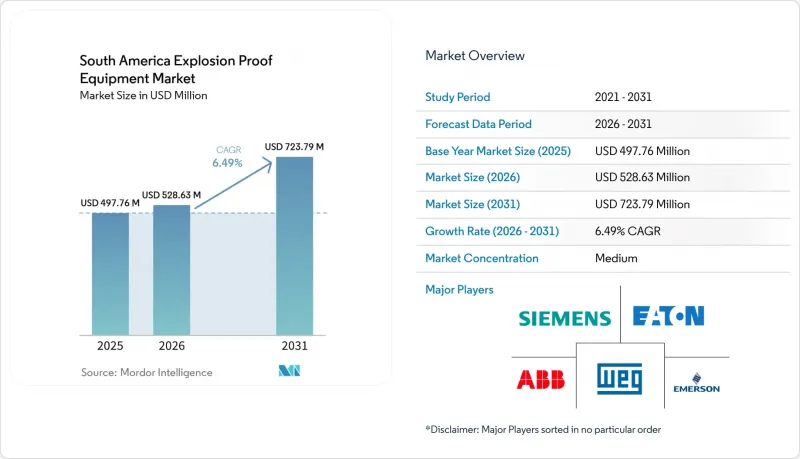
據 Mordor Intelligence 稱,南美防爆設備市場預計在 2025 年價值 4.978 億美元,並在預測期(2026-2031 年)內以 6.5% 的複合年成長率成長,從 2026 年的 5.286 億美元成長到 2031 億美元的 7.238 億美元。
南美洲防爆設備市場趨勢與洞察
巴西海上石油、天然氣和煉油基礎設施的擴張
巴西石油公司(Petrobras)2026-2030年產業計畫撥款692億美元用於探勘和生產,其中包括8個新的生產系統、11艘布濟奧斯型浮式生產儲卸油船(FPSO)、煉油廠擴建計劃,以及將海上生產和相關加工資產置於其資本計劃核心地位的戰略。這些開發項目需要在特定地點使用經認證的馬達、電纜固定頭、接線盒、照明設備、自動化設備、現場儀器和配套電氣基礎設施,其規格通常在施工開始前確定。巴西石油公司與SBM Offshore於2026年5月簽署的兩艘SEAP型FPSO合約涉及超過600億雷亞爾(約119億美元)的投資,設備規格製定工作將持續數年,從設計到試運行。每艘FPSO將產生設備供應、安裝、檢驗、更換、文件編制以及運作後持續維護等方面的需求。現有海上資產在油田擴建和維護計畫實施過程中也需要更換設備。當零件必須保持符合指定危險區域分類要求的狀態時,這種需求尤其突出。新建設和現有設備維護的結合,延長了南美洲防爆設備市場的採購週期,為原始設備製造商 (OEM) 和售後市場的認證供應商創造了商機。
銅礦、鐵礦石、鋰礦和金礦的擴張
採礦作業,包括破碎、運輸、鑽孔、選礦、泵送和物料輸送,都需要適用於易燃粉塵和危險作業環境的設備。由於地下作業區、選礦迴路、封閉式加工區和儲存設施都可能產生粉塵,因此危險區域設備的適用範圍已遠超過石油和天然氣設施。南美洲防爆設備市場受到採礦專案的影響,這些專案需要可靠的配電設備、馬達、照明、監控系統、電纜和機殼,以滿足嚴苛的現場條件。設備的選擇取決於區域分類、粉塵特性、溫度要求、安裝條件、維護便利性以及保護人員和設備資產的需求。在偏遠地區的採礦作業中,長時間運作中斷關鍵的加工操作,因此設備的耐用性、備件供應和現場維護支援至關重要。這些作業條件使得經過認證的設備不僅僅是一項獨立的採購,而是場地設計、試運行、維護和更換流程中不可或缺的一部分。
認證和生命週期合規相關的成本很高。
認證成本可能相當高昂,因為設備批准可能涉及測試、工廠評估、監控、認證續約、技術文件以及持續證明產品符合規範。即使是已獲得IECEx或ATEX認證的供應商,巴西的法規結構也可能增加額外的工作量。根據ABENDI的報告,截至2025年12月,巴西有超過280名專業人員持有IECEx認證。與危險區域設備的訓練、檢驗、安裝和維護需求相比,合格人員仍然有限。如果認證和培訓成本增加,或者合規措施與其他資本優先事項相衝突,小規模企業可能會推遲升級。這些成本可能會限制南美洲防爆設備市場的潛在需求,尤其是對於採購預算有限且缺乏專業工程資源的小規模專案。
細分市場分析
截至2025年,「防爆」將佔南美防爆設備市場42.9%的佔有率,預計到2031年將以8%的複合年成長率成長。此類別包括增強安全、防爆和密封等方法,操作員在尋求防護性能、設備重量、維護便利性和安裝實用性之間的最佳平衡時會選擇這些方法。這在海上設施中尤其重要,因為設備的放置位置、可用空間和安裝系統的重量都會影響專案設計和維護計劃。南美洲防爆設備市場中此類方法的規模也反映出,需要根據危險類型、設備功能和運作現場條件來調整防護方法。 ABENDI指出,巴西爆炸性環境的標準和維護規範的持續發展將貫穿整個2025年,這強調了正確選擇和記錄在案的檢查的重要性。
在石油和天然氣井口以及需要嚴格控制點火的製程區域,耐火設備仍然至關重要;而在氣體危險場所,本質安全型設備則廣泛應用於儀器和感測器電路。對於大型控制櫃和分析儀器,如果更換單一組件不切實際或需要對現有系統進行重大改造,則應採用加壓和吹掃的方式。實體隔離措施,例如屏障和防爆牆,則適用於設備放置和隔離對風險管理至關重要的應用情境。由於沒有單一方法適用於所有製程、場所、維護安排或危險等級,供應商必須提供全面的防護解決方案。這意味著產品選擇與特定場所的設計、檢驗、安裝和維護實務密切相關。
截至2025年,1區佔全部區域價值的37.8%。該區域涉及正常運作期間可能存在可燃性氣體的場所,例如海上平台、煉油裝置、接收終端和其他油氣加工設施。巴西的近海資產是1區設備部署的重要基礎。這是因為上游作業需要大規模的電氣、儀器、感測和通訊系統。隨著老舊資產進行維護和延壽工作,可能需要更換設備。南美洲防爆設備市場透過馬達、照明、外殼、接地、控制設備和感測設備來滿足這些需求。巴西石油公司(Petrobras)計劃在探勘、生產和煉油領域進行投資,這凸顯了這些應用的重要性。
預計到2031年,20區將以7.8%的複合年成長率成長,成為本研究預測中成長最快的區域分類。該區域適用於持續或長期存在可燃粉塵雲的場所,例如封閉的穀物、糖、生質燃料、採礦和其他物料輸送過程。 2區和22區涵蓋了不太可能持續存在有害氣體和粉塵的各種應用,而0區和21區對於需要防護持續存在的危險的較為有限的應用仍然至關重要。如此廣泛的區域分類意味著供應商必須提供適合運作環境、危險特徵、偵測系統和實際安裝條件的設備。這也意味著可能需要多種防護解決方案,而不是在整個設施中採用單一的設備設計。
其他好處:
- Excel格式的市場預測(ME)表
- 3個月的分析師支持
目錄
第1章:引言
- 研究假設和市場定義
- 調查範圍
第2章:調查方法
第3章執行摘要
第4章 市場狀況
- 市場概覽
- 市場促進因素
- 巴西海上石油、天然氣和煉油基礎設施的擴張
- 銅、鐵礦石、鋰和金礦開採的擴張
- 加強對危險區域的合規性和認證執法力度。
- 利用工業自動化和工業物改裝實施改造
- 整個流程工業老舊設備的更新換代
- 加強糧食、糖和生質燃料加工過程中粉塵區域的安全措施。
- 市場限制因素
- 認證和生命週期合規相關的高成本
- 經認證的設備和工程前期成本很高。
- 不同國家對舊標準的接受程度有差異
- 外匯波動、進口延誤和熟練人員短缺。
- 產業價值鏈分析
- 監理情勢
- 技術展望
- 宏觀經濟因素對市場的影響
- 波特五力分析
第5章 市場規模與成長預測
- 透過保護方法
- 防爆裝置(耐火型)
- 本質安全
- 加壓/吹掃
- 防爆
- 爆炸隔離
- 區
- 0區
- 1區
- 2區
- 20區
- 21區
- 22區
- 按最終用戶行業分類
- 石油和天然氣
- 化工/石油化工
- 採礦和金屬
- 能源與電力
- 製藥
- 食品/飲料加工
- 污水處理
- 氫氣生產和燃料電池
- 其他終端用戶產業
- 系統特定
- 電源供應/分配
- 馬達和驅動器
- 自動化和控制系統
- 照明系統
- 物料輸送設備
- 監測和檢測
- 暖氣和暖通空調
- 其他系統
- 國家
- 巴西
- 阿根廷
- 智利
- 哥倫比亞
- 秘魯
- 其他南美國家
第6章 競爭情勢
- 市場集中度
- 策略趨勢
- 市佔率分析
- 公司簡介
- WEG SA
- ABB Ltd.
- Siemens AG
- Eaton Corporation plc
- Emerson Electric Co.
- Pepperl+Fuchs SE
- R. STAHL AG
- BARTEC Top Holding GmbH
- Honeywell International Inc.
- Rockwell Automation, Inc.
- Schneider Electric SE
- Marechal Electric Group
- GM International SRL
- Warom Technology Incorporated Company
- Hawke International
- Kohlbach Motores e Equipamentos Eletricos Ltda.
第7章 市場機會與未來展望
According to Mordor Intelligence, the South America explosion proof equipment market was valued at USD 497.8 million in 2025 and is estimated to grow from USD 528.6 million in 2026 to USD 723.8 million by 2031, at a CAGR of 6.5% during the forecast period (2026-2031).
South America Explosion Proof Equipment Market Trends and Insights
Expansion of Brazil Offshore Oil and Gas and Refining Infrastructure
Petrobras's 2026-2030 business plan allocates USD 69.2 billion to exploration and production and includes 8 new production systems, 11 Buzios FPSOs, refinery expansion plans, and a strategy that keeps offshore production and related processing assets at the center of its capital program. These developments require certified motors, cable glands, junction boxes, lighting, automation equipment, field instrumentation, and supporting electrical infrastructure in classified locations, with specifications often set before construction begins. The May 2026 contracts between Petrobras and SBM Offshore for 2 SEAP FPSOs represent investments exceeding BRL 60 billion, or USD 11.9 billion, and extend equipment specification activities over several years, from engineering through commissioning. Each FPSO creates demand across equipment supply, installation, inspection, replacement work, documentation, and the ongoing maintenance programs required after it enters operation. Existing offshore assets also require equipment replacement during field extension and maintenance programs, particularly where components must remain suitable for the designated hazardous-area classification. This combination of new construction and installed-base work supports a longer procurement cycle for the South America explosion-proof equipment market and provides qualified suppliers opportunities across both original equipment and aftermarket activities.
Expansion of Copper, Iron Ore, Lithium, and Gold Mining
Mining sites require equipment suitable for combustible dust and hazardous operating conditions in crushing, conveying, drilling, mineral processing, pumping, and material transfer activities. Dust can occur in underground works, ore-handling circuits, enclosed processing areas, and storage points, thereby broadening the use of hazardous-area equipment beyond oil and gas facilities. The South America explosion-proof equipment market, therefore, has exposure to mining projects that require reliable electrical distribution, motors, lighting, monitoring systems, cable connections, and enclosures that meet demanding site conditions. Equipment selection depends on the zone classification, dust characteristics, temperature requirements, installation conditions, maintenance access, and the need to protect personnel and plant assets. Remote mining operations also place greater value on durable products, spare parts availability, and local maintenance support because extended downtime can disrupt essential processing tasks. These operating conditions make certified equipment an integral part of the site design, commissioning, maintenance, and replacement processes rather than a stand-alone purchase.
High Certification and Lifecycle Compliance Costs
Certification costs can be significant because equipment approval may involve testing, factory assessment, surveillance, certificate renewal, technical records, and ongoing evidence that product specifications remain compliant. Brazil's regulatory framework can create additional work for suppliers that already hold IECEx or ATEX approvals. ABENDI reported that more than 280 Brazilian professionals held IECEx Certified Persons competence certificates by December 2025. The available qualified workforce remains limited relative to the training, inspection, installation, and maintenance needs of hazardous-area installations. Smaller operators can delay upgrades when certification and training costs rise or when compliance work competes with other capital priorities. These costs can limit addressable demand in the South America explosion proof equipment market, particularly for smaller projects with limited procurement budgets and limited access to specialist engineering resources.
Other drivers and restraints analyzed in the detailed report include:
- Stricter Hazardous-Area Compliance and Certification Enforcement
- Industrial Automation and IIoT Retrofit Adoption
- High Upfront Cost for Certified Equipment and Engineering
For complete list of drivers and restraints, kindly check the Table Of Contents.
Segment Analysis
Explosion Prevention held 42.9% of the South America explosion proof equipment market share in 2025 and is expected to grow at a 8% CAGR through 2031. The category includes increased safety, non-sparking, and encapsulation approaches that operators select when they seek a suitable balance of protection, equipment weight, maintenance access, and installation practicality. It is relevant to offshore installations where equipment layout, available space, and the weight of installed systems affect project design and maintenance planning. The South America explosion proof equipment market size for this method also reflects the need to match the protection approach to the type of hazard, the equipment function, and the conditions at the operating location. ABENDI noted ongoing development of Brazilian explosive-atmosphere standards and maintenance practices during 2025, reinforcing the importance of appropriate selection and documented inspection.
Flameproof equipment remains important in oil and gas wellhead and process areas where robust ignition containment is required, while intrinsic safety is widely applicable to instrumentation and sensor circuits in gas-hazard locations. Pressurization and purging are suited to larger control enclosures and analyzers where replacing each individual component may not be practical or may require extensive changes to installed systems. Physical separation measures, such as barriers and blast walls, address applications where equipment layout and separation are central to risk control. Suppliers must maintain a broad protection portfolio because no single method fits every process, location, maintenance arrangement, or hazard classification. This requirement keeps product selection closely linked to site-specific engineering, inspection, installation, and maintenance practices.
Zone 1 represented 37.8% of regional value in 2025. This zone is associated with locations where flammable gas may be present during normal operations, including offshore platforms, refinery units, receiving terminals, and other hydrocarbon-processing assets. Brazil's offshore assets form a substantial installed base for Zone 1 equipment because upstream operations require extensive electrical, instrumentation, detection, and communications systems. Equipment replacement can remain necessary as mature assets undergo maintenance and life-extension work, and the South America explosion proof equipment market supports these needs through motors, lighting, enclosures, glands, controls, and detection equipment. Petrobras's planned exploration, production, and refining investments maintain the importance of these applications.
Zone 20 is forecast to advance at a 7.8% CAGR through 2031, making it the fastest-growing zone classification in the supplied estimates. It applies to locations where combustible dust clouds are continuously present or present for long periods, including enclosed grain, sugar, biofuels, mining, and other material-handling processes. Zones 2 and 22 cover a broad range of applications where hazardous gas or dust is less likely to be continuously present, while Zones 0 and 21 remain important for narrower applications that require protection against continuous-presence hazards. This spread of zone classifications requires suppliers to provide equipment that is appropriate for the operating environment, hazard profile, inspection regime, and practical installation conditions. It also means that a facility may require several protection solutions rather than a single equipment design across all areas.
Complete Report Scope:
- By Method of Protection
- Explosion Containment (Flame-Proof)
- Intrinsic Safety
- Pressurization / Purged
- Explosion Prevention
- Explosion Segregation
- By Zone
- Zone 0
- Zone 1
- Zone 2
- Zone 20
- Zone 21
- Zone 22
- By End-User Industry
- Oil and Gas
- Chemicals and Petrochemicals
- Mining and Metals
- Energy and Power
- Pharmaceuticals
- Food and Beverage Processing
- Wastewater Treatment
- Hydrogen Production and Fuel Cells
- Other End-User Industries
- By System
- Power Supply and Distribution
- Motors and Drives
- Automation and Control Systems
- Lighting Systems
- Material Handling Equipment
- Surveillance and Detection
- Heating and HVAC
- Other Systems
- By Country
- Brazil
- Argentina
- Chile
- Colombia
- Peru
- Rest of South America
List of Companies Covered in this Report:
- WEG S.A.
- ABB Ltd.
- Siemens AG
- Eaton Corporation plc
- Emerson Electric Co.
- Pepperl+Fuchs SE
- R. STAHL AG
- BARTEC Top Holding GmbH
- Honeywell International Inc.
- Rockwell Automation, Inc.
- Schneider Electric SE
- Marechal Electric Group
- G.M. International SRL
- Warom Technology Incorporated Company
- Hawke International
- Kohlbach Motores e Equipamentos Eletricos Ltda.
Additional Benefits:
- The market estimate (ME) sheet in Excel format
- 3 months of analyst support
TABLE OF CONTENTS
1 INTRODUCTION
- 1.1 Study Assumptions and Market Definition
- 1.2 Scope of the Study
2 RESEARCH METHODOLOGY
3 EXECUTIVE SUMMARY
4 MARKET LANDSCAPE
- 4.1 Market Overview
- 4.2 Market Drivers
- 4.2.1 Expansion of Brazil Offshore Oil and Gas and Refining Infrastructure
- 4.2.2 Expansion of Copper, Iron Ore, Lithium and Gold Mining
- 4.2.3 Stricter Hazardous-Area Compliance and Certification Enforcement
- 4.2.4 Industrial Automation and IIoT Retrofit Adoption
- 4.2.5 Aging Installed-Base Replacement Across Process Industries
- 4.2.6 Dust-Zone Safety Upgrades in Grain, Sugar and Biofuels Processing
- 4.3 Market Restraints
- 4.3.1 High Certification and Lifecycle Compliance Costs
- 4.3.2 High Upfront Cost for Certified Equipment and Engineering
- 4.3.3 Fragmented National Acceptance of Ex Standards
- 4.3.4 Currency Volatility, Import Delays and Specialist Shortages
- 4.4 Industry Value Chain Analysis
- 4.5 Regulatory Landscape
- 4.6 Technological Outlook
- 4.7 Impact of Macroeconomic Factors on the Market
- 4.8 Porter's Five Forces Analysis
- 4.8.1 Threat of New Entrants
- 4.8.2 Bargaining Power of Buyers
- 4.8.3 Bargaining Power of Suppliers
- 4.8.4 Threat of Substitutes
- 4.8.5 Intensity of Competitive Rivalry
5 MARKET SIZE AND GROWTH FORECASTS (VALUE)
- 5.1 By Method of Protection
- 5.1.1 Explosion Containment (Flame-Proof)
- 5.1.2 Intrinsic Safety
- 5.1.3 Pressurization / Purged
- 5.1.4 Explosion Prevention
- 5.1.5 Explosion Segregation
- 5.2 By Zone
- 5.2.1 Zone 0
- 5.2.2 Zone 1
- 5.2.3 Zone 2
- 5.2.4 Zone 20
- 5.2.5 Zone 21
- 5.2.6 Zone 22
- 5.3 By End-User Industry
- 5.3.1 Oil and Gas
- 5.3.2 Chemicals and Petrochemicals
- 5.3.3 Mining and Metals
- 5.3.4 Energy and Power
- 5.3.5 Pharmaceuticals
- 5.3.6 Food and Beverage Processing
- 5.3.7 Wastewater Treatment
- 5.3.8 Hydrogen Production and Fuel Cells
- 5.3.9 Other End-User Industries
- 5.4 By System
- 5.4.1 Power Supply and Distribution
- 5.4.2 Motors and Drives
- 5.4.3 Automation and Control Systems
- 5.4.4 Lighting Systems
- 5.4.5 Material Handling Equipment
- 5.4.6 Surveillance and Detection
- 5.4.7 Heating and HVAC
- 5.4.8 Other Systems
- 5.5 By Country
- 5.5.1 Brazil
- 5.5.2 Argentina
- 5.5.3 Chile
- 5.5.4 Colombia
- 5.5.5 Peru
- 5.5.6 Rest of South America
6 COMPETITIVE LANDSCAPE
- 6.1 Market Concentration
- 6.2 Strategic Moves
- 6.3 Market Share Analysis
- 6.4 Company Profiles (includes Global Level Overview, Market Level Overview, Core Segments, Financials as available, Strategic Information, Market Rank/Share, Products and Services, Recent Developments)
- 6.4.1 WEG S.A.
- 6.4.2 ABB Ltd.
- 6.4.3 Siemens AG
- 6.4.4 Eaton Corporation plc
- 6.4.5 Emerson Electric Co.
- 6.4.6 Pepperl+Fuchs SE
- 6.4.7 R. STAHL AG
- 6.4.8 BARTEC Top Holding GmbH
- 6.4.9 Honeywell International Inc.
- 6.4.10 Rockwell Automation, Inc.
- 6.4.11 Schneider Electric SE
- 6.4.12 Marechal Electric Group
- 6.4.13 G.M. International SRL
- 6.4.14 Warom Technology Incorporated Company
- 6.4.15 Hawke International
- 6.4.16 Kohlbach Motores e Equipamentos Eletricos Ltda.
7 MARKET OPPORTUNITIES AND FUTURE OUTLOOK
- 7.1 White-Space and Unmet-Need Assessment

 防爆比例閥市場:全球市場預測(2026-2032年)
 防爆灌裝機市場規模、佔有率和成長分析:按機器類型、填充技術、產品類型、應用、最終用戶產業和地區分類 - 2026-2033 年產業預測
 亞太地區防爆設備:市場佔有率分析、產業趨勢與統計及成長預測(2026-2031)防爆設備:市場佔有率分析、產業趨勢與統計、成長預測(2026-2031)
 2026年全球防爆設備市場報告
 全球防爆設備市場規模、佔有率、趨勢及成長分析報告(2026-2034年)2026年全球防爆艙市場報告防爆電梯市場:按產品、類型、安裝方式、負載容量、速度和最終用戶分類-2026-2032年全球預測防爆加濕器市場按類型、濕度輸出、應用、最終用戶和分銷管道分類,全球預測(2026-2032)
 防爆設備市場分析及預測(至2035年):依類型、產品類型、服務、技術、組件、應用、材質、設備、最終用戶、安裝類型分類