


 |
市場調查報告書
商品編碼
2120512
防爆設備:市場佔有率分析、產業趨勢與統計、成長預測(2026-2031)Explosion Proof Equipment - Market Share Analysis, Industry Trends & Statistics, Growth Forecasts (2026 - 2031) |
||||||

※ 本網頁內容可能與最新版本有所差異。詳細情況請與我們聯繫。
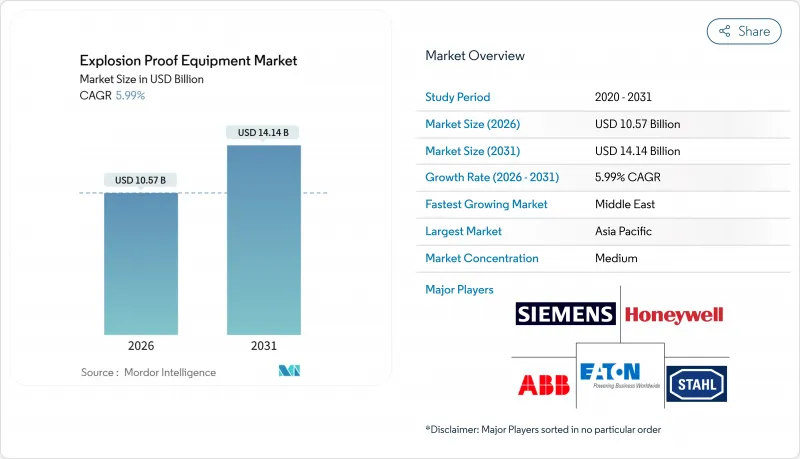
根據 Mordor Intelligence 預測,防爆設備市場規模預計將在 2026 年達到 105.7 億美元,並在 2031 年擴大到 141.4 億美元,在此期間的複合年成長率為 5.99%。
本報告依防護方式(防爆型(防火型)、本質安全型、加壓/吹掃型及其他)、區域(0區、1區及其他)、終端用戶產業(石油天然氣、化工及石化、採礦及金屬、能源及發電及其他)、系統(供電及南美配電、電機及歐洲地區、自動化及控制系統及其他)及地區細分(北美地區和中東地區)。市場預測以美元計價。
全球防爆設備市場趨勢及洞察
全球對ATEX和IECEx的監管更加嚴格。
2024年至2026年間,參與IECEx檢驗報告互認的成員國數量從28個增加到38個。這使得重複型式檢驗所需時間減少了約50%,迫使不符合標準的舊設備退役。歐盟在修訂後的ATEX指令中堵住了自我認證的漏洞,強制要求所有II類組件進行第三方審核。因此,德國和法國在2025年被處以超過50萬歐元(56.5萬美元)的罰款。由於原始設備製造商(OEM)爭相在海關進口禁令生效前遵守法規,TUV SUD和Intertek的審核請求量激增了22%。沿岸地區的業者為了避免港口延誤,使其採購符合IECEx標準,導致認證需求遠遠超過了傳統的油氣相關訂單。綜合來看,這些發展預計將使基準年成長率提高約 0.9 個百分點。
需要一級設備的綠色氫能項目數量不斷增加。
到2025年,電解槽的累積裝置容量將達到3.2吉瓦,另有12吉瓦正在建設中,但每個電解槽都需要I類1區接線盒、壓縮機和氣體感測迴路。加州氫能安全委員會已將允許的氫氣濃度限制在1%,實際上強制要求採用SIL 2級跳脫邏輯和本質安全訊號迴路。光是JAFRA二期工程中,2024年的採購輪次就撥款約10億美元用於防爆電氣設備。目前,配備防爆點火系統的100%氫氣適用型、經TUV認證的燃氣渦輪機已開始出貨,並在高峰發電廠和化工廠的廢氣回收管線中得到越來越廣泛的應用。隨著出口規模的氫氣終端在2028年投入運作,預計這一因素將使預計的複合年成長率提高1.2個百分點。
身份驗證和重新身份驗證成本高昂
獲得防爆認證通常需要花費每個產品系列 5 萬至 15 萬美元,每次設計調整都會額外增加 2 萬至 4 萬美元,並導致 3 至 6 個月的延誤。根據 Intertek 2024 年的報告,工業物聯網 (IIoT) 設備需要按照 IEC 62443-4-2 標準證明其網路安全性,這使得專案週期延長至 19 週。因此,小眾供應商不願進入次市場,導致防爆設備市場細分化,並阻礙了規模經濟的實現。原始設備製造商 (OEM) 必須以較低的銷售量來分攤合規成本,而終端用戶則面臨備件價格飆升的問題,這導致市場成長率下降了約 0.6 個百分點。
細分市場分析
到2025年,本質安全型防爆設備將佔防爆設備市場34.17%的佔有率,預計到2031年將以每年6.19%的速度成長,超過加壓式、防爆密閉式和其他傳統方法。這種轉變將透過減輕機殼重量和消除加工火焰通道,降低初始材料成本和整體生命週期維護成本。 ABB的AC500-S PLC系列採用本質安全輸出,無需單獨的防護架,並將機櫃面積減少25%。艾默生的SIL 3安全控制器可直接連接到1區HART迴路,從而在不中斷生產的情況下實現熱切換,同時保持現有線路。變頻驅動器仍然需要防火外殼,但散熱半導體技術的進步正在縮小需要密閉式外殼的輸出功率範圍。加壓式系統在分析儀器防護罩中仍然佔據主導地位,但由於吹掃空氣損失警報和聯鎖裝置的增加,其複雜性正在增加。預計到 2026 年,本質安全型防爆設備的市場規模將達到 36 億美元,到 2031 年將超過 49 億美元。中小機械製造商非常欣賞能夠透過單一認證在不同電壓或地區部署平台的能力,這加強了對節能型保護方案的長期支援。
儘管在600V開關設備和250kW馬達中,密閉式防爆方法仍然十分重要,但其市佔率卻持續下降。為了彌補檢測成本,原始設備製造商(OEM)目前正在為驅動器、啟動器或斷路器插件鑄造模組化防爆外殼,但即使是這些平台也面臨著來自本質安全型現場匯流排架構的激烈競爭。砂浸式和油浸式防爆方法在地下礦用變壓器中仍然很受歡迎,但隨著原油價格飆升,雙層油箱成本不斷增加,礦業公司正轉向緊湊型本質安全型遙測技術。預計到2031年,加壓防爆設備的市佔率將降至12%以下。這是由於預測性維護程序越來越重視本質安全型電路提供的「帶電運行」安全性。這種轉變在採購規範中已經顯現,當迴路電壓低於30V時,本質安全型防爆方法優先於密閉式防爆方法。
1區在絕對數量上仍然佔據主導地位,佔2025年已安裝設備的41.53%,但由於超級工廠和製藥粉末生產線的增加,易燃粉塵區域的擴張速度更快。預計20區和21區防爆設備的市場規模總計將在2026年超過18億美元,並在2031年達到27億美元。在鋰離子電池正極材料混合、石墨負極材料加工和溶劑回收系統中,存在粉塵和蒸氣的混合風險,因此需要符合IP6X防護等級且具有耐高溫性能的機殼。美國監管機構在2025年指出了47家存在粉塵相關違規行為的工廠,促使這些工廠即時對輸送機和斗式提昇機維修。
原始設備製造商 (OEM) 正積極響應這一趨勢,提供雙重認證產品,以應對氣體和粉塵危害,從而減輕分銷商的庫存負擔。伊頓的 CEAG 開關和 Vertec 的 Zone 20 照明燈具便是這一趨勢的典型例證,它們均達到 IP66/IP67 防塵防水等級,能夠承受清潔液的侵蝕,同時有效阻止細粉的進入。長期以來被視為中等風險的市政污水處理廠,正將其風機房升級至 Zone 1 等級,以應對因污水消化而導致的甲烷濃度升高。同時,Zone 0 等級仍是電解槽陰極室和儲存槽以外的小眾市場,但由於僅允許使用本質安全型設備,其單價較高。在防爆設備市場,Zone 0 等級的成本比 Zone 2 等級高出 30% 至 50%,即使部署規模有限,也能帶來可觀的利潤。
區域分析
到2025年,亞太地區將維持32.71%的最大市場佔有率,這主要得益於中國、印度和東南亞煉油廠和石化廠的擴張。中國計劃在2024年運作8套乙烯裂解裝置,並為每套裝置訂購多達3,000套防爆設備。同時,印度的沿海投資區正在投資超過1,000億美元建設綜合體。在日本,氨氣混燒維修需要使用I類設備來控制氨氣的可燃範圍(15%至28%);而在韓國,現有煉油廠正在加裝藍氫循環系統。
預計到2025年,北美將佔全球銷售額的約28%。美國墨西哥灣沿岸的蒸汽裂解裝置、LNG接收站和氫氣樞紐項目,憑藉美國能源局提供的70億美元津貼,獲得了大量訂單。加拿大油砂業者正持續以高效率的Ex e型防爆電機取代老舊的I類電機,這些電機採用耐腐蝕塗層,以應對含鹽尾礦的腐蝕環境。墨西哥則間接受益於此,該國組裝防爆外殼,規避對中國鑄件徵收的反傾銷稅,並將成品免稅出口到美國。
預計到2031年,中東地區將以8.27%的複合年成長率實現最高成長,這主要得益於傑夫拉、盧瓦伊斯和亞斯列夫等大型企劃,這些項目將防爆電封技術納入了數十億美元的EPC合約中。波斯灣沿岸的氫氣、氨氣和甲醇出口碼頭需要SIL 3級停堆系統、光纖配線盤以及數千個0區氣體偵測器。歐洲約佔24%的市場佔有率,但其成長受到能源價格不確定性的限制。儘管如此,BASF、殼牌和道達爾能源正在利用整合無線感測器對老舊設施進行數位化改造。拉丁美洲和非洲的市場規模仍然較小,但如果資金籌措到位,巴西、奈及利亞和安哥拉的鹽層下油田和新建煉油廠將提供間歇性成長的機會。
其他福利
- Excel格式的市場預測(ME)表
- 3個月的分析師支持
目錄
第1章:引言
- 研究假設和市場定義
- 調查範圍
第2章:調查方法
第3章執行摘要
第4章 市場狀況
- 市場概覽
- 市場促進因素
- 全球對ATEX和IECEx的監管更加嚴格。
- 需要一級設備的綠色氫能項目數量不斷增加。
- 符合工業物聯網標準的防爆維修
- 危險區域迅速轉向LED照明
- 鋰離子超級工廠對防塵設備的需求
- 太空產業所需的防爆系統測試台
- 市場限制因素
- 身份驗證和重新身份驗證成本高昂
- 不同區域的規劃標準有差異
- 耐火鑄件供應鏈延誤
- 對中國製造的外殼徵收反傾銷稅
- 產業價值鏈分析
- 監理情勢
- 技術展望
- 宏觀經濟因素對市場的影響
- 波特五力分析
第5章 市場規模與成長預測
- 透過保護方法
- 防爆裝置(耐火型)
- 本質安全
- 加壓和吹掃
- 防爆
- 爆炸隔離
- 區
- 0區
- 1區
- 2區
- 20區
- 21區
- 22區
- 按最終用戶行業分類
- 石油和天然氣
- 化工/石油化工
- 採礦和金屬
- 能源和發電
- 製藥
- 食品和飲料加工
- 污水處理
- 氫氣生產和燃料電池
- 其他
- 系統特定
- 電源/配電
- 馬達驅動
- 自動化和控制系統
- 照明系統
- 物料輸送設備
- 監測和檢測
- 暖氣和暖通空調
- 其他系統
- 按地區
- 北美洲
- 美國
- 加拿大
- 墨西哥
- 歐洲
- 德國
- 英國
- 法國
- 義大利
- 西班牙
- 俄羅斯
- 其他歐洲國家
- 亞太地區
- 中國
- 日本
- 印度
- 韓國
- ASEAN
- 澳洲和紐西蘭
- 其他亞太國家
- 南美洲
- 巴西
- 阿根廷
- 其他南美國家
- 中東
- 沙烏地阿拉伯
- 阿拉伯聯合大公國
- 土耳其
- 其他中東國家
- 非洲
- 南非
- 奈及利亞
- 其他非洲地區
- 北美洲
第6章 競爭情勢
- 市場集中度
- 策略趨勢
- 市佔率分析
- 公司簡介
- ABB Ltd.
- Eaton Corporation plc
- Siemens AG
- Honeywell International Inc.
- R. STAHL AG
- Pepperl+Fuchs GmbH
- Emerson Electric Co.
- Bartec GmbH
- Rockwell Automation Inc.
- Intertek Group plc
- Marechal Electric Group
- Adalet Inc.
- CZ Electric Co. Ltd.
- MAM Explosion-Proof Technology(Shanghai)Co. Ltd.
- GM International SRL
- Alloy Industry Co. Ltd.
- Hawke International
- Cooper Crouse-Hinds(Eaton)
- WEG Industries
- Advantech Co. Ltd.
第7章 市場機會與未來展望
According to Mordor Intelligence, the explosion proof equipment market size reached USD 10.57 billion in 2026 and is forecast to climb to USD 14.14 billion by 2031, reflecting a 5.99% CAGR across the period.
This report is Segmented by Method of Protection (Containment, Intrinsic Safety, Pressurization, and More), Zone (Zone 0, Zone 1, and More), End-User (Oil and Gas, Chemicals, Mining, Energy, and More), System (Power, Motors, Automation, and More), and Geography (North America, South America, Europe, Asia-Pacific, Middle East, Africa). The Market Forecasts are Provided in Terms of Value (USD).
Global Explosion Proof Equipment Market Trends and Insights
Stricter Global ATEX/IECEx Enforcement
Mutual recognition of IECEx test reports rose from 28 to 38 member states between 2024 and 2026, cutting duplicate type-testing times by roughly 50% and forcing non-compliant legacy gear out of service. The European Union closed a self-certification loophole in the revised ATEX Directive, obliging third-party audits for all Group II assemblies, and fines above EUR 500,000 (USD 565,000) were issued in Germany and France during 2025. TUV Sud and Intertek logged a 22% surge in audit requests as OEMs scrambled to comply before customs blocks took effect. Gulf-region operators aligned procurement with IECEx to avoid port delays, pushing certified demand far beyond historical oil and gas orders. Collectively, these moves lift the baseline CAGR by an estimated 0.9 percentage points.
Rising Green-Hydrogen Projects Needing Class I Equipment
Cumulative electrolyzer capacity reached 3.2 GW by 2025, with another 12 GW under execution, and each stack requires Class I, Division 1 junction boxes, compressors and gas detection loops. California's Hydrogen Safety Panel capped allowable hydrogen concentration at 1%, effectively mandating SIL 2 trip logic and intrinsically safe signal loops. Jafurah Phase 2 alone allocated roughly USD 1 billion for Ex-rated electrical scope in 2024 procurement rounds. TUV-certified turbines capable of 100% hydrogen now ship with flame-proof ignition systems, broadening adoption in peaker plants and chemical off-gas recovery lines. As export-scale hydrogen terminals start in 2028, the driver is expected to add 1.2 percentage points to the forecast CAGR.
High Certification and Recertification Cost
Obtaining Ex certificates typically costs USD 50,000-150,000 per product family, and any design tweak triggers an additional USD 20,000-40,000 plus a 3-6 month delay. Intertek's 2024 report notes project durations lengthened to 19 weeks as IIoT devices required cybersecurity evidence under IEC 62443-4-2. Niche suppliers therefore skip secondary markets, fragmenting the explosion proof equipment market and depressing economies of scale. End-users see higher spares prices because OEMs must amortize compliance cost across thin volumes, subtracting roughly 0.6 percentage points from growth.
Other drivers and restraints analyzed in the detailed report include:
- IIoT-Ready Explosion-Proof Retrofits
- Rapid LED Migration in Hazardous Lighting
- Divergent Regional Zoning Standards
For complete list of drivers and restraints, kindly check the Table Of Contents.
Segment Analysis
Intrinsic safety claimed 34.17% of the explosion proof equipment market in 2025 and is projected to grow at 6.19% through 2031, outpacing pressurization, explosion containment and other legacy approaches. The shift lowers enclosure mass and eliminates machined flame paths, reducing both upfront material and lifecycle maintenance costs. ABB's AC500-S PLC family embeds intrinsic outputs that negate separate barrier racks, freeing 25% of cabinet footprint. Emerson's SIL 3 safety controller connects directly to HART loops in Zone 1 areas, preserving wiring and enabling hot-cutovers without production downtime. Variable-frequency drives continue to require flame-proof housings, yet semiconductor advances that distribute heat are narrowing the power levels where containment is essential. Pressurization systems remain the method of choice in analyzer shelters, although purge-air loss alarms and interlocks add complexity. Explosion proof equipment market size for intrinsic safety reached USD 3.6 billion in 2026 and is foreseen to exceed USD 4.9 billion by 2031. Smaller machine builders appreciate the ability to certify once and roll platforms across voltages and regions, reinforcing long-term preference for energy-limiting protection.
While containment retains relevance for 600 V switchgear and 250 kW motors, its share continues to erode. OEMs now cast modular flame-proof housings that accept drive, starter or disconnect inserts to amortize testing fees, but even these platforms face stiff competition from intrinsic fieldbus architectures. Sand-filled and oil-immersed techniques find support in underground mining transformers, yet high oil prices make double-walled tanks expensive, steering miners toward compact intrinsic telemetry. Explosion proof equipment market share for pressurization is forecast to dip below 12% by 2031 as predictive-maintenance programs value the safer live-work privileges intrinsic circuits provide. The transition is already visible in procurement specifications that rank intrinsic safety ahead of containment whenever loop power stays below 30 V.
Zone 1 still dominates in absolute terms, representing 41.53% of installed devices in 2025, yet combustible-dust areas are expanding faster due to giga-factory and pharmaceutical powder lines. Explosion proof equipment market size for Zone 20 and Zone 21 combined crossed USD 1.8 billion in 2026 and is projected to reach USD 2.7 billion by 2031. Lithium-ion cathode mixing, graphite anode processing and solvent recovery systems present hybrid dust-and-vapor risks that demand IP6X enclosures with elevated temperature codes. Regulators in the United States cited 47 facilities in 2025 for dust violations, prompting immediate retrofits of conveyors and bucket elevators.
OEMs respond with dual-certified products that serve both gas and dust hazards, reducing inventory burden for distributors. Eaton's CEAG switches and BARTEC's Zone 20 luminaires exemplify this trend, each carrying IP66/IP67 ingress ratings to resist cleaning fluids while blocking fine powders. Municipal wastewater plants, long considered moderate-risk, are upgrading blower rooms to Zone 1 to accommodate rising methane concentrations from co-digestion. Meanwhile, Zone 0 remains niche outside electrolyzer cathode chambers and storage tank sumps, but unit values are high because only intrinsically safe apparatus is admissible. The explosion proof equipment market maintains a cost premium of 30%-50% in Zone 0 compared with Zone 2, contributing outsized revenue from a limited installed base.
Complete Report Scope:
- By Method of Protection
- Explosion Containment (Flame-Proof)
- Intrinsic Safety
- Pressurization / Purged
- Explosion Prevention
- Explosion Segregation
- By Zone
- Zone 0
- Zone 1
- Zone 2
- Zone 20
- Zone 21
- Zone 22
- By End-User Industry
- Oil and Gas
- Chemicals and Petrochemicals
- Mining and Metals
- Energy and Power
- Pharmaceuticals
- Food and Beverage Processing
- Waste-Water Treatment
- Hydrogen Production and Fuel Cells
- Other End-User Industries
- By System
- Power Supply and Distribution
- Motors and Drives
- Automation and Control Systems
- Lighting Systems
- Material Handling Equipment
- Surveillance and Detection
- Heating and HVAC
- Other Systems
- By Geography
- North America
- United States
- Canada
- Mexico
- Europe
- Germany
- United Kingdom
- France
- Italy
- Spain
- Russia
- Rest of Europe
- Asia Pacific
- China
- Japan
- India
- South Korea
- ASEAN
- Australia and New Zealand
- Rest of Asia Pacific
- South America
- Brazil
- Argentina
- Rest of South America
- Middle East
- Saudi Arabia
- United Arab Emirates
- Turkey
- Rest of Middle East
- Africa
- South Africa
- Nigeria
- Rest of Africa
- North America
Geography Analysis
Asia Pacific retained the largest share at 32.71% in 2025 owing to refinery and petrochemical build-outs across China, India, and Southeast Asia. China commissioned eight ethylene crackers in 2024, each ordering up to 3,000 Ex devices, while India's coastal investment zones are committing more than USD 100 billion to integrated complexes. Japan's ammonia co-firing retrofits require Class I equipment to manage the 15%-28% flammability window of ammonia, and South Korea is adding blue-hydrogen loops in existing refineries.
North America accounted for roughly 28% of 2025 revenue, as U.S. Gulf Coast steam crackers, LNG terminals, and hydrogen hubs secured orders following the DOE's USD 7 billion in grants. Canadian oil-sands operators continue to replace aging Class I motors with higher-efficiency Ex e units featuring corrosion-resistant coatings for saline tailings ponds. Mexico benefits indirectly by assembling flameproof enclosures to bypass anti-dumping tariffs on Chinese castings and by shipping finished goods duty-free into the United States.
The Middle East is forecast to post the fastest 8.27% CAGR through 2031, powered by Jafurah, Ruwais and Yasref mega-projects that bundle Ex electrical packages into multi-billion-dollar EPC contracts. Hydrogen, ammonia and methanol export terminals along the Persian Gulf demand SIL 3 shutdown systems, fiber-optic marshaling panels and thousands of Zone 0 gas detectors. Europe holds roughly 24% share, yet growth is constrained by energy-price uncertainty; still, BASF, Shell and TotalEnergies are digitizing historic complexes with intrinsic wireless sensors. Latin America and Africa remain smaller, but pre-salt fields and new refineries in Brazil, Nigeria and Angola offer episodic upside when financing aligns.
- ABB Ltd.
- Eaton Corporation plc
- Siemens AG
- Honeywell International Inc.
- R. STAHL AG
- Pepperl+Fuchs GmbH
- Emerson Electric Co.
- Bartec GmbH
- Rockwell Automation Inc.
- Intertek Group plc
- Marechal Electric Group
- Adalet Inc.
- CZ Electric Co. Ltd.
- MAM Explosion-Proof Technology (Shanghai) Co. Ltd.
- G.M. International SRL
- Alloy Industry Co. Ltd.
- Hawke International
- Cooper Crouse-Hinds (Eaton)
- WEG Industries
- Advantech Co. Ltd.
Additional Benefits:
- The market estimate (ME) sheet in Excel format
- 3 months of analyst support
TABLE OF CONTENTS
1 INTRODUCTION
- 1.1 Study Assumptions and Market Definition
- 1.2 Scope of the Study
2 RESEARCH METHODOLOGY
3 EXECUTIVE SUMMARY
4 MARKET LANDSCAPE
- 4.1 Market Overview
- 4.2 Market Drivers
- 4.2.1 Stricter Global ATEX/IECEx Enforcement
- 4.2.2 Rising Green-Hydrogen Projects Needing Class I Equipment
- 4.2.3 IIoT-Ready Explosion-Proof Retrofits
- 4.2.4 Rapid LED Migration in Hazardous Lighting
- 4.2.5 Lithium-Ion Gigafactories Demand for Dust-Zone Gear
- 4.2.6 Space-Industry Test Stands Requiring Ex-Rated Systems
- 4.3 Market Restraints
- 4.3.1 High Certification and Recertification Cost
- 4.3.2 Divergent Regional Zoning Standards
- 4.3.3 Supply-Chain Delays for Flame-Proof Castings
- 4.3.4 Anti-Dumping Tariffs on Chinese Ex Enclosures
- 4.4 Industry Value Chain Analysis
- 4.5 Regulatory Landscape
- 4.6 Technological Outlook
- 4.7 Impact of Macroeconomic Factors on the Market
- 4.8 Porter's Five Forces Analysis
- 4.8.1 Threat of New Entrants
- 4.8.2 Bargaining Power of Buyers
- 4.8.3 Bargaining Power of Suppliers
- 4.8.4 Threat of Substitutes
- 4.8.5 Intensity of Competitive Rivalry
5 MARKET SIZE AND GROWTH FORECASTS (VALUE)
- 5.1 By Method of Protection
- 5.1.1 Explosion Containment (Flame-Proof)
- 5.1.2 Intrinsic Safety
- 5.1.3 Pressurization / Purged
- 5.1.4 Explosion Prevention
- 5.1.5 Explosion Segregation
- 5.2 By Zone
- 5.2.1 Zone 0
- 5.2.2 Zone 1
- 5.2.3 Zone 2
- 5.2.4 Zone 20
- 5.2.5 Zone 21
- 5.2.6 Zone 22
- 5.3 By End-User Industry
- 5.3.1 Oil and Gas
- 5.3.2 Chemicals and Petrochemicals
- 5.3.3 Mining and Metals
- 5.3.4 Energy and Power
- 5.3.5 Pharmaceuticals
- 5.3.6 Food and Beverage Processing
- 5.3.7 Waste-Water Treatment
- 5.3.8 Hydrogen Production and Fuel Cells
- 5.3.9 Other End-User Industries
- 5.4 By System
- 5.4.1 Power Supply and Distribution
- 5.4.2 Motors and Drives
- 5.4.3 Automation and Control Systems
- 5.4.4 Lighting Systems
- 5.4.5 Material Handling Equipment
- 5.4.6 Surveillance and Detection
- 5.4.7 Heating and HVAC
- 5.4.8 Other Systems
- 5.5 By Geography
- 5.5.1 North America
- 5.5.1.1 United States
- 5.5.1.2 Canada
- 5.5.1.3 Mexico
- 5.5.2 Europe
- 5.5.2.1 Germany
- 5.5.2.2 United Kingdom
- 5.5.2.3 France
- 5.5.2.4 Italy
- 5.5.2.5 Spain
- 5.5.2.6 Russia
- 5.5.2.7 Rest of Europe
- 5.5.3 Asia Pacific
- 5.5.3.1 China
- 5.5.3.2 Japan
- 5.5.3.3 India
- 5.5.3.4 South Korea
- 5.5.3.5 ASEAN
- 5.5.3.6 Australia and New Zealand
- 5.5.3.7 Rest of Asia Pacific
- 5.5.4 South America
- 5.5.4.1 Brazil
- 5.5.4.2 Argentina
- 5.5.4.3 Rest of South America
- 5.5.5 Middle East
- 5.5.5.1 Saudi Arabia
- 5.5.5.2 United Arab Emirates
- 5.5.5.3 Turkey
- 5.5.5.4 Rest of Middle East
- 5.5.6 Africa
- 5.5.6.1 South Africa
- 5.5.6.2 Nigeria
- 5.5.6.3 Rest of Africa
- 5.5.1 North America
6 COMPETITIVE LANDSCAPE
- 6.1 Market Concentration
- 6.2 Strategic Moves
- 6.3 Market Share Analysis
- 6.4 Company Profiles (includes Global level Overview, Market level overview, Core Segments, Financials as available, Strategic Information, Market Rank/Share for key companies, Products and Services, Recent Developments)
- 6.4.1 ABB Ltd.
- 6.4.2 Eaton Corporation plc
- 6.4.3 Siemens AG
- 6.4.4 Honeywell International Inc.
- 6.4.5 R. STAHL AG
- 6.4.6 Pepperl+Fuchs GmbH
- 6.4.7 Emerson Electric Co.
- 6.4.8 Bartec GmbH
- 6.4.9 Rockwell Automation Inc.
- 6.4.10 Intertek Group plc
- 6.4.11 Marechal Electric Group
- 6.4.12 Adalet Inc.
- 6.4.13 CZ Electric Co. Ltd.
- 6.4.14 MAM Explosion-Proof Technology (Shanghai) Co. Ltd.
- 6.4.15 G.M. International SRL
- 6.4.16 Alloy Industry Co. Ltd.
- 6.4.17 Hawke International
- 6.4.18 Cooper Crouse-Hinds (Eaton)
- 6.4.19 WEG Industries
- 6.4.20 Advantech Co. Ltd.
7 MARKET OPPORTUNITIES AND FUTURE OUTLOOK
- 7.1 White-Space and Unmet Needs Assessment

 防爆比例閥市場:全球市場預測(2026-2032年)
 防爆灌裝機市場規模、佔有率和成長分析:按機器類型、填充技術、產品類型、應用、最終用戶產業和地區分類 - 2026-2033 年產業預測
 南美洲防爆裝置:市場佔有率分析、產業趨勢與統計數據以及成長預測(2026-2031 年)亞太地區防爆設備:市場佔有率分析、產業趨勢與統計及成長預測(2026-2031)
 2026年全球防爆設備市場報告
 全球防爆設備市場規模、佔有率、趨勢及成長分析報告(2026-2034年)2026年全球防爆艙市場報告防爆電梯市場:按產品、類型、安裝方式、負載容量、速度和最終用戶分類-2026-2032年全球預測防爆加濕器市場按類型、濕度輸出、應用、最終用戶和分銷管道分類,全球預測(2026-2032)
 防爆設備市場分析及預測(至2035年):依類型、產品類型、服務、技術、組件、應用、材質、設備、最終用戶、安裝類型分類