


 |
市場調查報告書
商品編碼
2154956
南美洲酒精飲料包裝:市佔率分析、產業趨勢與統計及成長預測(2026-2031 年)South America Alcoholic Drinks Packaging - Market Share Analysis, Industry Trends & Statistics, Growth Forecasts (2026 - 2031) |
||||||

※ 本網頁內容可能與最新版本有所差異。詳細情況請與我們聯繫。
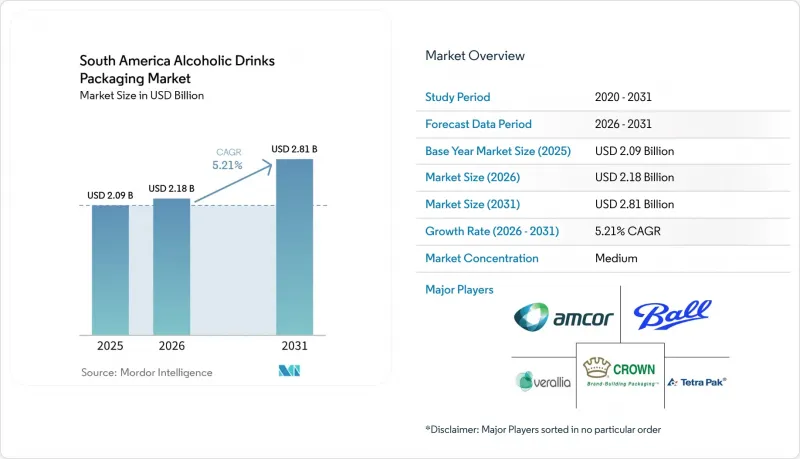
據 Mordor Intelligence 稱,2025 年南美洲酒精飲料包裝市場價值 20.9 億美元,預計將從 2026 年的 21.8 億美元成長到 2031 年的 28.1 億美元。
預計 2026 年至 2031 年的預測期內複合年成長率為 5.21%。
南美酒精飲料包裝市場趨勢與洞察
啤酒、烈酒和葡萄酒的優質化。
優質化趨勢的日益增強,進一步提升了酒類品牌產品包裝的重要性。當瓶身或罐身本身需要在消費者品嚐產品之前就傳遞品質感時,這一趨勢尤其顯著。獨特的玻璃瓶身造型、壓花工藝、精心挑選的色彩以及小批量生產,都有助於打造與主流產品在視覺上區分開來的精品和高級產品產品。厚重的琥珀色酒瓶在蘭姆酒、卡沙薩酒和威士忌的包裝中仍然扮演著至關重要的角色,它們不僅能保護產品,還能為國內外品牌在商店上營造出獨特的視覺效果。這種轉變提升了能夠提供設計支援、穩定生產品質以及瓶蓋性能實用指導的供應商的價值。此外,隨著生產商越來越重視外觀、品質保證以及執行既定設計的能力,單純的價格競爭在南美酒類包裝市場已不再奏效。因此,包裝供應商不僅要滿足灌裝、運輸、零售展示和退貨流量等營運需求,還要迎合那些將包裝容器視為品牌組成部分的客戶。
即飲型(RTD)雞尾酒形式的成長
2024年,巴西即飲雞尾酒銷量高居全球第八,消費量接近1.8億公升。該品類在2023年至2024年間成長超過4%。即飲雞尾酒通常採用金屬罐包裝,產品需求與容器生產需求和罐裝能力直接相關。這種包裝形式滿足了戶外和社交場合對攜帶式產品的需求,在這些場合,單份包裝方便易用,而玻璃容器則不切實際。在巴西,即飲雞尾酒已不再局限於小眾市場,而是影響現有飲料製造商的包裝決策,這些製造商的產品組合涵蓋啤酒、烈酒和非酒精飲料。此外,即飲雞尾酒正在推動南美酒精飲料包裝市場出現更廣泛的包裝組合,使品牌所有者能夠在同一品類中組合使用罐裝、紙盒、標籤和二級包裝。獲得此類填充和容器合約的供應商還可以獲得相關的需求,例如瓶蓋、標籤、印刷罐、多件裝和保護性二級包裝。
鋁、玻璃、樹脂和能源成本的波動。
由於包裝容器成本取決於原料價格,而原料價格的波動與飲料需求無關,因此原料和能源價格的波動仍然是南美包裝製造商面臨的結構性挑戰。阿根廷貨幣不穩定推高了進口鋁板和玻璃製造原料的本地成本,給依賴外幣採購的製造商帶來了特別沉重的壓力。玻璃熔爐需要大量能源,因此能源價格的波動是影響包裝容器成本和供應商維持價格穩定能力的關鍵因素。這些壓力會使固定價格合約變得複雜,並延誤有關模具選擇、新罐型或填充和加工設備升級的決策。與擁有更廣泛採購管道和財務資源的跨國製造商相比,小規模加工商和區域灌裝商應對貨幣和能源風險的能力較弱。因此,南美酒精飲料包裝市場更青睞那些擁有靈活採購系統、價格透明且能夠根據原料狀況變化調整產品組合的供應商。
細分市場分析
到2025年,玻璃容器將佔據南美酒精飲料包裝市場42.78%的佔有率,並在主要生產基地的啤酒和烈酒包裝市場中保持其核心地位。在巴西、阿根廷和智利,啤酒、烈酒和葡萄酒的瓶裝傳統支撐著對玻璃容器的需求,這些國家的品牌多年來一直使用玻璃瓶進行零售分銷和餐飲服務。玻璃也滿足了高階品牌的需求,這些品牌在競爭激烈的零售環境中,透過瓶型、顏色、瓶蓋設計和重量來區分產品。食品接觸材料的技術合規要求可能會提高供應商的認證標準,尤其是在將容器、瓶蓋和內襯作為完整系統進行評估時。對於飲料製造商而言,在產品保護、貨架展示、重複使用機制和成熟的填充生產線等方面都至關重要,因此玻璃仍然是不可或缺的材料。
預計2026年至2031年間,金屬包裝將以6.01%的複合年成長率成長,主要受即飲雞尾酒、罐裝卡沙薩酒和低酒精飲料等產品的推動,這些產品注重便利性和便攜性。巴西的金屬回收系統對尋求可回收包裝形式和清晰的消費後回收管道的飲料品牌日益重要。塑膠在注重成本的啤酒產品和部分即飲產品中仍扮演著重要角色,尤其是在輕便性和低搬運風險影響包裝選擇的情況下。其他材料包括紙盒,紙盒兼具運輸效率和保存期限,為品牌所有者提供了某些即飲產品的新選擇。因此,南美酒精飲料包裝市場的發展趨勢並非單一材料,而是多種材料的組合,其選擇取決於產品應用、價格範圍、零售環境和分銷需求。
到2025年,瓶裝飲料將佔南美酒精飲料包裝市場63.82%的佔有率。這反映了完善的填充基礎設施、消費者對瓶裝飲料的熟悉程度以及整體在各類飲料中的廣泛應用。玻璃瓶和寶特瓶由於與現有營運系統的兼容性以及能夠滿足各種產品尺寸的需求,在啤酒廠和釀酒廠仍然很常見。對於專注於銷售點視覺差異化的精釀啤酒、高級啤酒和烈酒品牌而言,瓶裝也是一種成熟的展示形式。現有的瓶裝灌裝生產線確保了生產商的營運連續性,使他們能夠從同一家工廠處理多種包裝尺寸、價格範圍和分銷管道。在某些啤酒分銷管道中,可回收瓶系統進一步促進了這種包裝形式的發展,因為回收和再填充可以與當地的配送系統結合。
預計2026年至2031年間,金屬罐的年複合成長率將達到5.89%,即飲型(RTD)產品在傳統啤酒和葡萄酒消費場景之外創造了新的消費機會。 2025年5月,皇冠公司宣佈在其位於蓬塔格羅薩的工廠新增第三條高速生產線。這將使其年產能從24億罐提升至36億罐,預計2026年第三季開始商業化生產。軟包裝在攜帶式葡萄酒和風味烈酒等應用領域仍佔有一席之地,其優勢在於降低破損風險和便於運輸。其他包裝形式包括盒中袋包裝,這種包裝常用於多份裝葡萄酒,特別適用於消費者和零售商尋求經濟包裝的情況。這種包裝組合使南美酒精飲料包裝市場能夠滿足現有零售產品、酒店餐飲業的需求以及以便利性為導向的新型產品形式。
其他好處:
- Excel格式的市場預測(ME)表
- 3個月的分析師支持
目錄
第1章:引言
- 研究假設和市場定義
- 調查範圍
第2章:調查方法
第3章執行摘要
第4章 市場狀況
- 市場概覽
- 宏觀經濟因素對市場的影響
- 市場促進因素
- 啤酒、烈酒和葡萄酒的優質化。
- 即飲雞尾酒的成長
- 擴大可回收金屬罐的用途
- 擴大回收玻璃瓶系統的應用
- 電子商務和對小包裹的需求
- 擴大無酒精和低酒精飲料的包裝範圍
- 市場限制因素
- 鋁、玻璃、樹脂和能源成本的波動。
- 收集和回收基礎設施不平衡
- 散裝葡萄酒出口抑制了國內包裝需求。
- 各國市場包裝法規的複雜性
- 產業價值鏈分析
- 監理情勢
- 技術展望
- 波特五力分析
第5章 市場規模與成長預測
- 材料
- 金屬
- 玻璃
- 塑膠
- 其他材料
- 按包裝類型
- 瓶子
- 金屬罐
- 小袋
- 其他包裝類型
- 依產品
- 啤酒
- 烈酒
- 葡萄酒
- 即飲雞尾酒
- 其他產品
- 透過分銷管道
- Off-Trade零售
- On-Trade/飯店餐飲
- 電子商務
- 免稅店
- 按地區
- 巴西
- 阿根廷
- 其他南美國家
第6章 競爭情勢
- 市場集中度
- 策略趨勢
- 市佔率分析
- 公司簡介
- Amcor plc
- Ball Corporation
- Crown Holdings, Inc.
- Verallia SA
- Tetra Pak International SA
- Ardagh Group SA
- CANPACK SA
- Graham Packaging Company LP
- Plastipak Holdings, Inc.
- Owens-Illinois, Inc.
- Berry Global Group, Inc.
- Trivium Packaging BV
- Refresco Group NV
- SIG Group AG
- AptarGroup, Inc.
- CCL Industries Inc.
- Envases Universales de Mexico, SAPI de CV
- Ecolean AB
- Alpek, SAB de CV
- Guala Closures SpA
- Closure Systems International, Inc.
第7章 市場機會與未來展望
According to Mordor Intelligence, the South America alcoholic drinks packaging market size was valued at USD 2.09 billion in 2025 and is estimated to expand from USD 2.18 billion in 2026 to reach USD 2.81 billion by 2031, at a CAGR of 5.21% during the forecast period from 2026 to 2031.
South America Alcoholic Drinks Packaging Market Trends and Insights
Premiumization of Beer, Spirits, and Wine Packaging
Premium positioning is making the primary pack more important in how alcoholic beverage brands present their products, particularly when a bottle or can must signal quality before consumers try the product. Distinctive glass shapes, embossing, controlled color choices, and smaller production runs support craft and premium offerings that seek a visible difference from mainstream products. Heavier amber bottles remain relevant for rum, cachaca, and whisky because they protect products while creating a differentiated shelf presence for domestic and export-facing brands. This shift places greater value on suppliers that can provide design support, consistent manufacturing quality, and practical guidance on the performance of bottles and closures. It also makes price-only competition less effective for the South America alcoholic drinks packaging market, since producers increasingly evaluate presentation, quality assurance, and the ability to execute a defined design. Packaging suppliers must therefore serve customers who treat the container as part of the brand, while still meeting the operational needs of filling, transport, retail display, and return logistics.
Growth of Ready-to-Drink Cocktail Formats
Brazil ranked eighth worldwide for ready-to-drink volume in 2024, with consumption close to 180 million liters, and the category expanded by more than 4% between 2023 and 2024. Ready-to-drink cocktails generally use metal cans, directly linking product demand with container production requirements and the availability of can-filling capacity. The format meets the demand for portable products for outdoor, social, and convenience-led occasions, where glass is less practical and single servings are easier to manage. In Brazil, the category has moved beyond a limited niche and is influencing packaging decisions among established beverage producers that already manage beer, spirits, and non-alcoholic portfolios. Ready-to-drink cocktails also support a broader format mix in the South America alcoholic drinks packaging market, because brand owners may use cans, cartons, labels, and secondary packs for the same category. Suppliers that secure filling and container contracts in this category can participate in related demand for closures, labels, printed cans, multipacks, and protective secondary packaging.
Volatility in Aluminum, Glass, Resin, and Energy Costs
Material and energy price changes remain a structural challenge for packaging producers across South America, because containers depend on inputs whose cost can move independently of beverage demand. Argentina's currency instability can raise the local cost of imported aluminum sheet and glassmaking inputs, placing particular pressure on producers that rely on foreign-currency purchases. Glass furnaces require substantial energy, which makes changes in energy tariffs important to container costs and to suppliers' ability to maintain stable pricing. These pressures complicate fixed-price contracts and can postpone decisions on molds, new can formats, or upgrades to filling and conversion equipment. Smaller converters and regional fillers have fewer tools to manage currency and energy risk than multinational producers with broader procurement and financial resources. The South America alcoholic drinks packaging market, therefore, rewards suppliers with flexible sourcing, transparent pricing arrangements, and the operational ability to adjust product mixes when input conditions change.
Other drivers and restraints analyzed in the detailed report include:
- Expansion of Recyclable Metal Can Applications
- Rising Adoption of Returnable Glass Bottle Systems
- Uneven Collection and Recycling Infrastructure
For complete list of drivers and restraints, kindly check the Table Of Contents.
Segment Analysis
Glass held 42.78% of the South America alcoholic drinks packaging market share in 2025, retaining its central position in beer and spirits packaging across established production centers. Beer, spirits, and wine bottling traditions support demand for glass across Brazil, Argentina, and Chile, where brands have long used bottles for retail distribution and on-premise service. Glass also serves brand needs in premium categories that use bottle shape, color, closure design, and weight to distinguish products in crowded retail environments. Technical compliance requirements for food-contact materials can raise the qualification threshold for suppliers, especially where containers, closures, and liners are evaluated as a complete system. The material remains important where product protection, shelf appearance, reuse arrangements, and established filling lines all matter to beverage producers.
Metal is projected to expand at a 6.01% CAGR from 2026 to 2031, supported by ready-to-drink cocktails, canned cachaca, and lower-alcohol beverages that favor convenience and portability. The material's collection system in Brazil strengthens its relevance to beverage brands seeking recyclable formats and a clear recovery pathway after consumption. Plastic remains relevant for cost-sensitive beer products and selected ready-to-drink formats, particularly where low weight and lower handling risk affect package choice. Other materials include carton formats that offer transport efficiency and shelf-stable storage, giving brand owners another option for selected ready-to-drink products. The South America alcoholic drinks packaging market is therefore not moving toward a single material, but toward a mix shaped by product use, price point, retail setting, and distribution needs.
Bottles held 63.82% of the South America alcoholic drinks packaging market share in 2025, reflecting installed filling infrastructure, consumer familiarity, and their broad use across beverage categories. Glass and PET bottles remain common across breweries and distilleries because they fit existing operations and accommodate a range of product sizes. Bottles also provide an established presentation format for craft, premium, and spirits brands that rely on visual differentiation at the point of sale. Existing bottle lines provide operational continuity for producers serving multiple package sizes, price tiers, and distribution channels from the same facility. Returnable bottle systems further support the package type in selected beer channels, where collection and refilling can be integrated with local delivery systems.
Metal cans are expected to expand at a 5.89% CAGR from 2026 to 2031, as ready-to-drink products create additional consumption occasions outside traditional beer and wine settings. Crown announced a third high-speed line at Ponta Grossa in May 2025, raising planned annual capacity from 2.4 billion to 3.6 billion cans, with commercial production targeted for the third quarter of 2026. Pouches retain a niche role in portable wine and flavored spirits applications, where reduced breakage risk and easy carrying are useful. Other package types include bag-in-box formats used for multi-serve wine, particularly where consumers and retailers seek economical formats. This package mix allows the South America alcoholic drinks packaging market to serve established retail products, hospitality needs, and newer convenience-led formats.
Complete Report Scope:
- By Material
- Metal
- Glass
- Plastic
- Other Materials
- By Package Type
- Bottles
- Metal Cans
- Pouches
- Other Package Types
- By Product
- Beer
- Spirits
- Wine
- Ready-To-Drink Cocktails
- Other Products
- By Distribution Channel
- Off-Trade Retail
- On-Trade / HoReCa
- E-Commerce
- Duty Free
- By Geography
- Brazil
- Argentina
- Rest of South America
List of Companies Covered in this Report:
- Amcor plc
- Ball Corporation
- Crown Holdings, Inc.
- Verallia S.A.
- Tetra Pak International S.A.
- Ardagh Group S.A.
- CANPACK S.A.
- Graham Packaging Company L.P.
- Plastipak Holdings, Inc.
- Owens-Illinois, Inc.
- Berry Global Group, Inc.
- Trivium Packaging B.V.
- Refresco Group N.V.
- SIG Group AG
- AptarGroup, Inc.
- CCL Industries Inc.
- Envases Universales de Mexico, S.A.P.I. de C.V.
- Ecolean AB
- Alpek, S.A.B. de C.V.
- Guala Closures S.p.A.
- Closure Systems International, Inc.
Additional Benefits:
- The market estimate (ME) sheet in Excel format
- 3 months of analyst support
TABLE OF CONTENTS
1 INTRODUCTION
- 1.1 Study Assumptions and Market Definition
- 1.2 Scope of the Study
2 RESEARCH METHODOLOGY
3 EXECUTIVE SUMMARY
4 MARKET LANDSCAPE
- 4.1 Market Overview
- 4.2 Impact of Macroeconomic Factors on the Market
- 4.3 Market Drivers
- 4.3.1 Premiumization of Beer, Spirits, and Wine Packaging
- 4.3.2 Growth of Ready-to-Drink Cocktail Formats
- 4.3.3 Expansion of Recyclable Metal Can Applications
- 4.3.4 Rising Adoption of Returnable Glass Bottle Systems
- 4.3.5 E-Commerce and Small-Pack Demand
- 4.3.6 Expansion of Non-Alcoholic and Low-Alcohol Beverage Packaging
- 4.4 Market Restraints
- 4.4.1 Volatility in Aluminum, Glass, Resin, and Energy Costs
- 4.4.2 Uneven Collection and Recycling Infrastructure
- 4.4.3 Bulk Wine Exports Limiting Local Packaging Demand
- 4.4.4 Packaging Compliance Complexity Across National Markets
- 4.5 Industry Value Chain Analysis
- 4.6 Regulatory Landscape
- 4.7 Technological Outlook
- 4.8 Porter's Five Forces Analysis
- 4.8.1 Bargaining Power of Suppliers
- 4.8.2 Bargaining Power of Buyers
- 4.8.3 Threat of New Entrants
- 4.8.4 Threat of Substitutes
- 4.8.5 Intensity of Competitive Rivalry
5 MARKET SIZE AND GROWTH FORECASTS (VALUE)
- 5.1 By Material
- 5.1.1 Metal
- 5.1.2 Glass
- 5.1.3 Plastic
- 5.1.4 Other Materials
- 5.2 By Package Type
- 5.2.1 Bottles
- 5.2.2 Metal Cans
- 5.2.3 Pouches
- 5.2.4 Other Package Types
- 5.3 By Product
- 5.3.1 Beer
- 5.3.2 Spirits
- 5.3.3 Wine
- 5.3.4 Ready-To-Drink Cocktails
- 5.3.5 Other Products
- 5.4 By Distribution Channel
- 5.4.1 Off-Trade Retail
- 5.4.2 On-Trade / HoReCa
- 5.4.3 E-Commerce
- 5.4.4 Duty Free
- 5.5 By Geography
- 5.5.1 Brazil
- 5.5.2 Argentina
- 5.5.3 Rest of South America
6 COMPETITIVE LANDSCAPE
- 6.1 Market Concentration
- 6.2 Strategic Moves
- 6.3 Market Share Analysis
- 6.4 Company Profiles (includes Global Level Overview, Market Level Overview, Core Segments, Financials as available, Strategic Information, Market Rank/Share, Products and Services, Recent Developments)
- 6.4.1 Amcor plc
- 6.4.2 Ball Corporation
- 6.4.3 Crown Holdings, Inc.
- 6.4.4 Verallia S.A.
- 6.4.5 Tetra Pak International S.A.
- 6.4.6 Ardagh Group S.A.
- 6.4.7 CANPACK S.A.
- 6.4.8 Graham Packaging Company L.P.
- 6.4.9 Plastipak Holdings, Inc.
- 6.4.10 Owens-Illinois, Inc.
- 6.4.11 Berry Global Group, Inc.
- 6.4.12 Trivium Packaging B.V.
- 6.4.13 Refresco Group N.V.
- 6.4.14 SIG Group AG
- 6.4.15 AptarGroup, Inc.
- 6.4.16 CCL Industries Inc.
- 6.4.17 Envases Universales de Mexico, S.A.P.I. de C.V.
- 6.4.18 Ecolean AB
- 6.4.19 Alpek, S.A.B. de C.V.
- 6.4.20 Guala Closures S.p.A.
- 6.4.21 Closure Systems International, Inc.
7 MARKET OPPORTUNITIES AND FUTURE OUTLOOK
- 7.1 White-Space and Unmet-Need Assessment

 酒精飲料包裝:市場佔有率分析、產業趨勢與統計、成長預測(2026-2031)
 酒精包裝市場分析及預測(至2035年):類型、材料類型、技術、應用、產品類型、最終用戶、製程、組件、功能與服務
 酒精飲料包裝市場規模、佔有率、成長率及全球產業分析:按類型、應用和地區分類,至2026-2034年的預測全球酒精飲料包裝市場規模、佔有率、趨勢和成長分析報告(2026-2034)永續酒精飲料包裝市場-2026-2031年預測
 酒精包裝市場規模、佔有率和成長分析(按材料類型、包裝類型、應用和地區分類):產業預測(2026-2033 年)2026-2032 年酒精飲料包裝市場(按材料類型、應用、包裝類型和地區分類)
 酒精包裝市場機會、成長動力、產業趨勢分析與 2025 - 2034 年預測中東和非洲酒精飲料包裝市場佔有率分析、行業趨勢和成長預測(2025-2030 年)亞太地區酒精飲料包裝:市場佔有率分析、產業趨勢與統計、成長預測(2025-2030 年)