


 |
市場調查報告書
商品編碼
2154954
南美洲人機介面:市場佔有率分析、產業趨勢與統計及成長預測(2026-2031 年)South America Human Machine Interface - Market Share Analysis, Industry Trends & Statistics, Growth Forecasts (2026 - 2031) |
||||||

※ 本網頁內容可能與最新版本有所差異。詳細情況請與我們聯繫。
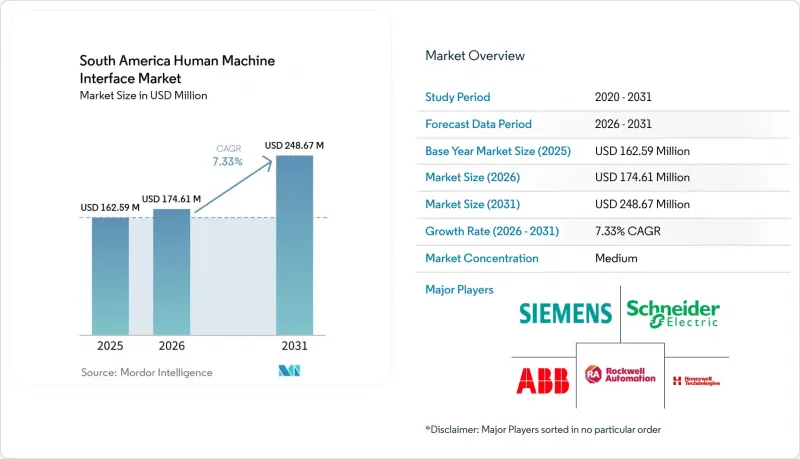
根據 Mordor Intelligence 預測,南美洲人機介面 (HMI) 市場規模預計將在 2025 年達到 1,625.9 億美元,到 2031 年達到 2,486.7 億美元,2026 年至 2031 年的複合年成長率為 7.33%。
南美洲人機介面市場趨勢與洞察
在製造業和加工產業實施工業4.0
巴西製造商正從孤立的設備轉向更互聯的生產系統。到2025年,74%的巴西工業企業將投資新設備,但互聯生產自動化僅佔總投資的5%。大型企業的比例上升至7%,顯示大規模工廠的採用率更高。這意味著許多機械化工廠在升級設備時都有潛力添加互聯介面。南美人機介面(HMI)市場正從中受益,因為在這些專案中,HMI通常用作操作員介面。此外,初始介面部署將帶動對製程資料、數位孿生和預測性維護工具的後續投資需求。
巴西的「提高巴西生產力計畫」(Programa Brasil Mais Produtivo)是一項由巴西工業發展局(ABDI)、巴西國家開發銀行(BNDES)和巴西國家工業和工業發展局(SENAI)共同發起的舉措,投資額達5,600萬雷亞爾(約1,088萬美元),旨在支持智慧工廠的數位轉型。該計劃有望幫助更多中型製造商率先採用人機介面(HMI)系統。此外,南美洲的人機介面市場也受益於一系列工業稅收政策,這些政策提高了自動化設備採購的投資報酬率(ROI)。大型企業可以將安裝和培訓成本分攤到多個地點,而小規模工廠通常需要更簡單的實施方案。供應商可以透過提供針對特定生產線的預先配置軟體包和現場技術支援來滿足這些需求。這種方法有望簡化互聯控制系統的部署,而無需對現有工廠設備進行徹底改造。
傳統人機介面與控制系統升級
該地區許多工業界面系統是在2008年至2015年商品投資週期期間安裝的。在此期間安裝的設備目前已達到或超過標準的8-12年更換週期。因此,即使工廠沒有增加產能,更換工程也可以進行。南美洲人機介面(HMI)市場正受益於這些升級,因為老舊的面板和軟體可能無法滿足當前的可靠性、連接性或安全性要求。營運商也面臨維護和重新認證老舊組件的困難風險。當介面控制大量生產或危險操作時,更換決策尤其關鍵。
過渡的時機可能會影響哪些供應商能夠維持與客戶的關係。能夠在平台變更期間最大限度減少中斷的供應商,將能夠在下一個更新周期中繼續獲得訂單。羅克韋爾自動化公司正在提案FactoryTalk Optix,作為新建專案和擴展專案的瀏覽器存取選項,同時保留 FactoryTalk View 部署的基礎架構。在南美人機介面 (HMI) 市場,隨著 2010 年至 2015 年間安裝的設備接近使用壽命終點,2028 年至 2030 年間的更新活動可能會活性化。此外,如果舊設備不再符合目前的認證要求,工業電子產品的認證要求可能會縮短某些更新週期。將升級規劃為預算內的可靠性改善計劃,可降低意外停機的風險。
前期投資高,且熟練操作人員短缺。
對於許多南美製造商而言,初始成本仍然是一大障礙。耐環境面板、工業用電腦、軟體授權和系統整合都需要大量的預付資金。中小企業還需要考慮培訓、安裝和支援的成本。到2025年,61%的巴西工業企業認為經濟不確定性是資本投資的主要障礙。同一項調查發現,43%的企業認為技術純熟勞工短缺也是一個障礙。在此背景下,技術採納和操作人員的準備情況在採購決策中相互交織。
大規模跨國公司和國有企業更容易為多站點人機介面 (HMI) 專案資金籌措。同時,許多中小企業 (SME) 仍然堅持更換基本面板,而不會遷移到互聯架構。這限制了供應商賴以產生持續收入的遠端存取、分析或高級配置工具等軟體的普及。如果供應商能夠提供結合硬體、簡易軟體和遠距離診斷的產業專用的軟體包,南美人機介面 (HMI) 市場就能更均衡地發展。標準化軟體包可以縮短工程時間,並提高專案預期收益的清晰度。此外,現場培訓仍然至關重要,因為系統的價值取決於操作人員有效使用和維護設備的能力。
細分市場分析
到2025年,硬體將佔南美人機介面(HMI)市場佔有率的63.42%。面板介面將繼續在汽車、食品飲料和能源產業的機器級控制中發揮核心作用。工業用電腦也將支援需要更高本地運算能力的應用。硬體需求主要源自於嵌入式面板的替換以及對能夠在工廠環境中可靠運作的設備的需求。已安裝設備的存在持續催生了對相容組件、服務和升級的需求。儘管客戶越來越關注軟體功能,但硬體仍然是許多自動化採購中最顯眼的部分。
預計2026年至2031年,軟體市場將以7.92%的複合年成長率成長。視覺化工具、配置環境、分析和遠端存取是推動南美人機介面(HMI)市場軟體規模成長的主要因素。Schneider Electric與Stefanini IHM的合作專注於“軟體定義自動化”,該技術將自動化軟體與專有硬體解耦。這種模式能夠在不完全替換實體平台的情況下實現數位轉型。試運行、遠距離診斷和生命週期支援等服務構成了第三層級的服務。這些服務對於老舊設備在原始硬體售出後仍能保持可靠性能至關重要。軟體供應商可以透過在客戶需要實現來自多個供應商的設備之間的互通性擴大市場佔有率。此外,由於巴西國家衛生監督局(ANVISA)對電腦化系統驗證的要求,軟體合格在巴西製藥生產中變得越來越重要。
到2025年,觸控螢幕技術將佔據南美人機介面(HMI)市場59.38%的佔有率。這項技術已廣泛應用於汽車組裝、製藥、加工廠和控制室等領域。其廣泛應用得益於諸多優勢,包括易用性、靈活的顯示佈局以及長期降低硬體成本。觸控螢幕系統還可以在單一裝置上顯示警報訊息、製程流程圖、操作規程和維護資訊。這些特性使其適用於許多常見的工業應用。然而,儘管觸控螢幕具有這些優勢,但在某些操作條件下,仍然需要實體按鈕和小鍵盤。
基於擴增實境/虛擬實境(AR/VR)的介面預計將在2026年至2031年間以8.31%的複合年成長率成長。遠端指導可應用於哥倫比亞的礦場、阿根廷的鋰礦開採場以及巴西的近海平台等專家難以到達的場所。當現場工作人員進行檢查和維護時,AR疊加層還可以顯示設備資訊。羅克韋爾自動化將AR和連網工人工具定位為工業數位化的重要組成部分。語音控制和手勢控制介面仍然是新興的選擇,例如在製藥行業的無塵室中,免持操作有助於無菌流程。在振動較大或危險的環境中,按鈕和鍵盤設備仍然非常重要,因為濕度、灰塵、手套和小鍵盤材質等因素會影響電容式觸控操作的可靠性。因此,南美人機介面(HMI)產業可能會採用混合介面,而不是單一的操作方式。供應商正在提高觸控螢幕的耐用性和響應速度,同時也為特殊環境開發遠端控制和免持功能。
其他好處:
- Excel格式的市場預測(ME)表
- 3個月的分析師支持
目錄
第1章:引言
- 研究假設和市場定義
- 調查範圍
第2章:調查方法
第3章執行摘要
第4章 市場狀況
- 市場概覽
- 宏觀經濟因素對市場的影響
- 市場促進因素
- 製造業和加工業採用工業4.0的現狀
- 傳統人機介面與控制系統升級
- 採礦、鋰礦以及石油和天然氣產業的自動化擴張
- 工業數位化和遠端監控技術的進步
- 在惡劣環境下對堅固耐用型介面的需求日益成長
- 人機介面工程和系統整合能力的在地化
- 市場限制因素
- 前期投資額大,且熟練操作人員短缺。
- 互聯操作技術(OT)中的網路安全風險
- 進口認證延誤和合規要求不一致
- 外匯波動風險與進口零件成本風險
- 產業價值鏈分析
- 監理情勢
- 技術展望
- 波特五力分析
第5章 市場規模與成長預測
- 報價
- 硬體
- 人機介面面板
- 工業用電腦
- 軟體
- 配置/程式設計
- 服務
- 硬體
- 透過介面技術
- 觸控螢幕
- 按鈕/小鍵盤
- 基於手勢
- 語音控制
- 利用擴增實境/虛擬實境技術
- 按最終用戶行業分類
- 車
- 食品/飲料
- 包裝
- 製藥
- 石油和天然氣
- 金屬和採礦
- 能源公用事業
- 航太/國防
- 半導體和電子學
- 其他最終用戶
- 透過配置
- 嵌入式人機介面
- 獨立式人機介面
- 去中心化/遠端人機介面
- 按地區
- 巴西
- 阿根廷
- 哥倫比亞
- 其他南美國家
第6章 競爭情勢
- 市場集中度
- 策略趨勢
- 市佔率分析
- 公司簡介
- Siemens AG
- Rockwell Automation, Inc.
- Schneider Electric SE
- ABB Ltd
- Honeywell International Inc.
- Mitsubishi Electric Corporation
- Emerson Electric Co.
- Advantech Co., Ltd.
- Omron Corporation
- Yokogawa Electric Corporation
- Eaton Corporation plc
- Robert Bosch GmbH
- Phoenix Contact GmbH & Co. KG
- Beckhoff Automation GmbH & Co. KG
- Beijer Electronics Group AB
- Weintek Labs., Inc.
- Delta Electronics, Inc.
- WEG SA
- COPA-DATA GmbH
- Elipse Software Ltda.
- Altus Sistemas de Automacao SA
第7章 市場機會與未來展望
According to Mordor Intelligence, the South America human machine interface market was valued at USD 162.59 billion in 2025 and is forecast to reach USD 248.67 billion by 2031, advancing at a CAGR of 7.33% from 2026 to 2031.
South America Human Machine Interface Market Trends and Insights
Industry 4.0 Adoption Across Manufacturing and Process Industries
Brazilian manufacturers are moving from stand-alone equipment toward more connected production systems. In 2025, 74% of Brazilian industrial companies invested in new equipment, but connected production automation accounted for only 5% of total investment. The figure reached 7% among large companies, showing that adoption is more advanced in larger facilities. This leaves a broad group of mechanized plants that may add connected interfaces as they update equipment. The South America human machine interface (HMI) market benefits because an HMI often serves as the operator-facing layer for those projects. Initial interface deployments can also create demand for later investments in process data, digital twins, and predictive maintenance tools.
Brazil's Programa Brasil Mais Produtivo is supporting smart-factory digitalization through a BRL 56 million (USD 10.88 million) initiative administered with ABDI, BNDES, and SENAI. That program can widen access to first-time HMI deployments among mid-sized manufacturers. The South America human machine interface market also benefits from industrial tax measures that improve the return on automation purchases. Larger businesses can spread configuration and training costs across multiple sites, while smaller facilities often need simpler entry points. Vendors can respond with preconfigured packages for particular production lines and local technical support. This approach may make connected control systems more accessible without requiring a full redesign of a factory's existing equipment.
Replacement of Legacy HMI and Control Systems
Many industrial interface systems in the region were installed during the 2008-2015 commodity investment cycle. Equipment from that period is now within or beyond a standard 8-12-year replacement window. Replacement projects can therefore proceed even when a plant is not adding capacity. The South America human machine interface market gains from these upgrades because older panels and software may no longer meet current reliability, connectivity, or security requirements. Operators also face the risk that legacy components become difficult to maintain or recertify. A replacement decision is especially important where an interface controls continuous production or hazardous operations.
The timing of a migration can influence which supplier retains the customer relationship. A supplier that limits operational disruption during a platform change may secure follow-on work for the next replacement cycle. Rockwell Automation has maintained its FactoryTalk View installed base while presenting FactoryTalk Optix as a browser-accessible option for new and expanding projects. The South America human machine interface market may see greater replacement activity from 2028 to 2030 as the 2010-2015 installation group reaches the end of life. Certification requirements for industrial electronics may also shorten some replacement cycles when older equipment cannot meet current qualification conditions. Planning upgrades as a budgeted reliability program can reduce the risk of an unplanned shutdown.
High Initial Investment and Skilled-Operator Shortages
Upfront cost remains a significant barrier for many South American manufacturers. Ruggedized panels, industrial PCs, software licenses, and systems integration can require a large initial commitment. Smaller firms also need to account for training, configuration, and support costs. In 2025, 61% of Brazilian industrial companies identified economic uncertainty as their main barrier to equipment investment. The same survey found that 43% identified skilled-labor shortages as a barrier. These conditions make technology acquisition and operator readiness part of the same purchase decision.
Large multinationals and state-linked enterprises can more readily fund multi-site HMI projects. Many SMEs instead replace basic panels without moving to a connected architecture. This limits software adoption where recurring vendor revenue depends on remote access, analytics, or advanced configuration tools. The South America human machine interface market may expand more evenly when suppliers offer sector-specific packages that combine hardware, simple software, and remote diagnostics. Standardized packages can reduce engineering time and improve the clarity of a project's expected return. Local training also remains important because the system's value depends on operators' ability to use and maintain the equipment effectively.
Other drivers and restraints analyzed in the detailed report include:
- Expansion of Mining, Lithium, Oil and Gas Automation
- Growth of Industrial Digitalization and Remote Monitoring
- Cybersecurity Exposure Across Connected Operational Technology
For complete list of drivers and restraints, kindly check the Table Of Contents.
Segment Analysis
Hardware accounted for 63.42% of the South America human machine interface market share in 2025. Panel interfaces remain central to machine-level control in automotive, food and beverage, and energy operations. Industrial PCs also support applications that require greater local computing capability. Hardware demand is sustained by embedded panel replacements and the need for equipment that operates reliably in plant environments. The installed base creates an ongoing requirement for compatible components, services, and upgrades. Hardware remains the most visible part of many automation purchases, even as customers place more emphasis on software capabilities.
Software is projected to advance at a 7.92% CAGR from 2026 to 2031. Visualization tools, configuration environments, analytics, and remote access support the South America human machine interface market size for software. Schneider Electric's partnership with Stefanini IHM focuses on software-defined automation that separates automation software from proprietary hardware. This model enables digital changes without requiring a complete replacement of the physical platform. Services such as commissioning, remote diagnostics, and lifecycle support constitute a third layer of offerings. Aging installations need these services to maintain reliable performance after the original hardware has been sold. Software suppliers can gain relevance where customers want interoperability across equipment from several vendors. ANVISA requirements for computerized-system validation also make software qualification important in Brazilian pharmaceutical production.
Touchscreen technology accounted for 59.38% of the South America human-machine interface market share in 2025. It is used across automotive assembly, pharmaceutical manufacturing, process plants, and control-room applications. Its broad acceptance reflects familiar operation, flexible display layouts, and lower hardware costs over time. Touchscreen systems also allow a single device to present alarms, process diagrams, operating instructions, and maintenance information. These features make them suitable for many general industrial uses. The dominant position does not eliminate the need for physical buttons or keypads under certain operating conditions.
AR/VR-assisted interfaces are projected to advance at an 8.31% CAGR from 2026 to 2031. Mining sites in Colombia, lithium operations in Argentina, and offshore platforms in Brazil can use remote guidance when experts cannot easily reach the location. AR overlays may show equipment information while a field worker performs inspection or maintenance work. Rockwell Automation identifies AR and connected-worker tools as components of industrial digitalization. Voice-controlled and gesture-based interfaces remain emerging options, including in pharmaceutical cleanrooms, where hands-free interaction can support sterile processes. Push-button and keypad devices remain relevant in high-vibration and hazardous environments where moisture, dust, gloves, or metallic material can make capacitive touch operation less reliable. The South America human machine interface industry is therefore likely to use hybrid interfaces rather than adopt a single interaction method. Suppliers are refining touchscreen durability and response while developing remote and hands-free functions for specialized settings.
Complete Report Scope:
- By Offering
- Hardware
- HMI Panels
- Industrial PCs
- Software
- Configuration / Programming
- Services
- Hardware
- By Interface Technology
- Touchscreen
- Push-button / Keypad
- Gesture-based
- Voice-controlled
- AR / VR-assisted
- By End-User Industry
- Automotive
- Food and Beverage
- Packaging
- Pharmaceutical
- Oil and Gas
- Metal and Mining
- Energy and Utilities
- Aerospace and Defense
- Semiconductors and Electronics
- Other End Users
- By Configuration
- Embedded HMI
- Stand-alone HMI
- Distributed / Remote HMI
- By Geography
- Brazil
- Argentina
- Colombia
- Rest of South America
List of Companies Covered in this Report:
- Siemens AG
- Rockwell Automation, Inc.
- Schneider Electric SE
- ABB Ltd
- Honeywell International Inc.
- Mitsubishi Electric Corporation
- Emerson Electric Co.
- Advantech Co., Ltd.
- Omron Corporation
- Yokogawa Electric Corporation
- Eaton Corporation plc
- Robert Bosch GmbH
- Phoenix Contact GmbH & Co. KG
- Beckhoff Automation GmbH & Co. KG
- Beijer Electronics Group AB
- Weintek Labs., Inc.
- Delta Electronics, Inc.
- WEG S.A.
- COPA-DATA GmbH
- Elipse Software Ltda.
- Altus Sistemas de Automacao S.A.
Additional Benefits:
- The market estimate (ME) sheet in Excel format
- 3 months of analyst support
TABLE OF CONTENTS
1 INTRODUCTION
- 1.1 Study Assumptions and Market Definition
- 1.2 Scope of the Study
2 RESEARCH METHODOLOGY
3 EXECUTIVE SUMMARY
4 MARKET LANDSCAPE
- 4.1 Market Overview
- 4.2 Impact of Macroeconomic Factors on the Market
- 4.3 Market Drivers
- 4.3.1 Industry 4.0 Adoption Across Manufacturing and Process Industries
- 4.3.2 Replacement of Legacy HMI and Control Systems
- 4.3.3 Expansion of Mining, Lithium, Oil and Gas Automation
- 4.3.4 Growth of Industrial Digitalization and Remote Monitoring
- 4.3.5 Increasing Demand for Ruggedized Interfaces in Harsh Environments
- 4.3.6 Localization of HMI Engineering and System-Integration Capabilities
- 4.4 Market Restraints
- 4.4.1 High Initial Investment and Skilled-Operator Shortages
- 4.4.2 Cybersecurity Exposure Across Connected Operational Technology
- 4.4.3 Import Certification Delays and Non-Harmonized Compliance Requirements
- 4.4.4 Currency Volatility and Imported-Component Cost Exposure
- 4.5 Industry Value Chain Analysis
- 4.6 Regulatory Landscape
- 4.7 Technological Outlook
- 4.8 Porter's Five Forces Analysis
- 4.8.1 Bargaining Power of Suppliers
- 4.8.2 Bargaining Power of Buyers
- 4.8.3 Threat of New Entrants
- 4.8.4 Threat of Substitutes
- 4.8.5 Intensity of Competitive Rivalry
5 MARKET SIZE AND GROWTH FORECASTS (VALUE)
- 5.1 By Offering
- 5.1.1 Hardware
- 5.1.1.1 HMI Panels
- 5.1.1.2 Industrial PCs
- 5.1.2 Software
- 5.1.2.1 Configuration / Programming
- 5.1.3 Services
- 5.1.1 Hardware
- 5.2 By Interface Technology
- 5.2.1 Touchscreen
- 5.2.2 Push-button / Keypad
- 5.2.3 Gesture-based
- 5.2.4 Voice-controlled
- 5.2.5 AR / VR-assisted
- 5.3 By End-User Industry
- 5.3.1 Automotive
- 5.3.2 Food and Beverage
- 5.3.3 Packaging
- 5.3.4 Pharmaceutical
- 5.3.5 Oil and Gas
- 5.3.6 Metal and Mining
- 5.3.7 Energy and Utilities
- 5.3.8 Aerospace and Defense
- 5.3.9 Semiconductors and Electronics
- 5.3.10 Other End Users
- 5.4 By Configuration
- 5.4.1 Embedded HMI
- 5.4.2 Stand-alone HMI
- 5.4.3 Distributed / Remote HMI
- 5.5 By Geography
- 5.5.1 Brazil
- 5.5.2 Argentina
- 5.5.3 Colombia
- 5.5.4 Rest of South America
6 COMPETITIVE LANDSCAPE
- 6.1 Market Concentration
- 6.2 Strategic Moves
- 6.3 Market Share Analysis
- 6.4 Company Profiles (includes Global Level Overview, Market Level Overview, Core Segments, Financials as available, Strategic Information, Market Rank/Share, Products and Services, Recent Developments)
- 6.4.1 Siemens AG
- 6.4.2 Rockwell Automation, Inc.
- 6.4.3 Schneider Electric SE
- 6.4.4 ABB Ltd
- 6.4.5 Honeywell International Inc.
- 6.4.6 Mitsubishi Electric Corporation
- 6.4.7 Emerson Electric Co.
- 6.4.8 Advantech Co., Ltd.
- 6.4.9 Omron Corporation
- 6.4.10 Yokogawa Electric Corporation
- 6.4.11 Eaton Corporation plc
- 6.4.12 Robert Bosch GmbH
- 6.4.13 Phoenix Contact GmbH & Co. KG
- 6.4.14 Beckhoff Automation GmbH & Co. KG
- 6.4.15 Beijer Electronics Group AB
- 6.4.16 Weintek Labs., Inc.
- 6.4.17 Delta Electronics, Inc.
- 6.4.18 WEG S.A.
- 6.4.19 COPA-DATA GmbH
- 6.4.20 Elipse Software Ltda.
- 6.4.21 Altus Sistemas de Automacao S.A.
7 MARKET OPPORTUNITIES AND FUTURE OUTLOOK
- 7.1 White-Space and Unmet-Need Assessment

 2026-2034年全球人機介面市場規模、佔有率、趨勢和成長分析報告
 人機介面市場:依產品、軟體、螢幕尺寸、配置和產業分類-全球預測至2032年
 人機互動(HCI)感知晶片市場:全球市場預測,2026-2032年人機介面晶片市場:全球市場預測,2026-2032年人機互動(HCI)技術市場:全球市場預測,2026-2032年
 人機協作市場規模、佔有率和成長分析:按協作類型、技術、應用、部署類型、最終用戶產業和地區分類-2026-2033年產業預測
 人機介面馬達市場規模、佔有率及成長分析:按馬達類型、人機介面類型、應用、最終用戶和地區分類-產業預測,2026-2033年人機介面(HMI)市場規模、佔有率、成長、全球產業分析、區域趨勢及2026-2034年預測
 北美人機介面:市場佔有率分析、產業趨勢與統計及成長預測(2026-2031 年)人機介面市場-2026-2032年全球市場預測