


 |
市場調查報告書
商品編碼
2120696
北美人機介面:市場佔有率分析、產業趨勢與統計及成長預測(2026-2031 年)North America Human Machine Interface - Market Share Analysis, Industry Trends & Statistics, Growth Forecasts (2026 - 2031) |
||||||

※ 本網頁內容可能與最新版本有所差異。詳細情況請與我們聯繫。
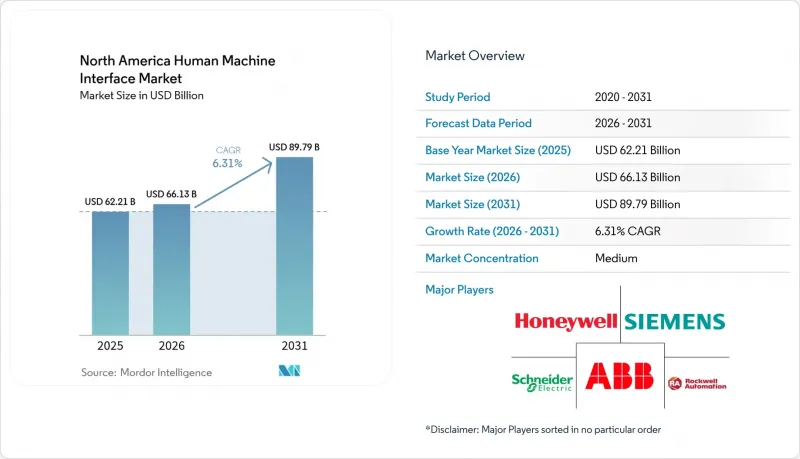
預計到 2026 年,北美人機介面 (HMI) 市場規模將達到 661.3 億美元,高於 2025 年的 622.1 億美元。
此外,預計到 2031 年市場規模將達到 897.9 億美元,並且預計從 2026 年到 2031 年將以 6.31% 的複合年成長率成長。
本報告按技術(可程式邏輯控制器、SCADA 等)、組件(通訊部分、控制設備等)、介面(觸控螢幕、小鍵盤等)、終端用戶產業(汽車、石油天然氣等)和國家(美國、加拿大)進行細分。市場規模和預測均以美元計價。
北美人機介面市場的趨勢與洞察
美國離散製造業對工業 4.0 的日益普及,推動了對互聯機器介面的需求。
如今,汽車、電子和消費品生產線的工廠經理們正在推行「單一資料架構」策略,將PLC邏輯、MES事務和品質分析整合到單一人機介面(HMI)中。西門子的「工業副駕駛」(Industrial Copilot)榮獲2025年赫爾墨斯獎,它融合了生成式人工智慧技術,在縮短工程時間的同時,提高了程式碼的健壯性。福特汽車已在其路易斯維爾組裝廠部署了一套軟體定義的“SIMATIC自動化工作站”,使得生產單元的重新配置能夠在數小時內完成,而不是數天。中型契約製造的類似部署表明,其人機介面正在從固定功能面板向可擴展的、以軟體為中心的HMI轉變,從而支援預測性維護和能源最佳化。這些升級直接擴大了北美人機介面市場的潛在基本客群。
美國職業安全與健康管理局 (OSHA) 和美國國家標準與技術研究院 (NIST) 的強制性網實整合合規性正在推動人機介面 (HMI) 的升級。
監管機構現在將安全措施不足的人機介面 (HMI) 視為安全隱患。美國職業安全與健康管理局 (OSHA) 的整改建議參考了美國國家標準與技術研究院 (NIST) SP 800-82 標準,迫使製藥和化學企業加強遠端網路基地台安全並實施多因素身份驗證。美國網路安全與基礎設施安全局 (CISA) 的 2024 年建議強調了廣泛部署的操作員工作站中存在的 SQL 注入漏洞,迫使企業停止使用不受支援的版本。違規的成本遠遠超過現代化改造預算,資金正被重新分配到加密協議和基於角色的存取控制。預認證符合 IEC 62443 標準的面板的供應商報告稱,北美人機介面市場實現了高於平均水平的成長。
傳統人機介面通訊協定中存在的持續性漏洞
2025 年 CISA 漏洞目錄重點指出 Modbus-TCP 和 DNP3 漏洞,這些漏洞可能導致攻擊者在未修補的終端上執行遠端程式碼,從而進一步從電路板層級審視工廠運作技術 (OT) 風險。北美許多工廠仍依賴「空氣間隙,而每一次新揭露的漏洞都在加速老舊配電盤的更換計畫。然而,現有線路的複雜性,加上逐步淘汰輸電線路的必要性,延緩了全面轉型。
細分市場分析
2025年,北美可程式邏輯控制器(PLC)人機介面(HMI)市場規模達169.8億美元,佔總支出的27.30%。儘管MES平台目前規模仍相對較小,但預計到2031年將以9.12%的年均成長率成長,反映出市場正朝著封閉回路型品管和即時成本會計的方向發展。供應商正在將運動、安全性和邊緣分析功能整合到下一代PLC中,在縮小機櫃面積的同時,將資料吞吐量擴展到企業雲端。電子產業的早期採用者透過整合PLC標籤和MES儀表板,已成功將廢品率降低了12%以上。同時,儘管SCADA和DCS解決方案在流程工業中依然強勁,但隨著財務長優先考慮將資本支出(Capex)轉化為營運支出(OpEx)的訂閱模式,雲端託管HMI軟體的銷售額正在超過永久授權。這種技術的整合確保了每項技術都能保持互通性,而不是相互競爭,從而支援北美人機介面 (HMI) 市場各個領域的逐步成長。
目前,越來越多的專案將產品生命週期管理 (PLM) 資料與操作介面整合,從而實現設計變更的即時應用。汽車原始設備製造商 (OEM) 報告稱,人機介面 (HMI) 工單中 CAD 修訂的自動反映,已將設計變更的部署時間縮短了兩天。基於 TSN 的開放原始碼OPC UA 協議正日益普及,成為一種通用協議,可將客製化中間件的成本降低 18%。這些進展共同表明,製造商在評估北美人機介面市場時,不僅關注面板數量,更著重於將數據轉化為實際財務成果的能力。
憑藉成熟的IP65防護等級機殼和完善的備件供應體系,觸控面板在2025年仍將佔據北美人機介面市場25.50%的佔有率。同時,隨著5G私有網路的成熟,行動和穿戴式介面預計將以每年8.97%的速度成長。航太組裝廠的早期部署表明,使用支援AR功能的智慧眼鏡疊加扭力規格和公差訊息,可將產品初始核准時間縮短30%。工業用電腦現在配備了NVIDIA GPU,使視覺應用程式能夠直接在設備上運行,無需單獨的伺服器。在存在爆炸危險的區域或需要戴手套的工作環境中,小鍵盤式人機介面仍然發揮著至關重要的作用,透過觸覺回饋防止操作失誤。語音控制的人機介面正在逐步普及,但背景噪音仍然是金屬成型生產線的一大障礙。
混合部署正變得越來越普遍。中央控制面板控制安全聯鎖裝置,而操作員則攜帶平板電腦進行一些較不重要的調整。由此形成的網狀界面結構透過冗餘提高了運作。即使控制面板發生故障,仍然可以透過經過認證的行動裝置對線路進行微調。這種配置拓寬了採購範圍,提高了整個設備系列網路安全認證的重要性,並增強了北美人機介面市場中供應商之間的差異化優勢。
其他好處:
- Excel格式的市場預測(ME)表
- 3個月的分析師支持
目錄
第1章:引言
- 研究假設和市場定義
- 調查範圍
第2章:調查方法
第3章執行摘要
第4章 市場狀況
- 市場概覽
- 市場促進因素
- 美國離散製造業對工業 4.0 的日益普及,推動了對互聯機器介面的需求。
- 美國職業安全與健康管理局 (OSHA) 和美國國家標準與技術研究院 (NIST) 對網實整合系統的合規性要求正在推動人機介面 (HMI) 的升級。
- 美國墨西哥灣沿岸和亞伯達油砂老舊製程裝置的維修。
- 部署專用 5G 網路,以實現智慧工廠中的即時人機交互
- 對多語言勞動力的需求日益成長,正在加速雙語人機介面面板的普及。
- 隨著電動車電池超級工廠在北美不斷擴張,需要先進的介面解決方案。
- 市場限制因素
- 傳統人機通訊協定中持續存在的漏洞引發了網路安全的擔憂。
- 負責整合 OT 和 IT 的人員嚴重短缺,導致實施週期延長。
- 半導體供應中斷導致控制器和顯示器的前置作業時間急劇增加。
- FDA嚴格的檢驗成本阻礙了製藥廠頻繁升級改造。
- 價值供應鏈分析
- 監管和技術展望
- 波特五力分析
- 投資分析(智慧製造介面領域的資本投資趨勢)
第5章 市場規模與成長預測
- 透過技術
- 可程式邏輯控制器(PLC)
- 監控與數據採集(SCADA)
- 企業資源規劃(ERP)
- 分散式控制系統(DCS)
- 人機介面(HMI)軟體
- 產品生命週期管理(PLM)
- 製造執行系統(MES)
- 其他技術
- 按介面類型
- 觸控螢幕操作面板
- 工業用電腦(面板式和箱式)
- 小鍵盤/功能鍵型人機介面
- 行動和穿戴式人機互動介面
- 支援語音和擴增實境技術的人機交互
- 按組件
- 電信業
- 控制設備
- 機器視覺系統
- 機器人技術
- 感應器
- 其他規則
- 按最終用戶行業分類
- 車
- 石油和天然氣
- 化工/石油化工
- 製藥
- 食品/飲料
- 金屬和採礦
- 其他行業
- 國家
- 美國
- 加拿大
第6章 競爭情勢
- 市場集中度
- 策略趨勢
- 市佔率分析
- 公司簡介
- ABB Ltd.
- Emerson Electric Company
- Fanuc Corporation
- General Electric Company
- Honeywell International Inc.
- Mitsubishi Electric Corporation
- Robert Bosch GmbH
- Rockwell Automation Inc.
- Schneider Electric SE
- Siemens AG
- Texas Instruments Incorporated
- Yokogawa Electric Corporation
- Omron Corporation
- Advantech Co., Ltd.
- Beijer Electronics Group
- Red Lion Controls(Spectris plc)
- Maple Systems Inc.
- BandR Industrial Automation GmbH(ABB Group)
- Phoenix Contact GmbH and Co. KG
- Keyence Corporation
- Parker Hannifin Corporation
- Eaton Corporation plc
- Lenze SE
第7章 市場機會與未來展望
According to Mordor Intelligence, the North America human machine interface market size in 2026 is estimated at USD 66.13 billion, growing from 2025 value of USD 62.21 billion with 2031 projections showing USD 89.79 billion, growing at 6.31% CAGR over 2026-2031.
This report is Segmented by Technology (Programmable Logic Controller, SCADA and More), Component (Communication Segment, Control Device and More), Interface (Touchscreen, Keypad and More), End-User Industry (Automotive, Oil and Gas and More), and Country (United States, Canada). Market Size and Forecasts are Provided in USD.
North America Human Machine Interface Market Trends and Insights
Increasing Industry 4.0 adoption in U.S. discrete manufacturing driving demand for connected machine interfaces
Plant managers in automotive, electronics, and packaged-goods lines now pursue single data fabric strategies that unify PLC logic, MES transactions, and quality analytics under one HMI umbrella. Siemens' Industrial Copilot, honored with the 2025 Hermes Award, embeds generative AI that cuts engineering hours while boosting code robustness. Ford integrated the software-defined SIMATIC Automation Workstation across Louisville assembly to reconfigure production cells within hours, not days. Similar deployments across mid-sized contract manufacturers indicate a structural shift from fixed-function panels to scalable, software-centric HMIs that support predictive maintenance and energy optimization. These upgrades directly enlarge the addressable base of the North America human machine interface market.
OSHA and NIST cyber-physical compliance mandates boosting HMI upgrades
Regulators now treat unsecured HMIs as safety risks. OSHA citations reference NIST SP 800-82 controls, compelling pharmaceutical and chemical operators to harden remote-access points and implement multi-factor authentication. CISA advisories in 2024 flagged SQL injection flaws in widely deployed operator stations, pushing firms to retire unsupported versions. The cost of non-compliance dwarfs modernization budgets, shunting capital toward encrypted protocols and role-based access. Vendors that pre-certify panels to IEC 62443 standards report above-market growth across the North America human machine interface market.
Persistent vulnerabilities in legacy HMI communication protocols
CISA's 2025 catalog highlights modbus-TCP and DNP3 weaknesses that permit remote code execution on unpatched terminals, intensifying board-level scrutiny of plant OT risk. Because many North American facilities still rely on air-gap illusions, each newly disclosed exploit accelerates plans to replace aging panels. However, complexity of brown-field wiring, combined with the need to stage line outages, slows full migration.
Other drivers and restraints analyzed in the detailed report include:
- Retrofitting aging process plants in U.S. Gulf Coast and Alberta oil sands
- Deployment of private 5G networks enabling real-time HMI in smart factories
- Acute shortage of OT-IT integration talent inflating implementation timelines
For complete list of drivers and restraints, kindly check the Table Of Contents.
Segment Analysis
The North America human machine interface market size for Programmable Logic Controllers stood at USD 16.98 billion in 2025 and retained a 27.30% share of total spending. MES platforms, although smaller, will grow 9.12% annually to 2031, reflecting a pivot toward closed-loop quality and real-time costing. Vendors integrate motion, safety, and edge analytics into new PLC generations, compressing cabinet footprint while expanding data throughput to enterprise clouds. Early adopters in electronics witness scrap reductions above 12% after unifying PLC tags with MES dashboards. While SCADA and DCS solutions maintain strongholds in process industries, cloud-hosted HMI software outsells perpetual licenses as CFOs prioritize subscription models that convert capex to opex. This technology convergence keeps technologies interoperating rather than cannibalizing, sustaining incremental growth in every layer of the North America human machine interface market.
A growing subset of projects now marries PLM data with operator interfaces so that engineering changes flow instantly to the shop floor. Automotive OEMs cite reductions of two days per engineering change roll-out when CAD revisions automatically populate HMI work instructions. Open-source OPC UA over TSN gains traction as common protocol, trimming custom middleware costs by 18%. Collectively, these advances underline how manufacturers judge the North America human machine interface market not simply on panel counts but on the capacity to convert data into actionable financial outcomes.
Touch-screen panels preserved 25.50% of the North America human machine interface market in 2025 due to their proven IP-65 housings and universal spare-parts ecosystems. Yet mobile and wearable interfaces will compound 8.97% per year as private 5G matures. Early roll-outs at aerospace assembly plants indicate 30% faster first-piece approvals when inspectors use AR-enabled smart glasses that overlay torque specs and tolerances. Industrial PCs now ship with NVIDIA GPUs, letting vision apps run directly on-device and eliminating separate servers. Keypad models stay relevant in explosive or gloved-hand zones, where tactile affirmations prevent mis-clicks. Voice-controlled HMIs inch forward, although background noise remains a barrier in metal-forming lines.
Hybrid deployments become common: a central panel governs safety interlocks while operators carry tablets for non-critical adjustments. The resulting interface mesh boosts uptime through redundancy; if a panel fails, the line can still be jogged from a certified mobile unit. Such configurations widen procurement scope and elevate the profile of cybersecurity certifications that span device families, reinforcing vendor differentiation across the North America human machine interface market.
Complete Report Scope:
- By Technology
- Programmable Logic Controller (PLC)
- Supervisory Control and Data Acquisition (SCADA)
- Enterprise Resource Planning (ERP)
- Distributed Control System (DCS)
- Human Machine Interface (HMI) Software
- Product Lifecycle Management (PLM)
- Manufacturing Execution System (MES)
- Other Technologies
- By Interface Type
- Touch-Screen Operator Panels
- Industrial PCs (Panel and Box)
- Keypad / Function-Key HMIs
- Mobile and Wearable HMIs
- Voice- and AR-Enabled HMIs
- By Component
- Communication Segment
- Control Device
- Machine Vision Systems
- Robotics
- Sensors
- Other Components
- By End-User Industry
- Automotive
- Oil and Gas
- Chemical and Petrochemical
- Pharmaceutical
- Food and Beverage
- Metals and Mining
- Other Industries
- By Country
- United States
- Canada
List of Companies Covered in this Report:
- ABB Ltd.
- Emerson Electric Company
- Fanuc Corporation
- General Electric Company
- Honeywell International Inc.
- Mitsubishi Electric Corporation
- Robert Bosch GmbH
- Rockwell Automation Inc.
- Schneider Electric SE
- Siemens AG
- Texas Instruments Incorporated
- Yokogawa Electric Corporation
- Omron Corporation
- Advantech Co., Ltd.
- Beijer Electronics Group
- Red Lion Controls (Spectris plc)
- Maple Systems Inc.
- BandR Industrial Automation GmbH (ABB Group)
- Phoenix Contact GmbH and Co. KG
- Keyence Corporation
- Parker Hannifin Corporation
- Eaton Corporation plc
- Lenze SE
Additional Benefits:
- The market estimate (ME) sheet in Excel format
- 3 months of analyst support
TABLE OF CONTENTS
1 INTRODUCTION
- 1.1 Study Assumptions and Market Definition
- 1.2 Scope of the Study
2 RESEARCH METHODOLOGY
3 EXECUTIVE SUMMARY
4 MARKET LANDSCAPE
- 4.1 Market Overview
- 4.2 Market Drivers
- 4.2.1 Increasing Industry 4.0 adoption in U.S. discrete manufacturing driving demand for connected machine interfaces
- 4.2.2 OSHA and NIST cyber-physical compliance mandates boosting HMI upgrades
- 4.2.3 Retrofitting ageing process plants in U.S. Gulf Coast and Alberta oil sands
- 4.2.4 Deployment of private 5G networks enabling real-time HMI in smart factories
- 4.2.5 Multilingual workforce requirements accelerating bilingual HMI panel adoption
- 4.2.6 Expansion of North American EV battery gigafactories requiring advanced interface solutions
- 4.3 Market Restraints
- 4.3.1 Persistent vulnerabilities in legacy HMI communication protocols raising cybersecurity concerns
- 4.3.2 Acute shortage of OT-IT integration talent inflating implementation timelines
- 4.3.3 Semiconductor supply disruptions causing controller and display lead-time spikes
- 4.3.4 Stringent FDA re-validation costs discouraging frequent upgrades in pharma plants
- 4.4 Value / Supply-Chain Analysis
- 4.5 Regulatory and Technological Outlook
- 4.6 Porter's Five Forces Analysis
- 4.6.1 Bargaining Power of Suppliers
- 4.6.2 Bargaining Power of Buyers
- 4.6.3 Threat of New Entrants
- 4.6.4 Threat of Substitutes
- 4.6.5 Intensity of Competitive Rivalry
- 4.7 Investment Analysis (Capital Expenditure Trends in Smart Manufacturing Interfaces)
5 MARKET SIZE AND GROWTH FORECASTS (VALUE)
- 5.1 By Technology
- 5.1.1 Programmable Logic Controller (PLC)
- 5.1.2 Supervisory Control and Data Acquisition (SCADA)
- 5.1.3 Enterprise Resource Planning (ERP)
- 5.1.4 Distributed Control System (DCS)
- 5.1.5 Human Machine Interface (HMI) Software
- 5.1.6 Product Lifecycle Management (PLM)
- 5.1.7 Manufacturing Execution System (MES)
- 5.1.8 Other Technologies
- 5.2 By Interface Type
- 5.2.1 Touch-Screen Operator Panels
- 5.2.2 Industrial PCs (Panel and Box)
- 5.2.3 Keypad / Function-Key HMIs
- 5.2.4 Mobile and Wearable HMIs
- 5.2.5 Voice- and AR-Enabled HMIs
- 5.3 By Component
- 5.3.1 Communication Segment
- 5.3.2 Control Device
- 5.3.3 Machine Vision Systems
- 5.3.4 Robotics
- 5.3.5 Sensors
- 5.3.6 Other Components
- 5.4 By End-User Industry
- 5.4.1 Automotive
- 5.4.2 Oil and Gas
- 5.4.3 Chemical and Petrochemical
- 5.4.4 Pharmaceutical
- 5.4.5 Food and Beverage
- 5.4.6 Metals and Mining
- 5.4.7 Other Industries
- 5.5 By Country
- 5.5.1 United States
- 5.5.2 Canada
6 COMPETITIVE LANDSCAPE
- 6.1 Market Concentration
- 6.2 Strategic Moves
- 6.3 Market Share Analysis
- 6.4 Company Profiles (includes Global level Overview, Market level overview, Core Segments, Financials as available, Strategic Information, Market Rank/Share for key companies, Products and Services, and Recent Developments)
- 6.4.1 ABB Ltd.
- 6.4.2 Emerson Electric Company
- 6.4.3 Fanuc Corporation
- 6.4.4 General Electric Company
- 6.4.5 Honeywell International Inc.
- 6.4.6 Mitsubishi Electric Corporation
- 6.4.7 Robert Bosch GmbH
- 6.4.8 Rockwell Automation Inc.
- 6.4.9 Schneider Electric SE
- 6.4.10 Siemens AG
- 6.4.11 Texas Instruments Incorporated
- 6.4.12 Yokogawa Electric Corporation
- 6.4.13 Omron Corporation
- 6.4.14 Advantech Co., Ltd.
- 6.4.15 Beijer Electronics Group
- 6.4.16 Red Lion Controls (Spectris plc)
- 6.4.17 Maple Systems Inc.
- 6.4.18 BandR Industrial Automation GmbH (ABB Group)
- 6.4.19 Phoenix Contact GmbH and Co. KG
- 6.4.20 Keyence Corporation
- 6.4.21 Parker Hannifin Corporation
- 6.4.22 Eaton Corporation plc
- 6.4.23 Lenze SE
7 MARKET OPPORTUNITIES AND FUTURE OUTLOOK
- 7.1 White-space and Unmet-Need Assessment

 人機介面 (HMI) 軟體市場預測至 2034 年—按軟體類型、部署模式、功能、應用、最終用戶和地區分類的全球分析
 人機介面(HMI)市場規模、佔有率、成長、全球產業分析、區域趨勢及2026-2034年預測
 人機介面市場-2026-2032年全球市場預測
 人機介面:市場佔有率分析、產業趨勢與統計、成長預測(2026-2031)
 人機介面 (HMI) 市場規模、佔有率和成長分析:按產品、最終用戶產業和地區分類-2026-2033 年產業預測人機介面(HMI)系統市場預測至2034年-按產品類型、組件、技術、應用、最終用戶和地區分類的全球分析
 人機介面市場報告:按組件、配置、技術類型、最終用途行業和地區分類(2026-2034 年)
 人機介面市場:依產品、應用和地區分類
 2026年全球人機互動市場報告2026年全球人機介面市場報告