


 |
市場調查報告書
商品編碼
2172837
人機介面市場:依產品、軟體、螢幕尺寸、配置和產業分類-全球預測至2032年Human Machine Interface Market by Offering (Basic, Advanced Panel-based, & Advanced PC-based HMI), Software (On-premises, Cloud-based), Screen Size (1"-9", 9"-17", More than 17"), Configuration (Standalone, Embedded), Industry - Global Forecast to 2032 |
||||||


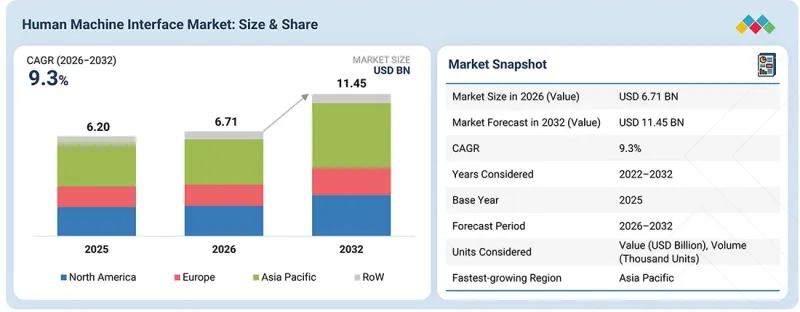
全球人機介面 (HMI) 市場預計將從 2026 年的 67.1 億美元成長到 2032 年的 114.5 億美元,複合年成長率為 9.3%。
現代生產線需要在複雜的製造環境中進行持續的即時運作監控,而工業自動化技術的日益普及推動了對人機介面 (HMI) 系統的需求。汽車組裝自動化、製藥流程中的線上批次監控以及連網機器人監控系統的擴展,都顯著提高了操作人員對遙測資料的需求,從而導致對耐用、高解析度視覺化面板的需求不斷成長。不完善或硬佈線的過時主機會降低運作視覺性,減少生產效率,並導致意外的生產線停機。
| 調查範圍 | |
|---|---|
| 調查期 | 2021-2032 |
| 基準年 | 2025 |
| 預測期 | 2026-2032 |
| 計算單位 | 金額(10億美元) |
| 部分 | 透過產品、軟體、產業和地區 |
| 目標區域 | 北美、歐洲、亞太地區及其他地區 |
因此,各公司正在整合先進的電容式多點觸控顯示器、專用邊緣運算控制器模組和基於網路的監控架構,尤其是在高多點觸控和先進的離散製造工廠中,以保持製程控制精度,確保獨特的生產運作,並遵守嚴格的職業安全法規。
“預計在預測期內,軟體行業將實現最高的複合年成長率。”
軟體預計將成為人機介面 (HMI) 市場中成長最快的細分領域,實現靈活的監控和控制、基於雲端的擴充性以及持續的分析整合。現代工業軟體套件提供資料密集型工廠運作所需的數位基礎設施,並透過基於 Web 的運作時消除對硬體的依賴。這在監控與資料採集 (SCADA)、分散式配方管理、集中式警報處理和遠端行動機器追蹤等應用中尤其有效。隨著智慧工廠架構透過工業IoT(IIoT) 連接、邊緣人工智慧部署和多站點企業網路不斷擴展,以低延遲處理海量運行資料流至關重要。此外,容器化邊緣微服務、支援 HTML5 的響應式視覺化框架和模組化 OPC UA 通訊驅動程式的創新提高了營運效率,並實現了軟體與標準工業運算架構的整合。
“展望 2025 年,從終端用戶行業來看,離散行業將在人機界面 (HMI) 市場佔據主導地位。”
到2025年,離散產業將在人機介面(HMI)市場佔據主導地位,這主要得益於對高速組裝監控和製造工廠自動化機械控制的廣泛需求。先進的生產設施正在不斷部署複雜的儀器設備,例如多點觸控工業用電腦、嵌入式觸控終端、可程式自動化控制器(PLC)和機器人監控面板。這些應用需要高精度的參數視覺化和即時運行回饋,以支援機器人組裝單元的協調、包裝線的同步、零件搬運管理以及汽車製造工作流程。智慧工廠理念在汽車製造、家用電子電器製造和工業機械生產領域的日益普及,正在創造對可靠的專用HMI硬體和軟體解決方案的穩定需求。
“到2025年,美國將在北美人機互動市場佔據最大的市場佔有率。”
美國憑藉其完善的工業自動化基礎設施和智慧製造實踐的快速普及,佔據了北美人機介面市場最大的佔有率。美國是先進機器人、流程自動化和工業IoT(IIoT) 整合領域的全球中心。這包括在汽車組裝、半導體製造和製藥製造地大規模部署觸控螢幕操作終端、工業面板電腦和基於網路的 SCADA 平台。這些操作需要耐用、高效能的介面硬體和軟體,用於即時視覺化設備遙測資料、大量製程監控和運行故障診斷。此外,對智慧工廠現代化改造的資本投資以及國內食品飲料包裝行業的擴張進一步推動了對專用人機介面 (HMI) 硬體的需求。政府支持數位化製造的舉措、成熟的工業研究項目以及領先自動化供應商的強大影響力,共同支撐著美國本土的工廠自動化基礎設施。這些營運因素鞏固了美國市場地位,並使其能夠維持區域市場佔有率。
- 依公司規模分類:一級公司 - 65%,二級公司 - 20%,三級公司 - 15%
- 按職位:董事 - 57%,C級主管 - 27%,其他 - 16%
- 按地區分類:北美 -24%,歐洲 -24%,亞太地區 -46%,其他地區 -6%
調查範圍:
本報告基於交付方式(硬體和軟體)、配置(獨立式和嵌入式)、產業(離散型和流程型)以及地區(北美、歐洲、亞太及其他地區),對人機介面 (HMI) 市場進行定義、描述和預測。報告還詳細分析了影響市場成長的促進因素、阻礙因素、機會和挑戰。此外,報告還分析了競爭格局,包括收購、產品發布、業務擴張以及主要參與者為促進市場成長所採取的措施。
購買本報告的理由:
本報告為市場領導者和新參與企業提供人機介面市場及其細分市場最準確的收入預測。它還有助於相關人員了解競爭格局,最佳化業務定位,並制定合適的打入市場策略。此外,報告還深入分析了市場趨勢以及關鍵促進因素、阻礙因素、機會和挑戰。
本報告深入分析了以下幾點:
- 本報告分析了關鍵促進因素(離散和流程工業中工業自動化的日益普及,以及對即時數據可視化和預測性維護的日益重視)、阻礙因素(硬體安裝和專業維護需要大量資本投資,以及設計和操作複雜系統的熟練技術人員短缺)、機遇(與工業IoT架構和雲端基礎邊緣監控系統整合,以及採用人工智慧驅動的擴增實境控制)和挑戰(互聯和雲端連接的運營商網路中的網路安全漏洞、傳統工業機器之間的互通性問題以及缺乏標準化協議)。
- 產品開發/創新:深入了解人機介面市場的未來技術、研發活動和產品發布。
- 市場發展:本報告提供有關盈利市場的全面信息,並分析了不同地區的人機界面市場。
- 市場多元化:全面介紹人機介面市場的新產品發布、未開發的地區、近期趨勢和投資情況。
- 競爭分析:對 HMI 市場主要參與者的市場佔有率、成長策略和產品/服務進行詳細評估。
目錄
第1章:引言
第2章執行摘要
第3章重要考察
- 人機互動市場為企業提供了極具吸引力的機會。
- 人機介面市場:依產品/服務分類
- 人機介面市場:依配置分類
- 人機介面市場:依最終用途產業分類
- 人機介面市場:依流程產業分類
- 人機介面市場:依離散製造業分類
- 北美人機介面市場:依最終用途產業分類
- 人機介面市場:依地區分類
第4章 市場概覽
- 市場動態
- 促進因素
- 抑制因子
- 機會
- 任務
- 未滿足的需求和未開發的領域
- 相互關聯的市場與跨產業機遇
- 一級/二級/三級主要公司的策略性舉措
第5章 產業趨勢
- 波特五力分析
- 新進入者的威脅
- 替代品的威脅
- 供應商的議價能力
- 買方的議價能力
- 競爭公司之間的競爭強度
- 宏觀經濟展望
- GDP趨勢與預測
- 全球製造業趨勢
- 全球汽車和電動汽車產業的趨勢
- 供應鏈分析
- 生態系分析
- 價格分析
- 按螢幕大小分類的平均售價趨勢
- 各地區平均售價趨勢(2022-2025 年)
- 貿易分析
- 進口方案(HS編碼853710)
- 出口方案(HS編碼853710)
- 重大會議和活動(2026-2027)
- 影響客戶業務的趨勢/變革
- 投資和資金籌措場景
- 案例研究分析
- 在義大利實施艾默生電氣公司的SCADA系統,用於監控和控制購物中心和大賣場。
- Rematic 開發了「Auto Inet」SaaS 解決方案,以改善對關鍵基礎設施的存取。
- ARB MIDSTREAM實施SCADA系統並建立營運管理中心。
- 美國關稅對人機介面市場的影響
- 主要關稅稅率
- 價格影響分析
- 對國家和地區的影響
- 對終端用戶產業的影響
第6章:技術進步、人工智慧的影響、專利、創新與未來應用
- 技術分析
- 主要技術
- 互補技術
- 鄰近技術
- 專利分析
- 人工智慧對人機介面市場的影響
- 主要應用場景和市場潛力
- 人機介面市場中原始設備製造商的最佳實踐
- 人工智慧在人機介面市場的應用案例研究
- 相互關聯的生態系統及其對市場參與者的影響
- 客戶對實施人工智慧整合人機介面解決方案的準備情況
第7章 監理情勢
- 區域法規和合規性
- 監管機構、政府機構和其他組織
- 標準
第8章:顧客趨勢與購買行為
- 決策流程
- 採購過程中的關鍵相關人員及其評估標準
- 採購過程中涉及的關鍵相關人員
- 購買標準
- 實施障礙和內部挑戰
- 各終端用戶產業尚未滿足的需求
第9章:人機介面設備中引入的技術
- 基於動作和手勢的互動
- 觸摸和觸覺互動
- 基於聲學和語音的互動
- 光學和視覺互動
- 新興的基於生物訊號的介面
第10章:人機介面技術的發展趨勢與新應用
- 人機介面技術的發展趨勢
- 將人機互動與手勢和語音辨識技術整合
- 將人機互動(HMI)與擴增實境(AR)和虛擬實境(VR)技術整合
- 人機互動(HMI)與人工智慧(AI)技術的整合
- 人機介面與邊緣運算技術的整合
- 人機介面技術的新應用領域
- 車
- 衛生保健
- 娛樂和遊戲
- 零售和運輸
- 工業自動化
第11章 人機介面解決方案的組成部分
- 顯示終端
- 電容式觸控螢幕
- 近距離成像觸控螢幕
- 紅外線和分佈式訊號觸控螢幕
- 電阻式
- 軟體
- 工業個人電腦(PC)
- 處理器
- 輸入/輸出設備
- 儲存裝置
- 薄膜開關
- 橡膠小鍵盤
- 遠端面板
第12章 以螢幕尺寸為基礎的人機介面系統分類
- 1-9英寸
- 9-17英寸
- 超過17英寸
第13章:人機介面解決方案的銷售管道
- 直接地
- 間接
第14章 人機介面市場:依產品/服務分類
- 硬體
- 軟體
第15章 人機介面市場:依配置分類
- 嵌入式
- 獨立版
第16章 人機介面市場:依最終用戶產業分類
- 流程工業
- 離散製造業
第17章 人機介面市場:依地區分類
- 北美洲
- 美國
- 加拿大
- 墨西哥
- 歐洲
- 英國
- 德國
- 法國
- 義大利
- 其他歐洲國家
- 亞太地區
- 中國
- 日本
- 印度
- 韓國
- 亞太其他地區
- 其他地區
- 南美洲
- 中東
- 非洲
第18章 競爭格局
- 概述
- 主要參與企業的策略/優勢,2023-2026 年
- 收入分析(2021-2025)
- 市佔率分析(2025 年)
- 企業估值和財務指標
- 品牌對比
- 企業估值矩陣:主要公司,2025 年
- 明星公司
- 新興領導者
- 具有廣泛影響力的公司
- 參與企業
- 企業企業發展:主要公司,2025 年
- 公司估值矩陣:新創企業/中小企業,2025 年
- 先進公司
- 應對力的公司
- 充滿活力的公司
- 起始點
- 競爭標竿分析:新創企業/中小企業,2025 年
- 競爭格局
- 產品發布
- 交易
第19章:公司簡介
- 大公司
- ROCKWELL AUTOMATION
- SIEMENS
- SCHNEIDER ELECTRIC
- ABB
- HONEYWELL INTERNATIONAL INC.
- ADVANTECH CO., LTD.
- EMERSON ELECTRIC CO.
- MITSUBISHI ELECTRIC CORPORATION
- YOKOGAWA ELECTRIC CORPORATION
- BEIJER ELECTRONICS
- 其他主要公司
- AMERICAN INDUSTRIAL SYSTEMS INC.
- BARTEC TOP HOLDING GMBH
- BECKHOFF AUTOMATION
- EAO AG
- INDUCTIVE AUTOMATION, LLC
- MAKERSAN
- MAPLE SYSTEMS INC.
- MICON AUTOMATION SYSTEMS PVT. LTD.
- NOVAKON CO., LTD.
- PCI PRIVATE LIMITED
- RED LION
- RITTAL GMBH &CO. KG
- SENECA SRL
- WECON
- WEINTEK LABS., INC.
第20章:調查方法
第21章附錄
The global human machine interface market is projected to grow from USD 6.71 billion in 2026 to USD 11.45 billion by 2032, registering a CAGR of 9.3%. Demand for human machine interface systems is increasing as automated industrial technologies proliferate because modern production lines require continuous, real-time operational monitoring in complex manufacturing environments. The expansion of automated automotive assembly, inline pharmaceutical batch monitoring, and connected robotics supervisory systems has significantly increased operator telemetry requirements, driving greater demand for durable, high-resolution visualization panels. Inadequate or hardwired legacy control consoles can degrade operational visibility, reduce production throughput, and cause unplanned line downtime.
| Scope of the Report | |
|---|---|
| Years Considered for the Study | 2021-2032 |
| Base Year | 2025 |
| Forecast Period | 2026-2032 |
| Units Considered | Value (USD Billion) |
| Segments | By Offering, Software, Industry and Region |
| Regions covered | North America, Europe, APAC, RoW |
As a result, enterprises are integrating advanced capacitive multi-touch displays, dedicated edge computing controller modules, and web-based supervisory architectures to maintain process control accuracy, secure proprietary production uptime, and comply with strict worker safety regulations, especially in high-throughput cleanroom and advanced discrete manufacturing facilities.
"The software segment is expected to record the highest CAGR during the forecast period."
Software is expected to be the fastest-growing segment in the human machine interface market due to its ability to deliver flexible supervisory control, cloud scalability, and continuous analytics integration. Modern industrial software suites provide the necessary digital infrastructure for data-intensive plant operations while eliminating hardware dependency through web-based runtimes. This makes them highly effective for applications such as supervisory control and data acquisition (SCADA), distributed recipe management, centralized alarm handling, and remote mobile machine tracking. As smart factory architectures expand through industrial IoT connectivity, edge AI adoption, and multi-facility enterprise networks, processing massive operational data streams with low latency becomes necessary. Additionally, innovations in containerized edge microservices, HTML5 responsive visualization frameworks, and modular OPC UA communication drivers improve operational efficiency and enable software integration into standard industrial computing architectures.
"The discrete industries segment dominated the human machine interface market, by end-use industry, in 2025."
Discrete industries captured a dominant share of the human machine interface market in 2025 due to the widespread requirement for high-speed assembly line monitoring and automated machinery control across manufacturing plants. Advanced production facilities continuously incorporate complex instrumentation such as multi-touch industrial PCs, embedded touch terminals, programmable automation controllers, and robotics supervisory panels. These applications require high-precision parameter visualization and real-time operational feedback to coordinate robotic assembly cells, synchronize packaging lines, manage component handling, and support automotive manufacturing workflows. The growing adoption of smart factory initiatives across automotive manufacturing, consumer electronics fabrication, and industrial machinery production creates consistent demand for reliable, dedicated human machine interface hardware and software solutions.
"The US accounted for the largest share of the North American human machine interface market in 2025."
The US accounted for the largest share of the North American human machine interface market because of its established industrial automation infrastructure and rapid adoption of smart manufacturing practices. The country serves as a global hub for advanced robotics, process automation, and Industrial IoT integration. This includes the large-scale deployment of touchscreen operator terminals, industrial panel PCs, and web-based SCADA platforms in automotive assembly plants, semiconductor fabrication facilities, and pharmaceutical manufacturing sites. These operations require durable, high-performance interface hardware and software for real-time equipment telemetry visualization, batch process monitoring, and operational fault diagnosis. Additionally, capital expenditure investments in smart factory modernization and the expansion of the domestic food and beverage packaging sector further increase demand for dedicated human machine interface hardware. Government initiatives supporting digital manufacturing, established industrial research programs, and the strong presence of major automation vendors support local factory automation infrastructure. These operational factors strengthen its market position and enable the US to maintain its regional share.
- By Company Type: Tier 1 - 65%, Tier 2 - 20%, and Tier 3 - 15%
- By Designation: Directors - 57%, C-level Executives - 27%, and Others - 16%
- By Region: North America - 24%, Europe - 24%, Asia Pacific - 46%, and RoW - 6%
Prominent players profiled in this report include ABB (Switzerland), Advantech Co., Ltd. (Taiwan), Emerson Electric Co. (US), General Electric (US), Honeywell International Inc. (US), Mitsubishi Electric Corporation (Japan), Rockwell Automation (US), Schneider Electric (France), Siemens (Germany), and Yokogawa Electric Corporation (Japan), among others.
Research Coverage:
The report defines, describes, and forecasts the human machine interface market based on offering (hardware and software), configuration (standalone and embedded), and industry (discrete and process), and region (North America, Europe, Asia Pacific, and RoW). It provides detailed information regarding drivers, restraints, opportunities, and challenges influencing the market's growth. It also analyzes competitive developments, including acquisitions, product launches, expansions, and actions taken by key players to grow in the market.
Reasons to Buy This Report:
The report will help market leaders/new entrants with information on the closest approximations of the revenue for the overall human machine interface market and its subsegments. The report will help stakeholders understand the competitive landscape and gain more insight to position their business better and plan suitable go-to-market strategies. The report also helps stakeholders understand the market's pulse and provides information on key drivers, restraints, opportunities, and challenges.
The report will provide insights into the following points:
- Analysis of key drivers (Rising adoption of industrial automation across discrete and process industries, Growing focus on real-time data visualization and predictive maintenance), restraints (Need for high capital investment for hardware installation and specialized maintenance, Shortage of skilled technical personnel to design and operate complex systems), opportunities (Integration with Industrial IoT architectures and cloud-based edge supervisory systems, Deployment of AI-driven adaptive interfaces and hands-free augmented reality controls), and challenges (Cybersecurity vulnerabilities in connected and cloud-linked operator networks, Interoperability friction and lack of standardized protocols across legacy industrial machinery) of the human machine interface market.
- Product Development/Innovation: Detailed insights into upcoming technologies, research & development activities, and product launches in the human machine interface market.
- Market Development: Comprehensive information about lucrative markets. The report analyzes the human machine interface market across various regions.
- Market Diversification: Exhaustive information about new products launched, untapped geographies, recent developments, and investments in the human machine interface market.
- Competitive Assessment: In-depth assessment of market share, growth strategies, and offerings of leading players, including Rockwell Automation (US), Siemens (Germany), Schneider Electric (France), ABB (Switzerland), and Honeywell International Inc. (US), in the human machine interface market.
TABLE OF CONTENTS
1 INTRODUCTION
- 1.1 STUDY OBJECTIVES
- 1.2 MARKET DEFINITION
- 1.3 STUDY SCOPE
- 1.3.1 MARKETS COVERED AND REGIONAL SCOPE
- 1.3.2 YEARS CONSIDERED
- 1.3.3 INCLUSIONS AND EXCLUSIONS
- 1.4 CURRENCY CONSIDERED
- 1.5 UNITS CONSIDERED
- 1.6 STAKEHOLDERS
- 1.7 SUMMARY OF CHANGES
2 EXECUTIVE SUMMARY
- 2.1 MARKET HIGHLIGHTS AND KEY INSIGHTS
- 2.2 KEY MARKET PARTICIPANTS: MAPPING OF STRATEGIC DEVELOPMENTS
- 2.3 DISRUPTIVE TRENDS IN HUMAN MACHINE INTERFACE MARKET
- 2.4 HIGH-GROWTH SEGMENTS
- 2.5 REGIONAL SNAPSHOT: MARKET SIZE, GROWTH RATE, AND FORECAST
3 PREMIUM INSIGHTS
- 3.1 ATTRACTIVE OPPORTUNITIES FOR PLAYERS IN HUMAN MACHINE INTERFACE MARKET
- 3.2 HUMAN MACHINE INTERFACE MARKET, BY OFFERING
- 3.3 HUMAN MACHINE INTERFACE MARKET, BY CONFIGURATION
- 3.4 HUMAN MACHINE INTERFACE MARKET, BY END-USE INDUSTRY
- 3.5 HUMAN MACHINE INTERFACE MARKET, BY PROCESS INDUSTRY
- 3.6 HUMAN MACHINE INTERFACE MARKET, BY DISCRETE INDUSTRY
- 3.7 HUMAN MACHINE INTERFACE MARKET IN NORTH AMERICA, BY END-USE INDUSTRY
- 3.8 HUMAN MACHINE INTERFACE MARKET, BY GEOGRAPHY
4 MARKET OVERVIEW
- 4.1 INTRODUCTION
- 4.2 MARKET DYNAMICS
- 4.2.1 DRIVERS
- 4.2.1.1 Mounting adoption of automation technologies to enhance manufacturing productivity and efficiency
- 4.2.1.2 Rising focus on real-time data visualization and predictive maintenance of industrial machinery
- 4.2.1.3 Increasing investment in IoT and 3D printing technologies to transform manufacturing chains
- 4.2.1.4 Surging demand for smart machines and rapid industrial revolution
- 4.2.2 RESTRAINTS
- 4.2.2.1 High costs associated with installation and maintenance of HMI systems
- 4.2.2.2 Need for periodic maintenance and frequent HMI software updates
- 4.2.2.3 Shortage of skilled and experienced workforce
- 4.2.3 OPPORTUNITIES
- 4.2.3.1 Heightened focus on workplace safety and regulatory compliance of automated systems
- 4.2.3.2 Increased adoption of IoT and cloud computing technologies
- 4.2.3.3 Need for advanced solutions to monitor ever-increasing renewable energy assets
- 4.2.4 CHALLENGES
- 4.2.4.1 Lack of standardization of industrial communication protocols
- 4.2.4.2 Susceptibility of cloud-based HMI systems to cyberattacks
- 4.2.1 DRIVERS
- 4.3 UNMET NEEDS AND WHITE SPACES
- 4.4 INTERCONNECTED MARKETS AND CROSS-SECTOR OPPORTUNITIES
- 4.5 STRATEGIC MOVES BY TIER 1/2/3 PLAYERS
5 INDUSTRY TRENDS
- 5.1 INTRODUCTION
- 5.2 PORTER'S FIVE FORCES ANALYSIS
- 5.2.1 THREAT OF NEW ENTRANTS
- 5.2.2 THREAT OF SUBSTITUTES
- 5.2.3 BARGAINING POWER OF SUPPLIERS
- 5.2.4 BARGAINING POWER OF BUYERS
- 5.2.5 INTENSITY OF COMPETITIVE RIVALRY
- 5.3 MACROECONOMIC OUTLOOK
- 5.3.1 INTRODUCTION
- 5.3.2 GDP TRENDS AND FORECAST
- 5.3.3 TRENDS IN GLOBAL MANUFACTURING INDUSTRY
- 5.3.4 TRENDS IN GLOBAL AUTOMOTIVE AND ELECTRIC VEHICLE INDUSTRY
- 5.4 SUPPLY CHAIN ANALYSIS
- 5.5 ECOSYSTEM ANALYSIS
- 5.6 PRICING ANALYSIS
- 5.6.1 AVERAGE SELLING PRICE TREND, BY SCREEN SIZE
- 5.6.2 AVERAGE SELLING PRICE TREND, BY REGION, 2022-2025
- 5.7 TRADE ANALYSIS
- 5.7.1 IMPORT SCENARIO (HS CODE 853710)
- 5.7.2 EXPORT SCENARIO (HS CODE 853710)
- 5.8 KEY CONFERENCES AND EVENTS, 2026-2027
- 5.9 TRENDS/DISRUPTIONS IMPACTING CUSTOMER BUSINESS
- 5.10 INVESTMENT AND FUNDING SCENARIO
- 5.11 CASE STUDY ANALYSIS
- 5.11.1 IMPLEMENTATION OF EMERSON ELECTRIC CO.'S SCADA SYSTEMS TO MONITOR AND CONTROL SHOPPING MALLS AND HYPERMARKETS IN ITALY
- 5.11.2 DEVELOPMENT OF LEMATIC'S AUTO INET SAAS SOLUTIONS TO IMPROVE ACCESS TO CRITICAL INFRASTRUCTURE
- 5.11.3 ADOPTION OF SCADA SYSTEMS BY ARB MIDSTREAM TO CREATE OPERATION CONTROL CENTER
- 5.12 IMPACT OF US TARIFFS - HUMAN MACHINE INTERFACE MARKET
- 5.12.1 INTRODUCTION
- 5.12.2 KEY TARIFF RATES
- 5.12.3 PRICE IMPACT ANALYSIS
- 5.12.4 IMPACT ON COUNTRIES/REGIONS
- 5.12.4.1 US
- 5.12.4.2 Europe
- 5.12.4.3 Asia Pacific
- 5.12.5 IMPACT ON END-USE INDUSTRIES
6 TECHNOLOGICAL ADVANCEMENTS, AI-DRIVEN IMPACT, PATENTS, INNOVATIONS, AND FUTURE APPLICATIONS
- 6.1 TECHNOLOGY ANALYSIS
- 6.1.1 KEY TECHNOLOGIES
- 6.1.1.1 Spatial computing
- 6.1.1.2 Transparent displays
- 6.1.1.3 Machine learning
- 6.1.1.4 Gesture control devices
- 6.1.1.5 Flexible displays
- 6.1.1.6 Sensor fusion
- 6.1.1.7 Artificial intelligence (AI)
- 6.1.1.8 Nanoimprint lithography
- 6.1.1.9 Integrated photonics
- 6.1.2 COMPLEMENTARY TECHNOLOGIES
- 6.1.2.1 Augmented reality
- 6.1.2.2 Virtual reality
- 6.1.2.3 Digitalization and Industrial Internet of Things
- 6.1.2.4 Internet of Things
- 6.1.3 ADJACENT TECHNOLOGIES
- 6.1.3.1 Bioacoustic sensing
- 6.1.1 KEY TECHNOLOGIES
- 6.2 PATENT ANALYSIS
- 6.3 IMPACT OF AI ON HUMAN MACHINE INTERFACE MARKET
- 6.3.1 TOP USE CASES AND MARKET POTENTIAL
- 6.3.2 BEST PRACTICES FOLLOWED BY OEMS IN HUMAN MACHINE INTERFACE MARKET
- 6.3.3 CASE STUDIES RELATED TO AI IMPLEMENTATION IN HUMAN MACHINE INTERFACE MARKET
- 6.3.4 INTERCONNECTED ECOSYSTEM AND IMPACT ON MARKET PLAYERS
- 6.3.5 CLIENTS' READINESS TO ADOPT AI-INTEGRATED HUMAN MACHINE INTERFACE SOLUTIONS
7 REGULATORY LANDSCAPE
- 7.1 REGIONAL REGULATIONS AND COMPLIANCE
- 7.1.1 REGULATORY BODIES, GOVERNMENT AGENCIES, AND OTHER ORGANIZATIONS
- 7.1.2 STANDARDS
- 7.1.2.1 IEC TS 62832-1:2020
- 7.1.2.2 ISO/IEC TR 63306-1:2020
- 7.1.2.3 ISO 55001:2014
8 CUSTOMER LANDSCAPE AND BUYER BEHAVIOR
- 8.1 DECISION-MAKING PROCESS
- 8.2 KEY STAKEHOLDERS INVOLVED IN BUYING PROCESS AND THEIR EVALUATION CRITERIA
- 8.2.1 KEY STAKEHOLDERS IN BUYING PROCESS
- 8.2.2 BUYING CRITERIA
- 8.3 ADOPTION BARRIERS AND INTERNAL CHALLENGES
- 8.4 UNMET NEEDS OF VARIOUS END-USE INDUSTRIES
9 TECHNOLOGIES DEPLOYED IN HMI DEVICES
- 9.1 INTRODUCTION
- 9.2 MOTION- AND GESTURE-BASED INTERACTION
- 9.3 TACTILE AND HAPTIC INTERACTION
- 9.4 ACOUSTIC AND VOICE-BASED INTERACTION
- 9.5 OPTICAL AND VISION-BASED INTERACTION
- 9.6 EMERGING BIO-SIGNAL-BASED INTERFACES
10 TRENDS AND EMERGING APPLICATIONS OF HMI TECHNOLOGY
- 10.1 INTRODUCTION
- 10.2 TRENDS RELATED TO HMI TECHNOLOGY
- 10.2.1 INTEGRATION OF HMI WITH GESTURE AND VOICE RECOGNITION TECHNOLOGY
- 10.2.2 INTEGRATION OF HMI WITH AUGMENTED REALITY (AR) AND VIRTUAL REALITY (VR) TECHNOLOGIES
- 10.2.3 INTEGRATION OF HMI WITH ARTIFICIAL INTELLIGENCE (AI) TECHNOLOGY
- 10.2.4 INTEGRATION OF HMI WITH EDGE COMPUTING TECHNOLOGY
- 10.3 EMERGING APPLICATIONS OF HMI TECHNOLOGY
- 10.3.1 AUTOMOTIVE
- 10.3.2 HEALTHCARE
- 10.3.3 ENTERTAINMENT AND GAMING
- 10.3.4 RETAIL AND TRANSPORTATION
- 10.3.5 INDUSTRIAL AUTOMATION
11 COMPONENTS OF HMI SOLUTIONS
- 11.1 INTRODUCTION
- 11.2 DISPLAY TERMINALS
- 11.2.1 CAPACITIVE TOUCHSCREENS
- 11.2.2 NEAR-FIELD IMAGING TOUCHSCREENS
- 11.2.3 INFRARED AND DISPERSIVE SIGNAL TOUCHSCREENS
- 11.2.4 RESISTIVE TOUCHSCREENS
- 11.3 SOFTWARE
- 11.4 INDUSTRIAL PERSONAL COMPUTERS (PCS)
- 11.4.1 PROCESSORS
- 11.4.2 INPUT/OUTPUT DEVICES
- 11.4.3 STORAGE DEVICES
- 11.5 MEMBRANE SWITCHES
- 11.6 RUBBER KEYPADS
- 11.7 REMOTE PANELS
12 SCREEN SIZE-BASED CLASSIFICATION OF HMI SYSTEMS
- 12.1 INTRODUCTION
- 12.2 BETWEEN 1 TO 9''
- 12.3 BETWEEN 9 TO 17''
- 12.4 MORE THAN 17''
13 SALES CHANNELS OF HMI SOLUTIONS
- 13.1 INTRODUCTION
- 13.2 DIRECT
- 13.3 INDIRECT
14 HUMAN MACHINE INTERFACE MARKET, BY OFFERING
- 14.1 INTRODUCTION
- 14.2 HARDWARE
- 14.2.1 BY TYPE
- 14.2.1.1 Basic HMI
- 14.2.1.1.1 Mounting adoption of cost-effective HMIs for basic machine control and monitoring to fuel segmental growth
- 14.2.1.2 Advanced panel-based HMI
- 14.2.1.2.1 Shifting preference toward HMIs with mobile functionalities to augment segmental growth
- 14.2.1.3 Advanced PC-based HMI
- 14.2.1.3.1 Rising need for high-performance HMIs to support complex visualization, data processing, and AI-enabled industrial applications to drive market
- 14.2.1.1 Basic HMI
- 14.2.1 BY TYPE
- 14.3 SOFTWARE
- 14.3.1 BY DEPLOYMENT MODE
- 14.3.1.1 On-premises
- 14.3.1.1.1 Strong data control, low latency, and security requirements to bolster segmental growth
- 14.3.1.2 Cloud-based
- 14.3.1.2.1 Growing emphasis on remote monitoring, scalability, and multi-location access to expedite segmental growth
- 14.3.1.1 On-premises
- 14.3.2 SOFTWARE GROWTH OPPORTUNITIES AND EMERGING TRENDS
- 14.3.2.1 Web-based/Browser-based HMI
- 14.3.2.2 Remote & mobile visualization
- 14.3.2.3 Cloud-native HMI
- 14.3.2.4 Edge-enabled HMI
- 14.3.2.5 AI-enabled visualization & analytics
- 14.3.2.6 Subscription-based & SaaS HMI software
- 14.3.2.7 Integration with SCADA, MES, IIoT, and enterprise systems
- 14.3.1 BY DEPLOYMENT MODE
15 HUMAN MACHINE INTERFACE MARKET, BY CONFIGURATION
- 15.1 INTRODUCTION
- 15.2 EMBEDDED
- 15.2.1 RAPID TECHNOLOGICAL ADVANCEMENTS AND DEVELOPMENT OF USER-FRIENDLY SOLUTIONS TO FOSTER SEGMENTAL GROWTH
- 15.3 STANDALONE
- 15.3.1 LOW TOTAL COST OF OWNERSHIP AND EASE OF INSTALLATION TO ACCELERATE SEGMENTAL GROWTH
16 HUMAN MACHINE INTERFACE MARKET, BY END-USE INDUSTRY
- 16.1 INTRODUCTION
- 16.2 PROCESS INDUSTRIES
- 16.2.1 OIL & GAS
- 16.2.1.1 Growing adoption of HMI solutions for remote monitoring and process control to accelerate segmental growth
- 16.2.2 FOOD & BEVERAGES
- 16.2.2.1 Strong focus on process monitoring and automation to contribute to segmental growth
- 16.2.3 PHARMACEUTICALS
- 16.2.3.1 Increasing need to minimize downtime and cost of pharmaceutical operations to foster segmental growth
- 16.2.4 CHEMICALS
- 16.2.4.1 Growing implementation of HMI technology to ensure high safety and product quality to boost segmental growth
- 16.2.5 ENERGY & POWER
- 16.2.5.1 Rising need to enhance production output to accelerate segmental growth
- 16.2.6 METALS & MINING
- 16.2.6.1 Growing emphasis on mine safety and automation to expedite segmental growth
- 16.2.7 WATER & WASTEWATER TREATMENT
- 16.2.7.1 Escalating adoption of HMI solutions to improve reliability of water treatment and distribution systems to fuel segmental growth
- 16.2.8 OTHER PROCESS INDUSTRIES
- 16.2.1 OIL & GAS
- 16.3 DISCRETE INDUSTRIES
- 16.3.1 AUTOMOTIVE
- 16.3.1.1 Increasing reliance on HMI solutions to analyze manufacturing processes in real time to drive market
- 16.3.2 AEROSPACE
- 16.3.2.1 Growing need for real-time information and intuitive controls in aircraft to bolster segmental growth
- 16.3.3 LOGISTICS & WAREHOUSING
- 16.3.3.1 Increasing warehouse automation and real-time operational visibility to foster segmental growth
- 16.3.4 MEDICAL DEVICES
- 16.3.4.1 Rising usage of HMI software to improve centralized medical device procurement processes to support market growth
- 16.3.5 SEMICONDUCTOR & ELECTRONICS
- 16.3.5.1 Increasing need for continuous monitoring and precise control of complex manufacturing processes to fuel segmental growth
- 16.3.6 DATA CENTERS
- 16.3.6.1 Mounting demand for simple and centralized interfaces to operate and monitor equipment to drive market
- 16.3.7 MARINE
- 16.3.7.1 Increasing automation and monitoring requirements in marine vessels to boost segmental growth
- 16.3.8 DEFENSE
- 16.3.8.1 Mounting adoption of electronic and automated systems to facilitate segmental growth
- 16.3.9 OTHER DISCRETE INDUSTRIES
- 16.3.1 AUTOMOTIVE
17 HUMAN MACHINE INTERFACE MARKET, BY REGION
- 17.1 INTRODUCTION
- 17.2 NORTH AMERICA
- 17.2.1 US
- 17.2.1.1 Large industrial base, industrial automation, and adoption of connected manufacturing technologies to augment market growth
- 17.2.2 CANADA
- 17.2.2.1 Requirement for advanced manufacturing technologies in food & beverages and chemicals industries to boost market growth
- 17.2.3 MEXICO
- 17.2.3.1 Reliance on advanced manufacturing technologies to contribute to market growth
- 17.2.1 US
- 17.3 EUROPE
- 17.3.1 UK
- 17.3.1.1 Growing emphasis on industrial automation to accelerate market growth
- 17.3.2 GERMANY
- 17.3.2.1 Utilization of HMI solutions to automate vehicle production process to stimulate market growth
- 17.3.3 FRANCE
- 17.3.3.1 Enforcement of regulations to mitigate greenhouse gas emissions to boost market growth
- 17.3.4 ITALY
- 17.3.4.1 Rapid industrial automation and energy-efficiency requirements to drive market
- 17.3.5 REST OF EUROPE
- 17.3.1 UK
- 17.4 ASIA PACIFIC
- 17.4.1 CHINA
- 17.4.1.1 Rising factory automation in automobile and electronics manufacturing sectors to drive market
- 17.4.2 JAPAN
- 17.4.2.1 Labor shortages and increasing automation in manufacturing to bolster market growth
- 17.4.3 INDIA
- 17.4.3.1 Rapid industrialization and growth of manufacturing industries to create market growth opportunities
- 17.4.4 SOUTH KOREA
- 17.4.4.1 Thriving semiconductor, electronics, and automotive industries to fuel market growth
- 17.4.5 REST OF ASIA PACIFIC
- 17.4.1 CHINA
- 17.5 ROW
- 17.5.1 SOUTH AMERICA
- 17.5.1.1 Growing adoption of digital manufacturing and automation to support market growth
- 17.5.2 MIDDLE EAST
- 17.5.2.1 Expansion of manufacturing and industrial automation to expedite market growth
- 17.5.2.2 GCC
- 17.5.2.3 Rest of Middle East
- 17.5.3 AFRICA
- 17.5.3.1 Growing adoption of industrial automation technologies to augment market growth
- 17.5.1 SOUTH AMERICA
18 COMPETITIVE LANDSCAPE
- 18.1 OVERVIEW
- 18.2 KEY PLAYER COMPETITIVE STRATEGIES/RIGHT TO WIN, 2023-2026
- 18.3 REVENUE ANALYSIS, 2021-2025
- 18.4 MARKET SHARE ANALYSIS, 2025
- 18.5 COMPANY VALUATION AND FINANCIAL METRICS
- 18.6 BRAND COMPARISON
- 18.7 COMPANY EVALUATION MATRIX: KEY PLAYERS, 2025
- 18.7.1 STARS
- 18.7.2 EMERGING LEADERS
- 18.7.3 PERVASIVE PLAYERS
- 18.7.4 PARTICIPANTS
- 18.7.5 COMPANY FOOTPRINT: KEY PLAYERS, 2025
- 18.7.5.1 Company footprint
- 18.7.5.2 Region footprint
- 18.7.5.3 Offering footprint
- 18.7.5.4 End-use industry footprint
- 18.8 COMPANY EVALUATION MATRIX: STARTUPS/SMES, 2025
- 18.8.1 PROGRESSIVE COMPANIES
- 18.8.2 RESPONSIVE COMPANIES
- 18.8.3 DYNAMIC COMPANIES
- 18.8.4 STARTING BLOCKS
- 18.8.5 COMPETITIVE BENCHMARKING: STARTUPS/SMES, 2025
- 18.8.5.1 Detailed list of key startups/SMEs
- 18.8.5.2 Competitive benchmarking of key startups/SMEs
- 18.9 COMPETITIVE SCENARIO
- 18.9.1 PRODUCT LAUNCHES
- 18.9.2 DEALS
19 COMPANY PROFILES
- 19.1 KEY PLAYERS
- 19.1.1 ROCKWELL AUTOMATION
- 19.1.1.1 Business overview
- 19.1.1.2 Products/Solutions/Services offered
- 19.1.1.3 Recent developments
- 19.1.1.3.1 Product launches
- 19.1.1.3.2 Deals
- 19.1.1.4 MnM view
- 19.1.1.4.1 Key strengths/Right to win
- 19.1.1.4.2 Strategic choices
- 19.1.1.4.3 Weaknesses/Competitive threats
- 19.1.2 SIEMENS
- 19.1.2.1 Business overview
- 19.1.2.2 Products/Solutions/Services offered
- 19.1.2.3 Recent developments
- 19.1.2.3.1 Product launches
- 19.1.2.3.2 Deals
- 19.1.2.4 MnM view
- 19.1.2.4.1 Key strengths/Right to win
- 19.1.2.4.2 Strategic choices
- 19.1.2.4.3 Weaknesses/Competitive threats
- 19.1.3 SCHNEIDER ELECTRIC
- 19.1.3.1 Business overview
- 19.1.3.2 Products/Solutions/Services offered
- 19.1.3.3 MnM view
- 19.1.3.3.1 Key strengths/Right to win
- 19.1.3.3.2 Strategic choices
- 19.1.3.3.3 Weaknesses/Competitive threats
- 19.1.4 ABB
- 19.1.4.1 Business overview
- 19.1.4.2 Products/Solutions/Services offered
- 19.1.4.3 Recent developments
- 19.1.4.3.1 Product launches
- 19.1.4.3.2 Deals
- 19.1.4.4 MnM view
- 19.1.4.4.1 Key strengths/Right to win
- 19.1.4.4.2 Strategic choices
- 19.1.4.4.3 Weaknesses/Competitive threats
- 19.1.5 HONEYWELL INTERNATIONAL INC.
- 19.1.5.1 Business overview
- 19.1.5.2 Products/Solutions/Services offered
- 19.1.5.3 Recent developments
- 19.1.5.3.1 Product launches
- 19.1.5.4 MnM view
- 19.1.5.4.1 Key strengths/Right to win
- 19.1.5.4.2 Strategic choices
- 19.1.5.4.3 Weaknesses/Competitive threats
- 19.1.6 ADVANTECH CO., LTD.
- 19.1.6.1 Business overview
- 19.1.6.2 Products/Solutions/Services offered
- 19.1.6.3 Recent developments
- 19.1.6.3.1 Product launches
- 19.1.7 EMERSON ELECTRIC CO.
- 19.1.7.1 Business overview
- 19.1.7.2 Products/Solutions/Services offered
- 19.1.7.3 Recent developments
- 19.1.7.3.1 Product launches
- 19.1.7.3.2 Deals
- 19.1.8 MITSUBISHI ELECTRIC CORPORATION
- 19.1.8.1 Business overview
- 19.1.8.2 Products/Solutions/Services offered
- 19.1.8.3 Recent developments
- 19.1.8.3.1 Product launches
- 19.1.9 YOKOGAWA ELECTRIC CORPORATION
- 19.1.9.1 Business overview
- 19.1.9.2 Products/Solutions/Services offered
- 19.1.9.3 Recent developments
- 19.1.9.3.1 Product launches
- 19.1.9.3.2 Deals
- 19.1.10 BEIJER ELECTRONICS
- 19.1.10.1 Business Overview
- 19.1.10.2 Products/Solutions/Services offered
- 19.1.10.3 Recent developments
- 19.1.10.3.1 Product launches
- 19.1.1 ROCKWELL AUTOMATION
- 19.2 OTHER PLAYERS
- 19.2.1 AMERICAN INDUSTRIAL SYSTEMS INC.
- 19.2.2 BARTEC TOP HOLDING GMBH
- 19.2.3 BECKHOFF AUTOMATION
- 19.2.4 EAO AG
- 19.2.5 INDUCTIVE AUTOMATION, LLC
- 19.2.6 MAKERSAN
- 19.2.7 MAPLE SYSTEMS INC.
- 19.2.8 MICON AUTOMATION SYSTEMS PVT. LTD.
- 19.2.9 NOVAKON CO., LTD.
- 19.2.10 PCI PRIVATE LIMITED
- 19.2.11 RED LION
- 19.2.12 RITTAL GMBH & CO. KG
- 19.2.13 SENECA SRL
- 19.2.14 WECON
- 19.2.15 WEINTEK LABS., INC.
20 RESEARCH METHODOLOGY
- 20.1 RESEARCH DATA
- 20.1.1 SECONDARY DATA
- 20.1.1.1 List of key secondary sources
- 20.1.1.2 Key data from secondary sources
- 20.1.2 PRIMARY DATA
- 20.1.2.1 List of primary interview participants
- 20.1.2.2 Breakdown of primary interviews
- 20.1.2.3 Key data from primary sources
- 20.1.2.4 Key industry insights
- 20.1.3 SECONDARY AND PRIMARY RESEARCH
- 20.1.1 SECONDARY DATA
- 20.2 MARKET SIZE ESTIMATION
- 20.2.1 BOTTOM-UP APPROACH
- 20.2.1.1 Approach to arrive at market size using bottom-up analysis (demand side)
- 20.2.2 TOP-DOWN APPROACH
- 20.2.2.1 Approach to arrive at market size using top-down analysis (supply side)
- 20.2.1 BOTTOM-UP APPROACH
- 20.3 FACTOR ANALYSIS
- 20.3.1 DEMAND-SIDE ANALYSIS
- 20.3.2 SUPPLY-SIDE ANALYSIS
- 20.4 DATA TRIANGULATION
- 20.5 RESEARCH ASSUMPTIONS
- 20.6 RISK ANALYSIS
- 20.7 RESEARCH LIMITATIONS
21 APPENDIX
- 21.1 DISCUSSION GUIDE
- 21.2 KNOWLEDGESTORE: MARKETSANDMARKETS' SUBSCRIPTION PORTAL
- 21.3 CUSTOMIZATION OPTIONS
- 21.4 RELATED REPORTS
- 21.5 AUTHOR DETAILS
List of Tables
- TABLE 1 HUMAN MACHINE INTERFACE MARKET: INCLUSIONS AND EXCLUSIONS
- TABLE 2 HUMAN MACHINE INTERFACE MARKET: SUMMARY OF CHANGES
- TABLE 3 KEY STRATEGIC FOCUS OF TIER 1/2/ 3 PLAYERS
- TABLE 4 IMPACT OF PORTER'S FIVE FORCES ANALYSIS
- TABLE 5 GDP PERCENTAGE CHANGE, BY KEY COUNTRY, 2021-2030
- TABLE 6 ROLE OF COMPANIES IN HUMAN MACHINE INTERFACE ECOSYSTEM
- TABLE 7 AVERAGE SELLING PRICE TREND, BY SCREEN SIZE (USD THOUSAND)
- TABLE 8 AVERAGE SELLING PRICE, BY REGION 2022-2025 (USD)
- TABLE 9 IMPORT DATA FOR HS CODE 853710-COMPLIANT PRODUCTS, BY COUNTRY, 2021-2025 (USD MILLION)
- TABLE 10 EXPORT DATA FOR HS CODE 853710-COMPLIANT PRODUCTS, BY COUNTRY, 2021-2025 (USD MILLION)
- TABLE 11 LIST OF KEY CONFERENCES AND EVENTS, 2026-2027
- TABLE 12 US-ADJUSTED RECIPROCAL TARIFF RATES
- TABLE 13 EVOLUTION OF HUMAN MACHINE INTERFACE (HMI) TECHNOLOGIES
- TABLE 14 LIST OF KEY PATENTS, 2016-2025
- TABLE 15 TOP AI USE CASES AND MARKET POTENTIAL
- TABLE 16 BEST PRACTICES FOLLOWED BY COMPANIES
- TABLE 17 CASE STUDIES RELATED TO AI IMPLEMENTATION
- TABLE 18 INTERCONNECTED ECOSYSTEM AND INFLUENCE ON MARKET PLAYERS
- TABLE 19 NORTH AMERICA: LIST OF REGULATORY BODIES, GOVERNMENT AGENCIES, AND OTHER ORGANIZATIONS
- TABLE 20 EUROPE: LIST OF REGULATORY BODIES, GOVERNMENT AGENCIES, AND OTHER ORGANIZATIONS
- TABLE 21 ASIA PACIFIC: LIST OF REGULATORY BODIES, GOVERNMENT AGENCIES, AND OTHER ORGANIZATIONS
- TABLE 22 ROW: LIST OF REGULATORY BODIES, GOVERNMENT AGENCIES, AND OTHER ORGANIZATIONS
- TABLE 23 INFLUENCE OF STAKEHOLDERS ON BUYING PROCESS FOR TOP THREE END-USE INDUSTRIES (%)
- TABLE 24 BUYING CRITERIA FOR TOP THREE END-USE INDUSTRIES
- TABLE 25 UNMET NEEDS, BY END-USE INDUSTRY
- TABLE 26 HUMAN MACHINE INTERFACE MARKET, BY OFFERING, 2022-2025 (USD MILLION)
- TABLE 27 HUMAN MACHINE INTERFACE MARKET, BY OFFERING, 2026-2032 (USD MILLION)
- TABLE 28 HARDWARE: HUMAN MACHINE INTERFACE MARKET, BY TYPE, 2022-2025 (USD MILLION)
- TABLE 29 HARDWARE: HUMAN MACHINE INTERFACE MARKET, BY TYPE, 2026-2032 (USD MILLION)
- TABLE 30 HARDWARE: HUMAN MACHINE INTERFACE MARKET, BY REGION, 2022-2025 (USD MILLION)
- TABLE 31 HARDWARE: HUMAN MACHINE INTERFACE MARKET, BY REGION, 2026-2032 (USD MILLION)
- TABLE 32 BASIC HMI: HUMAN MACHINE INTERFACE MARKET, 2022-2025 (THOUSAND UNITS)
- TABLE 33 BASIC HMI: HUMAN MACHINE INTERFACE MARKET, 2026-2032 (THOUSAND UNITS)
- TABLE 34 SOFTWARE: HUMAN MACHINE INTERFACE MARKET, BY DEPLOYMENT MODE, 2022-2025 (USD MILLION)
- TABLE 35 SOFTWARE: HUMAN MACHINE INTERFACE MARKET, BY DEPLOYMENT MODE, 2026-2032 (USD MILLION)
- TABLE 36 SOFTWARE: HUMAN MACHINE INTERFACE MARKET, BY REGION, 2022-2025 (USD MILLION)
- TABLE 37 SOFTWARE: HUMAN MACHINE INTERFACE MARKET, BY REGION, 2026-2032 (USD MILLION)
- TABLE 38 HUMAN MACHINE INTERFACE MARKET, BY CONFIGURATION, 2022-2025 (USD MILLION)
- TABLE 39 HUMAN MACHINE INTERFACE MARKET, BY CONFIGURATION, 2026-2032 (USD MILLION)
- TABLE 40 EMBEDDED: HUMAN MACHINE INTERFACE MARKET, BY PROCESS INDUSTRY, 2022-2025 (USD MILLION)
- TABLE 41 EMBEDDED: HUMAN MACHINE INTERFACE MARKET, BY PROCESS INDUSTRY, 2026-2032 (USD MILLION)
- TABLE 42 EMBEDDED: HUMAN MACHINE INTERFACE MARKET, BY DISCRETE INDUSTRY, 2022-2025 (USD MILLION)
- TABLE 43 EMBEDDED: HUMAN MACHINE INTERFACE MARKET, BY DISCRETE INDUSTRY, 2026-2032 (USD MILLION)
- TABLE 44 STANDALONE: HUMAN MACHINE INTERFACE MARKET, BY PROCESS INDUSTRY, 2022-2025 (USD MILLION)
- TABLE 45 STANDALONE: HUMAN MACHINE INTERFACE MARKET, BY PROCESS INDUSTRY, 2026-2032 (USD MILLION)
- TABLE 46 STANDALONE: HUMAN MACHINE INTERFACE MARKET, BY DISCRETE INDUSTRY, 2022-2025 (USD MILLION)
- TABLE 47 STANDALONE: HUMAN MACHINE INTERFACE MARKET, BY DISCRETE INDUSTRY, 2026-2032 (USD MILLION)
- TABLE 48 HUMAN MACHINE INTERFACE MARKET, BY END-USE INDUSTRY, 2022-2025 (USD MILLION)
- TABLE 49 HUMAN MACHINE INTERFACE MARKET, BY END-USE INDUSTRY, 2026-2032 (USD MILLION)
- TABLE 50 PROCESS INDUSTRIES: HUMAN MACHINE INTERFACE MARKET, BY SUB-TYPE, 2022-2025 (USD MILLION)
- TABLE 51 PROCESS INDUSTRIES: HUMAN MACHINE INTERFACE MARKET, BY SUB-TYPE, 2026-2032 (USD MILLION)
- TABLE 52 PROCESS INDUSTRIES: HUMAN MACHINE INTERFACE MARKET, BY REGION, 2022-2025 (USD MILLION)
- TABLE 53 PROCESS INDUSTRIES: HUMAN MACHINE INTERFACE MARKET, BY REGION, 2026-2032 (USD MILLION)
- TABLE 54 PROCESS INDUSTRIES: HUMAN MACHINE INTERFACE MARKET, BY CONFIGURATION, 2022-2025 (USD MILLION)
- TABLE 55 PROCESS INDUSTRIES: HUMAN MACHINE INTERFACE MARKET, BY CONFIGURATION, 2026-2032 (USD MILLION)
- TABLE 56 OIL & GAS: HUMAN MACHINE INTERFACE MARKET, BY REGION, 2022-2025 (USD MILLION)
- TABLE 57 OIL & GAS: HUMAN MACHINE INTERFACE MARKET, BY REGION, 2026-2032 (USD MILLION)
- TABLE 58 OIL & GAS: HUMAN MACHINE INTERFACE MARKET, BY CONFIGURATION, 2022-2025 (USD MILLION)
- TABLE 59 OIL & GAS: HUMAN MACHINE INTERFACE MARKET, BY CONFIGURATION, 2026-2032 (USD MILLION)
- TABLE 60 FOOD & BEVERAGES: HUMAN MACHINE INTERFACE MARKET, BY REGION, 2022-2025 (USD MILLION)
- TABLE 61 FOOD & BEVERAGES: HUMAN MACHINE INTERFACE MARKET, BY REGION, 2026-2032 (USD MILLION)
- TABLE 62 FOOD & BEVERAGES: HUMAN MACHINE INTERFACE MARKET, BY CONFIGURATION, 2022-2025 (USD MILLION)
- TABLE 63 FOOD & BEVERAGES: HUMAN MACHINE INTERFACE MARKET, BY CONFIGURATION, 2026-2032 (USD MILLION)
- TABLE 64 PHARMACEUTICALS: HUMAN MACHINE INTERFACE MARKET, BY REGION, 2022-2025 (USD MILLION)
- TABLE 65 PHARMACEUTICALS: HUMAN MACHINE INTERFACE MARKET, BY REGION, 2026-2032 (USD MILLION)
- TABLE 66 PHARMACEUTICALS: HUMAN MACHINE INTERFACE MARKET, BY CONFIGURATION, 2022-2025 (USD MILLION)
- TABLE 67 PHARMACEUTICALS: HUMAN MACHINE INTERFACE MARKET, BY CONFIGURATION, 2026-2032 (USD MILLION)
- TABLE 68 CHEMICALS: HUMAN MACHINE INTERFACE MARKET, BY REGION, 2022-2025 (USD MILLION)
- TABLE 69 CHEMICALS: HUMAN MACHINE INTERFACE MARKET, BY REGION, 2026-2032 (USD MILLION)
- TABLE 70 CHEMICALS: HUMAN MACHINE INTERFACE MARKET, BY CONFIGURATION, 2022-2025 (USD MILLION)
- TABLE 71 CHEMICALS: HUMAN MACHINE INTERFACE MARKET, BY CONFIGURATION, 2026-2032 (USD MILLION)
- TABLE 72 ENERGY & POWER: HUMAN MACHINE INTERFACE MARKET, BY REGION, 2022-2025 (USD MILLION)
- TABLE 73 ENERGY & POWER: HUMAN MACHINE INTERFACE MARKET, BY REGION, 2026-2032 (USD MILLION)
- TABLE 74 ENERGY & POWER: HUMAN MACHINE INTERFACE MARKET, BY CONFIGURATION, 2022-2025 (USD MILLION)
- TABLE 75 ENERGY & POWER: HUMAN MACHINE INTERFACE MARKET, BY CONFIGURATION, 2026-2032 (USD MILLION)
- TABLE 76 METALS & MINING: HUMAN MACHINE INTERFACE MARKET, BY REGION, 2022-2025 (USD MILLION)
- TABLE 77 METALS & MINING: HUMAN MACHINE INTERFACE MARKET, BY REGION, 2026-2032 (USD MILLION)
- TABLE 78 METALS & MINING: HUMAN MACHINE INTERFACE MARKET, BY CONFIGURATION, 2022-2025 (USD MILLION)
- TABLE 79 METALS & MINING: HUMAN MACHINE INTERFACE MARKET, BY CONFIGURATION, 2026-2032 (USD MILLION)
- TABLE 80 WATER & WASTEWATER TREATMENT: HUMAN MACHINE INTERFACE MARKET, BY REGION, 2022-2025 (USD MILLION)
- TABLE 81 WATER & WASTEWATER TREATMENT: HUMAN MACHINE INTERFACE MARKET, BY REGION, 2026-2032 (USD MILLION)
- TABLE 82 WATER & WASTEWATER TREATMENT: HUMAN MACHINE INTERFACE MARKET, BY CONFIGURATION, 2022-2025 (USD MILLION)
- TABLE 83 WATER & WASTEWATER TREATMENT: HUMAN MACHINE INTERFACE MARKET, BY CONFIGURATION, 2026-2032 (USD MILLION)
- TABLE 84 OTHER PROCESS INDUSTRIES: HUMAN MACHINE INTERFACE MARKET, BY REGION, 2022-2025 (USD MILLION)
- TABLE 85 OTHER PROCESS INDUSTRIES: HUMAN MACHINE INTERFACE MARKET, BY REGION, 2026-2032 (USD MILLION)
- TABLE 86 OTHER PROCESS INDUSTRIES: HUMAN MACHINE INTERFACE MARKET, BY CONFIGURATION, 2022-2025 (USD MILLION)
- TABLE 87 OTHER PROCESS INDUSTRIES: HUMAN MACHINE INTERFACE MARKET, BY CONFIGURATION, 2026-2032 (USD MILLION)
- TABLE 88 DISCRETE INDUSTRIES: HUMAN MACHINE INTERFACE MARKET, BY SUB-TYPE, 2022-2025 (USD MILLION)
- TABLE 89 DISCRETE INDUSTRIES: HUMAN MACHINE INTERFACE MARKET, BY SUB-TYPE, 2026-2032 (USD MILLION)
- TABLE 90 DISCRETE INDUSTRIES: HUMAN MACHINE INTERFACE MARKET, BY REGION, 2022-2025 (USD MILLION)
- TABLE 91 DISCRETE INDUSTRIES: HUMAN MACHINE INTERFACE MARKET, BY REGION, 2026-2032 (USD MILLION)
- TABLE 92 DISCRETE INDUSTRIES: HUMAN MACHINE INTERFACE MARKET, BY CONFIGURATION, 2022-2025 (USD MILLION)
- TABLE 93 DISCRETE INDUSTRIES: HUMAN MACHINE INTERFACE MARKET, BY CONFIGURATION, 2026-2032 (USD MILLION)
- TABLE 94 AUTOMOTIVE: HUMAN MACHINE INTERFACE MARKET, BY REGION, 2022-2025 (USD MILLION)
- TABLE 95 AUTOMOTIVE: HUMAN MACHINE INTERFACE MARKET, BY REGION, 2026-2032 (USD MILLION)
- TABLE 96 AUTOMOTIVE: HUMAN MACHINE INTERFACE MARKET, BY CONFIGURATION, 2022-2025 (USD MILLION)
- TABLE 97 AUTOMOTIVE: HUMAN MACHINE INTERFACE MARKET, BY CONFIGURATION, 2026-2032 (USD MILLION)
- TABLE 98 AEROSPACE: HUMAN MACHINE INTERFACE MARKET, BY REGION, 2022-2025 (USD MILLION)
- TABLE 99 AEROSPACE: HUMAN MACHINE INTERFACE MARKET, BY REGION, 2026-2032 (USD MILLION)
- TABLE 100 AEROSPACE: HUMAN MACHINE INTERFACE MARKET, BY CONFIGURATION, 2022-2025 (USD MILLION)
- TABLE 101 AEROSPACE: HUMAN MACHINE INTERFACE MARKET, BY CONFIGURATION, 2026-2032 (USD MILLION)
- TABLE 102 LOGISTICS & WAREHOUSING: HUMAN MACHINE INTERFACE MARKET, BY REGION, 2022-2025 (USD MILLION)
- TABLE 103 LOGISTICS & WAREHOUSING: HUMAN MACHINE INTERFACE MARKET, BY REGION, 2026-2032 (USD MILLION)
- TABLE 104 LOGISTICS & WAREHOUSING: HUMAN MACHINE INTERFACE MARKET, BY CONFIGURATION, 2022-2025 (USD MILLION)
- TABLE 105 LOGISTICS & WAREHOUSING: HUMAN MACHINE INTERFACE MARKET, BY CONFIGURATION, 2026-2032 (USD MILLION)
- TABLE 106 MEDICAL DEVICES: HUMAN MACHINE INTERFACE MARKET, BY REGION, 2022-2025 (USD MILLION)
- TABLE 107 MEDICAL DEVICES: HUMAN MACHINE INTERFACE MARKET, BY REGION, 2026-2032 (USD MILLION)
- TABLE 108 MEDICAL DEVICES: HUMAN MACHINE INTERFACE MARKET, BY CONFIGURATION, 2022-2025 (USD MILLION)
- TABLE 109 MEDICAL DEVICES: HUMAN MACHINE INTERFACE MARKET, BY CONFIGURATION, 2026-2032 (USD MILLION)
- TABLE 110 SEMICONDUCTOR & ELECTRONICS: HUMAN MACHINE INTERFACE MARKET, BY REGION, 2022-2025 (USD MILLION)
- TABLE 111 SEMICONDUCTOR & ELECTRONICS: HUMAN MACHINE INTERFACE MARKET, BY REGION, 2026-2032 (USD MILLION)
- TABLE 112 SEMICONDUCTOR & ELECTRONICS: HUMAN MACHINE INTERFACE MARKET, BY CONFIGURATION, 2022-2025 (USD MILLION)
- TABLE 113 SEMICONDUCTOR & ELECTRONICS: HUMAN MACHINE INTERFACE MARKET, BY CONFIGURATION, 2026-2032 (USD MILLION)
- TABLE 114 DATA CENTERS: HUMAN MACHINE INTERFACE MARKET, BY REGION, 2022-2025 (USD MILLION)
- TABLE 115 DATA CENTERS: HUMAN MACHINE INTERFACE MARKET, BY REGION, 2026-2032 (USD MILLION)
- TABLE 116 DATA CENTERS: HUMAN MACHINE INTERFACE MARKET, BY CONFIGURATION, 2022-2025 (USD MILLION)
- TABLE 117 DATA CENTERS: HUMAN MACHINE INTERFACE MARKET, BY CONFIGURATION, 2026-2032 (USD MILLION)
- TABLE 118 MARINE: HUMAN MACHINE INTERFACE MARKET, BY REGION, 2022-2025 (USD MILLION)
- TABLE 119 MARINE: HUMAN MACHINE INTERFACE MARKET, BY REGION, 2026-2032 (USD MILLION)
- TABLE 120 MARINE: HUMAN MACHINE INTERFACE MARKET, BY CONFIGURATION, 2022-2025 (USD MILLION)
- TABLE 121 MARINE: HUMAN MACHINE INTERFACE MARKET, BY CONFIGURATION, 2026-2032 (USD MILLION)
- TABLE 122 DEFENSE: HUMAN MACHINE INTERFACE MARKET, BY REGION, 2022-2025 (USD MILLION)
- TABLE 123 DEFENSE: HUMAN MACHINE INTERFACE MARKET, BY REGION, 2026-2032 (USD MILLION)
- TABLE 124 DEFENSE: HUMAN MACHINE INTERFACE MARKET, BY CONFIGURATION, 2022-2025 (USD MILLION)
- TABLE 125 DEFENSE: HUMAN MACHINE INTERFACE MARKET, BY CONFIGURATION, 2026-2032 (USD MILLION)
- TABLE 126 OTHER DISCRETE INDUSTRIES: HUMAN MACHINE INTERFACE MARKET, BY REGION, 2022-2025 (USD MILLION)
- TABLE 127 OTHER DISCRETE INDUSTRIES: HUMAN MACHINE INTERFACE MARKET, BY REGION, 2026-2032 (USD MILLION)
- TABLE 128 OTHER DISCRETE INDUSTRIES: HUMAN MACHINE INTERFACE MARKET, BY CONFIGURATION, 2022-2025 (USD MILLION)
- TABLE 129 OTHER DISCRETE INDUSTRIES: HUMAN MACHINE INTERFACE MARKET, BY CONFIGURATION, 2026-2032 (USD MILLION)
- TABLE 130 HUMAN MACHINE INTERFACE MARKET, BY REGION, 2022-2025 (USD MILLION)
- TABLE 131 HUMAN MACHINE INTERFACE MARKET, BY REGION, 2026-2032 (USD MILLION)
- TABLE 132 NORTH AMERICA: HUMAN MACHINE INTERFACE MARKET, BY COUNTRY, 2022-2025 (USD MILLION)
- TABLE 133 NORTH AMERICA: HUMAN MACHINE INTERFACE MARKET, BY COUNTRY, 2026-2032 (USD MILLION)
- TABLE 134 NORTH AMERICA: HUMAN MACHINE INTERFACE MARKET, BY OFFERING, 2022-2025 (USD MILLION)
- TABLE 135 NORTH AMERICA: HUMAN MACHINE INTERFACE MARKET, BY OFFERING, 2026-2032 (USD MILLION)
- TABLE 136 NORTH AMERICA: HUMAN MACHINE INTERFACE MARKET, BY PROCESS INDUSTRY, 2022-2025 (USD MILLION)
- TABLE 137 NORTH AMERICA: HUMAN MACHINE INTERFACE MARKET, BY PROCESS INDUSTRY, 2026-2032 (USD MILLION)
- TABLE 138 NORTH AMERICA: HUMAN MACHINE INTERFACE MARKET, BY DISCRETE INDUSTRY, 2022-2025 (USD MILLION)
- TABLE 139 NORTH AMERICA: HUMAN MACHINE INTERFACE MARKET, BY DISCRETE INDUSTRY, 2026-2032 (USD MILLION)
- TABLE 140 EUROPE: HUMAN MACHINE INTERFACE MARKET, BY COUNTRY, 2022-2025 (USD MILLION)
- TABLE 141 EUROPE: HUMAN MACHINE INTERFACE MARKET, BY COUNTRY, 2026-2032 (USD MILLION)
- TABLE 142 EUROPE: HUMAN MACHINE INTERFACE MARKET, BY OFFERING, 2022-2025 (USD MILLION)
- TABLE 143 EUROPE: HUMAN MACHINE INTERFACE MARKET, BY OFFERING, 2026-2032 (USD MILLION)
- TABLE 144 EUROPE: HUMAN MACHINE INTERFACE MARKET, BY PROCESS INDUSTRY, 2022-2025 (USD MILLION)
- TABLE 145 EUROPE: HUMAN MACHINE INTERFACE MARKET, BY PROCESS INDUSTRY, 2026-2032 (USD MILLION)
- TABLE 146 EUROPE: HUMAN MACHINE INTERFACE MARKET, BY DISCRETE INDUSTRY, 2022-2025 (USD MILLION)
- TABLE 147 EUROPE: HUMAN MACHINE INTERFACE MARKET, BY DISCRETE INDUSTRY, 2026-2032 (USD MILLION)
- TABLE 148 ASIA PACIFIC: HUMAN MACHINE INTERFACE MARKET, BY COUNTRY, 2022-2025 (USD MILLION)
- TABLE 149 ASIA PACIFIC: HUMAN MACHINE INTERFACE MARKET, BY COUNTRY, 2026-2032 (USD MILLION)
- TABLE 150 ASIA PACIFIC: HUMAN MACHINE INTERFACE MARKET, BY OFFERING, 2022-2025 (USD MILLION)
- TABLE 151 ASIA PACIFIC: HUMAN MACHINE INTERFACE MARKET, BY OFFERING, 2026-2032 (USD MILLION)
- TABLE 152 ASIA PACIFIC: HUMAN MACHINE INTERFACE MARKET, BY PROCESS INDUSTRY, 2022-2025 (USD MILLION)
- TABLE 153 ASIA PACIFIC: HUMAN MACHINE INTERFACE MARKET, BY PROCESS INDUSTRY, 2026-2032 (USD MILLION)
- TABLE 154 ASIA PACIFIC: HUMAN MACHINE INTERFACE MARKET, BY DISCRETE INDUSTRY, 2022-2025 (USD MILLION)
- TABLE 155 ASIA PACIFIC: HUMAN MACHINE INTERFACE MARKET, BY DISCRETE INDUSTRY, 2026-2032 (USD MILLION)
- TABLE 156 ROW: HUMAN MACHINE INTERFACE MARKET, BY REGION, 2022-2025 (USD MILLION)
- TABLE 157 ROW: HUMAN MACHINE INTERFACE MARKET, BY REGION, 2026-2032 (USD MILLION)
- TABLE 158 ROW: HUMAN MACHINE INTERFACE MARKET, BY OFFERING, 2022-2025 (USD MILLION)
- TABLE 159 ROW: HUMAN MACHINE INTERFACE MARKET, BY OFFERING, 2026-2032 (USD MILLION)
- TABLE 160 ROW: HUMAN MACHINE INTERFACE MARKET, BY PROCESS INDUSTRY, 2022-2025 (USD MILLION)
- TABLE 161 ROW: HUMAN MACHINE INTERFACE MARKET, BY PROCESS INDUSTRY, 2026-2032 (USD MILLION)
- TABLE 162 ROW: HUMAN MACHINE INTERFACE MARKET, BY DISCRETE INDUSTRY, 2022-2025 (USD MILLION)
- TABLE 163 ROW: HUMAN MACHINE INTERFACE MARKET, BY DISCRETE INDUSTRY, 2026-2032 (USD MILLION)
- TABLE 164 MIDDLE EAST: HUMAN MACHINE INTERFACE MARKET, BY COUNTRY, 2022-2025 (USD MILLION)
- TABLE 165 MIDDLE EAST: HUMAN MACHINE INTERFACE MARKET, BY COUNTRY, 2026-2032 (USD MILLION)
- TABLE 166 HUMAN MACHINE INTERFACE MARKET: OVERVIEW OF STRATEGIES ADOPTED BY KEY PLAYERS, JANUARY 2023-SEPTEMBER 2026
- TABLE 167 HUMAN MACHINE INTERFACE MARKET: DEGREE OF COMPETITION, 2025
- TABLE 168 HUMAN MACHINE INTERFACE MARKET: REGION FOOTPRINT
- TABLE 169 HUMAN MACHINE INTERFACE MARKET: OFFERING FOOTPRINT
- TABLE 170 HUMAN MACHINE INTERFACE MARKET: END-USE INDUSTRY FOOTPRINT
- TABLE 171 HUMAN MACHINE INTERFACE MARKET: DETAILED LIST OF KEY STARTUPS/SMES
- TABLE 172 HUMAN MACHINE INTERFACE MARKET: COMPETITIVE BENCHMARKING OF KEY STARTUPS/SMES (1/2)
- TABLE 173 HUMAN MACHINE INTERFACE MARKET: COMPETITIVE BENCHMARKING OF KEY STARTUPS/SMES (2/2)
- TABLE 174 HUMAN MACHINE INTERFACE MARKET: PRODUCT LAUNCHES, JANUARY 2023-SEPTEMBER 2026
- TABLE 175 HUMAN MACHINE INTERFACE MARKET: DEALS, JANUARY 2023-SEPTEMBER 2026
- TABLE 176 ROCKWELL AUTOMATION: COMPANY OVERVIEW
- TABLE 177 ROCKWELL AUTOMATION: PRODUCTS/SOLUTIONS/SERVICES OFFERED
- TABLE 178 ROCKWELL AUTOMATION: PRODUCT LAUNCHES
- TABLE 179 ROCKWELL AUTOMATION: DEALS
- TABLE 180 SIEMENS: COMPANY OVERVIEW
- TABLE 181 SIEMENS: PRODUCTS/SOLUTIONS/SERVICES OFFERED
- TABLE 182 SIEMENS: PRODUCT LAUNCHES
- TABLE 183 SIEMENS: DEALS
- TABLE 184 SCHNEIDER ELECTRIC: COMPANY OVERVIEW
- TABLE 185 SCHNEIDER ELECTRIC: PRODUCTS/SOLUTIONS/SERVICES OFFERED
- TABLE 186 ABB: COMPANY OVERVIEW
- TABLE 187 ABB: PRODUCTS/SOLUTIONS/SERVICES OFFERED
- TABLE 188 ABB: PRODUCT LAUNCHES
- TABLE 189 ABB: DEALS
- TABLE 190 HONEYWELL INTERNATIONAL INC.: COMPANY OVERVIEW
- TABLE 191 HONEYWELL INTERNATIONAL INC.: PRODUCTS/SOLUTIONS/SERVICES OFFERED
- TABLE 192 HONEYWELL INTERNATIONAL INC.: PRODUCT LAUNCHES
- TABLE 193 ADVANTECH CO., LTD.: COMPANY OVERVIEW
- TABLE 194 ADVANTECH CO., LTD.: PRODUCTS/SOLUTIONS/SERVICES OFFERED
- TABLE 195 ADVANTECH CO., LTD.: PRODUCT LAUNCHES
- TABLE 196 ADVANTECH CO., LTD.: DEALS
- TABLE 197 EMERSON ELECTRIC CO.: COMPANY OVERVIEW
- TABLE 198 EMERSON ELECTRIC CO.: PRODUCTS/SOLUTIONS/SERVICES OFFERED
- TABLE 199 EMERSON ELECTRIC CO.: PRODUCT LAUNCHES
- TABLE 200 EMERSON ELECTRIC CO.: DEALS
- TABLE 201 MITSUBISHI ELECTRIC CORPORATION: COMPANY OVERVIEW
- TABLE 202 MITSUBISHI ELECTRIC CORPORATION: PRODUCTS/SOLUTIONS/ SERVICES OFFERED
- TABLE 203 MITSUBISHI ELECTRIC CORPORATION: PRODUCT LAUNCHES
- TABLE 204 YOKOGAWA ELECTRIC CORPORATION: COMPANY OVERVIEW
- TABLE 205 YOKOGAWA ELECTRIC CORPORATION: PRODUCTS/SOLUTIONS/ SERVICES OFFERED
- TABLE 206 YOKOGAWA ELECTRIC CORPORATION: PRODUCT LAUNCHES
- TABLE 207 YOKOGAWA ELECTRIC CORPORATION: DEALS
- TABLE 208 BEIJER ELECTRONICS: COMPANY OVERVIEW
- TABLE 209 BEIJER ELECTRONICS: PRODUCTS/SOLUTIONS/SERVICES OFFERED
- TABLE 210 BEIJER ELECTRONICS: PRODUCT LAUNCHES
- TABLE 211 BEIJER ELECTRONICS: DEALS
- TABLE 212 DATA CAPTURED FROM PRIMARY SOURCES
- TABLE 213 HUMAN MACHINE INTERFACE MARKET: RISK ANALYSIS
List of Figures
- FIGURE 1 HUMAN MACHINE INTERFACE MARKET SEGMENTATION AND REGIONAL SCOPE
- FIGURE 2 HUMAN MACHINE INTERFACE MARKET: DURATION COVERED
- FIGURE 3 HUMAN MACHINE INTERFACE MARKET SCENARIO
- FIGURE 4 GLOBAL HUMAN MACHINE INTERFACE MARKET, 2022-2032
- FIGURE 5 MAJOR STRATEGIES ADOPTED BY KEY PLAYERS IN HUMAN MACHINE INTERFACE MARKET, JANUARY 2023-SEPTEMBER 2026
- FIGURE 6 DISRUPTIONS INFLUENCING GROWTH OF HUMAN MACHINE INTERFACE MARKET
- FIGURE 7 HIGH-GROWTH SEGMENTS IN HUMAN MACHINE INTERFACE MARKET, 2026-2032
- FIGURE 8 ASIA PACIFIC TO REGISTER HIGHEST CAGR IN HUMAN MACHINE INTERFACE MARKET FROM 2026 TO 2032
- FIGURE 9 INCREASING ADOPTION OF INDUSTRIAL AUTOMATION AND SMART MANUFACTURING TECHNOLOGIES TO DRIVE MARKET
- FIGURE 10 HARDWARE SEGMENT TO CAPTURE LARGER SHARE OF HUMAN MACHINE INTERFACE MARKET IN 2026 AND 2032
- FIGURE 11 EMBEDDED SEGMENT TO ACCOUNT FOR LARGER MARKET SHARE IN 2026 AND 2032
- FIGURE 12 DISCRETE INDUSTRY SEGMENT TO HOLD LARGER MARKET SHARE IN 2026 AND 2032
- FIGURE 13 OIL & GAS SEGMENT TO ACCOUNT FOR LARGEST SHARE OF HUMAN MACHINE INTERFACE MARKET IN 2032
- FIGURE 14 AUTOMOTIVE SEGMENT TO HOLD LARGEST MARKET SHARE IN 2026
- FIGURE 15 FOOD & BEVERAGES AND AUTOMOTIVE SEGMENTS TO CAPTURE LARGEST SHARES OF NORTH AMERICAN HUMAN MACHINE INTERFACE MARKET IN 2032
- FIGURE 16 INDIA TO EXHIBIT HIGHEST CAGR IN GLOBAL HUMAN MACHINE INTERFACE MARKET DURING FORECAST PERIOD
- FIGURE 17 DRIVERS, RESTRAINTS, OPPORTUNITIES, AND CHALLENGES
- FIGURE 18 IMPACT ANALYSIS: DRIVERS
- FIGURE 19 IMPACT ANALYSIS: RESTRAINTS
- FIGURE 20 IMPACT ANALYSIS: OPPORTUNITIES
- FIGURE 21 IMPACT ANALYSIS: CHALLENGES
- FIGURE 22 PORTER'S FIVE FORCES ANALYSIS
- FIGURE 23 HUMAN MACHINE INTERFACE SUPPLY CHAIN ANALYSIS
- FIGURE 24 HUMAN MACHINE INTERFACE ECOSYSTEM
- FIGURE 25 AVERAGE SELLING PRICE TREND, BY SCREEN SIZE
- FIGURE 26 ASP TREND, BY REGION, 2022-2025
- FIGURE 27 IMPORT DATA FOR HS CODE 853710-COMPLIANT PRODUCTS FOR TOP FIVE COUNTRIES, 2021-2025
- FIGURE 28 EXPORT DATA FOR HS CODE 853710-COMPLIANT PRODUCTS FOR TOP FIVE COUNTRIES, 2021-2025
- FIGURE 29 TRENDS/DISRUPTIONS INFLUENCING CUSTOMER BUSINESS
- FIGURE 30 INVESTMENT AND FUNDING SCENARIO, 2022-2025
- FIGURE 31 PATENTS APPLIED AND GRANTED, 2016-2025
- FIGURE 32 DECISION-MAKING FACTORS IN HUMAN MACHINE INTERFACE MARKET
- FIGURE 33 INFLUENCE OF STAKEHOLDERS ON BUYING PROCESS FOR TOP THREE END-USE INDUSTRIES
- FIGURE 34 KEY BUYING CRITERIA FOR TOP THREE END-USE INDUSTRIES
- FIGURE 35 HMI ADOPTION BARRIERS AND INTERNAL CHALLENGES
- FIGURE 36 HUMAN MACHINE INTERFACE MARKET: SCREEN SIZE-BASED CLASSIFICATION OF HMI SOLUTIONS
- FIGURE 37 HUMAN MACHINE INTERFACE MARKET, BY OFFERING
- FIGURE 38 HARDWARE SEGMENT TO HOLD LARGER SHARE OF HUMAN MACHINE INTERFACE MARKET IN 2032
- FIGURE 39 CLOUD-BASED SEGMENT TO EXHIBIT HIGHER CAGR IN HUMAN MACHINE INTERFACE MARKET FOR SOFTWARE DURING FORECAST PERIOD
- FIGURE 40 HUMAN MACHINE INTERFACE MARKET, BY CONFIGURATION
- FIGURE 41 EMBEDDED SEGMENT TO LEAD HUMAN MACHINE INTERFACE MARKET BETWEEN 2026 AND 2032
- FIGURE 42 HUMAN MACHINE INTERFACE MARKET, BY END-USE INDUSTRY
- FIGURE 43 HUMAN MACHINE INTERFACE MARKET, BY PROCESS INDUSTRY
- FIGURE 44 ASIA PACIFIC TO ACCOUNT FOR LARGEST SHARE OF MARKET FOR PROCESS INDUSTRIES IN 2032
- FIGURE 45 HUMAN MACHINE INTERFACE MARKET, BY DISCRETE INDUSTRY
- FIGURE 46 ASIA PACIFIC TO GROW AT HIGHEST CAGR IN MARKET FOR DISCRETE INDUSTRIES FROM 2026 TO 2032
- FIGURE 47 HUMAN MACHINE INTERFACE MARKET, BY REGION
- FIGURE 48 ASIA PACIFIC TO EXHIBIT HIGHEST CAGR IN HUMAN MACHINE INTERFACE MARKET FROM 2026 TO 2032
- FIGURE 49 NORTH AMERICA: HUMAN MACHINE INTERFACE MARKET SNAPSHOT
- FIGURE 50 EUROPE: HUMAN MACHINE INTERFACE MARKET SNAPSHOT
- FIGURE 51 ASIA PACIFIC: HUMAN MACHINE INTERFACE MARKET SNAPSHOT
- FIGURE 52 HUMAN MACHINE INTERFACE MARKET: REVENUE ANALYSIS OF TOP FOUR PLAYERS, 2021-2025
- FIGURE 53 MARKET SHARE ANALYSIS OF COMPANIES OFFERING HUMAN MACHINE INTERFACE SOLUTIONS, 2025
- FIGURE 54 COMPANY VALUATION
- FIGURE 55 FINANCIAL METRICS (EV/EBITDA)
- FIGURE 56 BRAND COMPARATIVE ANALYSIS
- FIGURE 57 HUMAN MACHINE INTERFACE MARKET: COMPANY EVALUATION MATRIX (KEY PLAYERS), 2025
- FIGURE 58 HUMAN MACHINE INTERFACE MARKET: COMPANY FOOTPRINT
- FIGURE 59 HUMAN MACHINE INTERFACE MARKET: COMPANY EVALUATION MATRIX (STARTUPS/SMES), 2025
- FIGURE 60 ROCKWELL AUTOMATION: COMPANY SNAPSHOT
- FIGURE 61 SIEMENS: COMPANY SNAPSHOT
- FIGURE 62 SCHNEIDER ELECTRIC: COMPANY SNAPSHOT
- FIGURE 63 ABB: COMPANY SNAPSHOT
- FIGURE 64 HONEYWELL INTERNATIONAL INC.: COMPANY SNAPSHOT
- FIGURE 65 ADVANTECH CO., LTD.: COMPANY SNAPSHOT
- FIGURE 66 EMERSON ELECTRIC CO.: COMPANY SNAPSHOT
- FIGURE 67 MITSUBISHI ELECTRIC CORPORATION: COMPANY SNAPSHOT
- FIGURE 68 YOKOGAWA ELECTRIC CORPORATION: COMPANY SNAPSHOT
- FIGURE 69 BEIJER ELECTRONICS: COMPANY SNAPSHOT
- FIGURE 70 HUMAN MACHINE INTERFACE MARKET: RESEARCH DESIGN
- FIGURE 71 CORE FINDINGS FROM INDUSTRY EXPERTS
- FIGURE 72 HUMAN MACHINE INTERFACE MARKET: RESEARCH APPROACH
- FIGURE 73 HUMAN MACHINE INTERFACE MARKET: BOTTOM-UP APPROACH
- FIGURE 74 HUMAN MACHINE INTERFACE MARKET: TOP-DOWN APPROACH
- FIGURE 75 HUMAN MACHINE INTERFACE MARKET SIZE ESTIMATION METHODOLOGY (SUPPLY SIDE)
- FIGURE 76 HUMAN MACHINE INTERFACE MARKET: DATA TRIANGULATION
- FIGURE 77 HUMAN MACHINE INTERFACE MARKET: RESEARCH ASSUMPTIONS

 2026-2034年全球人機介面市場規模、佔有率、趨勢和成長分析報告
 人機互動(HCI)感知晶片市場:全球市場預測,2026-2032年人機介面晶片市場:全球市場預測,2026-2032年人機互動(HCI)技術市場:全球市場預測,2026-2032年
 人機協作市場規模、佔有率和成長分析:按協作類型、技術、應用、部署類型、最終用戶產業和地區分類-2026-2033年產業預測
 人機介面馬達市場規模、佔有率及成長分析:按馬達類型、人機介面類型、應用、最終用戶和地區分類-產業預測,2026-2033年
 南美洲人機介面:市場佔有率分析、產業趨勢與統計及成長預測(2026-2031 年)人機介面(HMI)市場規模、佔有率、成長、全球產業分析、區域趨勢及2026-2034年預測北美人機介面:市場佔有率分析、產業趨勢與統計及成長預測(2026-2031 年)人機介面市場-2026-2032年全球市場預測