


 |
市場調查報告書
商品編碼
2154925
南美洲事件回應服務:市場佔有率分析、產業趨勢與統計及成長預測(2026-2031 年)South America Incident Response Services - Market Share Analysis, Industry Trends & Statistics, Growth Forecasts (2026 - 2031) |
||||||

※ 本網頁內容可能與最新版本有所差異。詳細情況請與我們聯繫。
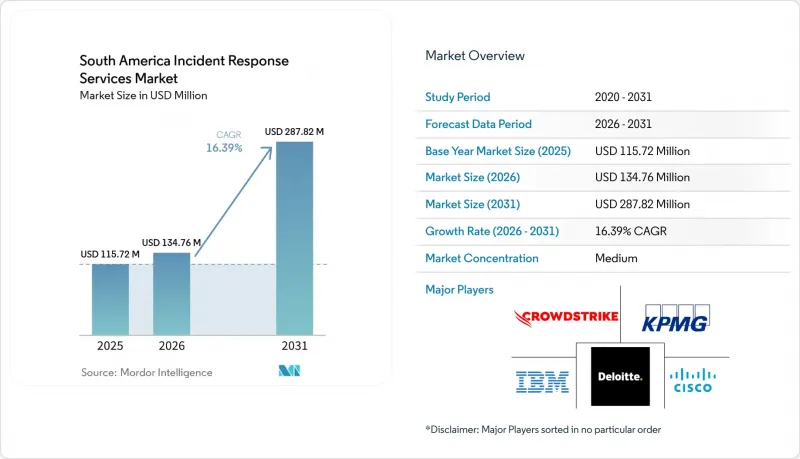
據 Mordor Intelligence 稱,2025 年南美洲事件回應服務市場價值為 1.1572 億美元,預計到 2026 年將成長至 1.3476 億美元,到 2031 年將成長至 2.8782 億美元。
預測期(2026-2031 年)的複合年成長率預計為 16.39%。
南美洲突發事件回應服務市場趨勢與洞察。
勒索軟體、商業電子郵件詐騙和資料外洩的威脅日益加劇。
2025年,南美洲持續面臨勒索軟體的威脅,對快速技術遏制的需求日益成長。卡巴斯基的一份報告顯示,該地區相當一部分組織在2025年遭受了勒索軟體攻擊,其中巴西是該地區的主要受害國。 CrowdStrike指出,2026年上半年,巴西的AI驅動型網路攻擊顯著增加。該報告將生成式人工智慧與高度可信的葡萄牙語社交工程攻擊聯繫起來,這些攻擊可以大規模部署。 CrowdStrike也報告稱,2025年被利用的漏洞中,很大一部分與零時差攻擊有關。該公司報告還發現,2025年雲端入侵事件顯著增加,這將導致南美洲事件回應服務市場更加依賴專業的取證和遏制能力。
強制性事件報告和隱私法規的執行
巴西國家資料保護局 (ANPD) 第 15 號決議 CD/ANPD No. 15 規定,管理員必須在發現安全事件後的三個工作天內通知有關部門和受影響的個人。該規定明確了調查、證據收集、客戶溝通以及受影響組織所做決策的記錄期限。它還將事件回應定位為一項合規性問題,而非一項可以在重大事件發生後推遲的酌情保全服務。無法及時記錄事件的組織將被迫依賴內部團隊的既定工作流程或外部供應商。阿根廷透過第 941/2025 號法令引入了類似的政策指南,該法令設立了國家網路安全中心,並於 2026 年 1 月開始運作。此外,2026 年 5 月的一項行政法令規定,行政機構必須在 180 天內記錄事件應變計畫。
專業緊急應變人員短缺
人才短缺促使企業更依賴外部服務,同時也限制了服務提供者的人員配置。在巴西,合格的網路安全專業人員嚴重短缺,導致本地事件回應團隊難以快速擴充。服務提供者可以從外部引進專家,但這會增加成本和營運複雜性。他們也可以製定培訓計劃,但培養經驗豐富的響應人員需要時間。這種人才短缺在託管偵測與回應 (MDR) 領域尤為突出,因為該領域的分析師需要掌握最新的威脅情報和葡萄牙語技能。人才供應有限可能會降低為巴西中型企業提供服務的公司回應的速度和範圍。
細分市場分析
2025年,「遏制與緩解」服務在南美洲事件回應服務市場佔25.33%的佔有率。該服務可在安全漏洞影響業務運作後立即隔離網路、修改憑證並阻止橫向移動。其領先地位反映了企業營運中快速阻止持續勒索軟體攻擊的迫切需求。金融機構需要這種能力,因為支付系統事件可能同時影響多個組織,需要協調一致的技術判斷。 2025年6月發生的C&M軟體安全漏洞事件導致六家金融機構的業務中斷,凸顯了建立協調回應系統的必要性。 「補救與恢復」服務可在事件發生後立即協助進行恢復與系統增強。 「數位取證與分析」服務可協助企業準備證據並滿足通知要求。其他服務類型包括準備工作、桌面演練、威脅狩獵和諮詢契約,這些服務可幫助客戶在事件確認之前做好準備。
預計到2031年,託管偵測與回應 (MDR) 的複合年成長率將達到16.88%。這項服務將持續監控與結構化的響應流程相結合,能夠在入侵擴散到所有聯網系統之前評估警報。據CrowdStrike稱,到2025年,平均突破時間已縮短至29分鐘。一個已確認的入侵案例僅花了27秒就完成了回應。在這樣的時間限制下,僅依賴人工升級、各自為政的工具以及非工作時間有限的人員配置的反應模式幾乎沒有生存空間。買家越來越重視穩定的供應商和透明的服務等級協定 (SLA),這些協定應明確定義責任、升級流程和回應預期。這一趨勢表明,市場正在轉向更清晰的反應結果。因此,隨著響應寬限期的縮短,MDR在拉丁美洲事件回應服務市場中扮演核心角色。
到 2025 年,本地部署將佔南美事件回應服務市場 40.49% 的佔有率。金融機構傾向於使用具有檢驗租戶隔離的專用基礎設施,尤其是在需要嚴格控制交易資料和調查記錄的情況下。政府機構也仍然存在一些遺留環境,其安全等級限制了雲端遷移。巴西的《通用資料保護法》(LGPD) 法規和央行的要求進一步強化了受監管業務中的趨勢。這種模式使組織能夠更嚴格地管理事件資料和調查記錄。它還可以滿足有關資料儲存位置、系統存取以及正式調查期間證據保存的內部要求。混合部署適用於同時管理雲端風險和本地風險的組織。在這些混合環境中,事件回應負責人需要將不同系統中的證據關聯起來。
預計到2031年,基於雲端的採用率將以16.92%的複合年成長率成長。聖保羅容量的提升使企業能夠在滿足本地資料居住要求的同時,支援需要低延遲運行存取的工作負載。雲端交付還支援計量型的商業契約,這在買家需要減少前期投資並柔軟性應對事件量波動的環境中至關重要。然而,到2025年,巴西的雲端安全準備工作將落後於工作負載遷移。思科的準備調查結果凸顯了企業為何被迫依賴外部事件回應能力。服務提供者需要在不影響本地管理要求的前提下,監控跨雲端工作負載的活動。這使得基於雲端的交付成為進入南美事件回應服務市場的關鍵切入點。
其他好處:
- Excel格式的市場預測(ME)表
- 3個月的分析師支持
目錄
第1章:引言
- 研究假設和市場定義
- 調查範圍
第2章:調查方法
第3章執行摘要
第4章 市場狀況
- 市場概覽
- 市場促進因素
- 勒索軟體、商業電子郵件詐騙和資料外洩的風險日益增加。
- 強制性事件報告和嚴格的隱私保護
- 雲端遷移和混合環境的複雜性
- 網路安全人員短缺和全天候監控需求
- 巴西數位商務與金融服務集中度
- 對跨國調查作出可信的回應,並將其作為證據。
- 市場限制因素
- 專業緊急應變人員短缺
- 中小企業的預算限制
- 法規和通知要求的差異
- 跨境資料傳輸和證據本地化方面的摩擦
- 產業價值鏈分析
- 宏觀經濟因素對市場的影響
- 監理情勢
- 技術展望
- 波特五力分析
第5章 市場規模與成長預測
- 按服務類型
- 遏制與緩解
- 修復和恢復
- 數位取證與分析
- 託管偵測與回應 (MDR)
- 其他服務類型
- 部署模式
- 現場
- 基於雲端的
- 混合
- 按公司規模
- 小型企業
- 大公司
- 按最終用戶行業分類
- BFSI
- 政府/國防
- IT/通訊
- 醫療保健和生命科學
- 工業製造
- 能源公用事業
- 零售與電子商務
- 其他終端用戶產業
- 按地區
- 巴西
- 阿根廷
- 其他南美國家
第6章 競爭情勢
- 市場集中度
- 策略趨勢
- 市佔率分析
- 公司簡介
- IBM Corporation
- Cisco Systems, Inc.
- Deloitte Touche Tohmatsu Limited
- KPMG International Cooperative
- CrowdStrike Holdings, Inc.
- Ernst & Young Global Limited
- Broadcom Inc.
- SentinelOne, Inc.
- LogRhythm, Inc.
- Check Point Software Technologies Ltd.
- Optiv Security Inc.
- Aon plc
- Fortinet, Inc.
- Palo Alto Networks, Inc.
- Rapid7, Inc.
- Secureworks Corp.
- Trustwave Holdings, Inc.
- Accenture plc
- STW Brasil Tecnologia Ltda.
- Stronit Tecnologia Ltda.
- KRYPTUS Seguranca da Informacao SA
第7章 市場機會與未來展望
According to Mordor Intelligence, the South America incident response services market size was valued at USD 115.72 million in 2025 and estimated to expand from USD 134.76 million in 2026 to reach USD 287.82 million by 2031, at a CAGR of 16.39% during the forecast period (2026-2031).
South America Incident Response Services Market Trends and Insights
Escalating Ransomware, Business Email Compromise, and Data Breach Exposure
South America faced sustained ransomware pressure in 2025, which increased demand for rapid technical containment. Kaspersky reported that a significant share of organizations in the region experienced ransomware attacks in 2025, with Brazil representing a major source of regional exposure. CrowdStrike stated that AI-enabled cyberattacks in Brazil increased substantially during the first half of 2026. The disclosure linked generative AI to credible Portuguese-language social engineering campaigns that can be carried out at scale. CrowdStrike reported that a substantial share of exploited vulnerabilities in 2025 involved zero-day attacks. Its report also found that cloud intrusions increased significantly during 2025, making the South America incident response services market more dependent on specialized forensic and containment capabilities.
Mandatory Incident Reporting and Privacy Enforcement
Brazil's ANPD Resolution CD/ANPD No. 15 requires controllers to notify the authority and affected individuals within 3 business days after confirming a security incident. The rule places a defined operating deadline around investigation, evidence collection, customer communication, and documented decisions by the affected organization. It also turns incident response into a compliance issue rather than a discretionary security service that can be postponed after a serious event occurs. Organizations that cannot document an incident quickly must rely on internal teams or external providers with established workflows. Argentina introduced a parallel policy direction through Decree 941/2025, which established its National Cybersecurity Centre and became operational in January 2026. A May 2026 executive decree also required public administration bodies to document incident response plans within 180 days.
Shortage of Specialized Incident Responders
The shortage that encourages external service use also restricts provider staffing. Brazil's significant shortage of qualified cybersecurity professionals makes it difficult to scale local incident response teams quickly. Providers can import expertise, but this raises cost and operational complexity. They can also build training pipelines, although these programs take time to produce experienced responders. The gap is most visible in managed detection and response, where analysts need current threat intelligence and Portuguese-language capabilities. Limited availability can reduce responsiveness and coverage for firms serving Brazil's mid-market.
Other drivers and restraints analyzed in the detailed report include:
- Cloud Migration and Hybrid-Environment Complexity
- Cybersecurity Skills Shortages and 24/7 Monitoring Requirements
- Budget Constraints Among SMEs
For complete list of drivers and restraints, kindly check the Table Of Contents.
Segment Analysis
Containment and Mitigation held 25.33% of the South America incident response services market share in 2025. This service addresses immediate network isolation, credential changes, and interruption of lateral movement after a breach affects business operations. Its leading position reflects the operational need to stop active ransomware events quickly. Financial institutions require this capability because payment-system incidents can affect several organizations at once and require coordinated technical decisions. The June 2025 C&M Software breach disrupted 6 financial institutions and raised the need for coordinated response arrangements. Remediation and Recovery supports restoration and hardening after the immediate event. Digital Forensics and Analytics helps organizations prepare evidence and meet notification requirements. Other service types include readiness work, tabletop exercises, threat hunting, and advisory retainers that help clients prepare before an incident is confirmed.
Managed Detection and Response is projected to expand at a 16.88% CAGR through 2031. The service combines continuous monitoring with an organized response process that can assess alerts before an intrusion spreads across connected systems. CrowdStrike reported that average breakout time fell to 29 minutes in 2025. One confirmed intrusion was completed in 27 seconds. These timelines leave little room for a response model that depends only on manual escalation, disconnected tools, and limited out-of-hours staffing. Buyers are placing more weight on stable providers and transparent service-level agreements that define responsibility, escalation, and response expectations. That preference indicates a move toward defined response outcomes. MDR is therefore central to the South America incident response services market as response windows become shorter.
On-Premises deployment held 40.49% of the South America incident response services market size in 2025. Financial institutions often prefer dedicated infrastructure with verifiable tenant isolation, particularly where transaction data and investigation records require close control. Government entities also retain legacy environments where cloud migration is limited by security classifications. Brazil's LGPD rules and Banco Central expectations reinforce this preference in regulated activities. The model gives organizations closer control over incident data and investigation records. It can also support internal requirements around data location, system access, and the retention of evidence during a formal investigation. Hybrid deployment serves organizations that manage cloud and on-premises exposures together. These mixed environments require responders to connect evidence across different systems.
Cloud-Based deployment is projected to expand at a 16.92% CAGR through 2031. Capacity additions in Sao Paulo have helped organizations address local data-residency needs while supporting workloads that require lower-latency operational access. Cloud delivery can also support consumption-based commercial arrangements. This is relevant in an environment where buyers seek lower upfront commitments and more flexibility when incident volumes change. However, cloud security readiness did not keep pace with workload migration in Brazil during 2025. Cisco's readiness findings show why organizations may depend on outside response capability. Providers must investigate activity across cloud workloads without weakening local control requirements. This makes cloud-based delivery an important route into the South America incident response services market.
Complete Report Scope:
- By Service Type
- Containment and Mitigation
- Remediation and Recovery
- Digital Forensics and Analytics
- Managed Detection and Response (MDR)
- Other Service Types
- By Deployment Mode
- On-Premises
- Cloud-Based
- Hybrid
- By Enterprise Size
- Small and Medium Enterprises
- Large Enterprises
- By End-User Industry
- BFSI
- Government and Defense
- IT and Telecom
- Healthcare and Life Sciences
- Industrial Manufacturing
- Energy and Utilities
- Retail and E-Commerce
- Other End-User Industries
- By Geography
- Brazil
- Argentina
- Rest of South America
List of Companies Covered in this Report:
- IBM Corporation
- Cisco Systems, Inc.
- Deloitte Touche Tohmatsu Limited
- KPMG International Cooperative
- CrowdStrike Holdings, Inc.
- Ernst & Young Global Limited
- Broadcom Inc.
- SentinelOne, Inc.
- LogRhythm, Inc.
- Check Point Software Technologies Ltd.
- Optiv Security Inc.
- Aon plc
- Fortinet, Inc.
- Palo Alto Networks, Inc.
- Rapid7, Inc.
- Secureworks Corp.
- Trustwave Holdings, Inc.
- Accenture plc
- STW Brasil Tecnologia Ltda.
- Stronit Tecnologia Ltda.
- KRYPTUS Seguranca da Informacao S.A.
Additional Benefits:
- The market estimate (ME) sheet in Excel format
- 3 months of analyst support
TABLE OF CONTENTS
1 INTRODUCTION
- 1.1 Study Assumptions and Market Definition
- 1.2 Scope of the Study
2 RESEARCH METHODOLOGY
3 EXECUTIVE SUMMARY
4 MARKET LANDSCAPE
- 4.1 Market Overview
- 4.2 Market Drivers
- 4.2.1 Escalating Ransomware, Business Email Compromise, and Data Breach Exposure
- 4.2.2 Mandatory Incident Reporting and Privacy Enforcement
- 4.2.3 Cloud Migration and Hybrid-Environment Complexity
- 4.2.4 Cybersecurity Skills Shortages and 24/7 Monitoring Requirements
- 4.2.5 Concentration of Digital Commerce and Financial Services in Brazil
- 4.2.6 Evidence-Grade Response for Cross-Border Investigations
- 4.3 Market Restraints
- 4.3.1 Shortage of Specialized Incident Responders
- 4.3.2 Budget Constraints Among SMEs
- 4.3.3 Fragmented Regulatory and Notification Requirements
- 4.3.4 Cross-Border Data Transfer and Evidence-Localization Friction
- 4.4 Industry Value Chain Analysis
- 4.5 Impact of Macroeconomic Factors on the Market
- 4.6 Regulatory Landscape
- 4.7 Technological Outlook
- 4.8 Porter's Five Forces Analysis
- 4.8.1 Bargaining Power of Suppliers
- 4.8.2 Bargaining Power of Buyers
- 4.8.3 Threat of New Entrants
- 4.8.4 Threat of Substitutes
- 4.8.5 Competitive Rivalry
5 MARKET SIZE AND GROWTH FORECASTS (VALUE)
- 5.1 By Service Type
- 5.1.1 Containment and Mitigation
- 5.1.2 Remediation and Recovery
- 5.1.3 Digital Forensics and Analytics
- 5.1.4 Managed Detection and Response (MDR)
- 5.1.5 Other Service Types
- 5.2 By Deployment Mode
- 5.2.1 On-Premises
- 5.2.2 Cloud-Based
- 5.2.3 Hybrid
- 5.3 By Enterprise Size
- 5.3.1 Small and Medium Enterprises
- 5.3.2 Large Enterprises
- 5.4 By End-User Industry
- 5.4.1 BFSI
- 5.4.2 Government and Defense
- 5.4.3 IT and Telecom
- 5.4.4 Healthcare and Life Sciences
- 5.4.5 Industrial Manufacturing
- 5.4.6 Energy and Utilities
- 5.4.7 Retail and E-Commerce
- 5.4.8 Other End-User Industries
- 5.5 By Geography
- 5.5.1 Brazil
- 5.5.2 Argentina
- 5.5.3 Rest of South America
6 COMPETITIVE LANDSCAPE
- 6.1 Market Concentration
- 6.2 Strategic Moves
- 6.3 Market Share Analysis
- 6.4 Company Profiles (includes Global Level Overview, Market Level Overview, Core Segments, Financials as available, Strategic Information, Market Rank/Share, Products and Services, Recent Developments)
- 6.4.1 IBM Corporation
- 6.4.2 Cisco Systems, Inc.
- 6.4.3 Deloitte Touche Tohmatsu Limited
- 6.4.4 KPMG International Cooperative
- 6.4.5 CrowdStrike Holdings, Inc.
- 6.4.6 Ernst & Young Global Limited
- 6.4.7 Broadcom Inc.
- 6.4.8 SentinelOne, Inc.
- 6.4.9 LogRhythm, Inc.
- 6.4.10 Check Point Software Technologies Ltd.
- 6.4.11 Optiv Security Inc.
- 6.4.12 Aon plc
- 6.4.13 Fortinet, Inc.
- 6.4.14 Palo Alto Networks, Inc.
- 6.4.15 Rapid7, Inc.
- 6.4.16 Secureworks Corp.
- 6.4.17 Trustwave Holdings, Inc.
- 6.4.18 Accenture plc
- 6.4.19 STW Brasil Tecnologia Ltda.
- 6.4.20 Stronit Tecnologia Ltda.
- 6.4.21 KRYPTUS Seguranca da Informacao S.A.
7 MARKET OPPORTUNITIES AND FUTURE OUTLOOK
- 7.1 White-Space and Unmet-Need Assessment

 2026-2030年全球事件回應系統市場
 網路安全事件回應服務市場:全球市場預測,2026-2032年
 雲端事件回應服務:市場佔有率分析、產業趨勢與統計資料、成長預測(2026-2031 年)事件回應服務:市場佔有率分析、產業趨勢與統計資料、成長預測(2026-2031 年)
 事件回應服務市場報告:按元件、服務類型、安全類型、部署模式、企業規模、最終用戶產業和地區分類(2026-2034 年)
 2026年全球事件回應自動化市場報告2026年全球事件回應市場報告
 事件回應市場:依組件、類型、事件類型、服務、最終用途、國家及地區分類-全球產業分析、市場規模、市場佔有率及2026年至2033年預測
 事件回應系統市場分析及預測(至 2035 年):按類型、產品類型、服務、技術、元件、應用、部署、最終使用者、功能和解決方案分類
 事件回應市場規模、佔有率和成長分析(按組件、服務類型、安全類型、部署類型、組織規模、垂直產業和地區分類)-2026-2033 年產業預測