


 |
市場調查報告書
商品編碼
2113515
事件回應服務:市場佔有率分析、產業趨勢與統計資料、成長預測(2026-2031 年)Incident Response Services - Market Share Analysis, Industry Trends & Statistics, Growth Forecasts (2026 - 2031) |
||||||

※ 本網頁內容可能與最新版本有所差異。詳細情況請與我們聯繫。
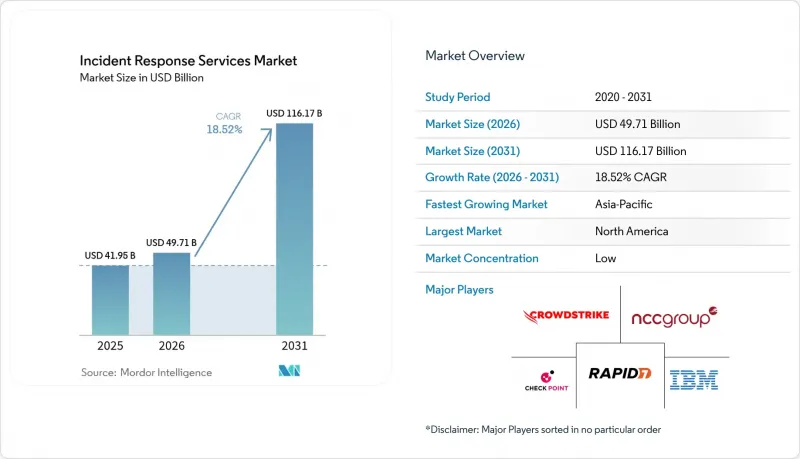
根據 Mordor Intelligence 估計,事件回應服務市場在 2026 年的價值將達到 497.1 億美元,高於 2025 年的 419.5 億美元,預計到 2031 年將達到 1,161.7 億美元。
預計從 2026 年到 2031 年,其複合年成長率將達到 18.52%。
本報告按服務類型(遏制/緩解、補救/恢復、其他)、部署類型(本地部署、雲端部署、其他)、企業規模(中小企業、大型企業)、最終用戶產業(銀行、金融服務和保險、政府/國防、其他)以及地區進行細分。市場預測以美元計價。
全球事件回應服務市場趨勢與洞察
針對銀行、金融服務和保險 (BFSI) 以及關鍵基礎設施的網路攻擊的頻率和複雜程度激增。
金融機構和公共產業業者如今面臨的情況是,攻擊延遲時間以分鐘而非天來計算,這迫使他們轉向以遏制為先的回應程序,優先考慮快速隔離端點和網路段。根據 Unit 42 的《全球事件回應報告》,2024 年 86% 的資料外洩事件會中斷業務運營,攻擊者會在外洩事件發生後一小時內竊取資料。在銀行、金融服務和保險 (BFSI) 行業,舊有系統與開放銀行 API 的整合增加了風險;而在能源和交通運輸行業,營運技術 (OT) 環境要求響應團隊在清除惡意軟體的同時維持運作。政府指南,例如德克薩斯州銀行部門 2025 年發布的通知中指出“基本的網路安全措施可以阻止 98% 的威脅”,也支持這樣一種觀點:專業的響應人員對於應對剩餘的複雜事件至關重要。
更嚴格的資料保護條例將推動基於合規義務的投資。
歐盟的NIS2指令強制要求關鍵業者在24小時內通報重大事件,違者將面臨最高1,000萬歐元(約1,130萬美元)的罰款。北美也出現了類似的趨勢,PCI-DSS 4.0和不斷發展的州隱私法要求檢驗的事件回應機制,不僅包括技術日誌,還包括下游報告和相關人員溝通。由於各地區合規要求存在重疊,跨國公司正在尋求全球響應合作夥伴,將證據收集、法律規定的資料保留義務和資訊揭露標準整合到一個統一協調的工作流程中。
全球範圍內熟練的緊急應變人員短缺限制了經濟成長。
到2025年,全球網路安全人才短缺問題將顯著加劇,事件回應負責人將成為最稀缺的技能之一。這種短缺將延長控制事件所需的時間,並增加資料外洩的責任。 IBM估計,缺乏專門事件回應資源的公司平均將額外花費176萬美元。雖然外包合作夥伴從中受益,但在多個客戶同時發生事件時,他們的處理能力仍然面臨瓶頸,這促使他們投資於人工智慧驅動的事件分診技術,以補充人工專業知識。
細分市場分析
到2025年,遏制和緩解措施將佔事件回應服務市場的32.75%。這反映出在攻擊者轉移攻擊目標或竊取資料之前隔離受損資產的迫切需求。隨著攻擊者平均延遲時間的縮短,快速隔離端點和特權憑證正成為標準做法。在整個預測期內,託管偵測與回應 (MDR) 將以20.6%的複合年成長率成長,持續的威脅搜尋和主動補救將成為關鍵的合約交付內容,而不僅僅是可選的附加服務。
託管偵測與回應 (MDR) 的發展勢頭主要得益於人工智慧輔助分析,它能夠偵測到人類分析師常常忽略的異常情況。供應商正在部署利用大規模語言模型 (LLM) 的協同駕駛功能,從而加速根本原因識別和自動化劇本執行,顯著縮短反應時間。糾正措施和恢復仍然至關重要,尤其是在監管報告和訴訟中,因為這些環節需要處理經認證的證據。數位取證和分析正透過基於機器學習的模式識別技術不斷發展,使事件負責人能夠更快地重建攻擊者的時間線,同時滿足法庭訴訟中的證據標準。
即使到了2025年,受主權法規和董事會優先考慮在國內儲存高度敏感日誌的趨勢驅動,本地部署仍將佔據事件回應服務市場56.45%的佔有率。金融機構和政府機構繼續限制向外部各方傳輸數據,尤其是在禁止將客戶資訊轉移到國外的司法管轄區。然而,隨著安全團隊採用即插即用的擴充性,基於雲端的事件回應工具預計將以19.85%的複合年成長率成長,超過整體市場成長率。
混合部署模式將本機日誌保留與雲端分析引擎結合,在不犧牲彈性運算能力的前提下,為組織提供必要的取證可見性。零信任方法透過降低網路位置作為安全邊界的重要性並標準化遠端取證調查,推動了這一轉變。服務提供者透過提供「自帶金鑰 (BYK)」加密和區域內資料儲存來滿足合規性稽核要求,從而實現差異化競爭。
區域分析
由於成熟的資料外洩通知法律和健全的安全生態系統,北美預計將繼續保持其在該地區領先地位,到2025年將佔據事件回應服務市場37.85%的佔有率。美國金融監管機構,例如紐約州金融服務部,正在強制要求制定正式的事件回應計劃,這推動了各大銀行和金融科技公司對相關服務的需求。加拿大關於關鍵基礎設施的指令以及墨西哥不斷完善的金融科技監管也促進了該地區市場的成長。
預計到2031年,亞太地區的複合年成長率將達到20.12%。日本、新加坡和澳洲的監管協調現已強制要求24小時內揭露資料外洩事件並採用經認證的回應流程,同時鼓勵企業在事件發生前簽訂緊急應變服務協議。預計到2024年,該地區將佔全球網路攻擊的34%,因此對能夠適應當地法規和多樣化雲端環境的雙語、跨司法管轄區緊急應變人員的需求日益成長。
在歐洲,合規主導的實施正在NIS2框架下加速。 NIS2擴大了「關鍵營業單位」的範圍,並提高了對準備不足的處罰。各組織必須將基於GDPR的資料外洩報告與NIS2安全事件揭露要求保持一致,這推動了對隱私和安全回應綜合服務的需求。東歐成員國擴大聘請顧問公司來本地化回應手冊,而主要經濟體則正在擴大合約範圍,以涵蓋供應鏈和營運技術(OT)威脅。
拉丁美洲、中東和非洲仍在發展中,但已展現出成長動能。數位商務的擴張和新資料保護法的頒布創造了機遇,但預算和人才的限制暫時限制了成長速度。國際服務提供者正與當地的託管安全服務提供者 (MSSP) 合作,以彌合語言、文化和合規方面的差距。隨著區域對網路安全韌性投資的持續增加,這種模式有望進一步擴展。
其他好處:
- Excel格式的市場預測(ME)表
- 3個月的分析師支持
目錄
第1章:引言
- 調查範圍
第2章:調查方法
第3章執行摘要
第4章 市場狀況
- 市場促進因素
- 針對銀行、金融服務和保險 (BFSI) 以及關鍵基礎設施的網路攻擊的頻率和複雜程度激增。
- 加強資料保護條例(GDPR、CCPA、PCI-DSS 4.0、NIS2)
- 採用「雲端優先」策略擴大了攻擊面,增加了對雲端中事件回應 (IR) 的需求。
- 利用 OAuth 令牌的「勒索雲」和「BEC 3.0」的興起。
- 一種網路保險評分模型,要求預先已通過核准IR預付款。
- ICS/OT 數位孿生分析正在加速安全漏洞發生後的根本原因調查。
- 市場限制因素
- 全球缺乏熟練的緊急應變人員
- 高級投資者關係顧問的高昂費用阻礙了中小企業採用此類服務。
- 與 XDR/SOAR 平台的重疊導致買家感到困惑。
- 零信任架構可以減少攻擊者的潛伏時間,並降低全面事件回應 (IR) 的需求。
- 供應鏈分析
- 監理情勢
- 技術展望
- 波特五力分析
- 供應商的議價能力
- 買方的議價能力
- 新進入者的威脅
- 替代品的威脅
- 競爭公司之間的競爭
- 產業相關人員分析
第5章 市場規模與成長預測
- 按服務類型
- 遏制與緩解
- 修復和恢復
- 數位取證與分析
- 託管偵測與回應 (MDR)
- 其他
- 部署模式
- 現場
- 基於雲端的
- 混合
- 按公司規模
- 小型企業
- 大公司
- 按最終用戶行業分類
- BFSI
- 政府/國防
- IT/通訊
- 醫療保健和生命科學
- 工業製造
- 能源公用事業
- 零售與電子商務
- 其他
- 按地區
- 北美洲
- 美國
- 加拿大
- 墨西哥
- 南美洲
- 巴西
- 阿根廷
- 其他南美國家
- 歐洲
- 德國
- 英國
- 法國
- 西班牙
- 義大利
- 俄羅斯
- 其他歐洲國家
- 亞太地區
- 中國
- 日本
- 印度
- 澳洲
- 韓國
- 其他亞太國家
- 中東和非洲
- 中東
- 沙烏地阿拉伯
- 阿拉伯聯合大公國
- 土耳其
- 其他中東國家
- 非洲
- 南非
- 其他非洲國家
- 中東
- 北美洲
第6章 競爭情勢
- 市場集中度
- 策略趨勢
- 市佔率分析
- 公司簡介
- CrowdStrike Holdings Inc.
- Check Point Software Technologies Ltd.
- BlackBerry Cybersecurity(Cylance)
- Mandiant Inc.(Google Cloud)
- Kaspersky Lab
- Rapid7 Inc.
- IBM Corporation
- NCC Group plc
- Optiv Security Inc.
- Secureworks Inc.
- Trustwave Holdings Inc.
- KPMG International Ltd.
- Deloitte Touche Tohmatsu Ltd.
- Ernst and Young Global Ltd.
- PricewaterhouseCoopers(PwC)
- Accenture plc
- Palo Alto Networks(Unit 42)
- Cisco Systems Inc.(Talos IR)
- Booz Allen Hamilton Inc.
- BAE Systems Digital Intelligence
第7章 市場機會與未來展望
According to Mordor Intelligence, incident response services market size in 2026 is estimated at USD 49.71 billion, growing from 2025 value of USD 41.95 billion with 2031 projections showing USD 116.17 billion, growing at 18.52% CAGR over 2026-2031.
This report is Segmented by Service Type (Containment and Mitigation, Remediation and Recovery, and More), by Deployment Mode (On-Premises, Cloud-Based, and More), by Enterprise Size (Small and Medium Enterprises and Large Enterprises), by End-User Industry (BFSI, Government and Defense, and More), by Geography. The Market Forecasts are Provided in Terms of Value (USD).
Global Incident Response Services Market Trends and Insights
Surge in Frequency and Sophistication of Cyber-Attacks in BFSI and Critical Infrastructure
Financial institutions and utility operators now contend with attack dwell times measured in minutes rather than days, forcing a pivot to containment-first playbooks that emphasize rapid isolation of endpoints and network segments. The Unit 42 Global Incident Response Report recorded that 86% of 2024 breaches disrupted business operations, while adversaries exfiltrated data inside the first hour of compromise. Legacy system convergence with open banking APIs compounds risk in BFSI, whereas operational technology (OT) environments in energy and transport require response teams to preserve uptime even while eradicating malware. Government guidance, such as the Texas Department of Banking's 2025 notice that basic cyber hygiene blocks 98% of threats, reinforces the view that specialized responders are essential for the remaining high-grade incidents.
Stricter Data-Protection Regulations Driving Compliance-Mandated Investments
The European Union's NIS2 directive obliges essential entities to report significant incidents within 24 hours and faces violators with fines up to EUR 10 million (USD 11.3 million). Similar momentum exists in North America, where PCI-DSS 4.0 and evolving state privacy laws demand verifiable incident response programs that extend beyond technical logs to downstream reporting and stakeholder communication. Compliance overlap across regions has spurred multinational firms to seek global response partners that can align evidence collection, legal holds, and public disclosure standards in one coordinated workflow.
Global Shortage of Skilled Incident Responders Constraining Growth
The worldwide cybersecurity workforce gap climbed significantly in 2025, with incident responders among the scarcest skill sets. Staffing deficits raise time-to-contain metrics and inflate breach liabilities; IBM estimates an average USD 1.76 million premium for firms lacking dedicated incident response resources. Outsourcing partners benefit, yet capacity bottlenecks persist during multi-client surge events, spurring investments in AI-driven triage to extend human expertise
Other drivers and restraints analyzed in the detailed report include:
- Cloud-First Adoption Expanding Attack Surface
- Rise of Ransom-Cloud and BEC 3.0 Exploiting OAuth Tokens
- High Cost of Premium IR Retainers Limiting SME Adoption
For complete list of drivers and restraints, kindly check the Table Of Contents.
Segment Analysis
Containment and Mitigation captured 32.75% of the incident response services market in 2025, reflecting the urgency to isolate compromised assets before attackers pivot or exfiltrate data. Rapid isolation of endpoints and privileged credentials has become standard practice as median attacker dwell time shrinks. Over the forecast horizon, Managed Detection and Response will expand at a 20.6% CAGR, elevating continuous threat-hunting and proactive remediation from optional add-ons to core contract deliverables.
MDR momentum is powered by AI-assisted analytics that surface anomalies human analysts might miss. Vendors infuse large-language-model copilots that accelerate root-cause discovery and automated playbook execution, slashing response hours. Remediation and Recovery maintain relevance, particularly when regulatory reporting or litigation requires certified evidence handling. Digital Forensics and Analytics is evolving through machine-learning-based pattern recognition, enabling incident responders to reconstruct attacker timelines faster while satisfying evidentiary standards for court proceedings.
On-Premises installations still held 56.45% share of the incident response services market size in 2025 due to sovereignty mandates and board-level preferences for local custody of sensitive logs. Financial institutions and public agencies continue to limit external data transfers, especially in jurisdictions that prohibit customer information from leaving national borders. Yet cloud-based response tooling will outpace overall growth at a 19.85% CAGR as security teams embrace plug-and-play scalability.
Hybrid deployment models now fuse local log retention with cloud analytics engines, giving organizations the forensic visibility they require without sacrificing elastic compute capacity. Zero-trust philosophies reinforce the shift by de-emphasizing network location as a security boundary and normalizing remote examination of forensic artifacts. Providers differentiate by offering "bring-your-own-key" encryption and in-region data storage to satisfy compliance audits.
Complete Report Scope:
- By Service Type
- Containment and Mitigation
- Remediation and Recovery
- Digital Forensics and Analytics
- Managed Detection and Response (MDR)
- Others
- By Deployment Mode
- On-Premises
- Cloud-based
- Hybrid
- By Enterprise Size
- Small and Medium Enterprises
- Large Enterprises
- By End-User Industry
- BFSI
- Government and Defense
- IT and Telecom
- Healthcare and Life Sciences
- Industrial Manufacturing
- Energy and Utilities
- Retail and E-commerce
- Others
- By Geography
- North America
- United States
- Canada
- Mexico
- South America
- Brazil
- Argentina
- Rest of South America
- Europe
- Germany
- United Kingdom
- France
- Spain
- Italy
- Russia
- Rest of Europe
- Asia-Pacific
- China
- Japan
- India
- Australia
- South Korea
- Rest of Asia-Pacific
- Middle East and Africa
- Middle East
- Saudi Arabia
- United Arab Emirates
- Turkey
- Rest of Middle East
- Africa
- South Africa
- Rest of Africa
- Middle East
- North America
Geography Analysis
North America retained the regional lead with 37.85% incident response services market share in 2025, propelled by mature breach-notification laws and robust security ecosystems. United States financial regulators, such as the New York Department of Financial Services, require formalized incident response plans, reinforcing demand across large banks and fintechs. Canada's critical-infrastructure directives and Mexico's expanding fintech rules extend regional volume.
Asia-Pacific is on track for a 20.12% CAGR to 2031. Regulatory harmonization in Japan, Singapore, and Australia now mandates 24-hour breach disclosure and certified response processes, encouraging organizations to secure retainers before incidents occur. The region recorded 34% of global attacks in 2024, intensifying demand for bilingual, cross-jurisdictional responders who can navigate local rules and diverse cloud stacks.
Europe's compliance-driven adoption accelerates under NIS2, which broadens the scope of "essential entities" and elevates fines for insufficient preparedness. Organizations must harmonize GDPR data-breach reporting with NIS2 security-incident disclosure, fueling bundled privacy-plus-security response engagements. Eastern European members look to consultancies for playbook localization, while larger economies deepen contracts to cover supply-chain and OT threats.
Latin America, the Middle East, and Africa remain nascent but rising. Digital-commerce expansion and new data-protection statutes open opportunities, though budgetary and talent constraints temper immediate growth. International providers partner with local MSSPs to bridge language, culture, and compliance gaps, a model expected to scale as regional investment in cyber resilience continues.
- CrowdStrike Holdings Inc.
- Check Point Software Technologies Ltd.
- BlackBerry Cybersecurity (Cylance)
- Mandiant Inc. (Google Cloud)
- Kaspersky Lab
- Rapid7 Inc.
- IBM Corporation
- NCC Group plc
- Optiv Security Inc.
- Secureworks Inc.
- Trustwave Holdings Inc.
- KPMG International Ltd.
- Deloitte Touche Tohmatsu Ltd.
- Ernst and Young Global Ltd.
- PricewaterhouseCoopers (PwC)
- Accenture plc
- Palo Alto Networks (Unit 42)
- Cisco Systems Inc. (Talos IR)
- Booz Allen Hamilton Inc.
- BAE Systems Digital Intelligence
Additional Benefits:
- The market estimate (ME) sheet in Excel format
- 3 months of analyst support
TABLE OF CONTENTS
1 INTRODUCTION
- 1.1 Scope of the Study
2 RESEARCH METHODOLOGY
3 EXECUTIVE SUMMARY
4 MARKET LANDSCAPE
- 4.1 Market Drivers
- 4.1.1 Surge in frequency and sophistication of cyber-attacks in BFSI and critical infrastructure
- 4.1.2 Stricter data-protection regulations (GDPR, CCPA, PCI-DSS 4.0, NIS2)
- 4.1.3 Cloud-first adoption expanding attack surface and driving cloud IR demand
- 4.1.4 Rise of ransom-cloud and BEC 3.0 exploiting OAuth tokens
- 4.1.5 Cyber-insurance scoring models mandating pre-approved IR retainers
- 4.1.6 ICS/OT digital-twin analytics accelerating post-breach root-cause investigations
- 4.2 Market Restraints
- 4.2.1 Global shortage of skilled incident responders
- 4.2.2 High cost of premium IR retainers limiting SME uptake
- 4.2.3 Overlap with XDR/SOAR platforms causing buyer confusion
- 4.2.4 Zero-trust architectures shortening dwell time, reducing full-scale IR engagements
- 4.3 Supply-Chain Analysis
- 4.4 Regulatory Landscape
- 4.5 Technological Outlook
- 4.6 Porters Five Force Analysis
- 4.6.1 Bargaining Power of Suppliers
- 4.6.2 Bargaining Power of Buyers
- 4.6.3 Threat of New Entrants
- 4.6.4 Threat of Substitutes
- 4.6.5 Intensity of Competitive Rivalry
- 4.7 Industry Stakeholder Analysis
5 MARKET SIZE AND GROWTH FORECASTS (VALUE)
- 5.1 By Service Type
- 5.1.1 Containment and Mitigation
- 5.1.2 Remediation and Recovery
- 5.1.3 Digital Forensics and Analytics
- 5.1.4 Managed Detection and Response (MDR)
- 5.1.5 Others
- 5.2 By Deployment Mode
- 5.2.1 On-Premises
- 5.2.2 Cloud-based
- 5.2.3 Hybrid
- 5.3 By Enterprise Size
- 5.3.1 Small and Medium Enterprises
- 5.3.2 Large Enterprises
- 5.4 By End-User Industry
- 5.4.1 BFSI
- 5.4.2 Government and Defense
- 5.4.3 IT and Telecom
- 5.4.4 Healthcare and Life Sciences
- 5.4.5 Industrial Manufacturing
- 5.4.6 Energy and Utilities
- 5.4.7 Retail and E-commerce
- 5.4.8 Others
- 5.5 By Geography
- 5.5.1 North America
- 5.5.1.1 United States
- 5.5.1.2 Canada
- 5.5.1.3 Mexico
- 5.5.2 South America
- 5.5.2.1 Brazil
- 5.5.2.2 Argentina
- 5.5.2.3 Rest of South America
- 5.5.3 Europe
- 5.5.3.1 Germany
- 5.5.3.2 United Kingdom
- 5.5.3.3 France
- 5.5.3.4 Spain
- 5.5.3.5 Italy
- 5.5.3.6 Russia
- 5.5.3.7 Rest of Europe
- 5.5.4 Asia-Pacific
- 5.5.4.1 China
- 5.5.4.2 Japan
- 5.5.4.3 India
- 5.5.4.4 Australia
- 5.5.4.5 South Korea
- 5.5.4.6 Rest of Asia-Pacific
- 5.5.5 Middle East and Africa
- 5.5.5.1 Middle East
- 5.5.5.1.1 Saudi Arabia
- 5.5.5.1.2 United Arab Emirates
- 5.5.5.1.3 Turkey
- 5.5.5.1.4 Rest of Middle East
- 5.5.5.2 Africa
- 5.5.5.2.1 South Africa
- 5.5.5.2.2 Rest of Africa
- 5.5.5.1 Middle East
- 5.5.1 North America
6 COMPETITIVE LANDSCAPE
- 6.1 Market Concentration
- 6.2 Strategic Moves
- 6.3 Market Share Analysis
- 6.4 Company Profiles (includes Global level Overview, Market level overview, Core Segments, Financials as available, Strategic Information, Market Rank/Share, Products and Services, Recent Developments)
- 6.4.1 CrowdStrike Holdings Inc.
- 6.4.2 Check Point Software Technologies Ltd.
- 6.4.3 BlackBerry Cybersecurity (Cylance)
- 6.4.4 Mandiant Inc. (Google Cloud)
- 6.4.5 Kaspersky Lab
- 6.4.6 Rapid7 Inc.
- 6.4.7 IBM Corporation
- 6.4.8 NCC Group plc
- 6.4.9 Optiv Security Inc.
- 6.4.10 Secureworks Inc.
- 6.4.11 Trustwave Holdings Inc.
- 6.4.12 KPMG International Ltd.
- 6.4.13 Deloitte Touche Tohmatsu Ltd.
- 6.4.14 Ernst and Young Global Ltd.
- 6.4.15 PricewaterhouseCoopers (PwC)
- 6.4.16 Accenture plc
- 6.4.17 Palo Alto Networks (Unit 42)
- 6.4.18 Cisco Systems Inc. (Talos IR)
- 6.4.19 Booz Allen Hamilton Inc.
- 6.4.20 BAE Systems Digital Intelligence
7 MARKET OPPORTUNITIES AND FUTURE OUTLOOK
- 7.1 White-space and Unmet-need Assessment

 2026-2030年全球事件回應系統市場
 網路安全事件回應服務市場:全球市場預測,2026-2032年
 雲端事件回應服務:市場佔有率分析、產業趨勢與統計資料、成長預測(2026-2031 年)南美洲事件回應服務:市場佔有率分析、產業趨勢與統計及成長預測(2026-2031 年)
 事件回應服務市場報告:按元件、服務類型、安全類型、部署模式、企業規模、最終用戶產業和地區分類(2026-2034 年)
 2026年全球事件回應自動化市場報告2026年全球事件回應市場報告
 事件回應市場:依組件、類型、事件類型、服務、最終用途、國家及地區分類-全球產業分析、市場規模、市場佔有率及2026年至2033年預測
 事件回應系統市場分析及預測(至 2035 年):按類型、產品類型、服務、技術、元件、應用、部署、最終使用者、功能和解決方案分類
 事件回應市場規模、佔有率和成長分析(按組件、服務類型、安全類型、部署類型、組織規模、垂直產業和地區分類)-2026-2033 年產業預測