


 |
市場調查報告書
商品編碼
2154918
泡沫材料:市場佔有率分析、行業趨勢和統計數據、成長預測(2026-2031 年)Foam - Market Share Analysis, Industry Trends & Statistics, Growth Forecasts (2026 - 2031) |
||||||

※ 本網頁內容可能與最新版本有所差異。詳細情況請與我們聯繫。
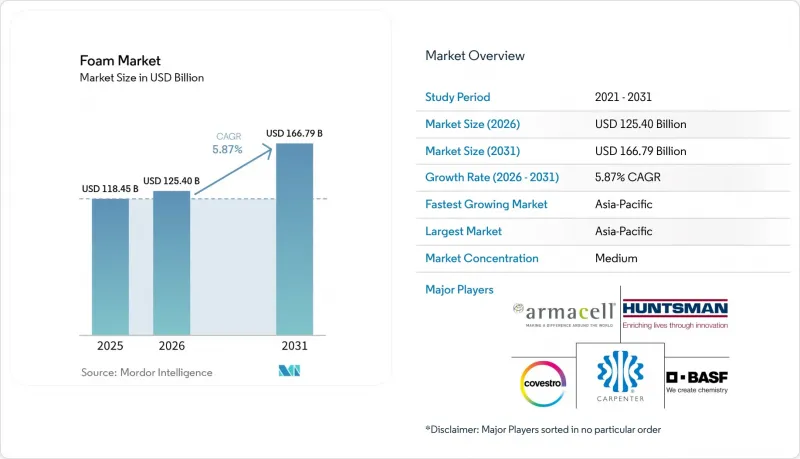
據 Mordor Intelligence 稱,2025 年發泡材市場價值為 1184.5 億美元,預計到 2031 年將達到 1,667.9 億美元,而 2026 年為 1,254 億美元,預測期(2026-2031 年)的複合年成長率為 5.87%。
全球發泡材市場趨勢及洞察
節能標準與建築維修需求
能源效率標準和建築維修需求為發泡材市場的保溫應用奠定了堅實的基礎。國際節能標準 (IECC)、美國暖氣、冷氣與空調工程師協會 (ASHRAE) 標準 90.1 以及歐盟建築能源性能指令均對新建和維修中隔熱材料的選擇提出了要求。即使在牆體厚度和安裝空間有限的情況下,硬質聚氨酯和聚苯乙烯產品也能滿足保溫要求。儘管單戶住宅的需求疲軟,但商業建築改造、電氣化項目和資料中心建設正在支撐市場需求。這些法規透過建立最低性能標準並確保合規性,正在降低發泡材市場對純粹可自由支配購買的依賴。
電子商務和對防護包裝日益成長的需求
電子商務和防護包裝需求的不斷成長,推動了整個小包裹遞送網路中防護材料需求的上升。線上銷售的履約需要能夠保護貨物免受反覆搬運和運輸條件波動影響的包裝。客製化發泡材內襯適用於消費性電子產品、醫療產品以及其他易損件會造成重大損失的商品。溫控藥品物流也需要材料來保護貨物在運輸過程中不受損壞。印度、中國和東南亞不斷擴張的製造業和數位零售網路正在創造巨大的商機。發泡材市場的這一細分領域不僅取決於零售包裝的銷量,還取決於產品保護、物流可靠性和材料效率。供應商需要設計出能夠最大限度減少損壞、適用於自動化包裝作業並支援長途配送全程一致客戶體驗的產品。
石油衍生原料價格波動
石油衍生原料價格波動會影響二苯基甲烷二異氰酸酯(MDI)、甲苯二異氰酸酯 (TDI)、多元醇及相關原料的成本。供應中斷會導致庫存減少,使發泡體生產商難以製定採購計畫和定價策略。與從現貨市場採購原料的混配商相比,自行管理原料的生產商受到的影響較小。這種差異會影響利潤率、合約條款以及在供應中斷期間維持供應的能力。此外,它還會加大購買力和庫存能力有限的中小型加工商的壓力。隨著原物料供應情況的變化,發泡體市場對靈活的採購方式和更最佳化的供應鏈調整的需求也日益成長。這是因為生產商必須權衡原料持有成本與訂單延遲、訂單遺失以及原料價格劇烈波動的風險。
細分市場分析
預計到2025年,聚氨酯將佔據發泡體市場40.43%的佔有率,並將在2031年之前以6.34%的複合年成長率成長。其應用領域包括硬質隔熱材料、軟性汽車座椅、噴塗氣密層和聲學組件。如此廣泛的應用使得聚氨酯能夠滿足多個細分市場的需求,即使在建築、汽車和消費品應用領域的具體情況有所不同。聚苯乙烯,包括發泡聚苯乙烯和押出成型聚苯乙烯,在硬質保溫包裝和包裝材料領域佔有一席之地。聚烯,例如聚乙烯、聚丙烯和乙烯-醋酸乙烯酯共聚物(EVA),則用於鞋類、運動用品和輕質包裝材料。酚醛樹脂和聚對苯二甲酸乙二醇酯(PET)發泡體材料在高性能應用中繼續發揮重要作用,例如防火建築系統和結構複合材料的芯複合材料。
聚氨酯發泡體市場規模的擴大得益於該材料在剛性和軟性泡沫領域的廣泛應用。 2026年3月,BASF宣佈在北美推出一系列生質能平衡聚醚多元醇產品,用於軟性發泡體應用,並已獲得國際永續發展與碳認證PLUS(ISCC PLUS)認證。該系列產品為原料替代提供了途徑,同時保持了客戶熟悉的加工條件。此品類的市場規模也支持對產品認證、認可和技術服務的投資。這使得製造商能夠在不改變每種應用所用樹脂平台的情況下,滿足客戶在隔熱材料、座椅、包裝和其他應用領域的需求。
區域分析
預計到2025年,亞太地區將佔據發泡體市場40.35%的佔有率,並將以6.89%的複合年成長率持續成長至2031年。該地區的成長主要得益於建築需求、製造業成長、電子商務發展以及汽車生產。這種多元化為供應商開闢了多個成長途徑,降低了他們對特定客戶產業或國家的依賴。中國憑藉其龐大的工業規模以及發泡體在隔熱材料、家電、汽車和包裝等領域的廣泛應用,仍然是一個重要的市場。印度正憑藉基礎建設、電子產品生產、汽車製造和數位零售等產業,成為第二大需求驅動力。東南亞國家則透過冷鏈物流、建築和消費品製造等產業,不斷增加市場需求。亞太地區發泡體市場也受惠於供應鏈投資,這些投資將生產基地遷移到本地客戶。本地化生產縮短了交貨週期,並使供應商能夠根據當地的建築規範、氣候條件和終端用戶偏好調整配方。
北美和歐洲是重要的收入來源,各自呈現不同的需求模式。北美的需求主要受建築節能法規、商業建築改造、電氣化專案和資料中心建設的驅動。該地區的汽車製造商也在尋求兼具隔音和隔熱性能的材料。在歐洲,基於建築政策和更嚴格的化學品及包裝合規要求的維修需求主導市場。在碳排放報告要求嚴格的北歐市場,儘早採用低全球暖化潛勢 (GWP) 和生物基產品尤為重要。在這些地區的發泡體市場,能夠兼顧材料性能和完善的監管文件的製造商擁有競爭優勢。供應商必須證明其產品符合安全、排放、回收和報告要求,同時確保所有生產基地的品質一致。
南美洲、中東和非洲雖然銷量較小,但卻是重要的成長區域。在巴西,建設活動和家俱生產支撐了市場需求。在阿根廷,經濟狀況限制了資本投資,並可能影響採購週期。科思創股份公司將於2026年6月啟動一項可行性研究,計劃在阿拉伯聯合大公國(阿拉伯聯合大公國)建造一座年產能為66萬噸的工廠,理由是市場對節能建築隔熱材料、家用電器製造和食品冷鏈的需求。沙烏地阿拉伯的建設計畫以及南非作為分銷中心的地位,也為發泡材市場創造了更多機會。向這些地區供貨的公司必須考慮當地的建築規範、運輸條件、客戶規格以及區域內的加工能力。
其他好處:
- Excel格式的市場預測(ME)表
- 3個月的分析師支持
目錄
第1章:引言
- 研究假設和市場定義
- 調查範圍
第2章:調查方法
第3章執行摘要
第4章 市場狀況
- 市場概覽
- 市場促進因素
- 節能標準與建築維修需求
- 電子商務和防護包裝的重要性
- 汽車輕量化與電動汽車聲學管理
- 舒適度、寢具更換和家具需求
- 使用可回收和生物基發泡材
- 市場限制因素
- 石油衍生原料價格波動
- 與回收和廢棄產品相關的合規成本
- 為實現阻燃和低排放,配方改良的複雜性。
- 價值鏈分析
- 波特五力分析
第5章 市場規模與成長預測
- 依樹脂類型
- 聚氨酯
- 聚苯乙烯
- 膨脹聚苯乙烯(EPS)
- 擠塑聚苯乙烯(XPS)
- 聚烯
- 聚乙烯(PE)
- 聚丙烯(PP)
- 乙烯-醋酸乙烯酯共聚物(EVA)
- 酚醛樹脂
- 聚對苯二甲酸乙二醇酯(PET)
- 其他樹脂類型
- 依表單類型
- 軟性發泡體
- 硬質發泡體
- 按最終用途行業分類
- 建築/施工
- 包裝
- 車
- 家具和床上用品
- 鞋類、運動和休閒
- 其他終端用戶產業
- 按地區
- 亞太地區
- 中國
- 印度
- 日本
- 韓國
- 東南亞國協
- 其他亞太國家
- 北美洲
- 美國
- 加拿大
- 墨西哥
- 歐洲
- 德國
- 英國
- 法國
- 義大利
- 北歐國家
- 俄羅斯
- 其他歐洲國家
- 南美洲
- 巴西
- 阿根廷
- 其他南美國家
- 中東和非洲
- 沙烏地阿拉伯
- 南非
- 其他中東和非洲國家
- 亞太地區
第6章 競爭情勢
- 市場集中度
- 策略趨勢
- 市佔率和排名分析
- 公司簡介
- ARMACELL
- BASF
- Carpenter Co.
- Covestro AG
- Future Foam
- Huntsman International LLC
- INOAC CORPORATION
- JSP
- Rogers Foam Corporation
- Saint-Gobain
- Sealed Air
- SEKISUI CHEMICAL CO., LTD.
- Synthos
- The Vita Group
- Trelleborg
- Woodbridge Corporation
- Zotefoams plc
第7章 市場機會與未來展望
According to Mordor Intelligence, the foam market size was valued at USD 118.45 billion in 2025 and is estimated to grow from USD 125.40 billion in 2026 to reach USD 166.79 billion by 2031, at a CAGR of 5.87% during the forecast period (2026-2031).
Global Foam Market Trends and Insights
Energy-Efficiency Codes and Building Retrofit Demand
Energy-efficiency codes and building retrofit demand create a durable base for insulation applications in the foam market. The International Energy Conservation Code (IECC), American Society of Heating, Refrigerating and Air-Conditioning Engineers Standard 90.1, and the European Union Energy Performance of Buildings Directive set requirements that affect insulation choices in new construction and renovations. Rigid polyurethane and polystyrene products can meet thermal requirements where wall thickness and installation space are limited. Commercial remodeling, electrification projects, and data-center construction can provide demand support when single-family housing activity is weak. These rules make the foam market less dependent on purely discretionary purchases because compliance establishes a minimum performance threshold.
E-Commerce and Protective Packaging Intensity
E-commerce and protective packaging intensity increase demand for protective materials across parcel delivery networks. Online fulfillment requires packaging that can protect goods through repeated handling and variable shipping conditions. Custom-fit foam inserts are relevant for consumer electronics, medical products, and other goods with a high cost of damage. Temperature-controlled pharmaceutical logistics also need materials that help protect shipments during transit. India, China, and Southeast Asian markets provide important opportunities because their manufacturing and digital retail networks are expanding. This part of the foam market depends on product protection, logistics reliability, and material efficiency rather than on retail packaging volume alone, and suppliers need designs that limit damage, fit automated packing operations, and support a consistent customer experience across long delivery routes.
Petroleum-Derived Feedstock Price Volatility
Petroleum-derived feedstock price volatility can disrupt costs for methylene diphenyl diisocyanate (MDI), toluene diisocyanate (TDI), polyols, and related inputs. Supply interruptions can reduce inventories and make it harder for foam producers to plan procurement and customer pricing. Producers that control feedstocks can be less exposed than formulators that buy materials on spot markets. This difference can affect margins, contract terms, and the ability to maintain supply during disruptions. It can also increase pressure on smaller converters that have less purchasing leverage and a limited ability to hold inventory. The foam market faces a continuing need for flexible sourcing and better supply-chain coordination as feedstock availability changes, because producers must balance the cost of holding material against the risk of delayed deliveries, lost orders, and rapid changes in input prices.
Other drivers and restraints analyzed in the detailed report include:
- Vehicle Lightweighting and EV Acoustic Management
- Comfort, Bedding Replacement, and Furniture Demand
- Recycling and End-of-Life Compliance Costs
For complete list of drivers and restraints, kindly check the Table Of Contents.
Segment Analysis
Polyurethane held 40.43% of the foam market share in 2025 and is projected to advance at a 6.34% CAGR through 2031. Its use spans rigid thermal insulation, flexible automotive seating, spray-applied air barriers, and acoustic components. This breadth helps polyurethane serve several demand pools when conditions differ between construction, vehicle, and consumer applications. Polystyrene, including expanded polystyrene and extruded polystyrene, competes in rigid insulation and packaging. Polyolefins such as polyethylene, polypropylene, and ethylene-vinyl acetate are used in footwear, sports products, and lightweight packaging. Phenolic and polyethylene terephthalate foams remain relevant in higher-performance uses such as fire-conscious construction systems and structural composite cores.
The foam market size for polyurethane benefits from the material's role in both rigid and flexible formats. BASF introduced an International Sustainability and Carbon Certification PLUS-certified biomass balance polyether polyol portfolio for North American flexible foam applications in March 2026. The offering provides a path to feedstock substitution while preserving familiar processing conditions for customers. The category's scale also supports investment in product qualification, certification, and technical service. This can help producers respond to customer demands across insulation, seating, packaging, and other applications without changing the underlying resin platform for every use.
Complete Report Scope:
- By Resin Type
- Polyurethane
- Polystyrene
- Expanded Polystyrene (EPS)
- Extruded Polystyrene (XPS)
- Polyolefin
- Polyethylene (PE)
- Polypropylene (PP)
- Ethylene-Vinyl Acetate (EVA)
- Phenolic
- Polyethylene Terephthalate (PET)
- Other Resin Types
- By Foam Type
- Flexible Foam
- Rigid Foam
- By End-Use Industry
- Building and Construction
- Packaging
- Automotive
- Furniture and Bedding
- Footwear, Sports and Recreational
- Other End-Use Industries
- By Geography
- Asia-Pacific
- China
- India
- Japan
- South Korea
- ASEAN Countries
- Rest of Asia-Pacific
- North America
- United States
- Canada
- Mexico
- Europe
- Germany
- United Kingdom
- France
- Italy
- NORDIC Countries
- Russia
- Rest of Europe
- South America
- Brazil
- Argentina
- Rest of South America
- Middle East and Africa
- Saudi Arabia
- South Africa
- Rest of Middle East and Africa
- Asia-Pacific
Geography Analysis
Asia-Pacific held 40.35% of the foam market share in 2025 and is projected to advance at a 6.89% CAGR through 2031. The region combines construction demand, manufacturing growth, e-commerce development, and vehicle production. This variety gives suppliers several routes to growth and reduces reliance on any one customer sector or country. China remains important because of its industrial scale and broad use of foam across insulation, appliances, vehicles, and packaging. India is becoming a secondary demand engine through infrastructure development, electronics production, automotive manufacturing, and digital retail. Southeast Asian economies add demand from cold-chain logistics, construction, and consumer product manufacturing. The foam market in Asia-Pacific also benefits from supply-chain investment that is moving more production closer to regional customers. Local production can shorten delivery times and help suppliers adapt formulations to regional building practices, climate conditions, and end-user preferences.
North America and Europe provide substantial revenue pools with different demand patterns. Construction efficiency rules, commercial remodeling, electrification projects, and data-center development support North American demand. Vehicle manufacturers in the region are also seeking materials that combine acoustic management and thermal performance. Europe is shaped by renovation demand under building policy and by tighter chemical and packaging compliance requirements. Early adoption of lower-global-warming-potential and bio-based products is particularly relevant in Nordic markets with demanding carbon-reporting expectations. The foam market in these regions rewards producers that can combine material performance with robust regulatory documentation. Suppliers need to show that their products meet safety, emissions, recycling, and reporting expectations while maintaining consistent quality across production sites.
South America and Middle East and Africa are smaller revenue pools but include important growth locations. Brazil supports demand through construction activity and furniture production. Argentina has faced macroeconomic conditions that can limit capital investment and affect procurement cycles. Covestro AG initiated a feasibility study in June 2026 for a United Arab Emirates facility with 660,000-metric-ton capacity and cited demand for energy-efficient building insulation, appliance manufacturing, and the food cold chain. Saudi Arabia's construction program and South Africa's role as a distribution hub create further avenues for the foam market. Suppliers serving these locations must account for local building practices, transport conditions, customer specifications, and the availability of regional conversion capacity.
- ARMACELL
- BASF
- Carpenter Co.
- Covestro AG
- Future Foam
- Huntsman International LLC
- INOAC CORPORATION
- JSP
- Rogers Foam Corporation
- Saint-Gobain
- Sealed Air
- SEKISUI CHEMICAL CO., LTD.
- Synthos
- The Vita Group
- Trelleborg
- Woodbridge Corporation
- Zotefoams plc
Additional Benefits:
- The market estimate (ME) sheet in Excel format
- 3 months of analyst support
TABLE OF CONTENTS
1 Introduction
- 1.1 Study Assumptions and Market Definition
- 1.2 Scope of the Study
2 Research Methodology
3 Executive Summary
4 Market Landscape
- 4.1 Market Overview
- 4.2 Market Drivers
- 4.2.1 Energy-Efficiency Codes and Building Retrofit Demand
- 4.2.2 E-Commerce and Protective Packaging Intensity
- 4.2.3 Vehicle Lightweighting and EV Acoustic Management
- 4.2.4 Comfort, Bedding Replacement, and Furniture Demand
- 4.2.5 Recyclable and Bio-Based Foam Adoption
- 4.3 Market Restraints
- 4.3.1 Petroleum-Derived Feedstock Price Volatility
- 4.3.2 Recycling and End-of-Life Compliance Costs
- 4.3.3 Flame-Retardancy and Low-Emission Reformulation Complexity
- 4.4 Value Chain Analysis
- 4.5 Porter's Five Forces Analysis
- 4.5.1 Threat of New Entrants
- 4.5.2 Bargaining Power of Suppliers
- 4.5.3 Bargaining Power of Buyers
- 4.5.4 Threat of Substitutes
- 4.5.5 Competitive Rivalry
5 Market Size and Growth Forecasts (Value)
- 5.1 By Resin Type
- 5.1.1 Polyurethane
- 5.1.2 Polystyrene
- 5.1.2.1 Expanded Polystyrene (EPS)
- 5.1.2.2 Extruded Polystyrene (XPS)
- 5.1.3 Polyolefin
- 5.1.3.1 Polyethylene (PE)
- 5.1.3.2 Polypropylene (PP)
- 5.1.3.3 Ethylene-Vinyl Acetate (EVA)
- 5.1.4 Phenolic
- 5.1.5 Polyethylene Terephthalate (PET)
- 5.1.6 Other Resin Types
- 5.2 By Foam Type
- 5.2.1 Flexible Foam
- 5.2.2 Rigid Foam
- 5.3 By End-Use Industry
- 5.3.1 Building and Construction
- 5.3.2 Packaging
- 5.3.3 Automotive
- 5.3.4 Furniture and Bedding
- 5.3.5 Footwear, Sports and Recreational
- 5.3.6 Other End-Use Industries
- 5.4 By Geography
- 5.4.1 Asia-Pacific
- 5.4.1.1 China
- 5.4.1.2 India
- 5.4.1.3 Japan
- 5.4.1.4 South Korea
- 5.4.1.5 ASEAN Countries
- 5.4.1.6 Rest of Asia-Pacific
- 5.4.2 North America
- 5.4.2.1 United States
- 5.4.2.2 Canada
- 5.4.2.3 Mexico
- 5.4.3 Europe
- 5.4.3.1 Germany
- 5.4.3.2 United Kingdom
- 5.4.3.3 France
- 5.4.3.4 Italy
- 5.4.3.5 NORDIC Countries
- 5.4.3.6 Russia
- 5.4.3.7 Rest of Europe
- 5.4.4 South America
- 5.4.4.1 Brazil
- 5.4.4.2 Argentina
- 5.4.4.3 Rest of South America
- 5.4.5 Middle East and Africa
- 5.4.5.1 Saudi Arabia
- 5.4.5.2 South Africa
- 5.4.5.3 Rest of Middle East and Africa
- 5.4.1 Asia-Pacific
6 Competitive Landscape
- 6.1 Market Concentration
- 6.2 Strategic Moves
- 6.3 Market Share (%)/Ranking Analysis
- 6.4 Company Profiles (includes Global Overview, Market Overview, Core Segments, Financials as available, Strategic Information, Products and Services, and Recent Developments)
- 6.4.1 ARMACELL
- 6.4.2 BASF
- 6.4.3 Carpenter Co.
- 6.4.4 Covestro AG
- 6.4.5 Future Foam
- 6.4.6 Huntsman International LLC
- 6.4.7 INOAC CORPORATION
- 6.4.8 JSP
- 6.4.9 Rogers Foam Corporation
- 6.4.10 Saint-Gobain
- 6.4.11 Sealed Air
- 6.4.12 SEKISUI CHEMICAL CO., LTD.
- 6.4.13 Synthos
- 6.4.14 The Vita Group
- 6.4.15 Trelleborg
- 6.4.16 Woodbridge Corporation
- 6.4.17 Zotefoams plc
7 Market Opportunities and Future Outlook
- 7.1 White-Space and Unmet-Need Assessment

 噴塗泡沫市場機會、成長要素、產業趨勢分析及2026-2035年預測。
 2026-2034年全球工程成型市場規模、佔有率、趨勢和成長分析報告
 碳泡沫:市場佔有率分析、產業趨勢與統計、成長預測(2026-2031)
 噴塗發泡設備市場報告:趨勢、預測與競爭分析(至2035年)工程化產品:市場佔有率分析、產業趨勢與統計、成長預測(2026-2031)
 工業發泡材市場-2026-2032年全球市場預測消費性發泡體市場-2026-2032年全球市場預測
 2034年碳泡沫材料市場預測-按材料類型、密度、性能、應用、產業和地區分類的全球分析
 家具發泡材市場:依發泡材類型、應用、密度等級及地區分類。碳泡棉市場:2026-2032年全球市場預測(依應用、最終用戶、產品形式、原料及製造流程分類)