


 |
市場調查報告書
商品編碼
2116637
碳泡沫:市場佔有率分析、產業趨勢與統計、成長預測(2026-2031)Carbon Foam - Market Share Analysis, Industry Trends & Statistics, Growth Forecasts (2026 - 2031) |
||||||

※ 本網頁內容可能與最新版本有所差異。詳細情況請與我們聯繫。
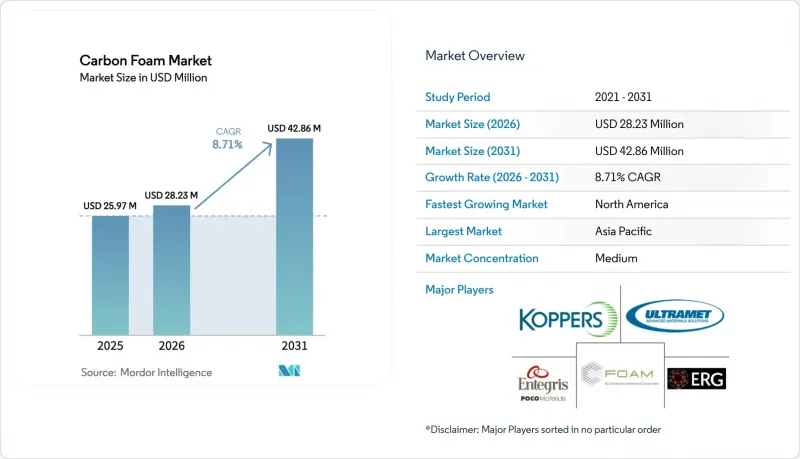
據 Mordor Intelligence 稱,2025 年碳泡沫市場價值為 2,597 萬美元,預計到 2031 年將達到 4,286 萬美元,而 2026 年為 2,823 萬美元,預測期(2026-2031 年)的複合年成長率為 8.71%。
本報告按類型(石墨基和非石墨基)、終端用戶產業(航太與國防、電子電氣、汽車與交通運輸、建築與施工、儲能與燃料電池、工業設備及其他)和地區(亞太地區、北美地區、歐洲地區、南美地區以及中東和非洲地區)進行細分。市場預測以美元計價。
全球碳泡沫市場趨勢及洞察
來自航太和國防領域的需求增加
高超音速飛機面臨高熱通量和高溫等嚴苛條件。值得注意的是,石墨基碳泡沫芯材能夠承受這些挑戰而不會過早燒蝕。 2024年至2025年間,美國空軍和海軍宣布了多項小型企業創新研究(SBIR)項目,旨在研發模組化碳-碳複合材料和碳泡沫結構,以降低一次性再入系統的單位成本。同時,Hexel公司在2024年擁有強勁的累積訂單。這一成長表明,在寬體飛機項目中,採用碳泡沫增強定向傳熱的引擎艙襯裡和機翼除冰系統正得到越來越廣泛的應用。國防和民用航太領域的這種整合不僅確保了多年生產的可視性,也使供應商免受正常飛機研發週期的影響。隨著高超音速測試在2020年代後期蓬勃發展,能夠進一步提高石墨化爐運作溫度的供應商將更有可能獲得未來合約的大量佔有率。
電力電子領域對溫度控管的需求日益成長。
用於電動車的絕緣柵雙極型電晶體 (IGBT) 的可靠性極限約為 150 度C。然而,透過將 IGBT 與相變材料 (PCM) 結合使用,多孔碳散熱器即使在 5C 的放電倍率下也能將結溫維持在遠低於此極限的水平。在 2025 年 6 月進行的測試中,採用覆銅碳泡沫和 PCM 的電池組顯著降低了峰值溫度。與傳統的液冷方法相比,這種配置也降低了系統品質。這種材料改進不僅減輕了重量,還顯著降低了寄生功耗。同時,資料中心營運商也面臨類似的密度挑戰,尤其是在人工智慧 (AI) 加速器中,每個晶片都會散發大量熱量。石墨烯泡沫蒸汽室正是在這種情況下發揮作用,在推理集群的溫度控管策略中扮演著至關重要的角色。鑑於交通運輸和運算領域對緩解熱節流的迫切需求日益成長,電力電子冷卻正在成為碳泡沫市場中最具盈利領域。
生產成本高,能源消耗高
泡棉石墨化需要爐溫遠超極高的閾值,並且需要在惰性氣體環境下長時間運行,這會消耗大量的電力——可堪比原生鋁提煉。 CONSOL 的連續先導工廠透過將氧化和碳化整合到單一製程簡化了操作,但建立工業生產線需要大量的資本投資,這構成了一道壁壘,使得只有資金雄厚的公司才能參與其中。歐洲天然氣和電力價格的上漲擠壓了 SGL Carbon 石墨解決方案部門的EBITDA獲利率,凸顯了能源密集地區永續獲利能力面臨的壓力。只要可再生能源在工業電網中的佔比低於一半,生產商就將難以應對石化燃料價格的波動,從而削弱其在建築和工業爐應用等價格敏感領域的競爭力。
細分市場分析
在碳泡沫市場,預計到2025年,石墨基泡沫將佔銷售額的74.55%,並預計在2031年之前以9.85%的複合年成長率成長。這反映了石墨基泡沫在超音速飛機蒙皮和功率逆變器中定向熱擴散的關鍵作用。儘管碳泡棉市場規模預計到2026年將達到2,823萬美元,但市場仍嚴重偏向石墨化等級,儘管其能耗較高,因為其他材料無法滿足40-180 W/(m·K)的面內導熱係數要求。東麗株式會社決定將其在日本和美國的石墨化碳泡沫產能翻番,這表明高溫產品線仍然是戰略瓶頸,能夠提供最高的利潤率。橡樹嶺國家實驗室的積層製造(AM)示範試驗表明,在火箭噴嘴嵌件中,耐高溫超過3000 度C的石墨基泡沫芯材表現出色,其抗彎強度接近235 MPa,而非石墨基泡沫則容易氧化。另一方面,在建築隔熱材料和爐襯材料領域,5-20 W/(m·K)的導熱係數即可滿足需求,且價格比性能更為重要,因此非石墨泡沫仍扮演重要角色。木質素衍生的泡沫材料已達到1050 度C的耐火溫度,這表明,如果生產商能夠擴大生產規模,生物基非石墨材料有望在建築領域獲得大規模的需求。因此,在降低成本的壓力下,碳泡棉市場可能分裂為高性能石墨層和注重成本的生物基層,兩者將在未來十年內共存。
區域分析
預計到2025年,亞太地區將佔全球銷售額的27.53%,這主要得益於東麗株式會社在韓國的擴張以及曉星集團在多個國家建立的氫氣壓力容器生產基地。此外,中日投資者也在擴大風力發電機和汽車複合材料的產能,進一步鞏固了該地區作為全球客戶生產中心的地位。在日本,政府優先發展高密度儲熱技術的藍圖正在推動國內對碳泡沫工業隔熱材料的需求成長。
預計北美將成為成長最快的地區,到 2031 年複合年成長率將達到 9.24%。美國國防機構正在資助高超音速飛機項目,這些項目需要使用石墨基泡沫材料製造耐高溫 5000°F 的隔熱罩,而民用航太領域的訂單積壓情況將持續到 2020 年代後期。
在歐洲,蓬勃發展的航太產業與嚴格的建築節能標準結合,後者推薦使用無毒、防火的隔熱材料。儘管2024年能源價格波動給Graphite Solutions的利潤率帶來了壓力,但循環經濟計劃刺激了對回收生產線的投資,這些生產線回收碳纖維廢料用於泡沫製造,預計將碳足跡減少高達95%。這些發展,加上歐盟《建築節能指令》(EPBD)的零排放路徑,催生了對高階航太泡沫和低成本建築泡沫的雙重需求,使歐洲成為技術培養箱和監管領域的領導者。
其他好處
- Excel格式的市場預測(ME)表
- 3個月的分析師支持
目錄
第1章:引言
- 研究假設和市場定義
- 調查範圍
第2章:調查方法
第3章執行摘要
第4章 市場狀況
- 市場概覽
- 市場促進因素
- 來自航太和國防領域的需求增加
- 電力電子領域對溫度控管的需求日益成長。
- 環保法規建議使用無毒阻燃的隔熱材料。
- 固態電池中碳泡沫集電器的快速普及
- 生質能衍生碳泡沫原料可降低成本
- 市場限制因素
- 生產成本高,能源消耗高
- 供不應求
- 由於缺乏全球檢驗標準,導致OEM認證延遲。
- 價值鏈分析
- 波特五力模型
第5章 市場規模與成長預測
- 按類型
- 石墨
- 非石墨型
- 按最終用戶行業分類
- 航太/國防
- 電子與電機工程
- 汽車和交通運輸
- 建築/施工
- 儲能和燃料電池
- 工業設備
- 其他
- 按地區
- 亞太地區
- 中國
- 印度
- 日本
- 韓國
- ASEAN
- 其他亞太國家
- 北美洲
- 美國
- 加拿大
- 墨西哥
- 歐洲
- 德國
- 英國
- 法國
- 義大利
- 西班牙
- 北歐國家
- 俄羅斯
- 其他歐洲國家
- 南美洲
- 巴西
- 阿根廷
- 其他南美國家
- 中東和非洲
- 沙烏地阿拉伯
- 南非
- 其他中東和非洲國家
- 亞太地區
第6章 競爭情勢
- 市場集中度
- 策略趨勢
- 市佔率和排名分析
- 公司簡介
- American Elements
- Beijing Jingke Xingye Technology Development Co., Ltd.
- Carbon-Core Corporation
- CONSOL Energy Inc.
- Entegris Inc.
- ERG Aerospace
- Evonik Industries
- Goodfellow Cambridge Ltd.
- Graphite India Limited
- Hexcel Corporation
- Koppers Inc.
- SGL Carbon
- TORAY CARBON MAGIC CO., LTD
- Touchstone Advanced Composites
- Ultramet
- Xiamen Zopin New Material Limited
第7章 市場機會與未來展望
According to Mordor Intelligence, the carbon foam market size was valued at USD 25.97 million in 2025 and is estimated to grow from USD 28.23 million in 2026 to reach USD 42.86 million by 2031, at a CAGR of 8.71% during the forecast period (2026-2031).
This report is Segmented by Type (Graphitic and Non-Graphitic), End-User Industry (Aerospace and Defence, Electronics and Electrical, Automotive and Transportation, Building and Construction, Energy Storage and Fuel Cells, Industrial Equipment, and Other End-Users), and Geography (Asia-Pacific, North America, Europe, South America, and Middle East and Africa). Market Forecasts are Provided in Terms of Value (USD).
Global Carbon Foam Market Trends and Insights
Increasing Demand from Aerospace and Defence
Hypersonic vehicles endure extreme conditions, facing high heat fluxes and temperatures. Remarkably, graphitic carbon-foam cores withstand these challenges without premature ablation. In 2024-2025, the U.S. Air Force and Navy unveiled several SBIR topics, targeting modular carbon-carbon and carbon-foam structures. Their goal: to reduce unit costs for expendable re-entry systems. Meanwhile, in 2024, Hexcel boasted a robust backlog. This surge indicates that wide-body programs are increasingly opting for nacelle liners and wing de-icing hardware, both integrating carbon foam for enhanced directional heat transfer. This convergence of defense and commercial aerospace not only ensures multi-year volume visibility but also shields suppliers from the typical airframe cycles. As hypersonic testing gains momentum heading into the late-2020s, suppliers who can elevate their graphitization furnaces to higher temperatures stand poised to secure a significant share of emerging contracts.
Expanding Thermal-Management Needs of Power Electronics
Insulated-gate bipolar transistors in electric vehicles have reliability thresholds hovering around 150 °C. However, when combined with phase-change materials, porous carbon heat-spreaders ensure junction temperatures remain well below this limit, even at 5C discharge rates. In trials conducted in June 2025, battery packs utilizing copper-coated carbon foam and PCM achieved a notable reduction in peak temperatures. This setup also managed to reduce the system's mass compared to traditional liquid cooling methods. Such a material switch not only lightens the load but also significantly cuts parasitic power draw. Meanwhile, data-center operators grapple with similar density challenges, especially as artificial-intelligence accelerators push out substantial heat per chip. Enter graphene-foam vapor chambers, now essential players in the thermal management strategies for inference clusters. Given the pressing need to mitigate thermal throttling in both transportation and computing realms, power-electronics cooling has emerged as the most lucrative segment for the carbon foam market.
High Production Cost and Energy Intensity
Graphitizing foam demands furnace temperatures exceeding high thresholds and inert atmospheres for extended durations, consuming significant power-a draw on par with primary aluminum smelting. While CONSOL's continuous pilot streamlines operations by merging oxidation and carbonization into a single pass, establishing an industrial line comes with substantial capital expenditure, a barrier that confines entry to well-capitalized firms. Rising gas and electricity prices in Europe squeezed SGL Carbon's Graphite Solutions EBITDA margin, highlighting persistent margin pressures in energy-intensive locales. As long as renewable energy constitutes less than half of industrial grids, producers will grapple with fossil-fuel price volatility, hindering their competitiveness in price-sensitive sectors like construction and industrial furnace applications.
Other drivers and restraints analyzed in the detailed report include:
- Environmental Regulations Favouring Non-Toxic, Fire-Resistant Insulation
- Rapid Adoption of Carbon-Foam Current Collectors in Solid-State Batteries
- Limited Supply of High-Quality Mesophase Pitch
For complete list of drivers and restraints, kindly check the Table Of Contents.
Segment Analysis
Graphitic foam accounted for 74.55% of 2025 revenue in the carbon foam market and is forecast to grow at a 9.85% CAGR to 2031, reflecting its indispensability for directional heat spreading in hypersonic skins and power inverters. At USD 28.23 million, the 2026 carbon foam market size skews heavily toward graphitized grades despite their higher energy footprint because alternative materials cannot meet 40-180 W/m*K in-plane conductivity requirements. Toray's decision to double graphitization capacity in Japan and the United States proves that high-temperature lines remain the strategic bottleneck that commands the best margins. Oak Ridge National Laboratory's additive manufacturing trials reached flexural strengths near 235 MPa, validating graphitic foam cores above 3,000 °C for rocket-nozzle inserts where non-graphitic foams oxidize. At the same time, non-graphitic foams maintain relevance in building insulation and furnace linings where 5-20 W/m*K conductivity suffices and price beats performance. Lignin-derived foams reaching 1,050 °C fire resistance signal that bio-based non-graphitic options could unlock large-volume construction demand once producers scale beyond pilot lots. Cost-down pressures, therefore, split the carbon foam market into a high-performance, graphitized tier and a cost-sensitive, bio-based tier that will coexist through the decade.
Complete Report Scope:
- By Type
- Graphitic
- Non-graphitic
- By End-user Industry
- Aerospace and Defence
- Electronics and Electrical
- Automotive and Transportation
- Building and Construction
- Energy Storage and Fuel Cells
- Industrial Equipment
- Other End-users
- By Geography
- Asia-Pacific
- China
- India
- Japan
- South Korea
- ASEAN Countries
- Rest of Asia-Pacific
- North America
- United States
- Canada
- Mexico
- Europe
- Germany
- United Kingdom
- France
- Italy
- Spain
- NORDIC Countries
- Russia
- Rest of Europe
- South America
- Brazil
- Argentina
- Rest of South America
- Middle East and Africa
- Saudi Arabia
- South Africa
- Rest of Middle East and Africa
- Asia-Pacific
Geography Analysis
Asia-Pacific delivered 27.53% of 2025 revenue, underpinned by Toray's South Korean expansion and Hyosung's multi-country build-out aimed at hydrogen pressure vessels. Chinese and Japanese investors also advanced capacity for wind-turbine and automotive composites, reinforcing the region's role as the production hub for global customers. Government roadmaps in Japan that prioritize high-density heat storage further elevate domestic demand for industrial thermal barriers made from carbon foam.
North America will be the fastest-growing region at a 9.24% CAGR through 2031. U.S. defense agencies fund hypersonic vehicle programs that insist on graphitic foams for 5,000 °F heat shields, while commercial aerospace backlogs stretch to the decade's end.
Europe blends strong aerospace activity with stringent building-energy codes that favor non-toxic, fire-safe insulation. Energy-price volatility compressed graphite-solutions margins in 2024, yet circular-economy policies catalyzed investment in recycling lines that recover carbon-fiber scrap for foam production at up to 95% lower carbon footprint. These moves, coupled with the EPBD's zero-emission trajectory, create a dual pull for high-end aerospace foams and low-cost building foams, positioning Europe as both a technology incubator and a regulatory driver.
- American Elements
- Beijing Jingke Xingye Technology Development Co., Ltd.
- Carbon-Core Corporation
- CONSOL Energy Inc.
- Entegris Inc.
- ERG Aerospace
- Evonik Industries
- Goodfellow Cambridge Ltd.
- Graphite India Limited
- Hexcel Corporation
- Koppers Inc.
- SGL Carbon
- TORAY CARBON MAGIC CO., LTD
- Touchstone Advanced Composites
- Ultramet
- Xiamen Zopin New Material Limited
Additional Benefits:
- The market estimate (ME) sheet in Excel format
- 3 months of analyst support
TABLE OF CONTENTS
1 Introduction
- 1.1 Study Assumptions and Market Definition
- 1.2 Scope of the Study
2 Research Methodology
3 Executive Summary
4 Market Landscape
- 4.1 Market Overview
- 4.2 Market Drivers
- 4.2.1 Increasing demand from aerospace and defence
- 4.2.2 Expanding thermal-management needs of power electronics
- 4.2.3 Environmental regulations favouring non-toxic, fire-resistant insulation
- 4.2.4 Rapid adoption of carbon-foam current collectors in solid-state batteries
- 4.2.5 Biomass-derived carbon-foam feedstocks enabling cost reduction
- 4.3 Market Restraints
- 4.3.1 High production cost and energy intensity
- 4.3.2 Limited supply of high-quality mesophase pitch
- 4.3.3 Lack of global test standards delaying OEM qualification
- 4.4 Value Chain Analysis
- 4.5 Porter's Five Forces
- 4.5.1 Bargaining Power of Suppliers
- 4.5.2 Bargaining Power of Buyers
- 4.5.3 Threat of New Entrants
- 4.5.4 Threat of Substitutes
- 4.5.5 Degree of Competition
5 Market Size and Growth Forecasts (Value)
- 5.1 By Type
- 5.1.1 Graphitic
- 5.1.2 Non-graphitic
- 5.2 By End-user Industry
- 5.2.1 Aerospace and Defence
- 5.2.2 Electronics and Electrical
- 5.2.3 Automotive and Transportation
- 5.2.4 Building and Construction
- 5.2.5 Energy Storage and Fuel Cells
- 5.2.6 Industrial Equipment
- 5.2.7 Other End-users
- 5.3 By Geography
- 5.3.1 Asia-Pacific
- 5.3.1.1 China
- 5.3.1.2 India
- 5.3.1.3 Japan
- 5.3.1.4 South Korea
- 5.3.1.5 ASEAN Countries
- 5.3.1.6 Rest of Asia-Pacific
- 5.3.2 North America
- 5.3.2.1 United States
- 5.3.2.2 Canada
- 5.3.2.3 Mexico
- 5.3.3 Europe
- 5.3.3.1 Germany
- 5.3.3.2 United Kingdom
- 5.3.3.3 France
- 5.3.3.4 Italy
- 5.3.3.5 Spain
- 5.3.3.6 NORDIC Countries
- 5.3.3.7 Russia
- 5.3.3.8 Rest of Europe
- 5.3.4 South America
- 5.3.4.1 Brazil
- 5.3.4.2 Argentina
- 5.3.4.3 Rest of South America
- 5.3.5 Middle East and Africa
- 5.3.5.1 Saudi Arabia
- 5.3.5.2 South Africa
- 5.3.5.3 Rest of Middle East and Africa
- 5.3.1 Asia-Pacific
6 Competitive Landscape
- 6.1 Market Concentration
- 6.2 Strategic Moves
- 6.3 Market Share/Ranking Analysis
- 6.4 Company Profiles (includes Global-level Overview, Market-level Overview, Core Segments, Financials as available, Strategic Information, Market Rank/Share, Products and Services, Recent Developments)
- 6.4.1 American Elements
- 6.4.2 Beijing Jingke Xingye Technology Development Co., Ltd.
- 6.4.3 Carbon-Core Corporation
- 6.4.4 CONSOL Energy Inc.
- 6.4.5 Entegris Inc.
- 6.4.6 ERG Aerospace
- 6.4.7 Evonik Industries
- 6.4.8 Goodfellow Cambridge Ltd.
- 6.4.9 Graphite India Limited
- 6.4.10 Hexcel Corporation
- 6.4.11 Koppers Inc.
- 6.4.12 SGL Carbon
- 6.4.13 TORAY CARBON MAGIC CO., LTD
- 6.4.14 Touchstone Advanced Composites
- 6.4.15 Ultramet
- 6.4.16 Xiamen Zopin New Material Limited
7 Market Opportunities and Future Outlook
- 7.1 White-space and Unmet-need Assessment

 噴塗泡沫市場機會、成長要素、產業趨勢分析及2026-2035年預測。
 2026-2034年全球工程成型市場規模、佔有率、趨勢和成長分析報告
 噴塗發泡設備市場報告:趨勢、預測與競爭分析(至2035年)
 工程化產品:市場佔有率分析、產業趨勢與統計、成長預測(2026-2031)
 工業發泡材市場-2026-2032年全球市場預測消費性發泡體市場-2026-2032年全球市場預測
 2034年碳泡沫材料市場預測-按材料類型、密度、性能、應用、產業和地區分類的全球分析
 家具發泡材市場:依發泡材類型、應用、密度等級及地區分類。碳泡棉市場:2026-2032年全球市場預測(依應用、最終用戶、產品形式、原料及製造流程分類)全球三聚氰胺泡沫市場規模、佔有率、趨勢和成長分析報告(2026-2034年)