


 |
市場調查報告書
商品編碼
2114733
工程化產品:市場佔有率分析、產業趨勢與統計、成長預測(2026-2031)Engineered Foam - Market Share Analysis, Industry Trends & Statistics, Growth Forecasts (2026 - 2031) |
||||||

※ 本網頁內容可能與最新版本有所差異。詳細情況請與我們聯繫。
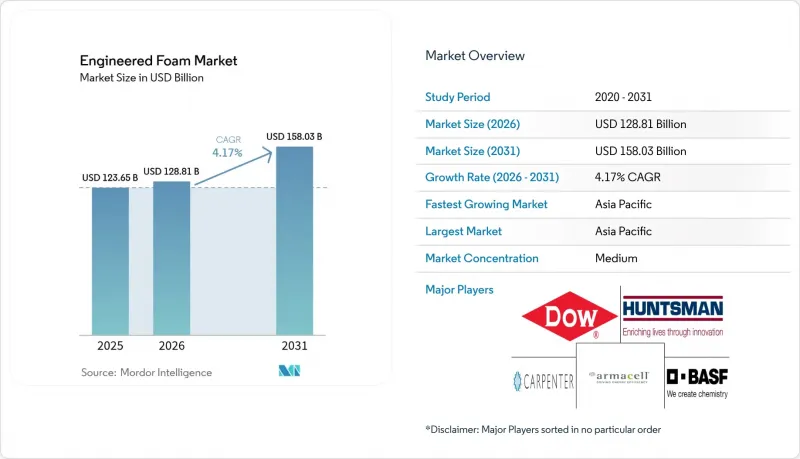
據 Mordor Intelligence 稱,工程泡沫市場預計到 2026 年價值將達到 1,288.1 億美元,高於 2025 年的 1,236.5 億美元,預計到 2031 年將達到 1,580.3 億美元。
預計從 2026 年到 2031 年,其複合年成長率將達到 4.17%。
本報告按聚合物類型(聚氨酯、聚烯等)、發泡體類型(軟泡沫、硬泡沫等)、功能(隔熱、隔音/隔振等)、終端用戶行業(建築、包裝等)和地區(亞太地區、北美地區等)進行細分。市場預測以美元計價。
全球工程泡沫市場趨勢與洞察
汽車產業對輕量化和節能材料的需求激增。
汽車製造商致力於減輕車身重量,以確保電動車的續航里程並滿足車隊平均二氧化碳排放量的相關法規要求。亨斯邁公司的SHOKLESS™等聚氨酯系統提供多種密度選擇,既能減輕車身重量,也能確保電池模組的安全。生命週期分析表明,與金屬相比,天然纖維複合材料能夠降低能源需求,這使得泡沫和複合材料結合的混合結構越來越受歡迎。墨西哥的聚氨酯產量增加了13%,使其成為全球第四大聚氨酯市場,凸顯了近岸外包策略帶來的區域性成長。隨著電動車滑板式平台的日益普及,兼具結構支撐、溫度控管和NVH(噪音、振動和聲振粗糙度)阻尼功能的泡沫材料在工程泡沫市場正從可選部件轉變為必備部件。
嚴格的建築節能標準推動了對工程保溫泡沫的需求。
2021 年版《美國住宅能源規範》(IECC) 強制要求 4 區和 5 區氣候區的房屋外牆必須採用連續保溫,規定每英吋閉孔聚氨酯泡沫塗料的保溫性能需達到 R-7。這項聯邦法規的實施使新建住宅的能源效率比 2009 年的標準提高了 34.4%,儘管增加了 7,229 美元的額外建造成本。亨斯邁公司估計,為美國現有住宅存量每年可節省 6,480 億度電的電力,相當於減少 3,890 萬輛汽車的排放量。旨在獲得 LEED 認證積分的商業建築商正在指定使用全球暖化潛勢 (GWP) 超過 10 的硬質保溫板,加速了 HFC-141b 的淘汰。因此,建築規範的壓力正推動工程泡沫隔熱材料材料市場對高性能泡沫的需求大幅成長。
異氰酸酯和多元醇的價格波動
2024年,MDI現貨指數出現兩位數波動,推高了聚氨酯樹脂價格,儘管汽車需求下降了25%。BASF收購Alsachimie PA 6.6合資企業,確保了己二酸和HMD的供應,這清楚地表明了後向整合如何對沖成本風險。中型加工商依賴與多家供應商的契約,但價格滯後持續擠壓著整個工程泡沫市場的利潤率。
細分市場分析
2025年,聚氨酯仍將以41.25%的市佔率佔據工程泡沫市場最大佔有率。這主要得益於封閉式體系,該體系在低溫運輸和屋頂建築領域佔據主導地位,每英吋厚度即可達到R-7的隔熱性能。然而,生物基製造製程、非異氰酸酯化學品以及二氧化碳改性主鏈正推動「其他聚合物類型」細分市場以5.06%的複合年成長率成長。BASF在路德維希港擴大EPS(聚苯乙烯泡沫)生產規模,旨在開拓家電和包裝等細分市場;而科思創開發的二氧化碳封裝率達20%的硬質發泡體原型產品,其性能已與現有石油基產品相媲美。
第二代聚烯具有更佳的可回收性,並為電商配送公司提供了一種低密度材料選擇,符合其對循環經濟的承諾。特種矽酮因其固有的阻燃性、低煙排放和低毒性,正逐步滲透到鐵路車輛內裝市場。儘管隨著原料多樣化的推進,聚氨酯的銷售主導地位可能會略有下降,但其無與倫比的隔熱性能和成熟的供應鏈將確保其在2030年仍能繼續保持核心地位,支撐工程泡棉市場的規模。
預計到2025年,軟質泡棉將佔銷售額的52.30%,主要應用領域包括寢具、家具和座椅。硬質板材將繼續滿足食品零售商冷藏陳列架的需求,而彈性體泡棉將滿足暖通空調(HVAC)密封墊的需求。同時,噴塗泡沫在工程泡沫市場中的佔有率逐年擴大,預計將以5.03%的複合年成長率成為同類產品中成長最快的,因為它們只需一次噴塗即可滿足建築的氣密性和隔熱性標準。亨斯邁建築解決方案公司的Icynene系列產品每英吋的R值可達7.4,並以低壓套件的形式面向裝修承包商銷售。
目前,新產品主要採用高泡沫注入(HFO)發泡,而屋頂工人則使用高揚程閉孔泡沫來縮短工期。隨著保險公司收緊有關能源損失的條款,到2030年,噴塗泡沫在北美牆體和屋頂隔熱市場的滲透率可能超過20%,預計將進一步擴大工程泡沫市場。
區域分析
亞太地區44.30%的市佔率和4.90%的複合年成長率反映了其涵蓋土木工程、汽車組裝和家用電子電器等領域的廣泛產業生態系統。位於中國湛江的可再生能源驅動型TPU綜合體,凸顯了該地區對本地價值鏈的承諾。日本正在為高階電動車開發NVH泡沫材料,而印度的建築熱潮正在推動新建都市區住宅對硬質板材和噴塗系統的需求。韓國為儲存晶片封裝提供先進樹脂,而東南亞國協的工廠則透過提供具有成本競爭力的加工服務來擴大市場佔有率。這些趨勢共同推動了該地區工程泡沫市場最強勁的成長。
在北美,嚴格的建築規範和便捷的資金籌措管道使該公司在低全球暖化潛勢(GWP)噴塗泡沫的生產能力方面佔據主導地位。亨斯邁的Icynene系列產品以及在全部區域的承包商培訓,進一步提高了開孔泡棉產品在閣樓維修工程的滲透率。墨西哥的近岸外包浪潮推動了汽車用聚氨酯的使用,而加拿大的寒冷氣候也支撐了對隔熱材料的需求。儘管仍有成長空間,但原物料價格的波動仍然是該地區泡沫市場相關人員面臨的成本不確定性因素。
歐洲在永續性扮演先鋒角色,將二氧化碳衍生多元醇和生物來源循環特性納入主流應用。科思創的原型硬質發泡體含有20%的回收二氧化碳,樹立了新的生命週期標竿。北歐國家的住宅獎勵策略推動了對高性能(高R值)結構保溫板的需求,而德國的汽車零件體係正在試驗使用阻燃輕質芯材製造電動車電池托盤。有關氟碳化合物(F-gas)和揮發性有機化合物(VOCs)限量的法規細化,有助於制定長期投資計劃,並鞏固歐洲工程泡沫市場的策略。
其他好處:
- Excel格式的市場預測(ME)表
- 3個月的分析師支持
目錄
第1章:引言
- 研究假設和市場定義
- 調查範圍
第2章:調查方法
第3章執行摘要
第4章 市場狀況
- 市場概覽
- 市場促進因素
- 汽車產業對輕量化和節能材料的需求激增。
- 嚴格的建築節能標準推動了對工程保溫泡沫的需求。
- 電子商務的擴張正在推動對防護發泡包裝的需求。
- 電動車座艙內聲波超材料泡棉的快速普及
- 氫能基礎設施對低溫泡沫作為隔熱材料的需求日益成長。
- 市場限制因素
- 異氰酸酯和多元醇的價格波動
- 加強對揮發性有機化合物發泡的監管
- 經認證的生物基多元醇原料短缺
- 價值鏈分析
- 波特五力模型
第5章 市場規模與成長預測
- 按聚合物類型
- 聚氨酯
- 聚烯
- 聚苯乙烯
- 其他聚合物類型(聚氯乙烯、矽酮等)
- 依表單類型
- 靈活的
- 死板的
- 噴
- 其他泡沫類型(例如,彈性體)
- 按功能
- 隔熱材料
- 聲學和振動控制
- 能量吸收和緩衝
- 浮力和漂浮
- 結構核心和減重
- 按最終用戶行業分類
- 建築/施工
- 包裝
- 家具和室內設計
- 汽車和運輸業
- 終端用戶產業(航太與國防、能源等)
- 按地區
- 亞太地區
- 中國
- 日本
- 印度
- 韓國
- 東南亞國協
- 其他亞太國家
- 北美洲
- 美國
- 加拿大
- 墨西哥
- 歐洲
- 德國
- 英國
- 法國
- 義大利
- 西班牙
- 俄羅斯
- 北歐國家
- 其他歐洲國家
- 南美洲
- 巴西
- 阿根廷
- 其他南美國家
- 中東和非洲
- 沙烏地阿拉伯
- 南非
- 其他中東和非洲國家
- 亞太地區
第6章 競爭情勢
- 市場集中度
- 策略趨勢
- 市佔率和排名分析
- 公司簡介
- BASF SE
- Armacell International SA
- Carpenter Co.
- Covestro AG
- Dow Inc.
- Evonik Industries AG
- Huntsman Corporation
- Kaneka Corporation
- Rogers Foam Corporation
- SABIC
- Sealed Air
- Trelleborg
- Woodbridge
- Zotefoams plc
第7章 市場機會與未來展望
According to Mordor Intelligence, engineered foam market size market size in 2026 is estimated at USD 128.81 billion, growing from 2025 value of USD 123.65 billion with 2031 projections showing USD 158.03 billion, growing at 4.17% CAGR over 2026-2031.
This report is Segmented by Polymer Type (Polyurethane, Polyolefins, and More), Foam Type (Flexible, Rigid, and More), Function (Thermal Insulation, Acoustic and Vibration Control, and More), End-User Industry (Building and Construction, Packaging, and More), and Geography (Asia-Pacific, North America, and More). The Market Forecasts are Provided in Terms of Value (USD).
Global Engineered Foam Market Trends and Insights
Surging demand for lightweight, fuel-efficient materials in automotive
Automakers target weight savings to shore up EV driving range and meet fleet-average CO2 limits. Polyurethane systems such as Huntsman's SHOKLESS(TM) provide density windows that secure battery modules while cutting mass Life-cycle analyses show natural-fiber composites cut energy demand versus metals, reinforcing the appeal of hybrid foam-composite architectures. Mexico's 13% output surge and its rise to fourth-largest polyurethane market underline the regional pull created by near-shoring strategies. As EV skateboard platforms proliferate, foams that fuse structural support, thermal management, and NVH damping shift from optional to critical components in the engineered foam market.
Stringent building energy codes driving demand for engineered insulation foams
The 2021 IECC mandates exterior continuous insulation in climate zones 4 and 5, cementing closed-cell spray polyurethane foam's R-7 per inch profile. Federal adoption lifts new-home efficiency by 34.4% compared with 2009 baselines, even after a USD 7 229 incremental build cost. Huntsman estimates that insulating the existing US housing stock could save 648 billion kWh a year-power equivalent to taking 38.9 million cars off the road. Commercial builders seeking LEED points specify rigid panels blown with greater than 10 GWP agents, accelerating the conversion away from HFC-141b. Consequently, code pressure channels the bulk of insulation volume toward higher-performance foams in the engineered foam market.
Volatility in isocyanate and polyol prices
MDI spot indices swung double-digit in 2024, lifting polyurethane resin quotes even as automotive demand dipped 25% BASF's buy-out of the Alsachimie PA 6.6 joint venture secures adipic-acid and HMD streams, illustrating how backward integration hedges cost risk. Mid-tier converters rely on multi-source contracts, yet price lags still compress margins across the engineered foam market.
Other drivers and restraints analyzed in the detailed report include:
- Expanding e-commerce boosting protective foam packaging
- Rapid adoption of acoustic metamaterial foams in EV cabins
- Tightening VOC blowing-agent regulations
For complete list of drivers and restraints, kindly check the Table Of Contents.
Segment Analysis
Polyurethane retained the largest engineered foam market share at 41.25% in 2025, rooted in closed-cell systems that deliver R-7 per inch and dominate cold-chain and roofing builds. Nonetheless, bio-based routes, non-isocyanate chemistries, and CO2-modified backbones fuel a 5.06% CAGR for the Other Polymer Types segment. BASF's Ludwigshafen EPS expansion targets appliance and packaging niches, while Covestro's prototype rigid foam with 20% captured CO2 hits spec parity with petro-based incumbents.
Second-generation polyolefins improve recyclability, giving e-commerce shippers a low-density option that meets circular pledges. Specialty silicones penetrate rolling-stock interiors thanks to intrinsic flame-smoke-toxicity compliance. As feedstock diversification deepens, polyurethane's revenue dominance will narrow slightly, yet it will still anchor engineered foam market size in 2030 because of unmatched insulation efficiency and mature supply chains.
Flexible foams accounted for 52.30% revenue in 2025, buoyed by bedding, furniture, and seat applications. Rigid boards preserved food-retail cold lanes, and elastomeric foams served HVAC gasket needs. Spray foams, however, are slated for a 5.03% CAGR-fastest in class-because they meet air-sealing and insulation codes in one pass, raising their engineered foam market size share year-over-year. Huntsman Building Solutions' Icynene Series reaches 7.4 per-inch R-value and rolls out in low-pressure kits for remodelers.
HFO-blown chemistry now dominates new launches, while roofing contractors exploit high-lift closed-cell variants to curb labor hours. As insurers tighten energy-loss clauses, spray foam penetration could top 20% of North American wall-and-roof insulation by 2030, further enlarging the engineered foam market.
Complete Report Scope:
- By Polymer Type
- Polyurethane
- Polyolefins
- Polystyrene
- Other Polymer Types (Polyvinyl Chloride, Silicone, etc.)
- By Foam Type
- Flexible
- Rigid
- Spray
- Other Foam Types (Elastomeric, etc.)
- By Function
- Thermal Insulation
- Acoustic and Vibration Control
- Energy Absorption and Cushioning
- Buoyancy and Floatation
- Structural Core and Lightweighting
- By End-user Industry
- Building and Construction
- Packaging
- Furniture and Interiors
- Automotive and Transportation
- End-user Industries (Aerospace and Defense, Energy, etc.)
- By Geography
- Asia-Pacific
- China
- Japan
- India
- South Korea
- ASEAN Countries
- Rest of Asia-Pacific
- North America
- United States
- Canada
- Mexico
- Europe
- Germany
- United Kingdom
- France
- Italy
- Spain
- Russia
- NORDIC Countries
- Rest of Europe
- South America
- Brazil
- Argentina
- Rest of South America
- Middle-East and Africa
- Saudi Arabia
- South Africa
- Rest of Middle-East and Africa
- Asia-Pacific
Geography Analysis
Asia-Pacific's 44.30% share and 4.90% CAGR reflect a full-spectrum industrial ecosystem that spans civil construction, auto assembly, and consumer electronics. China's renewable-powered TPU complex in Zhanjiang underscores commitment to local value chains. Japan refines NVH foams for premium EVs, and India's construction boom absorbs rigid boards and spray systems in new urban housing. South Korea contributes advanced resins for memory-chip packaging, whereas ASEAN factories gain share by offering cost-competitive conversion. Together these dynamics sustain the engineered foam market's highest regional momentum.
North America combines strict building codes with capital access, supporting leadership in low-GWP spray-foam capacity. Huntsman's Icynene Series and regionwide installer training push open-cell products deeper into retrofit attic jobs. Mexico's near-shoring wave powers automotive PU usage, and Canada's cold climate bolsters insulation demand. Upside persists, yet feedstock volatility remains a cost wild card for engineered foam market players across the region.
Europe plays sustainability spearhead, mainstreaming CO2-based polyols and bio-circular attributions. Covestro's rigid-foam prototypes with 20% captured CO2 set new life-cycle benchmarks. Nordic housing stimuli amplify demand for high-R SIP panels, whereas Germany's automotive tier system pilots flame-retardant lightweight cores for EV battery trays. Regulatory certainty around F-gas and VOC ceilings helps long-term investment planning, anchoring the engineered foam market's European strategy.
- BASF SE
- Armacell International SA
- Carpenter Co.
- Covestro AG
- Dow Inc.
- Evonik Industries AG
- Huntsman Corporation
- Kaneka Corporation
- Rogers Foam Corporation
- SABIC
- Sealed Air
- Trelleborg
- Woodbridge
- Zotefoams plc
Additional Benefits:
- The market estimate (ME) sheet in Excel format
- 3 months of analyst support
TABLE OF CONTENTS
1 Introduction
- 1.1 Study Assumptions and Market Definition
- 1.2 Scope of the Study
2 Research Methodology
3 Executive Summary
4 Market Landscape
- 4.1 Market Overview
- 4.2 Market Drivers
- 4.2.1 Surging Demand for Lightweight, Fuel-Efficient Materials in Automotive
- 4.2.2 Stringent Building Energy Codes Driving Demand for Engineered Insulation Foams
- 4.2.3 Expanding E-Commerce Boosting Protective Foam Packaging
- 4.2.4 Rapid Adoption of Acoustic Metamaterial Foams in EV Cabins
- 4.2.5 Growing Demand for Cryogenic-Capable Foams for Hydrogen Infrastructure Insulation
- 4.3 Market Restraints
- 4.3.1 Volatility in Isocyanate and Polyol Prices
- 4.3.2 Tightening VOC Blowing-Agent Regulations
- 4.3.3 Scarcity of Certified Bio-Based Polyol Feedstock
- 4.4 Value Chain Analysis
- 4.5 Porter's Five Forces
- 4.5.1 Bargaining Power of Suppliers
- 4.5.2 Bargaining Power of Buyers
- 4.5.3 Threat of New Entrants
- 4.5.4 Threat of Substitutes
- 4.5.5 Competitive Rivalry
5 Market Size and Growth Forecasts (Value)
- 5.1 By Polymer Type
- 5.1.1 Polyurethane
- 5.1.2 Polyolefins
- 5.1.3 Polystyrene
- 5.1.4 Other Polymer Types (Polyvinyl Chloride, Silicone, etc.)
- 5.2 By Foam Type
- 5.2.1 Flexible
- 5.2.2 Rigid
- 5.2.3 Spray
- 5.2.4 Other Foam Types (Elastomeric, etc.)
- 5.3 By Function
- 5.3.1 Thermal Insulation
- 5.3.2 Acoustic and Vibration Control
- 5.3.3 Energy Absorption and Cushioning
- 5.3.4 Buoyancy and Floatation
- 5.3.5 Structural Core and Lightweighting
- 5.4 By End-user Industry
- 5.4.1 Building and Construction
- 5.4.2 Packaging
- 5.4.3 Furniture and Interiors
- 5.4.4 Automotive and Transportation
- 5.4.5 End-user Industries (Aerospace and Defense, Energy, etc.)
- 5.5 By Geography
- 5.5.1 Asia-Pacific
- 5.5.1.1 China
- 5.5.1.2 Japan
- 5.5.1.3 India
- 5.5.1.4 South Korea
- 5.5.1.5 ASEAN Countries
- 5.5.1.6 Rest of Asia-Pacific
- 5.5.2 North America
- 5.5.2.1 United States
- 5.5.2.2 Canada
- 5.5.2.3 Mexico
- 5.5.3 Europe
- 5.5.3.1 Germany
- 5.5.3.2 United Kingdom
- 5.5.3.3 France
- 5.5.3.4 Italy
- 5.5.3.5 Spain
- 5.5.3.6 Russia
- 5.5.3.7 NORDIC Countries
- 5.5.3.8 Rest of Europe
- 5.5.4 South America
- 5.5.4.1 Brazil
- 5.5.4.2 Argentina
- 5.5.4.3 Rest of South America
- 5.5.5 Middle-East and Africa
- 5.5.5.1 Saudi Arabia
- 5.5.5.2 South Africa
- 5.5.5.3 Rest of Middle-East and Africa
- 5.5.1 Asia-Pacific
6 Competitive Landscape
- 6.1 Market Concentration
- 6.2 Strategic Moves
- 6.3 Market Share(%)/Ranking Analysis
- 6.4 Company Profiles {(includes Global level Overview, Market level overview, Core Segments, Financials as available, Strategic Information, Market Rank/Share for key companies, Products and Services, and Recent Developments)}
- 6.4.1 BASF SE
- 6.4.2 Armacell International SA
- 6.4.3 Carpenter Co.
- 6.4.4 Covestro AG
- 6.4.5 Dow Inc.
- 6.4.6 Evonik Industries AG
- 6.4.7 Huntsman Corporation
- 6.4.8 Kaneka Corporation
- 6.4.9 Rogers Foam Corporation
- 6.4.10 SABIC
- 6.4.11 Sealed Air
- 6.4.12 Trelleborg
- 6.4.13 Woodbridge
- 6.4.14 Zotefoams plc
7 Market Opportunities and Future Outlook
- 7.1 White-space and Unmet-Need Assessment

 噴塗泡沫市場機會、成長要素、產業趨勢分析及2026-2035年預測。
 2026-2034年全球工程成型市場規模、佔有率、趨勢和成長分析報告
 碳泡沫:市場佔有率分析、產業趨勢與統計、成長預測(2026-2031)
 噴塗發泡設備市場報告:趨勢、預測與競爭分析(至2035年)
 工業發泡材市場-2026-2032年全球市場預測消費性發泡體市場-2026-2032年全球市場預測
 2034年碳泡沫材料市場預測-按材料類型、密度、性能、應用、產業和地區分類的全球分析
 家具發泡材市場:依發泡材類型、應用、密度等級及地區分類。碳泡棉市場:2026-2032年全球市場預測(依應用、最終用戶、產品形式、原料及製造流程分類)全球三聚氰胺泡沫市場規模、佔有率、趨勢和成長分析報告(2026-2034年)