


 |
市場調查報告書
商品編碼
2154911
南美建築外觀:市場佔有率分析、產業趨勢與統計、成長預測(2026-2031 年)South America Facade - Market Share Analysis, Industry Trends & Statistics, Growth Forecasts (2026 - 2031) |
||||||

※ 本網頁內容可能與最新版本有所差異。詳細情況請與我們聯繫。
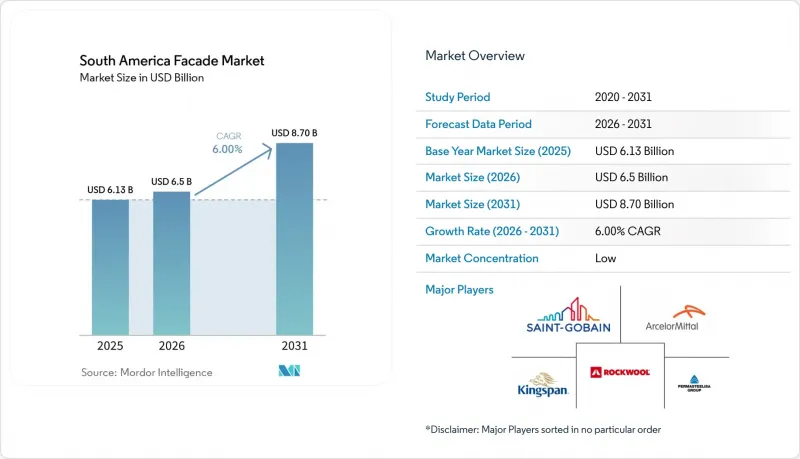
據 Mordor Intelligence 稱,2025 年南美外牆市場價值為 61.3 億美元,預計到 2031 年將達到 87 億美元,而 2026 年為 65 億美元,預測期(2026-2031 年)的複合年成長率為 6%。
南美洲外牆市場趨勢與洞察
商業和基礎設施建設的復甦正在推動對建築外觀的需求。
在巴西,2025年4月至2026年4月期間完工的住宅達到43.8萬套,帶動了對型材、建築玻璃、門窗和帷幕牆系統的需求。該國的建設活動還包括公共和商業項目,這些項目需要種類繁多的外牆建築材料。在智利,預計2026年建築總投資將成長4.8%,部分原因是採礦和能源基礎建設。這些設施通常需要高度耐用的外牆,以承受風吹雨打和運作條件的影響。因此,南美洲幕牆市場不僅對辦公大樓有需求,對物流設施、資料中心和能源相關設施也有需求。當施工速度、隔熱性和耐久性比視覺透明度更重要時,金屬和保溫板系統可能更為合適。
日益成長的節能建築需求正在推動高性能外牆的採用。
在巴西,新建建築的最低能源效率標準將於2025年9月頒布,並自2027年起分階段實施。聯邦公共建築必須在2027年前達到「國家能源效率標籤」A級標準,而新建私人商業建築則必須從2030年起至少達到C級標準。外觀設計透過其對太陽輻射熱增益、隔熱、氣密性、玻璃和通風層的性能影響這些結果。該標準提高了高性能玻璃、隔熱鋁框架和通風覆層在商業和公共建築項目中的重要性。在南美洲外觀市場,規範變更可能會提前發生,因為開發商可能會試圖在強制實施日期之前獲得能源效率認證。這將使能夠提供經過測試的系統和清晰性能文件的供應商獲得優勢。
鋁、鋼、玻璃和樹脂的價格波動推高了成本。
鋁、鋼、玻璃和樹脂的成本在帷幕牆系統的原料中佔很大比例,因此對專案預算影響顯著。價格波動會使設計和施工週期長的專案難以維持利潤率。承包商可能會透過採用替代面板或調整採購計劃來應對。高階幕牆和模組化系統仍然面臨風險,因為性能要求限制了材料的替換。在南美帷幕牆市場,如果開發商對設定價格上漲條款缺乏信心,採購決策可能會被推遲。能夠提供多種供應方案和透明定價機制的供應商可以為客戶降低這種風險。
細分市場分析
到2025年,通風帷幕牆將佔區域銷售額的52%,成為最大的細分市場。其空氣層將覆層與覆材隔開,從而實現溫度控管、水分釋放和通風。這些特性使該系統適用於商業高層建築、公共設施和高檔住宅。巴西建築業協會於2025年與來自七個州的專家就通風帷幕牆的性能進行了討論。此舉反映了人們對該系統的技術關注度日益提高,此前該系統僅限於高階專案。預計到2031年,通風帷幕牆的年複合成長率將達到6.5%。作為規模最大且成長最快的建築類型,通風帷幕牆還有很大的拓展空間,可應用於更多建築類別。
非通風幕牆和其他類型的帷幕牆在低成本和批量生產的住宅住宅中仍然發揮著重要作用。當客戶優先考慮初始成本和傳統施工方法時,這些方案可能頗具吸引力。當能源要求不高或專案預算控制嚴格時,這些方案也適用。然而,在能源性能和濕度控制日益重要的商業專案中,這些方案將面臨更嚴峻的挑戰。巴西新的能源要求規定,建築圍護結構的性能必須透過標籤和合規記錄來證明。因此,儘管南美幕牆市場仍將保持多種幕牆類型的組合,但高效能系統將在高階專案中扮演更重要的角色。供應商可以透過提供經過測試的通風解決方案以及傳統系統來滿足這兩種需求。
到2025年,帷幕牆系統將佔南美洲建築外觀市場的42%,成為最大的外觀系統細分市場。帷幕牆系統廣泛應用於高層辦公大樓、綜合用途建築、飯店和公共設施等項目中,以玻璃和鋁材打造連續的外觀。由於帷幕牆系統屬於非承重結構,因此可以在建築主體結構完工後進行安裝。在大型專案中,帷幕牆也用於整合太陽能控制玻璃、遮陽構件和伸縮縫。例如,在2025年完工的聖保羅MASP Pietro Maria Baldi擴建計畫中,就採用了波紋鋁覆層來控制太陽輻射並降低能耗。帷幕牆將繼續與高階城市開發緊密相關,因為設計品質和能源性能都是此類專案的關鍵資產價值提案。此外,由於帷幕牆系統涵蓋範圍積大且顯眼,因此可靠的工程和施工管理至關重要。
預計到2031年,雨幕覆層將以6.8%的複合年成長率成長,成為外牆系統類型中成長最快的。其空心結構有助於防止水滲入保溫層,從而實現良好的濕度管理。因此,雨幕系統不僅適用於潮濕地區、沿海地區和熱帶地區,也適用於維修工程。雨幕解決方案採用金屬、纖維水泥、複合材料、石材和其他板材。在南美洲外牆市場,隨著越來越多的業主尋求能夠最大限度減少現有商業建築施工干擾的系統,雨幕應用的市場規模有望擴大。同時,其他類型的系統在文化和公共建築等特殊項目中仍然發揮著重要作用,因為在這些項目中,外觀和獨特的材料選擇是設計的核心。如果供應商能夠提供適用於新建和維修項目的模組化系統,南美外牆市場將從中受益。
其他好處:
- Excel格式的市場預測(ME)表
- 3個月的分析師支持
目錄
第1章:引言
- 研究假設和市場定義
- 調查範圍
第2章:調查方法
第3章執行摘要
第4章 市場趨勢與分析
- 市場概覽
- 市場促進因素
- 商業設施和基礎設施建設的復甦正在推動對建築外觀的需求。
- 節能建築標準的加強導致高性能外牆的採用率不斷提高。
- 都市區高層建築的增加推高了對帷幕牆系統的需求。
- 基於氣候的設計正在推動濕度控制和太陽輻射管理解決方案的發展。
- 建築維修增加了對建築外觀現代化改造的需求。
- 異地製造正在加速外觀的建造。
- 市場限制因素
- 鋁、鋼、玻璃和樹脂的價格波動導致成本增加。
- 熟練的外牆施工技術人員短缺阻礙了專案的進展。
- 由於各國和各地方政府的法規各不相同,合規的複雜性日益增加。
- 通風幕牆的區域性標準有限,阻礙了其在市場上的普及。
- 外立面行業中使用的各種結構概述。
- 定價分析
- 價值供應鏈分析
- 監理情勢
- 技術展望
- 產業吸引力—五力分析
- 供應商的議價能力
- 消費者議價能力
- 新進入者的威脅
- 替代品的威脅
- 競爭公司之間的競爭
- 消費行為分析(建築公司、建築師、開發人員、個人買家、設施/物業經理/業主)
- 永續發展趨勢
第5章 市場規模與成長預測
- 按類型
- 通風類型
- 不通風的
- 其他
- 帷幕牆系統類型
- 雨幕式覆層
- 帷幕牆系統
- 其他
- 材料
- 玻璃
- 金屬
- 塑膠和纖維
- 石材
- 其他
- 按安裝類型
- 新建工程
- 維修和整修
- 最終用戶
- 商業
- 住宅
- 其他
- 國家
- 巴西
- 阿根廷
- 哥倫比亞
- 智利
- 其他南美國家
第6章 競爭情勢
- 市場集中度
- 策略趨勢
- 市佔率分析
- 公司簡介
- Compagnie de Saint-Gobain SA
- ArcelorMittal SA
- Kingspan Group plc
- ROCKWOOL A/S
- Permasteelisa Group
- AGC Inc.
- Reynaers Aluminium
- Schuco International SCS
- ALUK Group
- Etex NV
- Hunter Douglas NV
- Lindner Group
- Seele Unternehmensgruppe GmbH
- SABIC
- Sysbuilding Construcoes e Empreendimentos
- Arkos Brasil
- Kichler Engenharia de Fachadas
- TAMLYN do Brasil
- Aluminio Alcoa/Alcoa Corporation
- Hydro Extrusions/Norsk Hydro ASA
第7章 市場機會與未來展望
According to Mordor Intelligence, the South America facade market size was valued at USD 6.13 billion in 2025 and is estimated to grow from USD 6.5 billion in 2026 to reach USD 8.70 billion by 2031, at a CAGR of 6% during the forecast period (2026-2031).
South America Facade Market Trends and Insights
Commercial and Infrastructure Construction Recovery Drives Facade Demand
Brazil completed 438,000 housing units between April 2025 and April 2026, which sustained demand for aluminum profiles, architectural glass, windows, and facade systems. The country's construction activity also includes public works and commercial projects that require a broader range of external building materials. Chile projected 4.8% growth in total construction investment during 2026, led in part by mining and energy infrastructure. These facilities often need durable enclosures that manage weather exposure and operating conditions. The South America facade market, therefore, has demand beyond office towers, including logistics buildings, data centers, and energy-related facilities. Metal and insulated panel systems can be suitable where speed, thermal control, and durability matter more than visual transparency.
Energy-Efficient Building Requirements Increase High-Performance Facade Adoption
Brazil published minimum energy performance standards for new buildings in September 2025, with compliance stages beginning in 2027. Federal public buildings must reach Level A under the National Energy Conservation Label by 2027, while new private commercial buildings must meet at least Level C from 2030. Facade design affects these outcomes through solar heat gain, insulation, air leakage, glazing, and ventilation cavity performance. The standards make high-performance glazing, thermally broken aluminum frames, and ventilated cladding more relevant in commercial and institutional projects. The South America facade market is likely to see earlier specification changes because developers may seek energy credentials before the mandatory dates. This can favor suppliers that provide tested systems and clear performance documentation.
Aluminum, Steel, Glass, and Resin Price Volatility Raises Costs
Aluminum, steel, glass, and resin costs shape project budgets because they account for a large share of facade-system inputs. Price movements can make it difficult to protect margins on projects that have long design and construction periods. Contractors may respond by using alternative panels or by revising purchasing schedules. Premium curtain wall and unitized systems remain exposed because their performance requirements limit material substitution. The South America facade market can face delayed procurement decisions when developers cannot confidently set escalation provisions. Suppliers that maintain supply options and transparent price mechanisms can reduce this risk for customers.
Other drivers and restraints analyzed in the detailed report include:
- Urban Vertical Construction Boosts Facade System Demand
- Climate-Responsive Design Drives Moisture and Solar-Control Solutions
- Skilled Facade Installation Shortages Constrain Project Delivery
For complete list of drivers and restraints, kindly check the Table Of Contents.
Segment Analysis
Ventilated facades held 52% of regional type revenue in 2025 and were the largest type segment. Their air cavity separates the cladding from the structure and can support heat management, moisture drainage, and ventilation. These functions make the system relevant for commercial towers, institutional projects, and higher-value residential buildings. The Brazilian Chamber of Construction Industry discussed ventilated-facade performance with specialists from 7 states during 2025. This work reflects greater technical attention to a system that previously had a narrower premium-project base. Ventilated facades are forecast to grow at a 6.5% CAGR through 2031. Their position as both the largest and fastest-growing type shows that adoption has room to extend across more building categories.
Non-ventilated facades and other types remain relevant in lower-cost and mass-housing applications. These options can be easier to use when building owners prioritize initial cost and conventional construction methods. They can also remain suitable when energy requirements are less demanding or project budgets are tightly controlled. However, their position becomes more difficult in commercial projects as energy and moisture performance take greater importance. New Brazilian energy requirements add pressure to show envelope performance through labels and compliance records. The South America facade market is therefore likely to maintain a broad type mix while higher-performance systems take a larger role in advanced projects. Suppliers can serve both needs by offering conventional systems alongside tested ventilated solutions.
Curtain wall systems held 42% of the South America facade market in 2025, making them the largest facade-system segment. They are widely used in high-rise office, mixed-use, hotel, and institutional projects where glass and aluminum create a continuous exterior surface. Their non-load-bearing design can allow installation while the building's core structure is completed. Large projects also use them to integrate solar-control glazing, shading elements, and movement joints. The MASP Pietro Maria Bardi extension in Sao Paulo, completed in 2025, used corrugated aluminum curtain cladding to manage sunlight and lower energy use. Curtain walls will remain linked to premium urban development where design quality and energy performance are both part of the asset proposition. They also require reliable engineering and installation control because the systems cover large and visible surfaces.
Rainscreen cladding is forecast to grow at a 6.8% CAGR through 2031, the fastest rate among facade-system types. Its cavity arrangement can direct water away from the thermal envelope and support moisture control. This makes it relevant in humid, coastal, and tropical settings as well as in renovation projects. Rainscreen solutions can use metal, fiber cement, composite, stone, and other panel materials. The South America facade market size for rainscreen applications can expand as owners seek low-disruption systems for existing commercial assets. Other system types retain a role in specialty cultural and institutional projects where the external appearance or a unique material choice drives the design. The South America facade market can benefit when suppliers offer modular systems that suit both new construction and retrofit conditions.
Complete Report Scope:
- By Type
- Ventilated
- Non-Ventilated
- Others
- By Facade System Type
- Rainscreen Cladding
- Curtain Wall Systems
- Others
- By Material
- Glass
- Metal
- Plastic & Fibers
- Stone
- Others
- By Installation
- New Construction
- Renovation & Retrofit
- By End-User
- Commercial
- Residential
- Others
- By Country
- Brazil
- Argentina
- Colombia
- Chile
- Rest of South America
List of Companies Covered in this Report:
- Compagnie de Saint-Gobain S.A.
- ArcelorMittal S.A.
- Kingspan Group plc
- ROCKWOOL A/S
- Permasteelisa Group
- AGC Inc.
- Reynaers Aluminium
- Schuco International SCS
- ALUK Group
- Etex N.V.
- Hunter Douglas N.V.
- Lindner Group
- Seele Unternehmensgruppe GmbH
- SABIC
- Sysbuilding Construcoes e Empreendimentos
- Arkos Brasil
- Kichler Engenharia de Fachadas
- TAMLYN do Brasil
- Aluminio Alcoa / Alcoa Corporation
- Hydro Extrusions / Norsk Hydro ASA
Additional Benefits:
- The market estimate (ME) sheet in Excel format
- 3 months of analyst support
TABLE OF CONTENTS
1 Introduction
- 1.1 Study Assumptions & Market Definition
- 1.2 Scope of the Study
2 Research Methodology
3 Executive Summary
4 Market Insights and Dynamics
- 4.1 Market Overview
- 4.2 Market Drivers
- 4.2.1 Commercial and Infrastructure Construction Recovery Drives Facade Demand
- 4.2.2 Energy-Efficient Building Requirements Increase High-Performance Facade Adoption
- 4.2.3 Urban Vertical Construction Boosts Facade System Demand
- 4.2.4 Climate-Responsive Design Drives Moisture and Solar-Control Solutions
- 4.2.5 Building Retrofits Increase Facade Modernization Demand
- 4.2.6 Off-Site Fabrication Accelerates Facade Installation
- 4.3 Market Restraints
- 4.3.1 Aluminum, Steel, Glass, and Resin Price Volatility Raises Costs
- 4.3.2 Skilled Facade Installation Shortages Constrain Project Delivery
- 4.3.3 Fragmented Country and Municipal Regulations Increase Compliance Complexity
- 4.3.4 Limited Local Ventilated Facade Standards Slow Market Adoption
- 4.4 Brief on Different Structures Used in the Facades Industry
- 4.5 Pricing Analysis
- 4.6 Value / Supply-Chain Analysis
- 4.7 Regulatory Landscape
- 4.8 Technological Outlook
- 4.9 Industry Attractiveness - Porter's Five Forces Analysis
- 4.9.1 Bargaining Power of Suppliers
- 4.9.2 Bargaining Power of Consumers
- 4.9.3 Threat of New Entrants
- 4.9.4 Threat of Substitutes
- 4.9.5 Intensity of Competitive Rivalry
- 4.10 Consumer Behavior Analysis (Contractors, Architects, Developers, Individual Buyers, Facility & Property Managers/Building Owners)
- 4.11 Sustainability Trends
5 Market Size & Growth Forecasts (Value, in USD Billion)
- 5.1 By Type
- 5.1.1 Ventilated
- 5.1.2 Non-Ventilated
- 5.1.3 Others
- 5.2 By Facade System Type
- 5.2.1 Rainscreen Cladding
- 5.2.2 Curtain Wall Systems
- 5.2.3 Others
- 5.3 By Material
- 5.3.1 Glass
- 5.3.2 Metal
- 5.3.3 Plastic & Fibers
- 5.3.4 Stone
- 5.3.5 Others
- 5.4 By Installation
- 5.4.1 New Construction
- 5.4.2 Renovation & Retrofit
- 5.5 By End-User
- 5.5.1 Commercial
- 5.5.2 Residential
- 5.5.3 Others
- 5.6 By Country
- 5.6.1 Brazil
- 5.6.2 Argentina
- 5.6.3 Colombia
- 5.6.4 Chile
- 5.6.5 Rest of South America
6 Competitive Landscape
- 6.1 Market Concentration
- 6.2 Strategic Moves
- 6.3 Market Share Analysis
- 6.4 Company Profiles (Includes Global Level Overview, Market Level Overview, Core Segments, Financials as Available, Strategic Information, Products & Services, and Recent Developments)
- 6.4.1 Compagnie de Saint-Gobain S.A.
- 6.4.2 ArcelorMittal S.A.
- 6.4.3 Kingspan Group plc
- 6.4.4 ROCKWOOL A/S
- 6.4.5 Permasteelisa Group
- 6.4.6 AGC Inc.
- 6.4.7 Reynaers Aluminium
- 6.4.8 Schuco International SCS
- 6.4.9 ALUK Group
- 6.4.10 Etex N.V.
- 6.4.11 Hunter Douglas N.V.
- 6.4.12 Lindner Group
- 6.4.13 Seele Unternehmensgruppe GmbH
- 6.4.14 SABIC
- 6.4.15 Sysbuilding Construcoes e Empreendimentos
- 6.4.16 Arkos Brasil
- 6.4.17 Kichler Engenharia de Fachadas
- 6.4.18 TAMLYN do Brasil
- 6.4.19 Aluminio Alcoa / Alcoa Corporation
- 6.4.20 Hydro Extrusions / Norsk Hydro ASA
7 Market Opportunities & Future Outlook
- 7.1 White-Space & Unmet-Need Assessment

 外牆固定錨固系統市場規模、佔有率和成長分析:按錨固類型、幕牆材料、應用、最終用戶、安裝方法和地區分類-2026-2033年產業預測
 預製外牆市場規模、佔有率和成長分析:按產品類型、材料、應用、最終用途建築、產業和地區分類 - 產業預測,2026-2033 年
 英國外牆:市場佔有率分析、產業趨勢與統計、成長預測(2026-2031)
 2026年HPL帷幕牆全球市場研究報告
 帷幕牆系統市場-全球產業規模、佔有率、趨勢、機會、預測:按類型、材料、應用、地區和競爭格局分類,2021-2031年
 帷幕牆市場規模、佔有率和趨勢分析報告:按產品、最終用途、地區和細分市場分類(2026-2033 年)
 帷幕牆市場:按產品類型、材料、最終用途和地區分類,2026-2034 年
 2026年全球帷幕牆錨固系統市場報告
 帷幕牆系統市場:依產品類型、材料、應用、技術和地區分類建築幕牆:市場佔有率分析、產業趨勢與統計、成長預測(2026-2031)