


 |
市場調查報告書
商品編碼
2125590
英國外牆:市場佔有率分析、產業趨勢與統計、成長預測(2026-2031)UK Facade - Market Share Analysis, Industry Trends & Statistics, Growth Forecasts (2026 - 2031) |
||||||

※ 本網頁內容可能與最新版本有所差異。詳細情況請與我們聯繫。
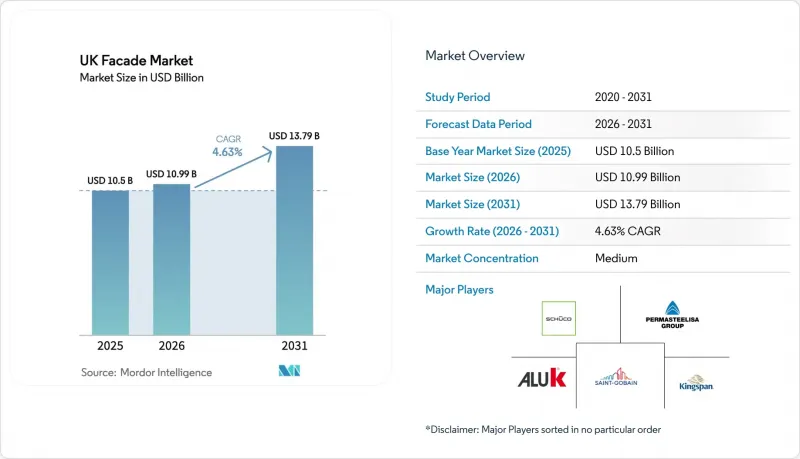
根據 Mordor Intelligence 估計,英國外牆市場在 2026 年的價值將達到 109.9 億美元,高於 2025 年的 105 億美元,預計到 2031 年將達到 137.9 億美元。
預計從 2026 年到 2031 年,其複合年成長率將達到 4.63%。
本報告按類型(通風式、非通風式及其他)、帷幕牆系統(雨幕式覆層等)、材料(玻璃、金屬等)、施工類型(新建、維修/整修)、最終用戶(商業、住宅及其他)和地區(英國等)進行分類。市場預測以美元計價。
英國外牆市場趨勢與洞察
格倫費爾大火後,外牆更換需求激增。
2022年《建築安全法》認定,截至2025年4月,共有5052棟高度超過11公尺的住宅建築使用了不符合安全標準的覆材,其中2477棟已開始進行維修。初審法院的判決現在認為,即使是「中等」的火災風險評估也是不可接受的,這擴大了責任範圍。保險公司已將易燃外牆排除在保險範圍之外,實際上強制要求採用A1級防火系統。維修工程的增值稅抵扣進一步降低了維修成本。因此,擁有經認證的防火產品系列的傳統供應商正面臨巨大的需求。
2050 年淨零排放建築圍護結構要求
計劃於2025年實施的「未來住宅標準」要求在營運過程中大幅減少碳排放。在倫敦,建築面積超過1000平方公尺的專案必須進行全生命週期碳排放評估。研究表明,玻璃佔建築立面隱含碳量的60%之多,促使製造商開發更高比例的再生玻璃產品。儘管政府將資料中心指定為國家關鍵基礎設施縮短了專案工期,但能源效能標準也變得更加嚴格。公共部門建築的BREEAM「優秀」評級標準如今取決於建築立面的脫碳情況,卡迪夫的維林德癌症中心就是一個典型的例子。
鋁和玻璃的價格波動
能源提煉鋁冶煉面臨供應環境變遷和地緣政治貿易風險,這些因素正波及到幕牆預算。截至2024年6月,英國建築材料指數年減2.0%,但現貨價格仍波動,使得前置作業時間較長的帷幕牆合約難以進行成本規劃。平板玻璃製造商正在投資自動化技術,以減少意外運作的損失,而此類停機造成的損失可能高達每分鐘100萬英鎊(135.1萬美元)。
細分市場分析
到2025年,通風系統將佔英國外牆市場佔有率的45.32%,預計到2031年,該細分市場將以7.65%的複合年成長率成長。其空心結構有助於抑制火勢蔓延並增強熱調節功能,這與目前英國外牆市場幾乎所有競標的兩大優先事項相契合:符合《建築安全法》和實現淨零排放目標。這項技術正在發展成為智慧模組,例如seele的“ISOshade®”,它利用內建感測器和人工智慧控制的百葉窗來調節太陽輻射熱增益,而無需主動消耗能源。此外,在居住的住宅高層建築中,對通風系統維修的需求也在不斷成長,以取代易燃覆材,並利用增值稅增值稅和保險優惠政策。隨著保險公司收緊承保標準,開發商越來越將通風系統視為標準解決方案,而不僅僅是升級選項。
預計到2025年,雨覆層將佔英國外牆市場銷售額的32.74%,其價值在於其多功能性和久經考驗的A1級組裝結構。然而,模組化幕牆正以8.47%的複合年成長率持續成長,直至2031年,這主要得益於工廠的品管和快速安裝,從而緩解了英國外牆市場的人手不足。製造商正在模糊不同系統之間的界限,將模組化幕牆和雨幕牆相結合的混合解決方案有望兼具雨幕牆的美觀性和模組化面板的快速安裝優勢。目前,大多數高層建築專案都強制要求使用CWCT認證的樣板,能夠對整個模組化組件進行最惡劣荷載工況測試的供應商更受青睞。隨著模組化建築商對單元尺寸進行標準化,模組化面板正逐漸成為預設的介面。
其他好處:
- Excel格式的市場預測(ME)表
- 3個月的分析師支持
目錄
第1章:引言
- 市場分析與定義的前提條件
- 分析範圍
第2章 分析方法
第3章執行摘要
第4章 市場狀況
- 市場概覽
- 市場促進因素
- 格倫費爾大火後,外牆板更換需求激增
- 為實現2050年淨零排放,強制建築圍護結構標準
- 模組化異地建造的引入
- 資料中心建設熱潮
- 增值稅減免措施正在為建築整合太陽能(BIPV)幕牆注入活力。
- 倫敦的「先改裝後翻新」政策
- 市場限制因素
- 鋁和玻璃的價格波動
- 合格的外牆施工工人短缺
- 易燃系統的保險除外責任
- 限制嵌入式碳排放(倫敦計劃)
- 幕牆產業中使用的各種結構概述
- 價格分析
- 價值鍊和供應鏈分析
- 監理情勢
- 技術展望
- 波特五力分析
- 消費行為分析(建築公司、建築師、開發人員、個人買家、設施/物業經理/業主)
- 永續發展趨勢
第5章 市場規模與成長預測
- 按類型
- 通風
- 非通風型
- 其他
- 帷幕牆系統類型
- 雨幕式覆層
- 帷幕牆系統
- 其他
- 材料
- 玻璃
- 金屬
- 塑膠和纖維
- 石材
- 其他
- 依建築類型
- 新建工程
- 維修和整修
- 最終用戶
- 商業設施
- 住宅
- 其他
- 按地區
- 英格蘭
- 蘇格蘭
- 威爾斯
- 北愛爾蘭
第6章 競爭情勢
- 市場集中度
- 策略趨勢
- 市佔率分析
- 公司簡介
- Schuco UK
- Permasteelisa UK
- Kingspan Insulated Panels UK
- Saint-Gobain Glass UK
- Reynaers Aluminium UK
- Kawneer UK
- AluK(GB)Ltd
- Senior Architectural Systems
- Yuanda Europe(UK)
- McMullen Facades
- Etex EOS Facades
- Sotech UK
- Prism Architectural
- Technal UK
- Alucraft Systems
- Vision Built UK
- Sto Ltd
- Glassolutions(Saint-Gobain)
- Fineline Aluminium
- OAG(Optima Architectural Glazing)
第7章 市場機會與未來展望
According to Mordor Intelligence, UK facade market size in 2026 is estimated at USD 10.99 billion, growing from 2025 value of USD 10.5 billion with 2031 projections showing USD 13.79 billion, growing at 4.63% CAGR over 2026-2031.
This report is Segmented by Type (Ventilated, Non-Ventilated, and Others), by Facade System Type (Rainscreen Cladding, and More), by Material (Glass, Metal, and More), by Installation (New Construction, Renovation & Retrofit), by End User (Commercial, Residential, and Others), and by Region (England, and More). The Market Forecasts are Provided in Terms of Value (USD).
UK Facade Market Trends and Insights
Post-Grenfell Recladding Surge
The Building Safety Act 2022 identified 5,052 residential blocks over 11 meters with unsafe cladding as of April 2025, with 2,477 already undergoing remediation . First-tier Tribunal rulings now deem even "medium" fire-risk ratings unacceptable, broadening liability exposure. Insurers are excluding combustible facades, effectively mandating A1-rated systems. VAT deductions on remediation work further lower upgrade costs. Established suppliers with certified, non-combustible portfolios are therefore capturing outsized demand.
Net-Zero 2050 Envelope Mandates
The Future Homes Standard, due in 2025, requires steep cuts in operational carbon, while London obliges whole-life carbon assessments for schemes above 1,000 m2. Research shows glass accounts for up to 60% of facade embodied carbon, prompting manufacturers to develop high-recycled-content glazing. Government recognition of data centers as nationally significant infrastructure is shortening planning timelines but tightening energy-performance criteria. Public-sector BREEAM "Excellent" thresholds now hinge on facade decarbonization, illustrated by Cardiff's Velindre Cancer Centre.
Aluminium & Glass Price Volatility
Energy-intensive aluminium smelting faces shifting supply dynamics and geopolitical trade risks that filter through to facade budgets. UK construction material indices recorded a 2.0% year-on-year decline as of June 2024, yet spot prices remain unstable, complicating cost planning for long-lead facade contracts. Flat-glass producers are investing in automation to curb unplanned downtime that can top GBP 1 million (USD 1.3501 million) per minute.
Other drivers and restraints analyzed in the detailed report include:
- Modular Off-Site Build Adoption
- Data-Center Build Boom
- Shortage of Certified Facade Labor
For complete list of drivers and restraints, kindly check the Table Of Contents.
Segment Analysis
Ventilated systems accounted for 45.32% of UK facade market share in 2025, and the segment is set to grow at a 7.65% CAGR through 2031. Their cavity design limits fire propagation and enhances thermal regulation, aligning with Building Safety Act compliance and net-zero targets two priorities that now shape nearly every tender in the UK facade market. The technology is evolving toward smart modules such as seele's ISOshade(R), which uses embedded sensors and AI-driven louvers to modulate solar gain without active energy consumption. Demand is also rising for ventilated retrofits on occupied residential towers, leveraging VAT relief and insurance incentives to replace combustible cladding. As insurers tighten underwriting, developers increasingly view ventilated systems as the baseline solution rather than an upgrade.
Rainscreen cladding captured 32.74% of UK facade market revenue in 2025, reflecting its versatility and proven A1-rated assemblies. However, unitised curtain walls are advancing at an 8.47% CAGR to 2031, driven by factory-controlled quality and faster installation that counters labor shortages in the UK facade market. Manufacturers are blurring lines between systems; hybrid unitised-rainscreen solutions promise the aesthetic freedom of rainscreens with the speed advantages of unitised panels. CWCT-certified mock-ups are now mandatory on most high-rise projects, favoring suppliers that can test entire unitised assemblies under worst-case load scenarios. As modular builders standardize bay sizes, unitised panels are becoming the default interface.
Complete Report Scope:
- By Type
- Ventilated
- Non-Ventilated
- Others
- By Facade System Type
- Rainscreen Cladding
- Curtain-Wall Systems
- Others
- By Material
- Glass
- Metal
- Plastic & Fibres
- Stone
- Others
- By Installation
- New Construction
- Renovation & Retrofit
- By End-User
- Commercial
- Residential
- Others
- By Region
- England
- Scotland
- Wales
- Northern Ireland
List of Companies Covered in this Report:
- Schuco UK
- Permasteelisa UK
- Kingspan Insulated Panels UK
- Saint-Gobain Glass UK
- Reynaers Aluminium UK
- Kawneer UK
- AluK (GB) Ltd
- Senior Architectural Systems
- Yuanda Europe (UK)
- McMullen Facades
- Etex EOS Facades
- Sotech UK
- Prism Architectural
- Technal UK
- Alucraft Systems
- Vision Built UK
- Sto Ltd
- Glassolutions (Saint-Gobain)
- Fineline Aluminium
- OAG (Optima Architectural Glazing)
Additional Benefits:
- The market estimate (ME) sheet in Excel format
- 3 months of analyst support
TABLE OF CONTENTS
1 Introduction
- 1.1 Study Assumptions & Market Definition
- 1.2 Scope of the Study
2 Research Methodology
3 Executive Summary
4 Market Landscape
- 4.1 Market Overview
- 4.2 Market Drivers
- 4.2.1 Post-Grenfell recladding surge
- 4.2.2 Net-zero 2050 envelope mandates
- 4.2.3 Modular off-site build adoption
- 4.2.4 Data-centre build boom
- 4.2.5 VAT relief energising BIPV facades
- 4.2.6 London "Retrofit First" policy
- 4.3 Market Restraints
- 4.3.1 Aluminium & glass price volatility
- 4.3.2 Shortage of certified facade labour
- 4.3.3 Insurance exclusions for combustible systems
- 4.3.4 Embodied-carbon caps (London Plan)
- 4.4 Brief on Different Structures Used in the Facades Industry
- 4.5 Pricing Analysis
- 4.6 Value / Supply-Chain Analysis
- 4.7 Regulatory Landscape
- 4.8 Technological Outlook
- 4.9 Porter's Five Forces
- 4.9.1 Bargaining Power of Suppliers
- 4.9.2 Bargaining Power of Consumers
- 4.9.3 Threat of New Entrants
- 4.9.4 Threat of Substitutes
- 4.9.5 Intensity of Competitive Rivalry
- 4.10 Consumer Behavior Analysis (Contractors, Architects, Developers, Individual Buyers, Facility & Property Managers/Building Owners)
- 4.11 Sustainability Trends
5 Market Size & Growth Forecasts (Value)
- 5.1 By Type
- 5.1.1 Ventilated
- 5.1.2 Non-Ventilated
- 5.1.3 Others
- 5.2 By Facade System Type
- 5.2.1 Rainscreen Cladding
- 5.2.2 Curtain-Wall Systems
- 5.2.3 Others
- 5.3 By Material
- 5.3.1 Glass
- 5.3.2 Metal
- 5.3.3 Plastic & Fibres
- 5.3.4 Stone
- 5.3.5 Others
- 5.4 By Installation
- 5.4.1 New Construction
- 5.4.2 Renovation & Retrofit
- 5.5 By End-User
- 5.5.1 Commercial
- 5.5.2 Residential
- 5.5.3 Others
- 5.6 By Region
- 5.6.1 England
- 5.6.2 Scotland
- 5.6.3 Wales
- 5.6.4 Northern Ireland
6 Competitive Landscape
- 6.1 Market Concentration
- 6.2 Strategic Moves
- 6.3 Market Share Analysis
- 6.4 Company Profiles (includes Global level Overview, Market level overview, Core Segments, Financials as available, Strategic Information, Market Rank/Share, Products & Services, Recent Developments)
- 6.4.1 Schuco UK
- 6.4.2 Permasteelisa UK
- 6.4.3 Kingspan Insulated Panels UK
- 6.4.4 Saint-Gobain Glass UK
- 6.4.5 Reynaers Aluminium UK
- 6.4.6 Kawneer UK
- 6.4.7 AluK (GB) Ltd
- 6.4.8 Senior Architectural Systems
- 6.4.9 Yuanda Europe (UK)
- 6.4.10 McMullen Facades
- 6.4.11 Etex EOS Facades
- 6.4.12 Sotech UK
- 6.4.13 Prism Architectural
- 6.4.14 Technal UK
- 6.4.15 Alucraft Systems
- 6.4.16 Vision Built UK
- 6.4.17 Sto Ltd
- 6.4.18 Glassolutions (Saint-Gobain)
- 6.4.19 Fineline Aluminium
- 6.4.20 OAG (Optima Architectural Glazing)
7 Market Opportunities & Future Outlook
- 7.1 White-Space & Unmet-Need Assessment

 2026年HPL帷幕牆全球市場研究報告
 帷幕牆系統市場:2026-2032年全球市場預測(按系統類型、材料類型、功能、項目類型、應用和分銷管道分類)
 帷幕牆系統市場-全球產業規模、佔有率、趨勢、機會、預測:按類型、材料、應用、地區和競爭格局分類,2021-2031年
 帷幕牆市場規模、佔有率和趨勢分析報告:按產品、最終用途、地區和細分市場分類(2026-2033 年)
 帷幕牆市場:按產品類型、材料、最終用途和地區分類,2026-2034 年
 2026年全球帷幕牆錨固系統市場報告
 帷幕牆系統市場:依產品類型、材料、應用、技術和地區分類
 美國建築外觀:市場佔有率分析、產業趨勢與統計、成長預測(2026-2031 年)建築幕牆:市場佔有率分析、產業趨勢與統計、成長預測(2026-2031)2026年全球建築幕牆系統市場報告