


 |
市場調查報告書
商品編碼
2154889
南美感測器市場:市場佔有率分析、產業趨勢與統計及成長預測(2026-2031 年)South America Occupancy Sensors - Market Share Analysis, Industry Trends & Statistics, Growth Forecasts (2026 - 2031) |
||||||

※ 本網頁內容可能與最新版本有所差異。詳細情況請與我們聯繫。
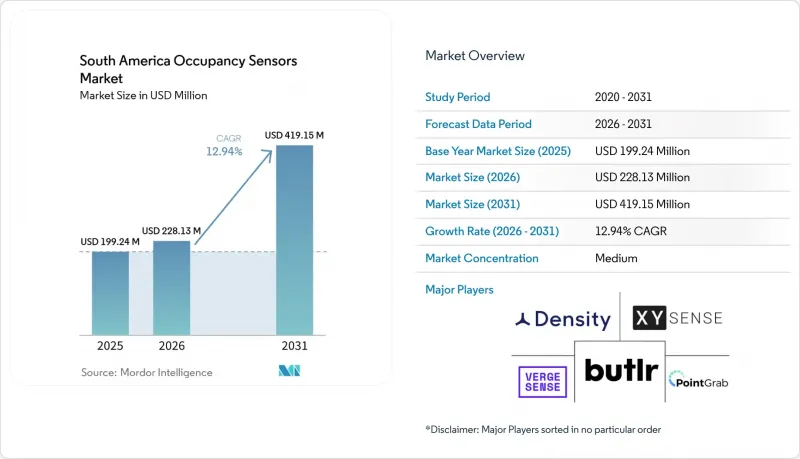
據 Mordor Intelligence 稱,2025 年南美洲佔用感測器市場價值為 1.9924 億美元,預計到 2031 年將達到 4.1915 億美元,而 2026 年為 2.2813 億美元,預測期(2026-2031 年)的複合成長率為 12.94%。
南美洲人體感應器市場趨勢與洞察
提高能源效率和降低公用事業成本的努力
在巴西,商業和公共建築的暖通空調(HVAC)系統消耗大量能源,因此實施區域控制系統具有實際意義。基於人員佔用情況的系統可以在房間無人時調暗或關閉照明,並調節通風。這些節能優勢,以及維護和營運成本的降低,正推動南美洲人員佔用感測器市場的發展。國際能源效率研究院(CGIEE)第4/2025號決議為巴西新建建築設定了最低能源效率標準,並於2027年開始分階段實施,2028年起對主要城市的商業建築提出額外要求。在開放式辦公佈局中,由於房間和一天中不同時間段的人員佔用情況各不相同,因此基於區域的控制比同時控制整個樓層更為有效。所以,感測器的選擇不僅取決於成本,還取決於控制細節和系統相容性。
智慧建築與建築管理系統的整合
人員佔用數據是建築管理系統的重要輸入,這些系統負責協調照明、暖通空調和報告。在大規模商業專案中,整合會影響佈線、閘道器和控制規範,使開發人員能夠更早選擇感測器平台。多感測器毫米波FMCW系統在實際室內環境中展現了人員計數和定位能力,支援即時控制決策。因此,南美洲的人員偵測感測器市場正轉向能夠透過現有建築協定進行通訊的產品。當專案中涉及多個供應商時,BACnet IP、DALI-2、KNX和Matter相容方案可以降低整合障礙。這些功能還有助於顧問將人員檢測數據與通風設定和室內空氣品質管理技術相結合。
翻新工程初期成本高昂,且投資報酬率存在不確定性。
網路化維修專案可能需要同時部署感測器、閘道器、中介軟體、試運行和分析軟體。如果節能效果沒有通用的基準值,中端市場的業主可能難以批准這些成本。即使是類似的項目,不同的審計假設也可能導致投資回收期有顯著差異。南美洲的佔用感測器市場在小規模建築和省會城市中面臨更直接的問題,因為這些地區的業主可能沒有內部能源管理負責人。配備長壽命電池的無線設備有助於減少安裝工作量,降低初始部署門檻。此外,隨著巴西能源效率監管政策的推進,合規性成為投資的更明確理由,採購週期可能會縮短。
細分市場分析
至2025年,有線基礎設施將佔據南美洲人體感應器市場53.24%的佔有率。在大規模商業和公共設施中,有線連接通常用於確保照明和暖通空調(HVAC)自動化系統中穩定的資料傳輸。醫院、政府部門和資料中心可以在全設施專案中採用乙太網路、BACnet MSTP或DALI-2配置。這些方案適用於需要考慮射頻條件和電池維護的場所。對於已經部署了結構化佈線和集中式建築控制系統的項目,有線設計也同樣適用。當設施管理團隊需要一條可靠的單一路徑來傳輸照明、通風、警報和能源報告時,這一點尤其重要。如果現場有技術人員和完善的網路規劃文檔,長期監控將更加便捷。在那些服務連續性比快速安裝更為重要的場所,有線連接的需求依然最為旺盛。
預計從2026年到2031年,無線連線將以13.41%的複合年成長率成長。這在維修工程中尤其重要,因為在已完成的天花板內鋪設電纜會干擾租戶或增加人力成本。 Wi-Fi可以利用現有的企業網路,Zigbee支援高密度網狀網路部署,而Z-Wave則適用於低功耗安裝。 2026年2月,PointGrab發表了CogniPoint 2 Flex,這是一款大規模企業部署的Thread網路感測器。它與Thread和Matter的兼容性支援需要多廠商互通性的專案。隨著模組成本的降低和維修項目的增加,無線技術的應用將縮小與有線系統的差距。此外,當佈局頻繁變更時,無線技術也為安裝人員提供了柔軟性。這對於租賃辦公空間尤其重要,因為業主在重新設計工作空間時無需再重新裝修已完成的表面。
截至2025年,被動紅外線(PIR)感測器佔整個技術類別的51.36%。其部署記錄反映了其在商業和住宅照明電路中的長期應用。 PIR產品為承包商所熟知,並且能夠在許多熱帶和溫帶環境中提供可靠的運動偵測和控制。超音波系統仍然適用於偵測坐姿下的細微動作。微波感測器則用於一些室外周界安防和工業物流應用。雙技術方案降低了單一檢測方法在複雜檢測環境中漏檢的風險。建築管理人員將根據房間佈局、預期活動以及漏檢造成的損失來選擇合適的技術。
毫米波/調頻連續波(mmWave/FMCW)雷達預計將在2026年至2031年間以13.16%的複合年成長率成長。在誤報可能影響病人安全和員工效率的領域,雙技術和多技術設計正日益受到關注。德克薩斯(TI)提供的IWRL6432模組整合了60GHz天線、電源管理和快閃記憶體,用於人員佔用和存在檢測。對多感測器毫米波調頻連續波系統的研究證實,該技術能夠對真實室內環境中的人員進行計數和定位。毫米波可以偵測到細微的動作,而不會拍攝可識別個人身份的影像,從而緩解了與攝影機相關的隱私問題。這項優勢正在推動南美洲醫療保健和其他敏感場所的人員佔用感測器市場發展。當設施營運方需要人員佔用資料但不想儲存影像時,該技術還可以簡化設施核准流程。在需要可靠地識別就座或靜止人員的情況下,這項技術仍然非常有用。
其他好處:
- Excel格式的市場預測(ME)表
- 3個月的分析師支持
目錄
第1章:引言
- 研究假設和市場定義
- 調查範圍
第2章:調查方法
第3章執行摘要
第4章 市場狀況
- 市場概覽
- 市場促進因素
- 提高能源效率和降低公用事業成本的努力
- 智慧建築與建築管理系統的整合
- 混合辦公模式擴展和工作空間利用的分析
- 綠建築標準和能源效率要求
- 為高度機密設施提供保護隱私的存在情報。
- 無線和長壽命電池感測器推動了改裝需求。
- 市場限制因素
- 維修工程的初始成本高,且投資回報存在不確定性。
- 與現有建築系統整合的複雜性
- 攝影機和設備追蹤系統中的隱私管治
- 在高密度環境、室外和不規則空間中偵測錯誤。
- 宏觀經濟因素對市場的影響
- 產業價值鏈分析
- 監理情勢
- 技術展望
- 波特五力分析
第5章 市場規模與成長預測
- 網路連線
- 有線
- 無線的
- Wi-Fi
- Zigbee
- Z-Wave
- 透過技術
- 被動紅外線
- 超音波
- 微波
- 雙技術和多技術
- 毫米波/調頻連續波雷達
- 按安裝類型
- 吸頂式
- 壁掛式
- 辦公桌和家具一體化
- 嵌入式/嵌入式照明燈具
- 按安裝類型
- 改裝
- 新建工程
- 依建築類型
- 住宅
- 商業
- 用於工業/倉儲用途
- 提供醫療和護理服務的輔助住宅
- 政府/教育
- 透過使用
- 照明控制
- 暖通空調和通風
- 安全監控
- 行人流量測量和空間利用率
- 監測床位和廁所使用情況
- 按地區
- 巴西
- 阿根廷
- 智利
- 哥倫比亞
- 其他南美國家
第6章 競爭情勢
- 市場集中度
- 策略趨勢
- 市佔率分析
- 公司簡介
- VergeSense, Inc.
- Butlr, Inc.
- PointGrab Ltd.
- XY Sense Pty Ltd.
- Density, Inc.
- Occuspace, Inc.
- BEG Bruck Electronic GmbH
- STEINEL GmbH
- Theben AG
- Pressac Communications Limited
- Terabee SA
- Avi-on Labs, Inc.
- Enerlites, Inc.
- Leviton Manufacturing Co., Inc.
- Lutron Electronics Co., Inc.
- Intermatic Incorporated
- RAB Lighting Inc.
- Distech Controls Inc.
- KMC Controls, Inc.
第7章 市場機會與未來展望
According to Mordor Intelligence, the South America occupancy sensors market size was valued at USD 199.24 million in 2025 and is estimated to grow from USD 228.13 million in 2026 to reach USD 419.15 million by 2031, at a CAGR of 12.94% during the forecast period (2026-2031).
South America Occupancy Sensors Market Trends and Insights
Energy Efficiency and Utility Cost Reduction Initiatives
Brazilian commercial and public buildings consume significant energy for HVAC, creating a practical case for controls that respond to occupied areas. Occupancy-responsive systems can dim or turn off lighting and adjust ventilation when rooms are empty. The South America occupancy sensors market benefits when these savings are considered together with maintenance and operating costs. Resolution CGIEE No. 4/2025 established minimum energy-efficiency indices for new buildings in Brazil, with phased requirements beginning in 2027 and additional requirements for commercial buildings in larger cities starting in 2028. Zone-level controls are more useful than whole-floor switching in open office layouts because occupancy varies by room and time of day. This makes sensor selection depend on control detail and system compatibility, not only on unit cost.
Smart Building and Building Management System Integration
Occupancy data has become a useful input for building management systems that coordinate lighting, air conditioning, and reporting. In larger commercial projects, developers can select the sensor platform earlier because integration affects cabling, gateways, and control specifications. Multi-sensor mmWave FMCW systems have demonstrated people-counting and localization capabilities in operational indoor settings, which support real-time control decisions. The South America occupancy sensors market is therefore shifting toward products that can communicate through established building protocols. BACnet IP, DALI-2, KNX, and Matter-compatible approaches can reduce integration barriers when a project involves multiple suppliers. These capabilities also help consultants connect occupancy data with ventilation settings and indoor air quality practices.
High Upfront Cost and Retrofit Payback Uncertainty
A networked retrofit may require sensors, gateways, middleware, commissioning, and analytics software simultaneously. This cost can be difficult for mid-market landlords to approve when electricity savings are not measured against a common baseline. Different audit assumptions can produce very different payback periods for similar projects. The South America occupancy sensors market faces this issue most directly in smaller buildings and secondary cities, where owners may not have internal energy management staff. Wireless equipment with long-life batteries can reduce installation labor and help lower the initial hurdle. Brazil's efficiency timetable may also shorten procurement cycles as compliance becomes a clearer reason to invest.
Other drivers and restraints analyzed in the detailed report include:
- Green Building Standards and Energy Conservation Requirements
- Expansion of Hybrid Work and Workspace Utilization Analytics
- Integration Complexity with Legacy Building Systems
For complete list of drivers and restraints, kindly check the Table Of Contents.
Segment Analysis
Wired infrastructure held 53.24% of the South America occupancy sensors market in 2025. Large commercial and institutional facilities often choose wired connections to ensure consistent data transmission for lighting and HVAC automation. Hospitals, ministries, and data centers can use Ethernet, BACnet MSTP, or DALI-2 arrangements in facility-wide projects. These approaches suit locations where radio-frequency conditions or battery maintenance create concerns. Wired designs can also suit projects that already have structured cabling and centralized building controls, particularly when facility teams want a single dependable pathway for lighting, ventilation, alarms, and energy reporting. They can simplify long-term supervision when a building has technical staff and a documented network plan. Their use remains strongest in spaces where service continuity carries more weight than rapid installation.
Wireless connectivity is projected to grow at a 13.41% CAGR from 2026 to 2031. It is useful in retrofits where installing cable through completed ceilings would disrupt tenants and add labor. Wi-Fi can use existing enterprise networks, while Zigbee supports dense mesh deployments and Z-Wave suits lower-power installations. PointGrab introduced CogniPoint 2 Flex in February 2026 as a Thread networking sensor for large enterprise deployments. Thread and Matter compatibility can support projects seeking multi-vendor interoperability. Wireless adoption can narrow the gap with wired systems as module costs fall and retrofit projects become more common. It can also give installers flexibility where floor plans are changed often. This matters in leased offices because owners can avoid reopening finished surfaces during workplace redesigns.
PIR sensors accounted for 51.36% of the technology category in 2025. Their installed base reflects long use in lighting circuits across commercial and residential buildings. PIR products are familiar to contractors and can provide reliable motion-based control in many tropical and temperate conditions. Ultrasonic systems remain relevant for detecting small seated movements. Microwave sensors are used in some outdoor perimeter and industrial logistics applications. Dual technology can reduce the risk that a single sensing method fails to identify a person in a challenging setting. Building managers may select the technology based on the room layout, expected activity, and the cost of missed detection.
mmWave/FMCW Radar is projected to grow at a 13.16% CAGR from 2026 to 2031. Dual- and multi-technology designs are gaining attention where a false-off event could affect patient safety or employee productivity. Texas Instruments offers the IWRL6432 module, which integrates a 60GHz antenna, power management, and flash memory for presence and occupancy detection. Research on multi-sensor mmWave FMCW systems supports the technology's ability to count and localize occupants in actual indoor environments. mmWave can detect micro-movements without capturing identifiable imagery, which can reduce the privacy concerns associated with cameras. This advantage supports the South America occupancy sensors market in healthcare and other sensitive locations. It can also make facility approvals more straightforward when the building operator needs presence data but does not want video storage. The technology remains relevant where seated or stationary occupants must be identified reliably.
Complete Report Scope:
- By Network Connectivity
- Wired
- Wireless
- Wi-Fi
- Zigbee
- Z-Wave
- By Technology
- Passive Infrared
- Ultrasonic
- Microwave
- Dual- and Multi-Technology
- mmWave / FMCW Radar
- By Mounting Type
- Ceiling-Mounted
- Wall-Mounted
- Desk- and Furniture-Integrated
- In-Fixture / Embedded Luminaire
- By Installation Type
- Retrofit
- New Construction
- By Building Type
- Residential
- Commercial
- Industrial and Warehousing
- Healthcare and Assisted Living
- Government and Education
- By Application
- Lighting Control
- HVAC and Ventilation
- Security and Surveillance
- People Counting and Space Utilization
- Bed and Restroom Occupancy Monitoring
- By Geography
- Brazil
- Argentina
- Chile
- Colombia
- Rest of South America
List of Companies Covered in this Report:
- VergeSense, Inc.
- Butlr, Inc.
- PointGrab Ltd.
- XY Sense Pty Ltd.
- Density, Inc.
- Occuspace, Inc.
- B.E.G. Bruck Electronic GmbH
- STEINEL GmbH
- Theben AG
- Pressac Communications Limited
- Terabee SA
- Avi-on Labs, Inc.
- Enerlites, Inc.
- Leviton Manufacturing Co., Inc.
- Lutron Electronics Co., Inc.
- Intermatic Incorporated
- RAB Lighting Inc.
- Distech Controls Inc.
- KMC Controls, Inc.
Additional Benefits:
- The market estimate (ME) sheet in Excel format
- 3 months of analyst support
TABLE OF CONTENTS
1 INTRODUCTION
- 1.1 Study Assumptions and Market Definition
- 1.2 Scope of the Study
2 RESEARCH METHODOLOGY
3 EXECUTIVE SUMMARY
4 MARKET LANDSCAPE
- 4.1 Market Overview
- 4.2 Market Drivers
- 4.2.1 Energy-Efficiency and Utility-Cost Reduction Initiatives
- 4.2.2 Smart-Building and Building-Management-System Integration
- 4.2.3 Expansion of Hybrid Work and Workspace Utilization Analytics
- 4.2.4 Green-Building Standards and Energy-Conservation Requirements
- 4.2.5 Privacy-Safe Presence Intelligence for Sensitive Facilities
- 4.2.6 Retrofit Demand from Wireless and Long-Life Battery Sensors
- 4.3 Market Restraints
- 4.3.1 High Upfront Cost and Retrofit Payback Uncertainty
- 4.3.2 Integration Complexity with Legacy Building Systems
- 4.3.3 Privacy Governance for Camera-Based and Device-Tracking Systems
- 4.3.4 Detection Errors in High-Density, Outdoor, and Irregular Spaces
- 4.4 Impact of Macroeconomic Factors on the Market
- 4.5 Industry Value Chain Analysis
- 4.6 Regulatory Landscape
- 4.7 Technological Outlook
- 4.8 Porter's Five Forces Analysis
- 4.8.1 Bargaining Power of Suppliers
- 4.8.2 Bargaining Power of Buyers
- 4.8.3 Threat of New Entrants
- 4.8.4 Threat of Substitutes
- 4.8.5 Competitive Rivalry
5 MARKET SIZE AND GROWTH FORECASTS (VALUE)
- 5.1 By Network Connectivity
- 5.1.1 Wired
- 5.1.2 Wireless
- 5.1.2.1 Wi-Fi
- 5.1.2.2 Zigbee
- 5.1.2.3 Z-Wave
- 5.2 By Technology
- 5.2.1 Passive Infrared
- 5.2.2 Ultrasonic
- 5.2.3 Microwave
- 5.2.4 Dual- and Multi-Technology
- 5.2.5 mmWave / FMCW Radar
- 5.3 By Mounting Type
- 5.3.1 Ceiling-Mounted
- 5.3.2 Wall-Mounted
- 5.3.3 Desk- and Furniture-Integrated
- 5.3.4 In-Fixture / Embedded Luminaire
- 5.4 By Installation Type
- 5.4.1 Retrofit
- 5.4.2 New Construction
- 5.5 By Building Type
- 5.5.1 Residential
- 5.5.2 Commercial
- 5.5.3 Industrial and Warehousing
- 5.5.4 Healthcare and Assisted Living
- 5.5.5 Government and Education
- 5.6 By Application
- 5.6.1 Lighting Control
- 5.6.2 HVAC and Ventilation
- 5.6.3 Security and Surveillance
- 5.6.4 People Counting and Space Utilization
- 5.6.5 Bed and Restroom Occupancy Monitoring
- 5.7 By Geography
- 5.7.1 Brazil
- 5.7.2 Argentina
- 5.7.3 Chile
- 5.7.4 Colombia
- 5.7.5 Rest of South America
6 COMPETITIVE LANDSCAPE
- 6.1 Market Concentration
- 6.2 Strategic Moves
- 6.3 Market Share Analysis
- 6.4 Company Profiles (includes Global Level Overview, Market Level Overview, Core Segments, Financials as available, Strategic Information, Market Rank/Share, Products and Services, Recent Developments)
- 6.4.1 VergeSense, Inc.
- 6.4.2 Butlr, Inc.
- 6.4.3 PointGrab Ltd.
- 6.4.4 XY Sense Pty Ltd.
- 6.4.5 Density, Inc.
- 6.4.6 Occuspace, Inc.
- 6.4.7 B.E.G. Bruck Electronic GmbH
- 6.4.8 STEINEL GmbH
- 6.4.9 Theben AG
- 6.4.10 Pressac Communications Limited
- 6.4.11 Terabee SA
- 6.4.12 Avi-on Labs, Inc.
- 6.4.13 Enerlites, Inc.
- 6.4.14 Leviton Manufacturing Co., Inc.
- 6.4.15 Lutron Electronics Co., Inc.
- 6.4.16 Intermatic Incorporated
- 6.4.17 RAB Lighting Inc.
- 6.4.18 Distech Controls Inc.
- 6.4.19 KMC Controls, Inc.
7 MARKET OPPORTUNITIES AND FUTURE OUTLOOK
- 7.1 White-Space and Unmet-Need Assessment

 人體感應器:市場佔有率分析、產業趨勢與統計、成長預測(2026-2031)無線人體感應器:市場佔有率分析、產業趨勢與統計及成長預測(2026-2031 年)
 人體感應器市場報告:按網路類型、技術、建築類型、覆蓋範圍、應用和地區分類,2026-2034 年
 全球人體感應器市場規模、佔有率、趨勢和成長分析報告(2026-2034年)
 智慧人體感應器照明應用市場:2026-2032年全球市場預測(以整合方式、連接方式、安裝方式、安裝方法、最終用戶和應用領域分類)
 桌面佔用感測器市場規模、佔有率和成長分析(按感測器類型、連接技術、應用、最終用戶和地區分類)—2026-2033年產業預測
 人體感應器市場分析及預測(至2035年):依類型、產品類型、服務、技術、組件、應用、最終用戶、功能、安裝類型分類無線人體感應器市場分析及預測(至2035年):依類型、產品類型、服務、技術、組件、應用、形式、部署方式、最終用戶及功能分類
 佔用感測器市場:全球按類型、操作、連接、技術和安裝分類 - 預測至 2030 年中東和非洲佔用感測器:市場佔有率分析、行業趨勢和成長預測(2025-2030)