


 |
市場調查報告書
商品編碼
2121286
無線人體感應器:市場佔有率分析、產業趨勢與統計及成長預測(2026-2031 年)Wireless Occupancy Sensors - Market Share Analysis, Industry Trends & Statistics, Growth Forecasts (2026 - 2031) |
||||||

※ 本網頁內容可能與最新版本有所差異。詳細情況請與我們聯繫。
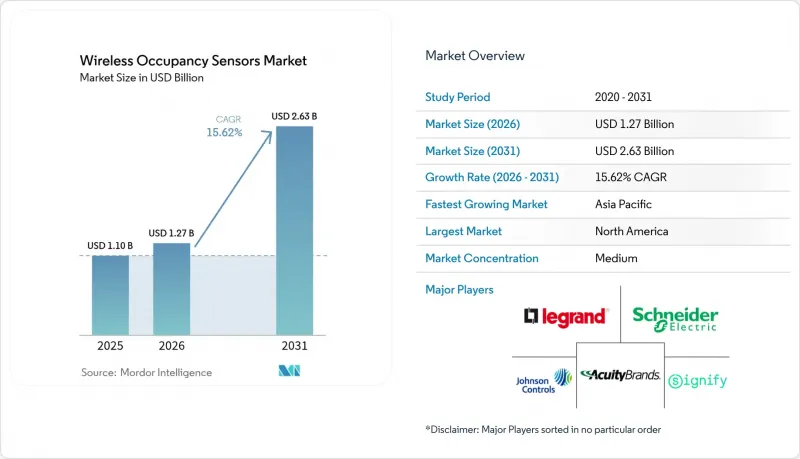
根據 Mordor Intelligence 預測,無線佔用感測器的市場規模預計將從 2025 年的 11 億美元成長到 2026 年的 12.7 億美元,然後在 2031 年達到 26.3 億美元,2026 年至 2031 年的複合年成長率為 15.62%。
本報告按技術(被動紅外線、超音波、雙技術及其他)、應用(照明控制、暖通空調/通風、安防/監控及其他)、建築類型(住宅、商業、工業及其他)、網路連接方式(Zigbee、藍牙/BLE及其他)、終端用戶行業和地區進行細分。市場預測以美元計價。
全球無線人體感應器市場趨勢與洞察
嚴格的能源效率法規
歐盟《建築能源性能指令》和加州第24號法規等能源法規強制要求對照明和暖通空調系統進行自動化控制,為無線人體感應器市場解決方案的長期需求奠定了基礎。紐約市第88號地方法律對違規行為增加了處罰,進一步鞏固了監管需求,使其超越了簡單的投資回報率計算。製造商預計歐盟每五年、美國多個州每三年將出現可預測的更新週期,這推動了持續的研發投入。這些法規也促使中小建築維修,而先前自動化在這些建築中被視為可選項。這些措施共同加速了專案推進,並將預期的複合年成長率提高了3.2個百分點。
智慧建築和物聯網的快速普及
思科Spaces和施耐德電氣EcoStruxure等智慧建築平台整合了即時佔用數據,實現了暖通空調、照明和維護的自動化,將感測器從單一功能設備轉變為數據節點,為企業分析提供數據。 Thread和Matter協定消除了互通性難題,讓藍牙、Zigbee和Wi-Fi裝置無需單獨的閘道即可共存。 Aqara等供應商提供雙PIR和毫米波感測器,可即插即用地連接到Apple Home、Alexa和Google生態系統,從而擴大了消費者覆蓋範圍。這些網路效應正在加速智慧建築的普及,尤其是在亞太地區的新商業設施。因此,智慧建築的普及預計將最大程度地推動無線佔用感測器市場實現4.1個百分點的複合年成長率。
故障/校準問題
傳統的被動紅外線(PIR)感測器經常會誤檢空調產生的氣流和溫度波動,導致即使無人時燈光也會亮起,從而削弱其節能效果。超音波飛行時間(ToF)感測器雖然提高了此類環境下的檢測精度,但需要安裝人員進行靈敏度微調,增加了人事費用。雙技術融合方案可以減少誤檢,但會使組件數量增加一倍,並增加電池消耗。高階毫米波雷達價格昂貴,且需要許多電工不熟悉的姿態設定程序。在人工智慧驅動的自動校準標準成熟之前,這些技術障礙將使無線人體感應器市場的複合年成長率(CAGR)下降2.1個百分點。
細分市場分析
被動紅外線 (PIR) 感測器憑藉其低成本和技術成熟度,在無線人體感應器市場仍佔據主導地位,預計到 2025 年仍將保持 45.45% 的市場佔有率。結合 PIR 和超音波訊號的雙技術設備預計將以 20.08% 的複合年成長率成長,因為用戶對空調開放式辦公室的精度要求更高。超音波感測器佔據第二大市場佔有率,因為其穩定的溫度環境非常適合利用聲波進行運動檢測。毫米波雷達正吸引醫療保健、機場和高階辦公室等買家的關注,他們需要在不到一秒的時間內確認人員佔用情況,以便做出關鍵的照明和暖通空調決策。電腦視覺和聲學變化技術雖然仍屬於小眾領域,但由於其在零售分析中客流統計方面的高精度,正受到越來越多的關注。
供應商的藍圖正朝著整合人工智慧融合引擎的方向發展,這些引擎能夠學習環境模式,從而顯著降低誤報率,這增強了人們對無線佔用感測器市場的信心。 Aqara 的 FP300 整合了雙 PIR、毫米波、溫度、濕度和光照度感測器,可將控制資料傳輸到 Matter 網路。此類平台採用無線更新,可在演算法演進過程中保護用戶投資。雖然物料清單 (BOM) 成本有所上升,但由於減少了回訪次數而節省的生命週期成本足以抵消更高的價格,從而為大規模企業採用鋪平了道路。
照明控制受益於商業室內建築領域數十年的監管實施,保持了其主導地位,預計2025年將佔銷售額的58.42%。同時,暖通空調(HVAC)領域預計將以18.74%的複合年成長率成長,因為入住率數據已被證明對最佳化氣流以滿足後疫情時代室內空氣品質標準至關重要。安防監控領域正在利用感測器進行警報啟動和疏散路線照明,從而實現跨預算協同效應。最有價值的細分領域是“空間利用分析”,其先進的聚合功能能夠幫助豪華物業最佳化租金。
霍尼韋爾的「Forge Sustainability+」方案表明,根據人員佔用情況調整的暖通空調系統可在保持舒適度的同時,將風扇能耗降低40%,從而為與能源合約掛鉤的無線人員佔用感測器市場開闢新的投資回報來源。供應商正在將雲端儀錶板打包,使資料訂閱的獲利模式超越硬體利潤。資產追蹤疊加層利用相同的基礎設施,建立了一個多服務平台,無需設施管理人員額外投資即可擴大潛在市場規模。
區域分析
預計到2025年,北美將以34.78%的市佔率領先市場。這主要得益於ASHRAE 90.1-2019和加州建築規範第24條(Title 24)的實施,這兩項規範強制要求幾乎所有商業項目都安裝感測器。美國在毫米波雷達的研發方面處於主導,像Novelda這樣的公司提供超寬頻檢測器,能夠追蹤病人病房應用中的細微動作。儘管貿易政策偶爾不確定性,但全部區域銷售仍保持穩定,這主要得益於加拿大以LEED認證為導向的維修以及墨西哥的工廠擴建。無線人體感應器市場持續受益於聯邦政府為升級到節能設備而提供的稅收優惠政策。
亞太地區是成長最快的區域,預計年複合成長率將達到17.32%,這主要得益於中國智慧城市計畫和日本零能耗建築目標推動了感測器的普及。印度的「百城智慧城市計畫」和5G的廣泛部署為商業建築中基於藍牙低功耗(BLE)技術的部署創造了有利環境。韓國正利用其國內電子製造能力縮短前置作業時間並降低系統價格,加速其教育和醫療保健產業的應用。充足的本地元件供應使該地區不易受到全球半導體短缺的影響,進一步支撐了無線人體感應器市場的成長。
在歐洲,《建築能源性能指令》已被證明行之有效,它強制要求定期進行性能審計,並促進持續的維修。德國在與工業自動化協同增效方面表現卓越,而英國則利用碳減排基金津貼公共部門的維修。法國正在探索一種系統,透過智慧電網與建築之間的數據交換,獎勵那些響應需求的建築,從而將感測器從合規成本轉變為創收資產。 《需量反應一般資料保護規則》(GDPR)正推動買家轉向邊緣處理解決方案,並青睞那些能夠對設備進行分析的供應商。這些因素共同鞏固了無線感測器作為歐洲脫碳路線藍圖基本要素的地位。
其他好處
- Excel格式的市場預測(ME)表
- 3個月的分析師支持
目錄
第1章:引言
- 調查假設和市場定義
- 調查範圍
第2章:調查方法
第3章執行摘要
第4章 市場狀況
- 市場概覽
- 市場促進因素
- 嚴格的能源效率法規
- 智慧建築和物聯網的快速普及
- 無電池能源採集感測器
- 空間分析領域對混合工作模式的需求
- 與環境、社會及公司治理 (ESG) 和運轉率掛鉤的空調設備合約
- 基於人工智慧毫米波融合的零延遲偵測
- 市場限制因素
- 故障/校準問題
- 對資料隱私和網路安全的擔憂
- 高密度物聯網部署中的射頻擁塞
- 與電池處置相關的合規成本
- 價值供應鏈分析
- 監理情勢
- 技術展望
- 波特五力分析
第5章 市場規模與成長預測
- 透過技術
- 被動紅外線(PIR)
- 超音波
- 雙重技術(PIR+超音波)
- 微波/毫米波雷達
- 其他
- 透過使用
- 照明控制
- 暖通空調(家庭通風)
- 安全監控
- 空間利用分析
- 其他
- 依建築類型
- 住宅
- 商業的
- 產業
- 公共和機構設施
- 網路連線
- Zigbee
- Bluetooth/BLE
- Wi-Fi
- EnOcean(能源採集)
- LoRa 和其他低功耗廣域網
- 按最終用戶行業分類
- 智慧建築
- 醫療機構
- 製造業
- 航太/國防
- 家用電器和智慧家居
- 其他
- 按地區
- 北美洲
- 美國
- 加拿大
- 墨西哥
- 歐洲
- 英國
- 德國
- 法國
- 義大利
- 其他歐洲國家
- 亞太地區
- 中國
- 日本
- 印度
- 韓國
- 其他亞太國家
- 中東
- 以色列
- 沙烏地阿拉伯
- 阿拉伯聯合大公國
- 土耳其
- 其他中東國家
- 非洲
- 南非
- 埃及
- 其他非洲國家
- 南美洲
- 巴西
- 阿根廷
- 南美洲其他地區
- 北美洲
第6章 競爭情勢
- 市場集中度
- 策略趨勢
- 市佔率分析
- 公司簡介
- Legrand SA
- Schneider Electric SE
- Acuity Brands Inc.
- Eaton Corporation plc
- Leviton Manufacturing Co. Inc.
- Johnson Controls International plc
- Signify NV
- Lutron Electronics Co. Inc.
- Honeywell International Inc.
- General Electric Co.
- Hubbell Incorporated
- ABB Ltd.
- Siemens AG
- Texas Instruments Inc.
- Crestron Electronics Inc.
- Enlighted Inc.(Siemens)
- RAB Lighting Inc.
- Autani LLC
- PointGrab Ltd.
- Delta Electronics Inc.
第7章 市場機會與未來展望
According to Mordor Intelligence, the wireless occupancy sensors market size is expected to grow from USD 1.1 billion in 2025 to USD 1.27 billion in 2026 and is forecast to reach USD 2.63 billion by 2031 at 15.62% CAGR over 2026-2031.
This report is Segmented by Technology (Passive Infrared, Ultrasonic, Dual Tech, and More), Application (Lighting Control, HVAC & Ventilation, Security & Surveillance, and More), Building Type (Residential, Commercial, Industrial, and More), Network Connectivity (Zigbee, Bluetooth/BLE, and More), End-User Industry, and Geography. The Market Forecasts are Provided in Terms of Value (USD).
Global Wireless Occupancy Sensors Market Trends and Insights
Stringent Energy-Efficiency Mandates
Energy codes such as the European Union's Energy Performance of Buildings Directive and California Title 24 require automatic lighting and HVAC controls, anchoring long-term demand for wireless occupancy sensors market solutions. New York City's Local Law 88 adds financial penalties for non-compliance, cementing a regulatory pull that transcends simple payback calculations. Manufacturers see predictable upgrade cycles every five years in the EU and every three years in several U.S. states, which encourages sustained R&D spending. The mandates also catalyze retrofits in small and midsize buildings that previously viewed automation as discretionary. Collectively, these measures add 3.2 percentage points to the forecast CAGR by accelerating project pipelines.
Rapid Smart-Building & IoT Adoption
Smart-building platforms such as Cisco Spaces and Schneider Electric EcoStruxure integrate real-time occupancy data to automate HVAC, lighting, and maintenance, transforming sensors from single-function devices into data nodes that feed enterprise analytics. Thread and Matter protocols now remove interoperability headaches, letting Bluetooth, Zigbee, and Wi-Fi devices coexist without proprietary gateways. Vendors like Aqara ship dual PIR and mmWave sensors that join Apple Home, Alexa, and Google ecosystems out of the box, widening consumer reach. These network effects drive faster adoption curves, particularly in Asia-Pacific's new commercial builds. As a result, smart-building penetration will deliver the highest driver uplift at 4.1 percentage points to the wireless occupancy sensors market CAGR.
False Triggering & Calibration Issues
Conventional PIR sensors misread HVAC drafts and temperature swings, causing lights to turn on without occupants and eroding energy-savings claims. Ultrasonic Time-of-Flight devices improve detection in such environments, but installers must fine-tune sensitivity, boosting labor costs. Dual-tech fusion reduces false positives yet doubles component count and battery drain. Premium mmWave radar remains costly and needs skilled setup unfamiliar to many electricians. Until AI-assisted auto-calibration standards mature, these technical frictions subtract 2.1 percentage points from the wireless occupancy sensors market CAGR.
Other drivers and restraints analyzed in the detailed report include:
- Battery-Free Energy-Harvesting Sensors
- Hybrid-Work Demand for Space Analytics
- Data-Privacy & Cybersecurity Concerns
For complete list of drivers and restraints, kindly check the Table Of Contents.
Segment Analysis
Passive Infrared maintained 45.45% share in 2025 thanks to low cost and maturity, positioning it as the volume anchor of the wireless occupancy sensors market. Dual-Tech devices that blend PIR and ultrasonic signals are projected to post a 20.08% CAGR as users demand higher precision in air-conditioned open offices. Ultrasonic standalone sensors hold the runner-up slot where stable temperatures favor sound-based motion detection. mmWave radar attracts healthcare, airport, and premium office buyers that need sub-second presence confirmation for critical lighting and HVAC decisions. Computer-vision and acoustic variants remain niche yet gain attention for people-counting accuracy in retail analytics.
Vendor roadmaps increasingly bundle AI fusion engines that learn environmental patterns to slash false positives, improving confidence in the wireless occupancy sensors market. Aqara's FP300 combines dual PIR, mmWave, temperature, humidity, and illuminance sensing to feed command data into Matter networks. Such platforms use over-the-air updates, protecting investment as algorithms evolve. While BOM costs rise, lifecycle savings from reduced callbacks justify the premium, setting the stage for larger enterprise rollouts.
Lighting Control retained 58.42% revenue dominance in 2025, benefiting from decades of code-driven deployment in commercial fit-outs. Yet HVAC & Ventilation is forecast to expand at a 18.74% CAGR, as occupancy data proves essential for right-sizing airflow to post-pandemic indoor-air-quality standards. Security & Surveillance uses sensors for alarm arming and egress path lighting, offering cross-budget synergies. The highest value accrues to Space-Utilization Analytics, where advanced counting functions enable rent optimization in premium real estate.
Honeywell's Forge Sustainability+ illustrates how occupancy-tuned HVAC can reduce fan energy by 40% while maintaining comfort, unlocking new ROI levers for the wireless occupancy sensors market size tied to energy contracts. Vendors package cloud dashboards that monetize data subscriptions beyond hardware margins. Asset-tracking overlays use the same infrastructure, giving facility managers a multi-service platform that widens TAM without extra capex.
Complete Report Scope:
- By Technology
- Passive Infrared (PIR)
- Ultrasonic
- Dual Tech (PIR + Ultrasonic)
- Microwave / mmWave Radar
- Other Technologies
- By Application
- Lighting Control
- HVAC and Ventilation
- Security and Surveillance
- Space-Utilization Analytics
- Other Applications
- By Building Type
- Residential
- Commercial
- Industrial
- Public and Institutional
- By Network Connectivity
- Zigbee
- Bluetooth / BLE
- Wi-Fi
- EnOcean (Energy-Harvesting)
- LoRa and Other LPWAN
- By End-User Industry
- Smart Buildings
- Healthcare Facilities
- Manufacturing
- Aerospace and Defense
- Consumer Electronics and Smart Home
- Others
- By Geography
- North America
- United States
- Canada
- Mexico
- Europe
- United Kingdom
- Germany
- France
- Italy
- Rest of Europe
- Asia-Pacific
- China
- Japan
- India
- South Korea
- Rest of Asia-Pacific
- Middle East
- Israel
- Saudi Arabia
- United Arab Emirates
- Turkey
- Rest of Middle East
- Africa
- South Africa
- Egypt
- Rest of Africa
- South America
- Brazil
- Argentina
- Rest of South America
- North America
Geography Analysis
North America led with a 34.78% revenue share in 2025, powered by ASHRAE 90.1-2019 and Title 24 codes that mandate sensors in virtually all commercial projects. The United States spearheads mmWave radar R&D, with firms such as Novelda delivering ultra-wideband detectors capable of micro-motion tracking for patient-room applications Novelda. Canada's LEED-centric retrofit drive and Mexico's factory expansion sustain regional volume despite occasional trade policy uncertainties. The wireless occupancy sensors market continues to benefit from federal tax incentives for energy-efficient equipment upgrades.
Asia-Pacific is the fastest-growing territory, projected to post a 17.32% CAGR as China's smart-city blueprint and Japan's Zero-Energy-Building targets boost sensor penetration. India's 100-Smart-Cities Mission and widespread 5G rollout create fertile ground for BLE-based installations in commercial towers. South Korea leverages its electronics manufacturing capacity to shorten lead times and reduce system prices, driving adoption in local education and healthcare sectors. Abundant local component supply shields the region from global chip shortages, reinforcing the wireless occupancy sensors market growth trajectory.
Europe benefits from the Energy Performance of Buildings Directive, which enforces periodic performance audits that spur continuous retrofit cycles. Germany excels in industrial automation synergies, while the United Kingdom channels carbon-reduction funds into public-sector retrofit grants. France explores smart-grid-to-building data exchanges that pay buildings for demand-response, making sensors revenue-generating assets instead of compliance costs. GDPR steers buyers toward edge-processed solutions, favoring vendors with on-device analytics. Together, these factors embed wireless sensors as a foundational element of Europe's decarbonization roadmap.
- Legrand SA
- Schneider Electric SE
- Acuity Brands Inc.
- Eaton Corporation plc
- Leviton Manufacturing Co. Inc.
- Johnson Controls International plc
- Signify N.V.
- Lutron Electronics Co. Inc.
- Honeywell International Inc.
- General Electric Co.
- Hubbell Incorporated
- ABB Ltd.
- Siemens AG
- Texas Instruments Inc.
- Crestron Electronics Inc.
- Enlighted Inc. (Siemens)
- RAB Lighting Inc.
- Autani LLC
- PointGrab Ltd.
- Delta Electronics Inc.
Additional Benefits:
- The market estimate (ME) sheet in Excel format
- 3 months of analyst support
TABLE OF CONTENTS
1 INTRODUCTION
- 1.1 Study Assumptions and Market Definition
- 1.2 Scope of the Study
2 RESEARCH METHODOLOGY
3 EXECUTIVE SUMMARY
4 MARKET LANDSCAPE
- 4.1 Market Overview
- 4.2 Market Drivers
- 4.2.1 Stringent energy-efficiency mandates
- 4.2.2 Rapid smart-building and IoT adoption
- 4.2.3 Battery-free energy-harvesting sensors
- 4.2.4 Hybrid-work demand for space analytics
- 4.2.5 ESG-linked occupancy-based HVAC contracts
- 4.2.6 AI-enabled mmWave fusion for zero-latency detection
- 4.3 Market Restraints
- 4.3.1 False triggering and calibration issues
- 4.3.2 Data-privacy and cybersecurity concerns
- 4.3.3 RF congestion in dense IoT deployments
- 4.3.4 Battery-disposal compliance costs
- 4.4 Value / Supply-Chain Analysis
- 4.5 Regulatory Landscape
- 4.6 Technological Outlook
- 4.7 Porter's Five Forces Analysis
- 4.7.1 Threat of New Entrants
- 4.7.2 Bargaining Power of Buyers/Consumers
- 4.7.3 Bargaining Power of Suppliers
- 4.7.4 Threat of Substitute Products
- 4.7.5 Intensity of Competitive Rivalry
5 MARKET SIZE AND GROWTH FORECASTS (VALUE)
- 5.1 By Technology
- 5.1.1 Passive Infrared (PIR)
- 5.1.2 Ultrasonic
- 5.1.3 Dual Tech (PIR + Ultrasonic)
- 5.1.4 Microwave / mmWave Radar
- 5.1.5 Other Technologies
- 5.2 By Application
- 5.2.1 Lighting Control
- 5.2.2 HVAC and Ventilation
- 5.2.3 Security and Surveillance
- 5.2.4 Space-Utilization Analytics
- 5.2.5 Other Applications
- 5.3 By Building Type
- 5.3.1 Residential
- 5.3.2 Commercial
- 5.3.3 Industrial
- 5.3.4 Public and Institutional
- 5.4 By Network Connectivity
- 5.4.1 Zigbee
- 5.4.2 Bluetooth / BLE
- 5.4.3 Wi-Fi
- 5.4.4 EnOcean (Energy-Harvesting)
- 5.4.5 LoRa and Other LPWAN
- 5.5 By End-User Industry
- 5.5.1 Smart Buildings
- 5.5.2 Healthcare Facilities
- 5.5.3 Manufacturing
- 5.5.4 Aerospace and Defense
- 5.5.5 Consumer Electronics and Smart Home
- 5.5.6 Others
- 5.6 By Geography
- 5.6.1 North America
- 5.6.1.1 United States
- 5.6.1.2 Canada
- 5.6.1.3 Mexico
- 5.6.2 Europe
- 5.6.2.1 United Kingdom
- 5.6.2.2 Germany
- 5.6.2.3 France
- 5.6.2.4 Italy
- 5.6.2.5 Rest of Europe
- 5.6.3 Asia-Pacific
- 5.6.3.1 China
- 5.6.3.2 Japan
- 5.6.3.3 India
- 5.6.3.4 South Korea
- 5.6.3.5 Rest of Asia-Pacific
- 5.6.4 Middle East
- 5.6.4.1 Israel
- 5.6.4.2 Saudi Arabia
- 5.6.4.3 United Arab Emirates
- 5.6.4.4 Turkey
- 5.6.4.5 Rest of Middle East
- 5.6.5 Africa
- 5.6.5.1 South Africa
- 5.6.5.2 Egypt
- 5.6.5.3 Rest of Africa
- 5.6.6 South America
- 5.6.6.1 Brazil
- 5.6.6.2 Argentina
- 5.6.6.3 Rest of South America
- 5.6.1 North America
6 COMPETITIVE LANDSCAPE
- 6.1 Market Concentration
- 6.2 Strategic Moves
- 6.3 Market Share Analysis
- 6.4 Company Profiles (includes Global level Overview, Market level overview, Core Segments, Financials as available, Strategic Information, Market Rank/Share for key companies, Products and Services, and Recent Developments)
- 6.4.1 Legrand SA
- 6.4.2 Schneider Electric SE
- 6.4.3 Acuity Brands Inc.
- 6.4.4 Eaton Corporation plc
- 6.4.5 Leviton Manufacturing Co. Inc.
- 6.4.6 Johnson Controls International plc
- 6.4.7 Signify N.V.
- 6.4.8 Lutron Electronics Co. Inc.
- 6.4.9 Honeywell International Inc.
- 6.4.10 General Electric Co.
- 6.4.11 Hubbell Incorporated
- 6.4.12 ABB Ltd.
- 6.4.13 Siemens AG
- 6.4.14 Texas Instruments Inc.
- 6.4.15 Crestron Electronics Inc.
- 6.4.16 Enlighted Inc. (Siemens)
- 6.4.17 RAB Lighting Inc.
- 6.4.18 Autani LLC
- 6.4.19 PointGrab Ltd.
- 6.4.20 Delta Electronics Inc.
7 MARKET OPPORTUNITIES AND FUTURE OUTLOOK
- 7.1 White-space and Unmet-Need Assessment

 人體感應器:市場佔有率分析、產業趨勢與統計、成長預測(2026-2031)
 人體感應器市場-2026-2032年全球市場預測
 人體感應器市場報告:按網路類型、技術、建築類型、覆蓋範圍、應用和地區分類,2026-2034 年
 人體感應器市場:按感測器類型、應用和地區分類
 全球人體感應器市場規模、佔有率、趨勢和成長分析報告(2026-2034年)智慧人體感應器照明應用市場:2026-2032年全球市場預測(以整合方式、連接方式、安裝方式、安裝方法、最終用戶和應用領域分類)
 桌面佔用感測器市場規模、佔有率和成長分析(按感測器類型、連接技術、應用、最終用戶和地區分類)—2026-2033年產業預測
 人體感應器市場分析及預測(至2035年):依類型、產品類型、服務、技術、組件、應用、最終用戶、功能、安裝類型分類有線人體感應器市場分析及預測(至2035年):依類型、產品類型、服務、技術、組件、應用、功能、安裝類型、設備及最終用戶分類無線人體感應器市場分析及預測(至2035年):依類型、產品類型、服務、技術、組件、應用、形式、部署方式、最終用戶及功能分類