

 |
市場調查報告書
商品編碼
2154836
南美洲振動感測器市場:市場佔有率分析、產業趨勢與統計及成長預測(2026-2031)South America Vibration Sensors - Market Share Analysis, Industry Trends & Statistics, Growth Forecasts (2026 - 2031) |
||||||

※ 本網頁內容可能與最新版本有所差異。詳細情況請與我們聯繫。
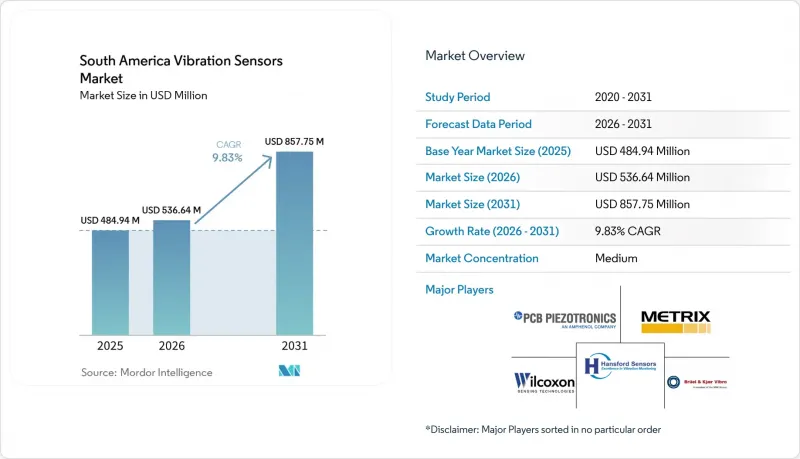
據 Mordor Intelligence 稱,2025 年南美振動感測器市值為 4.8494 億美元,預計到 2031 年將達到 8.5775 億美元,而 2026 年為 5.3664 億美元,預測期(2026-2031 年)複合年成長率為 9.83%。
南美洲振動感測器市場趨勢與洞察
預測性維護在採礦和金屬產業的擴展
南美洲振動感測器市場正受惠於礦業公司將設備監測視為營運連續性保障的一部分。大規模礦場依賴輸送機、磨機、泵浦、破碎機和其他設備,任何意外故障都可能中斷單一生產流程,延誤下游作業,並迫使工人在惡劣的工作環境中檢查設備。根據西班牙國家銅業委員會(Codelco)報告,埃爾特尼恩特礦引入感測器和分析技術,避免了超過1,100萬美元的潛在損失,並消除了與旋轉機械相關的人工操作。淡水河谷在七個礦壩安裝了467個連網資料記錄儀,顯示監測程序不僅可以針對單一機器,還可以針對基礎設施,將遠端資訊整合到通用的運作視圖中。 ISO 17359:2018和ISO 13373系列標準提供了一個通用的狀態監控框架,影響設備的規格製定、選擇和維護資料的檢驗。這些正式維護方法的廣泛應用,推動了南美洲振動感測器市場對感測器、整合服務和長期診斷服務的持續需求。
巴西海上油氣生產擴張
巴西鹽層下專案對能夠在惡劣運作環境下運作的高價值振動感測器的需求日益成長。巴西石油公司(Petrobras)及其合作夥伴已投資4.5億美元,利用專為深海作業設計的海底節點,在梅羅油田進行地震監測。在梅羅專案中,感測器單元於2026年初步合格階段安裝在約2000公尺深處。此海上平台還需要對泵浦、壓縮機、渦輪機、立管和其他設備進行監測。這些檢查和維護工作可能需要營運和維護團隊之間的密切協調,以及海上物流、生產計劃、安全管理和生產進度安排等環節的銜接。因此,每新增一個浮體式生產設施,都會產生長達數年的感測硬體、資料擷取系統、備用零件和維護支援需求。這種較長的專案週期使得南美洲振動感測器市場即使在短期大宗商品價格波動的情況下也能保持活力。
進口依賴度高和外匯風險
南美振動感測器市場嚴重依賴從北美和歐洲供應商進口精密硬體。阿根廷披索和巴西幣外匯的波動會影響當地購買力,擾亂已通過核准的預算,延誤採購決策,並可能導致進口系統的最終成本與專案核准時的預期成本存在差異。電子元件和測量儀器的進口關稅也推高了在巴西交付先進設備的成本。即使監測項目具有明確的營運價值和既定的維護需求,這些成本也可能削弱多年升級計畫的經濟可行性。本地整合服務可以幫助使用者配置系統、採購相容部件、獲得支持,並減少安裝所需的工作量。然而,由於許多精密感測器元件仍依賴進口,外匯風險持續影響南美振動感測器市場。
細分市場分析
到2025年,加速計將佔據南美振動感測器市場55.14%的佔有率。這些感測器廣泛應用於採礦、海上作業和製造設備中,用於檢測軸承缺陷、軸不平衡、結構共振和流體引起的振動。其久經考驗的性能已促成了警報閾值、校準程序和維護工作流程的建立,使終端用戶能夠輕鬆進行更換和擴展。速度感測器在老舊的旋轉機械中仍然發揮著重要作用,而位移感測器則用於監測渦輪機和壓縮機中的軸間隙。
預計到2031年,振動陀螺儀的年複合成長率將達到11.39%。它們將支援定向鑽井的自動化,並提供線性加速計無法捕獲的角振動資料。石油工程師協會(SPE)曾通報過一個與阿根廷瓦卡穆埃爾塔地層相關的套管鑽井即時監測案例。 2026年1月,PCB Piezotronics公司推出了HV356A03,該產品能夠直接接觸操作,最高電壓可達2000VDC。同時,Kistler公司推出的0.9克KiVibe微型設備則專注於結構動力學測試。這些發展在鞏固加速計領先地位的同時,也推動了專用設備在高價值應用領域的拓展。
到2025年,壓電技術將佔該地區銷售額的47.12%。該技術具有高頻靈敏度,並在海洋、化學和重工業環境中擁有成熟的應用經驗。電荷輸出法可與許多場所已安裝的振動分析設備和保護系統配合使用。壓電電阻、電容和應變計技術則應用於低頻準靜態應用,例如水壩、橋樑和風力發電機塔架的結構監測。
預計到2031年,MEMS技術將以10.87%的複合年成長率成長。更低的單位成本使得在有線系統經濟效益不佳的場所安裝無線三軸節點成為可能。 Tebe Sensors公司為工業應用提供振動和溫度監測產品。根據IEEE的一項研究,經測試,MEMS節點在故障分類方面表現達到或超過了基準壓電系統的水平。 Sinop Energia公司使用應變計和接近感測器監測了UHE Sinop水力發電廠的轉子部件。雖然壓電元件預計仍將繼續用於需要高精度的關鍵應用,但MEMS技術將拓展其應用範圍,惠及那些服務不足的設施。
其他好處:
- Excel格式的市場預測(ME)表
- 3個月的分析師支持
目錄
第1章:引言
- 研究假設和市場定義
- 調查範圍
第2章:調查方法
第3章執行摘要
第4章 市場狀況
- 市場概覽
- 市場促進因素
- 預測性維護在採礦和金屬產業的擴展
- 巴西海上油氣產量成長
- 工業現代化和工業4.0的引入
- 實現遠端資產的無線MEMS監控
- 風能和水力發電廠監測市場的成長
- 對老舊旋轉機械維修的需求
- 市場限制因素
- 進口依賴度高和外匯風險
- 振動診斷專家短缺
- 偏遠地區網路連結和數據主權的限制
- 採購體系碎片化和產業認證週期過長
- 產業價值鏈分析
- 監理情勢
- 技術展望
- 波特五力分析
- 宏觀經濟因素對市場的影響
第5章 市場規模與成長預測
- 依產品類型
- 加速計
- 速度感測器
- 位移感測器
- 陀螺儀(振動級)
- 透過技術
- 壓電
- 壓阻式
- 電容式
- 應變計
- MEMS
- 材料
- 石英
- 壓電陶瓷
- 矽酮摻雜
- 其他材料
- 按最終用途行業分類
- 車
- 航太/國防
- 石油和天然氣
- 工業製造
- 發電
- 衛生保健
- 家用電子電器和穿戴式裝置
- 其他終端用戶產業
- 按地區
- 巴西
- 阿根廷
- 智利
- 哥倫比亞
- 其他南美國家
第6章 競爭情勢
- 市場集中度
- 策略趨勢
- 市佔率分析
- 公司簡介
- PCB Piezotronics, Inc.
- Bruel & Kjaer Vibro GmbH
- Hansford Sensors Ltd.
- Metrix Instrument Co. LP
- Wilcoxon Sensing Technologies
- Dytran Instruments, Inc.
- Connection Technology Center, Inc.
- Kistler Instrumente AG
- Acoem France SAS
- CEMB SpA
- SPM Instrument AB
- Adash spol. s ro
- Vibration Research Corporation
- RDI Technologies, Inc.
- Sensoteq Limited
- SKF AB
- Meggitt Sensing Systems Limited
- FUTEK Advanced Sensor Technology, Inc.
- Advanced Sensors Calibration GmbH
- ASC GmbH
第7章 市場機會與未來趨勢
- 評估閒置頻段和未滿足的需求
According to Mordor Intelligence, the South America vibration sensors market size was valued at USD 484.94 million in 2025 and estimated to grow from USD 536.64 million in 2026 to reach USD 857.75 million by 2031, at a CAGR of 9.83% during the forecast period (2026-2031).
South America Vibration Sensors Market Trends and Insights
Expansion of Predictive Maintenance in Mining and Metals
The South America vibration sensors market benefits as mining companies treat equipment monitoring as part of operating continuity. Large mines depend on conveyors, mills, pumps, and crushers, where an unplanned failure can interrupt a single production process, delay downstream activities, and require workers to inspect equipment in difficult operating areas. Codelco reported that sensor and analytics work at El Teniente avoided potential losses exceeding USD 11 million and eliminated manual tasks related to rotating machinery. Vale used 467 connected loggers across 7 mine dams, showing that monitoring programs can cover infrastructure as well as individual machines and can bring information from remote locations into a common operational view. ISO 17359:2018 and the ISO 13373 series provide common condition-monitoring frameworks that influence equipment specifications, equipment selection, and the way maintenance data is reviewed. This wider use of formal maintenance methods supports repeat sensor purchases, integration services, and long-term diagnostics work in the South America vibration sensors market.
Offshore Oil and Gas Production Growth in Brazil
Brazil's pre-salt projects create demand for vibration sensors that can work in high-value and difficult operating environments. Petrobras and its partners committed USD 450 million to seismic monitoring at the Mero field, using ocean-bottom nodes designed for deepwater use. The Mero project involved sensor units at depths of nearly 2,000 meters during the first qualification phase in 2026. Offshore platforms also require monitoring of pumps, compressors, turbines, risers, and other assets, where inspection access may involve offshore logistics, production scheduling, safety controls, and careful coordination between operations and maintenance teams. Each additional floating production unit can therefore create several years of demand for sensing hardware, data collection systems, spare parts, and maintenance support. This long project cycle helps the South America vibration sensors market remain active even when commodity prices change in the short term.
High Import Dependence and Foreign-Exchange Exposure
The South America vibration sensors market relies heavily on imported precision hardware from North American and European suppliers. Changes in the Argentine peso and Brazilian real can alter local purchasing power, disrupt approved budgets, delay procurement decisions, and cause the final cost of an imported system to differ from the cost considered at the time of project approval. Import tariffs on electronic components and measurement instruments also raise the delivered cost of advanced equipment in Brazil. These costs can weaken the financial case for multi-year replacement plans, even when a monitoring project has clear operational value and an established maintenance need. Local integration services can help users configure systems, source compatible parts, provide support, and reduce the work required during installation. However, many precision transducer elements remain imported, so foreign-exchange exposure continues to affect the South America vibration sensors market.
Other drivers and restraints analyzed in the detailed report include:
- Industrial Modernization and Industry 4.0 Adoption
- Deployment of Wireless MEMS Monitoring in Remote Assets
- Shortage of Vibration Diagnostics Specialists
For complete list of drivers and restraints, kindly check the Table Of Contents.
Segment Analysis
Accelerometers accounted for 55.14% of the South America vibration sensor market share in 2025. They detect bearing defects, shaft imbalance, structural resonance, and flow-induced vibration across mining, offshore, and manufacturing equipment. Their installed base has created established alarm thresholds, calibration practices, and maintenance workflows, which make replacement and expansion simpler for end users. Velocity sensors remain useful on older rotating equipment, while displacement sensors serve shaft-gap monitoring on turbines and compressors.
Vibration-grade gyroscopes are projected to expand at an 11.39% CAGR through 2031. They support directional drilling automation and provide angular vibration data that linear accelerometers do not capture. The Society of Petroleum Engineers documented real-time monitoring for casing drilling, which is relevant to Argentina's Vaca Muerta formation. PCB Piezotronics released the HV356A03 in January 2026 for direct-contact operation up to 2,000 VDC, while Kistler's 0.9-gram KiVibe Miniature device was targeted for structural dynamics testing. These developments support accelerometer leadership while specialized devices expand in high-value applications.
Piezoelectric technology accounted for 47.12% of regional revenue in 2025. It offers high-frequency sensitivity and has a recognized record in offshore, chemical, and heavy industrial environments. Charge-output configurations can work with vibration analyzers and protection systems already installed at many sites. Piezoresistive, capacitive, and strain-gauge technologies are used in lower-frequency, quasi-static applications, including structural monitoring of dams, bridges, and wind turbine towers.
MEMS technology is projected to grow at a 10.87% CAGR through 2031. Lower unit costs allow wireless triaxial nodes to be installed where cabled systems were not economical. Tebe Sensors offers vibration and temperature monitoring products for industrial applications, and IEEE research found that the tested MEMS nodes matched or exceeded the performance of a reference piezoelectric system in fault classification. Sinop Energia used strain gauges and proximity transducers to monitor runner components at the UHE Sinop hydroelectric plant. Piezoelectric devices are likely to retain critical precision applications, while MEMS expands coverage across less-monitored equipment.
Complete Report Scope:
- By Product Type
- Accelerometers
- Velocity Sensors
- Displacement Sensors
- Gyroscopes (Vibration-Grade)
- By Technology
- Piezoelectric
- Piezoresistive
- Capacitive
- Strain-Gauge
- MEMS
- By Material
- Quartz
- Piezoelectric Ceramics
- Doped Silicon
- Other Materials
- By End-Use Industry
- Automotive
- Aerospace and Defense
- Oil and Gas
- Industrial Manufacturing
- Power Generation
- Healthcare
- Consumer Electronics and Wearables
- Other End-Use Industries
- By Geography
- Brazil
- Argentina
- Chile
- Colombia
- Rest of South America
List of Companies Covered in this Report:
- PCB Piezotronics, Inc.
- Bruel & Kjaer Vibro GmbH
- Hansford Sensors Ltd.
- Metrix Instrument Co. LP
- Wilcoxon Sensing Technologies
- Dytran Instruments, Inc.
- Connection Technology Center, Inc.
- Kistler Instrumente AG
- Acoem France SAS
- CEMB S.p.A.
- SPM Instrument AB
- Adash spol. s r.o.
- Vibration Research Corporation
- RDI Technologies, Inc.
- Sensoteq Limited
- SKF AB
- Meggitt Sensing Systems Limited
- FUTEK Advanced Sensor Technology, Inc.
- Advanced Sensors Calibration GmbH
- ASC GmbH
Additional Benefits:
- The market estimate (ME) sheet in Excel format
- 3 months of analyst support
TABLE OF CONTENTS
1 INTRODUCTION
- 1.1 Study Assumptions and Market Definition
- 1.2 Scope of the Study
2 RESEARCH METHODOLOGY
3 EXECUTIVE SUMMARY
4 MARKET LANDSCAPE
- 4.1 Market Overview
- 4.2 Market Drivers
- 4.2.1 Expansion of Predictive Maintenance in Mining and Metals
- 4.2.2 Offshore Oil and Gas Production Growth in Brazil
- 4.2.3 Industrial Modernization and Industry 4.0 Adoption
- 4.2.4 Deployment of Wireless MEMS Monitoring in Remote Assets
- 4.2.5 Growth of Wind and Hydropower Equipment Monitoring
- 4.2.6 Retrofit Demand from Aging Rotating Machinery
- 4.3 Market Restraints
- 4.3.1 High Import Dependence and Foreign-Exchange Exposure
- 4.3.2 Shortage of Vibration Diagnostics Specialists
- 4.3.3 Connectivity and Data-Sovereignty Constraints at Remote Sites
- 4.3.4 Fragmented Procurement and Long Industrial Qualification Cycles
- 4.4 Industry Value Chain Analysis
- 4.5 Regulatory Landscape
- 4.6 Technological Outlook
- 4.7 Porter's Five Forces Analysis
- 4.7.1 Bargaining Power of Suppliers
- 4.7.2 Bargaining Power of Buyers
- 4.7.3 Threat of New Entrants
- 4.7.4 Threat of Substitutes
- 4.7.5 Competitive Rivalry
- 4.8 Impact of Macroeconomic Factors on the Market
5 MARKET SIZE AND GROWTH FORECASTS (VALUE)
- 5.1 By Product Type
- 5.1.1 Accelerometers
- 5.1.2 Velocity Sensors
- 5.1.3 Displacement Sensors
- 5.1.4 Gyroscopes (Vibration-Grade)
- 5.2 By Technology
- 5.2.1 Piezoelectric
- 5.2.2 Piezoresistive
- 5.2.3 Capacitive
- 5.2.4 Strain-Gauge
- 5.2.5 MEMS
- 5.3 By Material
- 5.3.1 Quartz
- 5.3.2 Piezoelectric Ceramics
- 5.3.3 Doped Silicon
- 5.3.4 Other Materials
- 5.4 By End-Use Industry
- 5.4.1 Automotive
- 5.4.2 Aerospace and Defense
- 5.4.3 Oil and Gas
- 5.4.4 Industrial Manufacturing
- 5.4.5 Power Generation
- 5.4.6 Healthcare
- 5.4.7 Consumer Electronics and Wearables
- 5.4.8 Other End-Use Industries
- 5.5 By Geography
- 5.5.1 Brazil
- 5.5.2 Argentina
- 5.5.3 Chile
- 5.5.4 Colombia
- 5.5.5 Rest of South America
6 COMPETITIVE LANDSCAPE
- 6.1 Market Concentration
- 6.2 Strategic Moves
- 6.3 Market Share Analysis
- 6.4 Company Profiles (includes Global Level Overview, Market Level Overview, Core Segments, Financials as available, Strategic Information, Market Rank/Share, Products and Services, Recent Developments)
- 6.4.1 PCB Piezotronics, Inc.
- 6.4.2 Bruel & Kjaer Vibro GmbH
- 6.4.3 Hansford Sensors Ltd.
- 6.4.4 Metrix Instrument Co. LP
- 6.4.5 Wilcoxon Sensing Technologies
- 6.4.6 Dytran Instruments, Inc.
- 6.4.7 Connection Technology Center, Inc.
- 6.4.8 Kistler Instrumente AG
- 6.4.9 Acoem France SAS
- 6.4.10 CEMB S.p.A.
- 6.4.11 SPM Instrument AB
- 6.4.12 Adash spol. s r.o.
- 6.4.13 Vibration Research Corporation
- 6.4.14 RDI Technologies, Inc.
- 6.4.15 Sensoteq Limited
- 6.4.16 SKF AB
- 6.4.17 Meggitt Sensing Systems Limited
- 6.4.18 FUTEK Advanced Sensor Technology, Inc.
- 6.4.19 Advanced Sensors Calibration GmbH
- 6.4.20 ASC GmbH
7 MARKET OPPORTUNITIES AND FUTURE TRENDS
- 7.1 White-Space and Unmet-Need Assessment

 攜帶式智慧振動感測器市場:全球市場預測,2026-2032年
 振動感測器市場規模、佔有率和趨勢分析報告:按類型、技術、材料、最終用途、地區和細分市場預測(2026-2033 年)
 振動感測器:市場佔有率分析、產業趨勢與統計、成長預測(2026-2031)美國振動感測器:市場佔有率分析、行業趨勢和統計數據、成長預測(2026-2031 年)
 高溫振動感測器市場規模:按輸出類型、應用、地區和預測分類。
 振動感測器市場報告:按產品、技術、材料、終端應用產業和地區分類(2026-2034 年)全球振動感測器市場規模、佔有率、趨勢和成長分析報告(2026-2034年)超音波振動感測器市場按技術、產品類型、頻率範圍、應用、最終用戶和銷售管道,全球預測(2026-2032年)
 2032 年振動感測器市場預測:按類型、監測流程、設備、材料、網路、技術、最終用戶和地區進行的全球分析2032 年無線振動感測器市場預測:按感測器類型、應用和地區進行的全球分析