


 |
市場調查報告書
商品編碼
2120750
振動感測器:市場佔有率分析、產業趨勢與統計、成長預測(2026-2031)Vibration Sensor - Market Share Analysis, Industry Trends & Statistics, Growth Forecasts (2026 - 2031) |
||||||

※ 本網頁內容可能與最新版本有所差異。詳細情況請與我們聯繫。
根據 Mordor Intelligence 預測,振動感測器市場規模將從 2025 年的 61 億美元成長到 2026 年的 65 億美元,然後在 2031 年達到 89.2 億美元,2026 年至 2031 年的複合年成長率為 6.55%。
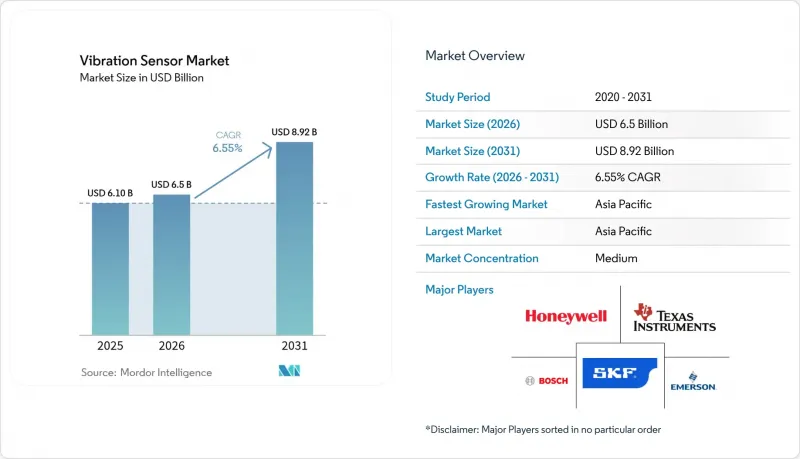
本報告按產品類型(加速計、速度感測器、位移感測器等)、技術(壓電、壓阻式、電容式、應變計、MEMS)、材料(石英、壓電陶瓷、摻雜矽等)、終端用戶產業(汽車、航太和國防等)以及地區(北美、歐洲、亞太地區、南美、中東和非洲)進行分類。
全球振動感測器市場趨勢及洞察
預測性維護計畫在連續流程產業的推廣
亞太地區的工廠營運商利用高密度感測器網路,將大規模數據傳輸至分析引擎,從而實現預測性維護,並將計劃外停機成本降低高達 50%。早期項目,例如 Nordic Sugar 公司蒸氣乾燥機的維修,實現了 13 天的故障預測時間,證明了大型化學和鋼鐵廠投資回報的有效性。持續監測取代了定期檢查,整合到節點中的邊緣運算晶片將延遲降低至毫秒級。推動中國「工業 4.0」升級的政策持續推動了這一趨勢,每個工廠部署了數千台設備。因此,振動感測器市場獲得了來自維護預算而非資本投資週期的長期持續需求。
無線MEMS感測器在危險油氣田的應用日益廣泛
海上平台和煉油廠採用了經認證的無線節點,無需在ATEX區域內進行高成本的電纜鋪設。電池壽命超過三年,壓電能源採集進一步延長了檢查間隔。營運商非常讚賞能夠對現有設備進行改造,而無需承擔每小時高達5萬美元的停機成本。每個感測器整合的FFT處理功能可產生混凝土軸承磨損指南,從而減少了對現場振動負責人的需求。這些優勢擴大了目標市場,並重振了先前數位化維護普及緩慢的油氣生產國的振動感測器市場。
極端溫度下壓電感測器的校準漂移
壓電元件在 110 度C以上會出現輸出偏差,即使在適中的加熱速率下,誤差也高達 1.06%。在渦輪機和航太引擎等每天都會發生熱循環的應用中,頻繁的重新校準增加了生命週期成本。高溫單晶感測器雖然能在 600 度C以上可靠運行,但價格極為昂貴。開發人員探索了補償電路和雙感測器配置,但其複雜的設計限制了它們在大眾市場的吸引力。由此產生的性能與價格之間的權衡,減緩了振動感測器市場中惡劣工作環境細分市場的普及速度。
細分市場分析
2025年,加速計佔銷售額的53.85%,憑藉其在汽車、智慧型手機和工廠馬達等三軸應用中的多功能性,為價值61億美元的振動感測器市場提供了有力支撐。無線速度感測器雖然銷售額較小,但由於煉油廠和管道工程師強調速度與軸承健康狀況之間的直接關聯,推動其在2031年之前以8.75%的複合年成長率持續成長。
小型化的努力推動了新一代加速計的發展,例如博世Sensortec公司的BMA580,它在滿足穿戴式裝置靈敏度要求的同時,將封裝體積縮小了76%。這些晶片整合了邊緣濾波功能,僅發送異常數據,從而減少傳輸數據量,節省網狀網路的頻寬。能源採集技術的同步進步延長了節點壽命,使遠端資產的維護週期可延長至五年。這些改進共同拓展了振動感測器市場,使其涵蓋了先前受制於功率和尺寸限制的穿戴式設備和狀態監測潤滑系統。
由於壓電元件具有低頻靈敏度,預計到2025年,其市佔率將維持在46.05%。同時,得益於半導體晶圓級規模經濟,微機電系統(MEMS)的出貨量將以9.85%的複合年成長率成長。振動感測器市場則受益於單晶片整合技術,該技術將分立的類比前端整合到緊湊的系統晶片(SoC)封裝中。
德克薩斯(TI) 的超音波鏡頭清洗示範凸顯了 MEMS 技術的多功能性,它利用可程式設計振動去除汽車攝影機上的污染物。代工技術的進步使得多軸陣列的實現成為可能,這些陣列能夠測量亞 g 級振動,適用於結構完整性監測。同時,壓阻式和電容式設計已被應用於低佔空比的超低功耗穿戴式裝置。這種多樣化的產品線使得 OEM 廠商能夠根據頻寬、成本和功耗選擇合適的架構,從而擴大了振動感測器的整體市場。
區域分析
到2025年,亞太地區將以33.90%的市場佔有率佔據全球領先地位,這主要得益於中國風力發電機渦輪機部署量的增加以及印度半導體設計中心的建立,從而提振了區域需求。該地區8.05%的複合年成長率也高於全球平均水平,預計將保持主導地位至2031年。日本精密機械製造商透過訂購用於機器人的高解析度感測器,進一步擴大了該地區的振動感測器市場。
北美緊隨其後,這主要得益於化學企業和航太專案對抗輻射設備的ISO合規性要求。在美國國防部門,為了降低網路安全風險,經過邊緣處理和空氣間隙保持的裝置更受青睞,用於維修升級。加拿大礦業公司透過在偏遠礦區部署耐環境影響的無線網狀網路,開闢了振動感測器的利基市場,因為在這些地方舖設有線電纜並不現實。
在歐洲,振動感測器市場已展現出高度成熟度,例如寶馬公司部署配備感測器的機器狗巡邏其引擎工廠。北歐離岸風力發電電場在15兆瓦風力渦輪機上安裝了高通道系統,用於監測偏航角和葉片諧波。嚴格的工人安全指令確保了系統的穩定升級,儘管面臨宏觀經濟逆風,振動感測器市場仍保持強勁勢頭。
南美洲、中東和非洲地區雖然仍屬於新興市場,但正經歷蓬勃發展。受微機電系統(MEMS)成本下降的推動,巴西的礦業公司和農產品加工商已開始部署狀態監控套件。沿岸地區的國家石油公司(NOC)透過採用經ATEX認證的無線感測器用於火炬塔和壓縮機,迅速擴大了其在危險區域振動感測器領域的市場佔有率。
其他好處:
- Excel格式的市場預測(ME)表
- 3個月的分析師支持
目錄
第1章:引言
- 研究假設和市場定義
- 調查範圍
第2章:調查方法
第3章執行摘要
第4章 市場狀況
- 市場概覽
- 市場促進因素
- 在連續流程產業中推廣預測性維護方案(亞太地區)
- 無線MEMS感測器在危險的油氣田(中東)的興起
- 邊緣人工智慧在汽車組裝過程中的診斷(歐洲)
- 在歐盟和北美遵守 ISO 20816 的義務
- 風力發電設施的擴張(北歐國家和中國)
- 對穿戴式和可聽設備小型化的需求
- 市場限制因素
- 極端溫度下壓電感測器的校準漂移
- 基於雲端的分析中的資料安全問題(國防領域)
- 特殊壓電陶瓷材料供不應求(中國出口配額限制)
- 價值鏈分析
- 技術展望
- 波特五力分析
- 投資分析
- 市場宏觀經濟因素的評估
第5章 市場規模與成長預測
- 依產品類型
- 加速計
- 速度感測器
- 位移感測器
- 陀螺儀(振動級)
- 透過技術
- 壓電
- 壓阻式
- 電容式
- 應變計
- MEMS
- 材料
- 石英
- 壓電陶瓷
- 矽酮摻雜
- 其他
- 按最終用途行業分類
- 車
- 航太/國防
- 石油和天然氣
- 工業製造
- 發電(包括風力發電)
- 衛生保健
- 家用電子電器和穿戴式裝置
- 其他
- 按地區
- 北美洲
- 美國
- 加拿大
- 歐洲
- 德國
- 英國
- 法國
- 義大利
- 西班牙
- 其他歐洲國家
- 亞太地區
- 中國
- 台灣
- 日本
- 韓國
- 印度
- ASEAN
- 其他亞太國家
- 南美洲
- 墨西哥
- 巴西
- 阿根廷
- 其他南美國家
- 中東和非洲
- 中東
- 沙烏地阿拉伯
- 阿拉伯聯合大公國
- 土耳其
- 其他中東國家
- 非洲
- 南非
- 其他非洲國家
- 中東
- 北美洲
第6章 競爭情勢
- 市場集中度
- 策略性舉措(併購、合作、資金籌措)
- 市佔率分析
- 公司簡介
- Emerson Electric Co.
- SKF AB
- Honeywell International Inc.
- Analog Devices Inc.
- TE Connectivity Ltd
- Bosch Sensortec GmbH
- Texas Instruments Inc.
- National Instruments Corp.
- Rockwell Automation Inc.
- NXP Semiconductors NV
- Parker Hannifin Corp.
- Baker Hughes(Bently Nevada)
- Wilcoxon Sensing Technologies
- PCB Piezotronics Inc.
- Meggitt PLC(Sensing Systems)
- IMI Sensors
- ifm electronic GmbH
- Siemens AG
- Omron Corporation
- Hansford Sensors Ltd
第7章 市場機會與未來展望
According to Mordor Intelligence, the vibration sensor market size is expected to grow from USD 6.10 billion in 2025 to USD 6.5 billion in 2026 and is forecast to reach USD 8.92 billion by 2031 at 6.55% CAGR over 2026-2031.
This report is Segmented by Product Type (Accelerometers, Velocity Sensors, Displacement Sensors, and More), Technology (Piezoelectric, Piezoresistive, Capacitive, Strain-Gauge, and MEMS), Material (Quartz, Piezoelectric Ceramics, Doped Silicon, and Others), End-Use Industry (Automotive, Aerospace and Defense, and More), and Geography (North America, Europe, Asia-Pacific, South America, and Middle East and Africa).
Global Vibration Sensor Market Trends and Insights
Proliferation of Predictive Maintenance Programs in Continuous Process Industries
Asia-Pacific plant operators used predictive maintenance to reduce unplanned downtime costs by up to 50%, relying on dense sensor grids that stream high-frequency data to analytics engines. Early projects such as the Nordic Sugar steam-dryer retrofit demonstrated 13-day fault-prediction windows, validating payback for large chemical and steel sites. Continuous monitoring displaced periodic walk-by inspections, and edge-computing chips embedded in nodes lowered latency to millisecond levels. Chinese stimulus for Industry 4.0 upgrades-maintained momentum, embedding thousands of devices per facility. Consequently, the vibration sensor market gained long-run recurring demand from maintenance budgets rather than capital expenditure cycles.
Rise of Wireless MEMS Sensors for Hazardous Oil and Gas Sites
Offshore platforms and refineries adopted certified wireless nodes that eliminated costly cable runs through ATEX zones. Battery lives exceeded three years, and piezoelectric energy harvesters further prolonged service intervals. Operators valued retrofit capability without shutting down throughput that could otherwise cost USD 50,000 per hour. Embedded FFT processing in each sensor produced actionable bearing-wear metrics, reducing the need for on-site vibration analysts. These benefits widened the addressable base and lifted the vibration sensor market in hydrocarbon economies that historically lagged digital-maintenance adoption.
Calibration Drift of Piezoelectric Sensors at Extreme Temperatures
Piezoelectric elements experienced output deviations above 110 °C, with errors hitting 1.06% at moderate heating rates. Frequent recalibration raised lifecycle costs in turbines and aerospace engines where thermal cycling was routine. High-temperature single-crystal alternatives operated reliably beyond 600 °C but commanded premium pricing. Developers explored compensation circuits and dual-sensor configurations, yet complex designs limited mass-market appeal. The resulting performance-price trade-off slowed deployments in harsh-duty niches of the vibration sensor market.
Other drivers and restraints analyzed in the detailed report include:
- Edge-AI Enabled Diagnostics in Automotive Assembly
- Mandatory ISO 20816 Compliance in EU and North America
- Data-Security Concerns in Cloud-based Analytics (Defense)
For complete list of drivers and restraints, kindly check the Table Of Contents.
Segment Analysis
Accelerometers generated 53.85% revenue in 2025, underpinning the vibration sensor market size of USD 6.10 billion through their tri-axial versatility in vehicles, smartphones, and factory motors. Wireless velocity devices, though smaller in value, led growth at 8.75% CAGR to 2031 as refinery and pipeline engineers valued velocity's direct correlation with bearing health.
The miniaturization push spurred next-generation accelerometers such as Bosch Sensortec's BMA580, which reduced package volume by 76% while meeting sensitivity targets for hearables. Edge filtering in these chips cuts outbound data by transmitting only anomalies, conserving bandwidth in mesh networks. Parallel advances in energy harvesting prolonged node life, enabling five-year maintenance intervals on remote assets. Together, these enhancements allowed the vibration sensor market to broaden into wearables and condition-based lubrication systems previously constrained by power or size limits.
Piezoelectric elements retained a 46.05% share in 2025 thanks to low-frequency sensitivity, but MEMS shipments expanded at a 9.85% CAGR as semiconductor fabs delivered wafer-level economies. The vibration sensor market benefited from single-die integration that collapsed discrete analog front-ends into compact system-on-chip packages.
Texas Instruments' ultrasonic lens-cleaning demo highlighted MEMS versatility, using programmable vibrations to remove contaminants from automotive cameras. Foundry advances enabled multi-axis arrays measuring sub-g vibrations suitable for structural-health monitoring. Meanwhile, piezoresistive and capacitive designs served ultra-low-power wearables where duty cycles were sparse. This diversified portfolio allowed OEMs to choose architectures based on bandwidth, cost, and power, expanding overall penetration of the vibration sensor market.
Complete Report Scope:
- By Product Type
- Accelerometers
- Velocity Sensors
- Displacement Sensors
- Gyroscopes (Vibration-Grade)
- By Technology
- Piezoelectric
- Piezoresistive
- Capacitive
- Strain-Gauge
- MEMS
- By Material
- Quartz
- Piezoelectric Ceramics
- Doped Silicon
- Others
- By End-Use Industry
- Automotive
- Aerospace and Defense
- Oil and Gas
- Industrial Manufacturing
- Power Generation (incl. Wind)
- Healthcare
- Consumer Electronics and Wearables
- Others
- By Geography
- North America
- United States
- Canada
- Europe
- Germany
- United Kingdom
- France
- Italy
- Spain
- Rest of Europe
- Asia-Pacific
- China
- Taiwan
- Japan
- South Korea
- India
- ASEAN
- Rest of Asia-Pacific
- South America
- Mexico
- Brazil
- Argentina
- Rest of South America
- Middle East and Africa
- Middle East
- Saudi Arabia
- United Arab Emirates
- Turkey
- Rest of Middle East
- Africa
- South Africa
- Rest of Africa
- Middle East
- North America
Geography Analysis
Asia-Pacific led with a 33.90% share in 2025 as China's wind-turbine roll-outs and India's semiconductor design centers lifted local demand. The region's 8.05% CAGR also out-paced global averages, preserving its leadership through 2031. Japanese precision-machinery firms ordered high-resolution sensors for robotics, further enlarging the vibration sensor market in the bloc.
North America followed, driven by ISO compliance in chemical plants and aerospace programs requiring radiation-tolerant devices. US defense retrofits favored edge-processed units that remained air-gapped, mitigating cybersecurity exposure. Canadian miners installed ruggedized wireless mesh networks across remote pits where wired runs were impractical, adding niche demand to the vibration sensor market.
Europe exhibited advanced maturity, exemplified by BMW's sensor-equipped robo-dogs patrolling engine plants. Nordic offshore wind farms fitted high-channel-count systems on 15 MW turbines to monitor yaw and blade harmonics. Strict worker-safety directives assured steady upgrades, keeping the vibration sensor market resilient despite macroeconomic headwinds.
South America and the Middle East/Africa remained emerging but dynamic. Brazilian miners and agribusiness processors began installing condition-monitoring kits, aided by falling MEMS costs. Gulf-region NOCs embraced ATEX-rated wireless sensors for flare stacks and compressors, quickly expanding the vibration sensor market footprint in hazardous-area deployments.
- Emerson Electric Co.
- SKF AB
- Honeywell International Inc.
- Analog Devices Inc.
- TE Connectivity Ltd
- Bosch Sensortec GmbH
- Texas Instruments Inc.
- National Instruments Corp.
- Rockwell Automation Inc.
- NXP Semiconductors N.V.
- Parker Hannifin Corp.
- Baker Hughes (Bently Nevada)
- Wilcoxon Sensing Technologies
- PCB Piezotronics Inc.
- Meggitt PLC (Sensing Systems)
- IMI Sensors
- ifm electronic GmbH
- Siemens AG
- Omron Corporation
- Hansford Sensors Ltd
Additional Benefits:
- The market estimate (ME) sheet in Excel format
- 3 months of analyst support
TABLE OF CONTENTS
1 INTRODUCTION
- 1.1 Study Assumptions and Market Definition
- 1.2 Scope of the Study
2 RESEARCH METHODOLOGY
3 EXECUTIVE SUMMARY
4 MARKET LANDSCAPE
- 4.1 Market Overview
- 4.2 Market Drivers
- 4.2.1 Proliferation of Predictive Maintenance Programs in Continuous Process Industries (Asia Pacific)
- 4.2.2 Rise of Wireless MEMS Sensors for Hazardous Oil and Gas Sites (Middle East)
- 4.2.3 Edge-AI Enabled Diagnostics in Automotive Assembly (Europe)
- 4.2.4 Mandatory ISO 20816 Compliance in EU and North America
- 4.2.5 Expansion of Wind Turbine Installations (Nordics and China)
- 4.2.6 Miniaturization Demand from Wearables and Hearables
- 4.3 Market Restraints
- 4.3.1 Calibration Drift of Piezoelectric Sensors at Extreme Temperatures
- 4.3.2 Data-Security Concerns in Cloud-based Analytics (Defense)
- 4.3.3 Shortage of Specialty Piezo-ceramic Materials (China Export Quotas)
- 4.4 Value Chain Analysis
- 4.5 Technological Outlook
- 4.6 Porter's Five Forces Analysis
- 4.6.1 Threat of New Entrants
- 4.6.2 Bargaining Power of Suppliers
- 4.6.3 Bargaining Power of Buyers
- 4.6.4 Threat of Substitutes
- 4.6.5 Intensity of Competitive Rivalry
- 4.7 Investment Analysis
- 4.8 Assessment of Macroeconomic Factors on the Market
5 MARKET SIZE AND GROWTH FORECASTS (VALUE)
- 5.1 By Product Type
- 5.1.1 Accelerometers
- 5.1.2 Velocity Sensors
- 5.1.3 Displacement Sensors
- 5.1.4 Gyroscopes (Vibration-Grade)
- 5.2 By Technology
- 5.2.1 Piezoelectric
- 5.2.2 Piezoresistive
- 5.2.3 Capacitive
- 5.2.4 Strain-Gauge
- 5.2.5 MEMS
- 5.3 By Material
- 5.3.1 Quartz
- 5.3.2 Piezoelectric Ceramics
- 5.3.3 Doped Silicon
- 5.3.4 Others
- 5.4 By End-Use Industry
- 5.4.1 Automotive
- 5.4.2 Aerospace and Defense
- 5.4.3 Oil and Gas
- 5.4.4 Industrial Manufacturing
- 5.4.5 Power Generation (incl. Wind)
- 5.4.6 Healthcare
- 5.4.7 Consumer Electronics and Wearables
- 5.4.8 Others
- 5.5 By Geography
- 5.5.1 North America
- 5.5.1.1 United States
- 5.5.1.2 Canada
- 5.5.2 Europe
- 5.5.2.1 Germany
- 5.5.2.2 United Kingdom
- 5.5.2.3 France
- 5.5.2.4 Italy
- 5.5.2.5 Spain
- 5.5.2.6 Rest of Europe
- 5.5.3 Asia-Pacific
- 5.5.3.1 China
- 5.5.3.2 Taiwan
- 5.5.3.3 Japan
- 5.5.3.4 South Korea
- 5.5.3.5 India
- 5.5.3.6 ASEAN
- 5.5.3.7 Rest of Asia-Pacific
- 5.5.4 South America
- 5.5.4.1 Mexico
- 5.5.4.2 Brazil
- 5.5.4.3 Argentina
- 5.5.4.4 Rest of South America
- 5.5.5 Middle East and Africa
- 5.5.5.1 Middle East
- 5.5.5.1.1 Saudi Arabia
- 5.5.5.1.2 United Arab Emirates
- 5.5.5.1.3 Turkey
- 5.5.5.1.4 Rest of Middle East
- 5.5.5.2 Africa
- 5.5.5.2.1 South Africa
- 5.5.5.2.2 Rest of Africa
- 5.5.5.1 Middle East
- 5.5.1 North America
6 COMPETITIVE LANDSCAPE
- 6.1 Market Concentration
- 6.2 Strategic Moves (M&A, Partnerships, Funding)
- 6.3 Market Share Analysis
- 6.4 Company Profiles (includes Global-level Overview, Market-level Overview, Core Segments, Financials, Strategic Information, Market Rank/Share, Products and Services, Recent Developments)
- 6.4.1 Emerson Electric Co.
- 6.4.2 SKF AB
- 6.4.3 Honeywell International Inc.
- 6.4.4 Analog Devices Inc.
- 6.4.5 TE Connectivity Ltd
- 6.4.6 Bosch Sensortec GmbH
- 6.4.7 Texas Instruments Inc.
- 6.4.8 National Instruments Corp.
- 6.4.9 Rockwell Automation Inc.
- 6.4.10 NXP Semiconductors N.V.
- 6.4.11 Parker Hannifin Corp.
- 6.4.12 Baker Hughes (Bently Nevada)
- 6.4.13 Wilcoxon Sensing Technologies
- 6.4.14 PCB Piezotronics Inc.
- 6.4.15 Meggitt PLC (Sensing Systems)
- 6.4.16 IMI Sensors
- 6.4.17 ifm electronic GmbH
- 6.4.18 Siemens AG
- 6.4.19 Omron Corporation
- 6.4.20 Hansford Sensors Ltd
7 MARKET OPPORTUNITIES AND FUTURE OUTLOOK
- 7.1 White-space and Unmet-Need Assessment

 美國振動感測器:市場佔有率分析、行業趨勢和統計數據、成長預測(2026-2031 年)
 高溫振動感測器市場規模:按輸出類型、應用、地區和預測分類。
 振動感測器市場:2026-2032年全球市場預測(按感測器類型、檢測技術、頻段、安裝類型、輸出類型、軸配置、應用和最終用途行業分類)
 振動感測器市場報告:按產品、技術、材料、終端應用產業和地區分類(2026-2034 年)全球振動感測器市場規模、佔有率、趨勢和成長分析報告(2026-2034年)
 2026年全球振動感測器市場報告超音波振動感測器市場按技術、產品類型、頻率範圍、應用、最終用戶和銷售管道,全球預測(2026-2032年)
 2032 年振動感測器市場預測:按類型、監測流程、設備、材料、網路、技術、最終用戶和地區進行的全球分析2032 年無線振動感測器市場預測:按感測器類型、應用和地區進行的全球分析
 振動感測器市場規模、佔有率和成長分析(按類型、監測過程、訊號、設備、技術、材料、垂直產業和地區)- 2025-2032 年產業預測