


 |
市場調查報告書
商品編碼
2154820
亞太地區食品級二氧化碳:市場佔有率分析、行業趨勢和統計數據以及成長預測(2026-2031 年)Asia-Pacific Food Grade Carbon Dioxide - Market Share Analysis, Industry Trends & Statistics, Growth Forecasts (2026 - 2031) |
||||||

※ 本網頁內容可能與最新版本有所差異。詳細情況請與我們聯繫。
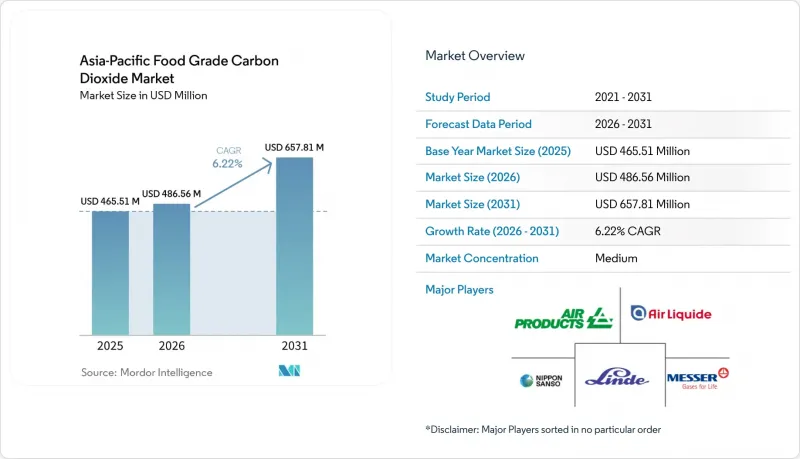
根據 Mordor Intelligence 預測,亞太地區食品二氧化碳市場規模將從 2025 年的 4.6551 億美元成長到 2026 年的 4.8656 億美元,然後在 2031 年達到 6.5781 億美元,2026 年至 2031 年的複合年成長率為 6.22%。
亞太地區食品級二氧化碳市場趨勢及洞察。
碳酸飲料消費量增加
碳酸飲料仍是全部區域食品級二氧化碳的主要需求來源。預計到2026年6月,中國酒精飲料、軟性飲料和精製茶的產量將年增6.1%,顯示大規模飲料生產基地的生產活動將持續活躍。隨著新興都市區飲料廠提高填充和碳酸化能力,亞太地區的食品級二氧化碳市場將受益。氣泡水、風味碳酸飲料和無糖產品需要可靠的碳酸化控制。這項要求有利於那些能夠提供穩定純度和可靠大批量供應的供應商。此外,與偶爾的現貨採購相比,長期供應合約對大規模飲料生產商變得越來越重要。類似的營運要求也強調本地儲存、定期罐車運輸以及供應商提供的品質相關文件。
食品加工和保藏業的擴張
在食品加工領域,二氧化碳的應用範圍已不再侷限於飲料生產。印度食品加工工業部指出,2025年至2047年間,冷鏈基礎建設將需要大量投資,尤其是在肉類和乳製品加工方面。預冷、隧道式冷凍和溫控儲存可能需要液態二氧化碳或乾冰。因此,亞太地區的食品二氧化碳市場正受惠於冷藏包裝食品的興起。在加工業者不斷延長配送距離和保存期限的地區,這種需求最為旺盛。能夠提供氣體供應、儲存和處理支援等綜合服務的供應商,能夠更好地滿足這些應用需求。隨著加工商從本地銷售轉向需要持續溫控的長距離配送,供應商的角色將變得更加關鍵。這也使得氣體需求與冷藏倉庫、運輸和食品處理設備的投資緊密相連。
區域間二氧化碳糧食供應不平衡
食品加工用二氧化碳的供應並不總是與食品加工需求的位置相吻合。大規模二氧化碳回收點集中在印度、中國和泰國的氨和乙醇生產設施附近。而在印尼、馬來西亞、越南和印度東北部,當地的精煉、儲存和分銷能力可能有限。因此,亞太地區食品級二氧化碳市場對沿海和內陸加工商而言可能呈現出不同的特徵。位於液態二氧化碳終端附近的工廠可以獲得長期供應合約。而遠離這些供應網路的加工商則面臨著在飲料需求高峰期出現季節性供應短缺的更高風險。此外,回收點與客戶之間的距離也會增加運輸成本,並降低小規模加工商的柔軟性。
細分市場分析
至2025年,氨廠回收的二氧化碳將佔區域供應量的35.14%。印度、中國和越南的化肥廠會產生高濃度二氧化碳流,這些二氧化碳流可以被回收和純化,用於食品領域。這種供應途徑受益於現有氨和尿素生產的規模優勢。另一方面,食品應用所需的氣體供應會受到化肥產量波動、天然氣成本或工廠維護計畫的影響。氫氣生產、天然氣加工和其他工業來源正作為更側重於本地的供應來源發揮作用。這些替代方案通常透過獨家供應合約或長期商業協議,為一家大規模飲料、食品和肉類加工企業提供支援。它們的貢獻程度取決於當地原料的供應、提純能力以及客戶對食品級品質的要求。
在亞太食品級二氧化碳市場,預計到2031年,從乙醇中回收二氧化碳的市場佔有率將以7.37%的複合年成長率成長。發酵過程會產生高濃度二氧化碳流,這些二氧化碳流可以純化後用於食品和飲料行業。受印度乙醇摻混計畫和泰國生質燃料擴張的推動,全部區域的蒸餾產能正在不斷提高。一座日產能100千公升的乙醇工廠每年可從發酵廢氣中回收13,000至15,000噸二氧化碳。日本酸素泰國公司和泰國特種氣體公司將於2026年啟動「綠色二氧化碳」項目,該項目將提純BBGI位於泰國北春騷府的乙醇生產過程中產生的二氧化碳,並將其供應給食品、飲料和工業領域。
其他好處:
- Excel格式的市場預測(ME)表
- 3個月的分析師支持
目錄
第1章:引言
- 研究假設和市場定義
- 調查範圍
第2章:調查方法
第3章執行摘要
第4章 市場狀況
- 市場概覽
- 市場促進因素
- 碳酸飲料消費量成長
- 食品加工和保藏技術的擴展
- 擴大調氣包裝(MAP)的應用
- 對加工肉類和家禽產品的需求不斷成長
- 擴大冷凍和冷藏食品的生產
- 包裝乳製品和冷凍產品的成長
- 市場限制因素
- 區域間二氧化碳糧食供應不平衡
- 需要對倉儲和配送基礎設施進行大量投資。
- 能源價格波動會影響二氧化碳生產的獲利能力。
- 對食品級純度和認證有嚴格的要求
- 供應鏈分析
- 監理展望
- 波特五力模型
第5章 市場規模與成長預測
- 來源
- 氨
- 乙醇
- 氫
- 天然氣加工
- 其他來源
- 按形式
- 液體
- 氣體
- 固體/乾冰
- 按最終用途行業分類
- 飲料
- 肉類/家禽
- 乳製品和冷凍食品
- 水果和蔬菜
- 麵包糖果甜點
- 其他食品業
- 國家
- 中國
- 日本
- 印度
- 韓國
- 澳洲
- 紐西蘭
- 印尼
- 馬來西亞
- 越南
- 其他亞太國家
第6章 競爭情勢
- 市場集中度
- 策略趨勢
- 市場排名分析
- 公司簡介
- Linde plc
- Air Liquide SA
- Air Products and Chemicals, Inc.
- TAIYO NIPPON SANSO CORPORATION
- Messer SE & Co. KGaA
- Sicgil India Limited
- Ellenbarrie Industrial Gases Limited
- IFB Agro Industries Limited
- WKS Industrial Gas Pte Ltd.
- Southern Gas Limited
- Yingde Gases Group Company Limited
- Hangzhou Hangyang Co., Ltd.
- Sichuan Tianyi Science and Technology Co., Ltd.
- Shandong Shouguang Juneng Golden Corn Co., Ltd.
- Jiangsu Huachang Chemical Co., Ltd.
- Guangdong Huate Gas Co., Ltd.
- Zhejiang Juhua Co., Ltd.
- India Glycols Limited
- PT Samator Indo Gas Tbk
- Air Water, Inc.
第7章 市場機會與未來展望
According to Mordor Intelligence, the asia-pacific food grade carbon dioxide market size is expected to grow from USD 465.51 million in 2025 to USD 486.56 million in 2026 and is forecast to reach USD 657.81 million by 2031 at 6.22% CAGR over 2026-2031.
Asia-Pacific Food Grade Carbon Dioxide Market Trends and Insights
Growth in carbonated beverage consumption
Carbonated beverages remain the main source of food-grade carbon dioxide demand across the region. China reported a 6.1% year-on-year increase in production of liquor, beverages, and refined tea in June 2026, indicating continued manufacturing activity in a large beverage base. The Asia-Pacific food-grade carbon dioxide market benefits when beverage plants add bottling and carbonation capacity in developing urban centers. Sparkling water, flavored carbonated drinks, and sugar-free products require reliable carbonation control. That requirement favors suppliers that can deliver consistent purity and dependable bulk volumes. It also makes long-term supply arrangements more relevant for large beverage producers than occasional spot purchases. The same operating requirements place value on local storage, scheduled tanker deliveries, and supplier quality documentation.
Expansion of food processing and preservation
Food processing is widening the use of carbon dioxide beyond beverage manufacturing. India's Ministry of Food Processing Industries identified a substantial need for cold-chain infrastructure investment between 2025 and 2047, particularly for the handling of meat and dairy products. Pre-cooling, tunnel freezing, and temperature-controlled storage can require liquid carbon dioxide or dry ice. The Asia-Pacific food-grade carbon dioxide market therefore gains from the shift toward refrigerated and packaged food. This demand is strongest where processors are extending distribution distances and shelf life. Supply providers that pair gas delivery with storage and handling support are better placed to serve these applications. Their role becomes more important when processors move from local sales toward longer distribution routes that require consistent temperature management. This also links gas demand to investments in refrigerated warehouses, transport, and food handling equipment.
Regional imbalances in food-grade CO2 availability
Food-grade carbon dioxide supply does not always match the location of food-processing demand. Large recovery sites are concentrated around ammonia and ethanol facilities in India, China, and Thailand. Indonesia, Malaysia, Vietnam, and northeastern India can face limited nearby purification, storage, and distribution capacity. The Asia-Pacific food-grade carbon dioxide market can therefore operate differently for coastal processors and inland processors. Plants located near liquid carbon dioxide terminals can use longer-term supply arrangements. Processors farther from those networks face a greater risk of seasonal supply tightening during peak beverage demand. The distance between recovery sites and customers can also increase delivery costs and reduce the flexibility of smaller processors.
Other drivers and restraints analyzed in the detailed report include:
- Increasing adoption of modified atmosphere packaging (MAP)
- Rising demand for meat and poultry processing
- High investment requirements for storage and distribution infrastructure
For complete list of drivers and restraints, kindly check the Table Of Contents.
Segment Analysis
Ammonia-plant recovery held 35.14% of regional supply in 2025. Fertilizer complexes in India, China, and Vietnam generate concentrated carbon dioxide streams that can be recovered and purified for food applications. This route benefits from the scale of existing ammonia and urea production. It can also expose food-gas supply to changes in fertilizer output, natural gas costs, or plant maintenance schedules. Hydrogen production, natural gas processing, and other industrial sources serve more localized supply positions. These alternatives often support one large beverage, food, or meat processor through captive arrangements or long-term commercial contracts. Their contribution depends on local feedstock availability, purification capability, and the customer's food-grade quality requirements.
Ethanol recovery is projected to grow at a 7.37% CAGR through 2031 within the Asia-Pacific food-grade carbon dioxide market. Fermentation creates a high-concentration carbon dioxide stream that can be purified for food and beverage use. India's ethanol blending program and Thailand's biofuel expansion are increasing distillation capacity across the region. A 100-KLPD ethanol plant can recover 13,000 to 15,000 tonnes of carbon dioxide each year from fermentation exhaust. Nippon Sanso Thailand and Thai Special Gas launched Green CO2 Co., Ltd. in 2026 to purify carbon dioxide from BBGI's ethanol process in Chachoengsao Province for food, beverage, and industrial supply.
Complete Report Scope:
- By Source
- Ammonia
- Ethanol
- Hydrogen
- Natural Gas Processing
- Other Sources
- By Form
- Liquid
- Gas
- Solid/Dry Ice
- By End-use Industry
- Beverages
- Meat & Poultry
- Dairy & Frozen Foods
- Fruits & Vegetables
- Bakery & Confectionery
- Other Food Industries
- By Country
- China
- Japan
- India
- South Korea
- Australia
- New Zealand
- Indonesia
- Malaysia
- Vietnam
- Rest of Asia-Pacific
List of Companies Covered in this Report:
- Linde plc
- Air Liquide S.A.
- Air Products and Chemicals, Inc.
- TAIYO NIPPON SANSO CORPORATION
- Messer SE & Co. KGaA
- Sicgil India Limited
- Ellenbarrie Industrial Gases Limited
- IFB Agro Industries Limited
- WKS Industrial Gas Pte Ltd.
- Southern Gas Limited
- Yingde Gases Group Company Limited
- Hangzhou Hangyang Co., Ltd.
- Sichuan Tianyi Science and Technology Co., Ltd.
- Shandong Shouguang Juneng Golden Corn Co., Ltd.
- Jiangsu Huachang Chemical Co., Ltd.
- Guangdong Huate Gas Co., Ltd.
- Zhejiang Juhua Co., Ltd.
- India Glycols Limited
- PT Samator Indo Gas Tbk
- Air Water, Inc.
Additional Benefits:
- The market estimate (ME) sheet in Excel format
- 3 months of analyst support
TABLE OF CONTENTS
1 INTRODUCTION
- 1.1 Study Assumptions and Market Definition
- 1.2 Scope of the Study
2 RESEARCH METHODOLOGY
3 EXECUTIVE SUMMARY
4 MARKET LANDSCAPE
- 4.1 Market Overview
- 4.2 Market Drivers
- 4.2.1 Growth in carbonated beverage consumption
- 4.2.2 Expansion of food processing and preservation
- 4.2.3 Increasing adoption of modified atmosphere packaging (MAP)
- 4.2.4 Rising demand for meat and poultry processing
- 4.2.5 Expansion of frozen and chilled food production
- 4.2.6 Growth in packaged dairy and frozen products
- 4.3 Market Restraints
- 4.3.1 Regional imbalances in food-grade CO2 availability
- 4.3.2 High investment requirements for storage and distribution infrastructure
- 4.3.3 Energy-price volatility affecting CO2 production economics
- 4.3.4 Stringent food-grade purity and certification requirements
- 4.4 Supply Chain Analysis
- 4.5 Regulatory Outlook
- 4.6 Porter's Five Forces
- 4.6.1 Threat of New Entrants
- 4.6.2 Bargaining Power of Buyers/Consumers
- 4.6.3 Bargaining Power of Suppliers
- 4.6.4 Threat of Substitute Products
- 4.6.5 Intensity of Competitive Rivalry
5 MARKET SIZE AND GROWTH FORECASTS (VALUE)
- 5.1 By Source
- 5.1.1 Ammonia
- 5.1.2 Ethanol
- 5.1.3 Hydrogen
- 5.1.4 Natural Gas Processing
- 5.1.5 Other Sources
- 5.2 By Form
- 5.2.1 Liquid
- 5.2.2 Gas
- 5.2.3 Solid/Dry Ice
- 5.3 By End-use Industry
- 5.3.1 Beverages
- 5.3.2 Meat & Poultry
- 5.3.3 Dairy & Frozen Foods
- 5.3.4 Fruits & Vegetables
- 5.3.5 Bakery & Confectionery
- 5.3.6 Other Food Industries
- 5.4 By Country
- 5.4.1 China
- 5.4.2 Japan
- 5.4.3 India
- 5.4.4 South Korea
- 5.4.5 Australia
- 5.4.6 New Zealand
- 5.4.7 Indonesia
- 5.4.8 Malaysia
- 5.4.9 Vietnam
- 5.4.10 Rest of Asia-Pacific
6 COMPETITIVE LANDSCAPE
- 6.1 Market Concentration
- 6.2 Strategic Moves
- 6.3 Market Ranking Analysis
- 6.4 Company Profiles (includes Company Highlights, Core Segments, Financials (if available), Strategic Information, Market Rank/Share, Products and Services, Recent Developments)
- 6.4.1 Linde plc
- 6.4.2 Air Liquide S.A.
- 6.4.3 Air Products and Chemicals, Inc.
- 6.4.4 TAIYO NIPPON SANSO CORPORATION
- 6.4.5 Messer SE & Co. KGaA
- 6.4.6 Sicgil India Limited
- 6.4.7 Ellenbarrie Industrial Gases Limited
- 6.4.8 IFB Agro Industries Limited
- 6.4.9 WKS Industrial Gas Pte Ltd.
- 6.4.10 Southern Gas Limited
- 6.4.11 Yingde Gases Group Company Limited
- 6.4.12 Hangzhou Hangyang Co., Ltd.
- 6.4.13 Sichuan Tianyi Science and Technology Co., Ltd.
- 6.4.14 Shandong Shouguang Juneng Golden Corn Co., Ltd.
- 6.4.15 Jiangsu Huachang Chemical Co., Ltd.
- 6.4.16 Guangdong Huate Gas Co., Ltd.
- 6.4.17 Zhejiang Juhua Co., Ltd.
- 6.4.18 India Glycols Limited
- 6.4.19 PT Samator Indo Gas Tbk
- 6.4.20 Air Water, Inc.
7 MARKET OPPORTUNITIES AND FUTURE OUTLOOK

 二氧化碳儲能市場規模、佔有率及成長預測(2026-2032 年)全球海洋二氧化碳移除市場規模、佔有率、趨勢和成長分析報告(2026-2034年)
 海洋二氧化碳去除市場機會、成長要素、產業趨勢分析及2026-2035年預測。
 二氧化碳利用市場規模、佔有率和成長分析:按技術、利用通路、終端用戶產業和地區分類-2026-2033年產業預測
 2035年全球液態二氧化碳市場報告
 直接空氣回收(DAC)系統市場預測至2034年-能源來源、部署類型、技術、應用、最終用戶和地區分類的全球分析
 二氧化碳監測儀市場:依產品、技術、連接方式、應用、最終用戶和銷售管道分類-2026-2032年全球預測二氧化碳市場規模、佔有率、成長及全球產業分析:按類型、應用和地區的洞察,2026-2034年的預測液態二氧化碳市場:依來源、純度、包裝類型、應用和終端用戶產業分類-全球預測,2026-2032年2026年全球二氧化碳儲能(CES)技術市場報告