

 |
市場調查報告書
商品編碼
2154751
通訊業意願管理平台:市場佔有率分析、產業趨勢與統計及成長預測(2026-2031)Intent Management Platforms For The Telecom - Market Share Analysis, Industry Trends & Statistics, Growth Forecasts (2026 - 2031) |
||||||

※ 本網頁內容可能與最新版本有所差異。詳細情況請與我們聯繫。
據 Mordor Intelligence 稱,通訊市場意圖管理平台的市場規模預計將從 2025 年的 3.5811 億美元成長到 2026 年的 4.8966 億美元,到 2031 年達到 9.5132 億美元,2026 年至 2031 年的複合年成長率為 114.21%。
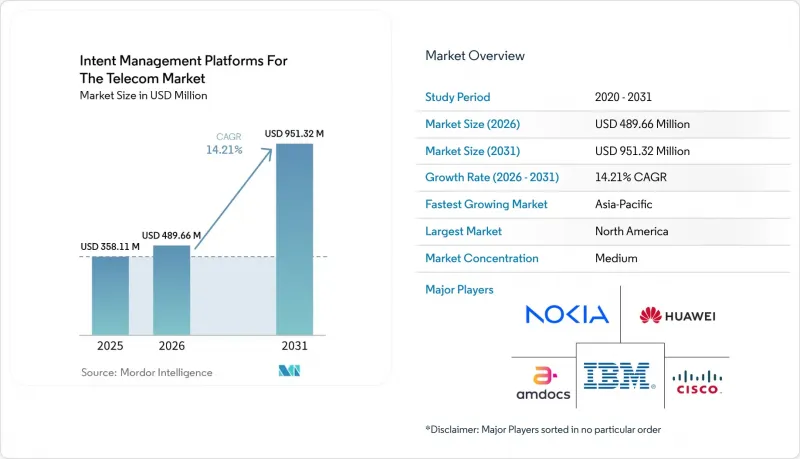
全球電信市場意圖管理平台的發展趨勢與洞察。
5G獨立組網和網路切片的複雜性
在 5G 獨立組網部署中,營運商需要協調無線、傳輸、核心網路和應用資源,以實現通用的服務目標。 2026 年 3 月,TM Forum 批准了《IG1358 基於意圖的操作使用者指南》,建立了一個用於跨多領域環境表示和報告意圖的通用框架。該框架透過為供應商和營運商提供更清晰的互通性基礎,支援電信市場的意圖管理平台。 Mavenir 為德國電信在 5G 獨立組網網路切片上提供的視訊電話服務提供了支持,展示了服務交付如何依賴網路功能和應用之間的協調。營運商必須將配置和維護網路切片的成本控制在收入以下。基於意圖的編配透過將服務目標轉換為可重複的網路操作,並降低跨域配置負擔,滿足了這項要求。
對閉合迴路網路自動化的需求
閉合迴路自動化將實際網路狀況與既定的服務目標進行比較,並在效能偏離目標時採取糾正措施。 3GPP 的「協調閉迴路控制」框架支援基於效能的控制迴路,包括最小切片吞吐量等目標。這項標準化工作為電信市場的意圖管理平台提供了從策略定義到實際網路執行的路線圖。 2026 年 2 月,樂天行動在運作中的Open RAN 環境中獲得了 TM Forum 4 級自主性檢驗,用於 RAN 能效最佳化。據估計,該方案透過自主和意圖驅動的運行,可將 RAN 能耗降低 20%。透過自動化迭代修正循環,電信業者可以改善成本管理並縮短服務保障的回應時間。
整合傳統OSS和BSS的複雜度。
傳統OSS和BSS環境會延緩電信市場意圖管理平台的部署。許多業者仍然維護著4G之前設計的中間層和OSS組件,這些組件採用專有介面和批次模式。這些系統無法直接支援意圖驅動控制所需的即時資料交換。營運商通常需要在平台大規模部署之前更新資料存取方式、規範庫存記錄並開放可靠的API。這會延長部署週期,並擴大系統整合商的角色。在南美洲、中東和非洲以及亞太部分地區,這個問題特別突出,因為這些地區的網路現代化進程比OSS更新周期更快。
細分市場分析
到2025年,「平台與解決方案」將佔據電信意圖管理平台市場的67.55%。初期應用主要集中在取得核心軟體,用於捕捉意圖、設定策略和控制網路行為。由於替換深度嵌入式系統成本高昂且可能中斷運營,電信業者往往更傾向於能夠與其現有開源環境整合的平台。愛立信、諾基亞、Amdocs和Netcracker等公司透過此類整合和長期營運合作關係,已確立了穩固的市場地位。因此,即使在大規模自動化專案的早期階段,平台收入仍佔據相當大的佔有率。
預計2026年至2031年間,電信業意圖管理平台市場將以15.76%的複合年成長率成長,成長率高於通訊業整體意圖管理平台市場。在軟體初期應用之後,市場需求正轉向整合、託管營運、AI模型調優和持續策略維護。 2026年2月,Amdocs發布了面向電信營運商的智慧層“aOS”,該平台不依賴BSS和OSS。 Amdocs表示,該平檯面向超過350家服務供應商。因此,通訊業的意圖管理平台不僅取決於軟體本身的功能,還取決於在運作中網路中部署和運行這些軟體所需的交付能力。
至2025年,雲端技術在電信意圖管理平台市場佔有率將佔57.88%。電信業者正在利用雲端環境擴展策略評估、保障數據以及動態網路工作負載的處理能力。德國電信報告稱,人工智慧驅動的工作負載調度可使5G核心網路營運節能高達65%。這些營運效率的提升進一步證明了電信業者採用雲端技術進行網路現代化改造的合理性。此外,雲端環境還能加快軟體更新速度,並促進與數據驅動型自動化工具的整合。
在電信市場,混合部署的意圖管理平台預計將在2026年至2031年間以16.41%的複合年成長率成長。許多電信業者仍在運作老舊設備並已建立本地系統,這使得將所有網路功能遷移到雲端環境變得不可能。混合平台允許在傳統域和雲端原生功能之間應用策略,而無需即時全面遷移。本地部署在主權網路和企業專用5G應用中仍然發揮著至關重要的作用,這些應用需要本地處理和嚴格的資料管理。因此,通訊業的意圖管理平台需要能夠適應各種不同的部署條件,而不是單一的運作模式。
區域分析
預計2025年,北美將佔據電信領域意圖管理平台市場27.66%的佔有率。該地區受惠於先進的5G獨立組網部署和對自主網路專案的持續投資。根據Proximus的預測,到2026年4月,獨立組網架構預計將佔北美5G連接量的32%。這將使美國和加拿大的營運商能夠獲得更多關於網路切片服務和營運需求的實務經驗。愛立信正在部署一個用於多廠商無線存取網管理和基於意圖的營運的「智慧自動化平台」。在墨西哥,隨著營運商透過頻率分配計畫擴大5G覆蓋範圍,新的商機正在湧現。
在歐洲,5G獨立網路部署、多廠商基礎設施以及自動化決策的管治需求持續影響市場格局。 Proximus預計2026年4月在比利時推出商用5G獨立網路服務,其應用情境涵蓋緊急服務、支付流量和媒體傳輸等領域。歐洲電信業者在部署人工智慧驅動的策略引擎時,需要具備可解釋性、可追溯性和審計記錄。電信市場的意圖管理平台應將這些控制措施整合到營運平台中,而不是作為獨立工具部署。 EANTC的2026年互通性測試預計將凸顯跨不同廠商環境營運所面臨的技術挑戰。英國、德國、法國、西班牙和北歐國家憑藉其先進的網路投資和自動化項目,仍然是重要的市場。
預計亞太地區在2026年至2031年間將以16.65%的複合年成長率成長,並有望成為通訊意圖管理平台市場所有區域中成長最快的地區。在中國,成熟的5G獨立網路環境正在支援面向消費者和企業用戶的商用網路切片。 NTT東日本預計在2026年3月宣布一項涉及26家企業的私人5G最佳化示範實驗,該實驗將採用RIC(網路智慧控制器)控制。該示範實驗預計將在特定條件下實現高達65%的能耗降低。日本和韓國也在透過政府主導的計畫推動網路自動化。沙烏地阿拉伯和阿拉伯聯合大公國(阿拉伯聯合大公國)正透過國家層級的數位轉型和主權網路計畫推動中東地區的需求,而非洲的採用則與能源效率和降低營運成本密切相關。
其他好處:
- Excel格式的市場預測(ME)表
- 3個月的分析師支持
目錄
第1章:引言
- 研究假設和市場定義
- 調查範圍
第2章:調查方法
第3章執行摘要
第4章 市場狀況
- 市場概覽
- 市場促進因素
- 5G獨立組網和網路切片的複雜性
- 對閉合迴路網路自動化的需求
- 雲端原生和多廠商通訊基礎設施的成長
- 網路即程式碼和可程式設計連線的商業化
- 無線和交通網路中的意圖感知能源最佳化
- 基於代理的AI在情境感知通訊操作的應用
- 市場限制因素
- 整合傳統OSS和BSS的複雜度。
- 缺乏通訊自動化和人工智慧工程的技能
- 生成式人工智慧策略引擎的非確定性行為
- 碎片化的意圖本體和供應商互通性
- 宏觀經濟因素對市場的影響
- 產業價值鏈分析
- 監理情勢
- 人工智慧管治和可解釋性的要求
- 數據主權和跨境通訊數據的管理
- 關鍵基礎設施的網路安全要求
- 電信雲端、開放式無線接取網路和網路API標準
- 技術展望
- 波特五力分析
第5章 市場規模與成長預測
- 按組件
- 平台和解決方案
- 服務
- 按部署模式
- 雲
- 現場
- 混合
- 按功能分類的平台
- 理解意圖和解讀自然語言
- 意圖建模和本體管理
- 策略轉換和配置生成
- 其他平台功能
- 按公司規模
- 主要電信營運商
- 本地企業與挑戰者企業
- 私有網路和中立主機營運商
- 按地區
- 北美洲
- 美國
- 加拿大
- 墨西哥
- 南美洲
- 巴西
- 阿根廷
- 其他南美國家
- 歐洲
- 英國
- 德國
- 法國
- 西班牙
- 其他歐洲國家
- 亞太地區
- 中國
- 日本
- 印度
- 韓國
- 其他亞太國家
- 中東
- 沙烏地阿拉伯
- 阿拉伯聯合大公國
- 其他中東國家
- 非洲
- 南非
- 埃及
- 其他非洲國家
- 北美洲
第6章 競爭情勢
- 市場集中度
- 策略趨勢
- 市佔率分析
- 公司簡介
- Cisco Systems, Inc.
- Nokia Corporation
- Juniper Networks, Inc.
- Huawei Technologies Co., Ltd.
- Telefonaktiebolaget LM Ericsson
- Hewlett Packard Enterprise Company
- IBM Corporation
- Ciena Corporation
- Amdocs Limited
- Netcracker Technology Corporation
- Blue Planet, a division of Ciena Corporation
- NEC Corporation
- ZTE Corporation
- Samsung Electronics Co., Ltd.
- VMware, Inc.
- Arista Networks, Inc.
- Forward Networks, Inc.
- NetBrain Technologies, Inc.
- Gluware, Inc.
- Itential, LLC
- Anuta Networks, Inc.
- Wipro Limited
- Accenture plc
第7章 市場機會與未來展望
According to Mordor Intelligence, the intent management platforms for the telecom market size is expected to increase from USD 358.11 million in 2025 to USD 489.66 million in 2026 and reach USD 951.32 million by 2031, expanding at a CAGR of 14.21% over 2026-2031.
Global Intent Management Platforms For The Telecom Market Trends and Insights
5G Standalone and Network Slicing Complexity
5G standalone deployments require operators to coordinate radio, transport, core, and application resources against a common service objective. TM Forum approved its IG1358 Intent-Based Operation User Guide in March 2026, establishing a shared framework for expressing and reporting intent across multi-domain environments. That framework supports intent management platforms in the telecom market by providing vendors and operators with a clearer basis for interoperability. Mavenir supported Deutsche Telekom's video telephony service over a 5G standalone network slice, showing how service delivery depends on coordination between network functions and applications. Operators must keep the cost of configuring and maintaining a slice below the revenue it can generate. Intent-based orchestration addresses this requirement by turning service objectives into repeatable network actions and reducing the configuration burden across domains.
Demand for Closed-Loop Network Automation
Closed-loop automation compares live network conditions with a declared service target and applies corrective actions when performance differs from that target. 3GPP's Coordinated Closed Control Loop framework supports performance-based control loops, including targets such as minimum slice throughput. This standard work provides intent management platforms for the telecom market with a route from policy definition to live network execution. Rakuten Mobile received TM Forum Level 4 Autonomy validation in February 2026 for RAN energy efficiency optimization in a live Open RAN environment. The deployment was estimated to reduce RAN energy consumption by 20% through autonomous, intent-driven operations. Operators that can automate repetitive correction cycles can improve cost control and shorten response times for service assurance.
Legacy OSS and BSS Integration Complexity
Legacy OSS and BSS environments can slow the rollout of intent management platforms in the telecom market. Many operators retain mediation layers and OSS components that were designed before 4G, with proprietary interfaces and batch-processing patterns. These systems do not readily support the real-time data exchange required by intent-driven control. Operators often need to update data access methods, normalize inventory records, and expose reliable APIs before a platform can be deployed at scale. This work can extend deployment schedules and increase the role of systems integrators. The issue is particularly relevant in South America, the Middle East, and Africa, as well as parts of Asia-Pacific, where network modernization can outpace OSS refresh cycles.
Other drivers and restraints analyzed in the detailed report include:
- Growth of Cloud-Native and Multi-Vendor Telecom Infrastructure
- Network-as-Code and Programmable Connectivity Monetization
- Shortage of Telecom Automation and AI Engineering Skills
For complete list of drivers and restraints, kindly check the Table Of Contents.
Segment Analysis
Platforms and Solutions accounted for 67.55% of the telecom market share in intent management platforms in 2025. Early adoption focused on acquiring core software that captures intent, sets policies, and controls network actions. Operators often prefer platforms that integrate with their existing OSS environments, as replacing deeply embedded systems can be costly and disruptive. Ericsson, Nokia, Amdocs, and Netcracker have established strong positions through these integrations and long-term operational relationships. As a result, platform revenue remains significant during the initial phases of large-scale automation programs.
Services are projected to grow at a 15.76% CAGR from 2026 to 2031, outpacing the overall telecom intent management platforms market. Following initial software deployment, demand is shifting toward integration, managed operations, AI model tuning, and ongoing policy maintenance. In February 2026, Amdocs launched aOS, a BSS- and OSS-agnostic intelligence layer for telecom operators. Amdocs stated that the platform was designed for more than 350 service providers. Therefore, intent management platforms for the telecom industry depend not only on software capabilities but also on the delivery capacity needed to deploy and operate them across live networks.
Cloud deployment accounted for 57.88% of the telecom market share for intent management platforms in 2025. Operators use cloud environments to scale processing capacity for policy evaluation, assurance data, and dynamic network workloads. Deutsche Telekom reported that AI-driven workload scheduling could deliver up to 65% energy savings in 5G core operations. These operational efficiencies strengthen the case for cloud deployment among operators that have started modernizing their network functions. Cloud environments also enable faster software updates and integration with data-driven automation tools.
Hybrid deployment is projected to grow at a CAGR of 16.41% from 2026 to 2031 in the intent management platforms for the telecom market. Many operators cannot migrate all network functions to cloud environments because they continue to operate long-lived equipment and have established on-premises systems. A hybrid platform can apply policies across legacy domains and cloud-native functions without requiring an immediate, full-scale migration. On-premises deployment remains relevant for sovereign networks and private enterprise 5G applications that require local processing or stringent data controls. Therefore, the intent management platforms for the telecom industry must support diverse deployment conditions rather than a single operating model.
Complete Report Scope:
- By Component
- Platforms and Solutions
- Services
- By Deployment Model
- Cloud
- On-Premises
- Hybrid
- By Platform Capability
- Intent Capture and Natural-Language Interpretation
- Intent Modeling and Ontology Management
- Policy Translation and Configuration Generation
- Other Platform Capability
- By Enterprise Size
- Large Telecom Operators
- Regional and Challenger Operators
- Private Network and Neutral-Host Operators
- By Geography
- North America
- United States
- Canada
- Mexico
- South America
- Brazil
- Argentina
- Rest of South America
- Europe
- United Kingdom
- Germany
- France
- Spain
- Rest of Europe
- Asia-Pacific
- China
- Japan
- India
- South Korea
- Rest of Asia-Pacific
- Middle East
- Saudi Arabia
- United Arab Emirates
- Rest of Middle East
- Africa
- South Africa
- Egypt
- Rest of Africa
- North America
Geography Analysis
North America is projected to account for 27.66% of the intent management platforms for the telecom market in 2025. The region benefits from advanced 5G standalone deployments and sustained investment in autonomous network programs. Proximus is expected to report that standalone architecture will represent 32% of North American 5G connections in April 2026. This environment provides U.S. and Canadian operators with greater commercial experience in the service and operational requirements of network slicing. Ericsson has positioned its Intelligent Automation Platform for multi-vendor RAN management and intent-based operations. Mexico presents a developing opportunity as operators expand 5G coverage through spectrum allocation programs.
Europe continues to be shaped by 5G standalone deployment, multi-vendor infrastructure, and governance requirements for automated decision-making. Proximus is expected to launch commercial 5G standalone services in Belgium in April 2026, with use cases spanning emergency services, payment traffic, and media distribution. European operators require explainability, traceability, and audit records when deploying AI-driven policy engines. Intent management platforms for the telecom market benefit when these controls are integrated into the operating platform rather than deployed as separate tools. EANTC's 2026 interoperability testing is expected to highlight the engineering challenges of operating across diverse vendor environments. The United Kingdom, Germany, France, Spain, and the Nordic countries remain important markets due to their network investment and automation programs.
Asia-Pacific is projected to grow at a CAGR of 16.65% from 2026 to 2031, representing the highest regional growth rate in the telecom intent management platforms market. China's mature 5G standalone network environment supports commercial network slicing across consumer and enterprise use cases. NTT EAST is expected to report a private 5G optimization demonstration in March 2026 involving 26 companies and RIC-enabled control. The demonstration is expected to show up to a 65% reduction in power consumption under specified conditions. Japan and South Korea also support network automation through government-backed programs. Saudi Arabia and the UAE drive demand in the Middle East through national digital transformation and sovereign network initiatives, while adoption in Africa is more closely linked to energy efficiency and operating cost control.
- Cisco Systems, Inc.
- Nokia Corporation
- Juniper Networks, Inc.
- Huawei Technologies Co., Ltd.
- Telefonaktiebolaget LM Ericsson
- Hewlett Packard Enterprise Company
- IBM Corporation
- Ciena Corporation
- Amdocs Limited
- Netcracker Technology Corporation
- Blue Planet, a division of Ciena Corporation
- NEC Corporation
- ZTE Corporation
- Samsung Electronics Co., Ltd.
- VMware, Inc.
- Arista Networks, Inc.
- Forward Networks, Inc.
- NetBrain Technologies, Inc.
- Gluware, Inc.
- Itential, LLC
- Anuta Networks, Inc.
- Wipro Limited
- Accenture plc
Additional Benefits:
- The market estimate (ME) sheet in Excel format
- 3 months of analyst support
TABLE OF CONTENTS
1 INTRODUCTION
- 1.1 Study Assumptions and Market Definition
- 1.2 Scope of the Study
2 RESEARCH METHODOLOGY
3 EXECUTIVE SUMMARY
4 MARKET LANDSCAPE
- 4.1 Market Overview
- 4.2 Market Drivers
- 4.2.1 5G Standalone and Network Slicing Complexity
- 4.2.2 Demand for Closed-Loop Network Automation
- 4.2.3 Growth of Cloud-Native and Multi-Vendor Telecom Infrastructure
- 4.2.4 Network-as-Code and Programmable Connectivity Monetization
- 4.2.5 Intent-Aware Energy Optimization in Radio and Transport Networks
- 4.2.6 Agentic AI for Context-Aware Telecom Operations
- 4.3 Market Restraints
- 4.3.1 Legacy OSS and BSS Integration Complexity
- 4.3.2 Shortage of Telecom Automation and AI Engineering Skills
- 4.3.3 Non-Deterministic Behavior of Generative AI Policy Engines
- 4.3.4 Fragmented Intent Ontologies and Cross-Vendor Interoperability
- 4.4 Impact of Macroeconomic Factors on the Market
- 4.5 Industry Value Chain Analysis
- 4.6 Regulatory Landscape
- 4.6.1 Artificial Intelligence Governance and Explainability Requirements
- 4.6.2 Data Sovereignty and Cross-Border Telecom Data Controls
- 4.6.3 Critical Infrastructure Cybersecurity Requirements
- 4.6.4 Telecom Cloud, Open RAN, and Network API Standards
- 4.7 Technological Outlook
- 4.8 Porter's Five Forces Analysis
- 4.8.1 Threat of New Entrants
- 4.8.2 Bargaining Power of Suppliers
- 4.8.3 Bargaining Power of Buyers
- 4.8.4 Threat of Substitutes
- 4.8.5 Competitive Rivalry
5 MARKET SIZE AND GROWTH FORECASTS (VALUE)
- 5.1 By Component
- 5.1.1 Platforms and Solutions
- 5.1.2 Services
- 5.2 By Deployment Model
- 5.2.1 Cloud
- 5.2.2 On-Premises
- 5.2.3 Hybrid
- 5.3 By Platform Capability
- 5.3.1 Intent Capture and Natural-Language Interpretation
- 5.3.2 Intent Modeling and Ontology Management
- 5.3.3 Policy Translation and Configuration Generation
- 5.3.4 Other Platform Capability
- 5.4 By Enterprise Size
- 5.4.1 Large Telecom Operators
- 5.4.2 Regional and Challenger Operators
- 5.4.3 Private Network and Neutral-Host Operators
- 5.5 By Geography
- 5.5.1 North America
- 5.5.1.1 United States
- 5.5.1.2 Canada
- 5.5.1.3 Mexico
- 5.5.2 South America
- 5.5.2.1 Brazil
- 5.5.2.2 Argentina
- 5.5.2.3 Rest of South America
- 5.5.3 Europe
- 5.5.3.1 United Kingdom
- 5.5.3.2 Germany
- 5.5.3.3 France
- 5.5.3.4 Spain
- 5.5.3.5 Rest of Europe
- 5.5.4 Asia-Pacific
- 5.5.4.1 China
- 5.5.4.2 Japan
- 5.5.4.3 India
- 5.5.4.4 South Korea
- 5.5.4.5 Rest of Asia-Pacific
- 5.5.5 Middle East
- 5.5.5.1 Saudi Arabia
- 5.5.5.2 United Arab Emirates
- 5.5.5.3 Rest of Middle East
- 5.5.6 Africa
- 5.5.6.1 South Africa
- 5.5.6.2 Egypt
- 5.5.6.3 Rest of Africa
- 5.5.1 North America
6 COMPETITIVE LANDSCAPE
- 6.1 Market Concentration
- 6.2 Strategic Moves
- 6.3 Market Share Analysis
- 6.4 Company Profiles (includes Global Level Overview, Market Level Overview, Core Segments, Financials as available, Strategic Information, Market Rank/Share, Products and Services, Recent Developments)
- 6.4.1 Cisco Systems, Inc.
- 6.4.2 Nokia Corporation
- 6.4.3 Juniper Networks, Inc.
- 6.4.4 Huawei Technologies Co., Ltd.
- 6.4.5 Telefonaktiebolaget LM Ericsson
- 6.4.6 Hewlett Packard Enterprise Company
- 6.4.7 IBM Corporation
- 6.4.8 Ciena Corporation
- 6.4.9 Amdocs Limited
- 6.4.10 Netcracker Technology Corporation
- 6.4.11 Blue Planet, a division of Ciena Corporation
- 6.4.12 NEC Corporation
- 6.4.13 ZTE Corporation
- 6.4.14 Samsung Electronics Co., Ltd.
- 6.4.15 VMware, Inc.
- 6.4.16 Arista Networks, Inc.
- 6.4.17 Forward Networks, Inc.
- 6.4.18 NetBrain Technologies, Inc.
- 6.4.19 Gluware, Inc.
- 6.4.20 Itential, LLC
- 6.4.21 Anuta Networks, Inc.
- 6.4.22 Wipro Limited
- 6.4.23 Accenture plc
7 MARKET OPPORTUNITIES AND FUTURE OUTLOOK
- 7.1 White-Space and Unmet-Need Assessment

 網路自動化與編配:研究訂閱自動化保障:研究訂閱
 意圖驅動型網路市場預測至2034年—按組件、功能、部署模式、技術、應用、最終用戶和地區分類的全球分析
 全球網路自動化市場(至 2032 年):依網路自動化類型分類(編配自動化、設定自動化、腳本驅動網路自動化、AI 驅動網路自動化、IBN 自動化、網路安全自動化)
 寬頻體驗分析:市場佔有率分析、產業趨勢與統計、成長預測(2026-2031 年)
 低壓和中壓電力網路自動化市場-2026年至2032年全球市場預測網路自動化:市場佔有率分析、產業趨勢與統計、成長預測(2026-2031)網路自動化市場:按元件、應用、網路類型、部署模式、最終用戶、國家和地區分類-產業分析、市場規模、市場佔有率和預測(2026-2033 年)網路自動化市場-2026-2032年全球市場預測營運支援系統市場預測至2034年-按組件、部署模式、網路類型、功能、最終用戶和地區分類的全球分析