


 |
市場調查報告書
商品編碼
2119335
寬頻體驗分析:市場佔有率分析、產業趨勢與統計、成長預測(2026-2031 年)Broadband Experience Analytics - Market Share Analysis, Industry Trends & Statistics, Growth Forecasts (2026 - 2031) |
||||||

※ 本網頁內容可能與最新版本有所差異。詳細情況請與我們聯繫。
根據 Mordor Intelligence 預測,寬頻體驗分析市場規模將從 2025 年的 31.8 億美元和 2026 年的 35.5 億美元成長到 2031 年的 62.1 億美元,2026 年至 2031 年的年複合成長率(CAGR)為 11.83%。
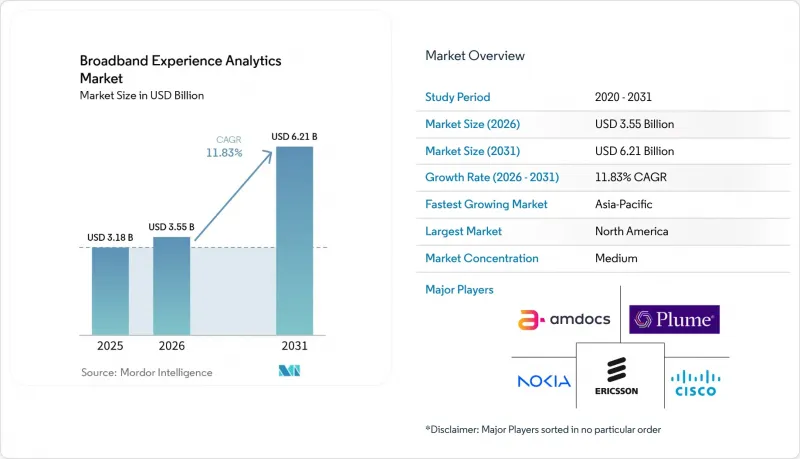
本報告按分析功能(例如,客戶體驗分析)、部署模式(雲端、本地部署)、元件(軟體、服務)、供應商類型(例如,寬頻網際網路服務供應商、電信服務供應商)、組織規模(大型業者、中小企業)、應用程式(例如,網路效能管理)和地區進行細分。市場預測以美元計價。
全球寬頻體驗分析市場趨勢與洞察
用戶對穩定寬頻體驗的期望不斷提高
在寬頻體驗分析市場,服務品質是留住用戶的關鍵。寬頻供應商需要更清楚地了解整個流程的效能,涵蓋從接取網路和應用程式到家庭Wi-Fi和客戶支援的各個環節。歐洲電子隱私框架將隱私保護測量作為處理通訊資料的部署環境中的關鍵設計要求。英國資訊專員辦公室 (ICO) 指出,流量資料需要適當的處理和管理,且不應保留超過其用途所需的時間。這項要求推動了寬頻體驗分析市場對能夠在不依賴不必要的個人資料保留的情況下識別服務問題的平台的需求。因此,隨著營運商利用用戶層面的證據在問題導致重複支持請求或客戶轉換之前解決問題,寬頻體驗分析市場將從中受益。
光纖、固定無線存取和多Gigabit網路的擴展
光纖、DOCSIS、固定無線存取和低地球軌道衛星服務正在加劇同一家庭內部的連接競爭。在這種環境下,由於業者需要比較不同接取方式的效能,單一技術的監控效用逐漸降低。據光纖寬頻協會(FBA)稱,截至今年年底,光纖已覆蓋美國眾多家庭,連接了相當數量的家庭,並實現了中等程度的全國普及率。據全球供應商協會(GSA)稱,截至2026年4月,商用5G固定無線存取在歐洲、中東和非洲的部署仍在繼續。隨著網路規模的擴大,寬頻體驗分析市場對能夠追蹤延遲、抖動、閘道器行為和Wi-Fi效能的系統需求日益成長,尤其是在用戶切換接取技術時。隨著營運商尋求制定容量規劃和技術遷移決策所需的依據,寬頻體驗分析市場的重要性進一步凸顯。
高昂的實施和整合成本
在寬頻體驗分析市場部署寬頻體驗分析需要協調多家供應商的傳統偵測器、深層封包檢測(DPI) 系統、雲端擷取器和設備。這會導致部署週期延長和整體擁有成本 (TCO) 增加,尤其對於非大型電信集團而言更是如此。當光纖、DOCSIS 和固定無線存取層產生格式和詳細程度各異的資料時,這項挑戰會進一步加劇。小規模的區域營運商可能缺乏能夠大規模管理自訂介面的分析工程團隊。雖然託管服務和雲端產品可以減輕這種負擔,但與本地部署系統相比,它們可能會導致更高的持續成本。除非供應商提供更多現成的連接器、更簡單的平台和基於效能的定價模式,否則寬頻體驗分析市場的發展將受到限制。
細分市場分析
截至2025年,客戶體驗分析(QoE)的市佔率已達31.28%。電信業者利用這項功能將網路效能與服務互動、計費清晰度、支援回應速度和客戶維繫風險關聯起來。這使得團隊能夠在客戶不滿升級為流失或公開申訴之前識別出問題所在。預計到2031年,客戶體驗品質(QoE)分析市場將以12.12%的複合年成長率成長。 2025年5月,寬頻論壇推出了WT-524項目,旨在開發通用的QoE參數以及基於人工智慧的頻寬、延遲、抖動和封包遺失測量框架。這項措施將有助於服務提供者更一致地評估寬頻服務的品質。
預計到2025年,中國的光纖到戶(FTTR)部署將顯著擴大,並在2026年繼續成長,這將導致營運商需要監控的房間、設備和閘道器數量增加。網路效能分析為容量規劃提供信息,服務保障分析則有助於監控企業和公共部門連接的服務等級協定(SLA)。客戶體驗分析還可以評估服務和支援體驗。一個整合了這兩種觀點的平台能夠區分網路故障和服務流程問題,從而支援更有針對性的糾正措施。
預計到2025年,雲端採用率將佔市場佔有率的57.77%,並將以12.24%的複合年成長率持續成長至2031年。電信營運商正在利用雲端平台支援持續軟體交付、在尖峰時段擴展規模,以及在無需依賴設備更換週期的情況下存取人工智慧服務。 2026年6月,諾基亞和Google雲端宣布計畫於2026年9月透過Google雲端市場以SaaS應用的形式推出「諾基亞保障中心」。該服務也旨在透過谷歌分散式雲端支援本地部署。這項選擇反映了電信業者在龐大且監管嚴格的環境中對柔軟性的需求。
當資料居住要求限制用戶資料在本地基礎架構之外的移動時,本地部署仍然可行。混合架構將資料擷取置於更靠近網路的位置,同時將部分運算工作負載遷移到雲端。這種方法既降低了傳輸原始遙測資料的成本,也保留了用戶層級的詳細資訊。 2025年10月,RADCOM發布了其「高容量用戶分析」解決方案,該方案利用NVIDIA的網路平台,在單一商用伺服器上收集和分析高達400 Gbps的資料。如果供應商能夠同時滿足雲端現代化目標和資料居住要求,寬頻體驗分析市場將從中受益。
區域分析
到2025年,北美將佔據30.27%的市場。光纖網路的過度開發、網路服務供應商(ISP)之間的激烈競爭以及成熟的營運支撐系統(OSS)和業務支撐系統(BSS)現代化項目,都在支撐著美國和加拿大的市場需求。根據光纖寬頻協會預測,到2025年底,美國將有8,460萬戶家庭接入光纖網路。在這種情況下,對於在競爭激烈的地區營運的服務提供者而言,客戶維繫和服務差異化顯得尤為重要。
預計到2031年,亞太地區將以12.58%的複合年成長率成長,成為寬頻體驗分析市場成長最快的地區。日本、韓國和中國龐大的寬頻用戶數量、密集的FTTH(光纖到戶)部署以及體驗品質(QoE)報告項目都支撐了這一地位。在中國,固定寬頻用戶基數在2025年持續成長,FTTR(光纖到府)部署量也在年底前顯著增加。 SK Broadband推出了「AQUA」系統,該系統利用人工智慧識別和解決IPTV異常問題,預計每年可大幅減少客戶申訴數量。該系統的聊天機器人無需人工客服即可處理大部分諮詢。
由於歐洲擁有完善的服務品質法規和網路彈性義務,因此仍是寬頻體驗分析市場的重要區域。德國、英國和法國是關鍵市場,其大規模光纖部署計劃和品質報告框架為分析技術的應用提供了支援。歐洲資料保護委員會 (EDPB) 計劃於 2025 年推出的偽匿名化方案將為用戶資料的合規處理提供進一步指南。在中東,特別是沙烏地阿拉伯和阿拉伯聯合大公國,分析技術正被用於數位基礎設施的現代化改造;而在非洲,南非、奈及利亞和埃及等領先的行動寬頻營運商正積極採用分析技術。
其他好處:
- Excel格式的市場預測(ME)表
- 三個月的分析師支持
目錄
第1章:引言
- 研究假設和市場定義
- 調查範圍
第2章:調查方法
第3章執行摘要
第4章 市場狀況
- 市場概覽
- 市場促進因素
- 用戶對穩定寬頻體驗的期望日益提高
- 光纖、固定無線存取和多Gigabit網路的擴展。
- 人工智慧驅動的預測網路保固和自動維修
- 降低寬頻用戶解約率並最佳化客戶終身價值
- 基於真實世界經驗的標竿分析,以實現競爭優勢
- 家庭 Wi-Fi 與家庭體驗之間的可見性差距
- 市場限制因素
- 高昂的實施和整合成本
- 資料隱私、資料居住要求和同意限制
- 碎片化的遙測資料和有限的寬頻經驗資料標準
- 體驗式投資短期盈利難以證明。
- 宏觀經濟因素對市場的影響
- 產業價值鏈分析
- 監理情勢
- 技術展望
- 波特五力分析
第5章 市場規模與成長預測
- 透過分析能力
- 客戶經驗分析
- 網路效能分析
- 體驗品質 (QoE) 分析
- 服務保障分析
- 其他分析技能
- 不同的發展
- 雲
- 現場
- 按組件
- 軟體
- 服務
- 諮詢和整合服務
- 託管服務
- 支援和維護服務
- 按提供者類型
- 寬頻網際網路服務供應商
- 電信服務供應商
- 有線電視營運商
- 託管服務供應商
- 政府和監管機構
- 企業網路供應商
- 按組織規模
- 主要企業
- 中小企業
- 透過使用
- 網路效能管理
- 故障檢測和根本原因分析
- 用戶體驗監測
- 家庭 Wi-Fi 與連網裝置分析
- 服務等級協定 (SLA) 監控
- 取消預測和客戶維繫
- 其他用途
- 按地區
- 北美洲
- 美國
- 加拿大
- 墨西哥
- 南美洲
- 巴西
- 阿根廷
- 智利
- 其他南美國家
- 歐洲
- 德國
- 英國
- 法國
- 義大利
- 西班牙
- 俄羅斯
- 其他歐洲國家
- 亞太地區
- 中國
- 印度
- 日本
- 韓國
- 澳洲
- 印尼
- 其他亞太國家
- 中東
- 沙烏地阿拉伯
- 阿拉伯聯合大公國
- 以色列
- 土耳其
- 其他中東國家
- 非洲
- 南非
- 奈及利亞
- 埃及
- 肯亞
- 其他非洲國家
- 北美洲
第6章 競爭情勢
- 市場集中度
- 策略趨勢
- Product Launches and Platform Enhancements
- Partnerships and Ecosystem Integration
- Acquisitions and Portfolio Expansion
- Cloud-Native and AI Investment
- 市佔率分析
- 公司簡介
- Nokia Corporation
- Cisco Systems, Inc.
- Telefonaktiebolaget LM Ericsson
- Amdocs Limited
- Huawei Technologies Co., Ltd.
- Plume Design, Inc.
- Calix, Inc.
- Broadcom Inc.
- RADCOM Ltd.
- Infovista SAS
- Opensignal Limited
- Ookla LLC
- Anritsu Corporation
- Rohde & Schwarz GmbH & Co. KG
- EXFO Inc.
- VIAVI Solutions Inc.
- Sandvine Corporation
- NETSCOUT SYSTEMS, INC.
- Enghouse Systems Limited
- ASSIA, Inc.
- MedUX
- Epitiro Limited
- Accenture plc
第7章 市場機會與未來展望
According to Mordor Intelligence, the broadband experience analytics market size is projected to expand from USD 3.18 billion in 2025 and USD 3.55 billion in 2026 to USD 6.21 billion by 2031, registering a CAGR of 11.83% between 2026 to 2031.
This report is Segmented by Analytics Capability (Customer Experience Analytics, and More), Deployment (Cloud, and On-Premises), Component (Software, and Services), Provider Type (Broadband ISPs, Telecom SPs, and More), Organization Size (Large Operators, and SMEs), Application (Network Performance Management, and More), and Geography. The Market Forecasts are Provided in Terms of Value (USD).
Global Broadband Experience Analytics Market Trends and Insights
Rising Subscriber Expectations for Consistent Broadband Experience
Service quality has become central to subscriber retention in the broadband experience analytics market. Broadband providers need a clearer view of performance across the access network, applications, home Wi-Fi, and customer support journey. The European ePrivacy framework makes privacy-preserving measurement an important design requirement for deployments that process communications data. The UK Information Commissioner's Office states that traffic data requires suitable processing controls and should not be retained longer than necessary for its purpose. This requirement increases demand in the broadband experience analytics market for platforms that can identify service issues without relying on unnecessary retention of personal data. The broadband experience analytics market, therefore, benefits when operators use subscriber-level evidence to resolve faults before they lead to repeat support interactions or switching decisions.
Fiber, Fixed Wireless Access, and Multi-Gigabit Network Expansion
Fiber, DOCSIS, fixed wireless access, and low-earth-orbit satellite services increasingly compete for the same household connections. This mix makes single-technology monitoring less useful because operators need to compare performance across different access methods. The Fiber Broadband Association reported that fiber reached a broad base of U.S. homes by the end of the year, with a substantial number of households connected and a moderate national take rate. The Global Supplier Association reported continued commercial 5G fixed wireless access launches as of April 2026, with activity spanning Europe, the Middle East, and Africa. These network expansions create greater demand in the broadband experience analytics market for systems that can track latency, jitter, gateway behavior, and Wi-Fi performance as customers move between access technologies. The broadband experience analytics market gains importance when providers need evidence for capacity planning and technology migration decisions.
High Implementation and Integration Costs
Deployments in the broadband experience analytics market must connect legacy probes, deep packet inspection systems, cloud collectors, and equipment from several vendors. This work can extend delivery schedules and increase the total cost of ownership, particularly outside the largest operator group. The challenge becomes greater when fiber, DOCSIS, and fixed wireless access layers produce data in different formats and at different levels of detail. Smaller regional operators may not have analytics engineering teams that can manage custom interfaces at scale. Managed services and cloud-based delivery can reduce this burden, but they may carry a higher recurring cost than self-operated systems. The broadband experience analytics market faces a constraint until vendors provide more pre-built connectors, simpler platforms, and pricing tied to operational outcomes.
Other drivers and restraints analyzed in the detailed report include:
- AI-Enabled Predictive Network Assurance and Automated Remediation
- Broadband Churn Reduction and Customer Lifetime Value Optimization
- Data Privacy, Residency, and Consent Constraints
For complete list of drivers and restraints, kindly check the Table Of Contents.
Segment Analysis
Customer Experience Analytics held 31.28% of the share of the market in 2025. Operators use this capability to connect network performance with service interactions, billing clarity, support responsiveness, and retention risk. It helps teams identify dissatisfaction before it becomes a churn event or a public complaint. Quality of Experience Analytics is projected to expand at a 12.12% CAGR through 2031. The Broadband Forum launched the WT-524 project in May 2025 to develop common quality-of-experience parameters and AI-enhanced measurement frameworks for bandwidth, latency, jitter, and packet loss. This work supports a more consistent evaluation of broadband service quality across providers.
China's FTTR deployment is projected to expand significantly through 2025 and continue growing in 2026, increasing the number of rooms, devices, and gateways that providers must monitor. Network Performance Analytics provides inputs for capacity planning, while Service Assurance Analytics supports service-level agreement monitoring for business and public-sector connections. Customer Experience Analytics also assesses the service and support experience. Platforms that integrate both views can distinguish a network fault from a service-process issue and support more targeted remediation.
Cloud deployment accounted for 57.77% of the share of the market in 2025 and is projected to expand at a 12.24% CAGR through 2031. Operators use cloud platforms to support continuous software delivery, scale during traffic peaks, and use AI services without relying on appliance replacement cycles. In June 2026, Nokia and Google Cloud announced a plan to offer Nokia Assurance Center as a SaaS application through Google Cloud Marketplace in September 2026. The offering was also designed for on-premises deployment through Google Distributed Cloud. This choice reflects the need for flexibility in large and regulated operator environments.
On-premises deployment remains relevant where data residency requirements limit the movement of subscriber data outside the national infrastructure. Hybrid architecture places the collection close to the network while moving selected computing workloads to the cloud. This approach can reduce the cost of transferring raw telemetry while preserving subscriber-level detail. RADCOM introduced its High-Capacity User Analytics solution in October 2025, stating that it could capture and analyze up to 400 Gbps on a single commercial server using NVIDIA networking platforms. The broadband experience analytics market benefits when vendors can meet both cloud modernization goals and data-residency requirements.
Complete Report Scope:
- By Analytics Capability
- Customer Experience Analytics
- Network Performance Analytics
- Quality of Experience Analytics
- Service Assurance Analytics
- Others Analytics Capability
- By Deployment
- Cloud
- On-Premises
- By Component
- Software
- Services
- Consulting and Integration Services
- Managed Services
- Support and Maintenance Services
- By Provider Type
- Broadband Internet Service Providers
- Telecom Service Providers
- Cable Operators
- Managed Service Providers
- Government and Regulatory Agencies
- Enterprise Network Operators
- By Organization Size
- Large Operators
- Small and Medium-Sized Operators
- By Application
- Network Performance Management
- Fault Detection and Root-Cause Analysis
- Subscriber Experience Monitoring
- Home Wi-Fi and Connected Device Analytics
- Service-Level Agreement Monitoring
- Churn Prediction and Retention
- Other Applications
- By Geography
- North America
- United States
- Canada
- Mexico
- South America
- Brazil
- Argentina
- Chile
- Rest of South America
- Europe
- Germany
- United Kingdom
- France
- Italy
- Spain
- Russia
- Rest of Europe
- Asia-Pacific
- China
- India
- Japan
- South Korea
- Australia
- Indonesia
- Rest of Asia-Pacific
- Middle East
- Saudi Arabia
- United Arab Emirates
- Israel
- Turkey
- Rest of Middle East
- Africa
- South Africa
- Nigeria
- Egypt
- Kenya
- Rest of Africa
- North America
Geography Analysis
North America held 30.27% of the share of the market in 2025. Fiber overbuilds, intense ISP competition, and mature OSS and BSS modernization programs support demand across the United States and Canada. The Fiber Broadband Association reported that fiber is expected to pass 84.6 million U.S. homes by year-end 2025. These conditions make retention and service differentiation more important for providers operating in competitive areas.
Asia-Pacific is projected to expand at a 12.58% CAGR through 2031, making it the fastest-growing region in the broadband experience analytics market. High broadband subscriber numbers, dense FTTH deployment, and quality-of-experience reporting programs in Japan, South Korea, and China support this position. China's fixed broadband base continued to expand in 2025, while FTTR adoption also increased significantly by year-end. SK Broadband deployed its AQUA system to identify and resolve IPTV anomalies using AI, and expected annual customer complaints to decline substantially. The system's chatbot handled most inquiries without human agents.
Europe remains an established region for the broadband experience analytics market because of detailed service-quality rules and network resilience obligations. Germany, the United Kingdom, and France are important markets because large fiber deployment programs and quality-reporting frameworks support analytics adoption. The European Data Protection Board's 2025 work on pseudonymization adds further guidance for compliant subscriber-data processing. The Middle East, especially Saudi Arabia and the United Arab Emirates, is using analytics in digital infrastructure modernization, while African adoption is concentrated among major mobile broadband providers in South Africa, Nigeria, and Egypt.
- Nokia Corporation
- Cisco Systems, Inc.
- Telefonaktiebolaget LM Ericsson
- Amdocs Limited
- Huawei Technologies Co., Ltd.
- Plume Design, Inc.
- Calix, Inc.
- Broadcom Inc.
- RADCOM Ltd.
- Infovista S.A.S.
- Opensignal Limited
- Ookla LLC
- Anritsu Corporation
- Rohde & Schwarz GmbH & Co. KG
- EXFO Inc.
- VIAVI Solutions Inc.
- Sandvine Corporation
- NETSCOUT SYSTEMS, INC.
- Enghouse Systems Limited
- ASSIA, Inc.
- MedUX
- Epitiro Limited
- Accenture plc
Additional Benefits:
- The market estimate (ME) sheet in Excel format
- 3 months of analyst support
TABLE OF CONTENTS
1 INTRODUCTION
- 1.1 Study Assumptions and Market Definition
- 1.2 Scope of the Study
2 RESEARCH METHODOLOGY
3 EXECUTIVE SUMMARY
4 MARKET LANDSCAPE
- 4.1 Market Overview
- 4.2 Market Drivers
- 4.2.1 Rising Subscriber Expectations for Consistent Broadband Experience
- 4.2.2 Fiber, Fixed Wireless Access, and Multi-Gigabit Network Expansion
- 4.2.3 AI-Enabled Predictive Network Assurance and Automated Remediation
- 4.2.4 Broadband Churn Reduction and Customer Lifetime Value Optimization
- 4.2.5 Real-World Experience Benchmarking for Competitive Differentiation
- 4.2.6 Home Wi-Fi and In-Home Experience Visibility Gap
- 4.3 Market Restraints
- 4.3.1 High Implementation and Integration Costs
- 4.3.2 Data Privacy, Residency, and Consent Constraints
- 4.3.3 Fragmented Telemetry and Limited Broadband Experience Data Standards
- 4.3.4 Difficulty Demonstrating Short-Term Return on Experience Investments
- 4.4 Impact of Macroeconomic Factors on the Market
- 4.5 Industry Value Chain Analysis
- 4.6 Regulatory Landscape
- 4.7 Technological Outlook
- 4.8 Porter's Five Forces Analysis
- 4.8.1 Bargaining Power of Suppliers
- 4.8.2 Bargaining Power of Buyers
- 4.8.3 Threat of New Entrants
- 4.8.4 Threat of Substitutes
- 4.8.5 Competitive Rivalry
5 MARKET SIZE AND GROWTH FORECASTS (VALUE)
- 5.1 By Analytics Capability
- 5.1.1 Customer Experience Analytics
- 5.1.2 Network Performance Analytics
- 5.1.3 Quality of Experience Analytics
- 5.1.4 Service Assurance Analytics
- 5.1.5 Others Analytics Capability
- 5.2 By Deployment
- 5.2.1 Cloud
- 5.2.2 On-Premises
- 5.3 By Component
- 5.3.1 Software
- 5.3.2 Services
- 5.3.2.1 Consulting and Integration Services
- 5.3.2.2 Managed Services
- 5.3.2.3 Support and Maintenance Services
- 5.4 By Provider Type
- 5.4.1 Broadband Internet Service Providers
- 5.4.2 Telecom Service Providers
- 5.4.3 Cable Operators
- 5.4.4 Managed Service Providers
- 5.4.5 Government and Regulatory Agencies
- 5.4.6 Enterprise Network Operators
- 5.5 By Organization Size
- 5.5.1 Large Operators
- 5.5.2 Small and Medium-Sized Operators
- 5.6 By Application
- 5.6.1 Network Performance Management
- 5.6.2 Fault Detection and Root-Cause Analysis
- 5.6.3 Subscriber Experience Monitoring
- 5.6.4 Home Wi-Fi and Connected Device Analytics
- 5.6.5 Service-Level Agreement Monitoring
- 5.6.6 Churn Prediction and Retention
- 5.6.7 Other Applications
- 5.7 By Geography
- 5.7.1 North America
- 5.7.1.1 United States
- 5.7.1.2 Canada
- 5.7.1.3 Mexico
- 5.7.2 South America
- 5.7.2.1 Brazil
- 5.7.2.2 Argentina
- 5.7.2.3 Chile
- 5.7.2.4 Rest of South America
- 5.7.3 Europe
- 5.7.3.1 Germany
- 5.7.3.2 United Kingdom
- 5.7.3.3 France
- 5.7.3.4 Italy
- 5.7.3.5 Spain
- 5.7.3.6 Russia
- 5.7.3.7 Rest of Europe
- 5.7.4 Asia-Pacific
- 5.7.4.1 China
- 5.7.4.2 India
- 5.7.4.3 Japan
- 5.7.4.4 South Korea
- 5.7.4.5 Australia
- 5.7.4.6 Indonesia
- 5.7.4.7 Rest of Asia-Pacific
- 5.7.5 Middle East
- 5.7.5.1 Saudi Arabia
- 5.7.5.2 United Arab Emirates
- 5.7.5.3 Israel
- 5.7.5.4 Turkey
- 5.7.5.5 Rest of Middle East
- 5.7.6 Africa
- 5.7.6.1 South Africa
- 5.7.6.2 Nigeria
- 5.7.6.3 Egypt
- 5.7.6.4 Kenya
- 5.7.6.5 Rest of Africa
- 5.7.1 North America
6 COMPETITIVE LANDSCAPE
- 6.1 Market Concentration
- 6.2 Strategic Moves
- 6.2.1 Product Launches and Platform Enhancements
- 6.2.2 Partnerships and Ecosystem Integration
- 6.2.3 Acquisitions and Portfolio Expansion
- 6.2.4 Cloud-Native and AI Investment
- 6.3 Market Share Analysis
- 6.4 Company Profiles (includes Global Level Overview, Market Level Overview, Core Segments, Financials as available, Strategic Information, Market Rank/Share, Products and Services, Recent Developments)
- 6.4.1 Nokia Corporation
- 6.4.2 Cisco Systems, Inc.
- 6.4.3 Telefonaktiebolaget LM Ericsson
- 6.4.4 Amdocs Limited
- 6.4.5 Huawei Technologies Co., Ltd.
- 6.4.6 Plume Design, Inc.
- 6.4.7 Calix, Inc.
- 6.4.8 Broadcom Inc.
- 6.4.9 RADCOM Ltd.
- 6.4.10 Infovista S.A.S.
- 6.4.11 Opensignal Limited
- 6.4.12 Ookla LLC
- 6.4.13 Anritsu Corporation
- 6.4.14 Rohde & Schwarz GmbH & Co. KG
- 6.4.15 EXFO Inc.
- 6.4.16 VIAVI Solutions Inc.
- 6.4.17 Sandvine Corporation
- 6.4.18 NETSCOUT SYSTEMS, INC.
- 6.4.19 Enghouse Systems Limited
- 6.4.20 ASSIA, Inc.
- 6.4.21 MedUX
- 6.4.22 Epitiro Limited
- 6.4.23 Accenture plc
7 MARKET OPPORTUNITIES AND FUTURE OUTLOOK
- 7.1 White-Space and Unmet-Need Assessment

 意圖驅動型網路市場預測至2034年—按組件、功能、部署模式、技術、應用、最終用戶和地區分類的全球分析
 全球網路自動化市場(至 2032 年):依網路自動化類型分類(編配自動化、設定自動化、腳本驅動網路自動化、AI 驅動網路自動化、IBN 自動化、網路安全自動化)
 低壓和中壓電力網路自動化市場-2026年至2032年全球市場預測
 網路自動化:市場佔有率分析、產業趨勢與統計、成長預測(2026-2031)
 網路自動化市場:按元件、應用、網路類型、部署模式、最終用戶、國家和地區分類-產業分析、市場規模、市場佔有率和預測(2026-2033 年)網路自動化市場-2026-2032年全球市場預測營運支援系統市場預測至2034年-按組件、部署模式、網路類型、功能、最終用戶和地區分類的全球分析網路自動化市場預測至2034年-按組件、部署模式、網路類型、功能、企業規模、最終用戶和地區分類的全球分析意圖驅動型網路市場:按組件、部署類型、應用程式、組織規模和最終用戶分類-2026-2032年全球市場預測2034年電力傳輸和配電網路自動化市場預測-按組件、通訊基礎設施、技術、應用、最終用戶和地區分類的全球分析