


 |
市場調查報告書
商品編碼
2113975
網路自動化:市場佔有率分析、產業趨勢與統計、成長預測(2026-2031)Network Automation - Market Share Analysis, Industry Trends & Statistics, Growth Forecasts (2026 - 2031) |
||||||

※ 本網頁內容可能與最新版本有所差異。詳細情況請與我們聯繫。
根據 Mordor Intelligence 預測,全球網路自動化市場規模預計在 2026 年達到 368.6 億美元,到 2031 年達到 861.6 億美元,2026 年至 2031 年的複合年成長率為 18.51%。
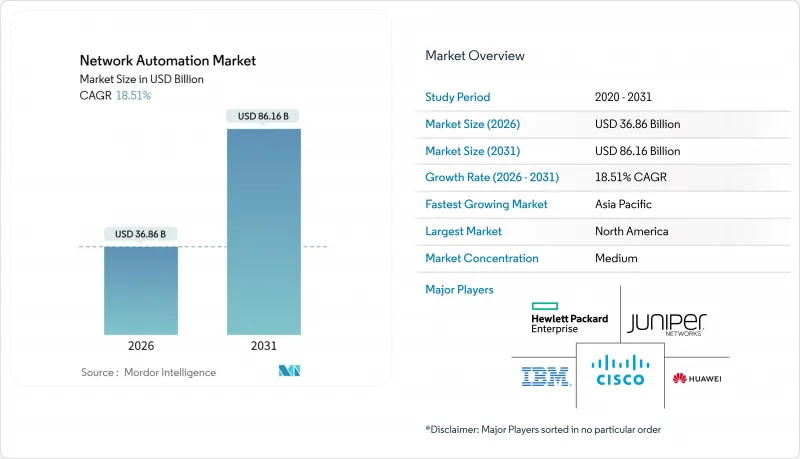
本報告按網路基礎架構(實體、虛擬、混合)、元件(解決方案、服務)、部署模式(雲端、本地部署)、組織規模(大型企業、中小企業)、最終用戶產業(IT與電信、銀行與金融服務、製造業等)以及地區進行細分。市場預測以美元計價。
全球網路自動化市場趨勢與洞察
資料中心網路升級激增
超大規模資料中心和託管服務供應商正在基於 400 GbE 和 800 GbE 交換器重建脊葉式網路架構,以支援用於訓練生成式 AI 模型的 GPU叢集。手動配置數萬個連接埠存在服務級聯中斷的風險,因此各組織正在轉向能夠產生檢驗的配置並可大規模部署的自動化意圖引擎。 2025 年藍圖中重點介紹的封裝光模組和網路內運算需要可程式管線,而傳統的 CLI 工作流程無法有效地編配這些管線。向液冷技術的維修進一步增加了佈線的複雜性,供應商正在將物理層發現功能與基礎設施即程式碼 (IaC) 模板整合,以確保即時拓撲結構的準確性。
物聯網和連網設備的激增
到2025年,連網終端數量將超過750億,將對網路容量帶來巨大壓力,並暴露安全漏洞。製造商指出,由於老舊的SCADA設備缺乏基本的加密和身份驗證功能,網路複雜性是IT和OT融合的最大障礙。如今,整合了設備生命週期管理的自動化平台無需人工提交工單即可完成感測器註冊、分配分段標籤和應用防火牆策略,從而將引進週期從數週縮短至數小時。
自動化領域精通工程師短缺
網路安全專業人才短缺480萬人,其中Python、Ansible和YANG等技術人才嚴重匱乏,迫使企業支付高昂的諮詢費用,並延緩了這些技術的全面應用。儘管認證專案和內部培訓系統正在擴展,但生產力提升通常需要12到18個月才能趕上投資回報,阻礙了初期投資回報率。
細分市場分析
到 2025 年,混合架構將佔據網路自動化市場 45.60% 的佔有率,這凸顯了企業如何依賴實體底層網路來確保確定性延遲,同時利用軟體疊加層來靈活應對新的工作負載。由容器網路介面驅動的虛擬層可自動實現微隔離,預計到 2031 年將以 18.80% 的複合年成長率成長。混合拓撲結構支援分階段過渡,使企業能夠在內部擴展自動化之前,先在邊緣試點 SD-WAN。思科報告稱,其 63% 的 SD-WAN 客戶正在使用 MPLS 和寬頻路徑的混合方案,凸顯了多傳輸策略的永續性。
電信業者正在採用混合模式來避免廠商鎖定,因為他們無需更換交換硬體即可切換虛擬功能。 TM Forum 的「開放數位架構 2025」標準規範了 Intent API,幫助營運商整合最佳元件。硬體廠商正在整合 gRPC 導出器和 YANG 介面,將傳統底盤轉變為可編程節點,可程式設計整合到基礎設施即代碼 (IaC) 流水線中。因此,在整個預測期內,混合模式很可能仍將是網路自動化市場的基石。
儘管解決方案在2025年佔總營收的62.31%,但隨著企業將設計、整合和營運管理外包,服務業務預計將以19.40%的複合年成長率成長。需求也將擴展到架構諮詢、概念驗證(PoC)以及針對傳統OSS/BSS系統的客製化連接器開發。在紅帽公司,培訓收入年增了22%,凸顯了營運團隊迫切需要重新提陞技能。
目前,人工智慧建議引擎已作為自動化套件的一部分提供,但由於需要根據每個客戶的網路拓撲結構進行客製化,這為整合商創造了高利潤的商機。託管服務供應商可保證運轉率和合規性,並將營運風險從客戶的資產負債表中轉移出去。這一趨勢表明,即使軟體日趨成熟,專業服務託管服務仍將繼續佔據網路自動化市場相當大的佔有率。
區域分析
到2025年,北美將佔據網路自動化市場38.43%的佔有率。聯邦政府的零信任指令、高密度超大規模資料中心的部署以及活躍的金融中心正在推動持續的支出。監管機構鼓勵在農村地區發展光纖網路,這增加了對自動化配置的需求,從而最大限度地減少現場出行。
預計亞太地區2026年至2031年的複合年成長率將達到21.43%。中國、印度、日本和韓國的全國性5G部署需要達到零接觸式切片和無線參數最佳化。中國移動的5G-Advanced試驗證實了人工智慧在節能方面的優勢,而印度營運商則依靠自動化技術將傳統4G網路與獨立網路的5G核心網路進行整合。日本開放式無線接取網路(Open RAN)的試點部署增加了多廠商環境的複雜性,也提高了對編配的需求。
歐洲的成長更為穩健,這得益於NIS2指令要求在24小時內報告事故。德國的「工業4.0」計畫要求微秒同步,從而刺激了對時間敏感型網路的投資。在中東,基於「2030願景」和國家人工智慧戰略的投資正在推進;而在拉丁美洲和非洲,自動化正被用於彌補當地勞動力短缺,並將4G和5G網路擴展到服務不足的地區。巴西的頻譜競標和南非的光纖部署凸顯了該地區日益成長的關注。
其他好處:
- Excel格式的市場預測(ME)表
- 3個月的分析師支持
目錄
第1章:引言
- 研究假設和市場定義
- 調查範圍
第2章:調查方法
第3章執行摘要
第4章 市場狀況
- 市場概覽
- 市場促進因素
- 資料中心網路升級激增
- 物聯網和連網型設備的激增
- 快速部署SD-WAN和虛擬化
- 向雲端和多重雲端遷移的浪潮
- 基於人工智慧的自癒意圖網路
- 透過零接觸式 5G 網路切片獲利
- 市場限制因素
- 自動化技術專業工程師短缺
- 整合遺留基礎設施的挑戰
- 透過專有平台鎖定供應商的風險
- 跨境變更管理合規性
- 產業價值鏈分析
- 監理情勢
- 技術展望
- 宏觀經濟因素的影響
- 波特五力分析
第5章 市場規模與成長預測
- 網路基礎設施
- 物理
- 虛擬性
- 混合
- 按組件
- 解決方案
- 服務
- 部署模式
- 雲
- 現場
- 按組織規模
- 大公司
- 小型企業
- 按最終用戶行業分類
- 資訊科技/通訊
- 銀行和金融服務
- 製造業
- 能源公用事業
- 教育
- 衛生保健
- 政府/國防
- 其他行業
- 按地區
- 北美洲
- 美國
- 加拿大
- 墨西哥
- 歐洲
- 德國
- 英國
- 法國
- 義大利
- 西班牙
- 俄羅斯
- 其他歐洲國家
- 亞太地區
- 中國
- 日本
- 印度
- 韓國
- 澳洲
- 其他亞太國家
- 中東
- 沙烏地阿拉伯
- 阿拉伯聯合大公國
- 土耳其
- 其他中東國家
- 非洲
- 南非
- 奈及利亞
- 其他非洲國家
- 南美洲
- 巴西
- 阿根廷
- 其他南美國家
- 北美洲
第6章 競爭情勢
- 市場集中度
- 策略趨勢
- 市佔率分析
- 公司簡介
- Cisco Systems Inc.
- Juniper Networks Inc.
- IBM Corporation
- Hewlett Packard Enterprise Company
- Arista Networks Inc.
- VMware Inc.
- SolarWinds Corporation
- BMC Software Inc.
- Extreme Networks Inc.
- NetBrain Technologies Inc.
- Forward Networks Inc.
- Nuage Networks(Nokia Corp.)
- Huawei Technologies Co. Ltd.
- Red Hat Inc.
- Fortra LLC
- OpenText Corporation
- Fujitsu Limited
- Broadcom Inc.
- Broadcom Inc.
- F5 Inc.
- Anuta Networks Inc.
- Micro Focus International plc
- BlueCat Networks
- Apstra Inc.
第7章 市場機會與未來展望
According to Mordor Intelligence, the global network automation market size stood at USD 36.86 billion in 2026 and is projected to reach USD 86.16 billion by 2031, reflecting an 18.51% CAGR over 2026-2031.
This report is Segmented by Network Infrastructure (Physical, Virtual, and Hybrid), Component (Solutions, and Services), Deployment Mode (Cloud, and On-Premise), Organization Size (Large Enterprises, and Small and Medium Enterprises), End-User Industry (IT and Telecom, Banking and Financial Services, Manufacturing, and More), and Geography. The Market Forecasts are Provided in Terms of Value (USD).
Global Network Automation Market Trends and Insights
Surge in Data-Center Network Upgrades
Hyperscale and colocation providers are rebuilding spine-leaf fabrics around 400 GbE and 800 GbE switching to support GPU clusters that train generative AI models. Manual configuration of tens of thousands of ports risks cascading outages, so organizations are turning to automated intent engines that generate validated configurations and push them at scale. Co-packaged optics and in-network compute highlighted in 2025 roadmaps demand programmable pipelines that legacy CLI workflows cannot orchestrate effectively . Liquid-cooling retrofits further complicate cabling, prompting vendors to bundle physical-layer discovery with infrastructure-as-code templates for real-time topology accuracy.
IoT and Connected-Device Proliferation
The installed base of connected endpoints topped 75 billion in 2025, stretching network capacity and exposing security gaps. Manufacturers cite network complexity as the top barrier to IT-OT convergence because aging SCADA gear lacks encryption and authentication primitives. Automation platforms that integrate device-lifecycle management now onboard sensors, assign segmentation tags, and apply firewall policies without manual tickets, trimming rollout cycles from weeks to hours .
Shortage of Automation-Skilled Engineers
A 4.8-million-person cybersecurity talent gap includes acute shortages in Python, Ansible, and YANG expertise, forcing enterprises to pay premium consulting fees and delaying full-scale deployments. Certification programs and internal academies are ramping up, but productivity gains often trail investment by 12-18 months, eroding early ROI.
Other drivers and restraints analyzed in the detailed report include:
- Rapid SD-WAN and Virtualization Roll-Outs
- Cloud and Multi-Cloud Migration Wave
- Legacy Infrastructure Integration Issues
For complete list of drivers and restraints, kindly check the Table Of Contents.
Segment Analysis
Hybrid architectures captured 45.60% of the network automation market share in 2025, underscoring enterprise reliance on physical underlays for deterministic latency while software overlays unlock agility for emerging workloads. The virtual tier is on an 18.80% CAGR through 2031, propelled by container network interfaces that automate micro-segmentation. Hybrid topologies allow gradual migration, enabling organizations to pilot SD-WAN at the edge before extending automation inward. Cisco reported that 63% of its SD-WAN customers ran mixed MPLS and broadband paths, highlighting the staying power of multi-transport strategies.
Operators use hybrid models to hedge against vendor lock-in because virtual functions can be swapped without replacing switching hardware. The TM Forum's 2025 Open Digital Architecture codified intent APIs, helping carriers integrate best-of-breed components . Physical vendors are embedding gRPC exporters and YANG interfaces, turning legacy chassis into programmable nodes that slot into infrastructure-as-code pipelines. Consequently, the hybrid paradigm is likely to remain the backbone of the network automation market well into the forecast horizon.
Solutions held 62.31% of revenue in 2025, but services are forecast to rise at a 19.40% CAGR as enterprises outsource design, integration, and managed operations. Demand spans architecture consulting, proofs-of-concept, and custom connector development for legacy OSS/BSS systems. Training revenues surged 22% year over year at Red Hat, underscoring the urgent need to reskill operations teams.
AI recommendation engines now ship inside automation suites, yet they require tuning to each customer's topology, creating high-margin opportunities for integrators. Managed-service providers guarantee uptime and compliance, shifting operational risk off customers' balance sheets. This dynamic indicates that professional and managed services will continue commanding a premium portion of the network automation market size, even as software matures.
Complete Report Scope:
- By Network Infrastructure
- Physical
- Virtual
- Hybrid
- By Component
- Solutions
- Services
- By Deployment Mode
- Cloud
- On-Premise
- By Organization Size
- Large Enterprises
- Small and Medium Enterprises
- By End-User Industry
- IT and Telecom
- Banking and Financial Services
- Manufacturing
- Energy and Utilities
- Education
- Healthcare
- Government and Defense
- Other Industries
- By Geography
- North America
- United States
- Canada
- Mexico
- Europe
- Germany
- United Kingdom
- France
- Italy
- Spain
- Russia
- Rest of Europe
- Asia-Pacific
- China
- Japan
- India
- South Korea
- Australia
- Rest of Asia-Pacific
- Middle East
- Saudi Arabia
- United Arab Emirates
- Turkey
- Rest of Middle East
- Africa
- South Africa
- Nigeria
- Rest of Africa
- South America
- Brazil
- Argentina
- Rest of South America
- North America
Geography Analysis
North America held 38.43% of the network automation market in 2025. Federal zero-trust directives, dense hyperscale data-center footprints, and active financial hubs drive continued spending. Regulators encourage rural fiber builds, increasing demand for automated provisioning that minimizes truck rolls.
Asia-Pacific is projected to register a 21.43% CAGR from 2026-2031. Nationwide 5G rollouts in China, India, Japan, and South Korea require zero-touch slicing and radio parameter optimization. China Mobile's 5G-Advanced trials showcased AI-driven energy savings, while Indian carriers rely on automation to integrate legacy 4G with standalone 5G cores. Open RAN pilots in Japan increase multi-vendor complexity, heightening the need for orchestration.
Europe's growth is steadier but supported by the NIS2 Directive's 24-hour incident-reporting mandate. Germany's Industry 4.0 programs demand microsecond-level synchronization, prompting investments in time-sensitive networking. The Middle East invests under Vision 2030 and national AI strategies, while Latin America and Africa expand 4G and 5G to underserved areas, using automation to compensate for limited onsite talent. Brazil's spectrum auctions and South Africa's fiber rollouts attest to rising regional interest.
- Cisco Systems Inc.
- Juniper Networks Inc.
- IBM Corporation
- Hewlett Packard Enterprise Company
- Arista Networks Inc.
- VMware Inc.
- SolarWinds Corporation
- BMC Software Inc.
- Extreme Networks Inc.
- NetBrain Technologies Inc.
- Forward Networks Inc.
- Nuage Networks (Nokia Corp.)
- Huawei Technologies Co. Ltd.
- Red Hat Inc.
- Fortra LLC
- OpenText Corporation
- Fujitsu Limited
- Broadcom Inc.
- Broadcom Inc.
- F5 Inc.
- Anuta Networks Inc.
- Micro Focus International plc
- BlueCat Networks
- Apstra Inc.
Additional Benefits:
- The market estimate (ME) sheet in Excel format
- 3 months of analyst support
TABLE OF CONTENTS
1 INTRODUCTION
- 1.1 Study Assumptions and Market Definition
- 1.2 Scope of the Study
2 RESEARCH METHODOLOGY
3 EXECUTIVE SUMMARY
4 MARKET LANDSCAPE
- 4.1 Market Overview
- 4.2 Market Drivers
- 4.2.1 Surge in Data-Center Network Upgrades
- 4.2.2 IoT and Connected-Device Proliferation
- 4.2.3 Rapid SD-WAN and Virtualization Roll-Outs
- 4.2.4 Cloud and Multi-Cloud Migration Wave
- 4.2.5 AI-Driven Self-Healing Intent-Based Networks
- 4.2.6 Zero-Touch 5G Network-Slicing Monetization
- 4.3 Market Restraints
- 4.3.1 Shortage of Automation-Skilled Engineers
- 4.3.2 Legacy Infrastructure Integration Issues
- 4.3.3 Proprietary Platform Vendor-Lock-In Risk
- 4.3.4 Cross-Border Change-Control Compliance
- 4.4 Industry Value Chain Analysis
- 4.5 Regulatory Landscape
- 4.6 Technological Outlook
- 4.7 Impact of Macroeconomic Factors
- 4.8 Porter's Five Forces Analysis
- 4.8.1 Threat of New Entrants
- 4.8.2 Bargaining Power of Suppliers
- 4.8.3 Bargaining Power of Buyers
- 4.8.4 Threat of Substitutes
- 4.8.5 Competitive Rivalry
5 MARKET SIZE AND GROWTH FORECASTS (VALUE)
- 5.1 By Network Infrastructure
- 5.1.1 Physical
- 5.1.2 Virtual
- 5.1.3 Hybrid
- 5.2 By Component
- 5.2.1 Solutions
- 5.2.2 Services
- 5.3 By Deployment Mode
- 5.3.1 Cloud
- 5.3.2 On-Premise
- 5.4 By Organization Size
- 5.4.1 Large Enterprises
- 5.4.2 Small and Medium Enterprises
- 5.5 By End-User Industry
- 5.5.1 IT and Telecom
- 5.5.2 Banking and Financial Services
- 5.5.3 Manufacturing
- 5.5.4 Energy and Utilities
- 5.5.5 Education
- 5.5.6 Healthcare
- 5.5.7 Government and Defense
- 5.5.8 Other Industries
- 5.6 By Geography
- 5.6.1 North America
- 5.6.1.1 United States
- 5.6.1.2 Canada
- 5.6.1.3 Mexico
- 5.6.2 Europe
- 5.6.2.1 Germany
- 5.6.2.2 United Kingdom
- 5.6.2.3 France
- 5.6.2.4 Italy
- 5.6.2.5 Spain
- 5.6.2.6 Russia
- 5.6.2.7 Rest of Europe
- 5.6.3 Asia-Pacific
- 5.6.3.1 China
- 5.6.3.2 Japan
- 5.6.3.3 India
- 5.6.3.4 South Korea
- 5.6.3.5 Australia
- 5.6.3.6 Rest of Asia-Pacific
- 5.6.4 Middle East
- 5.6.4.1 Saudi Arabia
- 5.6.4.2 United Arab Emirates
- 5.6.4.3 Turkey
- 5.6.4.4 Rest of Middle East
- 5.6.5 Africa
- 5.6.5.1 South Africa
- 5.6.5.2 Nigeria
- 5.6.5.3 Rest of Africa
- 5.6.6 South America
- 5.6.6.1 Brazil
- 5.6.6.2 Argentina
- 5.6.6.3 Rest of South America
- 5.6.1 North America
6 COMPETITIVE LANDSCAPE
- 6.1 Market Concentration
- 6.2 Strategic Moves
- 6.3 Market Share Analysis
- 6.4 Company Profiles (includes Global level Overview, Market level overview, Core Segments, Financials as available, Strategic Information, Market Rank/Share for key companies, Products and Services, and Recent Developments)
- 6.4.1 Cisco Systems Inc.
- 6.4.2 Juniper Networks Inc.
- 6.4.3 IBM Corporation
- 6.4.4 Hewlett Packard Enterprise Company
- 6.4.5 Arista Networks Inc.
- 6.4.6 VMware Inc.
- 6.4.7 SolarWinds Corporation
- 6.4.8 BMC Software Inc.
- 6.4.9 Extreme Networks Inc.
- 6.4.10 NetBrain Technologies Inc.
- 6.4.11 Forward Networks Inc.
- 6.4.12 Nuage Networks (Nokia Corp.)
- 6.4.13 Huawei Technologies Co. Ltd.
- 6.4.14 Red Hat Inc.
- 6.4.15 Fortra LLC
- 6.4.16 OpenText Corporation
- 6.4.17 Fujitsu Limited
- 6.4.18 Broadcom Inc.
- 6.4.19 Broadcom Inc.
- 6.4.20 F5 Inc.
- 6.4.21 Anuta Networks Inc.
- 6.4.22 Micro Focus International plc
- 6.4.23 BlueCat Networks
- 6.4.24 Apstra Inc.
7 MARKET OPPORTUNITIES AND FUTURE OUTLOOK
- 7.1 White-Space and Unmet-Need Assessment

 意圖驅動型網路市場預測至2034年—按組件、功能、部署模式、技術、應用、最終用戶和地區分類的全球分析
 全球網路自動化市場(至 2032 年):依網路自動化類型分類(編配自動化、設定自動化、腳本驅動網路自動化、AI 驅動網路自動化、IBN 自動化、網路安全自動化)
 寬頻體驗分析:市場佔有率分析、產業趨勢與統計、成長預測(2026-2031 年)
 低壓和中壓電力網路自動化市場-2026年至2032年全球市場預測
 網路自動化市場:按元件、應用、網路類型、部署模式、最終用戶、國家和地區分類-產業分析、市場規模、市場佔有率和預測(2026-2033 年)網路自動化市場-2026-2032年全球市場預測營運支援系統市場預測至2034年-按組件、部署模式、網路類型、功能、最終用戶和地區分類的全球分析網路自動化市場預測至2034年-按組件、部署模式、網路類型、功能、企業規模、最終用戶和地區分類的全球分析意圖驅動型網路市場:按組件、部署類型、應用程式、組織規模和最終用戶分類-2026-2032年全球市場預測2034年電力傳輸和配電網路自動化市場預測-按組件、通訊基礎設施、技術、應用、最終用戶和地區分類的全球分析