


 |
市場調查報告書
商品編碼
2154749
南美洲防護包裝:市場佔有率分析、產業趨勢與統計及成長預測(2026-2031 年)South America Protective Packaging - Market Share Analysis, Industry Trends & Statistics, Growth Forecasts (2026 - 2031) |
||||||

※ 本網頁內容可能與最新版本有所差異。詳細情況請與我們聯繫。
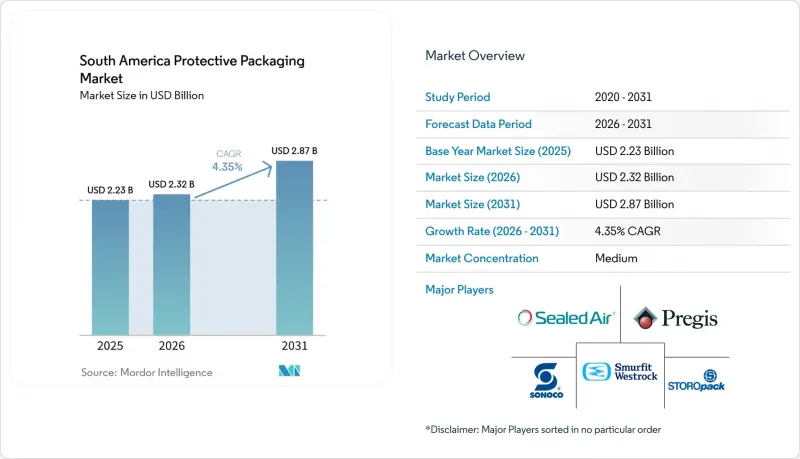
據 Mordor Intelligence 稱,2025 年南美防護包裝市場價值為 22.3 億美元,預計到 2031 年將從 2026 年的 23.2 億美元成長至 28.7 億美元,預測期(2026-2031 年)複合年成長率為 4.35%。
南美洲防護包裝市場趨勢與洞察
電子商務和小包裹履約的成長
預計到2025年,該地區的線上零售額將超過1,900億美元,到2026年將超過2,000億美元,這將推動整個履約中對小包裹保護的需求。預計到2025年,巴西的電子商務滲透率將達到商業總額的14.3%,將帶動主要履約對保護性信封、空氣枕和氣泡膜的需求。據Mercado Libre稱,到2024年,包裝成本將佔履約成本的18%,這促使該公司引入按需機械以減少材料用量和包裝成本。此舉使每個小包裹的包裝成本降低了18%,填充材的使用量減少了35%,這充分說明了大規模平台為何青睞能夠提高一致性和材料利用率的系統。此外,基於體積重量的運費也鼓勵買家選擇更輕、更靈活的包裝方案,這些方案既能提供保護,又不會增加貨物的體積。這一趨勢證實,南美防護包裝市場對整合設備包裝方案的需求將持續成長。
擴大食品安全和冷鏈要求
南美洲冷鏈對食品接觸材料的認證需求日益成長,推動了食品接觸相關要求的嚴格執行。 2025年6月,巴西國家衛生監督局(ANVISA)發布了第979/2025號決議,根據南方共同市場(Mercosur)的措施修訂了纖維素基包裝材料的食品接觸標準。這項變更有利於能夠提供紙基保護基材成分和合規性證明的供應商。新鮮農產品、蛋白質和加工食品的出口商也需要保護系統來確保長途運輸過程中的搬運控制。具有保溫容器和溫度指示器的產品可以滿足需要冷鏈性能認證的客戶的需求。因此,南美洲的保護性包裝市場正從標準的運輸保護擴展到食品安全文件和溫度保證領域。
聚合物、紙張和發泡材材料原料成本的波動
對於使用聚乙烯、聚丙烯、紙張和特殊發泡材的加工商而言,原料成本波動是短期內面臨的主要挑戰。 2026年的供應中斷加劇了整個區域包裝供應鏈中聚合物供應和價格的壓力。能夠靈活切換紙張、纖維和聚合物材料的加工商在面對原料價格波動時將具有更大的柔軟性。而僅使用單一材料的企業則面臨更高的利潤率壓力和客戶價格抵制風險。因此,在南美洲防護包裝市場,那些擁有廣泛的材料組合、具備在地採購管道且材料規格可靈活調整而不影響客戶包裝營運的供應商,更有可能獲得競爭優勢。
細分市場分析
2025年,軟性保護包裝佔據了南美保護包裝市場64.16%的佔有率。這一領先地位反映了小包裹電商的需求,以及輕質空氣枕、保護性郵寄袋、氣泡膜和紙質填充材在運輸方面的優勢。這些包裝形式因其緊湊的存儲和快速的供應,非常適合聖保羅、波哥大和聖地亞哥的快速物流中心。軟性包裝也有助於賣家在不影響正常小包裹處理所需保護功能的前提下,控制體積重量。另一方面,硬質包裝仍用於需要結構支撐的工業產品、汽車零件和家用電器。在產品重量、表面易碎或運輸路線條件等軟性保護不足以滿足需求的情況下,瓦楞紙板保護罩、模塑紙漿和保溫容器仍然發揮著重要作用。
預計到2031年,泡棉包裝將以6.04%的複合年成長率成長,成為所有產品類型中成長最快的。客製化模壓內襯和現場發泡系統可有效保護醫療設備和貴重電子設備。這些產品的損壞會導致更換成本、保固責任風險以及客戶不滿。鬆散填充和泡沫片材在運輸需要對不規則形狀產品進行靈活保護的工業產品方面也繼續發揮重要作用。由於有關回收材料含量的法規影響著材料的選擇,紙基填充材正在為某些泡沫應用帶來新的競爭壓力。巴西國家衛生監督局(ANVISA)的良好生產規範(GMP)要求和ISO 11607標準正在推動高性能泡沫產品在無菌醫療設備運輸中的應用。因此,南美洲防護包裝市場中泡棉產品的市場規模不僅受材料成本的支撐,也受對精準保護日益成長的應用需求的推動。
到2025年,塑膠將佔南美防護包裝市場銷售額的41.29%,成為該市場中最大的材料佔有率。聚乙烯和發泡聚苯乙烯仍廣泛用於氣泡膜、氣墊、防護郵寄袋和其他小包裹保護產品。巴西、阿根廷和哥倫比亞憑藉其發達的電子商務和工業基礎設施,佔據了這項需求的大部分。紙張和紙板用於紙張填充材和食品應用,而發泡聚合物則用於工業和製藥領域的防護應用。模塑紙漿用於需要結構性和纖維性材料的應用。客戶對回收義務和可追溯性的期望正日益影響材料的選擇。
預計到2031年,生物基材料將以5.56%的複合年成長率成長,成為材料領域中成長最快的細分市場。 2025年第12688號聯邦法令規定,自2026年1月起,大型企業塑膠包裝中必須含有22%的再生材料,並設定了32%的回收目標。這些要求推動了再生纖維、甘蔗衍生材料和桉樹纖維基材的發展,這些材料能夠展現出優異的性能並符合相關法規。 Cravin公司一體化的桉樹纖維業務為包裝材料提供了本土來源,從而實現了材料可追溯性和在地採購。智利對合成添加劑的要求也影響加工商對替代塗料和粘合劑的評估。因此,南美洲生物基防護包裝市場的規模將取決於該地區的法規遵循和纖維原料的供應。
其他好處:
- Excel格式的市場預測(ME)表
- 3個月的分析師支持
目錄
第1章:引言
- 研究假設和市場定義
- 調查範圍
第2章:調查方法
第3章執行摘要
第4章 市場狀況
- 市場概覽
- 市場促進因素
- 電子商務和小包裹履約的成長
- 擴大對食品安全和冷鏈的要求
- 工業生產和區域內貿易的擴張
- 保護藥品和醫療保健產品的運輸
- 強制使用再生材料並採用永續材料替代。
- 根據損壞資料進行自動化包裝和最佳化尺寸。
- 市場限制因素
- 聚合物、紙張和發泡材材料原料成本的波動
- 收集和回收基礎設施不足
- 外匯風險及進口特殊材料
- 標準與非正式保護性包裝做法的差異
- 產業價值鏈分析
- 監理情勢
- 技術展望
- 波特五力分析
- 宏觀經濟因素對市場的影響
第5章 市場規模與成長預測
- 依產品類型
- 死板的
- 紙板保護套
- 模塑紙漿
- 保溫運輸貨櫃
- 其他剛性類型
- 靈活的
- 保護性郵寄信封
- 氣泡膜
- 空氣枕/氣囊
- 紙漿
- 其他靈活類型
- 形式
- 模壓發泡體
- 原位發泡(FIP)
- 散裝填充物
- 泡棉捲/片
- 其他形式
- 死板的
- 材料
- 塑膠
- 泡沫聚合物
- 紙張和紙板
- 模塑紙漿
- 生物基材料
- 功能性別
- 緩衝功能
- 填充物
- 包裝
- 塊狀支撐
- 隔熱材料
- 其他功能
- 按最終用戶行業分類
- 食品/飲料
- 工業產品
- 家用電子產品
- 醫療和藥品
- 電器產品
- 電子商務履約
- 其他終端用戶產業
- 國家
- 巴西
- 阿根廷
- 智利
- 哥倫比亞
- 其他南美國家
第6章 競爭情勢
- 市場集中度
- 策略趨勢
- 市佔率分析
- 公司簡介
- Sealed Air Corporation
- Pregis LLC
- Storopack Hans Reichenecker GmbH
- Ranpak Holdings Corp.
- Nefab Group AB
- EFP, LLC
- Intertape Polymer Group Inc.
- Sonoco Products Company
- Smurfit Westrock plc
- International Paper Company
- Mondi plc
- DS Smith plc
- Huhtamaki Oyj
- Amcor plc
- Crown Holdings, Inc.
- Avery Dennison Corporation
- Ameson Packaging Co., Ltd.
- Airfil Protective Packaging Ltd
- Polyair Inter Pack Inc.
- Protective Packaging Limited
- Kite Packaging Limited
- Cushion Pack Limited
- DAPACK Ingenieria en Embalajes SRL
- Molpack Corporation
第7章 市場機會與未來趨勢
- 評估閒置頻段和未滿足的需求
According to Mordor Intelligence, the South America protective packaging market size was valued at USD 2.23 billion in 2025 and estimated to grow from USD 2.32 billion in 2026 to reach USD 2.87 billion by 2031, at a CAGR of 4.35% during the forecast period (2026-2031).
South America Protective Packaging Market Trends and Insights
Growth of E-Commerce and Parcel Fulfillment
Regional online retail sales surpassed USD 190 billion in 2025 and are expected to exceed USD 200 billion in 2026, supporting demand for parcel protection across fulfillment networks. Brazil's e-commerce penetration reached 14.3% of total commerce in 2025, increasing demand for protective mailers, air pillows, and bubble wrap around major fulfillment hubs. Mercado Libre reported that packaging accounted for 18% of its fulfillment costs in 2024, supporting its use of on-demand machinery to reduce material use and packing costs. Its installations reduced per-parcel packaging cost by 18% and void fill by 35%, showing why large platforms favor systems that improve consistency and material efficiency. Dimensional-weight freight charges are also directing buyers toward lighter, flexible formats that maintain protection without increasing shipment size. This pattern supports continuing demand for equipment-linked packaging programs in the South America protective packaging market.
Expansion of Food Safety and Cold-Chain Requirements
Food-contact requirements are increasing the need for documented packaging materials throughout South American cold chains. ANVISA published Resolution No. 979/2025 in June 2025, updating food-contact standards for cellulosic packaging in line with a MERCOSUR measure. The change favors suppliers that can document the composition and compliance status of paper-based protective substrates. Exporters of fresh produce, protein, and processed foods also need protective systems to ensure controlled handling during long journeys. Insulated containers and temperature-indicating formats can address those needs when customers require proof of cold-chain performance. These conditions are expanding the South America protective packaging market beyond standard transport protection into food-safety documentation and temperature assurance.
Volatility in Polymer, Paper, and Foam Input Costs
Input-cost volatility is a major near-term concern for converters that use polyethylene, polypropylene, paper, and specialty foam. Supply disruption in 2026 increased pressure on polymer availability and pricing across regional packaging supply chains. Converters that can switch among paper, fiber, and polymer formats have greater flexibility as material prices change. Single-material operations face a greater risk of margin compression or customer price resistance. The South America protective packaging market may therefore favor suppliers that maintain broader material portfolios, local procurement options, and material specifications that can be adjusted without disrupting customer packing operations.
Other drivers and restraints analyzed in the detailed report include:
- Industrial Output and Intraregional Trade Expansion
- Pharmaceutical and Healthcare Shipment Protection
- Inadequate Collection and Recycling Infrastructure
For complete list of drivers and restraints, kindly check the Table Of Contents.
Segment Analysis
Flexible protective packaging held 64.16% of the South America protective packaging market share in 2025. Its leadership reflected demand from parcel e-commerce and the freight advantage of lightweight air pillows, protective mailers, bubble wrap, and paper fill. These formats suited fast-moving fulfillment centers in Sao Paulo, Bogota, and Santiago because they could be stored compactly and dispensed quickly. Flexible formats also helped sellers control dimensional weight without removing the protection needed for routine parcel handling. Rigid packaging continued to serve industrial goods, automotive parts, and household appliances that needed structural support. Corrugated protectors, molded pulp, and insulated containers remained relevant where product weight, surface sensitivity, or route conditions made flexible protection insufficient.
Foam packaging is projected to expand at a 6.04% CAGR through 2031, the highest rate among product types. Custom-molded inserts and foam-in-place systems support medical devices and high-value electronics, where product damage can create replacement costs, warranty exposure, and customer dissatisfaction. Loose fill and foam sheets also retain a role in industrial shipments that require adaptable protection around irregular shapes. Paper-based fill alternatives are creating substitution pressure on some foam applications as recycled-content rules affect material selection. ANVISA good manufacturing practice requirements and ISO 11607 standards support the use of high-performance formats for sterile medical-device shipments. The South America protective packaging market size for foam formats is therefore supported by applications where precision protection matters more than material cost alone.
Plastics held 41.29% revenue share in 2025, the largest material position in the South America protective packaging market. Polyethylene and expanded polystyrene remained widely used in bubble wrap, air cushions, protective mailers, and other parcel-protection formats. Brazil, Argentina, and Colombia account for much of this demand because of their larger e-commerce and industrial bases. Paper and paperboard serve paper fill and food-grade uses, while foam polymers support industrial and pharmaceutical protection. Molded pulp is used in applications that require structure and a fiber-based material. Material selection is increasingly affected by recovery obligations and customer expectations for traceability.
Bio-based materials are projected to grow at a 5.56% CAGR through 2031, the fastest rate among material segments. Federal Decree No. 12,688/2025 requires 22% recycled content in plastic packaging for large companies from January 2026 and sets a recovery target of 32%. These requirements support recycled fiber, sugarcane-derived materials, and eucalyptus-fiber substrates where performance and compliance can be demonstrated. Klabin's integrated eucalyptus-fiber operations provide a domestic packaging supply with material traceability and the potential for local sourcing. Synthetic additive requirements in Chile also influence how converters assess alternative coatings and binders. The South America protective packaging market size for bio-based materials is therefore linked to both regulatory compliance and the regional availability of fiber inputs.
Complete Report Scope:
- By Product Type
- Rigid
- Corrugated Paperboard Protectors
- Molded Pulp
- Insulated Shipping Containers
- Other Rigid Types
- Flexible
- Protective Mailers
- Bubble Wrap
- Air Pillows / Air Bags
- Paper Fill
- Other Flexible Types
- Foam
- Molded Foam
- Foam-in-Place (FIP)
- Loose Fill
- Foam Rolls / Sheets
- Other Foam Types
- Rigid
- By Material
- Plastics
- Foam Polymers
- Paper and Paperboard
- Molded Pulp
- Bio-Based Materials
- By Functionality
- Cushioning
- Void Fill
- Wrapping
- Blocking and Bracing
- Insulation
- Other Functionalities
- By End-User Industry
- Food and Beverage
- Industrial Goods
- Consumer Electronics
- Healthcare and Pharmaceuticals
- Household Appliances
- E-Commerce Fulfillment
- Other End-User Industries
- By Country
- Brazil
- Argentina
- Chile
- Colombia
- Rest of South America
List of Companies Covered in this Report:
- Sealed Air Corporation
- Pregis LLC
- Storopack Hans Reichenecker GmbH
- Ranpak Holdings Corp.
- Nefab Group AB
- EFP, LLC
- Intertape Polymer Group Inc.
- Sonoco Products Company
- Smurfit Westrock plc
- International Paper Company
- Mondi plc
- DS Smith plc
- Huhtamaki Oyj
- Amcor plc
- Crown Holdings, Inc.
- Avery Dennison Corporation
- Ameson Packaging Co., Ltd.
- Airfil Protective Packaging Ltd
- Polyair Inter Pack Inc.
- Protective Packaging Limited
- Kite Packaging Limited
- Cushion Pack Limited
- DAPACK Ingenieria en Embalajes S.R.L.
- Molpack Corporation
Additional Benefits:
- The market estimate (ME) sheet in Excel format
- 3 months of analyst support
TABLE OF CONTENTS
1 INTRODUCTION
- 1.1 Study Assumptions and Market Definition
- 1.2 Scope of the Study
2 RESEARCH METHODOLOGY
3 EXECUTIVE SUMMARY
4 MARKET LANDSCAPE
- 4.1 Market Overview
- 4.2 Market Drivers
- 4.2.1 Growth of E-Commerce and Parcel Fulfillment
- 4.2.2 Expansion of Food Safety and Cold-Chain Requirements
- 4.2.3 Industrial Output and Intraregional Trade Expansion
- 4.2.4 Pharmaceutical and Healthcare Shipment Protection
- 4.2.5 Recycled-Content Mandates and Sustainable Material Substitution
- 4.2.6 Packaging Automation and Damage-Data-Based Right-Sizing
- 4.3 Market Restraints
- 4.3.1 Volatility in Polymer, Paper, and Foam Input Costs
- 4.3.2 Inadequate Collection and Recycling Infrastructure
- 4.3.3 Foreign-Exchange Exposure and Imported Specialty Materials
- 4.3.4 Fragmented Standards and Informal Protective-Packaging Practices
- 4.4 Industry Value Chain Analysis
- 4.5 Regulatory Landscape
- 4.6 Technological Outlook
- 4.7 Porter's Five Forces Analysis
- 4.7.1 Threat of New Entrants
- 4.7.2 Bargaining Power of Suppliers
- 4.7.3 Bargaining Power of Buyers
- 4.7.4 Threat of Substitutes
- 4.7.5 Competitive Rivalry
- 4.8 Impact of Macroeconomic Factors on the Market
5 MARKET SIZE AND GROWTH FORECASTS (VALUES)
- 5.1 By Product Type
- 5.1.1 Rigid
- 5.1.1.1 Corrugated Paperboard Protectors
- 5.1.1.2 Molded Pulp
- 5.1.1.3 Insulated Shipping Containers
- 5.1.1.4 Other Rigid Types
- 5.1.2 Flexible
- 5.1.2.1 Protective Mailers
- 5.1.2.2 Bubble Wrap
- 5.1.2.3 Air Pillows / Air Bags
- 5.1.2.4 Paper Fill
- 5.1.2.5 Other Flexible Types
- 5.1.3 Foam
- 5.1.3.1 Molded Foam
- 5.1.3.2 Foam-in-Place (FIP)
- 5.1.3.3 Loose Fill
- 5.1.3.4 Foam Rolls / Sheets
- 5.1.3.5 Other Foam Types
- 5.1.1 Rigid
- 5.2 By Material
- 5.2.1 Plastics
- 5.2.2 Foam Polymers
- 5.2.3 Paper and Paperboard
- 5.2.4 Molded Pulp
- 5.2.5 Bio-Based Materials
- 5.3 By Functionality
- 5.3.1 Cushioning
- 5.3.2 Void Fill
- 5.3.3 Wrapping
- 5.3.4 Blocking and Bracing
- 5.3.5 Insulation
- 5.3.6 Other Functionalities
- 5.4 By End-User Industry
- 5.4.1 Food and Beverage
- 5.4.2 Industrial Goods
- 5.4.3 Consumer Electronics
- 5.4.4 Healthcare and Pharmaceuticals
- 5.4.5 Household Appliances
- 5.4.6 E-Commerce Fulfillment
- 5.4.7 Other End-User Industries
- 5.5 By Country
- 5.5.1 Brazil
- 5.5.2 Argentina
- 5.5.3 Chile
- 5.5.4 Colombia
- 5.5.5 Rest of South America
6 COMPETITIVE LANDSCAPE
- 6.1 Market Concentration
- 6.2 Strategic Moves
- 6.3 Market Share Analysis
- 6.4 Company Profiles (includes Global Level Overview, Market Level Overview, Core Segments, Financials as available, Strategic Information, Market Rank/Share, Products and Services, Recent Developments)
- 6.4.1 Sealed Air Corporation
- 6.4.2 Pregis LLC
- 6.4.3 Storopack Hans Reichenecker GmbH
- 6.4.4 Ranpak Holdings Corp.
- 6.4.5 Nefab Group AB
- 6.4.6 EFP, LLC
- 6.4.7 Intertape Polymer Group Inc.
- 6.4.8 Sonoco Products Company
- 6.4.9 Smurfit Westrock plc
- 6.4.10 International Paper Company
- 6.4.11 Mondi plc
- 6.4.12 DS Smith plc
- 6.4.13 Huhtamaki Oyj
- 6.4.14 Amcor plc
- 6.4.15 Crown Holdings, Inc.
- 6.4.16 Avery Dennison Corporation
- 6.4.17 Ameson Packaging Co., Ltd.
- 6.4.18 Airfil Protective Packaging Ltd
- 6.4.19 Polyair Inter Pack Inc.
- 6.4.20 Protective Packaging Limited
- 6.4.21 Kite Packaging Limited
- 6.4.22 Cushion Pack Limited
- 6.4.23 DAPACK Ingenieria en Embalajes S.R.L.
- 6.4.24 Molpack Corporation
7 MARKET OPPORTUNITIES AND FUTURE TRENDS
- 7.1 White-Space and Unmet-Need Assessment

 邊緣保護器和托盤固定件市場預測至2034年-產品類型、材料、保護功能、最終用戶和地區分類的全球分析可生物分解花生形緩衝墊和散裝填充物市場:預測(至2034年)-按產品類型、原料、功能特性、密度等級、包裝應用、分銷管道、最終用戶和地區分類的全球分析
 2026-2030年全球紙張護角市場瓦楞紙板和紙質保護性包裝市場預測至2034年-按產品類型、材料類型、功能、分銷管道、最終用戶和地區分類的全球分析
 瓦楞紙棧板市場規模、佔有率、成長、全球產業分析、區域趨勢及2026-2034年預測。
 北美防護包裝:市佔率分析、產業趨勢與統計及成長預測(2026-2031 年)防護包裝:市場佔有率分析、產業趨勢與統計、成長預測(2026-2031)
 防護包裝市場:全球預測,2026-2032年
 2026年全球夾層托盤門網市場報告2034年防護包裝市場預測-按產品類型、材料類型、功能、分銷管道、最終用戶和地區分類的全球分析