


 |
市場調查報告書
商品編碼
2154745
電池溫度控管材料:市場佔有率分析、產業趨勢與統計、成長預測(2026-2031)Battery Thermal Management Materials - Market Share Analysis, Industry Trends & Statistics, Growth Forecasts (2026 - 2031) |
||||||

※ 本網頁內容可能與最新版本有所差異。詳細情況請與我們聯繫。
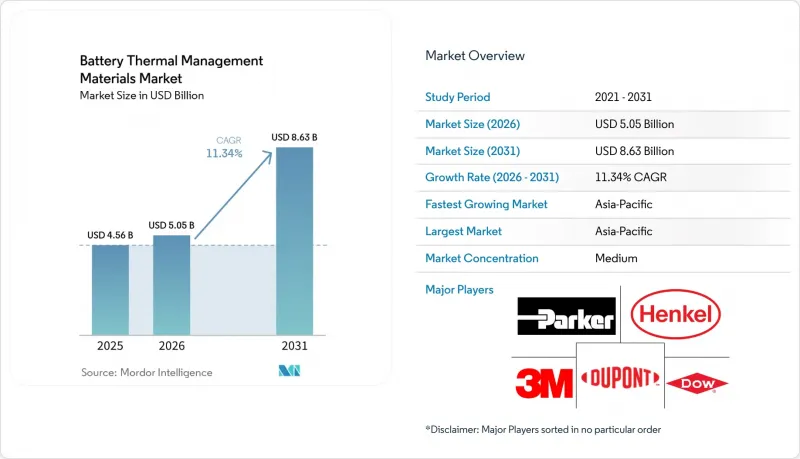
據 Mordor Intelligence 稱,2025 年電池溫度控管材料市場價值為 45.6 億美元,預計到 2031 年將從 2026 年的 50.5 億美元成長至 86.3 億美元,預測期(2026-2031 年)複合年成長率為 11.34%。
全球電池溫度控管材料市場趨勢與洞察
電動車產量及電池製造能力提升
電動車的生產是電池溫度控管材料市場需求的主要驅動力。這是因為每個電池組中,電芯、模組和電池包的各個連接點都需要材料。預計到2025年,電池裝置容量將從2024年的901.4 GWh增加到1187 GWh,這將增加對間隙填充劑、灌封膠、導熱黏合劑和保護層的需求。 2025年,中國仍將是電動車的主要生產和銷售中心,這將影響材料採購、設計決策和供應商認證。儘管中國超級工廠的產能過剩可能會對材料價格構成壓力,但電池產能的進一步擴張將繼續支撐電池溫度控管材料市場的需求。北美和歐洲的汽車製造商(OEM)正在推進電池組裝的本地化,這增加了對擁有區域認證生產能力和技術支援的供應商的需求。在亞洲擁有應用實驗室和認證數據的公司可以幫助客戶將亞洲電池組設計應用於其他地區的工廠。
提高電池能量密度和快速充電的要求。
能量密度的提高和對快速充電的需求導致電池組內部發熱量增加,因此需要具有更高導熱性、更薄黏合層和可靠溫度循環性能的材料。單體電池到電池組(Cell-to-pack)的設計可透過減少電池間距並消除模組外殼的熱緩衝作用來提高體積能量密度。向800V汽車平臺的過渡增加了超快速充電過程中的溫度梯度,而超快速充電可在不到15分鐘內完成。對石蠟浸漬奈米多孔銅集電器的研究表明,其在磷酸鋰鐵(LFP)和鎳錳鈷(NMC)軟包電池中具有自調節過熱保護功能。這項研究表明,熱控制正從電池組級間隙填充轉向單體電池級保護。在電池溫度控管材料市場,兼具結構黏合性和導熱性的雙功能產品可以在不影響熱控制性能的前提下減少層數和組裝步驟。
先進溫度控管材料高成本且技術複雜
先進的溫度控管材料通常比傳統的矽膠墊更昂貴,並且可能需要特殊的加工工藝,這限制了它們在對價格敏感的電池項目中的應用。氣凝膠複合材料、高導熱間隙填充材料和微膠囊相變材料對材料系統和生產過程的要求更高,以滿足製造和應用方面的要求。先進的間隙填充材料需要使用導熱填料,例如氮化硼、氮化鋁和碳化矽,才能實現高導熱性。在電池單體到電池組的組裝過程中,導熱結構結構性黏著劑需要比簡單的墊片插入更精密的塗覆設備和更嚴格的製程控制。當熱性能要求允許時,中國汽車製造商可能會選擇聚氨酯材料而不是矽基間隙填充材料。這些因素在電池溫度控管材料市場中形成了性價比的等級分類,影響高性能複合材料的應用。
細分市場分析
到2025年,導熱界面材料將佔電池溫度控管材料市場銷售額的37.45%,成為該市場中最大的材料類別。這些材料用於液冷電池組中電芯與冷卻板的接觸點。即使在不平整的表面之間,它們也能有效傳遞熱量,同時防止產生可能降低冷卻效率的氣隙。導熱黏合劑正日益取代電芯-電池組系統中的特定間隙填充劑,因為它們只需一次塗覆即可同時實現結構黏合和熱傳遞,省去了墊片插入的組裝工序。 2026年5月,漢高公司發表了Bergquist TGF 2030APS,這是一款不含矽的雙組分導熱間隙填充劑,導熱係數為1.7 W/m*K,擠出速率超過40 cm³/s。該公司還發布了Loctite TLB 9270APS,這是一款用於電芯-電池組設計的聚氨酯基導熱黏合劑,導熱係數為2 W/m*K。
在電池組返工和無損電池檢修至關重要的應用中,間隙填充物和導熱墊仍然發揮關鍵作用。同時,灌封和封裝產品在固定式儲能應用中越來越受歡迎,因為在這些應用中,防止機械損傷和化學物質侵蝕比拆卸更為重要。相變材料 (PCM) 預計到 2031 年將以 12.56% 的複合年成長率成長,因為它們無需主動泵送系統即可吸收和釋放潛熱。一項關於被動電池溫度控管的研究表明,在典型的駕駛循環中,厚度為 3 毫米的含膨脹石墨的複合相變材料 (PCM) 塗層可將電池的平均峰值溫升降低 7 度C。電池溫度控管材料產業需要兼顧導熱性、應用速度、固化特性、返工要求和被動安全性能的產品。這項需求推動了廣泛的產品系列的開發,並促使電池組設計人員在開發初期就進行密切合作。
區域分析
到2025年,亞太地區將佔據電池溫度控管材料市場45.13%的佔有率,預計到2031年將以12.62%的複合年成長率成長。在該地區,電池生產、電動車組裝、電芯研發和能源儲存系統部署一體化,產生了巨大的材料需求,並支撐著許多合格製造商。到2025年,中國將佔全球小型電動車銷量的62%和全球電動車產量的71%。如此龐大的市場規模推動了電動車、固定式儲能和工業應用領域對導熱介面材料、相變產品和耐火級產品的需求。中國將於2026年7月生效的GB 38031-2025標準規定,電池在發生熱失控後必須能夠防止兩小時內起火或爆炸,該標準將用於新車型式認證。
韓國憑藉其電池材料生態系統和本土溫度控管產品專家,為亞太地區提供了進一步的需求基礎。瓦克化學股份公司正在日本筑波和韓國鎮川擴大其特種矽膠的生產規模,使其能夠通過本地生產的導熱界面材料等級和更短的供應路線,為亞洲汽車行業的客戶提供服務。印度是一個新興的需求中心,其電動二輪車和三輪車車隊需要滿足安全要求的電池溫度控管解決方案。國內電池組裝能力的擴大也創造了對進口電池組以外的需求。亞太地區的電芯製造商採用「電芯到電池組」和「電芯到底底盤」架構的速度比許多歐美市場更快,這縮短了材料認證週期,並為供應商提供了對本地應用實驗室的支援。
北美和歐洲是收入排名第二和第三大的區域市場,但它們的需求推動要素有所不同。在歐洲,預計到2025年,電池式電動車在新車銷量中的佔有率將達到18%,高於2024年的14%。歐盟電池法規2023/1542推動了對用於保障電池安全、便於拆解和報廢電池處置的材料的需求。在北美,ANSI/CAN/UL 9540A和ANSI/CAN/UL 1487標準對電網級儲能容器的要求支撐了市場需求。南美洲、中東和非洲的市場規模仍然小規模,但需求集中在巴西、阿根廷、沙烏地阿拉伯和南非,這些國家的儲能和電氣化計畫為全球供應商提供了多元化發展的機會。
其他好處:
- Excel格式的市場預測(ME)表
- 3個月的分析師支持
目錄
第1章:引言
- 研究假設和市場定義
- 調查範圍
第2章:調查方法
第3章執行摘要
第4章 市場狀況
- 市場概覽
- 市場促進因素
- 電動車產量及電池製造能力提升
- 對提高電池能量密度和快速充電的需求日益成長。
- 熱失控預防和電池安全要求
- 能源儲存系統的發展與可再生能源併網
- “單元到封裝”和“單元到底底盤”架構正在增加材料的使用。
- 市場限制因素
- 先進熱材料高成本且技術複雜
- 認證週期和來自不同原始設備製造商的各種電池組要求
- 採用固化型導熱界面材料、封裝和黏合劑。
- 價值鏈分析
- 波特五力分析
第5章 市場規模與成長預測
- 材料類型
- 熱界面材料
- 縫隙填充物和導熱墊
- 相變材料
- 導熱黏合劑
- 灌封封裝材料
- 隔熱和防火材料
- 其他
- 透過使用
- 電動車
- 能源儲存系統
- 家用電子產品
- 工業設備
- 其他
- 按地區
- 亞太地區
- 中國
- 印度
- 日本
- 韓國
- 其他亞太國家
- 北美洲
- 美國
- 加拿大
- 墨西哥
- 歐洲
- 德國
- 英國
- 法國
- 義大利
- 俄羅斯
- 其他歐洲國家
- 南美洲
- 巴西
- 阿根廷
- 其他南美國家
- 中東和非洲
- 沙烏地阿拉伯
- 南非
- 其他中東和非洲國家
- 亞太地區
第6章 競爭情勢
- 市場集中度
- 策略趨勢
- 市佔率和排名分析
- 公司簡介
- 3M
- Asahi Kasei Corporation
- Aspen Aerogels, Inc.
- Dow
- DuPont
- Elkem ASA
- GrafTech International
- HB Fuller Company
- Henkel AG & Co. KGaA
- Momentive
- PARKER HANNIFIN CORP
- Saint-Gobain
- Shin-Etsu Chemical Co., Ltd.
- Sika AG
- Wacker Chemie AG
第7章 市場機會與未來展望
According to Mordor Intelligence, the battery thermal management materials market size was valued at USD 4.56 billion in 2025 and is estimated to grow from USD 5.05 billion in 2026 to reach USD 8.63 billion by 2031, at a CAGR of 11.34% during the forecast period (2026-2031).
Global Battery Thermal Management Materials Market Trends and Insights
Rising Electric Vehicle Production and Battery Manufacturing Capacity
Electric vehicle production is a key driver of demand in the battery thermal management materials market, as each battery pack requires materials at the cell, module, and pack interfaces. Battery installations reached 1,187 GWh in 2025, up from 901.4 GWh in 2024, increasing demand for gap fillers, potting compounds, thermal adhesives, and protective barriers. China remained the main production and sales hub for electric vehicles in 2025, influencing material procurement, design decisions, and supplier qualification. Excess gigafactory capacity in China may pressure material prices; however, additional battery capacity continues to support demand in the battery thermal management materials market. North American and European original equipment manufacturers (OEMs) are localizing battery assembly, creating demand for suppliers with qualified regional production capabilities and technical support. Companies with application laboratories and qualification data in Asia can support customers adapting Asian battery pack designs for facilities in other regions.
Higher Battery Energy Density and Faster Charging Requirements
Higher energy density and faster charging increase heat generation within battery packs, requiring materials with higher thermal conductivity, thinner bondlines, and reliable temperature-cycling performance. Cell-to-pack designs increase volumetric energy density by reducing cell-to-cell spacing and eliminating the heat-buffering effect of module housings. The transition to 800 V vehicle platforms increases thermal gradients during ultra-fast charging events that can last less than 15 minutes. Research on paraffin-impregnated nanoporous copper current collectors demonstrated self-regulated overheating protection in lithium iron phosphate (LFP) and nickel manganese cobalt (NMC) pouch cells. This research indicates a shift in thermal control from pack-level gap fillers toward cell-level protection. In the battery thermal management materials market, dual-function products that combine structural bonding and heat transfer can reduce the number of layers and assembly steps without compromising thermal control.
High Cost and Technical Complexity of Advanced Thermal Materials
Advanced thermal materials often cost more than conventional silicone pads and may require specialized processing, limiting adoption in price-sensitive battery programs. Aerogel composites, high-conductivity gap fillers, and micro-encapsulated phase change materials rely on material systems and production methods with higher manufacturing and application requirements. Advanced gap fillers require thermally conductive fillers, such as boron nitride, aluminum nitride, and silicon carbide, to achieve high thermal conductivity. In cell-to-pack assembly, thermally conductive structural adhesives require precise dispensing equipment and tighter process controls than simpler pad insertion. Vehicle manufacturers in China may select polyurethane materials instead of silicone-based gap fillers when thermal performance requirements permit. These factors create cost and performance tiers within the battery thermal management materials market and affect the adoption of higher-performance formulations.
Other drivers and restraints analyzed in the detailed report include:
- Thermal-Runaway Prevention and Battery-Safety Requirements
- Growth of Energy Storage Systems and Renewable-Power Integration
- Qualification Cycles and Diverse OEM Battery-Pack Requirements
For complete list of drivers and restraints, kindly check the Table Of Contents.
Segment Analysis
Thermal interface materials accounted for 37.45% of revenue in 2025, making them the largest material category in the battery thermal management materials market. These materials are deployed at cell-to-cooling-plate contact points in liquid-cooled battery packs. They transfer heat across uneven surfaces while preventing air gaps that can reduce cooling efficiency. Thermally conductive adhesives are increasingly replacing certain gap fillers in cell-to-pack systems because they provide structural bonding and heat transfer in a single dispensed layer, eliminating the assembly stage required for pad insertion. In May 2026, Henkel introduced Bergquist TGF 2030APS, a silicone-free, two-component thermal gap filler with thermal conductivity of 1.7 W/m*K and dispensing rates above 40 cm3/s. The company also introduced Loctite TLB 9270APS, a polyurethane thermally conductive adhesive with thermal conductivity of 2 W/m*K for cell-to-pack designs.
Gap fillers and thermal pads remain relevant in applications where pack rework and non-destructive cell access are important. Meanwhile, potting and encapsulation products are gaining adoption in stationary energy storage applications, where protection from mechanical damage and chemical ingress can take priority over disassembly. Phase change materials are forecast to grow at a CAGR of 12.56% through 2031 because they absorb and release latent heat without requiring active pumping systems. According to research on passive battery thermal management, composite phase change material (PCM) coatings containing expanded graphite reduced average peak cell temperature increases by 7°C at a thickness of 3 mm during standard drive cycles. The battery thermal management materials industry requires products that balance thermal conductivity, dispensing speed, curing behavior, rework requirements, and passive safety performance. This requirement supports broad product portfolios and closer collaboration with battery pack designers during early-stage development.
Complete Report Scope:
- By Material Type
- Thermal Interface Materials
- Gap Fillers and Thermal Pads
- Phase Change Materials
- Thermal Conductive Adhesives
- Potting and Encapsulation Materials
- Thermal Insulation and Fire-Protection Materials
- Others
- By Application
- Electric Vehicles
- Energy Storage Systems
- Consumer Electronics
- Industrial Equipment
- Others
- By Geography
- Asia-Pacific
- China
- India
- Japan
- South Korea
- Rest of Asia-Pacific
- North America
- United States
- Canada
- Mexico
- Europe
- Germany
- United Kingdom
- France
- Italy
- Russia
- Rest of Europe
- South America
- Brazil
- Argentina
- Rest of South America
- Middle East and Africa
- Saudi Arabia
- South Africa
- Rest of Middle East and Africa
- Asia-Pacific
Geography Analysis
Asia-Pacific holds 45.13% of the battery thermal management materials market in 2025 and is forecast to grow at a CAGR of 12.62% through 2031. The region combines battery production, electric vehicle (EV) assembly, cell research, and energy storage deployment, generating material demand and supporting a broad base of qualified manufacturers. China accounts for 62% of global light-duty EV sales and 71% of global EV production in 2025. This scale drives demand for thermal interface materials, phase-change products, and fire-protection grades across EV, stationary storage, and industrial applications. China's GB 38031-2025, which took effect in July 2026 for new vehicle declarations, requires batteries to prevent fire and explosion for two hours after thermal runaway begins.
South Korea provides an additional regional demand base through its battery materials ecosystem and domestic thermal management product specialists. Wacker Chemie AG has expanded specialty silicone production in Tsukuba, Japan, and Jincheon, South Korea, enabling the company to serve Asian automotive customers with locally produced thermal interface material grades and shorter supply routes. India is an emerging demand center, as its electric two- and three-wheeler fleets require battery thermal management solutions that meet safety requirements. Expanding domestic battery assembly capacity also creates demand beyond imported battery packs. Asia-Pacific cell manufacturers are adopting cell-to-pack and cell-to-chassis architectures more rapidly than many Western markets, shortening material qualification timelines and supporting suppliers with established regional application laboratories.
North America and Europe represent the next-largest geographic revenue blocks, although their demand drivers differ. Europe's battery-electric vehicle share of new car sales reached 18% in 2025, up from 14% in 2024. The EU Battery Regulation 2023/1542 increases demand for materials that support safety, disassembly, and end-of-life battery handling. In North America, ANSI/CAN/UL 9540A and ANSI/CAN/UL 1487 requirements for grid-scale energy storage containment support demand. South America, the Middle East, and Africa remain smaller markets, with demand concentrated in Brazil, Argentina, Saudi Arabia, and South Africa, where energy storage and electrification projects provide diversification opportunities for global suppliers.
- 3M
- Asahi Kasei Corporation
- Aspen Aerogels, Inc.
- Dow
- DuPont
- Elkem ASA
- GrafTech International
- H.B. Fuller Company
- Henkel AG & Co. KGaA
- Momentive
- PARKER HANNIFIN CORP
- Saint-Gobain
- Shin-Etsu Chemical Co., Ltd.
- Sika AG
- Wacker Chemie AG
Additional Benefits:
- The market estimate (ME) sheet in Excel format
- 3 months of analyst support
TABLE OF CONTENTS
1 Introduction
- 1.1 Study Assumptions and Market Definition
- 1.2 Scope of the Study
2 Research Methodology
3 Executive Summary
4 Market Landscape
- 4.1 Market Overview
- 4.2 Market Drivers
- 4.2.1 Rising Electric Vehicle Production and Battery Manufacturing Capacity
- 4.2.2 Higher Battery Energy Density and Faster Charging Requirements
- 4.2.3 Thermal-Runaway Prevention and Battery-Safety Requirements
- 4.2.4 Growth of Energy Storage Systems and Renewable-Power Integration
- 4.2.5 Cell-to-Pack and Cell-to-Chassis Architectures Increasing Material Intensity
- 4.3 Market Restraints
- 4.3.1 High Cost and Technical Complexity of Advanced Thermal Materials
- 4.3.2 Qualification Cycles and Diverse OEM Battery-Pack Requirements
- 4.3.3 Recyclability Challenges for Cured TIMs, Encapsulants, and Adhesive-Bonded Packs
- 4.4 Value Chain Analysis
- 4.5 Porter's Five Forces Analysis
- 4.5.1 Threat of New Entrants
- 4.5.2 Bargaining Power of Suppliers
- 4.5.3 Bargaining Power of Buyers
- 4.5.4 Threat of Substitutes
- 4.5.5 Competitive Rivalry
5 Market Size and Growth Forecasts (Value)
- 5.1 By Material Type
- 5.1.1 Thermal Interface Materials
- 5.1.2 Gap Fillers and Thermal Pads
- 5.1.3 Phase Change Materials
- 5.1.4 Thermal Conductive Adhesives
- 5.1.5 Potting and Encapsulation Materials
- 5.1.6 Thermal Insulation and Fire-Protection Materials
- 5.1.7 Others
- 5.2 By Application
- 5.2.1 Electric Vehicles
- 5.2.2 Energy Storage Systems
- 5.2.3 Consumer Electronics
- 5.2.4 Industrial Equipment
- 5.2.5 Others
- 5.3 By Geography
- 5.3.1 Asia-Pacific
- 5.3.1.1 China
- 5.3.1.2 India
- 5.3.1.3 Japan
- 5.3.1.4 South Korea
- 5.3.1.5 Rest of Asia-Pacific
- 5.3.2 North America
- 5.3.2.1 United States
- 5.3.2.2 Canada
- 5.3.2.3 Mexico
- 5.3.3 Europe
- 5.3.3.1 Germany
- 5.3.3.2 United Kingdom
- 5.3.3.3 France
- 5.3.3.4 Italy
- 5.3.3.5 Russia
- 5.3.3.6 Rest of Europe
- 5.3.4 South America
- 5.3.4.1 Brazil
- 5.3.4.2 Argentina
- 5.3.4.3 Rest of South America
- 5.3.5 Middle East and Africa
- 5.3.5.1 Saudi Arabia
- 5.3.5.2 South Africa
- 5.3.5.3 Rest of Middle East and Africa
- 5.3.1 Asia-Pacific
6 Competitive Landscape
- 6.1 Market Concentration
- 6.2 Strategic Moves
- 6.3 Market Share (%)/Ranking Analysis
- 6.4 Company Profiles (includes Global Overview, Market Overview, Core Segments, Financials as available, Strategic Information, Products and Services, and Recent Developments)
- 6.4.1 3M
- 6.4.2 Asahi Kasei Corporation
- 6.4.3 Aspen Aerogels, Inc.
- 6.4.4 Dow
- 6.4.5 DuPont
- 6.4.6 Elkem ASA
- 6.4.7 GrafTech International
- 6.4.8 H.B. Fuller Company
- 6.4.9 Henkel AG & Co. KGaA
- 6.4.10 Momentive
- 6.4.11 PARKER HANNIFIN CORP
- 6.4.12 Saint-Gobain
- 6.4.13 Shin-Etsu Chemical Co., Ltd.
- 6.4.14 Sika AG
- 6.4.15 Wacker Chemie AG
7 Market Opportunities and Future Outlook
- 7.1 White-Space and Unmet-Need Assessment

 熱失控感測器市場:全球市場預測,2026-2032年
 電池溫度控管市場預測至2034年-全球分析(按溫度控管方法、組件、電池化學成分、電池形狀、溫度控管功能、車輛類型、能源儲存系統類型、最終用戶和地區分類)
 電池溫度控管系統市場:按技術、組件、電池、推進系統、電池容量、供應、車輛類型和地區分類-預測至2033年電動車整合溫度控管系統市場:全球市場預測,2026-2032年電動車冷卻鋼塑管市場:全球市場預測,2026-2032年
 電池熱失控預防材料:市場佔有率分析、產業趨勢與統計、成長預測(2026-2031)電動車冷卻系統市場:未來預測(至2034年)-按組件、冷卻系統、冷卻介質、推進系統、車輛類型、最終用戶和地區分類的全球分析電池機殼及溫度控管材料市場預測至2034年-按電池類型、材料類型、功能、應用、最終用戶和地區分類的全球分析
 汽車電池溫度控管系統市場分析及至2035年的預測:按類型、產品、技術、組件、應用、材料類型、最終用戶、功能和安裝類型分類
 2026年全球汽車電池溫度控管系統市場報告