


 |
市場調查報告書
商品編碼
2119251
電池熱失控預防材料:市場佔有率分析、產業趨勢與統計、成長預測(2026-2031)Battery Thermal Runaway Propagation Barrier Materials - Market Share Analysis, Industry Trends & Statistics, Growth Forecasts (2026 - 2031) |
||||||

※ 本網頁內容可能與最新版本有所差異。詳細情況請與我們聯繫。
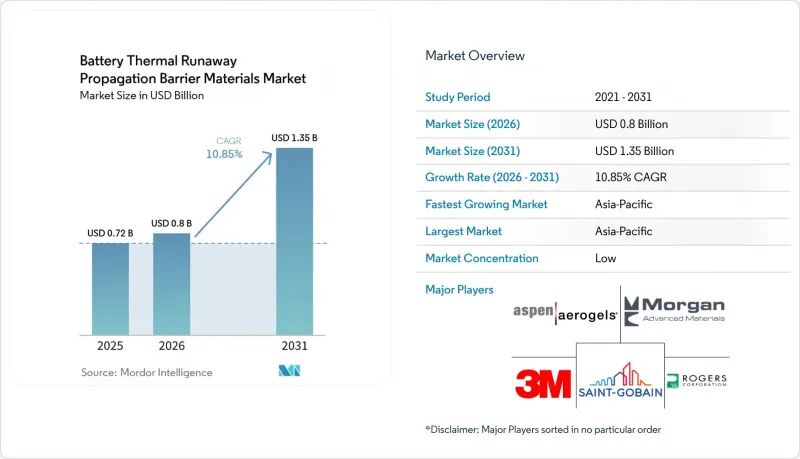
根據 Mordor Intelligence 預測,電池熱失控預防材料市場規模預計在 2025 年達到 7.2 億美元,2026 年達到 8 億美元,到 2031 年達到 13.5 億美元,在預測期(2026-2031 年)內複合年成長率為 10.85%。
本報告材料類型(雲母、氣凝膠及其他)、泡沫類型(片材/墊片、塗層及其他)、電池化學成分(NMC和NCA電池、LFP和LMFP電池及其他)、應用領域(電動車、工業應用及其他)和地區(亞太地區、北美地區及其他)進行細分。市場預測以美元計價。
全球電池熱失控預防材料市場趨勢及洞察。
中國和北美有關熱傳遞預防法規的合規義務
中國GB 38031-2025標準將於2026年7月1日起對新註冊車輛生效,現有車輛須於2027年7月1日前符合該標準。標準要求熱失控事件發生後兩小時內不得發生點火或爆炸,且不得有煙霧進入乘員艙。此外,該標準還包括底部衝擊試驗、快速充電後300次循環老化試驗以及後續外部短路試驗。這些試驗表明,屏障在機械和熱應力下的耐久性是電池熱失控防護材料市場的認證要求。在北美,供應商可透過美國保險商實驗室(UL)9540A測試(針對儲能系統)和FMVSS 305a草案(針對高壓汽車電池)取得不同的合規途徑。這催生了對既滿足車輛又滿足固定式儲能系統安全要求的被動式屏障的需求。
透過電芯到電池組和電芯到電池體的結構實現更高的電池組密度。
電池直接封裝(Cell-to-pack)設計省去了中間模組層,將電池利用率從40-50%提高到60-70%。這種架構也取消了先前限制電池間熱傳遞的模組外殼壁。 2026年的一項研究表明,電池直接封裝模組中熱失控期間的熱傳遞直接取決於電池界面處屏障的熱導率和機械性能。在電池直接封裝(Cell-to-Body)設計中,電池機殼成為車輛結構的一部分,承受碰撞負荷和壓縮應力。因此,電池熱失控防護材料的市場正在轉向保形模塑件、精密模切、射出成型和塗層技術。由於安全組件需要整合到越來越緊湊的電池組結構中,輕薄材料仍然至關重要。
氣凝膠和先進多層阻隔系統高成本
與雲母和陶瓷纖維等替代材料相比,氣凝膠阻隔材料的單位面積成本更高,尤其是在成本控制嚴格的大批量磷酸鐵鋰電池(LFP)項目中。 Aspen Aerogels公司取消了原計劃於2025年在喬治亞斯泰茨伯勒投資3.25億美元建設的工廠,轉而專注於其位於羅德島的生產能力和外包委託製造。這項決定清楚地表明了大規模汽車氣凝膠生產的高資本密集度和運轉率風險。此外,阻隔材料必須在壓縮、通風和衝擊負荷下保持隔熱性能,這意味著低成本材料可能不適用於要求嚴格的電池包裝設計。 2025年6月,Alkegen公司開始全面生產其「AlkeGel」纖維氣凝膠複合材料,採用低粉塵生產方法,旨在省去傳統氣凝膠所需的封裝製程。雖然這種方法解決了電池包裝組裝階段的成本挑戰,但材料的選擇仍然取決於每個項目的安全性和價格目標。
細分市場分析
預計到2025年,雲母將佔電池熱失控傳播預防市場銷售額的34.18%,成為該市場領先的材料類別。雲母的介電強度超過11kV,耐熱性超過1000 度C,使其適用於單體電池和模組級應用。雲母兼具成本效益和成熟的熱學及電學性能,在大批量生產的磷酸鐵鋰(LFP)和鎳鈷錳酸鋰(NMC)電池項目中繼續發揮至關重要的作用。電池封裝設計對能夠貼合3D棱柱形電池表面(而非傳統的平面間隙)的材料需求日益成長。這使得能夠根據特定封裝佈局對複雜的雲母組件進行模塑、切割和組裝的供應商更具優勢。
預計到2031年,氣凝膠將以12.02%的複合年成長率成長,成為電池熱失控傳播預防材料產業中成長最快的材料類型。 Aspen Aerogels公司報告稱,其電動車隔熱材料的銷售額在2024年超過3億美元,其中大部分銷售額來自與單一原始設備製造商(OEM)的交易。陶瓷纖維和陶瓷紙適用於需要持續阻燃的應用,例如NMC和NCA模組中的隔熱層。與被動式雲母和氣凝膠不同,膨脹性材料遇熱會形成碳化層。因此,電池熱失控傳播預防材料市場既包含成熟的隔熱產品,也包含用於更嚴苛應用情境的活性反應材料。
至2025年,片狀墊片將佔銷售額的34.31%,成為電池熱失控傳播預防泡棉材料市場中比重最大的產品。這種外形尺寸的產品正逐漸被雲母、氣凝膠和陶瓷纖維等材料整體,因為它可以放置在電芯、模組或結構部件之間。羅傑斯公司(Rogers Corporation)的「ProCell EV Firewall 300」系列產品將間隙填充、振動管理和熱傳播預防功能整合到單一矽橡膠組件中。模製部件可適應複雜的電池組結構,包括電芯隔板、模組蓋和匯流排絕緣層。埃爾林克林格公司(ElringKlinger)的「ElroForm TP」耐熱溫度高達1300 度C,並通過了UL 94 V-0認證,適用於上述應用。
預計到2031年,塗料市場將以11.71%的複合年成長率成長。塗料領域中電池熱失控傳播預防材料的市場規模主要受電池單體封裝和電池單體外殼封裝設計的影響,在這些設計中,直接塗覆可能是高密度封裝電池之間唯一可行的方式。浸塗、噴塗和網版印刷等製程無需額外嵌件即可在電池表面形成阻隔材料。 2026年2月,住友理工公司獲得了美國專利號12,562,415,該專利涉及一種用於電池單體之間的含二氧化矽氣凝膠的絕緣片。 ISO 12405和IEC 62619測試條件也要求材料能夠在電、機械和熱應力下保持功能性。因此,塗料提供了一種兼顧安全性能和緊湊型電池封裝整合性的有效途徑。
區域分析
亞太地區預計到2025年將佔電池熱失控傳播抑製材料市場44.47%的銷售額,並預計到2031年將以11.86%的複合年成長率成長,成為所有地區中成長最快的市場。中國集電芯生產、電池組組裝、汽車需求和儲能系統部署於一體,規模遠超其他地區。到2025年,中國將新增63吉瓦的電池儲能系統(BESS)產能,成為繼電動車之後的第二個需求管道。隨著GB 38031-2025標準的實施,熱傳播性能已成為中國電池認證的核心要素。日本和韓國也透過開發固態固態電池和未來的OEM認證計畫做出貢獻。
在北美,預計到2026年底,國內電池產能將超過60吉瓦,主要得益於公用事業規模的鋰離子電池系統。這使得電池櫃和機架隔熱層的需求與汽車電池組有所不同。 Aspen Aerogels公司第一季與通用汽車達成一項價值3,760萬美元的商業性和解協議,該協議是一項長期電動車隔熱層供應協議。此次合作體現了平台特定供應合約的高價值和密集性。在巴西和阿根廷,預計與國內電池計劃和可再生能源併網相關的早期商業機會將會出現。
在歐洲,車輛安全、可追溯性和儲能系統採購要求正在推動電池熱失控傳播預防市場的收入成長。聯合國歐洲經濟委員會R100.3號法規和歐盟電池法規2023/1542強調了防火、系統隔離、負責任的採購和報廢電池處置的重要性。 ElringKlinger公司從歐洲通用關鍵專案(IPCEI)獲得了3,380萬歐元(約3,700萬美元)的資金,接受在2026年前開發創新的電池單元外殼設計。在義大利,MACSE的一次競標獲得了一個10吉瓦時公用事業規模儲能系統的契約,預計將於2028年交付。同時,英國的長期儲能計畫目標是在2035年前部署2.7至7.7吉瓦時的儲能容量。在中東和非洲,沙烏地阿拉伯的可再生能源儲能專案正在推動市場需求,而南非對電網的投資則為未來的需求提供了支持。
其他好處
- Excel格式的市場預測(ME)表
- 3個月的分析師支持
目錄
第1章:引言
- 研究假設和市場定義
- 調查範圍
第2章:調查方法
第3章執行摘要
第4章 市場狀況
- 市場概覽
- 市場促進因素
- 中國和北美有關熱傳遞預防法規的合規義務
- 透過「電芯到電池組」和「電芯到機身」架構實現更高的電池組密度。
- 對更高能量密度和快速充電的需求日益成長。
- 電網級電池儲能系統的擴展
- 將熱保護、機械保護和電氣保護功能整合於單一組件中。
- 對輕薄可塑性屏障系統的需求日益成長
- 市場限制因素
- 氣凝膠和先進多層阻隔系統高成本
- OEM認證和檢驗週期越來越長。
- 材料在壓縮載荷、通風載荷和衝擊載荷下的性能權衡。
- 關於回收、舊產品分類和材料可追溯性的限制。
- 價值鏈分析
- 波特五力分析
第5章 市場規模與成長預測
- 依材料類型
- 雲母
- 氣凝膠
- 陶瓷纖維和陶瓷紙
- 可膨脹材料
- 其他材料類型
- 依表單類型
- 座墊
- 塗層
- 模製零件
- 其他形式類型
- 電池化學成分
- NMC和NCA電池
- LFP 和 LMFP 電池
- 全固態電池
- 其他電池化學成分
- 透過使用
- 電動車
- 電池儲能系統
- 工業應用
- 其他用途
- 按地區
- 亞太地區
- 中國
- 印度
- 日本
- 韓國
- 其他亞太國家
- 北美洲
- 美國
- 加拿大
- 墨西哥
- 歐洲
- 德國
- 英國
- 法國
- 義大利
- 其他歐洲國家
- 南美洲
- 巴西
- 阿根廷
- 其他南美國家
- 中東和非洲
- 沙烏地阿拉伯
- 南非
- 其他中東和非洲國家
- 亞太地區
第6章 競爭情勢
- 市場集中度
- 策略趨勢
- 市佔率和排名分析
- 公司簡介
- 3M
- Alkegen
- Aspen Aerogels, Inc.
- DuPont
- ElringKlinger AG
- KULR Technology Group, Inc.
- L&L Products
- Morgan Advanced Materials plc
- Pyrophobic Systems Ltd.
- Rochling SE & Co. KG
- Rogers Corporation
- Saint-Gobain
- Sumitomo Riko Company Limited
- Von Roll Holding AG
- Zotefoams plc
第7章 市場機會與未來展望
According to Mordor Intelligence, the battery thermal runaway propagation barrier materials market was valued at USD 0.72 billion in 2025 and is estimated to grow from USD 0.80 billion in 2026 to reach USD 1.35 billion by 2031, at a CAGR of 10.85% during the forecast period (2026-2031).
This report is Segmented by Material Type (Mica, Aerogel, and More), Form Type (Sheets and Pads, Coatings, and More), Battery Chemistry (NMC and NCA Batteries, LFP and LMFP Batteries, and More), Application (Electric Vehicles, Industrial Applications, and More), and Geography (Asia-Pacific, North America, and More). The Market Forecasts are Provided in Terms of Value (USD).
Global Battery Thermal Runaway Propagation Barrier Materials Market Trends and Insights
Mandatory Thermal Propagation Compliance in China and North America
China's GB 38031-2025 took effect for newly declared vehicle models on July 1, 2026, and requires existing models to comply by July 1, 2027. The standard requires a two-hour no-fire, no-explosion outcome after thermal runaway, while smoke must not enter the passenger compartment. It also includes bottom-impact testing and a post-fast-charging sequence of 300 aging cycles followed by an external short-circuit test. These tests make barrier durability under mechanical and thermal stress a qualification requirement for the battery thermal runaway propagation barrier materials market. In North America, Underwriters Laboratories (UL) 9540A testing for storage systems and draft FMVSS 305a requirements for high-voltage vehicle batteries create separate compliance paths for suppliers. The result is demand for passive barriers that address both vehicle and stationary-storage safety conditions.
Battery Pack Densification Through Cell-to-Pack and Cell-to-Body Architectures
Cell-to-pack designs remove the intermediate module layer and increase cell utilization from 40-50% to 60-70%. This architecture also removes module housing walls that had limited heat transfer between cells. A 2026 study found that heat transfer during thermal runaway in cell-to-pack modules depends directly on barrier conductivity and mechanical behavior at the cell interface. Cell-to-body designs add crash loads and compressive stress because the battery enclosure becomes part of the vehicle structure. The battery thermal runaway propagation barrier materials market is therefore moving toward conformal parts, precision die-cutting, injection molding, and coating methods. Low-weight and thin materials remain important because safety components must fit into increasingly compact pack geometries.
High Cost of Aerogel and Advanced Multilayer Barrier Systems
Aerogel barriers cost more per unit area than mica or ceramic fiber alternatives, especially in high-volume LFP programs with tight cost limits. Aspen Aerogels stopped its planned USD 325 million facility in Statesboro, Georgia, in 2025 and focused on Rhode Island capacity and external fabrication. The decision showed the capital intensity and utilization risk associated with large-scale automotive aerogel production. Barriers must also preserve their thermal function under compression, venting, and crash loads, which can make a low-cost material unsuitable for a demanding pack design. Alkegen started full-scale production of its AlkeGel fiber-aerogel composite in June 2025, using a low-dust format intended to remove the encapsulation step required by conventional aerogels. This approach addresses cost at the pack assembly stage, although material selection still depends on the safety and price targets of each program.
Other drivers and restraints analyzed in the detailed report include:
- Rising Energy Density and Faster Charging Requirements
- Expansion of Grid-Scale Battery Energy Storage Systems
- Recycling, End-of-Life Separation and Material Traceability Constraints
For complete list of drivers and restraints, kindly check the Table Of Contents.
Segment Analysis
Mica held 34.18% of 2025 revenue, making it the leading material category in the battery thermal runaway propagation barrier materials market. Its dielectric strength exceeds 11 kV, and its temperature resistance is above 1,000 °C, supporting cell-to-cell and module-level applications. Mica remains relevant in high-volume LFP and NMC programs because it combines cost control with established thermal and electrical performance. Cell-to-pack designs increase the need for materials that fit three-dimensional prismatic cell surfaces rather than regular planar gaps. This favors suppliers that can mold, die-cut, and assemble complex mica components for specific pack layouts.
Aerogel is forecast to expand at a 12.02% CAGR through 2031, the fastest rate among material types in the battery thermal runaway propagation barrier materials industry. Aspen Aerogels reported more than USD 300 million in EV thermal barrier revenue during 2024, with most of that revenue linked to a single OEM relationship. Ceramic fiber and ceramic paper remain suited to applications that require sustained flame resistance, including NMC and NCA module barriers. Intumescent materials provide a char-forming response under heat, unlike passive mica and aerogel formats. The battery thermal runaway propagation barrier materials market thus contains both established insulation products and active-response materials for more severe use cases.
Sheets and pads held 34.31% of revenue in 2025, the largest form type share within the battery thermal runaway propagation barrier materials market. This format is established across mica, aerogel, and ceramic fiber products because it can be placed between cells, modules, or structural components. Rogers Corporation's ProCell EV Firewall 300 series combines gap filling, vibration management, and thermal propagation protection in one silicone elastomeric component. Molded parts support complex pack geometries, including cell barriers, module covers, and busbar insulation. ElringKlinger's ElroForm TP is rated to 1,300 °C and has UL 94 V-0 certification for these applications.
Coatings are forecast to grow at an 11.71% CAGR through 2031. The battery thermal runaway propagation barrier materials market size for coatings is supported by cell-to-pack and cell-to-body designs, where direct application may be the only workable geometry between closely arranged cells. Dip-coating, spray coating, and screen printing allow barriers to follow cell surfaces without adding separate inserts. Sumitomo Riko received US Patent 12,562,415 in February 2026 for a silica-aerogel-containing insulation sheet between battery cells. ISO 12405 and IEC 62619 testing conditions also favor materials that maintain their function under electrical, mechanical, and thermal stress. Coatings, therefore, offer a route to combine safety performance with compact pack integration.
Complete Report Scope:
- By Material Type
- Mica
- Aerogel
- Ceramic Fiber and Ceramic Paper
- Intumescent Materials
- Other Material Types
- By Form Type
- Sheets and Pads
- Coatings
- Molded Parts
- Other Form Types
- By Battery Chemistry
- NMC and NCA Batteries
- LFP and LMFP Batteries
- Solid-State Batteries
- Other Battery Chemistries
- By Application
- Electric Vehicles
- Battery Energy Storage Systems
- Industrial Applications
- Other Applications
- By Geography
- Asia-Pacific
- China
- India
- Japan
- South Korea
- Rest of Asia-Pacific
- North America
- United States
- Canada
- Mexico
- Europe
- Germany
- United Kingdom
- France
- Italy
- Rest of Europe
- South America
- Brazil
- Argentina
- Rest of South America
- Middle-East and Africa
- Saudi Arabia
- South Africa
- Rest of Middle-East and Africa
- Asia-Pacific
Geography Analysis
Asia-Pacific held 44.47% of 2025 revenue and is forecast to grow at an 11.86% CAGR through 2031, the highest regional rate in the battery thermal runaway propagation barrier materials market. China combines cell production, battery pack assembly, automotive demand, and storage deployment at a scale unmatched by other regions. China added 63 GW of new BESS capacity in 2025, creating a second demand channel beyond electric vehicles. The enforcement of GB 38031-2025 makes thermal propagation performance a central part of battery qualification in the country. Japan and South Korea also contribute through solid-state cell development and future OEM qualification programs.
In North America, domestic battery storage capacity is projected to exceed 60 GW by the end of 2026, with most capacity in utility-scale lithium-ion systems. This creates requirements for cabinet and rack barriers that differ from automotive pack requirements. Aspen Aerogels reached a USD 37.6 million commercial settlement with General Motors in the first quarter of 2026 under a long-term EV thermal barrier supply agreement. The relationship reflects the high-value and concentrated nature of platform-specific supply arrangements. Brazil and Argentina represent earlier-stage opportunities linked to domestic battery plans and renewable energy integration.
Europe has a growing revenue contribution in the battery thermal runaway propagation barrier materials market because of vehicle safety, traceability, and storage procurement requirements. UNECE R100.3 and the EU Battery Regulation 2023/1542 increase attention to fire protection, system separation, responsible sourcing, and end-of-life treatment. ElringKlinger received EUR 33.8 million (approximately USD 37 million) in Important Projects of Common European Interest (IPCEI) funding for an innovative battery cell housing design through 2026. Italy's MACSE auction contracted 10 GWh of utility-scale storage for delivery by 2028, while Great Britain's long-duration storage plan targets 2.7-7.7 GWh by 2035. The Middle-East and Africa drive demand through renewable storage projects in Saudi Arabia, and grid investment in South Africa supports later demand.
- 3M
- Alkegen
- Aspen Aerogels, Inc.
- DuPont
- ElringKlinger AG
- KULR Technology Group, Inc.
- L&L Products
- Morgan Advanced Materials plc
- Pyrophobic Systems Ltd.
- Rochling SE & Co. KG
- Rogers Corporation
- Saint-Gobain
- Sumitomo Riko Company Limited
- Von Roll Holding AG
- Zotefoams plc
Additional Benefits:
- The market estimate (ME) sheet in Excel format
- 3 months of analyst support
TABLE OF CONTENTS
1 Introduction
- 1.1 Study Assumptions and Market Definition
- 1.2 Scope of the Study
2 Research Methodology
3 Executive Summary
4 Market Landscape
- 4.1 Market Overview
- 4.2 Market Drivers
- 4.2.1 Mandatory Thermal Propagation Compliance in China and North America
- 4.2.2 Battery Pack Densification Through Cell-to-Pack and Cell-to-Body Architectures
- 4.2.3 Rising Energy Density and Faster Charging Requirements
- 4.2.4 Expansion of Grid-Scale Battery Energy Storage Systems
- 4.2.5 Integration of Thermal, Mechanical and Electrical Protection in Single Components
- 4.2.6 Qualification Demand for Low-Weight, Thin and Moldable Barrier Systems
- 4.3 Market Restraints
- 4.3.1 High Cost of Aerogel and Advanced Multilayer Barrier Systems
- 4.3.2 Lengthy OEM Qualification and Validation Cycles
- 4.3.3 Material Performance Trade-Offs Under Compression, Venting and Crash Loads
- 4.3.4 Recycling, End-of-Life Separation and Material Traceability Constraints
- 4.4 Value Chain Analysis
- 4.5 Porter's Five Forces
- 4.5.1 Threat of New Entrants
- 4.5.2 Bargaining Power of Suppliers
- 4.5.3 Bargaining Power of Buyers
- 4.5.4 Threat of Substitutes
- 4.5.5 Competitive Rivalry
5 Market Size and Growth Forecasts (Value)
- 5.1 By Material Type
- 5.1.1 Mica
- 5.1.2 Aerogel
- 5.1.3 Ceramic Fiber and Ceramic Paper
- 5.1.4 Intumescent Materials
- 5.1.5 Other Material Types
- 5.2 By Form Type
- 5.2.1 Sheets and Pads
- 5.2.2 Coatings
- 5.2.3 Molded Parts
- 5.2.4 Other Form Types
- 5.3 By Battery Chemistry
- 5.3.1 NMC and NCA Batteries
- 5.3.2 LFP and LMFP Batteries
- 5.3.3 Solid-State Batteries
- 5.3.4 Other Battery Chemistries
- 5.4 By Application
- 5.4.1 Electric Vehicles
- 5.4.2 Battery Energy Storage Systems
- 5.4.3 Industrial Applications
- 5.4.4 Other Applications
- 5.5 By Geography
- 5.5.1 Asia-Pacific
- 5.5.1.1 China
- 5.5.1.2 India
- 5.5.1.3 Japan
- 5.5.1.4 South Korea
- 5.5.1.5 Rest of Asia-Pacific
- 5.5.2 North America
- 5.5.2.1 United States
- 5.5.2.2 Canada
- 5.5.2.3 Mexico
- 5.5.3 Europe
- 5.5.3.1 Germany
- 5.5.3.2 United Kingdom
- 5.5.3.3 France
- 5.5.3.4 Italy
- 5.5.3.5 Rest of Europe
- 5.5.4 South America
- 5.5.4.1 Brazil
- 5.5.4.2 Argentina
- 5.5.4.3 Rest of South America
- 5.5.5 Middle-East and Africa
- 5.5.5.1 Saudi Arabia
- 5.5.5.2 South Africa
- 5.5.5.3 Rest of Middle-East and Africa
- 5.5.1 Asia-Pacific
6 Competitive Landscape
- 6.1 Market Concentration
- 6.2 Strategic Moves
- 6.3 Market Share (%)/Ranking Analysis
- 6.4 Company Profiles (includes Global Overview, Market Overview, Core Segments, Financials as available, Strategic Information, Products and Services, and Recent Developments)
- 6.4.1 3M
- 6.4.2 Alkegen
- 6.4.3 Aspen Aerogels, Inc.
- 6.4.4 DuPont
- 6.4.5 ElringKlinger AG
- 6.4.6 KULR Technology Group, Inc.
- 6.4.7 L&L Products
- 6.4.8 Morgan Advanced Materials plc
- 6.4.9 Pyrophobic Systems Ltd.
- 6.4.10 Rochling SE & Co. KG
- 6.4.11 Rogers Corporation
- 6.4.12 Saint-Gobain
- 6.4.13 Sumitomo Riko Company Limited
- 6.4.14 Von Roll Holding AG
- 6.4.15 Zotefoams plc
7 Market Opportunities and Future Outlook
- 7.1 White-Space and Unmet-Need Assessment

 電動車冷卻系統市場:未來預測(至2034年)-按組件、冷卻系統、冷卻介質、推進系統、車輛類型、最終用戶和地區分類的全球分析電池機殼及溫度控管材料市場預測至2034年-按電池類型、材料類型、功能、應用、最終用戶和地區分類的全球分析
 汽車電池溫度控管系統市場:依產品類型、冷卻方式、安裝等級及最終用戶分類-2026-2032年全球市場預測
 汽車電池溫度控管系統市場分析及至2035年的預測:按類型、產品、技術、組件、應用、材料類型、最終用戶、功能和安裝類型分類電池溫度控管市場預測至2034年—按系統類型、組件、技術、應用、最終用戶和地區分類的全球分析
 2026年全球汽車電池溫度控管系統市場報告電池溫度控管系統市場:全球市場預測(按應用、冷卻技術、電池化學成分和系統類型分類),2026年至2032年
 電池溫度控管系統市場機會、成長要素、產業趨勢分析及2026-2035年預測新能源汽車電子水閥市場按推進類型、車輛類型、應用、材料和銷售管道,全球預測(2026-2032年)
 全球電動車電池溫度控管系統市場規模、佔有率、趨勢和成長分析報告(2026-2034年)