

 |
市場調查報告書
商品編碼
2154517
積層製造用樹脂:市場佔有率分析、產業趨勢與統計資料、成長預測(2026-2031 年)Additive Manufacturing Resins - Market Share Analysis, Industry Trends & Statistics, Growth Forecasts (2026 - 2031) |
||||||

※ 本網頁內容可能與最新版本有所差異。詳細情況請與我們聯繫。
據 Mordor Intelligence 稱,2025 年積層製造樹脂市場價值為 571.2 億美元,預計到 2031 年將達到 804.8 億美元,而 2026 年為 604.8 億美元,預測期(2026-2031 年)的複合年成長率為 5.88%。
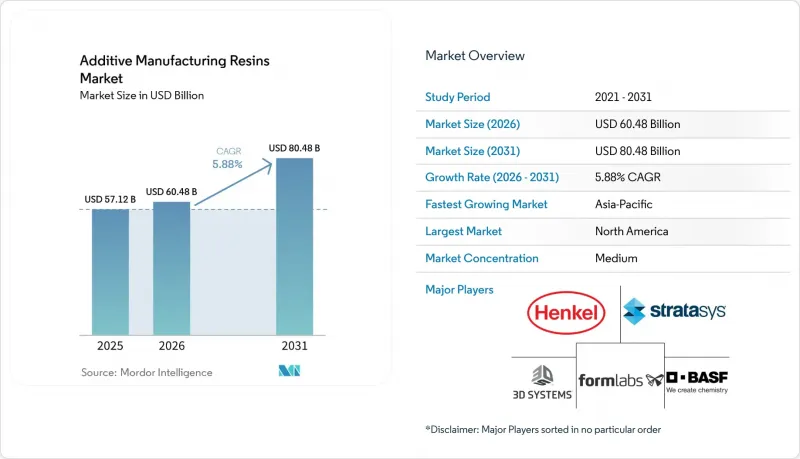
全球積層製造樹脂市場趨勢及洞察。
對病患專用醫療組件的需求
個人化醫療製造正在推動積層製造樹脂市場的長期需求。這是因為臨床組件需要明確的材料特性和受控的生產記錄。國際標準化組織 (ISO) 10993 系列生物相容性標準日益明確了醫用樹脂產品(包括擬與患者反覆接觸的產品)的合格標準。 Stratasys 的「P3 MED Silicone 25A」已通過 ISO 10993-5、ISO 10993-10 和 ISO 10993-23 認證,並獲得美國食品藥物管理局(FDA) 病患專用穿戴醫療設備主體文件的支援。 FDA 和歐盟醫療設備法規 (EU MDR) 的上市後監測要求有利於擁有檢驗供應鏈、可追溯批次記錄和完善文件流程的供應商。這些要求有助於簽訂多年期供應契約,因為製造商必須保護用於每項臨床應用的檢驗流程。在日本,3D列印全口義齒材料於2025年納入國家健康保險的報銷範圍,2026年6月擴大了報銷範圍,涵蓋的義齒類型也隨之增加。
從原型製作到功能性樹脂零件的過渡
隨著工業用戶從原型製作轉向對列印後性能要求更高的功能性部件,積層製造樹脂市場正蓬勃發展。這種轉變改變了採購重點,從基本的可列印性轉向在實際運作條件下的性能,例如疲勞強度、彎曲性能和尺寸精度。功能性應用需要樹脂具備一致的機械性能、良好的儲存穩定性、可重複的批次性能以及適用於現有印表機的加工特性。 Formlabs 於 2025 年 3 月推出了 Tough 1500 樹脂,其疲勞強度和彎曲性能可與射出成型成型的聚丙烯相媲美。 2025 年 11 月,該公司發布了 Tough 1000 樹脂及其改進版本 Tough 2000 樹脂,進一步擴展了其功能性材料產品線,以滿足對衝擊強度和表面品質要求更高的組件的需求。在大規模生產環境中,經過認證的樹脂消耗速度很快,並且對流變性能的控制要求比原型製作環境更為嚴格,因此經過檢驗的配方對使用者而言更有價值。
經認證的工程樹脂和生物相容性樹脂高成本
高昂的認證成本是積層製造樹脂市場推廣應用的限制因素,對於無法透過大規模生產分攤認證成本的中小型醫療和牙科使用者而言,這尤其是一個重大障礙。根據 ISO 10993 標準,樹脂在用於人體接觸應用之前,需要進行細胞毒性、刺激性和致敏性測試,並具備檢驗的方案、技術文件和受控的後處理。 Stratasys 公司的 Somos BioClear 樹脂已通過 ISO 10993-5、ISO 10993-10 和美國藥典 (USP) VI 級標準的醫療設備應用測試。認證等級的樹脂價格可能是標準原型製作等級的 2 到 5 倍,這對實驗室和對成本敏感的製造商來說是一個顯著的價格差異。漢高公司 (Henkel AG & Co. KGaA) 在使用模擬食品材料進行遷移和萃取測試後,旨在使 Loctite 3D IND3785 樹脂滿足歐盟 (EU) 10/2011 食品接觸要求。歐洲的合規要求可能會延長產品上市時間,因此擁有大規模的法規遵循團隊、成熟的測試方法和完善的品質系統的供應商會更受青睞。
細分市場分析
截至2025年,光固化樹脂將佔據積層製造樹脂市場56.34%的佔有率,預計到2031年將以6.45%的複合年成長率成長。這一市場地位反映了其與立體光刻技術(SLA)、數位光刻(DLP)和CLIP平台廣泛的兼容性,這些平台廣泛應用於牙科、醫療和工業領域,使供應商能夠利用相關的化學平台和針對特定應用的配方來滿足多樣化的應用需求。熱塑性樹脂被用於熔融沈積成型(FDM)系統中的結構和耐熱應用。這些材料適用於那些對柔軟性、耐熱性和形狀要求高於50微米以下解析度的零件設計。環氧樹脂則用於複合材料層壓的模具和芯軸,這些應用需要其在機械負載下保持尺寸穩定性。
聚氨酯樹脂在整個積層製造樹脂市場中為彈性體和晶格結構應用提供了支持,因為柔軟性零件需要在列印後控制變形。其他樹脂包括生物基和陶瓷填充複合材料,以滿足特定的性能要求。 Formlabs 提供超過 40 種 SLA 材料,而 Stratasys 則為要求苛刻的應用提供 Somos BioClear。 2025 年 4 月,阿科瑪位於維吉尼亞州查維吉尼亞和賓夕法尼亞州韋斯特切斯特的 Sartmar 工廠獲得了國際永續碳認證 (ISCC) PLUS 認證。此認證使其能夠開發用於紫外線發光二極體(UV-LED) 的生物基電子束樹脂解決方案。
區域分析
2025年,北美佔據了積層製造樹脂市場38.77%的佔有率。該地區擁有深厚的生產級DLP和SLA系統基礎,集中了許多獲得FDA已通過核准的光固化樹脂,以及許多數位化先進的牙體技術所。 2025年9月,漢高股份及兩合公司(Henkel AG & Co. KGaA)完成了其位於南達科他州布蘭登工廠的3000萬美元擴建項目,使工廠面積加倍,達到7萬平方英尺,並增強了其樂泰(LOCTITE)品牌黏合劑和溫度控管材料的產能。歐洲繼續發揮區域中心的重要作用,其中德國是該產業的中心。
德國的合規要求推動了對高性能且文檔齊全的材料的投資。這些要求強調可追溯性、可預測的加工性能以及滿足特定應用標準的能力。預計到2031年,亞太地區的複合年成長率將達到6.33%。中國和印度是該地區銷售的主要驅動力,而日本、韓國和台灣地區則支撐著對特殊樹脂的需求。這種區域構成對低成本功能級樹脂和高階特殊複合材料提出了不同的要求。
在日本,3D列印義齒材料的保險覆蓋範圍於2025年開始實施,並於2026年6月擴大。科思創股份公司在中國南方城市珠海開設了一家熱塑性聚氨酯生產廠,初始年產能為3萬噸。南美、中東和非洲仍處於早期市場階段,由於認證級材料的取得管道有限,市場接受度較低。儘管這些地區具有潛在需求,但分銷能力和認證成本仍然是重要的障礙。
其他好處:
- Excel格式的市場預測(ME)表
- 3個月的分析師支持
目錄
第1章:引言
- 研究假設和市場定義
- 調查範圍
第2章:調查方法
第3章執行摘要
第4章 市場狀況
- 市場概覽
- 市場促進因素
- 擴展生產級牙科工作流程
- 從原型製作到功能性樹脂零件的過渡
- 對病患專用醫療組件的需求
- 部署高通量DLP和CLIP平台
- 相容印表機的開放材料生態系統
- 市場限制因素
- 經認證的工程樹脂和生物相容性樹脂高成本
- 透過對專有印表機樹脂進行認證來鎖定市場。
- 光引發劑和寡聚物的供應濃度
- 價值鏈分析
- 波特五力分析
第5章 市場規模與成長預測
- 依樹脂類型
- 光聚合樹脂
- 熱塑性樹脂
- 環氧樹脂
- 聚氨酯樹脂
- 其他樹脂
- 按最終用途行業分類
- 衛生保健
- 車
- 航太/國防
- 工業製造
- 消費品
- 其他終端用戶產業
- 按地區
- 亞太地區
- 中國
- 印度
- 日本
- 韓國
- 東南亞國協
- 其他亞太國家
- 北美洲
- 美國
- 加拿大
- 墨西哥
- 歐洲
- 德國
- 英國
- 法國
- 義大利
- 北歐國家
- 其他歐洲國家
- 南美洲
- 巴西
- 阿根廷
- 其他南美國家
- 中東和非洲
- 沙烏地阿拉伯
- 南非
- 其他中東和非洲國家
- 亞太地區
第6章 競爭情勢
- 市場集中度
- 策略趨勢
- 市佔率和排名分析
- 公司簡介
- 3D Systems, Inc.
- Arkema SA
- BASF
- Carbon, Inc.
- COVESTRO
- DWS Srl
- Evonik Industries AG
- Formlabs
- Henkel AG & Co. KGaA
- Keystone Industries
- Photocentric Ltd
- Stratasys
- UnionTech
第7章 市場機會與未來展望
According to Mordor Intelligence, the additive manufacturing resins market size was valued at USD 57.12 billion in 2025 and is estimated to grow from USD 60.48 billion in 2026 to reach USD 80.48 billion by 2031, at a CAGR of 5.88% during the forecast period (2026-2031).
Global Additive Manufacturing Resins Market Trends and Insights
Demand for Patient-Specific Medical Components
Personalized medical manufacturing supports long-term demand for the additive manufacturing resins market because clinical parts require defined material performance and controlled production records. International Organization for Standardization (ISO) 10993-series biocompatibility standards increasingly define the qualification threshold for medical resin products, including products intended for repeated patient contact. Stratasys' P3 MED Silicone 25A is certified against ISO 10993-5, ISO 10993-10, and ISO 10993-23, and it is supported by a Food and Drug Administration (FDA) Master File for patient-specific wearable medical devices. FDA and European Union Medical Device Regulation (EU MDR) post-market surveillance requirements favor suppliers with validated supply chains, traceable batch records, and established documentation processes. These requirements can support multiyear supply arrangements because manufacturers must protect the validated process used for each clinical application. Japan included 3D-printed complete denture materials in national insurance coverage in 2025 and expanded the applicable denture types in June 2026.
Shift From Prototyping to Functional Resin Parts
The additive manufacturing resins market is gaining support as industrial users shift from prototypes toward functional parts that must work consistently after printing. This transition changes purchasing priorities from basic printability toward performance under operational conditions, including fatigue, flex behavior, and dimensional reliability. Functional applications require resins with consistent mechanical properties, shelf stability, repeatable batch performance, and processing characteristics that suit the installed printer base. Formlabs launched Tough 1500 Resin in March 2025 to address fatigue and flex performance comparable with injection-molded polypropylene. The company introduced Tough 1000 Resin and an improved Tough 2000 Resin in November 2025, extending its functional materials range for assemblies that require impact resistance and improved surface quality. Production operations consume qualified resin at sustained rates and require tighter rheological control than prototyping environments, making validated formulations more valuable to users.
High Cost of Certified Engineering and Biocompatible Resins
High certification costs constrain adoption in the additive manufacturing resins market, particularly among smaller medical and dental users who cannot spread qualification expenses across high production volumes. ISO 10993 cytotoxicity, irritation, and sensitization testing requires validated protocols, technical documentation, and controlled post-processing before a resin can serve body-contact applications. Stratasys' Somos BioClear underwent ISO 10993-5, ISO 10993-10, and United States Pharmacopeia Class VI testing for medical device applications. Certified grades can cost 2-5 times more than standard prototyping grades, creating a clear price gap for laboratories and cost-sensitive manufacturing operations. Henkel AG & Co. KGaA pursued European Union 10/2011 food-contact requirements for Loctite 3D IND3785 after migration and extraction testing across food simulants. European compliance requirements can lengthen commercialization schedules and favor suppliers with larger regulatory teams, proven testing methods, and established quality systems.
Other drivers and restraints analyzed in the detailed report include:
- Expansion of Production-Grade Dental Workflows
- Adoption of High-Throughput DLP and CLIP Platforms
- Proprietary Printer-Resin Qualification Lock-In
For complete list of drivers and restraints, kindly check the Table Of Contents.
Segment Analysis
Photopolymer resins held 56.34% of the additive manufacturing resins market share in 2025 and are projected to advance at a 6.45% CAGR through 2031. Their position reflected broad compatibility with stereolithography (SLA), DLP, and CLIP platforms used in dental, medical, and industrial applications, allowing suppliers to address multiple uses with related chemistry platforms and application-specific formulations. Thermoplastic resins served structural and high-temperature uses on fused deposition modeling (FDM) systems. These materials supported part designs where flexibility, temperature resistance, and geometry were more important than sub-50-micron resolution. Epoxy resins addressed tooling and composite lay-up mandrel applications that required dimensional stability under mechanical loading.
Polyurethane resins supported elastomeric and lattice applications across the additive manufacturing resins market because flexible components require controlled deformation after printing. Other resins included bio-based and ceramic-filled composites that addressed specialized performance requirements. Formlabs offered more than 40 SLA materials, while Stratasys supplied Somos BioClear for demanding applications. Arkema obtained International Sustainability and Carbon Certification (ISCC) PLUS certification for Sartomer sites in Chatham, Virginia, and West Chester, Pennsylvania, in April 2025. The certification enabled bio-attributed ultraviolet light-emitting diode electron beam resin solutions.
Complete Report Scope:
- By Resin Type
- Photopolymer Resins
- Thermoplastic Resins
- Epoxy Resins
- Polyurethane Resins
- Other Resins
- By End-Use Industry
- Healthcare
- Automotive
- Aerospace and Defense
- Industrial Manufacturing
- Consumer Goods
- Other End-Use Industries
- By Geography
- Asia-Pacific
- China
- India
- Japan
- South Korea
- ASEAN Countries
- Rest of Asia-Pacific
- North America
- United States
- Canada
- Mexico
- Europe
- Germany
- United Kingdom
- France
- Italy
- NORDIC Countries
- Rest of Europe
- South America
- Brazil
- Argentina
- Rest of South America
- Middle East and Africa
- Saudi Arabia
- South Africa
- Rest of Middle East and Africa
- Asia-Pacific
Geography Analysis
North America held 38.77% of the additive manufacturing resins market share in 2025. The region had a deep installed base of production-grade DLP and SLA systems, a high concentration of FDA-cleared photopolymer materials, and digitally advanced dental laboratories. Henkel AG & Co. KGaA completed a USD 30 million expansion of its Brandon, South Dakota, facility in September 2025, doubling the site to 70,000 square feet for LOCTITE-branded adhesives and thermal management materials Europe continued to serve as a significant regional base, with Germany acting as an industrial hub.
German compliance requirements support investment in materials with advanced performance and documentation. These requirements place emphasis on traceability, predictable processing, and the ability to meet application-specific standards. Asia-Pacific is projected to advance at a 6.33% CAGR through 2031. China and India support regional revenue, while Japan, South Korea, and Taiwan support specialty resin demand. The regional mix creates different requirements for lower-cost functional grades and premium specialty formulations.
Japan's insurance coverage of 3D-printed denture materials began in 2025 and expanded in June 2026. Covestro AG opened a thermoplastic polyurethane facility in Zhuhai, South China, with an initial annual capacity of 30,000 metric tons. South America, the Middle East, and Africa remain early-stage markets where access to certified-grade materials limits adoption. These regions have demand potential, but distribution capacity and certification costs remain significant barriers.
- 3D Systems, Inc.
- Arkema S.A.
- BASF
- Carbon, Inc.
- COVESTRO
- DWS S.r.l.
- Evonik Industries AG
- Formlabs
- Henkel AG & Co. KGaA
- Keystone Industries
- Photocentric Ltd
- Stratasys
- UnionTech
Additional Benefits:
- The market estimate (ME) sheet in Excel format
- 3 months of analyst support
TABLE OF CONTENTS
1 Introduction
- 1.1 Study Assumptions and Market Definition
- 1.2 Scope of the Study
2 Research Methodology
3 Executive Summary
4 Market Landscape
- 4.1 Market Overview
- 4.2 Market Drivers
- 4.2.1 Expansion of Production-Grade Dental Workflows
- 4.2.2 Shift From Prototyping to Functional Resin Parts
- 4.2.3 Demand for Patient-Specific Medical Components
- 4.2.4 Adoption of High-Throughput DLP and CLIP Platforms
- 4.2.5 Printer-Qualified Open Material Ecosystems
- 4.3 Market Restraints
- 4.3.1 High Cost of Certified Engineering and Biocompatible Resins
- 4.3.2 Proprietary Printer-Resin Qualification Lock-In
- 4.3.3 Photoinitiator and Oligomer Supply Concentration
- 4.4 Value Chain Analysis
- 4.5 Porter's Five Forces Analysis
- 4.5.1 Bargaining Power of Suppliers
- 4.5.2 Bargaining Power of Buyers
- 4.5.3 Threat of New Entrants
- 4.5.4 Threat of Substitutes
- 4.5.5 Competitive Rivalry
5 Market Size and Growth Forecasts (Value)
- 5.1 By Resin Type
- 5.1.1 Photopolymer Resins
- 5.1.2 Thermoplastic Resins
- 5.1.3 Epoxy Resins
- 5.1.4 Polyurethane Resins
- 5.1.5 Other Resins
- 5.2 By End-Use Industry
- 5.2.1 Healthcare
- 5.2.2 Automotive
- 5.2.3 Aerospace and Defense
- 5.2.4 Industrial Manufacturing
- 5.2.5 Consumer Goods
- 5.2.6 Other End-Use Industries
- 5.3 By Geography
- 5.3.1 Asia-Pacific
- 5.3.1.1 China
- 5.3.1.2 India
- 5.3.1.3 Japan
- 5.3.1.4 South Korea
- 5.3.1.5 ASEAN Countries
- 5.3.1.6 Rest of Asia-Pacific
- 5.3.2 North America
- 5.3.2.1 United States
- 5.3.2.2 Canada
- 5.3.2.3 Mexico
- 5.3.3 Europe
- 5.3.3.1 Germany
- 5.3.3.2 United Kingdom
- 5.3.3.3 France
- 5.3.3.4 Italy
- 5.3.3.5 NORDIC Countries
- 5.3.3.6 Rest of Europe
- 5.3.4 South America
- 5.3.4.1 Brazil
- 5.3.4.2 Argentina
- 5.3.4.3 Rest of South America
- 5.3.5 Middle East and Africa
- 5.3.5.1 Saudi Arabia
- 5.3.5.2 South Africa
- 5.3.5.3 Rest of Middle East and Africa
- 5.3.1 Asia-Pacific
6 Competitive Landscape
- 6.1 Market Concentration
- 6.2 Strategic Moves
- 6.3 Market Share (%)/Ranking Analysis
- 6.4 Company Profiles (includes Global Overview, Market Overview, Core Segments, Financials as available, Strategic Information, Products and Services, and Recent Developments)
- 6.4.1 3D Systems, Inc.
- 6.4.2 Arkema S.A.
- 6.4.3 BASF
- 6.4.4 Carbon, Inc.
- 6.4.5 COVESTRO
- 6.4.6 DWS S.r.l.
- 6.4.7 Evonik Industries AG
- 6.4.8 Formlabs
- 6.4.9 Henkel AG & Co. KGaA
- 6.4.10 Keystone Industries
- 6.4.11 Photocentric Ltd
- 6.4.12 Stratasys
- 6.4.13 UnionTech
7 Market Opportunities and Future Outlook
- 7.1 White-Space and Unmet-Need Assessment

 高速大尺寸切割系統市場:全球市場預測,2026-2032年
 2026-2030年全球積層製造市場
 2034 年積層製造材料市場預測-按材料類型、材料形式、與製造技術的兼容性、最終用戶和地區進行全球分析。
 積層製造設備市場規模、佔有率、成長、全球產業分析、區域趨勢及2026-2034年預測
 雷射積層製造監測市場-全球及區域分析:按應用、產品與國家分類-分析與預測,2026-2035年混合積層製造設備市場:全球市場預測,2026-2032年
 積層製造與材料:市場佔有率分析、產業趨勢與統計、成長預測(2026-2031)全球積層製造設備市場規模、佔有率、趨勢和成長分析報告(2026-2034年)銅積層製造市場:依製造流程、材料類型、服務類型、應用和最終用途產業分類-2026-2032年全球市場預測
 2026年全球混合積層製造設備市場報告