

 |
市場調查報告書
商品編碼
2154490
智慧體人工智慧管理服務:市場佔有率分析、產業趨勢與統計、成長預測(2026-2031 年)Agentic AI Managed Services - Market Share Analysis, Industry Trends & Statistics, Growth Forecasts (2026 - 2031) |
||||||

※ 本網頁內容可能與最新版本有所差異。詳細情況請與我們聯繫。
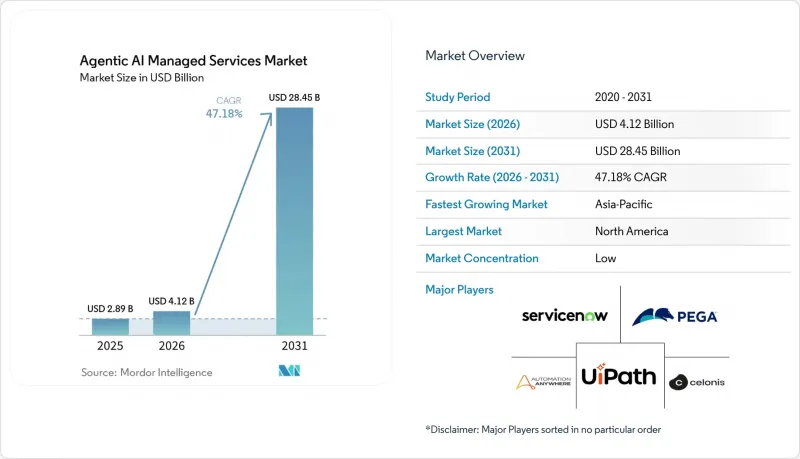
根據 Mordor Intelligence 預測,基於代理商的 AI 管理服務市場將從 2025 年的 28.9 億美元成長到 2026 年的 41.2 億美元,到 2031 年達到 284.5 億美元,2026 年至 2031 年的年複合成長率(CAGR)為 47.18%。
全球基於代理的AI管理服務市場趨勢及洞察
企業對自主端到端工作流程執行的需求
對流程層級自動化的需求,而非任務級支持,才是推動以代理為基礎的AI管理服務市場發展的更強動力。企業正將關注點從單一助理轉向能夠跨職能部門(例如財務、營運、客戶服務和技術)完成協調作業的代理。這種轉變導致對能夠將代理商與企業資源規劃 (ERP)、客戶關係管理 (CRM) 和 IT 服務管理系統整合的供應商的需求不斷成長。與舊有系統的整合、AI 營運成本的波動以及數位化勞動力的經濟性等因素,使得僅靠小規模內部團隊難以運行這些專案。因此,實施和整合合約正從一次性部署轉向持續營運合約。此外,基於使用量和結果的定價模式也使供應商的營運與客戶對自動化工作流程的期望價值更加契合。
生產環境需要代理監控和可觀測性
基於代理的AI託管服務市場依賴可靠的生產環境監控,因為自主系統可能會出現傳統應用工具無法偵測到的故障。生產代理可能會執行不恰當的提示路徑、濫用工具或以異常速度消耗令牌,而這些故障可能無法被傳統系統錯誤偵測到。 2025年2月,Arize AI融資7000萬美元,用於擴展其在企業環境中對大規模語言模型和AI代理的評估和可觀測性工具。監控提供者透過追蹤、評估、預算、回歸測試和升級規則來應對這項挑戰。託管服務供應商可以將這些活動與人工審核流程結合,幫助客戶建立更全面的營運模式。隨著企業測試代理人對異常和高風險情況的回應,生產前部署評估階段的重要性日益凸顯。
自主決策中問責機制缺乏明確性
在金融、投資和客戶服務流程中,自主決策引發了課責問題,並可能減緩基於代理的人工智慧管理服務市場的成長。服務提供者必須能夠展示代理的行動方式、使用的數據和工具,以及何時本應由人工干預。隨著《歐盟條約》第50條規定的透明度義務於2026年8月2日生效,在相關的歐洲部署中記錄代理歷史記錄的需求日益成長。在多個代理程式協同工作的系統中,這個問題更為複雜,因為必須追蹤整個相關操作序列的問責情況。如果供應商無法提供可信賴的決策過程,銀行、金融和保險(BFSI)以及醫療保健行業的客戶批准部署的可能性會降低。因此,審計記錄、人工升級程序以及服務提供者和客戶團隊之間明確的問責機制至關重要。
細分市場分析
到2025年,代理部署和整合服務將佔據基於代理的AI託管服務市場佔有率的38.72%。這反映出將代理商與現有企業資源規劃 (ERP)、客戶關係管理 (CRM) 和IT服務管理 (ITSM) 平台整合的高度重視。客戶通常需要支持,以便在不中斷現有營運的情況下,將代理商從設計階段遷移到運作流程。監控和可觀測性服務可以幫助已完成初始部署階段並需要更穩定日常營運的組織。版本控制和生命週期管理服務滿足了管理提示、模型、工具和代理程式配置變更的需求。其他服務,包括成本最佳化和服務等級協定 (SLA) 管理,則解決了對令牌使用和效能保證的擔憂。
預計到2031年,代理管治和合規服務將以48.16%的複合年成長率成長。如此高的成長率反映出,在自主行為影響受監管或面向客戶的流程之前,實施適當的控制措施至關重要。由於在引進週期後期未能有效控制可能導致代價高昂的回滾,因此,管治工作越來越受到重視,需要在引進週期的早期階段就加以考慮。此外,由於客戶需要證明代理商即使在異常情況下也能正常運行,因此生產前測試也變得越來越重要。將管治和合規功能納入部署協議的提供者可以在整個工作流程發布之前解決這些問題。在基於代理的人工智慧管理服務產業,這種方法可以透過降低客戶在部署後發現重大管理缺陷的風險來提高業務連續性。
到 2025 年,雲端部署將佔基於代理的 AI 託管服務市場 66.38% 的佔有率,預計到 2031 年將以 47.58% 的複合年成長率成長。這一地位得益於高彈性的基礎設施、整合的監控工具、託管身分控制以及更短的實施週期。 AWS Bedrock AgentCore、Google Cloud Vertex AI Agent Engine 和 Microsoft Foundry Agent Service 提供的託管環境影響著服務供應商設計和營運其服務的方式。雲端平台使服務供應商能夠交付可複現的流程,而無需為每個客戶建立相同的底層基礎架構。業務應用程式持續遷移到雲端環境以及本地部署方案的可用性有限,都支援了此模式。
當雲端採用受到資料主權、空氣間隙安全或嚴格延遲要求的限制時,本地部署環境仍然發揮著至關重要的作用。金融市場基礎設施營運商、國防相關企業和國家政府機構是這些部署中的關鍵需求群。由於在缺乏超大規模基礎設施的情況下維護生產級代理環境在營運上十分複雜,這些機構可能需要高級服務合約。諸如 Agent2Agent 和模型上下文協議 (MCP) 等互通性標準正逐漸成為服務這些客戶的供應商的重要技術基礎。供應商必須在不損害客戶安全態勢的前提下,管理模型、工具和資料來源之間的連結。這確保了即使基於雲端的交付仍然是主要的部署模式,本地部署服務仍然能夠發揮關鍵作用。
區域分析
到2025年,北美將佔據基於代理的AI託管服務市場38.73%的佔有率。該地區擁有高密度超大規模資料中心業者基礎設施,以及眾多在生產環境中運作代理的銀行、金融和保險(BFSI)機構。此外,北美還擁有廣泛的可觀測性、管治和企業自動化供應商。花旗集團的「Arc」平台、匯豐銀行與Google雲端的銀行合作以及博德瑞的生產計畫都清晰地展現了該地區金融服務業的蓬勃發展。 Arize AI、Patronus AI和Automation Anywhere等供應商也為滿足這項需求做出了貢獻。因此,基於代理的AI託管服務市場受益於成熟的技術生態系統和有能力投資複雜部署的基本客群。
預計到2031年,亞太地區將以48.19%的複合年成長率成長。印度的技術服務能力、新加坡在金融科技領域的領先地位,以及日本、韓國和新加坡企業人工智慧的快速普及,正在推動該地區的成長前景。星展集團計劃在2026年7月前向新加坡的35萬家企業客戶部署基於代理的人工智慧助手,並在2026年9月前將該服務擴展到香港的10萬用戶。如此大規模的部署表明,該地區的金融服務公司正朝著在其營運中廣泛應用人工智慧的方向發展。在印度擁有服務交付能力的供應商可以支援本地客戶,同時根據當地的數據、語言和監管環境調整其服務。這些因素共同促成了亞太地區成為基於代理的人工智慧管理服務市場的主要成長區域。
歐洲是第二大區域市場,其中英國、德國和法國擁有大量高價值企業客戶。德國對以安全為中心的託管服務的採用,推動了對具備管治功能的AI服務的需求,尤其是在實施過程中需要正式控制結構的情況下。歐盟AI法律也進一步促使客戶要求自主代理提供透明的營運流程和文件。 2026年3月,桑坦德銀行和萬事達卡在受監管的銀行體系內,完成了歐洲首個由AI代理執行的運作即時結算。在中東,阿拉伯聯合大公國和沙烏地阿拉伯的政府和金融服務項目正在推動市場發展。非洲仍處於起步階段,南非和奈及利亞是金融科技和IT/電信領域早期應用案例的中心。同時,南美洲市場正透過服務國際客戶的金融科技和IT外包管道獲得發展動力。
其他好處:
- Excel格式的市場預測(ME)表
- 3個月的分析師支持
目錄
第1章:引言
- 研究假設和市場定義
- 調查範圍
第2章:調查方法
第3章執行摘要
第4章 市場狀況
- 市場概覽
- 市場促進因素
- 企業對自主端到端工作流程執行的需求
- 生產對代理監控和可觀測性的需求
- 在企業系統中擴展多代理編配
- 部署雲端原生人工智慧基礎架構和託管運行時
- 代理商管理服務助力舊有系統現代化
- 代理營運工程和管治人員內部短缺。
- 市場限制因素
- 自主決策中的責任歸屬尚不明確。
- 資料隱私、安全和監管風險
- 由於模型和工具更新,導致代理行為不穩定。
- 代理工作負載成本洩漏和不可預測的使用情況
- 宏觀經濟因素對市場的影響
- 產業價值鏈分析
- 監理情勢
- 技術展望
- 波特五力分析
第5章 市場規模與成長預測
- 按服務類型
- 代理部署和整合服務
- 代理監控和追蹤服務
- 代理版本控制和生命週期管理服務
- 代理管治與合規服務
- 其他服務類型
- 按部署模式
- 雲
- 現場
- 按組織規模
- 大公司
- 小型企業
- 按最終用戶行業分類
- 銀行業、金融服務業及保險業
- 資訊科技/通訊
- 醫療保健和生命科學
- 零售與電子商務
- 製造業
- 政府/公共部門
- 專業服務
- 能源公用事業
- 運輸/物流
- 媒體與娛樂
- 其他終端用戶產業
- 按地區
- 北美洲
- 美國
- 加拿大
- 墨西哥
- 南美洲
- 巴西
- 阿根廷
- 其他南美國家
- 歐洲
- 英國
- 德國
- 法國
- 義大利
- 西班牙
- 俄羅斯
- 其他歐洲國家
- 亞太地區
- 中國
- 印度
- 日本
- 韓國
- 新加坡
- 澳洲
- 其他亞太國家
- 中東
- 阿拉伯聯合大公國
- 沙烏地阿拉伯
- 土耳其
- 其他中東國家
- 非洲
- 南非
- 奈及利亞
- 埃及
- 其他非洲國家
- 北美洲
第6章 競爭情勢
- 市場集中度
- 策略趨勢
- 市佔率分析
- 公司簡介
- UiPath, Inc.
- Automation Anywhere, Inc.
- Pegasystems Inc.
- Appian Corporation
- Celonis SE
- ServiceNow, Inc.
- SS&C Technologies Holdings, Inc.
- Amelia US LLC
- Aisera, Inc.
- Moveworks, Inc.
- Kore.ai, Inc.
- Cognigy GmbH
- Yellow.ai, Inc.
- Haptik Infotech Private Limited
- Relevance AI Pty Ltd
- Lyzr AI Private Limited
- LangChain, Inc.
- Arize, Inc.
- WhyLabs, Inc.
- Humanloop, Inc.
- Patronus AI, Inc.
- Braintrust Data, Inc.
- Galileo Technologies, Inc.
- Dust, Inc.
- Glean Technologies, Inc.
第7章 市場機會與未來展望
According to Mordor Intelligence, the agentic AI managed services market size is projected to expand from USD 2.89 billion in 2025 to USD 4.12 billion in 2026, and to USD 28.45 billion by 2031, registering a CAGR of 47.18% between 2026 and 2031.
Global Agentic AI Managed Services Market Trends and Insights
Enterprise Demand for Autonomous End-to-End Workflow Execution
Demand for full-process automation is driving the agentic AI managed services market more strongly than demand for task-level support. Organizations are shifting their focus from isolated assistants to agents capable of completing connected actions across finance, operations, customer service, and technology functions. This transition creates a need for providers that can integrate agents with enterprise resource planning, customer relationship management, and IT service management systems. Legacy integration work, variable AI operating costs, and digital labor economics make these programs difficult to run with a small internal team. Deployment and integration contracts are consequently shifting toward continuing operations arrangements rather than one-time implementation work. Consumption and outcome-based pricing also align the provider's work with the value that a customer expects from an automated workflow.
Production Need for Agent Monitoring and Observability
The agentic AI managed services market depends on reliable production monitoring because autonomous systems can fail in ways that traditional application tools may not detect. A production agent can follow an unsuitable prompt path, use a tool incorrectly, or consume tokens at an unexpected rate without creating a conventional system error. Arize AI raised USD 70 million in February 2025 to expand evaluation and observability tools for large language models and AI agents in enterprise environments. Monitoring providers are addressing this gap through tracing, evaluation, budget controls, regression checks, and escalation rules. Managed service providers can package those activities with human review procedures, which support a more complete operating model for customers. The evaluation layer is becoming important before production as enterprises test how agents respond to unusual or high-risk conditions.
Unclear Accountability for Autonomous Decisions
Autonomous decisions in financial, operational, and customer-facing processes create accountability questions that can slow the agentic AI managed services market. A provider must be able to show how an agent reached an action, what data and tools it used, and when a human could intervene. Article 50 transparency obligations took effect on August 2, 2026, increasing the need for documented agent provenance in relevant European deployments. The issue is more difficult for multi-agent systems because responsibility must be traced across several connected actions. Customers in BFSI and healthcare are less likely to approve deployments if a vendor cannot provide a reliable decision trail. This places a premium on audit records, human escalation procedures, and clear responsibility across the provider and customer teams.
Other drivers and restraints analyzed in the detailed report include:
- Expansion of Multi-Agent Orchestration Across Enterprise Systems
- Cloud-Native AI Infrastructure and Managed Runtime Adoption
- Data Privacy, Security, and Regulatory Exposure
For complete list of drivers and restraints, kindly check the Table Of Contents.
Segment Analysis
Agent Deployment and Integration Services held 38.72% of the agentic AI managed services market share in 2025. This position reflects the immediate priority of connecting agents with established enterprise resource planning, customer relationship management, and IT service management platforms. Customers often need support to move an agent from design into a live process without interrupting existing operations. Monitoring and observability services serve organizations that have passed initial implementation and now need more stable daily operations. Versioning and lifecycle management services address the need to control changes across prompts, models, tools, and agent configurations. Other services, including cost optimization and service-level agreement management, address concerns about token usage and performance commitments.
Agent Governance and Compliance Services is projected to expand at a 48.16% CAGR through 2031. The higher rate reflects the need to place controls around autonomous actions before they affect regulated or customer-facing processes. Governance work is increasingly considered earlier in a deployment cycle because a later control failure can require a costly rollback. Pre-production testing is also becoming more important when a customer needs evidence that an agent behaves properly under unusual conditions. Providers that include governance and compliance capabilities in a deployment agreement can address these concerns before a full workflow is released. Within the agentic AI managed services industry, this approach can improve continuity by reducing the risk that customers discover material control gaps after deployment.
Cloud deployment accounted for 66.38% of the agentic AI managed services market size in 2025 and is projected to expand at a 47.58% CAGR through 2031. Its position is supported by elastic infrastructure, integrated monitoring tools, managed identity controls, and shorter implementation cycles. AWS Bedrock AgentCore, Google Cloud Vertex AI Agent Engine, and Microsoft Foundry Agent Service provide managed environments that influence how providers design and operate services. Cloud platforms enable a provider to offer repeatable processes without having to build the same foundational infrastructure for each client. Ongoing migration of business applications to cloud environments supports this model. The limited availability of on-premises alternatives with comparable capabilities also favors cloud adoption.
On-premises environments remain relevant where data sovereignty, air-gapped security, or strict latency needs limit cloud use. Financial market infrastructure operators, defense contractors, and national government agencies are important demand groups for these deployments. These organizations can require premium service arrangements because maintaining a production-grade agent environment without hyperscale infrastructure is operationally complex. Interoperability standards such as Agent2Agent and Model Context Protocol are becoming a useful technical baseline for providers serving these customers. A provider must manage connections among models, tools, and data sources without weakening the customer's security posture. This preserves a focused role for on-premises services even as cloud-based delivery remains the main deployment model.
Complete Report Scope:
- By Service Type
- Agent Deployment and Integration Services
- Agent Monitoring and Tracking Services
- Agent Versioning and Lifecycle Management Services
- Agent Governance and Compliance Services
- Other Service Types
- By Deployment Model
- Cloud
- On-Premises
- By Organization Size
- Large Enterprises
- Small and Medium Enterprises
- By End-User Industry
- Banking, Financial Services, and Insurance
- Information Technology and Telecommunications
- Healthcare and Life Sciences
- Retail and E-Commerce
- Manufacturing
- Government and Public Sector
- Professional Services
- Energy and Utilities
- Transportation and Logistics
- Media and Entertainment
- Other End-User Industries
- By Geography
- North America
- United States
- Canada
- Mexico
- South America
- Brazil
- Argentina
- Rest of South America
- Europe
- United Kingdom
- Germany
- France
- Italy
- Spain
- Russia
- Rest of Europe
- Asia-Pacific
- China
- India
- Japan
- South Korea
- Singapore
- Australia
- Rest of Asia-Pacific
- Middle East
- United Arab Emirates
- Saudi Arabia
- Turkey
- Rest of Middle East
- Africa
- South Africa
- Nigeria
- Egypt
- Rest of Africa
- North America
Geography Analysis
North America held 38.73% of the agentic AI managed services market in 2025. The region combines dense hyperscaler infrastructure with numerous BFSI organizations running agents in production. It also has a wide base of observability, governance, and enterprise automation suppliers. Citi's Arc platform, HSBC's Google Cloud banking collaboration, and Broadridge's production work illustrate the level of financial services activity in the region. Arize AI, Patronus AI, and Automation Anywhere represent part of the supplier base supporting this demand. The agentic AI managed services market, therefore, benefits from an established technology ecosystem and a customer base capable of funding complex deployments.
Asia-Pacific is projected to expand at a 48.19% CAGR through 2031. India's technology services capacity, Singapore's role in financial technology, and faster enterprise AI adoption in Japan, South Korea, and Singapore support the regional outlook. DBS Group introduced an agentic AI assistant for 350,000 corporate clients in Singapore in July 2026 and planned to extend it to 100,000 additional users in Hong Kong by September 2026. The scale of this rollout indicates that financial services organizations in the region are moving toward broad operational use. Providers with delivery capabilities in India can support regional customers while adapting services to local data, language, and regulatory conditions. This combination makes Asia-Pacific a central expansion area for the agentic AI managed services market.
Europe is the second-largest regional market, with the United Kingdom, Germany, and France representing high-value enterprise buyers. Germany's security-oriented adoption of managed services supports demand for governance-enabled AI services, particularly where deployment requires formal control structures. The EU AI Act provides an additional reason for customers to seek transparent operating procedures and documentation for autonomous agents. Santander and Mastercard completed Europe's first live end-to-end payment executed by an AI agent in a regulated banking framework in March 2026. The Middle East is emerging through government and financial services programs in the United Arab Emirates and Saudi Arabia. Africa remains early-stage, with South Africa and Nigeria serving as early centers for financial technology and telecommunications use cases, while South America is gaining traction through financial technology and IT outsourcing channels that serve international clients.
- UiPath, Inc.
- Automation Anywhere, Inc.
- Pegasystems Inc.
- Appian Corporation
- Celonis SE
- ServiceNow, Inc.
- SS&C Technologies Holdings, Inc.
- Amelia US LLC
- Aisera, Inc.
- Moveworks, Inc.
- Kore.ai, Inc.
- Cognigy GmbH
- Yellow.ai, Inc.
- Haptik Infotech Private Limited
- Relevance AI Pty Ltd
- Lyzr AI Private Limited
- LangChain, Inc.
- Arize, Inc.
- WhyLabs, Inc.
- Humanloop, Inc.
- Patronus AI, Inc.
- Braintrust Data, Inc.
- Galileo Technologies, Inc.
- Dust, Inc.
- Glean Technologies, Inc.
Additional Benefits:
- The market estimate (ME) sheet in Excel format
- 3 months of analyst support
TABLE OF CONTENTS
1 INTRODUCTION
- 1.1 Study Assumptions and Market Definition
- 1.2 Scope of the Study
2 RESEARCH METHODOLOGY
3 EXECUTIVE SUMMARY
4 MARKET LANDSCAPE
- 4.1 Market Overview
- 4.2 Market Drivers
- 4.2.1 Enterprise Demand for Autonomous End-to-End Workflow Execution
- 4.2.2 Production Need for Agent Monitoring and Observability
- 4.2.3 Expansion of Multi-Agent Orchestration Across Enterprise Systems
- 4.2.4 Cloud-Native AI Infrastructure and Managed Runtime Adoption
- 4.2.5 Agentic Managed Services for Legacy-System Modernization
- 4.2.6 Shortage of Internal AgentOps Engineering and Governance Talent
- 4.3 Market Restraints
- 4.3.1 Unclear Accountability for Autonomous Decisions
- 4.3.2 Data Privacy, Security, and Regulatory Exposure
- 4.3.3 Unstable Agent Behavior Across Model and Tool Updates
- 4.3.4 Agentic Workload Cost Leakage and Unpredictable Usage
- 4.4 Impact of Macroeconomic Factors on the Market
- 4.5 Industry Value Chain Analysis
- 4.6 Regulatory Landscape
- 4.7 Technological Outlook
- 4.8 Porter's Five Forces Analysis
- 4.8.1 Bargaining Power of Buyers
- 4.8.2 Bargaining Power of Suppliers
- 4.8.3 Threat of New Entrants
- 4.8.4 Threat of Substitutes
- 4.8.5 Intensity of Competitive Rivalry
5 MARKET SIZE AND GROWTH FORECASTS (VALUE)
- 5.1 By Service Type
- 5.1.1 Agent Deployment and Integration Services
- 5.1.2 Agent Monitoring and Tracking Services
- 5.1.3 Agent Versioning and Lifecycle Management Services
- 5.1.4 Agent Governance and Compliance Services
- 5.1.5 Other Service Types
- 5.2 By Deployment Model
- 5.2.1 Cloud
- 5.2.2 On-Premises
- 5.3 By Organization Size
- 5.3.1 Large Enterprises
- 5.3.2 Small and Medium Enterprises
- 5.4 By End-User Industry
- 5.4.1 Banking, Financial Services, and Insurance
- 5.4.2 Information Technology and Telecommunications
- 5.4.3 Healthcare and Life Sciences
- 5.4.4 Retail and E-Commerce
- 5.4.5 Manufacturing
- 5.4.6 Government and Public Sector
- 5.4.7 Professional Services
- 5.4.8 Energy and Utilities
- 5.4.9 Transportation and Logistics
- 5.4.10 Media and Entertainment
- 5.4.11 Other End-User Industries
- 5.5 By Geography
- 5.5.1 North America
- 5.5.1.1 United States
- 5.5.1.2 Canada
- 5.5.1.3 Mexico
- 5.5.2 South America
- 5.5.2.1 Brazil
- 5.5.2.2 Argentina
- 5.5.2.3 Rest of South America
- 5.5.3 Europe
- 5.5.3.1 United Kingdom
- 5.5.3.2 Germany
- 5.5.3.3 France
- 5.5.3.4 Italy
- 5.5.3.5 Spain
- 5.5.3.6 Russia
- 5.5.3.7 Rest of Europe
- 5.5.4 Asia-Pacific
- 5.5.4.1 China
- 5.5.4.2 India
- 5.5.4.3 Japan
- 5.5.4.4 South Korea
- 5.5.4.5 Singapore
- 5.5.4.6 Australia
- 5.5.4.7 Rest of Asia-Pacific
- 5.5.5 Middle East
- 5.5.5.1 United Arab Emirates
- 5.5.5.2 Saudi Arabia
- 5.5.5.3 Turkey
- 5.5.5.4 Rest of Middle East
- 5.5.6 Africa
- 5.5.6.1 South Africa
- 5.5.6.2 Nigeria
- 5.5.6.3 Egypt
- 5.5.6.4 Rest of Africa
- 5.5.1 North America
6 COMPETITIVE LANDSCAPE
- 6.1 Market Concentration
- 6.2 Strategic Moves
- 6.3 Market Share Analysis
- 6.4 Company Profiles (includes Global Level Overview, Market Level Overview, Core Segments, Financials as available, Strategic Information, Market Rank/Share, Products and Services, Recent Developments)
- 6.4.1 UiPath, Inc.
- 6.4.2 Automation Anywhere, Inc.
- 6.4.3 Pegasystems Inc.
- 6.4.4 Appian Corporation
- 6.4.5 Celonis SE
- 6.4.6 ServiceNow, Inc.
- 6.4.7 SS&C Technologies Holdings, Inc.
- 6.4.8 Amelia US LLC
- 6.4.9 Aisera, Inc.
- 6.4.10 Moveworks, Inc.
- 6.4.11 Kore.ai, Inc.
- 6.4.12 Cognigy GmbH
- 6.4.13 Yellow.ai, Inc.
- 6.4.14 Haptik Infotech Private Limited
- 6.4.15 Relevance AI Pty Ltd
- 6.4.16 Lyzr AI Private Limited
- 6.4.17 LangChain, Inc.
- 6.4.18 Arize, Inc.
- 6.4.19 WhyLabs, Inc.
- 6.4.20 Humanloop, Inc.
- 6.4.21 Patronus AI, Inc.
- 6.4.22 Braintrust Data, Inc.
- 6.4.23 Galileo Technologies, Inc.
- 6.4.24 Dust, Inc.
- 6.4.25 Glean Technologies, Inc.
7 MARKET OPPORTUNITIES AND FUTURE OUTLOOK
- 7.1 White-Space and Unmet-Need Assessment

 2026年全球基於代理的人工智慧工具市場報告
 學習支援技術市場規模、佔有率和趨勢分析報告:按產品類型、應用、最終用途、地區和細分市場預測(2026-2033 年)
 智慧體人工智慧諮詢服務:市場佔有率分析、產業趨勢與統計、成長預測(2026-2031)
 全球基於代理的人工智慧市場(至 2033 年):按產品類別(開發平台、編配和運行時平台、流程自動化平台、現成的基於代理的人工智慧應用)和應用(客戶服務與支援、營收營運、IT 營運、商業智慧與分析)分類美國基於代理的AI安全市場規模、佔有率和趨勢分析報告:按組件、部署模式、組織規模、最終用途、地區和細分市場預測(2026-2033年)美國基於代理的人工智慧市場規模、佔有率和趨勢分析報告:按組件、應用、最終用途和細分市場預測(2026-2033 年)基於代理的人工智慧市場規模、佔有率和趨勢分析報告:按組件、應用、最終用途、地區和細分市場分類(2026-2033 年)基於代理的人工智慧安全市場規模、佔有率和趨勢分析報告:按組件、部署模式、組織規模、最終用途、地區和細分市場預測(2026-2033 年)B2B自主商務軟體:市場佔有率分析、產業趨勢與統計、成長預測(2026-2031年)
 全球代理商務市場:按產品、交易類型、通路、應用程式、最終用戶和地區分類-市場規模、產業動態、機會分析和預測(2026-2035 年)