


 |
市場調查報告書
商品編碼
2118143
B2B自主商務軟體:市場佔有率分析、產業趨勢與統計、成長預測(2026-2031年)B2B Autonomous Commerce Software - Market Share Analysis, Industry Trends & Statistics, Growth Forecasts (2026 - 2031) |
||||||

※ 本網頁內容可能與最新版本有所差異。詳細情況請與我們聯繫。
根據 Mordor Intelligence 預測,B2B 自主商務軟體市場規模將從 2025 年的 87.4 億美元成長到 2026 年的 102.1 億美元,到 2031 年將達到 289.6 億美元,2026 年至 2031 年的複合成長率為 23.18%。
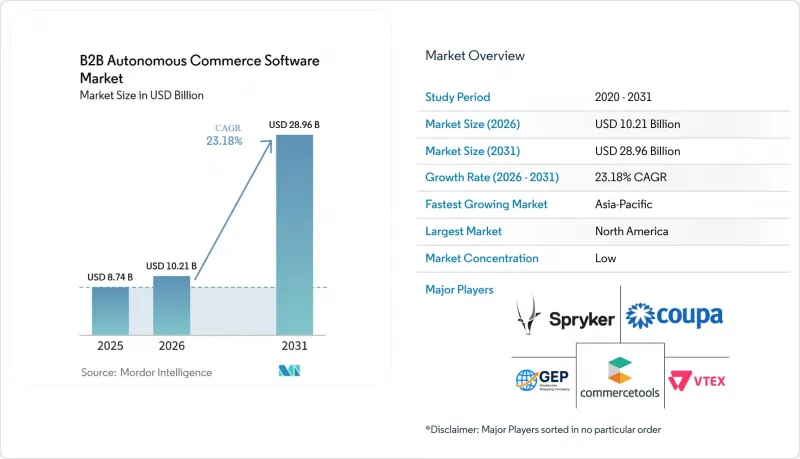
本報告按元件(軟體和服務)、部署模式(雲端、混合、本地部署)、企業規模(大型企業和中小企業)、商業功能(自主採購和尋源等)、最終用戶(IT和電信、銀行、金融服務和保險等)以及地區進行細分。市場預測以價值(美元)表示。
全球B2B自主商務軟體市場趨勢與洞察
企業對超自動化和成本效益的需求
採購和訂單管理中人事費用的壓力,使得財務和營運領導者更清楚地認知到自動化的必要性。人工B2B採購流程會導致顧客體驗下降和銷售機會流失,因此,更快、更可靠的交易更能創造價值。一家全球製造商在部署Lio Technologies的AI原生採購團隊後,僅用了六個月的時間就實現了先前外包採購業務75%的自動化。其優勢遠不止於降低人事費用。更快的發票處理速度提升了應收帳款回收率和供應商協作效率,而減少人工異常處理則使團隊能夠騰出時間來處理需要決策的特殊訂單和供應商問題。因此,B2B自主商務軟體市場正吸引那些需要實際改善現金週期和採購效率的財務領導者的注意。能夠同時提供這兩項價值的供應商,相較於那些僅依靠功能數量的供應商,擁有顯著的優勢。
大規模語言模型和工具編配的快速發展
如今,專業代理程式可以在協調層下處理供應商發現、競標分析、合約審查和異常處理路由。這種方法克服了傳統基於規則的採購工具的局限性,後者只有在資料欄位統一且每個決策都能透過預定義條件表達時才能發揮最大效用。能夠處理非結構化文件、產品目錄和定價資訊的代理程式將自動化擴展到難以用固定邏輯處理的動態領域。 2026年5月,SAP發布了其“自主企業”願景和“SAP自主套件”,其中包括用於公司企業軟體環境中採購和尋源的“Joule”助理。隨著領先的平台提供者將代理功能添加到已用於核心商業運營的系統中,B2B自主商務軟體市場正在從中受益。模型功能的快速提升也縮短了產品發布週期,並減少了供應商保持技術優勢的時間。
實施成本高,且難以與舊有系統整合。
將自主代理連接到企業資源計劃 (ERP) 系統、供應商入口網站、合約庫和支付系統仍然是實施過程中的一大障礙。許多此類系統在設計之初並未考慮機器可讀的 API 存取。較舊的系統可能需要客製化適配器、手動進行電子資料交換 (EDI) 映射以及開發產品分類系統,這些都會將實施週期從數週延長至數個季度。對於中小企業 (SME) 而言,這一負擔往往更為沉重,因為整合成本在其第一年的軟體成本中佔很大比例,而且他們通常缺乏既了解自身採購流程又了解其傳統企業軟體環境的員工。儘管 B2B 自主商務軟體市場在預先建置連接器、標準化入駐流程和基於結果的定價方面取得了進展,但對於許多正在考慮首次部署的企業而言,實施仍然是一個主要限制因素。
細分市場分析
至2025年,軟體將佔B2B自主商務軟體市場72.41%的佔有率。企業通常會先部署採購、訂單管理或付款等授權模組,然後再新增配置和整合服務。這種「平台優先」的方法反映了一種趨勢,即優先考慮可重複使用功能而非完全客製化的解決方案,因為企業可以從預先定義的工作流程入手,然後在初步營運成果確立後擴展部署範圍。預先定義的工作流程還允許更廣泛地應用相同的營運模式,同時專注於特定的採購類別、重複性訂單流程或有限的供應商群體。預計到2031年,服務將以26.83%的複合年成長率成長。服務業務的快速成長表明,部署到生產環境仍然需要在企業資源計劃(ERP)系統、供應商網路、支付管道、合約庫和內部核准流程等方面投入大量精力,而這些傳統上通常是單獨開發的。
實施、諮詢和管理服務可以幫助企業應對先導計畫在整合階段可能遇到的停滯。 GEP Worldwide 和 JAGGAER 就是透過其軟體產品為這項工作提供支援的供應商的典範。 2026 年 6 月,Labviva 發布了“The Agentic Crew”,這是一款結合了專門的小型語言模型和協調模型的研發採購解決方案,專為生命科學領域的研發採購而設計。其設計從一開始就融入了合規性和可審計性要求。隨著企業專案的擴展,B2B 自主商務軟體市場預計將湧現出支援持續模型管治和企業資源規劃 (ERP) 同步的服務。
至2025年,雲端技術將佔據B2B自主商務軟體市場74.18%的佔有率。這一主導地位反映了SaaS(軟體即服務)模式的快速普及和訂閱定價模式顯著降低了初始基礎設施成本。雲端系統還允許隨著交易量的成長靈活擴展代理使用量。同時,混合環境預計到2031年將以25.42%的複合年成長率成長。這反映了那些在本地ERP(企業資源計畫)系統上投入巨資,但尚未能將其記錄系統完全遷移到公共雲端的企業的需求。這些企業還要求新服務能夠與現有的記錄、核准途徑和安全管理機制協同運行,而無需在自動化開始之前進行流程重組。
混合系統將基於雲端的代理與本地環境中管理的交易資料存取權限結合。這種配置允許在不更改核心記錄管理系統或中斷現有交易管理的情況下引入新的自動化服務,同時保持與舊有系統的連接。歐洲的資料主權要求也推動了對歐盟託管和本地部署方案的興趣。德國供應商,例如 mysupply、Procuras 和 Valora,都圍繞著資料保留在歐盟境內的理念來定位其產品。本地部署仍然是小規模的模式,但在國防、受監管的金融服務和公共採購領域中發揮著至關重要的作用。因此,B2B 自主商務軟體市場需要既符合現代化計畫又符合當地資料法規的部署方案。
區域分析
到2025年,北美將佔據B2B自主商務軟體市場36.73%的佔有率。該地區擁有大量企業軟體買家、專注於代理商的新創公司以及擁有成熟採購技術系統的公司,其中美國在採購到付款、訂單管理和代理商輔助支付方面的部署最為廣泛。 Coupa Software和GEP Worldwide已在北美大規模的企業基本客群中建立了買家和供應商網路。加拿大和墨西哥的製造業和汽車供應鏈正在增加需求,跨境採購也提高了對發票匹配和多幣種支付管理的需求。
歐洲為B2B自主商務軟體市場提供了一個規模龐大但又獨具特色的區域環境。歐盟的合規要求推動產品設計圍繞著可審計性、可追溯性和人工干預功能。歐盟人工智慧法和NIS2法規提升了管治和供應鏈安全功能的重要性,而資料主權問題則促使德國及其鄰國的買家仔細審查採購平台是否將資料儲存在歐盟境內。德國是歐洲最大的市場,但在中小工業製造商中的市場滲透率仍然較低。英國和法國正在成為新興市場,而巴西則透過與多語言、多幣種供應商合作,利用製造業和農產品出口來支持南美市場的需求。
預計到2031年,亞太地區將以27.84%的複合年成長率成長。這一成長主要得益於印度和東南亞企業資源計畫(ERP)系統的雲端遷移、公共數位化採購項目以及管理多幣種交易的出口導向企業。印度既是終端用戶市場,也是代理主導採購軟體(包括Procol Technologies)的開發中心。同時,中國擁有龐大的製造地和不斷成長的B2B數位商務基礎設施,儘管數據本地化法規正在影響跨境平台的設計。沙烏地阿拉伯和阿拉伯聯合大公國(阿拉伯聯合大公國)正在推動政府主導的企業數位化和採購現代化。南非和奈及利亞是新興的商業中心,行動優先的企業平台正在降低其應用門檻。
其他好處:
- Excel格式的市場預測(ME)表
- 3個月的分析師支持
目錄
第1章:引言
- 研究假設和市場定義
- 調查範圍
第2章:調查方法
第3章執行摘要
第4章 市場狀況
- 市場概覽
- 市場促進因素
- 企業對超自動化和成本效益的需求
- 大規模語言模型和工具的編配取得了快速進展。
- 擴展雲端基礎設施並降低推理成本
- 對ERP系統進行現代化改造,並建立支援API的B2B交易管道。
- 機器可讀的商業數據正成為一項競爭優勢。
- 針對大型和長尾訂單的自主異常處理
- 市場限制因素
- 實施成本高,且難以與舊有系統整合。
- 資料隱私、網路安全和監管不確定性
- 缺乏B2B定價談判和合約條款的訓練數據。
- 多方自主交易中的低可靠性故障模式
- 宏觀經濟因素對市場的影響
- 產業價值鏈分析
- 科技趨勢
- 監理情勢
- 波特五力分析
第5章 市場規模與成長預測
- 按組件
- 軟體
- 服務
- 按部署模式
- 雲
- 混合
- 現場
- 按公司規模
- 大公司
- 小型企業
- 按商業職能
- 自主採購與尋源
- 自主銷售和報價生成
- 訂單處理和訂單執行
- 定價、促銷、合約合規性
- 庫存補貨和履約
- 自主支付和匹配
- 最終用戶
- 資訊科技/通訊
- BFSI
- 汽車和運輸業
- 醫療保健和生命科學
- 零售與電子商務
- 工業製造
- 教育和研究機構
- 政府/行政部門
- 能源公用事業
- 其他最終用戶
- 按地區
- 北美洲
- 美國
- 加拿大
- 墨西哥
- 南美洲
- 巴西
- 阿根廷
- 其他南美國家
- 歐洲
- 德國
- 英國
- 法國
- 俄羅斯
- 西班牙
- 其他歐洲國家
- 亞太地區
- 中國
- 日本
- 印度
- 韓國
- 東南亞
- 其他亞太國家
- 中東和非洲
- 中東
- 沙烏地阿拉伯
- 阿拉伯聯合大公國
- 其他中東國家
- 非洲
- 南非
- 奈及利亞
- 其他非洲國家
- 中東
- 北美洲
第6章 競爭情勢
- 市場集中度
- 策略趨勢
- 市佔率分析
- 公司簡介
- commercetools GmbH
- Spryker Systems GmbH
- Oro Inc.
- Sana Commerce BV
- VTEX, Inc.
- Go Autonomous ApS
- Lio Technologies GmbH
- Procure Technologies, Inc.
- Mercanis GmbH
- Didero, Inc.
- Zinit GmbH
- Procol Technologies Private Limited
- Keelvar, Inc.
- GEP Worldwide LLC
- Coupa Software Incorporated
- JAGGAER, LLC
- Zycus Inc.
- Punchout2Go
- KIBO Commerce, Inc.
- Tacton Systems AB
- CommerceFlow, Inc.
- Endless Commerce, Inc.
第7章 市場機會與未來展望
According to Mordor Intelligence, the B2B autonomous commerce software market size is expected to grow from USD 8.74 billion in 2025 to USD 10.21 billion in 2026 and is forecast to reach USD 28.96 billion by 2031 at 23.18% CAGR over 2026-2031.
This report is Segmented by Component (Software, and Services), Deployment Model (Cloud, Hybrid, and On-Premises), Enterprise Size (Large Enterprises, and Small and Medium-Sized Enterprises), Commerce Function (Autonomous Procurement and Sourcing, and More), End User (IT and Telecommunication, BFSI, and More), and Geography. The Market Forecasts are Provided in Terms of Value (USD).
Global B2B Autonomous Commerce Software Market Trends and Insights
Enterprise Demand for Hyper-Automation and Cost Efficiency
Labor cost pressure in procurement and order management has made the case for automation clearer for finance and operations leaders. Manual B2B buying processes can create poor customer experiences and lost sales opportunities, which increases the value of faster, more reliable transactions. A global manufacturer automated 75% of procurement work that it had previously outsourced within 6 months after deploying Lio Technologies' AI-native procurement workforce. The focus is not limited to lower labor costs, as faster invoice processing can improve cash collection and supplier coordination, while fewer manual exceptions can give teams more time to address unusual orders and supplier issues that require judgment. The B2B Autonomous Commerce Software Market is therefore attracting attention from finance leaders who need measurable improvements in cash cycles and procurement productivity. Providers that show both types of value are better placed than those competing only on the number of features.
Rapid Advances in Large Language Models and Tool Orchestration
Specialized agents can now handle supplier discovery, bid analysis, contract review, and exception routing under a coordinating layer. This approach reduces the limits of earlier rules-based procurement tools, which were most effective only when data fields were consistent and each decision could be expressed through predefined conditions. Agents that can work with unstructured documents, product catalogs, and pricing information extend automation into areas that were too variable for fixed logic. SAP introduced its Autonomous Enterprise vision and SAP Autonomous Suite in May 2026, including Joule assistants for procurement and sourcing within its enterprise software environment. The B2B Autonomous Commerce Software Market is benefiting as larger platform providers add agent capabilities to systems already used for core commercial operations. Faster improvements in model capabilities are also shortening product release cycles and reducing the time vendors have to sustain a technical lead.
High Implementation Costs and Legacy Integration Challenges
Connecting autonomous agents to enterprise resource planning systems, supplier portals, contract repositories, and payment systems remains a major barrier to adoption. Many of these systems were not built for machine-readable application programming interface access. Older systems can require custom adapters, manual electronic data interchange mapping, and product taxonomy work, which can lengthen deployment from weeks to quarters. The burden is often heavier for small and medium-sized enterprises because integration spending represents a larger share of their first-year software cost, and these organizations may have fewer staff who understand both purchasing processes and older enterprise software environments. The B2B Autonomous Commerce Software Market is responding with prebuilt connectors, standardized onboarding, and outcome-based pricing. Even so, implementation work remains a material constraint for many organizations considering their first deployment.
Other drivers and restraints analyzed in the detailed report include:
- Cloud Infrastructure Expansion and Lower Inference Costs
- ERP Modernization and API-Ready B2B Transaction Channels
- Data Privacy, Cybersecurity, and Regulatory Uncertainty
For complete list of drivers and restraints, kindly check the Table Of Contents.
Segment Analysis
Software held 72.41% of the B2B Autonomous Commerce Software Market share in 2025. Enterprises commonly begin with licensed modules for procurement, order management, or payments before adding services for configuration and integration. This platform-first approach reflects a preference for reusable capabilities rather than fully custom builds, because organizations can begin with a defined workflow and extend the deployment after early operating results are established, and the defined workflow may focus on a specific purchasing category, a recurring order process, or a limited group of suppliers before the same operating model is applied more widely. Services are projected to expand at a 26.83% CAGR through 2031. The faster growth of services shows that production deployments still require substantial work across enterprise resource planning systems, supplier networks, payment rails, contract repositories, and internal approval processes that were often developed independently.
Implementation, consulting, and managed services help organizations move beyond pilots that might otherwise stall at the integration stage. GEP Worldwide and JAGGAER are among the providers supporting this work through their software offerings. Labviva launched The Agentic Crew in June 2026, combining specialized small language models and a coordinating model for life sciences research and development procurement. Its design includes compliance and auditability requirements from the start. As enterprise programs expand, the B2B Autonomous Commerce Software Market is likely to see services support ongoing model governance and enterprise resource planning synchronization.
Cloud accounted for 74.18% of the B2B Autonomous Commerce Software Market share in 2025. Its lead reflects the speed of software-as-a-service deployment and subscription pricing that avoids large initial infrastructure costs. Cloud systems also allow organizations to scale agent use as transaction volumes increase, while hybrid is projected to expand at a 25.42% CAGR through 2031. This reflects the needs of enterprises that retain significant on-premises enterprise resource planning investments and cannot move their systems of record fully to the public cloud in the near term, and their new services need to work with established records, approval paths, and security controls rather than requiring those processes to be rebuilt before automation begins.
Hybrid systems can pair cloud-based agents with access to transaction data maintained in local environments. This arrangement preserves connectivity to older systems while allowing new automation services to be introduced without requiring changes to the core recordkeeping system or disrupting established transaction controls. European data sovereignty requirements are also encouraging interest in European Union-hosted and on-premises options. German providers such as mysupply, Procuras, and Valora have positioned their offerings around data remaining in the European Union. On-premises deployment remains the smallest model, but it is important in defense, regulated financial services, and public procurement. The B2B Autonomous Commerce Software Market, therefore, needs deployment options that align with both modernization plans and local data regulations.
Complete Report Scope:
- By Component
- Software
- Services
- By Deployment Model
- Cloud
- Hybrid
- On-Premises
- By Enterprise Size
- Large Enterprises
- Small and Medium-Sized Enterprises
- By Commerce Function
- Autonomous Procurement and Sourcing
- Autonomous Sales and Quoting
- Order Capture and Order Execution
- Pricing, Promotion, and Contract Compliance
- Inventory Replenishment and Fulfillment
- Autonomous Payments and Reconciliation
- By End User
- IT and Telecommunication
- BFSI
- Automotive and Transportation
- Healthcare and Life Sciences
- Retail and E-Commerce
- Industrial Manufacturing
- Education and Research Institutions
- Government and Administration
- Energy and Utilities
- Other End Users
- By Geography
- North America
- United States
- Canada
- Mexico
- South America
- Brazil
- Argentina
- Rest of South America
- Europe
- Germany
- United Kingdom
- France
- Russia
- Spain
- Rest of Europe
- Asia-Pacific
- China
- Japan
- India
- South Korea
- Southeast Asia
- Rest of Asia-Pacific
- Middle East and Africa
- Middle East
- Saudi Arabia
- United Arab Emirates
- Rest of Middle East
- Africa
- South Africa
- Nigeria
- Rest of Africa
- Middle East
- North America
Geography Analysis
North America held 36.73% of the B2B Autonomous Commerce Software Market share in 2025. The region has a high concentration of enterprise software buyers, agent-focused startups, and companies with established procurement technology systems, and the United States has the largest number of deployments across source-to-pay, order management, and agent-supported payments. Coupa Software and GEP Worldwide have built buyer and supplier networks from substantial North American enterprise customer bases. Canada and Mexico add demand from manufacturing and automotive supply chains, where cross-border procurement creates a need for invoice reconciliation and multi-currency payment management.
Europe is a sizable but distinct regional environment for the B2B Autonomous Commerce Software Market. European Union compliance requirements are shaping product design around auditability, traceability, and human override functions. The European Union AI Act and NIS2 are increasing the importance of governance and supply-chain security features, while data sovereignty has led German and nearby buyers to examine whether procurement platforms keep data within the European Union. Germany is the largest European market and has an underpenetrated base of small- and medium-sized industrial manufacturers. The United Kingdom and France are growing deployment markets, while Brazil supports South American demand through manufacturing and agribusiness exports that work with multilingual, multi-currency suppliers.
Asia-Pacific is projected to expand at a 27.84% CAGR through 2031. Growth is supported by enterprise resource planning cloud migration in India and Southeast Asia, public digital procurement programs, and export-oriented companies managing multi-currency trade. India is both an end-user market and a development base for agent-led procurement software, including Procol Technologies, while China has a large manufacturing base and growing B2B digital commerce infrastructure, although data localization rules affect cross-border platform designs. Saudi Arabia and the United Arab Emirates are pursuing government-led enterprise digitization and procurement modernization. South Africa and Nigeria are emerging commercial hubs where mobile-first enterprise platforms are reducing implementation barriers.
- commercetools GmbH
- Spryker Systems GmbH
- Oro Inc.
- Sana Commerce B.V.
- VTEX, Inc.
- Go Autonomous ApS
- Lio Technologies GmbH
- Procure Technologies, Inc.
- Mercanis GmbH
- Didero, Inc.
- Zinit GmbH
- Procol Technologies Private Limited
- Keelvar, Inc.
- GEP Worldwide LLC
- Coupa Software Incorporated
- JAGGAER, LLC
- Zycus Inc.
- Punchout2Go
- KIBO Commerce, Inc.
- Tacton Systems AB
- CommerceFlow, Inc.
- Endless Commerce, Inc.
Additional Benefits:
- The market estimate (ME) sheet in Excel format
- 3 months of analyst support
TABLE OF CONTENTS
1 INTRODUCTION
- 1.1 Study Assumptions and Market Definition
- 1.2 Scope of the Study
2 RESEARCH METHODOLOGY
3 EXECUTIVE SUMMARY
4 MARKET LANDSCAPE
- 4.1 Market Overview
- 4.2 Market Drivers
- 4.2.1 Enterprise Demand for Hyper-Automation and Cost Efficiency
- 4.2.2 Rapid Advances in Large Language Models and Tool Orchestration
- 4.2.3 Cloud Infrastructure Expansion and Lower Inference Costs
- 4.2.4 ERP Modernization and API-Ready B2B Transaction Channels
- 4.2.5 Machine-Readable Commercial Data Becoming a Competitive Requirement
- 4.2.6 Autonomous Exception Resolution for High-Volume, Long-Tail Orders
- 4.3 Market Restraints
- 4.3.1 High Implementation Costs and Legacy Integration Challenges
- 4.3.2 Data Privacy, Cybersecurity, and Regulatory Uncertainty
- 4.3.3 Sparse Training Data for Negotiated B2B Pricing and Contract Terms
- 4.3.4 Low-Trust Failure Modes in Multi-Party Autonomous Transactions
- 4.4 Impact of Macroeconomic Factors on the Market
- 4.5 Industry Value-Chain Analysis
- 4.6 Technology Outlook
- 4.7 Regulatory Landscape
- 4.8 Porter's Five Forces Analysis
- 4.8.1 Threat of New Entrants
- 4.8.2 Bargaining Power of Suppliers
- 4.8.3 Bargaining Power of Buyers
- 4.8.4 Threat of Substitutes
- 4.8.5 Intensity of Competitive Rivalry
5 MARKET SIZE AND GROWTH FORECASTS (VALUE)
- 5.1 By Component
- 5.1.1 Software
- 5.1.2 Services
- 5.2 By Deployment Model
- 5.2.1 Cloud
- 5.2.2 Hybrid
- 5.2.3 On-Premises
- 5.3 By Enterprise Size
- 5.3.1 Large Enterprises
- 5.3.2 Small and Medium-Sized Enterprises
- 5.4 By Commerce Function
- 5.4.1 Autonomous Procurement and Sourcing
- 5.4.2 Autonomous Sales and Quoting
- 5.4.3 Order Capture and Order Execution
- 5.4.4 Pricing, Promotion, and Contract Compliance
- 5.4.5 Inventory Replenishment and Fulfillment
- 5.4.6 Autonomous Payments and Reconciliation
- 5.5 By End User
- 5.5.1 IT and Telecommunication
- 5.5.2 BFSI
- 5.5.3 Automotive and Transportation
- 5.5.4 Healthcare and Life Sciences
- 5.5.5 Retail and E-Commerce
- 5.5.6 Industrial Manufacturing
- 5.5.7 Education and Research Institutions
- 5.5.8 Government and Administration
- 5.5.9 Energy and Utilities
- 5.5.10 Other End Users
- 5.6 By Geography
- 5.6.1 North America
- 5.6.1.1 United States
- 5.6.1.2 Canada
- 5.6.1.3 Mexico
- 5.6.2 South America
- 5.6.2.1 Brazil
- 5.6.2.2 Argentina
- 5.6.2.3 Rest of South America
- 5.6.3 Europe
- 5.6.3.1 Germany
- 5.6.3.2 United Kingdom
- 5.6.3.3 France
- 5.6.3.4 Russia
- 5.6.3.5 Spain
- 5.6.3.6 Rest of Europe
- 5.6.4 Asia-Pacific
- 5.6.4.1 China
- 5.6.4.2 Japan
- 5.6.4.3 India
- 5.6.4.4 South Korea
- 5.6.4.5 Southeast Asia
- 5.6.4.6 Rest of Asia-Pacific
- 5.6.5 Middle East and Africa
- 5.6.5.1 Middle East
- 5.6.5.1.1 Saudi Arabia
- 5.6.5.1.2 United Arab Emirates
- 5.6.5.1.3 Rest of Middle East
- 5.6.5.2 Africa
- 5.6.5.2.1 South Africa
- 5.6.5.2.2 Nigeria
- 5.6.5.2.3 Rest of Africa
- 5.6.5.1 Middle East
- 5.6.1 North America
6 COMPETITIVE LANDSCAPE
- 6.1 Market Concentration
- 6.2 Strategic Moves
- 6.3 Market Share Analysis
- 6.4 Company Profiles (includes Global Level Overview, Market Level Overview, Core Segments, Financials as available, Strategic Information, Market Rank/Share, Products and Services, Recent Developments)
- 6.4.1 commercetools GmbH
- 6.4.2 Spryker Systems GmbH
- 6.4.3 Oro Inc.
- 6.4.4 Sana Commerce B.V.
- 6.4.5 VTEX, Inc.
- 6.4.6 Go Autonomous ApS
- 6.4.7 Lio Technologies GmbH
- 6.4.8 Procure Technologies, Inc.
- 6.4.9 Mercanis GmbH
- 6.4.10 Didero, Inc.
- 6.4.11 Zinit GmbH
- 6.4.12 Procol Technologies Private Limited
- 6.4.13 Keelvar, Inc.
- 6.4.14 GEP Worldwide LLC
- 6.4.15 Coupa Software Incorporated
- 6.4.16 JAGGAER, LLC
- 6.4.17 Zycus Inc.
- 6.4.18 Punchout2Go
- 6.4.19 KIBO Commerce, Inc.
- 6.4.20 Tacton Systems AB
- 6.4.21 CommerceFlow, Inc.
- 6.4.22 Endless Commerce, Inc.
7 MARKET OPPORTUNITIES AND FUTURE OUTLOOK
- 7.1 White-Space and Unmet-Need Assessment

 全球基於代理的人工智慧市場(至 2033 年):按產品類別(開發平台、編配和運行時平台、流程自動化平台、現成的基於代理的人工智慧應用)和應用(客戶服務與支援、營收營運、IT 營運、商業智慧與分析)分類
 全球代理商務市場:按產品、交易類型、通路、應用程式、最終用戶和地區分類-市場規模、產業動態、機會分析和預測(2026-2035 年)
 基於代理的人工智慧自動化市場預測至2034年-按部署模式、企業規模、技術水平、功能應用、最終用戶和地區分類的全球分析
 基於代理商的商業、人工智慧編配和自主支付市場:2026 年
 基於代理的人工智慧開發平台:市場佔有率分析、行業趨勢和統計數據、成長預測(2026-2031)醫療保健領域的智慧體人工智慧:市場佔有率分析、行業趨勢和統計數據以及成長預測(2026-2031 年)基於代理的人工智慧市場:按組件、部署類型、企業規模、最終用戶、國家和地區分類-行業分析、市場規模、市場佔有率及2026年至2033年預測無障礙學習技術市場預測至2034年-全球分析(按組件、殘疾類型、部署模式、技術、應用、最終用戶和地區分類)
 全球基於代理的人工智慧安全市場(至 2032 年):按安全功能和工具(即時安全工具、防護框架、人工智慧穿透測試和紅隊工具)和部署層級分類
 全球基於代理的人工智慧市場規模、佔有率、趨勢和成長分析報告(2026-2034)