


 |
市場調查報告書
商品編碼
2154463
智慧體人工智慧管治平台:市場佔有率分析、產業趨勢與統計、成長預測(2026-2031)Agentic AI Governance Platforms In BFSI - Market Share Analysis, Industry Trends & Statistics, Growth Forecasts (2026 - 2031) |
||||||

※ 本網頁內容可能與最新版本有所差異。詳細情況請與我們聯繫。
根據 Mordor Intelligence 預測,BFSI 市場中基於代理的 AI管治平台的市場規模預計將從 2025 年的 62.1 億美元成長到 2026 年的 89.2 億美元,然後從 2026 年到 2031 年以 9.71% 的複合年成長率成長,達到 2031 年到 2031 年以 9.71% 的複合年成長率成長,達到 2031 年至 2031 年。
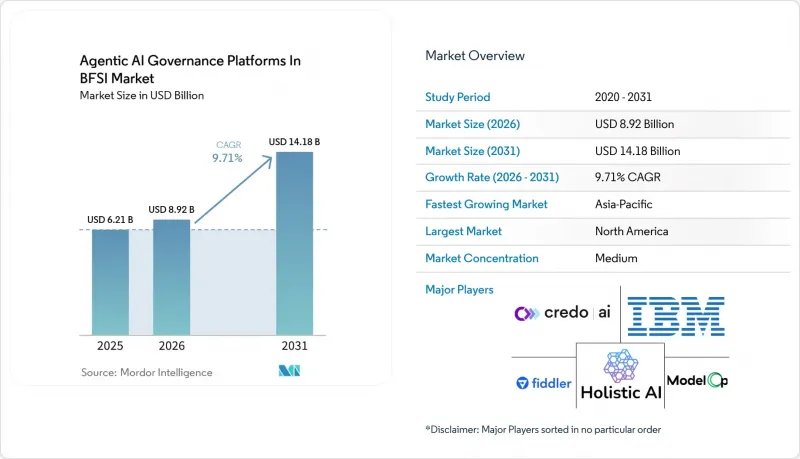
全球趨勢及對銀行、金融服務和保險(BFSI)市場中基於代理的人工智慧管治平台的洞察
企業對自主工作流程轉型的需求
金融機構正在將基於代理的人工智慧部署到其生產工作流程中,這使得每個步驟的控制需求日益增加。巴克萊銀行正在透過基於代理的編配來重構客戶審查流程,涵蓋文件審查、制裁篩檢和核准路徑,同時在每個步驟中保留審計追蹤。渣打銀行將基於代理的人工智慧描述為一種金融機構可以立即開始採用的營運模式,前提是能夠在現有架構中安全部署。因此,銀行、金融服務和保險(BFSI)市場的基於代理的人工智慧管治平台正在超越傳統的模型檢驗,轉向涵蓋代理識別、授權、決策和記錄的生命週期管理。結合了編配、共用記憶體以及確定性和非確定性工作流程的多代理系統,使得在初始階段設計控制措施比被動應對更為可行。這項需求正在推動對能夠與業務系統整合(而不僅僅是作為合規儲存庫)的平台的需求。
對人工智慧管治和主權人工智慧準備工作的需求日益成長。
監管要求已將管治採購要求,而不僅僅是最佳實踐。歐盟《人工智慧法案》自2026年8月2日起引入透明度義務,對部署面向客戶的人工智慧系統的機構施加直接義務。 2026年1月,歐洲銀行管理局(EBA)更新了其內部管治指南,新增了人工智慧風險管理要求,涵蓋董事會課責、檢驗以及信貸決策的可解釋性。 2026年5月,英國金融監理機構表示,企業應根據人工智慧驅動型威脅的演進速度,規劃並實施因應人工智慧相關網路漏洞的措施。此外,「主權人工智慧」優先事項鼓勵混合部署和內部部署,金融機構應將敏感資料和控制措施保留在既定的安全邊界內。在銀行、金融服務和保險(BFSI)市場中,基於代理的人工智慧管治平台如果能夠將涵蓋監管和資料居住要求的控制措施映射到單一系統中,而無需重複進行證據建構工作,則將從中受益。
高度自動化工作流程的投資報酬率 (ROI) 尚不明確
為管治平台製定預算可能難以證明其合理性,因為其諸多益處並非即時,而是體現在風險降低和審計流程加快等方面。 NTT DATA 的一份報告顯示,升級基於代理的 AI 基礎設施的成本可能是初始 AI 投資預算的 3 到 5 倍,而複雜的部署還會大幅增加效率低下成本。安永指出,隨著部署規模的擴大,管治、組織轉型和監管的影響會更加明顯,因此需要全面了解整體擁有成本 (TCO)。如果控制措施的益處無法轉化為明確的業務成果,那麼銀行、金融服務和保險 (BFSI) 市場中基於代理的 AI管治平台的採購週期可能會很長。 2026 年的一項調查發現,只有 18% 的銀行高層對其 AI 控制措施能夠透過獨立審查充滿信心。能夠提供審計時間、核准週期和糾正措施工作量節省證明的供應商,可以幫助買家更有效地評估商業案例。
細分市場分析
2025年,軟體在銀行、金融服務和保險(BFSI)市場的智慧代理AI管治平台市佔率中佔比高達68.23%。在BFSI市場中使用智慧代理AI管治平台的金融機構最初優先考慮的是能夠支援資產管理、政策執行以及在其不斷擴展的AI環境中進行監管映射的平台許可。這些功能可以應用於越來越多的代理,而無需應對日益成長的人工審核工作量。該軟體還為風險、合規和技術團隊提供了一個用於政策管理和證據收集的共用平台。如此高的市場佔有率反映了市場對可重複控制機制的需求,而不是每次部署都進行單獨的諮詢專案。
在銀行、金融服務和保險 (BFSI) 市場中,Aggent AI管治平台服務預計將在 2026 年至 2031 年間以 11.34% 的複合年成長率成長。平台實施需要進行變更管理、資料整合、工作流程重新設計,並適應各金融機構的具體規則。內部團隊可能缺乏足夠的專業知識來完成這項任務,同時也要維護現有的控制程序。這可能會增加對託管服務和了解金融服務流程的專業實施合作夥伴的需求。在 BFSI 市場的 Aggent AI管治平台領域,能夠將軟體與實際實施支援結合的供應商預計將具有競爭優勢。
至2025年,雲端採用將佔BFSI(銀行、金融服務和保險)市場中Agentic AI管治平台市場規模的54.61%。 BFSI市場中Agentic AI管治平台的雲端環境支援共用監控工作負載、標準化更新以及靈活的運算能力,以滿足管治營運的需求。這與金融機構廣泛採用雲端原生風險和合規基礎設施的趨勢相符。許多金融機構可以利用雲端服務處理不涉及最敏感代理記錄的工作負載。這使得雲端採用成為管治部署的實際可行的起點。
在銀行、金融服務和保險 (BFSI) 市場中,Agentic AI管治平台的混合架構預計將在 2026 年至 2031 年間以 11.27% 的複合年成長率成長。在多個司法管轄區運作的金融機構需要在雲端效率與資料儲存、稽核權限和第三方風險管理之間取得平衡。混合架構允許金融機構在其自身環境中保留敏感的審計日誌、檢驗的證據和決策記錄。德國聯邦金融監理局 (BaFin) 於 2025 年 12 月發布的關於人工智慧使用相關的資訊通訊技術 (ICT) 風險的指南再次強調了金融機構管理技術風險的必要性。 BFSI 市場的 Agentic AI管治平台可以受益於利用那些對雲端和本地系統應用相同策略的產品。
區域分析
2025年,北美在銀行、金融服務和保險(BFSI)市場中,生成式人工智慧管治平台的市佔率佔比達38.17%。大型銀行的技術預算、先進的風險管理能力以及嚴謹的監管活動支撐了全部區域需求。儘管修訂後的美國機構間模型風險指導(將於2026年4月生效)改變了銀行的政策框架,但對生成式和基於代理的人工智慧進行管治仍不在模型風險的正式範圍內,而是由各個金融機構自行負責。美國財政部的金融服務人工智慧風險框架提供了針對特定產業的控制目標,以幫助金融機構建構這些計畫。歐洲仍然蘊藏著巨大的機遇,因為銀行必須同時應對營運韌性和人工智慧管治的雙重挑戰,而歐洲央行2026-2028年的監管重點也包括更關注銀行業中的生成式人工智慧應用。
預計亞太地區在2026年至2031年間將以10.81%的複合年成長率成長。新加坡的SAFR框架要求對基於代理的AI行為進行預先申報、核准和評估,這推動了對行為等級控制的需求。印度銀行、金融服務和保險(BFSI)市場對基於代理的AI管治平台的要求不斷演變,強調金融機構的可解釋性、課責、風險管理和部署後監控。中國、日本、韓國和澳洲各自採取不同的監管方法,但日益重視監控和權益文件記錄。中東地區可望率先採用AI技術,這得益於各國的AI戰略、金融現代化計劃和政府投資重點。
南美洲正成為金融服務業(BFSI)市場中基於代理的人工智慧管治平台的新機會。秘魯的DS 115-2025-PCM法規要求對高風險人工智慧應用進行文件記錄、提高透明度並加強人工監督,凸顯了金融領域管控的必要性。哥倫比亞和智利正按計劃推進各自的國家人工智慧戰略。在非洲,南非、奈及利亞和埃及蘊藏著巨大的潛力。在這些國家,金融科技的普及速度可能超過管治基礎設施的建造速度,隨著本地要求的逐步完善,對專業合規工具的需求也將日益成長。
其他好處:
- Excel格式的市場預測(ME)表
- 3個月的分析師支持
目錄
第1章:引言
- 研究假設和市場定義
- 調查範圍
第2章:調查方法
第3章執行摘要
第4章 市場狀況
- 市場概覽
- 市場促進因素
- 企業對自主工作流程轉型的需求
- 多代理企業部署的複雜性日益增加。
- 對人工智慧管治和主權人工智慧準備工作的需求日益成長。
- 專業化的基於代理的人工智慧工程和轉型管理人才短缺
- 在受監管行業中擴大基於代理的人工智慧的應用
- 向以結果為導向、積極主動的人工智慧轉型計劃過渡
- 市場限制因素
- 高度自動化工作流程的投資報酬率 (ROI) 尚不明確。
- 代理之間的互通性和評估標準的碎片化
- 計算、推理和代理運行成本不斷上升
- 自主決策缺乏課責制
- 宏觀經濟因素對市場的影響
- 產業價值鏈分析
- 科技趨勢
- 監理情勢
- 波特五力分析
第5章 市場規模與成長預測
- 報價
- 軟體
- 服務
- 不同的發展
- 雲端採用
- 本地部署
- 混合
- 按組織規模
- 主要銀行和金融集團
- 中型銀行和信貸機構
- 中小型銀行、金融科技公司、保險科技公司
- 資產管理公司和資本市場相關企業
- 保險公司和再保險公司
- 按管治職能
- 人工智慧驅動的庫存管理和發現。
- 風險分類和分層
- 模型和代理生命週期管理
- 策略管理和策略即程式碼
- 模型風險管理與檢驗
- 監測、測試和評估
- 偏見、公平和歧視管理
- 可解釋性和透明度
- 隱私、資料保護和保密
- 監管合規性和控制措施的映射
- 審計證據和報告
- 第三方人工智慧風險管理
- 事件管理和糾正措施
- 按地區
- 北美洲
- 美國
- 加拿大
- 墨西哥
- 南美洲
- 巴西
- 阿根廷
- 智利
- 其他南美國家
- 歐洲
- 德國
- 英國
- 法國
- 義大利
- 西班牙
- 其他歐洲國家
- 亞太地區
- 中國
- 日本
- 印度
- 韓國
- 澳洲
- 其他亞太國家
- 中東
- 阿拉伯聯合大公國
- 沙烏地阿拉伯
- 卡達
- 其他中東國家
- 非洲
- 南非
- 埃及
- 奈及利亞
- 其他非洲國家
- 北美洲
第6章 競爭情勢
- 市場集中度
- 策略趨勢
- 市佔率分析
- 公司簡介
- Credo AI, Inc.
- ValidMind, Inc.
- Fiddler AI, Inc.
- Holistic AI Limited
- ModelOp, Inc.
- Monitaur, Inc.
- Asenion Inc.
- Arthur AI, Inc.
- Trustible, Inc.
- Aporia Technologies Ltd.
- Truera, Inc.
- Saidot Oy
- International Business Machines Corporation
- Enkrypt AI, Inc.
- LatticeFlow AG
- Lakera AI AG
- Virtue AI, Inc.
- Veilfire, Inc.
- Straiker AI, Inc.
- Pillar Security, Inc.
- Cranium AI, Inc.
- Geordie AI, Inc.
- Aethryx AI Ltd.
- KLA Digital Ltd.
第7章 市場機會與未來展望
According to Mordor Intelligence, the agentic AI governance platforms in BFSI Market size is expected to grow from USD 6.21 billion in 2025 to USD 8.92 billion in 2026, and is forecast to reach USD 14.18 billion by 2031, at a 9.71% CAGR over 2026-2031.
Global Agentic AI Governance Platforms In BFSI Market Trends and Insights
Enterprise Demand for Autonomous Workflow Transformation
Financial institutions are deploying agentic AI in production workflows, increasing the need for controls at each step. Barclays re-engineered client due diligence with agentic orchestration across document review, sanctions screening, and approval routing, while retaining audit evidence at each step. Standard Chartered described agentic AI as an operating model that institutions can begin adopting today, provided it is deployed safely within existing architecture. The Agentic AI Governance Platforms in BFSI Market is therefore moving beyond traditional model validation toward lifecycle controls that cover agent identity, permissions, decisions, and records. Multi-agent systems combine orchestration, shared memory, and deterministic and nondeterministic workflows, which makes early control design more practical than later remediation. This requirement supports demand for platforms that integrate with operational systems rather than serving only as a compliance repository.
Growing Need for AI Governance and Sovereign AI Readiness
Regulatory requirements are making governance a procurement need rather than a separate best-practice exercise. The EU AI Act introduces transparency obligations as of August 2, 2026, adding direct duties for institutions that deploy relevant customer-facing AI systems. The EBA updated internal governance guidelines in January 2026 to include AI risk management expectations covering board accountability, validation, and explainability for credit decisions. The United Kingdom's financial authorities stated in May 2026 that firms should plan for and address AI-related cyber vulnerabilities at a pace that matches the pace of AI-driven threats. Sovereign AI priorities also encourage hybrid and internal deployments in which institutions retain sensitive data and controls within defined security boundaries. The Agentic AI Governance Platforms in BFSI Market can benefit when one system maps controls across regulatory and data-residency requirements without creating duplicate evidence work.
Unclear Return on Investment for High-Autonomy Workflows
Governance platform budgets can be difficult to justify because much of the benefit appears as lower risk and faster audit work rather than immediate revenue. NTT DATA reported that agentic AI infrastructure upgrades may require 3 to 5 times the original AI investment budget, while complex implementations can add material inefficiency costs. EY noted that governance, organizational change, and regulatory impact become more visible as deployments scale, which requires a full view of the cost of ownership. The Agentic AI Governance Platforms in BFSI Market may face longer purchasing cycles when control benefits cannot be connected to clear business outcomes. A 2026 survey reported that only 18% of banking leaders were confident their AI controls would pass an independent review. Suppliers that document savings in audit time, approval cycles, and remediation effort can make the business case easier for buyers to evaluate.
Other drivers and restraints analyzed in the detailed report include:
- Rising Complexity of Multi-Agent Enterprise Deployments
- Expansion of Agentic AI Use Cases Across Regulated Industries
- Accountability Gaps in Autonomous Decision-Making
For complete list of drivers and restraints, kindly check the Table Of Contents.
Segment Analysis
Software held 68.23% of the Agentic AI Governance Platforms in BFSI Market share in 2025. Financial institutions in the Agentic AI Governance Platforms in BFSI Market initially prioritized platform licenses that support inventories, policy enforcement, and regulatory mapping across their expanding AI estates. These functions can be applied to a growing number of agents without matching the growth in manual-checking workload. Software also provides risk, compliance, and technology teams with a shared platform for managing policies and gathering evidence. The leading share reflects a need for repeatable controls rather than separate advisory projects for every implementation.
Services in the Agentic AI Governance Platforms in BFSI Market is forecast to grow at 11.34% CAGR from 2026 to 2031. Platform implementation requires change management, data integration, workflow redesign, and calibration against institution-specific rules. Internal teams may not have enough specialized staff to complete this work while maintaining existing control programs. This can shift demand toward managed services and specialist implementation partners that understand financial services processes. The Agentic AI Governance Platforms in BFSI Market industry is likely to reward vendors that combine software with practical deployment support.
Cloud deployment accounted for 54.61% of the Agentic AI Governance Platforms in BFSI Market size in 2025. Cloud environments in the Agentic AI Governance Platforms in BFSI Market support shared monitoring workloads, standardized updates, and flexible computing capacity for governance operations. They also fit the broader use of cloud-native risk and compliance infrastructure by financial institutions. Many institutions can use cloud services for workloads that do not contain their most sensitive agent records. This makes cloud deployment a practical starting point for governance rollouts.
Hybrid architecture in the Agentic AI Governance Platforms in BFSI Market is forecast to grow at 11.27% CAGR from 2026 to 2031. Institutions operating in several jurisdictions must balance cloud efficiency with data residency, audit rights, and third-party risk controls. Hybrid designs let institutions retain sensitive audit logs, validation evidence, and decision records within their own environments. BaFin's December 2025 guidance on ICT risks associated with AI use reinforces the need for financial institutions to manage technology risk. The Agentic AI Governance Platforms in BFSI Market can benefit from products that apply the same policy across cloud and internal systems.
Complete Report Scope:
- By Offering
- Software
- Services
- By Deployment
- Cloud Deployment
- On-Premises Deployment
- Hybrid
- By Organization Size
- Large Banks and Financial Groups
- Mid-Size Banks and Credit Institutions
- Small Banks, Fintechs and Insurtechs
- Asset Managers and Capital Markets Firms
- Insurance Companies and Reinsurers
- By Governance Function
- AI Inventory and Discovery
- Risk Classification and Tiering
- Model and Agent Lifecycle Management
- Policy Management and Policy-as-Code
- Model Risk Management and Validation
- Monitoring, Testing and Evaluation
- Bias, Fairness and Discrimination Management
- Explainability and Transparency
- Privacy, Data Protection and Confidentiality
- Regulatory Compliance and Control Mapping
- Audit Evidence and Reporting
- Third-Party AI Risk Management
- Incident Management and Remediation
- By Geography
- North America
- United States
- Canada
- Mexico
- South America
- Brazil
- Argentina
- Chile
- Rest of South America
- Europe
- Germany
- United Kingdom
- France
- Italy
- Spain
- Rest of Europe
- Asia-Pacific
- China
- Japan
- India
- South Korea
- Australia
- Rest of Asia-Pacific
- Middle East
- United Arab Emirates
- Saudi Arabia
- Qatar
- Rest of Middle East
- Africa
- South Africa
- Egypt
- Nigeria
- Rest of Africa
- North America
Geography Analysis
North America held 38.17% of the Agentic AI Governance Platforms in BFSI Market share in 2025. Large bank technology budgets, sophisticated risk functions, and dense supervisory activity support demand across the region. Revised U.S. interagency model risk guidance in April 2026 changed the policy context for banks while leaving institutions to establish governance for generative and agentic AI outside the formal model risk scope. The U.S. Treasury's financial services AI risk framework provides sector-specific control objectives that can help institutions structure these programs. Europe remains a major opportunity because banks must address the combined operational resilience and AI governance burden, while the ECB's 2026 to 2028 supervisory priorities include a closer focus on generative AI applications in banking.
Asia-Pacific is forecast to grow at 10.81% CAGR from 2026 to 2031. Singapore's SAFR framework requires agentic actions to be declared, authorized, and assessed before execution, thereby supporting the demand for action-level controls. India's evolving requirements for the Agentic AI Governance Platforms in BFSI Market emphasize explainability, accountability, risk management, and post-deployment monitoring for financial institutions. China, Japan, South Korea, and Australia are following different oversight paths, but each increases attention to monitoring and fairness documentation. The Middle East is an early-adopting regional opportunity as national AI strategies, financial modernization programs, and sovereign investment priorities support deployment.
South America is an emerging opportunity for the Agentic AI Governance Platforms in BFSI Market. Peru's DS 115-2025-PCM requires documentation, transparency, and human oversight for high-risk AI use, strengthening the need for controls in finance. Colombia and Chile are advancing their national AI strategies on their own timelines. Africa has focused potential in South Africa, Nigeria, and Egypt, where fintech deployment can outpace governance infrastructure, creating demand for specialized compliance tools as local requirements mature.
- Credo AI, Inc.
- ValidMind, Inc.
- Fiddler AI, Inc.
- Holistic AI Limited
- ModelOp, Inc.
- Monitaur, Inc.
- Asenion Inc.
- Arthur AI, Inc.
- Trustible, Inc.
- Aporia Technologies Ltd.
- Truera, Inc.
- Saidot Oy
- International Business Machines Corporation
- Enkrypt AI, Inc.
- LatticeFlow AG
- Lakera AI AG
- Virtue AI, Inc.
- Veilfire, Inc.
- Straiker AI, Inc.
- Pillar Security, Inc.
- Cranium AI, Inc.
- Geordie AI, Inc.
- Aethryx AI Ltd.
- KLA Digital Ltd.
Additional Benefits:
- The market estimate (ME) sheet in Excel format
- 3 months of analyst support
TABLE OF CONTENTS
1 INTRODUCTION
- 1.1 Study Assumptions and Market Definition
- 1.2 Scope of the Study
2 RESEARCH METHODOLOGY
3 EXECUTIVE SUMMARY
4 MARKET LANDSCAPE
- 4.1 Market Overview
- 4.2 Market Drivers
- 4.2.1 Enterprise Demand for Autonomous Workflow Transformation
- 4.2.2 Rising Complexity of Multi-Agent Enterprise Deployments
- 4.2.3 Growing Need for AI Governance and Sovereign AI Readiness
- 4.2.4 Shortage of Specialized Agentic AI Engineering and Change-Management Talent
- 4.2.5 Expansion of Agentic AI Use Cases Across Regulated Industries
- 4.2.6 Shift Toward Outcome-Based Agentic AI Transformation Programs
- 4.3 Market Restraints
- 4.3.1 Unclear Return on Investment for High-Autonomy Workflows
- 4.3.2 Fragmented Agent Interoperability and Evaluation Standards
- 4.3.3 Rising Compute, Inference, and AgentOps Costs
- 4.3.4 Accountability Gaps in Autonomous Decision-Making
- 4.4 Impact of Macroeconomic Factors on the Market
- 4.5 Industry Value-Chain Analysis
- 4.6 Technology Outlook
- 4.7 Regulatory Landscape
- 4.8 Porter's Five Forces Analysis
- 4.8.1 Threat of New Entrants
- 4.8.2 Bargaining Power of Suppliers
- 4.8.3 Bargaining Power of Buyers
- 4.8.4 Threat of Substitutes
- 4.8.5 Intensity of Competitive Rivalry
5 MARKET SIZE AND GROWTH FORECASTS (VALUE)
- 5.1 By Offering
- 5.1.1 Software
- 5.1.2 Services
- 5.2 By Deployment
- 5.2.1 Cloud Deployment
- 5.2.2 On-Premises Deployment
- 5.2.3 Hybrid
- 5.3 By Organization Size
- 5.3.1 Large Banks and Financial Groups
- 5.3.2 Mid-Size Banks and Credit Institutions
- 5.3.3 Small Banks, Fintechs and Insurtechs
- 5.3.4 Asset Managers and Capital Markets Firms
- 5.3.5 Insurance Companies and Reinsurers
- 5.4 By Governance Function
- 5.4.1 AI Inventory and Discovery
- 5.4.2 Risk Classification and Tiering
- 5.4.3 Model and Agent Lifecycle Management
- 5.4.4 Policy Management and Policy-as-Code
- 5.4.5 Model Risk Management and Validation
- 5.4.6 Monitoring, Testing and Evaluation
- 5.4.7 Bias, Fairness and Discrimination Management
- 5.4.8 Explainability and Transparency
- 5.4.9 Privacy, Data Protection and Confidentiality
- 5.4.10 Regulatory Compliance and Control Mapping
- 5.4.11 Audit Evidence and Reporting
- 5.4.12 Third-Party AI Risk Management
- 5.4.13 Incident Management and Remediation
- 5.5 By Geography
- 5.5.1 North America
- 5.5.1.1 United States
- 5.5.1.2 Canada
- 5.5.1.3 Mexico
- 5.5.2 South America
- 5.5.2.1 Brazil
- 5.5.2.2 Argentina
- 5.5.2.3 Chile
- 5.5.2.4 Rest of South America
- 5.5.3 Europe
- 5.5.3.1 Germany
- 5.5.3.2 United Kingdom
- 5.5.3.3 France
- 5.5.3.4 Italy
- 5.5.3.5 Spain
- 5.5.3.6 Rest of Europe
- 5.5.4 Asia-Pacific
- 5.5.4.1 China
- 5.5.4.2 Japan
- 5.5.4.3 India
- 5.5.4.4 South Korea
- 5.5.4.5 Australia
- 5.5.4.6 Rest of Asia-Pacific
- 5.5.5 Middle East
- 5.5.5.1 United Arab Emirates
- 5.5.5.2 Saudi Arabia
- 5.5.5.3 Qatar
- 5.5.5.4 Rest of Middle East
- 5.5.6 Africa
- 5.5.6.1 South Africa
- 5.5.6.2 Egypt
- 5.5.6.3 Nigeria
- 5.5.6.4 Rest of Africa
- 5.5.1 North America
6 COMPETITIVE LANDSCAPE
- 6.1 Market Concentration
- 6.2 Strategic Moves
- 6.3 Market Share Analysis
- 6.4 Company Profiles (includes Global Level Overview, Market Level Overview, Core Segments, Financials as available, Strategic Information, Market Rank/Share, Products and Services, Recent Developments)
- 6.4.1 Credo AI, Inc.
- 6.4.2 ValidMind, Inc.
- 6.4.3 Fiddler AI, Inc.
- 6.4.4 Holistic AI Limited
- 6.4.5 ModelOp, Inc.
- 6.4.6 Monitaur, Inc.
- 6.4.7 Asenion Inc.
- 6.4.8 Arthur AI, Inc.
- 6.4.9 Trustible, Inc.
- 6.4.10 Aporia Technologies Ltd.
- 6.4.11 Truera, Inc.
- 6.4.12 Saidot Oy
- 6.4.13 International Business Machines Corporation
- 6.4.14 Enkrypt AI, Inc.
- 6.4.15 LatticeFlow AG
- 6.4.16 Lakera AI AG
- 6.4.17 Virtue AI, Inc.
- 6.4.18 Veilfire, Inc.
- 6.4.19 Straiker AI, Inc.
- 6.4.20 Pillar Security, Inc.
- 6.4.21 Cranium AI, Inc.
- 6.4.22 Geordie AI, Inc.
- 6.4.23 Aethryx AI Ltd.
- 6.4.24 KLA Digital Ltd.
7 MARKET OPPORTUNITIES AND FUTURE OUTLOOK
- 7.1 White-Space and Unmet-Need Assessment

 營運風險管理分析市場:全球市場預測,2026-2032年人工智慧風險管理市場:全球市場預測,2026-2032年
 2026年全球人工智慧(AI)測試與檢驗市場報告
 人工智慧模型風險管理市場規模、佔有率、成長及全球產業分析、區域趨勢及2026-2034年預測
 影子人工智慧風險與管治市場:按解決方案和服務分類-全球預測至2032年
 AI訓練資料來源和歷史管理軟體:市場佔有率分析、行業趨勢和統計數據、成長預測(2026-2031年)歐盟人工智慧法律合規軟體:市場佔有率分析、產業趨勢與統計及成長預測(2026-2031 年)
 人工智慧模型審計市場分析與預測(至2035年):類型、產品類型、服務、技術、應用、部署模式、最終用戶、解決方案
 人工智慧風險管理市場預測至2034年—按組件、部署模式、風險類型、技術、應用、最終用戶和地區分類的全球分析2026年全球人工智慧安全記分卡市場報告