


 |
市場調查報告書
商品編碼
2118190
歐盟人工智慧法律合規軟體:市場佔有率分析、產業趨勢與統計及成長預測(2026-2031 年)EU AI Act Compliance Software - Market Share Analysis, Industry Trends & Statistics, Growth Forecasts (2026 - 2031) |
||||||

※ 本網頁內容可能與最新版本有所差異。詳細情況請與我們聯繫。
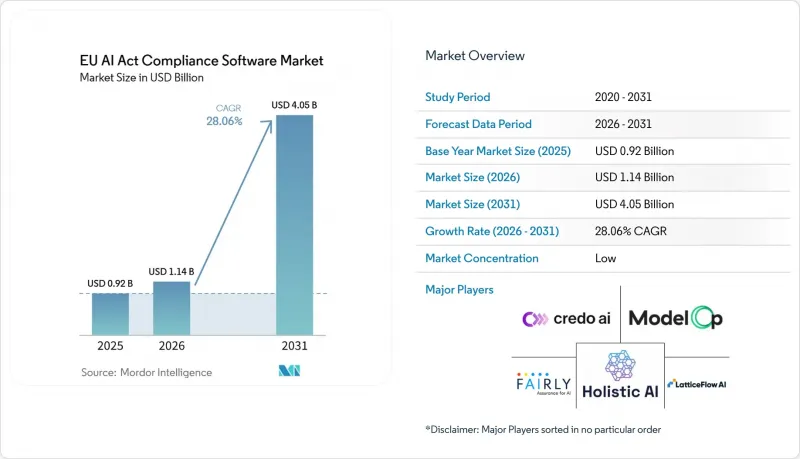
據 Mordor Intelligence 稱,2025 年歐盟人工智慧法律合規軟體市場價值為 9.2 億美元,預計到 2031 年將從 2026 年的 11.4 億美元成長至 40.5 億美元,預測期(2026-2031 年)的複合年成長率為 28.06%。
本報告按解決方案類型(軟體和服務)、合規能力(風險分類、人工智慧生命週期管治和監控等)、部署模式(雲端、混合、本地部署)、企業規模(大型企業、中小企業)、最終用戶(銀行、金融服務和保險等)以及地區進行細分。市場預測以美元計價。
歐盟人工智慧法律合規軟體市場趨勢與洞察
歐盟人工智慧法分階段實施,合規期限短
歐盟人工智慧法規合規軟體市場受益於分階段的合規計劃,該計劃創造了多次購買機會,而不是單一截止日期。第5條規定的禁令於2025年2月2日生效,第50條規定的透明度義務於2026年8月2日生效。修訂後的計畫將附件三規定的高風險要求於2027年12月2日生效,附件一規定的關於產品中嵌入人工智慧的要求於2028年8月2日生效。這一順序鼓勵企業在最繁重的義務生效之前建立資產清單和文件流程。由於違規人工智慧行為可能面臨高達3500萬歐元(937萬美元)或全球年銷售額7%的罰款,因此從財務角度來看,儘早建立控制系統至關重要。此外,企業還需要使其人工智慧合規與特定行業的法規(例如DORA和醫療設備法規)保持一致,這推動了對能夠將多項合規任務整合到單一工作流程中的軟體的需求。
域外適用及進入歐盟市場的風險
歐盟人工智慧法規合規軟體市場的需求不僅限於歐盟境內的組織。這是因為該法規針對的是歐盟境內使用的特定人工智慧系統的產出結果。這一範圍也影響到那些服務於歐洲客戶,但總部設在美國、英國、新加坡和其他市場的供應商和實施者。此外,位於歐盟境外的高風險系統供應商必須在歐盟境內擁有經認證的代理機構。軟體能夠幫助這些組織在不同地點分配職責、維護記錄並提供證據。基於雲端的交付方式有利於分散式團隊,因為它允許使用者維護共享的合規工作流程,而無需在每個國家/地區建立單獨的內部平台。類似的跨境協調需求也支援那些能夠將歐盟要求與相關管治框架(例如 ISO/IEC 42001 和 NIST 人工智慧風險管理框架)共用協調的工具。
技術標準不明確,指南不一
歐盟人工智慧法規合規軟體市場面臨許多限制因素,主要源自於法律義務與證明合規性所需的技術基礎設施之間的差距。截至2026年4月,統一標準尚未在歐盟官方公報上發布,導致買家對某些控制措施的具體技術依據尚不清楚。此外,缺乏正式指定的人工智慧法規評估認證機構也加劇了這種不確定性。隨著標準和指南的完善,軟體供應商必須建立相應的工作流程,以適應可能更具體的要求。如果買家預計在詳細標準發布後需要對其平台進行修改,則可能會推遲決策。儘管更新後的時間表延長了準備期,但各組織仍需權衡眼前的透明度義務與未來可能出現的高風險義務。人工智慧管治和合規性評估方面專業知識的匱乏進一步延緩了標準的採用,尤其是在內部團隊必須全面解讀監管、技術和特定產業要求的情況下。
細分市場分析
2025年,軟體將佔據歐盟人工智慧法律合規軟體市場72.41%的佔有率。這個細分市場佔據主導地位,是因為企業需要切實可行的工具來管理風險分類、技術文件、監控和合規性評估。這些功能在許多人工智慧系統中都很通用,但僅靠電子表格或個別法律審查難以實現一致的管理。利用集中式平台,團隊可以記錄系統目標、識別適用義務、分配行動並儲存證據。因此,軟體已成為擁有大量人工智慧資產的公司的主要部署模式。此外,該細分市場也適用於需要根據指南和內部政策的變化更新其控制措施的企業。
預計到2031年,服務市場將以30.74%的複合年成長率成長。許多在2025年選擇平台的企業現在正著手進行部署、配置、培訓和審計準備。這催生了對專家支援的需求,這些專家能夠將需求轉化為內部流程。 Credo AI在2025年擴展了其合作夥伴計劃,將Databricks、微軟和管治風險專家納入其中,這充分展現了其合作夥伴生態系統在企業級產品中的優勢。即使是小規模企業,也可能由於缺乏內部法律和技術資源而需要指導服務。雖然平台和服務結合擴大了供應商的商機,但服務角色的日益增強也可能對利潤率構成壓力。
2025年,風險分類將佔歐盟人工智慧法律合規軟體市場26.83%的佔有率。分類是合規計畫的起點,因為組織需要確定其系統是否屬於禁止系統、高風險系統、需遵守透明度要求的系統,或僅需履行較低層級的義務。此流程還有助於團隊識別相關職責、資料來源和必要的文件。歐盟委員會關於高風險分類的指南鼓勵採用更系統化的方法來完成這項任務。利用軟體可以透過使用可重複的問卷並將決策與系統記錄關聯起來,從而提高分類的一致性。生命週期監控、資料管治和資料處理歷程、透明度和文件管理等相關功能在初始分類完成後變得日益重要。
預計到2031年,合規性評估和審計管理將以29.91%的複合年成長率成長。高風險人工智慧系統供應商必須根據修訂後的時間表,在將系統引入歐盟市場之前,準備技術文件、完成相關評估並註冊系統。這需要產品、工程、法律、安全和營運團隊提供證據。軟體可以將控制措施、測試結果、文件和批准資訊整合到單一記錄中,從而減少人工後續工作。 2026年4月,LatticeFlow AI發布了“AI Atlas”,將人工智慧管治框架與技術評估相結合。這是一個以檢驗證據為核心的產品方法範例。隨著企業從識別系統轉向創建符合審計要求的合規文件,此功能的價值將進一步提升。
其他好處:
- Excel格式的市場預測(ME)表
- 3個月的分析師支持
目錄
第1章:引言
- 研究假設和市場定義
- 調查範圍
第2章:調查方法
第3章執行摘要
第4章 市場狀況
- 市場概覽
- 市場促進因素
- 歐盟人工智慧法的分階段實施和短期合規期限
- 域外效力及進入歐盟市場的風險
- 受監管產業中高風險人工智慧應用案例的擴展
- 人工智慧整個生命週期中持續證據的需求
- 歐盟人工智慧法律、ISO/IEC 42001 和 NIST 人工智慧風險管理框架控制措施之間的一致性。
- 採購和董事會層級都要求提供可驗證且負責任的人工智慧解決方案。
- 市場限制因素
- 技術標準不明確,指南不一
- 供應商、實施者和第三方模型供應商之間的責任分配。
- 缺乏人工智慧管治和合規性評估的專業知識。
- 影子人工智慧、傳統 MLOps 和多重雲端環境之間的整合摩擦。
- 宏觀經濟因素對市場的影響
- 產業價值鏈分析
- 科技趨勢
- 監理情勢
- 波特五力分析
第5章 市場規模與成長預測
- 按解決方案類型
- 軟體
- 服務
- 按功能合規
- 風險分類
- 人工智慧生命週期管治與監控
- 資料管治與血緣關係
- 透明度和文件管理
- 合格評定與審核管理
- 按部署模式
- 雲
- 混合
- 現場
- 按公司規模
- 大公司
- 小型企業
- 最終用戶
- 資訊科技/通訊
- BFSI
- 汽車和運輸業
- 醫療保健和生命科學
- 零售與電子商務
- 其他最終用戶
- 按地區
- 德國
- 英國
- 法國
- 俄羅斯
- 西班牙
- 其他歐洲國家
第6章 競爭情勢
- 市場集中度
- 策略趨勢
- 市佔率分析
- 公司簡介
- Holistic AI Limited
- Credo AI, Inc.
- ModelOp, Inc.
- Fairly AI Inc.
- LatticeFlow AG
- Fiddler Labs, Inc.
- ArthurAI, Inc.
- Aporia Technologies Ltd.
- Monitaur, LLC
- Trustible, Inc.
- Modulos AG
- Mindgard Ltd.
- CalypsoAI Corp.
- FairNow, Inc.
- WhyLabs, Inc.
- ComplyAI, Inc.
- Parity Responsible AI, Inc.
- Securiti.ai, Inc.
- Truera, Inc.
- Robust Intelligence, Inc.
第7章 市場機會與未來展望
According to Mordor Intelligence, the EU AI act compliance software market size was valued at USD 0.92 billion in 2025 and is estimated to grow from USD 1.14 billion in 2026 to reach USD 4.05 billion by 2031, at a CAGR of 28.06% during the forecast period (2026-2031).
This report is Segmented by Solution Type (Software, and Services), Compliance Function (Risk Classification, AI Lifecycle Governance and Monitoring, and More), Deployment Model (Cloud, Hybrid, and On-Premises), Enterprise Size (Large Enterprises, and Small and Medium-Sized Enterprises), End User (BFSI, and More), and Geography. The Market Forecasts are Provided in Terms of Value (USD).
EU AI Act Compliance Software Market Trends and Insights
Phased EU AI Act Enforcement and Near-Term Compliance Deadlines
The EU AI Act Compliance Software Market benefits from a phased compliance schedule that creates several purchasing points rather than a single deadline. Prohibitions in Article 5 have been in effect since February 2, 2025, and Article 50 transparency obligations apply from August 2, 2026. The revised schedule places the Annex III high-risk requirements on December 2, 2027, and the Annex I product-embedded AI requirements on August 2, 2028. This sequence encourages organizations to establish an inventory and documentation process before their most demanding obligations apply. Penalties can reach EUR 35 million (USD 9.37 million) or 7% of worldwide annual turnover for prohibited AI practices, which raises the financial importance of early controls. Organizations also need to align AI Act work with sector rules such as DORA and the Medical Device Regulation, which support demand for software that consolidates several compliance tasks into a single workflow.
Extraterritorial Reach and EU Market-Access Exposure
The EU AI Act Compliance Software Market has demand beyond EU-based organizations, as the Act covers certain AI system outputs used within the Union. This scope affects providers and deployers that operate from the United States, the United Kingdom, Singapore, and other markets but serve European customers. Providers of high-risk systems established outside the Union also need an authorized representative in the EU. Software can help these organizations assign responsibilities, retain records, and make evidence available across different locations. Cloud delivery is useful for distributed teams because it lets users maintain shared compliance workflows without building a separate internal platform in every country. The same need for cross-border coordination supports tools that connect EU requirements with related governance frameworks, including ISO/IEC 42001 and the NIST AI Risk Management Framework.
Unsettled Technical Standards and Moving Interpretive Guidance
The EU AI Act Compliance Software Market faces constraints due to the gap between legal obligations and the technical infrastructure required to demonstrate conformity. Harmonized standards had not yet been published in the Official Journal as of April 2026, leaving buyers less certain about the exact technical basis for some controls. The lack of formally designated notified bodies for AI Act assessments adds to this uncertainty. Software providers must configure workflows for requirements that may become more specific as standards and guidance mature. Buyers may delay decisions if they expect to revise a platform after detailed standards are issued. The updated timetable adds more time for preparation, but it also leaves organizations balancing immediate transparency duties with later high-risk obligations. Limited availability of AI governance and conformity-assessment expertise further slows implementation, especially where internal teams must interpret regulatory, technical, and sector-specific requirements together.
Other drivers and restraints analyzed in the detailed report include:
- Expansion of High-Risk AI Use Cases in Regulated Industries
- Need for Continuous Evidence Across the AI Lifecycle
- Fragmented Accountability Across Providers, Deployers, and Third-Party Model Vendors
For complete list of drivers and restraints, kindly check the Table Of Contents.
Segment Analysis
Software captured 72.41% of the EU AI Act Compliance Software Market share in 2025. The segment leads because organizations need practical tools for risk classification, technical documentation, monitoring, and management of conformity assessment. These functions are repeated across many AI systems and are difficult to manage consistently through spreadsheets or isolated legal reviews. A centralized platform can help teams document the system's purpose, identify applicable obligations, assign actions, and retain evidence. This makes software the primary delivery model for enterprises with broad AI inventories. The segment also fits organizations that need to update controls as guidance and internal policies change.
Services are forecast to grow at a 30.74% CAGR through 2031. Many organizations that selected a platform in 2025 are now moving into implementation, configuration, training, and audit-readiness work. This creates demand for specialist support that can translate requirements into internal procedures. Credo AI expanded its partner program in 2025 to include Databricks, Microsoft, and governance and risk specialists, illustrating the use of partner ecosystems for enterprise delivery. Smaller firms may also need guided services because they lack in-house legal and technical capacity. The mix of platforms and services can widen vendor revenue opportunities, although a larger services role can place pressure on margins.
Risk classification held 26.83% of the EU AI Act Compliance Software Market share in 2025. Classification is the starting point for a compliance program because organizations must determine whether a system is prohibited, high-risk, subject to transparency requirements, or subject to lower-level obligations. The process also helps teams identify the relevant owner, data sources, and required documentation. The European Commission's high-risk classification guidance supports a more structured approach to this work. Software can make classification more consistent by using repeatable questions and keeping the decisions connected to the system record. Lifecycle monitoring, data governance and lineage, and transparency and documentation management are related functions that become more important after the initial classification is complete.
Conformity assessment and audit management are forecast to grow at a 29.91% CAGR through 2031. Providers of high-risk AI systems will need to prepare technical documentation, complete applicable assessments, and register systems before placing them on the EU market under the revised timeline. The task requires evidence from product, engineering, legal, security, and operational teams. Software can reduce manual follow-up by linking controls, test results, documentation, and approvals into a single record. LatticeFlow AI launched AI Atlas in April 2026 to map AI governance frameworks to technical evaluations, an example of a product approach focused on verifiable evidence. This function becomes more valuable as organizations move from identifying systems to preparing an audit-ready compliance file.
Complete Report Scope:
- By Solution Type
- Software
- Services
- By Compliance Function
- Risk Classification
- AI Lifecycle Governance and Monitoring
- Data Governance and Lineage
- Transparency and Documentation Management
- Conformity Assessment and Audit Management
- By Deployment Model
- Cloud
- Hybrid
- On-Premises
- By Enterprise Size
- Large Enterprises
- Small and Medium-Sized Enterprises
- By End User
- IT and Telecommunication
- BFSI
- Automotive and Transportation
- Healthcare and Life Sciences
- Retail and E-Commerce
- Other End Users
- By Geography
- Germany
- United Kingdom
- France
- Russia
- Spain
- Rest of Europe
List of Companies Covered in this Report:
- Holistic AI Limited
- Credo AI, Inc.
- ModelOp, Inc.
- Fairly AI Inc.
- LatticeFlow AG
- Fiddler Labs, Inc.
- ArthurAI, Inc.
- Aporia Technologies Ltd.
- Monitaur, LLC
- Trustible, Inc.
- Modulos AG
- Mindgard Ltd.
- CalypsoAI Corp.
- FairNow, Inc.
- WhyLabs, Inc.
- ComplyAI, Inc.
- Parity Responsible AI, Inc.
- Securiti.ai, Inc.
- Truera, Inc.
- Robust Intelligence, Inc.
Additional Benefits:
- The market estimate (ME) sheet in Excel format
- 3 months of analyst support
TABLE OF CONTENTS
1 INTRODUCTION
- 1.1 Study Assumptions and Market Definition
- 1.2 Scope of the Study
2 RESEARCH METHODOLOGY
3 EXECUTIVE SUMMARY
4 MARKET LANDSCAPE
- 4.1 Market Overview
- 4.2 Market Drivers
- 4.2.1 Phased EU AI Act Enforcement and Near-Term Compliance Deadlines
- 4.2.2 Extraterritorial Reach and EU Market-Access Exposure
- 4.2.3 Expansion of High-Risk AI Use Cases in Regulated Industries
- 4.2.4 Need for Continuous Evidence Across the AI Lifecycle
- 4.2.5 Convergence of EU AI Act, ISO/IEC 42001, and NIST AI RMF Controls
- 4.2.6 Procurement and Board-Level Demand for Demonstrable Responsible AI
- 4.3 Market Restraints
- 4.3.1 Unsettled Technical Standards and Moving Interpretive Guidance
- 4.3.2 Fragmented Accountability Across Providers, Deployers, and Third-Party Model Vendors
- 4.3.3 Limited Availability of AI Governance and Conformity-Assessment Expertise
- 4.3.4 Integration Friction Across Shadow AI, Legacy MLOps, and Multi-Cloud Estates
- 4.4 Impact of Macroeconomic Factors on the Market
- 4.5 Industry Value-Chain Analysis
- 4.6 Technology Outlook
- 4.7 Regulatory Landscape
- 4.8 Porter's Five Forces Analysis
- 4.8.1 Threat of New Entrants
- 4.8.2 Bargaining Power of Suppliers
- 4.8.3 Bargaining Power of Buyers
- 4.8.4 Threat of Substitutes
- 4.8.5 Intensity of Competitive Rivalry
5 MARKET SIZE AND GROWTH FORECASTS (VALUE)
- 5.1 By Solution Type
- 5.1.1 Software
- 5.1.2 Services
- 5.2 By Compliance Function
- 5.2.1 Risk Classification
- 5.2.2 AI Lifecycle Governance and Monitoring
- 5.2.3 Data Governance and Lineage
- 5.2.4 Transparency and Documentation Management
- 5.2.5 Conformity Assessment and Audit Management
- 5.3 By Deployment Model
- 5.3.1 Cloud
- 5.3.2 Hybrid
- 5.3.3 On-Premises
- 5.4 By Enterprise Size
- 5.4.1 Large Enterprises
- 5.4.2 Small and Medium-Sized Enterprises
- 5.5 By End User
- 5.5.1 IT and Telecommunication
- 5.5.2 BFSI
- 5.5.3 Automotive and Transportation
- 5.5.4 Healthcare and Life Sciences
- 5.5.5 Retail and E-Commerce
- 5.5.6 Other End Users
- 5.6 By Geography
- 5.6.1 Germany
- 5.6.2 United Kingdom
- 5.6.3 France
- 5.6.4 Russia
- 5.6.5 Spain
- 5.6.6 Rest of Europe
6 COMPETITIVE LANDSCAPE
- 6.1 Market Concentration
- 6.2 Strategic Moves
- 6.3 Market Share Analysis
- 6.4 Company Profiles (includes Global Level Overview, Market Level Overview, Core Segments, Financials as available, Strategic Information, Market Rank/Share, Products and Services, Recent Developments)
- 6.4.1 Holistic AI Limited
- 6.4.2 Credo AI, Inc.
- 6.4.3 ModelOp, Inc.
- 6.4.4 Fairly AI Inc.
- 6.4.5 LatticeFlow AG
- 6.4.6 Fiddler Labs, Inc.
- 6.4.7 ArthurAI, Inc.
- 6.4.8 Aporia Technologies Ltd.
- 6.4.9 Monitaur, LLC
- 6.4.10 Trustible, Inc.
- 6.4.11 Modulos AG
- 6.4.12 Mindgard Ltd.
- 6.4.13 CalypsoAI Corp.
- 6.4.14 FairNow, Inc.
- 6.4.15 WhyLabs, Inc.
- 6.4.16 ComplyAI, Inc.
- 6.4.17 Parity Responsible AI, Inc.
- 6.4.18 Securiti.ai, Inc.
- 6.4.19 Truera, Inc.
- 6.4.20 Robust Intelligence, Inc.
7 MARKET OPPORTUNITIES AND FUTURE OUTLOOK
- 7.1 White-Space and Unmet-Need Assessment

 AI訓練資料來源和歷史管理軟體:市場佔有率分析、行業趨勢和統計數據、成長預測(2026-2031年)
 2026-2030年全球人工智慧模型風險管理市場
 人工智慧模型審計市場分析與預測(至2035年):類型、產品類型、服務、技術、應用、部署模式、最終用戶、解決方案
 人工智慧風險管理市場預測至2034年—按組件、部署模式、風險類型、技術、應用、最終用戶和地區分類的全球分析
 2026年全球人工智慧安全記分卡市場報告2026年全球模型卡管治市場報告2026年大規模語言模型(LLM)訓練資料譜系全球市場報告2026年數據漂移檢測人工智慧(AI)全球市場報告
 人工智慧模型風險管理市場:按組件、風險類型、應用、產業、部署模式和組織規模分類-2026年至2032年全球市場預測2026年全球機器人資料處理歷程管治分析市場報告