


 |
市場調查報告書
商品編碼
2118221
AI訓練資料來源和歷史管理軟體:市場佔有率分析、行業趨勢和統計數據、成長預測(2026-2031年)AI Training Data Provenance Software - Market Share Analysis, Industry Trends & Statistics, Growth Forecasts (2026 - 2031) |
||||||

※ 本網頁內容可能與最新版本有所差異。詳細情況請與我們聯繫。
根據 Mordor Intelligence 預測,人工智慧訓練資料來源和歷史管理軟體的市場規模預計將從 2025 年的 31.8 億美元和 2026 年的 40.3 億美元成長到 2031 年的 124.6 億美元,2026 年至 2031 年的年複合成長率(CAGR)率為 26.5%。
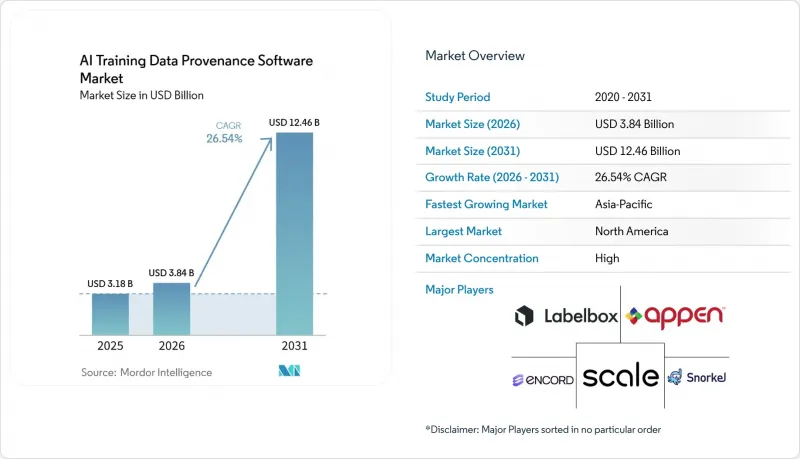
本報告按產品類型(例如,來源和血緣管理軟體)、部署模式(雲端、混合、本地部署)、企業規模(大型企業、中小企業)、最終用戶(例如,IT和電信、銀行、金融服務和保險、汽車和交通運輸)以及地區進行細分。市場預測以價值(美元)表示。
全球人工智慧學習資料來源和歷史管理軟體市場的趨勢和洞察。
歐盟人工智慧法下資料管治的證據要件
人工智慧訓練資料來源及溯源管理軟體市場正受到監管法規的推動,這些法規要求高風險人工智慧提供者記錄其資料的來源、收集、標註、偏差審查和糾正措施。這些義務使得文件編制工作從部署後由團隊完成,轉移到了訓練過程。通用模型的透明度要求也使得訓練資料摘要成為更突出的管治問題。這種時間節點的轉變導致了支出重點的轉移,因為組織現在不僅在審計開始時需要溯源工具,而且在整個資料管理過程中都需要使用。對溯源揭露的研究表明,涵蓋來源、轉換歷史和權限狀態的完整記錄在公共模型庫中仍然不常見。因此,隨著組織尋求單一的工作流程來支援資料管治、刪除義務和操作日誌,人工智慧訓練資料來源及溯源管理軟體市場將從中受益。
訓練資料的版權和許可可追溯性
隨著版權糾紛的日益增多,記錄單一訓練項目的來源和許可狀態的價值也日益凸顯。各組織需要了解某個項目是否已獲得許可、是否被選擇退出,或是否受到後續權利主張的限制。美國版權局指出,在確定生成式人工智慧訓練與版權法的關係時,歸屬和記錄保存問題至關重要。這使得在資料取得和準備階段掌握權利資訊變得尤為重要。此外,在團隊和供應商之間傳輸內容時,也需要能夠維護清晰記錄的系統。在人工智慧訓練資料來源和出處管理軟體市場中,權利、許可和版權管理工具可以幫助買家在訓練時將單一內容項目與其允許的用途關聯起來。
缺乏人工智慧管治和數據工程技能
人工智慧訓練資料來源和溯源管理軟體市場面臨部署方面的挑戰,因為實施過程中需要資料工程、機器學習操作和監管知識。團隊必須配置資料收集,將其連接到訓練流程,並確保產生的記錄可用於審核。當組織將管治任務分配給資料系統經驗有限的員工時,這項任務就變得特別困難。對於無法維持專門技術或合規團隊的小規模買家而言,這種技能不足的問題尤其嚴重。因此,組織可能會發現自己購買了軟體,但尚未完全配置,也無法提供審計人員可能要求的證據。供應商可以透過預置模板、引導式部署和自動化證據收集來緩解這一障礙,從而減少所需的專業工作量。
細分市場分析
2025年,溯源和血緣管理軟體佔了28.41%的市場。此類別滿足了追蹤從資料收集到預處理和訓練的完整流程的基本需求。機構使用此類軟體記錄來源資訊、收集方法、註釋和預處理程序。這個類別至關重要,因為底層記錄支援後續的版權審查、品質檢查和合規性報告。版權、授權和版權管理軟體以及人工智慧資料管治、品質和合規性管理軟體構成了產品組合的另一部分。隨著訓練資料文件在模型風險管理實踐中變得越來越重要,銀行、金融和保險 (BFSI) 以及醫療保健行業的買家正在採用這些產品。
人工智慧「遺忘」和刪除管理軟體預計到2031年將以28.42%的複合年成長率成長,從而推動人工智慧訓練資料來源和歷史管理軟體市場的發展。此類別旨在處理資料刪除請求,並確保這些請求得到妥善處理。歐洲資料保護委員會(EDPB)已將資料刪除權列為2025年和2026年協調執法工作的重點。刪除訓練資料需要記錄其使用地點以及對後續流程的影響。 NeurIPS 上發表的一項研究表明,逐個案例地追溯訓練資料來源是檢驗資料刪除是否符合監管標準的主要障礙。因此,該類別依賴與資料血緣管理相同的記錄,而不是作為一個獨立的合規功能運作。
到 2025 年,雲端採用率將佔市場佔有率的 72.18%。雲端系統非常適合企業級機器學習環境,因為它們可以透過 API 連接到託管的訓練和微調服務。它們也為開發團隊提供了一個跨分散式專案的通用管治層。對於需要快速存取運算資源和協作工具的組織而言,這種方法仍然非常有效。然而,這種市場地位並不意味著所有資料集和 Provence 記錄都可以儲存在組織自身環境之外。資料居住要求、行業法規和內部安全策略仍然會影響敏感記錄的儲存位置。
混合部署預計到2031年將以27.83%的複合年成長率成長。這種模式允許組織在私有環境中保留敏感的訓練資料和血緣記錄,同時利用公共雲端資源處理運算密集型任務。此模式適用於銀行、金融和保險(BFSI)、醫療保健、政府機構以及其他具有嚴格資料保留要求的組織。它還有助於開發人員管理可能需要監管機構或客戶驗證的文件。在人工智慧訓練資料來源和溯源管理軟體市場,隨著組織在雲端效率和資料記錄控制需求之間尋求平衡,這種架構正日益受到青睞。在訓練資料文件存放位置受國界限制的主權人工智慧專案中,本地部署方案仍被廣泛採用。
區域分析
到2025年,北美將佔據34.62%的市場佔有率。該地區擁有龐大的生成式人工智慧開發基礎,企業也較早採用了管治實踐,但版權訴訟使得訓練資料文檔化成為開發人員和法務團隊面臨的營運挑戰。 NIST人工智慧風險管理框架(NIST AI RMF)的使用以及政府採購中的相關要求也推動了對資料來源文件的需求。加拿大正透過其人工智慧和數據政策舉措加大投入,而墨西哥則受益於其技術供應鏈的拓展,從而提高了管治預期。該地區管治人才的短缺可能會減緩人工智慧的普及,但也推動了人們對軟體主導自動化技術的興趣。
截至2025年,歐洲是第二大市場。 「人工智慧學習資料來源和溯源管理軟體市場」的發展主要受歐盟人工智慧法律的要求所驅動,該法律鼓勵在將高風險系統推向市場之前進行資料文件化。德國、英國和法國是主要的需求中心。德國的工業基礎支撐著對版本控制和可重現性工具的需求。英國的金融服務業則支撐著對版權和許可管理的需求。法國的「健康資料中心」和歐盟的「人工智慧工廠」舉措正在為能夠滿足政府技術要求的供應商開闢新的公共部門銷售管道。
預計到2031年,亞太地區的複合年成長率將達到28.31%。中國對生成式人工智慧服務的監管要求服務提供者確保訓練資料的合法性和準確性,這推動了平台層面的資料來源管理。印度在資料管治方面的舉措,提高了人工智慧新創公司對資料居住要求和文件記錄的關注度。韓國和日本已發布管治框架,以規範訓練資料的文檔記錄。新加坡正逐漸成為以管治為重點的人工智慧活動的區域中心,Scale AI於2026年4月與新加坡資訊通訊媒體發展局(IMDA Singapore)正式簽署了人工智慧評估研究方面的合作協議。在以巴西為首的南美洲,隱私權和人工智慧政策措施正在金融服務和政府部門提出新的要求。中東和非洲也蘊藏著巨大的機遇,儘管它們仍處於發展初期。沙烏地阿拉伯和阿拉伯聯合大公國正在製定國家主導的人工智慧項目,這些項目要求政府系統提供資料來源的文件資訊。
其他好處:
- Excel格式的市場預測(ME)表
- 3個月的分析師支持
目錄
第1章:引言
- 研究假設和市場定義
- 調查範圍
第2章:調查方法
第3章執行摘要
第4章 市場狀況
- 市場概覽
- 市場促進因素
- 歐盟人工智慧法下資料管治的證據要件
- 訓練資料的版權和許可可追溯性
- 企業級部署和微調生成式人工智慧工作負載
- 對已獲授權的多模態資料集的需求
- 與此相關的反學習和移除措施
- 用於模型可複現性的資料集指紋識別
- 市場限制因素
- 缺乏人工智慧管治和數據工程技能
- 不同司法管轄區的法律標準不同。
- 專有資料集格式和平台間較低的互通性
- 存在源元資料外洩和惡意篡改的風險。
- 宏觀經濟因素對市場的影響
- 產業價值鏈分析
- 技術展望
- 監理情勢
- 波特五力分析
第5章 市場規模與成長預測
- 依產品類型
- 起源和譜繫管理軟體
- 權利、授權和版權管理軟體
- 用於確保資料集的生命週期、版本控制和可重複性的軟體。
- 人工智慧資料管治、品質和合規軟體
- AI 遺忘與移除管理軟體
- 按部署模式
- 雲
- 混合
- 現場
- 按公司規模
- 大公司
- 小型企業
- 最終用戶
- 資訊科技/通訊
- BFSI
- 汽車和運輸業
- 醫療保健和生命科學
- 零售與電子商務
- 工業製造
- 其他最終用戶
- 按地區
- 北美洲
- 美國
- 加拿大
- 墨西哥
- 南美洲
- 巴西
- 阿根廷
- 其他南美國家
- 歐洲
- 德國
- 英國
- 法國
- 俄羅斯
- 西班牙
- 其他歐洲國家
- 亞太地區
- 中國
- 日本
- 印度
- 韓國
- 東南亞
- 其他亞太國家
- 中東和非洲
- 中東
- 沙烏地阿拉伯
- 阿拉伯聯合大公國
- 其他中東國家
- 非洲
- 南非
- 奈及利亞
- 其他非洲國家
- 中東
- 北美洲
第6章 競爭情勢
- 市場集中度
- 策略趨勢
- 市佔率分析
- 公司簡介
- Scale AI, Inc.
- Appen Limited
- Labelbox, Inc.
- Encord Ltd.
- Snorkel AI, Inc.
- SuperAnnotate AI, Inc.
- Dataloop Ltd.
- V7 Labs, Inc.
- Toloka AI, Inc.
- Weights and Biases
- Iterative, Inc.
- Defined.ai, Inc.
- HumanSignal, Inc.
- Dataiku, Inc.
- Collibra, Inc.
- Alation, Inc.
- Atlan Pte. Ltd.
- Acryl Data, Inc.
- OneTrust Technology Limited
- Credo AI, Inc.
第7章 市場機會與未來展望
According to Mordor Intelligence, the AI training data provenance software market size is projected to expand from USD 3.18 billion in 2025 and USD 4.03 billion in 2026 to USD 12.46 billion by 2031, registering a CAGR of 26.54% between 2026 and 2031.
This report is Segmented by Product Type (Provenance and Lineage Management Software, and More), Deployment Model (Cloud, Hybrid, and On-Premises), Enterprise Size (Large Enterprises, and Small and Medium-Sized Enterprises), End User (IT and Telecommunication, BFSI, Automotive and Transportation, and More), and Geography. The Market Forecasts are Provided in Terms of Value (USD).
Global AI Training Data Provenance Software Market Trends and Insights
EU AI Act Data Governance Evidence Requirements
The AI Training Data Provenance Software Market is gaining support from rules requiring high-risk AI providers to document data origin, collection, labeling, bias review, and corrective action. These obligations move documentation into the training process rather than allowing teams to assemble records after deployment. General-purpose model transparency requirements also make training-data summaries a more visible governance matter. This timing shifts spending priorities because organizations need lineage tools while curating data, not only when an audit begins. Research on provenance disclosure found that complete records covering origin, transformation history, and rights status remained uncommon across public model repositories. The AI Training Data Provenance Software Market therefore benefits when organizations seek one workflow that supports data governance, deletion obligations, and operational logging.
Copyright and License Traceability for Training Data
Copyright disputes are increasing the value of records that identify the source and license status of each training item. Organizations need to know whether an item was licensed, subject to an opt-out, or restricted by a later rights request. The U.S. Copyright Office identified attribution and recordkeeping issues as material questions in determining how generative AI training relates to copyright law. This makes rights information important at the point where data is acquired and prepared. It also creates demand for systems that can preserve a clear record when content changes hands across teams or vendors. In the AI Training Data Provenance Software Market, rights, license, and copyright management tools help buyers connect individual content items to their permitted use at the time of training.
Shortage of AI Governance and Data Engineering Skills
The AI Training Data Provenance Software Market faces a deployment constraint because implementation requires data engineering, ML operations, and regulatory knowledge. Teams must configure data capture, connect it to training pipelines, and make the resulting record usable for review. This work is difficult when organizations assign governance duties to staff who lack experience with data systems. The shortage is especially important for smaller buyers who cannot maintain dedicated technical and compliance teams. It can leave organizations with software that has been purchased but not fully configured, leaving them without the evidence an auditor may request. Vendors can reduce this barrier through prebuilt templates, guided deployment, and automated evidence collection, thereby limiting the amount of specialist work required.
Other drivers and restraints analyzed in the detailed report include:
- Enterprise Scaling of Generative AI and Fine-Tuning Workloads
- Demand for Rights-Cleared Multimodal Datasets
- Fragmented Legal Standards Across Jurisdictions
For complete list of drivers and restraints, kindly check the Table Of Contents.
Segment Analysis
Provenance and Lineage Management Software held 28.41% of the market in 2025. This category meets the basic need to follow data from collection through preparation and training. Organizations use it to record source information, collection methods, annotations, and preprocessing steps. The category is important because foundational records support later rights review, quality checks, and compliance reporting. Rights, License, and Copyright Management Software and AI Data Governance, Quality, and Compliance Software form the next part of the product mix. BFSI and healthcare buyers are using these products as their model risk practices increasingly focus on training data documentation.
AI Unlearning and Takedown Management Software is projected to expand at a 28.42% CAGR through 2031, contributing to the AI Training Data Provenance Software Market. The category addresses requests to remove data and demonstrates that the request was handled. The European Data Protection Board made the right to erasure a coordinated enforcement priority for 2025 and 2026. Removing a training item requires a record of where it was used and how it affected later processes. Research presented at NeurIPS identified per-example training provenance as a central barrier to verifying regulatory-grade erasure. The category, therefore, depends on the same records that underpin lineage management, rather than operating as an isolated compliance function.
Cloud deployment accounted for 72.18% of the market in 2025. Cloud systems fit enterprise ML environments because they can connect through APIs to managed training and fine-tuning services. They also give development teams a common governance layer across distributed projects. This approach remains useful for organizations that need rapid access to compute and collaboration tools. The market position does not mean every dataset or provenance record can leave the organization's own environment. Data residency, sector rules, and internal security policies still influence where sensitive records are stored.
Hybrid deployment is projected to expand at a CAGR of 27.83% through 2031. It enables organizations to retain sensitive training data and lineage records in private environments while using public cloud resources for demanding compute tasks. This model is relevant to BFSI, healthcare, government, and other organizations with strict custody requirements. It can also support developer control of the documentation that regulators or customers may need to review. The AI Training Data Provenance Software Market is seeing this architecture gain attention as organizations balance cloud efficiency against the need to maintain control over data records. On-premises options continue to serve sovereign AI programs where national boundaries determine where training data documentation must remain.
Complete Report Scope:
- By Product Type
- Provenance and Lineage Management Software
- Rights, License, and Copyright Management Software
- Dataset Lifecycle, Versioning and Reproducibility Software
- AI Data Governance, Quality and Compliance Software
- AI Unlearning and Takedown Management Software
- By Deployment Model
- Cloud
- Hybrid
- On-Premises
- By Enterprise Size
- Large Enterprises
- Small and Medium-Sized Enterprises
- By End User
- IT and Telecommunication
- BFSI
- Automotive and Transportation
- Healthcare and Life Sciences
- Retail and E-Commerce
- Industrial Manufacturing
- Other End Users
- By Geography
- North America
- United States
- Canada
- Mexico
- South America
- Brazil
- Argentina
- Rest of South America
- Europe
- Germany
- United Kingdom
- France
- Russia
- Spain
- Rest of Europe
- Asia-Pacific
- China
- Japan
- India
- South Korea
- Southeast Asia
- Rest of Asia-Pacific
- Middle East and Africa
- Middle East
- Saudi Arabia
- United Arab Emirates
- Rest of Middle East
- Africa
- South Africa
- Nigeria
- Rest of Africa
- Middle East
- North America
Geography Analysis
North America held 34.62% of the market in 2025. The region combines a large base of generative AI development with early enterprise adoption of governance practices. Copyright litigation is making training-data records an operational issue for developers and legal teams. NIST AI RMF use and government procurement expectations also support demand for documented data provenance. Canada adds interest through its AI and data policy work, while Mexico benefits as technology supply chains extend governance expectations. The region's shortage of governance talent can slow deployments but also increases interest in software-led automation.
Europe was the second-largest geography in 2025. The AI Training Data Provenance Software Market is supported by EU AI Act requirements that encourage data documentation before high-risk systems enter the market. Germany, the United Kingdom, and France are the main demand centers. Germany's industrial base supports demand for versioning and reproducibility tools. The United Kingdom's financial services sector supports rights and license management needs. France's Health Data Hub and the EU AI Factories initiative add a public-sector channel for suppliers that can support government technology requirements.
Asia-Pacific is projected to expand at a CAGR of 28.31% through 2031. China's rules for generative AI services require providers to address the lawfulness and accuracy of their training data, which supports platform-level controls over provenance. India's data-governance direction is increasing interest in data residency and documented records among AI startups. South Korea and Japan have published governance frameworks that reference training-data documentation. Singapore is becoming a regional center for governance-focused AI work, and Scale AI formalized an AI evaluation research collaboration with Singapore's IMDA in April 2026. South America, led by Brazil, is emerging as privacy and AI policy measures create requirements in financial services and public administration. The Middle East and Africa are also early but important opportunities because Saudi Arabia and the UAE are developing sovereign AI programs that require documented data provenance for government systems.
- Scale AI, Inc.
- Appen Limited
- Labelbox, Inc.
- Encord Ltd.
- Snorkel AI, Inc.
- SuperAnnotate AI, Inc.
- Dataloop Ltd.
- V7 Labs, Inc.
- Toloka AI, Inc.
- Weights and Biases
- Iterative, Inc.
- Defined.ai, Inc.
- HumanSignal, Inc.
- Dataiku, Inc.
- Collibra, Inc.
- Alation, Inc.
- Atlan Pte. Ltd.
- Acryl Data, Inc.
- OneTrust Technology Limited
- Credo AI, Inc.
Additional Benefits:
- The market estimate (ME) sheet in Excel format
- 3 months of analyst support
TABLE OF CONTENTS
1 INTRODUCTION
- 1.1 Study Assumptions and Market Definition
- 1.2 Scope of the Study
2 RESEARCH METHODOLOGY
3 EXECUTIVE SUMMARY
4 MARKET LANDSCAPE
- 4.1 Market Overview
- 4.2 Market Drivers
- 4.2.1 EU AI Act Data-Governance Evidence Requirements
- 4.2.2 Copyright and License Traceability for Training Data
- 4.2.3 Enterprise Scaling of Generative AI and Fine-Tuning Workloads
- 4.2.4 Demand for Rights-Cleared Multimodal Datasets
- 4.2.5 Provenance-Linked Unlearning and Takedown Operations
- 4.2.6 Dataset Fingerprinting for Model Reproducibility
- 4.3 Market Restraints
- 4.3.1 Shortage of AI Governance and Data-Engineering Skills
- 4.3.2 Fragmented Legal Standards Across Jurisdictions
- 4.3.3 Proprietary Dataset Formats and Weak Cross-Platform Interoperability
- 4.3.4 Provenance Metadata Leakage and Adversarial Manipulation Risk
- 4.4 Impact of Macroeconomic Factors on the Market
- 4.5 Industry Value-Chain Analysis
- 4.6 Technology Outlook
- 4.7 Regulatory Landscape
- 4.8 Porter's Five Forces Analysis
- 4.8.1 Threat of New Entrants
- 4.8.2 Bargaining Power of Suppliers
- 4.8.3 Bargaining Power of Buyers
- 4.8.4 Threat of Substitutes
- 4.8.5 Intensity of Competitive Rivalry
5 MARKET SIZE AND GROWTH FORECASTS (VALUE)
- 5.1 By Product Type
- 5.1.1 Provenance and Lineage Management Software
- 5.1.2 Rights, License, and Copyright Management Software
- 5.1.3 Dataset Lifecycle, Versioning and Reproducibility Software
- 5.1.4 AI Data Governance, Quality and Compliance Software
- 5.1.5 AI Unlearning and Takedown Management Software
- 5.2 By Deployment Model
- 5.2.1 Cloud
- 5.2.2 Hybrid
- 5.2.3 On-Premises
- 5.3 By Enterprise Size
- 5.3.1 Large Enterprises
- 5.3.2 Small and Medium-Sized Enterprises
- 5.4 By End User
- 5.4.1 IT and Telecommunication
- 5.4.2 BFSI
- 5.4.3 Automotive and Transportation
- 5.4.4 Healthcare and Life Sciences
- 5.4.5 Retail and E-Commerce
- 5.4.6 Industrial Manufacturing
- 5.4.7 Other End Users
- 5.5 By Geography
- 5.5.1 North America
- 5.5.1.1 United States
- 5.5.1.2 Canada
- 5.5.1.3 Mexico
- 5.5.2 South America
- 5.5.2.1 Brazil
- 5.5.2.2 Argentina
- 5.5.2.3 Rest of South America
- 5.5.3 Europe
- 5.5.3.1 Germany
- 5.5.3.2 United Kingdom
- 5.5.3.3 France
- 5.5.3.4 Russia
- 5.5.3.5 Spain
- 5.5.3.6 Rest of Europe
- 5.5.4 Asia-Pacific
- 5.5.4.1 China
- 5.5.4.2 Japan
- 5.5.4.3 India
- 5.5.4.4 South Korea
- 5.5.4.5 Southeast Asia
- 5.5.4.6 Rest of Asia-Pacific
- 5.5.5 Middle East and Africa
- 5.5.5.1 Middle East
- 5.5.5.1.1 Saudi Arabia
- 5.5.5.1.2 United Arab Emirates
- 5.5.5.1.3 Rest of Middle East
- 5.5.5.2 Africa
- 5.5.5.2.1 South Africa
- 5.5.5.2.2 Nigeria
- 5.5.5.2.3 Rest of Africa
- 5.5.5.1 Middle East
- 5.5.1 North America
6 COMPETITIVE LANDSCAPE
- 6.1 Market Concentration
- 6.2 Strategic Moves
- 6.3 Market Share Analysis
- 6.4 Company Profiles (includes Global Level Overview, Market Level Overview, Core Segments, Financials as available, Strategic Information, Market Rank/Share, Products and Services, Recent Developments)
- 6.4.1 Scale AI, Inc.
- 6.4.2 Appen Limited
- 6.4.3 Labelbox, Inc.
- 6.4.4 Encord Ltd.
- 6.4.5 Snorkel AI, Inc.
- 6.4.6 SuperAnnotate AI, Inc.
- 6.4.7 Dataloop Ltd.
- 6.4.8 V7 Labs, Inc.
- 6.4.9 Toloka AI, Inc.
- 6.4.10 Weights and Biases
- 6.4.11 Iterative, Inc.
- 6.4.12 Defined.ai, Inc.
- 6.4.13 HumanSignal, Inc.
- 6.4.14 Dataiku, Inc.
- 6.4.15 Collibra, Inc.
- 6.4.16 Alation, Inc.
- 6.4.17 Atlan Pte. Ltd.
- 6.4.18 Acryl Data, Inc.
- 6.4.19 OneTrust Technology Limited
- 6.4.20 Credo AI, Inc.
7 MARKET OPPORTUNITIES AND FUTURE OUTLOOK
- 7.1 White-Space and Unmet-Need Assessment

 歐盟人工智慧法律合規軟體:市場佔有率分析、產業趨勢與統計及成長預測(2026-2031 年)
 2026-2030年全球人工智慧模型風險管理市場
 人工智慧模型審計市場分析與預測(至2035年):類型、產品類型、服務、技術、應用、部署模式、最終用戶、解決方案
 人工智慧風險管理市場預測至2034年—按組件、部署模式、風險類型、技術、應用、最終用戶和地區分類的全球分析
 2026年全球人工智慧安全記分卡市場報告2026年全球模型卡管治市場報告2026年大規模語言模型(LLM)訓練資料譜系全球市場報告2026年數據漂移檢測人工智慧(AI)全球市場報告
 人工智慧模型風險管理市場:按組件、風險類型、應用、產業、部署模式和組織規模分類-2026年至2032年全球市場預測2026年全球機器人資料處理歷程管治分析市場報告