


 |
市場調查報告書
商品編碼
2154413
生物氫:市場佔有率分析、產業趨勢與統計、成長預測(2026-2031)Bio Hydrogen - Market Share Analysis, Industry Trends & Statistics, Growth Forecasts (2026 - 2031) |
||||||

※ 本網頁內容可能與最新版本有所差異。詳細情況請與我們聯繫。
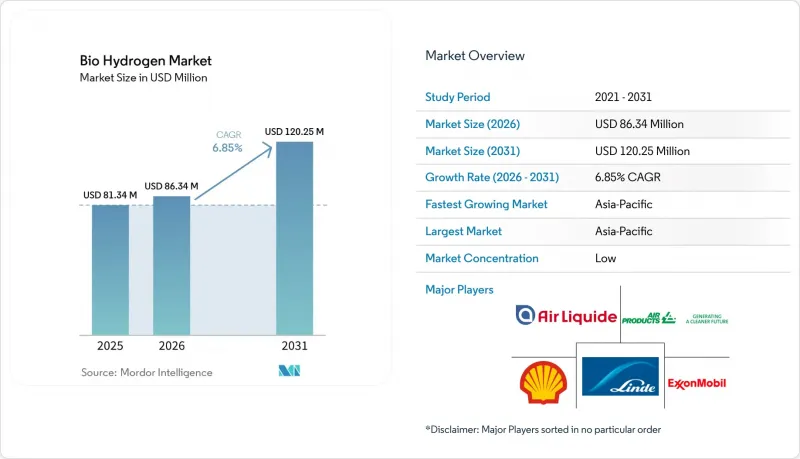
據 Mordor Intelligence 稱,生物氫市場預計在 2025 年價值 8,134 萬美元,預計在預測期(2026-2031 年)內將以 6.85% 的複合年成長率成長,從 2026 年的 8,634 萬美元成長到 2031 年的 1.2025 億美元。
全球生物氫市場趨勢與洞察
氫氣需求的脫碳是一個難以減少的問題。
生物氫市場正受益於鋼鐵、煉油、水泥和氨生產商對檢驗的低碳氫化合物源的需求。由於這些產業無法完全依賴直接電氣化,氫的來源和排放特性變得商業性重要。截至2026年6月初,已有13個歐盟成員國完成了將《可再生能源指令》納入其國家立法。由此產生的框架催生了每年超過57.5萬噸(ktpa)的低排放、具有已證實永續性特徵的氫的需求。生質能氣化與碳捕獲技術的結合,既能滿足CertifHy設定的負排放要求,又能支援符合基於ISO 19880系列標準的氫氣品質要求。英國的評估指出,生質能氣化結合捕碳封存(CCS)是商業性最先進的「氫生質能源、捕碳封存(H2BECCS)」路線。同時,混合氣化和固體氧化物燃料電池系統的效率最高可達55%。
碳捕獲技術透過實現經認證的負排放產品,正在改變生物來源氫在生物氫市場中的角色。當買家不僅要求降低營運過程中的排放,還要求提供永續性方面的證明文件時,這項特性至關重要。它還有助於將生物來源氫的生產過程與電解區分開來,尤其是在電網排放仍然顯著的情況下。由此產生的溢價與原料收集、轉化、回收和分銷等各環節的可追溯性密切相關。因此,開發商必須將認證系統納入專案設計,而不僅僅是在生產開始後才將其視為行政程序。這項要求有利於那些能夠記錄生質能來源以及每個轉化階段相關排放的項目。
有效利用廢物流和循環氫氣
廢棄物轉化正在推動生物氫市場的發展,它將處置義務轉化為潛在的生產投入。 2024年5月,中國報告稱,農業、林業和都市區每年產生的有機廢棄物超過35億噸。據報道,這些廢棄物的利用率不足14%,這意味著對於能夠收集和處理這些廢棄物的項目而言,存在著大量的原料過剩。廢棄物處理業者可以降低處置成本,減少對掩埋的依賴,而氫氣生產商則可以以低成本甚至零成本獲得原料。這種機制能夠以單一成長率無法體現的方式提高專案的經濟可行性。它還有助於將生物氫市場與循環經濟政策和地方廢棄物管理義務聯繫起來。
食物廢棄物、城市有機物和農業殘渣的含水量、雜質含量和處理要求各不相同。這些差異決定了哪些生物或熱化學過程適用於不同的場地。如果能在同一場地同時實現廢棄物管理、氫氣生產和環境責任履行,專案的經濟效益將會提升。此類項目需要可靠的收集系統以及與廢棄物所有者達成明確的協議。場地級專案可以將降低垃圾掩埋廢棄物、氫氣銷售和環境合規的掩埋。當廢棄物所有者、市政當局和氫氣購買者能夠協商達成長期協議時,這種模式才能有效發揮作用。
單位生產成本高,氫氣產量低
生產成本仍然是生物氫市場,特別是生物轉化途徑中最迫切的限制因素。原料成分的差異會限制產量,並可能阻礙大規模電解和蒸汽甲烷重整裝置實現規模經濟效益。一項2025年的技術經濟分析發現,將暗發酵與微生物電解池結合,在20 A/m²的電流密度下,氫氣生產成本為每公斤17-30美元。根據模型估算,將電流密度提高到100 A/m²可將成本降低至每公斤4-6.9美元。然而,隨著電流密度的增加,人們對材料耐久性的擔憂也隨之加劇,這在商業營運中仍是一個尚未解決的問題。雖然獎勵可以縮小這一差距,但在缺乏支持體系的地區,激勵措施無法完全消除技術和財務風險。
原料中的雜質也是阻礙因素。混合有機物會抑制生物過程,並使工廠運作複雜化。農業和工業廢棄物在轉化前廢棄物需要進行分類、預處理或製程控制。這些要求會增加小規模分散式設施的資本投資和營運成本。選擇技術時,必須考慮水分含量、化學成分和供應穩定性。雖然排碳權和廢棄物處理費的收入可以提高經濟可行性,但這兩種收入來源都無法取代穩定的氫氣產量。生物氫市場需要建立能夠像管理氫氣產量一樣精心管理原料品質的營運模式。
細分市場分析
預計到2025年,生質能氣化將佔生物氫市場35.80%的佔有率,到2031年,其複合年成長率預計將達到7.35%,位居市場之首。這一雙重地位反映了該技術的現有地位及其持續成長的潛力。氣化技術可以處理農業和林業供應鏈中豐富的木質纖維素固體原料。此外,它還相容於碳捕獲系統,從而能夠改善排放性能。生質能源任務33在其2050年前的H2BECCS部署預測中,將氣化技術列為最有前景的途徑。該評估除了指出其碳捕獲優勢外,還提到了全球已建立的商業營運。
區域分析
預計到2025年,亞太地區將佔據生物氫市場29.71%的佔有率,並將在2031年實現7.29%的最高複合年成長率。該地區受益於豐富的生質能供應、政府的扶持政策以及燃料電池部署的不斷擴大。生物製氫在中國「十五」規劃中被列為戰略重點。 2026年3月,工信部、財政部和國家發展和改革委員會聯合發布通知,要求城市叢集引導投資流向氫能的多元化終端應用領域,特別支持利用廢棄物和有機廢棄物製取生物氫。在印度,目前有60個氫能項目正在進行中,預計總投資額達1,050億美元。此外,早期氨氣採購協議的簽訂也幫助開發商找到了買家。
在日本,一項差價合約(CFD)已簽署,旨在到2026年5月底前每年支持約13萬噸低排放氫氣的生產。韓國正努力成為生質能資源豐富的東南亞國協的生物氫進口中心。泰國和印尼已證實利用稻草製氫製程的有效性,與化石氫相比,其全球暖化潛勢值降低了55%至60%。北美和歐洲分別位列區域佔有率第二和第三。在美國,《能源法》第45V條允許對合格且生命週期排放績效經過檢驗的專案提供支援。歐洲也正透過氫氣競標機制和永續性法規發揮政策影響力。
歐洲氫能銀行第三輪競標向七個歐洲經濟區 (EEA) 國家的九個項目授予了超過 10 億歐元(11.6 億美元)的資金,這些項目的總裝置容量約為 1.1 吉瓦。南美洲、中東和非洲的生物氫市場仍處於起步階段。巴西可以利用其乙醇基礎設施進行現場重整,從而避免對氣化設施進行新的投資。沙烏地阿拉伯的「2030 願景」計畫正在推動上游氫能投資,隨著其廢棄物管理框架的建立,生物來源原料可能會被納入其中。儘管監管差異和基礎設施不足限制了中東和非洲的短期發展,但未來的出口路線和歐盟認證要求可能會使這些地區在生物氫市場中扮演長期角色。
其他好處:
- Excel格式的市場預測(ME)表
- 3個月的分析師支持
目錄
第1章:引言
- 研究假設和市場定義
- 調查範圍
第2章:調查方法
第3章執行摘要
第4章 市場狀況
- 市場概覽
- 市場促進因素
- 氫氣需求的脫碳是一個難以減少的問題。
- 將廢物流變資源化並生產可再生氫
- 政策獎勵和對氫認證的需求
- 燃料電池和低碳燃料的推廣
- 生物氫與碳捕獲和產品差異化相結合
- 市場限制因素
- 單位生產成本高,氫氣產量低
- 儲存、配送和收集基礎設施不足
- 原料中雜質的波動和生物過程的抑制
- 價值鏈分析
- 波特五力分析
第5章 市場規模與成長預測
- 透過生產技術
- 生質能氣化
- 深色發酵
- 光發酵
- 其他
- 按原料
- 農業殘餘物
- 食物和有機廢棄物
- 污水和污水污泥
- 其他
- 透過使用
- 運輸燃料
- 發電
- 工業原料
- 其他
- 按地區
- 亞太地區
- 中國
- 印度
- 日本
- 韓國
- 東南亞國協
- 其他亞太國家
- 北美洲
- 美國
- 加拿大
- 墨西哥
- 歐洲
- 德國
- 英國
- 法國
- 義大利
- 北歐國家
- 俄羅斯
- 其他歐洲國家
- 南美洲
- 巴西
- 阿根廷
- 其他南美國家
- 中東和非洲
- 沙烏地阿拉伯
- 南非
- 其他中東和非洲國家
- 亞太地區
第6章 競爭情勢
- 市場集中度
- 策略趨勢
- 市佔率和排名分析
- 公司簡介
- Air Liquide
- Air Products and Chemicals, Inc.
- Ballard Power Systems
- Cummins Inc.
- Enapter AG
- ENGIE
- Exxon Mobil Corporation
- ITM Power plc
- Linde PLC
- McPhy Energy
- Nel ASA
- Plug Power Inc.
- Shell plc
- Siemens Energy
- Sunfire SE
第7章 市場機會與未來展望
According to Mordor Intelligence, the bio hydrogen market size was estimated at USD 81.34 million in 2025 and is estimated to grow from USD 86.34 million in 2026 to USD 120.25 million by 2031, at a CAGR of 6.85% during the forecast period (2026-2031).
Global Bio Hydrogen Market Trends and Insights
Decarbonization of Hard-to-Abate Hydrogen Demand
The biohydrogen market benefits from pressure on steel, refining, cement, and ammonia producers to obtain verifiable low-carbon hydrogen. These sectors cannot fully rely on direct electrification, making the origin and emissions profile of hydrogen more commercially important. By early June 2026, 13 European Union member states had completed the transposition of the Renewable Energy Directive for transport. The resulting framework created demand for more than 575 kilotons per annum (ktpa) of low-emission hydrogen with documented sustainability attributes . Biomass gasification paired with carbon capture can meet negative-emissions requirements under CertifHy and support compliance with hydrogen quality standards under the ISO 19880 series. A UK assessment identified biomass gasification with carbon capture and storage as the most commercially advanced Hydrogen Bioenergy with Carbon Capture and Storage (H2BECCS) route, while hybrid gasification and solid oxide fuel cell systems achieved efficiencies of up to 55%.
Carbon capture changes the role of biogenic hydrogen within the biohydrogen market by enabling a certified negative-emissions product. This feature is relevant where buyers require documented sustainability attributes rather than only lower operational emissions. It also helps differentiate biogenic pathways from hydrogen produced through electrolysis when grid emissions remain material. The resulting premium is tied to traceability across feedstock collection, conversion, capture, and delivery. Developers therefore need to treat certification systems as part of project design rather than as an administrative step after production begins. This requirement favors projects that can document both the origin of the biomass and the emissions associated with each conversion stage.
Waste-Stream Valorization and Circular Hydrogen Production
Waste conversion supports the biohydrogen market by turning a disposal obligation into a potential production input. In May 2024, China reported annual agricultural, forestry, and urban organic waste output exceeding 3.5 billion tons. The reported utilization rate was below 14%, resulting in a substantial feedstock surplus for projects capable of collecting and processing these materials. Waste handlers can reduce disposal costs and exposure to landfill, while hydrogen producers can obtain feedstocks at low or negative cost. This structure can improve project economics in ways that a single growth rate does not capture. It also connects the biohydrogen market with circular economy policies and local waste-management obligations.
Food waste, municipal organic material, and agricultural residues differ in moisture content, contaminants, and handling requirements. These differences influence which biological or thermochemical route is appropriate at each site. Project economics improve when a single site can manage waste, produce hydrogen, and meet environmental obligations. Such projects require reliable collection systems and clear agreements with waste owners. Site-level projects can combine avoided waste-tipping fees with hydrogen sales and environmental compliance. This model is relevant where waste owners, municipalities, and hydrogen buyers can coordinate long-term contracts.
High Unit Production Cost and Low Hydrogen Yield
Production cost remains the most immediate restraint on the bio hydrogen market, especially for biological conversion pathways. Variable feedstock composition can limit yields and prevent the scale benefits available to large electrolysis and steam methane reforming facilities. A 2025 techno-economic analysis found that dark fermentation integrated with microbial electrolysis cells produced hydrogen at USD 17-30 per kg at a current density of 20 A/m2. Raising current density to 100 A/m2 reduced the modeled cost to USD 4-6.9 per kg. Higher current density also raises materials durability concerns that remain unresolved in commercial operation. Incentives can narrow the gap, but they do not eliminate technical and financial risks in unsupported locations.
Feedstock contaminants pose another limitation, as mixed organic material can inhibit biological processes and complicate plant operations. Agricultural and industrial waste streams may require sorting, pretreatment, or process controls before conversion. These requirements can raise capital and operating costs at smaller distributed sites. Technology selection must account for moisture content, chemical composition, and supply consistency. Carbon-credit or waste-fee revenue can improve the economics, but neither revenue stream removes the need for stable hydrogen yields. The bio hydrogen market will need operating models that manage feedstock quality as carefully as they manage hydrogen output.
Other drivers and restraints analyzed in the detailed report include:
- Policy Incentives and Hydrogen Certification Demand
- Fuel-Cell and Low-Carbon Fuel Adoption
- Immature Storage, Distribution, and Offtake Infrastructure
For complete list of drivers and restraints, kindly check the Table Of Contents.
Segment Analysis
Biomass gasification held 35.80% of the bio hydrogen market share in 2025 and recorded the highest projected CAGR of 7.35% through 2031. This dual position reflects its established role and continued growth potential. Gasification can process solid lignocellulosic materials available across agricultural and forestry supply chains. It also aligns with carbon capture systems that can improve emissions performance. IEA Bioenergy Task 33 identified gasification as the pathway with the highest confidence in H2BECCS deployment projections through 2050. The assessment cited established global commercial operations, alongside the carbon-capture layer.
Complete Report Scope:
- By Production Technology
- Biomass Gasification
- Dark Fermentation
- Photofermentation
- Others
- By Feedstock
- Agricultural Residues
- Food and Organic Waste
- Wastewater and Sewage Sludge
- Others
- By Application
- Transportation Fuel
- Power Generation
- Industrial Feedstock
- Others
- By Geography
- Asia-Pacific
- China
- India
- Japan
- South Korea
- ASEAN Countries
- Rest of Asia-Pacific
- North America
- United States
- Canada
- Mexico
- Europe
- Germany
- United Kingdom
- France
- Italy
- NORDIC Countries
- Russia
- Rest of Europe
- South America
- Brazil
- Argentina
- Rest of South America
- Middle-East and Africa
- Saudi Arabia
- South Africa
- Rest of Middle-East and Africa
- Asia-Pacific
Geography Analysis
Asia-Pacific held 29.71% of the bio hydrogen market share in 2025 and was projected to record the highest regional CAGR of 7.29% through 2031. The region benefits from extensive biomass availability, government commitments, and expanding fuel cell deployment. China's 15th Five-Year Plan identifies biogenic hydrogen as a strategic priority. A March 2026 notice from the Ministry of Industry and Information Technology, the Ministry of Finance, and the National Development and Reform Commission directed city-cluster investments toward diverse hydrogen end uses, specifically supporting bio hydrogen from agricultural and organic waste streams. India had 60 active hydrogen projects with an estimated combined investment of USD 105 billion, while early ammonia offtake agreements helped developers secure buyers.
Japan had issued contracts for difference supporting nearly 130 ktpa of low-emission hydrogen by late May 2026. South Korea is positioning itself as a bio hydrogen import hub for biomass-rich ASEAN economies. Thailand and Indonesia present a supporting case, as rice-straw pathways showed a 55-60% reduction in warming potential compared to fossil hydrogen. North America and Europe held the second- and third-largest regional shares, respectively. In the United States, Section 45V can support qualifying projects with verified lifecycle-emissions performance. Europe's policy influence is also channeled through hydrogen auction mechanisms and sustainability rules.
The European Hydrogen Bank's third auction awarded more than EUR 1 billion (USD 1.16 billion) to 9 projects across 7 European Economic Area countries, representing nearly 1.1 GW of capacity. South America, the Middle-East, and Africa remain earlier-stage regions within the bio hydrogen market. Brazil can leverage its ethanol infrastructure for on-site reforming, avoiding greenfield gasification investment. Saudi Arabia's Vision 2030 program is driving upstream hydrogen investment that could incorporate biogenic feedstocks as waste frameworks develop. Regulatory differences and infrastructure shortages constrain near-term progress in the Middle-East and Africa, although future export corridors and EU certification requirements could create a longer-term role for these regions.
- Air Liquide
- Air Products and Chemicals, Inc.
- Ballard Power Systems
- Cummins Inc.
- Enapter AG
- ENGIE
- Exxon Mobil Corporation
- ITM Power plc
- Linde PLC
- McPhy Energy
- Nel ASA
- Plug Power Inc.
- Shell plc
- Siemens Energy
- Sunfire SE
Additional Benefits:
- The market estimate (ME) sheet in Excel format
- 3 months of analyst support
TABLE OF CONTENTS
1 Introduction
- 1.1 Study Assumptions and Market Definition
- 1.2 Scope of the Study
2 Research Methodology
3 Executive Summary
4 Market Landscape
- 4.1 Market Overview
- 4.2 Market Drivers
- 4.2.1 Decarbonization of Hard-to-Abate Hydrogen Demand
- 4.2.2 Waste-Stream Valorization and Circular Hydrogen Production
- 4.2.3 Policy Incentives and Hydrogen Certification Demand
- 4.2.4 Fuel-Cell and Low-Carbon Fuel Adoption
- 4.2.5 Integrated Biohydrogen With Carbon Capture and Co-Products
- 4.3 Market Restraints
- 4.3.1 High Unit Production Cost and Low Hydrogen Yield
- 4.3.2 Immature Storage, Distribution and Offtake Infrastructure
- 4.3.3 Feedstock Contaminant Variability and Biological Process Inhibition
- 4.4 Value Chain Analysis
- 4.5 Porter's Five Forces Analysis
- 4.5.1 Bargaining Power of Suppliers
- 4.5.2 Bargaining Power of Buyers
- 4.5.3 Threat of New Entrants
- 4.5.4 Threat of Substitutes
- 4.5.5 Competitive Rivalry
5 Market Size and Growth Forecasts (Value)
- 5.1 By Production Technology
- 5.1.1 Biomass Gasification
- 5.1.2 Dark Fermentation
- 5.1.3 Photofermentation
- 5.1.4 Others
- 5.2 By Feedstock
- 5.2.1 Agricultural Residues
- 5.2.2 Food and Organic Waste
- 5.2.3 Wastewater and Sewage Sludge
- 5.2.4 Others
- 5.3 By Application
- 5.3.1 Transportation Fuel
- 5.3.2 Power Generation
- 5.3.3 Industrial Feedstock
- 5.3.4 Others
- 5.4 By Geography
- 5.4.1 Asia-Pacific
- 5.4.1.1 China
- 5.4.1.2 India
- 5.4.1.3 Japan
- 5.4.1.4 South Korea
- 5.4.1.5 ASEAN Countries
- 5.4.1.6 Rest of Asia-Pacific
- 5.4.2 North America
- 5.4.2.1 United States
- 5.4.2.2 Canada
- 5.4.2.3 Mexico
- 5.4.3 Europe
- 5.4.3.1 Germany
- 5.4.3.2 United Kingdom
- 5.4.3.3 France
- 5.4.3.4 Italy
- 5.4.3.5 NORDIC Countries
- 5.4.3.6 Russia
- 5.4.3.7 Rest of Europe
- 5.4.4 South America
- 5.4.4.1 Brazil
- 5.4.4.2 Argentina
- 5.4.4.3 Rest of South America
- 5.4.5 Middle-East and Africa
- 5.4.5.1 Saudi Arabia
- 5.4.5.2 South Africa
- 5.4.5.3 Rest of Middle-East and Africa
- 5.4.1 Asia-Pacific
6 Competitive Landscape
- 6.1 Market Concentration
- 6.2 Strategic Moves
- 6.3 Market Share (%)/Ranking Analysis
- 6.4 Company Profiles (includes Global Overview, Market Overview, Core Segments, Financials as available, Strategic Information, Products and Services, and Recent Developments)
- 6.4.1 Air Liquide
- 6.4.2 Air Products and Chemicals, Inc.
- 6.4.3 Ballard Power Systems
- 6.4.4 Cummins Inc.
- 6.4.5 Enapter AG
- 6.4.6 ENGIE
- 6.4.7 Exxon Mobil Corporation
- 6.4.8 ITM Power plc
- 6.4.9 Linde PLC
- 6.4.10 McPhy Energy
- 6.4.11 Nel ASA
- 6.4.12 Plug Power Inc.
- 6.4.13 Shell plc
- 6.4.14 Siemens Energy
- 6.4.15 Sunfire SE
7 Market Opportunities and Future Outlook
- 7.1 White-Space and Unmet-Need Assessment

 氫氣生產市場報告:趨勢、預測與競爭分析(至2035年)
 下一代水處理膜市場分析與預測(至2035年):按類型、產品、技術、組件、應用、材料類型、製程、最終用戶、功能和安裝配置分類負碳氫能技術市場分析與預測(至2035年):類型、產品類型、服務、技術、組件、應用、製程、部署狀態、最終用戶、解決方案離網製氫市場分析與預測(至2035年):按類型、技術、組件、應用、製程、最終用戶、安裝類型、設備、解決方案和方法分類
 美國氫氣生產:市場佔有率分析、行業趨勢和統計數據以及成長預測(2026-2031 年)歐洲氫氣生產:市場佔有率分析、產業趨勢與統計及成長預測(2026-2031 年)
 氫氣生產市場:按類型、生產方法、原料、產品、應用和終端用戶產業分類-2026-2032年全球市場預測
 石油煉製領域自產氫氣市場-全球產業規模、佔有率、趨勢、機會和預測:按製造流程、應用、類型、最終用途產業、地區和競爭格局專屬式,2021-2031年蒸汽甲烷重整(SMR)市場-全球產業規模、佔有率、趨勢、機會、預測:依原料、轉化技術、應用、區域、競爭格局分類,2021-2031年
 可再生氫市場預測至2034年-全球分析(依再生能源來源、技術、生產規模、純度、儲存與運輸、分銷通路、應用、終端用戶產業及地區分類)