


 |
市場調查報告書
商品編碼
2154372
私人 5G 系統整合商:市場佔有率分析、產業趨勢與統計數據、成長預測(2026-2031 年)Private 5G System Integrator - Market Share Analysis, Industry Trends & Statistics, Growth Forecasts (2026 - 2031) |
||||||

※ 本網頁內容可能與最新版本有所差異。詳細情況請與我們聯繫。
據 Mordor Intelligence 稱,2025 年私人 5G 系統整合商市場價值為 15.3 億美元,預計到 2031 年將達到 57.2 億美元,而 2026 年為 22.1 億美元,2026 年至 2031 年預測期內的複合成長率為 20.95%。
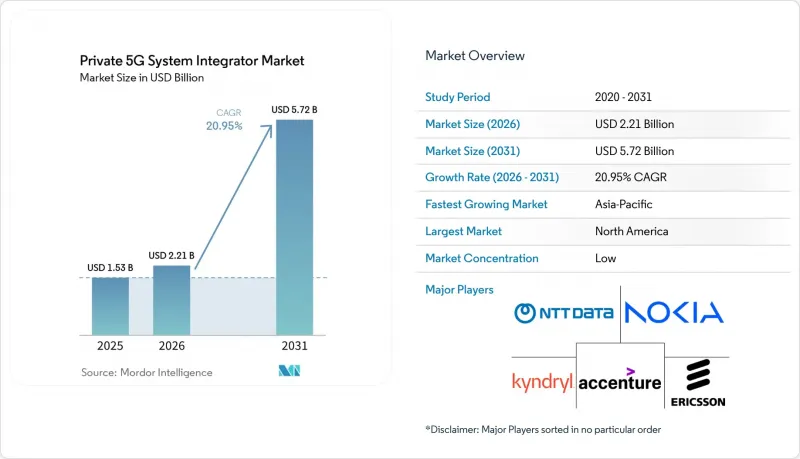
全球私有5G系統整合商市場趨勢與洞察
工業自動化和智慧工廠的引入
工業自動化是推動需求成長的主要因素,因為製造商需要可靠的無線連接來支援行動裝置、感測器和生產系統。隨著企業將單站點試點項目擴展到多站點項目,私有5G系統整合商市場將從中受益。 2026年2月,NTT DATA宣布其私有5G服務已涵蓋嘉吉公司在美國和歐洲的50個製造和加工基地。此類專案需要在每個地點進行站點設計、設備連接、應用整合和營運支援。此外,還需要與現有工廠設備和工業協議(例如Modbus、OPC UA和Profinet)進行精細整合。這意味著,擁有工業和網路專業知識的整合商將在整個部署生命週期中發揮關鍵作用。
企業對安全、低延遲、關鍵任務型連線的需求。
營運鐵路設施、礦場、公共產業和生產工廠的公司需要可靠的本地連接來保障對時間要求嚴格的營運。 「專用 5G 系統整合商市場」透過將無線系統與安全、設備管理和本地運算整合來滿足此需求。 2025 年 9 月,GlobalLogic 和愛立信在日立鐵路位於馬裡蘭州佔地 30.7 萬平方英尺的數位化工廠部署了專用 5G 網路。該專案涵蓋技術諮詢、實施、營運技術 (OT) 和 IT 整合以及生命週期管理。 Verizon 報告稱,當網路服務與業務運營整合時,專用無線網路有助於提高營運效率。綜合整合商可以維護和管理網路,並使其適應不斷變化的營運需求。
較高的初始實施和整合成本
高昂的初始成本可能會阻礙企業部署私人 5G 網路,尤其是在客戶已擁有運作中的Wi-Fi 系統的情況下。對於老舊的工業設施而言,這項挑戰更為嚴峻,因為這些設施通常存在於遺留的控制系統,並且需要進行客製化整合和耗時的測試。企業在批准專案之前,需要評估頻段、設備、裝置、安全、支援和整合等方面的成本。對於中小企業而言,初始投資的負擔可能尤其沉重。託管服務和「即服務」合約可以透過根據營運需求客製化支出,減輕前期付款的壓力。服務提供者應避免採用會導致部署後支援成本飆升的設計方案。
細分市場分析
至2025年,安裝和整合服務將佔私有5G系統整合商市場規模的47.21%。這一比例反映了企業建置私有網路時所需的大量設計和部署工作。這些服務通常包括站點評估、無線設計、核心網路配置、設備連接、測試和驗收。專業服務仍然至關重要,因為客戶在部署開始之前需要規劃和架構支援。當企業需要連接現有生產設備時,這些服務尤其關鍵。它們還有助於客戶明確營運商、設備供應商和系統整合商各自的職責。
預計到2031年,託管服務將以21.87%的複合年成長率成長。這一轉變反映出客戶對持續性能管理而非一次性交貨模式的日益關注。 NTT DATA為嘉吉公司部署的私人5G網路,到2026年2月已涵蓋其50個製造和加工基地。該公司將該專案描述為一項完全託管的服務,支援多個業務和營運系統。對於服務提供者而言,它透過可複製的服務方法提高了各站點之間的一致性。對於客戶而言,託管服務提供了一個統一的聯絡點,用於管理網路可用性和應對持續變更。
在2025年的私有5G系統整合商市場中,本地部署將佔據45.04%的市場佔有率,受到那些需要嚴格控制營運數據和網路效能的用戶青睞。國防、公共產業和石化設施通常對本地系統有優先考慮的需求。本機部署也適用於那些無法接受遠端運算資源延遲的應用程式場景。這類部署要求客戶或整合商在現場管理大部分技術堆疊。因此,對經驗豐富的工程和維運團隊的需求可能會增加。
混合部署預計到 2031 年將以 22.76% 的複合年成長率成長。這種部署方式讓企業在本地維護高度敏感且時間敏感的功能,同時利用雲端資源進行分析和更廣泛的協調。 Mavenir 的一份報告顯示,2025 年,48% 的受訪者認為私有 5G 是網路邊緣雲端中最受歡迎的工作負載。這種方法使企業能夠在無需將所有應用程式部署到遠端雲端的情況下管理多個位置。對於希望維持較低本地基礎設施所有權水準的客戶而言,託管服務仍然是關鍵選擇。無論採用哪種模式,都必須仔細定義資料路徑、安全責任和服務等級。
預計到2025年,私有5G系統整合商市場中授權頻段的佔有率將達到48.12%,到2031年將以21.87%的複合年成長率成長。企業在需要可預測的性能和更強的干擾控制時會使用授權頻段。這對於安全、生產和即時通訊至關重要的應用場景尤其重要。實施授權方案通常需要在系統運作前進行正式的規劃和協調。這項工作會增加整合商的專案複雜性,由於必須維護合規性和網路運營,也可能導致長期的客戶參與。
共用頻譜為那些無法或不需要專用頻率的客戶提供了一種替代方案。它適用於需要私有通訊區域但又不想支付授權費用的工業和醫療環境。免許可的 5G 頻譜目前仍然有限,最適合受控的室內環境。德國的區域頻率規劃已於 2025 年 11 月前分配了 484 個頻率。這種框架為企業提供了更清晰的專用頻率獲取途徑。此外,對當地法規的了解是整合和部署的關鍵因素。
區域分析
到2025年,北美將佔據74.23%的私有5G系統整合商市場。該地區受益於成熟的CBRS生態系統、工業投資以及公共部門用戶的需求。美國擁有廣泛的製造、交通、國防和公共產業場所網路,這些場所均可利用私人無線系統。在加拿大,工業私有5G部署也不斷擴展。 2026年5月,TERAGO和愛立信在加拿大麥克馬斯特製造實驗室推出了託管式私有5G網路。該部署將支援人工智慧驅動的自動化、機器人、即時處理和智慧製造應用。
預計到2031年,亞太地區將以22.67%的複合年成長率成長。日本、韓國、中國、印度和澳洲各自憑藉著其不同的產業環境和政策狀況,都在創造需求。在韓國,4.7 GHz和28 GHz的專用5G頻段已向非電信公司開放。日本正致力於透過其國內5G生態系統提升互通性。 2026年3月,NTT東日本公佈了涉及26家公司的265項跨廠商互聯測試的結果。這項措施有助於緩解企業在連接不同供應商設備時面臨的整合難題。該地區的多元化要求整合商根據每個國家的具體情況調整其交付模式。
由於德國的區域頻率框架和龐大的工業基本客群,歐洲佔據著舉足輕重的地位。德國在2025年11月前分配的484個區域5G頻段為園區部署奠定了堅實的基礎。英國、法國、義大利和西班牙也提供了跨國業務機會,但當地法規要求現場規劃。南美洲、中東和非洲仍處於早期階段,這些地區的業務機會仍有待開發。這些地區的需求與採礦、公共產業、石油和天然氣、港口以及智慧城市項目密切相關。隨著頻率獲取、專業技術和企業應用案例的日益成熟,這些地區的私人5G系統整合商市場仍有進一步成長的空間。
其他好處:
- Excel格式的市場預測(ME)表
- 3個月的分析師支持
目錄
第1章:引言
- 研究假設和市場定義
- 調查範圍
第2章:調查方法
第3章執行摘要
第4章 市場狀況
- 市場概覽
- 市場促進因素
- 工業自動化與智慧工廠實施
- 企業對安全、低延遲、關鍵任務型連線的需求。
- 區域和共用頻段的自由化
- 工業級5G模組和小型基地台價格下降
- 雲端原生 5G 獨立網路核心網路與邊緣平台
- 跨多個地點棕地整合的要求
- 市場限制因素
- 分散化的頻段監管和跨境互通性
- 實施和整合的初始成本較高
- 缺乏頻譜工程和核心編配。
- 棕地維修的投資報酬率前景仍不明朗。
- 宏觀經濟因素對市場的影響
- 產業價值鏈分析
- 科技趨勢
- 監理情勢
- 波特五力分析
第5章 市場規模與成長預測
- 報價
- 專業服務
- 實施和整合服務
- 託管服務
- 按部署模式
- 現場
- 混合
- 託管
- 按頻段分配
- 許可頻寬
- 共用頻譜
- 免許可頻段
- 按頻段
- 低頻段
- 中頻
- 毫米波
- 透過網路架構
- 獨立版
- 非獨立式
- 雲端模型
- 私有雲端或專用雲
- 公共雲端
- 混合雲端
- 按公司規模
- 大公司
- 小型企業
- 按行業分類
- 製造/工廠
- 車
- 能源公用事業
- 運輸/物流
- 採礦、石油和天然氣
- 農業
- 媒體與娛樂
- 資訊科技/通訊
- 其他工業部門
- 按地區
- 北美洲
- 美國
- 加拿大
- 墨西哥
- 南美洲
- 巴西
- 阿根廷
- 智利
- 其他南美國家
- 歐洲
- 德國
- 英國
- 法國
- 義大利
- 西班牙
- 其他歐洲國家
- 亞太地區
- 中國
- 日本
- 印度
- 韓國
- 澳洲
- 其他亞太國家
- 中東
- 阿拉伯聯合大公國
- 沙烏地阿拉伯
- 卡達
- 其他中東國家
- 非洲
- 南非
- 埃及
- 奈及利亞
- 其他非洲國家
- 北美洲
第6章 競爭情勢
- 市場集中度
- 策略趨勢
- 市佔率分析
- 公司簡介
- Accenture plc
- Cisco Systems, Inc.
- Hewlett Packard Enterprise Company
- International Business Machines Corporation
- Kyndryl Holdings, Inc.
- Nokia Corporation
- Telefonaktiebolaget LM Ericsson
- Huawei Technologies Co., Ltd.
- Samsung Electronics Co., Ltd.
- ZTE Corporation
- NEC Corporation
- Fujitsu Limited
- Siemens AG
- Deutsche Telekom AG
- Orange SA
- Vodafone Group Plc
- AT&T Inc.
- Verizon Communications Inc.
- NTT DATA Corporation
- Amazon Web Services, Inc.
- Microsoft Corporation
- Mavenir Systems, Inc.
- Rakuten Symphony Singapore Pte. Ltd.
- Celona, Inc.
- Federated Wireless, Inc.
- Betacom Incorporated
- Boingo Wireless, Inc.
- JMA Wireless, Inc.
- Tech Mahindra Limited
- Capgemini SE
第7章 市場機會與未來展望
According to Mordor Intelligence, the private 5G system integrator market size was valued at USD 1.53 billion in 2025 and is estimated to grow from USD 2.21 billion in 2026 to reach USD 5.72 billion by 2031, at a CAGR of 20.95% during the forecast period 2026-2031.
Global Private 5G System Integrator Market Trends and Insights
Industrial Automation and Smart Factory Rollouts
Industrial automation is a major driver of demand because manufacturers need reliable wireless connectivity for mobile equipment, sensors, and production systems. The Private 5G System Integrator Market benefits when enterprises expand a site pilot into a multi-location program. NTT DATA announced in February 2026 that its private 5G service covered 50 Cargill manufacturing and processing sites in the United States and Europe. Such programs require site design, device connection, application integration, and operational support at every location. They also require careful work with older factory equipment and industrial protocols such as Modbus, OPC UA, and Profinet. This gives integrators with industrial and network expertise a role throughout the deployment lifecycle.
Enterprise Demand for Secure, Low-Latency Mission-Critical Connectivity
Enterprises operating rail facilities, mines, utilities, and production plants need dependable local connectivity for time-sensitive activities. The Private 5G System Integrator Market addresses this need by connecting radio systems with security, device management, and local computing. GlobalLogic and Ericsson deployed a private 5G network at Hitachi Rail's 307,000-square-foot digital factory in Maryland in September 2025. The work included technical consulting, deployment, OT and IT integration, and lifecycle management. Verizon reported that private wireless can support operational efficiency when network services are connected with business operations. Full-scope integrators can maintain the network and adapt it as operational needs change.
High Upfront Deployment and Integration Costs
Upfront costs can delay private 5G decisions, especially when a customer already has a working Wi-Fi system. The challenge is greater at older industrial sites, where legacy controls can require custom integration and extended testing. Enterprises must assess the costs of spectrum, equipment, devices, security, support, and integration before approving a program. Smaller businesses can find the initial commitment particularly difficult. Managed service and as-a-service contracts can reduce the initial payment burden by aligning spending with operating needs. Providers must still avoid designs that become expensive to support after deployment.
Other drivers and restraints analyzed in the detailed report include:
- Cloud-Native 5G Standalone Cores and Edge Platforms
- Local and Shared Spectrum Liberalization
- Fragmented Spectrum Rules and Cross-Border Interoperability
For complete list of drivers and restraints, kindly check the Table Of Contents.
Segment Analysis
Installation and integration services accounted for 47.21% of the Private 5G System Integrator Market size in 2025. This position reflects the substantial design and deployment work required as enterprises build private networks. The service typically includes site assessment, radio design, core setup, device connection, testing, and acceptance. Professional services also remain important because customers need planning and architecture support before deployment begins. These services are particularly relevant where an enterprise must connect legacy production equipment. They also help customers define the responsibilities of the operator, equipment supplier, and systems integrator.
Managed services are projected to grow at a 21.87% CAGR through 2031. The shift reflects customer interest in continuous performance management rather than a one-time delivery model. NTT DATA's private 5G deployment for Cargill covered 50 manufacturing and processing sites by February 2026. The company described the program as a fully managed service supporting several business and operational systems. For providers, repeatable service methods can improve consistency across locations. For customers, managed delivery can provide a single point of contact responsible for network availability and ongoing changes.
On-premises deployment accounted for 45.04% of the Private 5G System Integrator Market share in 2025, and it is favored by users who need close control over operational data and network performance. Defense, utilities, and petrochemical facilities often have requirements that favor local systems. Local deployment can also support applications that cannot accept delays from distant computing resources. These installations require the customer or integrator to manage a larger portion of the stack on-site. That requirement can increase the need for experienced engineering and operations teams.
Hybrid deployment is projected to grow at a 22.76% CAGR through 2031. It can keep sensitive and time-critical functions on-site while using cloud resources for analytics and broader coordination. In 2025, Mavenir reported that 48% of respondents identified private 5G as the most popular network edge cloud workload. This approach can help enterprises manage multiple sites without deploying every application to a remote cloud. Hosted services remain relevant for customers who prefer lower levels of internal infrastructure ownership. Each model requires careful definition of data paths, security responsibilities, and service levels.
Licensed spectrum accounted for 48.12% of the Private 5G System Integrator Market share in 2025, and it is expected to grow at a CAGR of 21.87% by 2031. Enterprises use licensed frequencies when they need predictable performance and stronger control over interference, which is important for applications with safety, production, and real-time communication requirements. Licensed deployments usually involve formal planning and coordination before the system becomes operational. That work can increase project complexity for the integrator. It can also support longer customer engagements because compliance and network operations must be maintained.
Shared spectrum provides an alternative for customers who cannot obtain dedicated frequencies or do not need them. It can be useful in industrial and healthcare settings that need private coverage without the cost of licensed access. Unlicensed 5G remains more limited and is best suited to controlled indoor environments. Germany's local spectrum program had issued 484 allocations by November 2025. This type of framework provides enterprises with a clearer path to dedicated spectrum. It also makes local regulatory expertise an important part of integration and delivery.
Complete Report Scope:
- By Offering
- Professional Services
- Installation and Integration Services
- Managed Services
- By Deployment Model
- On-Premise
- Hybrid
- Hosted
- By Spectrum Allocation
- Licensed Spectrum
- Shared Spectrum
- Unlicensed Spectrum
- By Frequency Band
- Low Band
- Mid Band
- mmWave
- By Network Architecture
- Standalone
- Non-Standalone
- By Cloud Model
- Private or Dedicated Cloud
- Public Cloud
- Hybrid Cloud
- By Enterprise Size
- Large Enterprises
- Small and Medium Enterprises
- By Industry Vertical
- Manufacturing and Factories
- Automotive
- Energy and Utilities
- Transportation and Logistics
- Mining and Oil and Gas
- Agriculture
- Media and Entertainment
- IT and Telecommunications
- Other Industry Verticals
- By Geography
- North America
- United States
- Canada
- Mexico
- South America
- Brazil
- Argentina
- Chile
- Rest of South America
- Europe
- Germany
- United Kingdom
- France
- Italy
- Spain
- Rest of Europe
- Asia-Pacific
- China
- Japan
- India
- South Korea
- Australia
- Rest of Asia-Pacific
- Middle East
- United Arab Emirates
- Saudi Arabia
- Qatar
- Rest of Middle East
- Africa
- South Africa
- Egypt
- Nigeria
- Rest of Africa
- North America
Geography Analysis
North America held 74.23% of the Private 5G System Integrator Market share in 2025. The region benefits from a developed CBRS ecosystem, industrial investment, and demand from public-sector users. The United States has a broad base of manufacturing, transport, defense, and utility sites that can use private wireless systems. Canada is also developing industrial private 5G references. TERAGO and Ericsson launched a managed private 5G network at McMaster Manufacturing Research Institute in Canada in May 2026. The deployment supports AI-driven automation, robotics, real-time processing, and smart manufacturing applications.
Asia-Pacific is projected to expand at a 22.67% CAGR through 2031. Japan, South Korea, China, India, and Australia each provide demand through different industrial and policy conditions. South Korea has opened the 4.7 GHz and 28 GHz private 5G frequency bands to non-operator enterprises. Japan is building greater interoperability through its local 5G ecosystem. NTT EAST published results from 265 cross-vendor interconnection tests involving 26 participating companies in March 2026. This work can reduce integration difficulty for enterprises that need to connect equipment from different suppliers. The region's diversity means integrators must adjust their delivery model to each country.
Europe holds a significant position due to Germany's local spectrum framework and its industrial customer base. Germany's 484 local 5G spectrum allocations by November 2025 provide a clear foundation for campus deployments. The United Kingdom, France, Italy, and Spain also offer multi-country opportunities, but their national rules require local planning. South America, the Middle East, and Africa remain earlier-stage opportunities. Their demand is tied to mining, utilities, oil and gas, ports, and smart city programs. The Private 5G System Integrator Market has room to develop in these regions as spectrum access, skills, and enterprise use cases become more established.
- Accenture plc
- Cisco Systems, Inc.
- Hewlett Packard Enterprise Company
- International Business Machines Corporation
- Kyndryl Holdings, Inc.
- Nokia Corporation
- Telefonaktiebolaget LM Ericsson
- Huawei Technologies Co., Ltd.
- Samsung Electronics Co., Ltd.
- ZTE Corporation
- NEC Corporation
- Fujitsu Limited
- Siemens AG
- Deutsche Telekom AG
- Orange S.A.
- Vodafone Group Plc
- AT&T Inc.
- Verizon Communications Inc.
- NTT DATA Corporation
- Amazon Web Services, Inc.
- Microsoft Corporation
- Mavenir Systems, Inc.
- Rakuten Symphony Singapore Pte. Ltd.
- Celona, Inc.
- Federated Wireless, Inc.
- Betacom Incorporated
- Boingo Wireless, Inc.
- JMA Wireless, Inc.
- Tech Mahindra Limited
- Capgemini SE
Additional Benefits:
- The market estimate (ME) sheet in Excel format
- 3 months of analyst support
TABLE OF CONTENTS
1 INTRODUCTION
- 1.1 Study Assumptions and Market Definition
- 1.2 Scope of the Study
2 RESEARCH METHODOLOGY
3 EXECUTIVE SUMMARY
4 MARKET LANDSCAPE
- 4.1 Market Overview
- 4.2 Market Drivers
- 4.2.1 Industrial Automation and Smart Factory Rollouts
- 4.2.2 Enterprise Demand for Secure, Low-Latency Mission-Critical Connectivity
- 4.2.3 Liberalization of Local and Shared Spectrum
- 4.2.4 Falling Prices of Industrial 5G Modules and Small Cells
- 4.2.5 Cloud-Native 5G Standalone Cores and Edge Platforms
- 4.2.6 Multi-Site Brownfield Integration Requirements
- 4.3 Market Restraints
- 4.3.1 Fragmented Spectrum Rules and Cross-Border Interoperability
- 4.3.2 High Upfront Deployment and Integration Costs
- 4.3.3 Shortage of Spectrum Engineering and Core Orchestration Skills
- 4.3.4 Unclear Return on Investment for Brownfield Retrofits
- 4.4 Impact of Macroeconomic Factors on the Market
- 4.5 Industry Value-Chain Analysis
- 4.6 Technology Outlook
- 4.7 Regulatory Landscape
- 4.8 Porter's Five Forces Analysis
- 4.8.1 Threat of New Entrants
- 4.8.2 Bargaining Power of Suppliers
- 4.8.3 Bargaining Power of Buyers
- 4.8.4 Threat of Substitutes
- 4.8.5 Intensity of Competitive Rivalry
5 MARKET SIZE AND GROWTH FORECASTS (VALUE)
- 5.1 By Offering
- 5.1.1 Professional Services
- 5.1.2 Installation and Integration Services
- 5.1.3 Managed Services
- 5.2 By Deployment Model
- 5.2.1 On-Premise
- 5.2.2 Hybrid
- 5.2.3 Hosted
- 5.3 By Spectrum Allocation
- 5.3.1 Licensed Spectrum
- 5.3.2 Shared Spectrum
- 5.3.3 Unlicensed Spectrum
- 5.4 By Frequency Band
- 5.4.1 Low Band
- 5.4.2 Mid Band
- 5.4.3 mmWave
- 5.5 By Network Architecture
- 5.5.1 Standalone
- 5.5.2 Non-Standalone
- 5.6 By Cloud Model
- 5.6.1 Private or Dedicated Cloud
- 5.6.2 Public Cloud
- 5.6.3 Hybrid Cloud
- 5.7 By Enterprise Size
- 5.7.1 Large Enterprises
- 5.7.2 Small and Medium Enterprises
- 5.8 By Industry Vertical
- 5.8.1 Manufacturing and Factories
- 5.8.2 Automotive
- 5.8.3 Energy and Utilities
- 5.8.4 Transportation and Logistics
- 5.8.5 Mining and Oil and Gas
- 5.8.6 Agriculture
- 5.8.7 Media and Entertainment
- 5.8.8 IT and Telecommunications
- 5.8.9 Other Industry Verticals
- 5.9 By Geography
- 5.9.1 North America
- 5.9.1.1 United States
- 5.9.1.2 Canada
- 5.9.1.3 Mexico
- 5.9.2 South America
- 5.9.2.1 Brazil
- 5.9.2.2 Argentina
- 5.9.2.3 Chile
- 5.9.2.4 Rest of South America
- 5.9.3 Europe
- 5.9.3.1 Germany
- 5.9.3.2 United Kingdom
- 5.9.3.3 France
- 5.9.3.4 Italy
- 5.9.3.5 Spain
- 5.9.3.6 Rest of Europe
- 5.9.4 Asia-Pacific
- 5.9.4.1 China
- 5.9.4.2 Japan
- 5.9.4.3 India
- 5.9.4.4 South Korea
- 5.9.4.5 Australia
- 5.9.4.6 Rest of Asia-Pacific
- 5.9.5 Middle East
- 5.9.5.1 United Arab Emirates
- 5.9.5.2 Saudi Arabia
- 5.9.5.3 Qatar
- 5.9.5.4 Rest of Middle East
- 5.9.6 Africa
- 5.9.6.1 South Africa
- 5.9.6.2 Egypt
- 5.9.6.3 Nigeria
- 5.9.6.4 Rest of Africa
- 5.9.1 North America
6 COMPETITIVE LANDSCAPE
- 6.1 Market Concentration
- 6.2 Strategic Moves
- 6.3 Market Share Analysis
- 6.4 Company Profiles (includes Global Level Overview, Market Level Overview, Core Segments, Financials as available, Strategic Information, Market Rank/Share, Products and Services, Recent Developments)
- 6.4.1 Accenture plc
- 6.4.2 Cisco Systems, Inc.
- 6.4.3 Hewlett Packard Enterprise Company
- 6.4.4 International Business Machines Corporation
- 6.4.5 Kyndryl Holdings, Inc.
- 6.4.6 Nokia Corporation
- 6.4.7 Telefonaktiebolaget LM Ericsson
- 6.4.8 Huawei Technologies Co., Ltd.
- 6.4.9 Samsung Electronics Co., Ltd.
- 6.4.10 ZTE Corporation
- 6.4.11 NEC Corporation
- 6.4.12 Fujitsu Limited
- 6.4.13 Siemens AG
- 6.4.14 Deutsche Telekom AG
- 6.4.15 Orange S.A.
- 6.4.16 Vodafone Group Plc
- 6.4.17 AT&T Inc.
- 6.4.18 Verizon Communications Inc.
- 6.4.19 NTT DATA Corporation
- 6.4.20 Amazon Web Services, Inc.
- 6.4.21 Microsoft Corporation
- 6.4.22 Mavenir Systems, Inc.
- 6.4.23 Rakuten Symphony Singapore Pte. Ltd.
- 6.4.24 Celona, Inc.
- 6.4.25 Federated Wireless, Inc.
- 6.4.26 Betacom Incorporated
- 6.4.27 Boingo Wireless, Inc.
- 6.4.28 JMA Wireless, Inc.
- 6.4.29 Tech Mahindra Limited
- 6.4.30 Capgemini SE
7 MARKET OPPORTUNITIES AND FUTURE OUTLOOK
- 7.1 White-Space and Unmet-Need Assessment

 本地電信合作夥伴和系統整合商分佈圖:市場佔有率分析、產業趨勢和統計數據以及成長預測(2026-2031 年)系統整合商:市場佔有率分析、產業趨勢與統計資料、成長預測(2026-2031 年)
 系統整合服務市場-2026-2032年全球市場預測
 2026年全球工業自動化系統整合商市場報告SAP S4 系統整合商服務全球市場報告(2026 年)2026年全球系統整合商市場報告
 工業自動化系統整合商市場規模、佔有率和成長分析(按系統整合商類型、服務、專業領域、公司規模、產業和地區分類)-2026年至2033年產業預測
 系統整合商市場分析及預測(至2035年):按類型、產品、服務、技術、組件、應用、流程、部署、最終用戶及解決方案分類
 系統整合商市場規模、佔有率和成長分析(按產品、技術、最終用戶產業和地區分類)-2026-2033年產業預測
 2032 年工業自動化系統整合商市場預測:按服務類型、組件、技術、應用、最終用戶和地區進行的全球分析